REVIEW 3 major objections 3 minor 1 cited by
Entropy stable high-order discontinuous Galerkin spectral-element methods on curvilinear, hybrid meshes
T0 review · 3 major / 3 minor · reviewed 2026-08-06 · deepseek-v4-flash
Pith's one-line read The paper constructs an entropy-stable DGSEM of arbitrary order on curvilinear hybrid meshes of hexahedra, prisms, tetrahedra, and pyramids, and proves a discrete entropy balance in Theorem 3.2.
desk verdict Solid extension to prisms/pyramids, but the entropy-stability proof skips the triangular-face projection that the code actually uses. read the letter →
The pith
A machine-rendered reading of the paper's core claim, the machinery that carries it, and where it could break.
The reading
What carries the argument
The load-bearing device is the collapsed coordinate transformation: a map from the unit cube to each polytopal reference element (prism, pyramid, tetrahedron, or triangle) that collapses cube faces onto edges or vertices. This turns all element shapes into tensor-product quadrature structures on the cube, so a one-dimensional Legendre–Gauss quadrature and differentiation operator can be applied in each direction. The discrete summation-by-parts identity of the generalized SBP operator in eq. (45) is what converts local volume integrations into boundary terms and makes the entropy-balance proof go through. A second mechanism is the weight-adjusted modal formulation: coefficients of the orthogonal modal basis are advanced in time, with the inverse of the curved mass matrix approximated by eq. (60), which keeps tensor-product cost and avoids time-step collapse. To evaluate fluxes on shared triangular faces, the solution is projected onto a fixed triangle quadrature rule, producing unique nodes from either side of the interface.
What would settle it
Run the entropy-conservative variant, without interface dissipation, on a distorted hybrid mesh with tetrahedron-prism and tetrahedron-pyramid interfaces, and track the discrete integral entropy: if it drifts beyond round-off over the vortex-decay timespan, the triangular-face projection is violating the entropy-conservation condition. Separately, perform a manufactured-solution h-convergence study on a genuinely curved pyramid mesh: if the error stagnates rather than converging at the expected order, the metric terms from the collapsed pyramid mapping are not sufficiently accurate.
Extended reading notes
Core claim
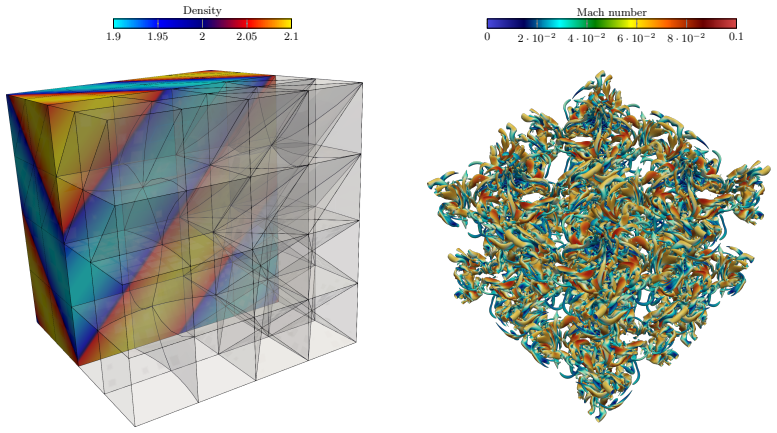
The paper claims to be the first entropy-stable DGSEM formulation that works on curvilinear hybrid meshes of hexahedra, prisms, tetrahedra, and pyramids. The construction maps every polytopal reference element to the unit cube via a collapsed coordinate transformation, then applies Legendre–Gauss collocation with a generalized summation-by-parts operator and entropy-projected variables. Time evolution uses modal coefficients and a weight-adjusted approximation of the inverse mass matrix to avoid the small time steps that collapsing usually causes; viscous fluxes are added with a lifting procedure. Theorem 3.2 proves that the semi-discrete scheme in eq. (61) with the spatial operator in eq. (46) is discretely entropy-stable and satisfies the entropy balance in eq. (63), with equality when the numerical flux is entropy conservative. The proof covers quadrature nodes on triangular faces after projection to a single triangle quadrature rule, while the analytic entropy-stability argument for such non-unique nodes is deferred to a cited earlier work and demonstrated numerically.
Load-bearing premise
The load-bearing assumption is that the projection used to make triangular-face quadrature nodes unique preserves the discrete entropy balance and quadrature accuracy for every interface orientation, with curved-pyramid convergence left unproved and deliberately avoided in the tests.
Editorial extensions
If this is right
- Entropy-stable high-order simulations become possible on curved meshes that mix hexahedra with prisms, tetrahedra, and pyramids, without splitting elements into hexahedra.
- The tensor-product cost scaling of DGSEM, roughly $O(N^{d+1})$ operations per element for polynomial degree $N$ in $d$ dimensions, carries over to the non-hexahedral element types.
- Modal time evolution with the weight-adjusted inverse mass matrix removes the severe explicit time-step restriction that collapsed coordinates would otherwise impose.
- With an entropy-conservative two-point flux and no surface dissipation, the scheme is discretely entropy conservative; adding a stable dissipative interface flux makes it entropy stable.
- The extension to viscous compressible flows via a lifting procedure means the same hybrid-mesh entropy framework applies beyond the inviscid equations.
Reading between the lines
- A natural next step, not pursued in the paper, is to extend the proof from semi-discrete to fully discrete stability by pairing the spatial operator with an entropy-stable time integrator; the current tests rely on small time steps to keep temporal error negligible.
- The projection of triangular-face quadrature points to a single triangle rule is mortar-like in spirit, so the same construction could extend to nonconforming or hanging-node hybrid meshes, where face nodes from different levels of refinement must be matched.
- Because convergence for curved pyramids is not guaranteed in the paper and pyramid nodes are left unperturbed in the convergence tests, a practical hybrid-mesh strategy may either avoid curved pyramids or split them; a pyramid-only curvilinear refinement study would settle how much of the claimed geometric flexibility survives.
- The weight-adjusted modal formulation could be reused for p-adaptivity, since modal coefficients are the evolved unknowns and element-local polynomial degree changes map naturally through the same Vandermonde matrices; this is an extension the authors do not discuss.
Editorial analysis
A structured set of objections, weighed in public.
Referee Report
Summary. The paper develops an entropy-stable discontinuous Galerkin spectral element method (DGSEM) of arbitrary polynomial order on two- and three-dimensional hybrid curvilinear meshes containing triangles/quadrilaterals and tetrahedra, prisms, pyramids, and hexahedra. The construction uses a collapsed-coordinate (Duffy) transformation, Legendre-Gauss collocation with a generalized summation-by-parts operator, entropy-projected variables, and a modal time-stepping formulation based on a weight-adjusted inverse mass matrix. The hyperbolic operator is extended to the Navier-Stokes equations with a BR1 lifting procedure. The authors prove free-stream preservation (Theorem 3.1) and discrete entropy stability (Theorem 3.2) for the semi-discrete scheme, and validate the method through free-stream tests, manufactured-solution convergence studies, a weakly compressible Taylor-Green vortex, and an inviscid flow around the NASA Common Research Model.
Significance. If the central claim is correct, the paper delivers the first arbitrary-order entropy-stable DGSEM on curvilinear hybrid meshes with hexahedral, tetrahedral, prismatic, and pyramidal elements while retaining tensor-product computational efficiency. The combination of collapsed coordinates, generalized SBP operators, entropy projection, and weight-adjusted mass matrices is a natural and valuable extension of prior work by Chan and by Montoya and Zingg. The numerical evidence is substantial: free-stream preservation to machine precision, expected h- and p-convergence rates on curved non-simplex elements, entropy conservation/stability for the TGV test case, and a large-scale CRM simulation. The implementation in the open-source FLEXI framework is a practical strength. However, the proof of the central Theorem 3.2 leaves a load-bearing gap for the triangular-facet coupling implemented in Section 3.2.1, and the convergence study explicitly avoids curved pyramids, which narrows the advertised scope.
major comments (3)
- [§3.2.1 and Theorem 3.2] The entropy-stability theorem is stated for the spatial operator in eq. (46), whose surface terms are assembled on each element's native collapsed-coordinate face nodes through V_f^T W_f f^*. On triangular faces between arbitrarily oriented tetrahedra, prisms, and pyramids, Section 3.2.1 replaces this evaluation by a three-step procedure: interpolation to Xiao-Gimbutas triangle quadrature nodes, evaluation of the numerical flux there, and interpolation of the flux back to the local element face nodes. The proof of Theorem 3.2 never introduces these interpolation/transfer operators, and the statement that the non-unique-node proof 'can be derived by directly following [74]' is not a derivation; moreover, [74] concerns mortar methods on non-conforming hexahedral meshes, not the collapsed-coordinate projection used here. Unless a mortar-type compatibility condition is established for these projection operators, the telescoping of the entropy flux potential in eqs. (67)-(68) need not hold for the implemented scheme. The TGV entropy tests in Section 4.3.1 use structured splits of hexahedra, so the face-node mismatch is mild; they do not certify arbitrary face orientations. This is a load-bearing gap that the authors should close with a proof or with careful numerical experiments on genuinely unstructured hybrid interfaces.
- [§4.2] The convergence study does not support the full 'curvilinear hybrid mesh' claim for pyramids. The text states that 'convergence cannot be guaranteed for curved pyramids' and that pyramid nodes are left unperturbed in the PYRA (uncurv) and MIX cases. Consequently, the p- and h-convergence results in Fig. 3 demonstrate convergence on curved tetrahedra, prisms, and hexahedra, but only on straight pyramids. The authors should either prove or numerically demonstrate convergence and entropy stability on genuinely curved pyramids, or they should explicitly state in the abstract and conclusion that the method's robustness for pyramids is currently established only for rectilinear pyramidal elements.
- [§3.3, proof of Theorem 3.1] The proof of Theorem 3.1 contains a notational inconsistency that obscures the conservation argument. After invoking Q1=0 and the metric identities, the proof writes 'M(κ)˜q(κ)_t = −(1(nq))^⊤ Σ_ζ (V_f^ζ)^T W_f ...', which appears to equate a modal vector with a row-vector expression. The subsequent sentence 'with V 1(M(N)) = 1(nq)' does not resolve how the transpose of the modal-to-nodal Vandermonde enters. This intermediate step should be rewritten to show explicitly how the volume and surface contributions combine into the global conservation statement.
minor comments (3)
- [Eq. (34)] The basis function for hexahedral elements is written as 'P 0,0)' with a missing left parenthesis; it should read P^{(0,0)}_j(η_2).
- [Figure 3 caption] The caption states 'Left: p-convergence ... Right: h-convergence', but the panels themselves are labeled '2D:h-convergence' and '2D:p-convergence' with the h-axis on the left and the N-axis on the right; the caption appears to reverse the panels.
- [Theorem 3.1] The theorem statement contains the typo 'free-steam preserving'; this should be 'free-stream preserving'.
Circularity Check
No circular derivation; the entropy-stable DGSEM is constructed from independent SBP and entropy-projection results, with only minor self-citations and a deferred proof for triangular-face quadrature.
full rationale
The paper's central derivation is not circular. The entropy-stable DGSEM is defined by the generalized SBP operator (45) and the spatial operator (46), and Theorem 3.2 is proven directly from the SBP property Q^T+Q=diag(0,W_f), the metric identities, and Tadmor's condition on the two-point flux, following the independent frameworks of Chan [20] and Chan–Wilcox [73]. No free parameter is fit to the entropy balance or to any numerical target; the free-stream, convergence, and entropy results are verified consequences of the construction. The self-citations used in the paper (e.g., [3,8,57]) concern the solver framework and a node-efficiency comparison, not the entropy-stability theorem, so they are not load-bearing. The only caveat is that the proof for entropy stability on triangular facets with non-unique quadrature nodes is deferred to the independent mortar analysis in [74] (§3.3). That is a gap in the present proof, not a circular reduction: the paper does not assume the theorem to prove itself, and the cited work is external. Therefore no circular step is exhibited, and the score reflects only the minor self-citations and the deferred proof.
Assumptions & free parameters
assumptions (4)
- domain assumption The entropy-stable SBP framework of Chan [20] extends to hybrid collapsed-coordinate elements.
- domain assumption The metric identities are satisfied discretely via the conservative curl form of Kopriva [66].
- domain assumption The entropy-stability of the BR1 viscous operator holds as in Dalcin et al. [60].
- domain assumption Flux evaluation on triangular facets with Xiao-Gimbutas nodes preserves consistency and stability.
Cite this review
Pith. "Pith review of Entropy stable high-order discontinuous Galerkin spectral-element methods on curvilinear, hybrid meshes." pith.science (2026). https://pith.science/paper/XZBUGISN
@misc{pith2026250704334,
  author       = {Pith},
  title        = {Pith review of: Entropy stable high-order discontinuous Galerkin spectral-element methods on curvilinear, hybrid meshes},
  year         = {2026},
  howpublished = {\url{https://pith.science/paper/XZBUGISN}},
  note         = {Machine review of arXiv:2507.04334}
}
read the original abstract
Hyperbolic-parabolic partial differential equations are widely used for the modeling of complex, multiscale problems. High-order methods such as the discontinuous Galerkin (DG) scheme are attractive candidates for their numerical approximation. However, high-order methods are prone to instabilities in the presence of underresolved flow features. A popular counter measure to stabilize DG methods is the use of entropy-stable formulations based on summation-by-parts (SBP) operators. The present paper aims to construct a robust and efficient entropy-stable discontinuous Galerkin spectral element method (DGSEM) of arbitrary order on heterogeneous, curvilinear grids composed of triangular and quadrilateral elements or hexahedral, prismatic, tetrahedral and pyramid elements. To the author's knowledge, with the exception of hexahedral and quadrilateral elements, entropy-stable DGSE operators have been constructed exclusively for tetrahedral and triangular meshes. The extension of the DGSEM to more complex element shapes is achieved by means of a collapsed coordinate transformation. Legendre--Gauss quadrature nodes are employed as collocation points in conjunction with a generalized SBP operator and entropy-projected variables. The purely hyperbolic operator is extended to hyperbolic-parabolic problems by the use of a lifting procedure. To circumvent the penalizing time step restriction imposed by the collapsing, modal rather than nodal degrees of freedom are evolved in time, thereby relying on a memory-efficient weight-adjusted approximation to the inverse of the mass matrix. Essential properties of the proposed numerical scheme including free-stream preservation, polynomial and grid convergence as well as entropy conservation / stability are verified. Finally, with the flow around the common research model, the applicability of the presented method to real-world problems is demonstrated.
Figures


Figures from the paper (4 more)


Forward citations
Cited by 1 Pith paper
-
An entropy-stable and kinetic energy-preserving macro-element HDG method for compressible flows
A macro-element HDG method with entropy-stable, kinetic energy-preserving fluxes satisfies a discrete entropy inequality and achieves about 2.7x speedup over standard HDG on vortex benchmarks.
Reference graph
Works this paper leans on
-
[74]
J. Chan, M. J. Bencomo, D. C. Del Rey Fern´ andez, Mortar-based Entropy-Stable Discontinuous Galerkin Methods on Non-conforming Quadrilateral and Hexahedral Meshes, Journal of Scientific Comput- ing 89 (2021) 1–33. doi: 10.1007/s10915-021-01652-3
-
[1]
G. Gassner, D. A. Kopriva, A Comparison of the Dispersion and Dis- sipation Errors of Gauss and Gauss–Lobatto Discontinuous Galerkin Spectral Element Methods, SIAM Journal on Scientific Computing 33 (2011) 2560–2579. doi: 10.1137/100807211
-
[2]
M. Blind, P. Kopper, D. Kempf, M. Kurz, A. Schwarz, C.-D. Munz, A. Beck, Performance Improvements for Large-Scale Simulations using the Discontinuous Galerkin Framework FLEXI, in: High Performance Computing in Science and Engineering ’22, Springer Nature Switzerland, Cham, 2024, pp. 249–264. doi: 10.1007/978-3-031-46870-4_17
-
[3]
M. Kurz, D. Kempf, M. P. Blind, P. Kopper, P. Offenh¨ auser, A. Schwarz, S. Starr, J. Keim, A. Beck, GALÆXI: Solving complex compressible 35 flows with high-order discontinuous Galerkin methods on accelerator- based systems, Computer Physics Communications 306 (2025) 109388. doi:10.1016/j.cpc.2024.109388
arXiv 2025
-
[4]
C. Mavriplis, Adaptive mesh strategies for the spectral element method, Computer Methods in Applied Mechanics and Engineering 116 (1994) 77–86. doi:10.1016/S0045-7825(94)80010-3
-
[5]
P. Mossier, A. Beck, C. D. Munz, A p-Adaptive Discontinuous Galerkin Method with hp-Shock Capturing, Journal of Scientific Computing 91 (2022) 1–36. doi: 10.1007/s10915-022-01770-6
-
[6]
C. D. Cantwell, D. Moxey, A. Comerford, A. Bolis, G. Rocco, G. Men- galdo, D. De Grazia, S. Yakovlev, J. E. Lombard, D. Ekelschot, B. Jordi, H. Xu, Y. Mohamied, C. Eskilsson, B. Nelson, P. Vos, C. Biotto, R. M. Kirby, S. J. Sherwin, Nektar++: An open-source spectral/hp element framework, Computer Physics Communications 192 (2015) 205–219. doi:10.1016/j.cp...
-
[7]
F. D. Witherden, B. C. Vermeire, P. E. Vincent, Heterogeneous com- puting on mixed unstructured grids with PyFR, Computers and Fluids 120 (2015) 173–186. doi: 10.1016/j.compfluid.2015.07.016
Show all 79 references
-
[8]
Krais, A
N. Krais, A. Beck, T. Bolemann, H. Frank, D. Flad, G. Gassner, F. Hin- denlang, M. Hoffmann, T. Kuhn, M. Sonntag, C.-D. Munz, FLEXI: A high order discontinuous Galerkin framework for hyperbolic-parabolic conservation laws, Computers & Mathematics with Applications 81 (2021) 18...
2021 doi
-
[9]
Schlottke-Lakemper, G
M. Schlottke-Lakemper, G. J. Gassner, H. Ranocha, A. R. Winters, J. Chan, Trixi.jl: Adaptive high-order numerical simulations of hyper- bolic PDEs in Julia, https://github.com/trixi-framework/Trixi. jl, 2021. doi: 10.5281/zenodo.3996439
2021 doi
-
[10]
Parsani, R
M. Parsani, R. Boukharfane, I. R. Nolasco, D. C. Del Rey Fern´ andez, S. Zampini, B. Hadri, L. Dalcin, High-order accurate entropy-stable dis- continuous collocated Galerkin methods with the summation-by-parts property for compressible CFD frameworks: Scalable SSDC algorithms ...
2021
-
[11]
Ferrer, G
E. Ferrer, G. Rubio, G. Ntoukas, W. Laskowski, O. Mari˜ no, S. Colombo, A. Mateo-Gab ´ ın, H. Marbona, F. Manrique de Lara, D. Huergo, J. Man- zanero, A. Rueda-Ram ´ ırez, D. Kopriva, E. Valero, HORSES3D: A high-order discontinuous Galerkin solver for flow simulations and mult...
2023
-
[12]
Persson, J
P.-O. Persson, J. Peraire, Sub-Cell Shock Capturing for Discontinuous Galerkin Methods, 2012. doi: 10.2514/6.2006-112
2012 doi
-
[13]
Dzanic, F
T. Dzanic, F. Witherden, Positivity-preserving entropy-based adaptive filtering for discontinuous spectral element methods, Journal of Compu- tational Physics 468 (2022) 111501. doi: 10.1016/j.jcp.2022.111501
2022
-
[14]
D. Kuzmin, A new perspective on flux and slope limiting in discontin- uous Galerkin methods for hyperbolic conservation laws, Computer Methods in Applied Mechanics and Engineering 373 (2021) 113569. doi:10.1016/j.cma.2020.113569
2021
-
[15]
G. J. Gassner, A. D. Beck, On the accuracy of high-order dis- cretizations for underresolved turbulence simulations, Theoretical and Computational Fluid Dynamics 27 (2012) 221–237. doi: 10.1007/ s00162-011-0253-7
2012
-
[16]
Sonntag, C.-D
M. Sonntag, C.-D. Munz, Shock Capturing for Discontinuous Galerkin Methods using Finite Volume Subcells, in: Finite Volumes for Complex Applications VII-Elliptic, Parabolic and Hyperbolic Problems, Springer: Berlin, 2014, pp. 945–953. doi: 10.1007/978-3-319-05591-6_96
2014 doi
-
[17]
Dumbser, R
M. Dumbser, R. Loub` ere, A simple robust and accurate a posteriori sub-cell finite volume limiter for the discontinuous Galerkin method on unstructured meshes, Journal of Computational Physics 319 (2016) 163–
2016
-
[18]
Huerta, E
A. Huerta, E. Casoni, J. Peraire, A simple shock-capturing technique for high-order discontinuous Galerkin methods, International Journal for Numerical Methods in Fluids 69 (2012) 1614–1632. doi: 10.1002/ fld.2654
2012
-
[19]
Hennemann, A
S. Hennemann, A. M. Rueda-Ram ´ ırez, F. J. Hindenlang, G. J. Gassner, A provably entropy stable subcell shock capturing approach for high 37 order split form DG for the compressible Euler equations, Journal of Computational Physics 426 (2021) 109935. doi: 10.1016/j.jcp.2020. 109935
2021 doi
-
[20]
Chan, On discretely entropy conservative and entropy stable discon- tinuous Galerkin methods, Journal of Computational Physics 362 (2018) 346–374
J. Chan, On discretely entropy conservative and entropy stable discon- tinuous Galerkin methods, Journal of Computational Physics 362 (2018) 346–374. doi:10.1016/j.jcp.2018.02.033
2018 doi
-
[21]
Tadmor, The numerical viscosity of entropy stable schemes for sys- tems of conservation laws
E. Tadmor, The numerical viscosity of entropy stable schemes for sys- tems of conservation laws. I, Mathematics of Computation 49 (1987) 91–103. doi:10.1090/S0025-5718-1987-0890255-3
1987 doi
-
[22]
P. G. LeFloch, J. M. Mercier, C. Rohde, Fully Discrete, Entropy Con- servative Schemes of Arbitrary Order, SIAM Journal on Numerical Analysis 40 (2002) 1968–1992. doi: 10.1137/S003614290240069X
2002 doi
-
[23]
T. C. Fisher, M. H. Carpenter, High-order entropy stable finite difference schemes for nonlinear conservation laws: Finite domains, J. Comput. Phys. 252 (2013) 518–557
2013
-
[24]
M. H. Carpenter, T. C. Fisher, E. J. Nielsen, S. H. Frankel, Entropy Stable Spectral Collocation Schemes for the Navier–Stokes Equations: Discontinuous Interfaces, SIAM J. Sci. Comput. 36 (2014) B835–B867. doi:10.1137/130932193
2014 doi
-
[25]
G. J. Gassner, A Skew-Symmetric Discontinuous Galerkin Spectral El- ement Discretization and Its Relation to SBP-SAT Finite Difference Methods, SIAM Journal on Scientific Computing 35 (2013) A1233– A1253. doi:10.1137/120890144
2013 doi
-
[26]
G. J. Gassner, A. R. Winters, D. A. Kopriva, Split form nodal dis- continuous Galerkin schemes with summation-by-parts property for the compressible Euler equations, Journal of Computational Physics 327 (2016) 39–66. doi: 10.1016/j.jcp.2016.09.013
2016 doi
-
[28]
J. E. Hicken, D. C. Del Rey Fern´ andez, D. W. Zingg, Multidimen- sional Summation-by-Parts Operators: General Theory and Application to Simplex Elements, SIAM Journal on Scientific Computing 38 (2016) A1935–A1958. doi:10.1137/15M1038360
2016 doi
-
[30]
J. Chan, R. J. Hewett, T. Warburton, Weight-Adjusted Discontinuous Galerkin Methods: Curvilinear Meshes, SIAM Journal on Scientific Computing 39 (2017) A2395–A2421. doi: 10.1137/16M1089198
2017 doi
-
[31]
Crean, J
J. Crean, J. E. Hicken, D. C. Del Rey Fern´ andez, D. W. Zingg, M. H. Carpenter, Entropy-stable summation-by-parts discretization of the Eu- ler equations on general curved elements, Journal of Computational Physics 356 (2018) 410–438. doi: 10.1016/j.jcp.2017.12.015
2018 doi
-
[32]
J. Chan, D. C. Del Rey Fern´ andez, M. H. Carpenter, Efficient En- tropy Stable Gauss Collocation Methods, SIAM Journal on Scientific Computing 41 (2019) A2938–A2966. doi: 10.1137/18M1209234
2019 doi
-
[33]
T. C. Tianheng Chen, C.-W. S. Chi-Wang Shu, Review of Entropy Stable Discontinuous Galerkin Methods for Systems of Conservation Laws on Unstructured Simplex Meshes, CSIAM Transactions on Ap- plied Mathematics 1 (2020) 1–52. doi: 10.4208/csiam-am.2020-0003
2020 doi
-
[34]
S. A. Orszag, Spectral methods for problems in complex geome- tries, Journal of Computational Physics 37 (1980) 70–92. doi: 10.1016/ 0021-9991(80)90005-4
1980
-
[35]
Z. A. Worku, J. E. Hicken, D. W. Zingg, Quadrature Rules on Tri- angles and Tetrahedra for Multidimensional Summation-By-Parts Op- erators, Journal of Scientific Computing 101 (2024) 24. doi: 10.1007/ s10915-024-02656-5
2024
-
[36]
Montoya, D
T. Montoya, D. W. Zingg, Efficient Tensor-Product Spectral-Element Operators with the Summation-by-Parts Property on Curved Trian- gles and Tetrahedra, SIAM Journal on Scientific Computing 46 (2024) A2270–A2297. doi:10.1137/23M1573963. 39
2024 doi
-
[37]
D¨ urrw¨ achter, M
J. D¨ urrw¨ achter, M. Kurz, P. Kopper, D. Kempf, C.-D. Munz, A. Beck, An efficient sliding mesh interface method for high-order discontinuous Galerkin schemes, Computers & Fluids 217 (2021) 104825. doi:10.1016/ j.compfluid.2020.104825
2021
-
[38]
Blind, M
M. Blind, M. Gao, D. Kempf, P. Kopper, M. Kurz, A. Schwarz, A. Beck, Towards Exascale CFD Simulations Using the Discontinuous Galerkin Solver FLEXI (2023). URL: http://arxiv.org/abs/2306.12891
2023 arXiv
-
[39]
M. P. Blind, T. Gibis, C. Wenzel, A. Beck, Wall-modeled large eddy simulation of a tandem wing configuration in transonic flow, Physics of Fluids 36 (2024). doi: 10.1063/5.0198271
2024 doi
-
[40]
Montoya, D
T. Montoya, D. W. Zingg, Stable and Conservative High-Order Meth- ods on Triangular Elements Using Tensor-Product Summation-by-Parts Operators, in: ICCFD11, 2022, pp. 1–22
2022
-
[41]
Montoya, D
T. Montoya, D. W. Zingg, Efficient entropy-stable discontinuous spectral-element methods using tensor-product summation-by-parts op- erators on triangles and tetrahedra, Journal of Computational Physics 516 (2024) 113360. doi: 10.1016/j.jcp.2024.113360
2024
-
[42]
Dubiner, Spectral methods on triangles and other domains, Journal of Scientific Computing 6 (1991) 345–390
M. Dubiner, Spectral methods on triangles and other domains, Journal of Scientific Computing 6 (1991) 345–390. doi: 10.1007/BF01060030
1991 doi
-
[43]
Lomtev, G
I. Lomtev, G. E. Karniadakis, A discontinuous Galerkin method for the Navier-Stokes equations, International Journal for Nu- merical Methods in Fluids 29 (1999) 587–603. doi: 10.1002/(SICI) 1097-0363(19990315)29:5<587::AID-FLD805>3.0.CO;2-K
1999 doi
-
[44]
Warburton, I
T. Warburton, I. Lomtev, Y. Du, S. Sherwin, G. Karniadakis, Galerkin and discontinuous Galerkin spectral/hp methods, Computer Methods in Applied Mechanics and Engineering 175 (1999) 343–359. doi: 10.1016/ S0045-7825(98)00360-0
1999
-
[45]
R. M. Kirby, T. C. Warburton, I. Lomtev, G. E. Karniadakis, Dis- continuous Galerkin spectral/hp method on hybrid grids, Applied Nu- merical Mathematics 33 (2000) 393–405. doi: 10.1016/S0168-9274(99) 00106-3. 40
2000 doi
-
[46]
J. Chan, Z. Wang, A. Modave, J.-F. Remacle, T. Warburton, GPU- accelerated discontinuous Galerkin methods on hybrid meshes, Jour- nal of Computational Physics 318 (2016) 142–168. doi: 10.1016/j.jcp. 2016.04.003
2016 doi
-
[47]
M. G. Duffy, Quadrature Over a Pyramid or Cube of Integrands with a Singularity at a Vertex, SIAM Journal on Numerical Analysis 19 (1982) 1260–1262. doi:10.1137/0719090
1982 doi
-
[48]
Proriol, Sur une famille de polynomes ´ a deux variables orthogo- naux dans un triangle, Comptes rendus hebdomadaires des seances de l academie des sciences 245 (1957) 2459–2461
J. Proriol, Sur une famille de polynomes ´ a deux variables orthogo- naux dans un triangle, Comptes rendus hebdomadaires des seances de l academie des sciences 245 (1957) 2459–2461
1957
-
[49]
Koornwinder, Two-Variable Analogues of the Classical Orthogonal Polynomials, in: Theory and Application of Special Functions, Elsevier, 1975, pp
T. Koornwinder, Two-Variable Analogues of the Classical Orthogonal Polynomials, in: Theory and Application of Special Functions, Elsevier, 1975, pp. 435–495. doi: 10.1016/B978-0-12-064850-4.50015-X
1975 doi
-
[50]
F. Kemm, E. Gaburro, F. Thein, M. Dumbser, A simple diffuse interface approach for compressible flows around moving solids of arbitrary shape based on a reduced Baer–Nunziato model, Computers and Fluids 204 (2020). doi:10.1016/j.compfluid.2020.104536
2020
-
[51]
Kummer, J
F. Kummer, J. Weber, M. Smuda, BoSSS: A package for multigrid extended discontinuous Galerkin methods, Computers and Mathematics with Applications 81 (2021) 237–257. doi: 10.1016/j.camwa.2020.05. 001
2021 doi
-
[52]
Henneaux, P
D. Henneaux, P. Schrooyen, P. Chatelain, T. Magin, High-order en- forcement of jumps conditions between compressible viscous phases: An extended interior penalty discontinuous Galerkin method for sharp in- terface simulation, Computer Methods in Applied Mechanics and Engi- nee...
2023
-
[53]
S. May, F. Streitb¨ urger, DoD Stabilization for non-linear hyperbolic con- servation laws on cut cell meshes in one dimension, Applied Mathematics and Computation 419 (2022) 126854. doi:10.1016/j.amc.2021.126854
2022
-
[54]
C. G. Taylor, J. Chan, An Entropy Stable High-Order Discontinuous Galerkin Method on Cut Meshes (2024). URL:http://arxiv.org/abs/ 2412.13002. 41
2024 arXiv
-
[55]
Z. A. Worku, J. E. Hicken, D. W. Zingg, Tensor-product split-simplex summation-by-parts operators, Journal of Computational Physics 527 (2025) 113796. doi: 10.1016/j.jcp.2025.113796
2025
-
[56]
J. Chan, H. Ranocha, A. M. Rueda-Ram ´ ırez, G. Gassner, T. Warburton, On the Entropy Projection and the Robustness of High Order Entropy Stable Discontinuous Galerkin Schemes for Under-Resolved Flows, Fron- tiers in Physics 10 (2022) 1–31. doi: 10.3389/fphy.2022.898028
2022
-
[57]
Schwarz, D
A. Schwarz, D. Kempf, J. Keim, P. Kopper, C. Rohde, A. Beck, Compar- ison of Entropy Stable Collocation High-Order DG Methods for Com- pressible Turbulent Flows (2025). URL: http://arxiv.org/abs/2504. 00173
2025
-
[58]
Bassi, S
F. Bassi, S. Rebay, A High-Order Accurate Discontinuous Finite Ele- ment Method for the Numerical Solution of the Compressible Navier- Stokes Equations, Journal of Computational Physics 131 (1997) 267–
1997
-
[59]
G. J. Gassner, F. L¨ orcher, C.-D. Munz, J. S. Hesthaven, Polymorphic nodal elements and their application in discontinuous Galerkin methods, Journal of Computational Physics 228 (2009) 1573–1590. doi: 10.1016/ j.jcp.2008.11.012
2009
-
[60]
Dalcin, D
L. Dalcin, D. Rojas, S. Zampini, D. C. Del Rey Fern´ andez, M. H. Car- penter, M. Parsani, Conservative and entropy stable solid wall boundary conditions for the compressible Navier–Stokes equations: Adiabatic wall and heat entropy transfer, Journal of Computational Physics 39...
2019 doi
-
[61]
J. Chan, Y. Lin, T. Warburton, Entropy stable modal discontinuous Galerkin schemes and wall boundary conditions for the compressible Navier-Stokes equations, Journal of Computational Physics 448 (2022) 110723. doi:10.1016/j.jcp.2021.110723
2022
-
[62]
J. S. Hesthaven, T. Warburton, Nodal Discontinuous Galerkin Methods, volume 54 of Texts in Applied Mathematics , Springer New York, New York, NY, 2008. doi:10.1007/978-0-387-72067-8 . 42
2008 doi
-
[63]
Karniadakis, S
G. Karniadakis, S. Sherwin, Spectral/hp Element Methods for Compu- tational Fluid Dynamics, Oxford University Press, 2005. doi: 10.1093/ acprof:oso/9780198528692.001.0001
2005
-
[64]
Bergot, M
M. Bergot, M. Durufl´ e, High-order optimal edge elements for pyramids , prisms and hexahedra l, Journal of Computational Physics 232 (2013) 189–213. doi:10.1016/j.jcp.2012.08.005
2013 doi
-
[65]
D. A. Kopriva, Implementing spectral methods for partial differential equations: Algorithms for scientists and engineers, Springer Science & Business Media, 2009
2009
-
[66]
D. A. Kopriva, Metric identities and the discontinuous spectral element method on curvilinear meshes, Journal of Scientific Computing 26 (2006) 301
2006
-
[67]
Harten, J
A. Harten, J. M. Hyman, Self adjusting grid methods for one- dimensional hyperbolic conservation laws, Journal of Computational Physics 50 (1983) 235–269. doi: 10.1016/0021-9991(83)90066-9
1983 doi
-
[68]
A. Jameson, Formulation of kinetic energy preserving conservative sche- mes for gas dynamics and direct numerical simulation of one-dimensional viscous compressible flow in a shock tube using entropy and kinetic energy preserving schemes, J. Sci. Comput. 34 (2008) 188–208
2008
-
[69]
F. J. Hindenlang, G. J. Gassner, On the order reduction of entropy stable DGSEM for the compressible Euler equations, Lecture Notes in Computational Science and Engineering 134 (2020) 21–44. doi:10.1007/ 978-3-030-39647-3_2
2020
-
[70]
T. C. Warburton, S. J. Sherwin, G. E. Karniadakis, Unstructured hp/Spectral Elements: Connectivity and Optimal Ordering, in: Compu- tational Mechanics ’95, Springer Berlin Heidelberg, Berlin, Heidelberg, 1995, pp. 433–444. doi: 10.1007/978-3-642-79654-8_72
1995 doi
-
[71]
H. Xiao, Z. Gimbutas, A numerical algorithm for the construction of efficient quadrature rules in two and higher dimensions, Computers & Mathematics with Applications 59 (2010) 663–676. doi: https://doi. org/10.1016/j.camwa.2009.10.027. 43
2010 doi
-
[72]
Krais, A
N. Krais, A. Beck, T. Bolemann, H. Frank, D. Flad, G. Gassner, F. Hin- denlang, M. Hoffmann, T. Kuhn, M. Sonntag, C.-D. Munz, FLEXI: A high order discontinuous Galerkin framework for hyperbolic–parabolic conservation laws, Comput. Math. with Appl. 81 (2021) 186–219
2021
-
[73]
J. Chan, L. C. Wilcox, On discretely entropy stable weight-adjusted dis- continuous Galerkin methods : curvilinear meshes, Journal of Compu- tational Physics 378 (2019) 366–393. doi:10.1016/j.jcp.2018.11.010
2019 doi
-
[75]
Hindenlang, G
F. Hindenlang, G. J. Gassner, C. Altmann, A. Beck, M. Stauden- maier, C.-D. Munz, Explicit discontinuous Galerkin methods for un- steady problems, Computers & Fluids 61 (2012) 86–93. doi: 10.1016/j. compfluid.2012.03.006
2012 doi
-
[76]
G. I. Taylor, A. E. Green, Mechanism of the production of small eddies from large ones, Proceedings of the Royal Society of London. Series A-Mathematical and Physical Sciences 158 (1937) 499–521
1937
-
[77]
Chandrashekar, Kinetic energy preserving and entropy stable finite volume schemes for compressible Euler and Navier-Stokes equations, Commun
P. Chandrashekar, Kinetic energy preserving and entropy stable finite volume schemes for compressible Euler and Navier-Stokes equations, Commun. Comput. Phys. 14 (2013) 1252–1286
2013
-
[78]
DeBonis, Solutions of the Taylor–Green vortex problem using high- resolution explicit finite difference methods, in: 51st AIAA Aerospace Sciences Meeting, 2013, p
J. DeBonis, Solutions of the Taylor–Green vortex problem using high- resolution explicit finite difference methods, in: 51st AIAA Aerospace Sciences Meeting, 2013, p. 382
2013
-
[79]
Vassberg, M
J. Vassberg, M. Dehaan, M. Rivers, R. Wahls, Development of a Common Research Model for Applied CFD Validation Studies, 2012. doi:10.2514/6.2008-6919. 44
2012 doi
-
[199]
doi:10.1016/j.jcp.2016.05.002
2016 doi
-
[279]
doi:10.1006/jcph.1996.5572
1996
Reviewed August 6, 2026 · model on record in the stance chip above.
Discussion (0). Continue with ORCID to comment.