REVIEW 4 major objections 5 minor 2 cited by
Activation Steering for Chain-of-Thought Compression
T0 review · 4 major / 5 minor · reviewed 2026-08-06 · deepseek-v4-flash
Pith's one-line read A single steering vector injected into a model's hidden states compresses chain-of-thought reasoning by up to 67.43% without retraining or accuracy loss.
desk verdict A plausible training-free steering method for CoT compression, but the headline numbers rest on an uncleared evaluation-set overlap that needs to be resolved before I'd trust them. read the letter →
The pith
A machine-rendered reading of the paper's core claim, the machinery that carries it, and where it could break.
The reading
What carries the argument
The load-bearing object is the steering vector $v_\ell = \frac{1}{N}\sum_{i}\left(h_\ell(q_i \oplus s_i)[-1] - h_\ell(q_i \oplus l_i)[-1]\right)$, the average difference of the final-token residual-stream activation at layer $\ell$ between concise and verbose chains over $N=50$ calibration pairs. At inference, each decoding step updates the hidden state as $h_\ell(x_i) \leftarrow h_\ell(x_i) + \gamma v_\ell$. The scaling $\gamma$ is set by a KL-constrained rule: under a Lipschitz smoothness assumption on the logit Jacobian, the divergence bound reduces to a cubic equation $x^3 + x^2 - \beta = 0$ whose real Cardano root gives $\gamma_{\text{raw}}$, followed by a curvature safety factor $\gamma_{\max} = \max(0, (1 - L\gamma_{\text{raw}}/4a)\gamma_{\text{raw}})$, with $a = \|Wv\|_2$ estimated from one Jacobian-vector product per calibration point.
What would settle it
Take a held-out set of math problems unlike the calibration distribution in wording and format, apply the same 50-pair vector at the KL-selected gamma, and measure answer accuracy and token counts. If accuracy falls much more than the vanilla-CoT dispersion while tokens keep shrinking, or if the same gamma produces degenerate output on a different model family without recalibration, the single linear direction and the estimated Lipschitz bound are falsified.
Extended reading notes
Core claim
The central discovery is that the mean difference between final-token residual-stream activations of concise and verbose answers to calibration questions forms a valid steering direction for compression. When this vector is injected into a mid-layer hidden state at every decoding step, generation shifts from verbose, natural-language-heavy rationales toward math-centric concise ones. The paper reports that this single linear intervention achieves the largest token reductions among the compared training-free methods, up to 67.43% on GSM8K and around 50.7% on MATH500 for the largest model, without accuracy degradation. It further reports that the gamma chosen by the KL-constrained scaling rule sits exactly at the empirical accuracy-breakdown point in a strength sweep.
Load-bearing premise
The whole method rests on the assumption that the average activation difference of 50 paired examples points along a universal "conciseness direction" that holds for new questions, datasets, and model sizes; if that direction actually encodes the style of the concise examples rather than conciseness itself, the compression and accuracy-preservation claims collapse.
Editorial extensions
If this is right
- CoT compression becomes an inference-time knob: a single vector addition, with no retraining, can be composed with prompting, early-exit, or token-pruning methods.
- The same steering vector transfers across tasks: MATH500 and GSM8K vectors have cosine similarity 0.92, and cross-dataset steering retains most of the compression and accuracy.
- Latency- and cost-sensitive deployments of reasoning models can realize a 2.73x end-to-end speedup on MATH500-scale problems without accuracy loss.
- Steering-strength selection no longer requires grid search: the KL-constrained gamma tracks the empirical accuracy breakpoint.
Reading between the lines
- If the verbosity axis is truly universal, the same calibration procedure could compress reasoning in non-mathematical domains, such as code synthesis or multi-hop QA, and might transfer across model families with one calibration set.
- Because the concise chains are generated by a different model than the target, the vector may encode the concise author's style rather than general conciseness; swapping which model writes the verbose and concise members of each pair would separate content from style.
- The Lipschitz constant is estimated from only 50 hidden states, so the safety guarantee is only as good as that estimate; a stress test on out-of-distribution prompts or newly released models would show whether the gamma budget holds.
- An obvious next step is adaptive steering, where gamma varies per token or per estimated answer confidence instead of being fixed for the whole generation.
Editorial analysis
A structured set of objections, weighed in public.
Referee Report
Summary. This paper proposes Activation-Steered Compression (ASC), a training-free inference-time method that learns a single steering vector from 50 paired verbose and concise chains of thought and injects it into a selected transformer layer at every decoding step to shift generation toward shorter rationales. The authors report up to 67.43% token-count reduction on GSM8K and MATH500 with roughly unchanged accuracy across Qwen-7B, LLaMA-8B, and QwQ-32B, a 2.73x wall-clock speedup on MATH500, and a closed-form KL-divergence-based rule for setting the steering strength. They also report a cosine similarity of 0.92 between steering vectors derived from MATH500 and GSM8K, supporting cross-task generalization. The central claims are that a linear activation injection can compress CoTs without retraining and that the proposed scaling rule selects a gamma that matches the empirical accuracy breakpoint.
Significance. If the empirical results survive scrutiny, ASC would be a practical and unusually lightweight addition to the CoT-compression toolbox, and the cross-task vector-alignment result would be a valuable interpretability finding. The paper is clearly written, the method is simple to implement, and the open-source code release is a strength. The theoretical derivation, though currently incomplete, points in an interesting direction. However, the calibration-set contamination, the absence of repeated-seed evaluation, and the unverified Lipschitz assumption are load-bearing issues that must be resolved before the empirical and theoretical claims can be accepted.
major comments (4)
- [Section 4, Table 1] The calibration protocol is not fully specified. In Section 4 the authors state that they "randomly sample 50 calibration samples from target dataset" from MATH500 and GSM8K, but the paper never states whether these 50 questions are excluded from the evaluation set when computing the accuracy and token counts in Table 1. MATH500 contains only 500 problems, so the 50 calibration questions constitute 10% of the evaluation set; for GSM8K the overlap is about 3.8%. If the calibration questions are not removed, the steering vector is extracted from the very questions whose metrics are reported, which can inflate both compression and accuracy retention through memorization of question-specific activation differences. This affects the headline 67.43% GSM8K reduction and all in-dataset rows in Tables 1 and 2, and it cannot be fully rescued by the cross-dataset rows in Table 2. The authors must either state the exclusion procedure clearly or re-run the evaluation with a held-out test set.
- [Appendix A.1, Eq. (10)] The theoretical guarantee is not established as stated. The KL bound is derived for the next-token distribution conditional on a fixed prefix h, but at inference time the steering vector is injected at every decoding step, so the prefix at step i is itself generated under the steered distribution. The per-step bound does not compose into a bound on the distribution over the entire generated chain, and the paper does not address this accumulation. In addition, Assumption 1 is a global Lipschitz condition on the logit Jacobian along the ray h + tv; estimating L from 50 hidden states (95th percentile of HVP norms) does not verify the required supremum over t in [0, gamma], and the statement "One checks directly" accompanying Eq. (13) is not a proof. The empirical gamma selection may still work, but the paper's claim of a 'provable' KL-constrained calibration needs to be revisited or substantially qualified.
- [Table 1, Section 5.1] All reported numbers come from a single run at temperature 0.7. Under stochastic sampling, accuracy differences of 0.2-0.4 percentage points (e.g., the 0.2% GSM8K improvement on LLaMA-8B and the 0.4% MATH500 improvement on QwQ-32B) are within likely sampling noise, and token counts also vary across runs. Without repeated seeds, confidence intervals, or at least a statement of variance, the claim of "maintaining accuracy" is not statistically supported. This is a load-bearing part of the paper's central claim and should be addressed with repeated runs or by lowering the significance attached to small accuracy differences.
- [Table 1, Section 5.1] The baseline comparison is not fully controlled. The paper does not state whether TCC, DEER, CoD, and SEAL results in Table 1 were re-run with the same decoding settings (temperature 0.7, top_p 0.9, repetition penalty 1.1) or are taken from the original publications. If the numbers are imported from prior work, differences in sampling, prompt format, or length measurement could account for part of the reported gap. The authors should clarify the provenance of every baseline number and, ideally, re-run the baselines in the same harness.
minor comments (5)
- [Section 4] The text says "we estimate the two scale parameters alpha and L" but the notation introduced earlier is a and L; this inconsistency is confusing and should be corrected.
- [Appendix C] The layer index is "determined empirically," which is not a parameter-free choice; this should be acknowledged in Section 4 where "no additional hyperparameters are introduced" is stated.
- [Figure 2] The t-SNE visualization does not report the random seed or perplexity value, making the figure hard to reproduce.
- [Section 5.2, first paragraph] The sentence "On the DeepSeek-R1-Distill-LLaMA-8B model, ASC reduces CoT length by up to 61.2%" appears to attribute the 61.2% reduction to the wrong model; Table 1 shows that the 61.2% reduction corresponds to Qwen-7B on MATH500 (3984 to 1543 tokens), while LLaMA-8B achieves 67.43% on GSM8K.
- [Figure 5] The gamma-sweep figure would be more informative if it also showed the epsilon used for the KL rule and the computed gamma_max for each model; currently only the selected gamma is marked.
Circularity Check
Main compression figures are in-sample because the steering vector is calibrated on 50 samples drawn from the same MATH500/GSM8K evaluation sets with no stated exclusion, and the KL-selected gamma is calibrated on the same model/data it is said to predict.
-
fitted input called prediction
[Section 4 (calibration/steering-vector construction) and Section 5.2 / Table 1 (main results)]
"First, we randomly sample 50 calibration samples from target dataset (in our case we have focused on MATH500 [13] and from GSM8K [8]). ... vℓ = (1/N) Σ_i (hℓ(qi ⊕ si)[−1] − hℓ(qi ⊕ li)[−1]). ... The evaluation is performed on multiple reasoning benchmarks, including MATH-500 [14] and GSM8K [8]."
The steering vector vℓ is fitted as the average final-token activation difference over these 50 target-dataset samples, and Table 1 then reports token counts and accuracy on the same MATH500 and GSM8K datasets. The paper never states that the 50 calibration questions are removed before evaluation, so the headline compression and accuracy-retention figures are not held-out predictions for those items: the vector is constructed from the exact questions whose metrics appear in the main results. For MATH500, 50 samples are 10% of the evaluation set; for GSM8K, about 3.8%. This is the fitted-input-called-prediction pattern, with the fitted direction evaluated on its own calibration subset.
-
fitted input called prediction
[Section 4 (KL-constrained γmax) and Section 6 / Figure 5 (breakpoint alignment)]
"In practice, we estimate the two scale parameters a and L on the small calibration set (50 hidden states). ... Notably, the value of γ selected by ASC—computed via the KL-divergence–constrained scaling described in Section 4—closely aligns with the empirical breakpoint where performance begins to degrade."
The selected γmax is a deterministic function of a and L, both estimated from the same 50 calibration hidden states of the same model and task, with ε = 10^-3 chosen by the user and the layer index chosen empirically (Table 3). The 'prediction' that γ aligns with the accuracy breakpoint in Figure 5 is therefore a consistency check on calibrated constants rather than an independent external prediction: a, L, ε, and layer are all set on the same model/dataset whose empirical accuracy curve is used as the target. The bound controls KL divergence, not accuracy, so the agreement with the breakpoint is not entailed by the derivation alone.
full rationale
The paper's closed-form KL bound is an internal derivation and does not by itself force the empirical compression results: the Taylor/Bregman inequalities are standard, and the steering direction is an average activation difference whose effect on token counts is an empirical question. There is no load-bearing self-citation chain; the authors cite external work (ActAdd, SEAL, CoD) rather than their own prior results. The main circularity is in the evaluation protocol: the ASC vector is constructed from 50 calibration samples drawn from the same MATH500 and GSM8K evaluation sets, and the paper never states that those samples are removed before Table 1 is computed. In-dataset compression and accuracy numbers therefore include the calibration points and are not fully held-out predictions. A second, milder instance is the claim that the KL-selected γ 'closely aligns with the empirical breakpoint': this γ is produced from a, L, ε, and a layer index that are themselves calibrated on the same model and dataset, so the alignment in Figure 5 is a consistency check on fitted quantities rather than an independent prediction. Cross-dataset steering (Table 2, cosine similarity 0.92) provides independent support that a shared verbosity direction exists, which keeps the central idea from being definitionally circular. Overall score 4: partial circularity in the headline evaluation and in the gamma/breakpoint comparison, but the core intervention is not a definitional tautology and retains independent cross-task evidence.
Assumptions & free parameters
free parameters (5)
- gamma (steering strength gamma_max) =
Qwen-7B: 0.275; Llama-8B: 0.46; QwQ-32B: 0.50
- layer index ell =
Qwen-7B: 21; Llama-8B: 21; QwQ-32B: 57
- KL divergence budget epsilon =
1e-3
- Jacobian norm estimate a =
not reported
- directional curvature estimate L =
not reported
assumptions (4)
- domain assumption Assumption 1: there is a constant L such that ||J(h+tv)-J(h)||_2 <= L t for every unit direction v and t in [0,gamma].
- domain assumption The average difference of final-token residual-stream activations between paired verbose and concise CoTs defines a reusable conciseness direction.
- domain assumption The concise CoTs generated by GPT-4o are a reliable, correctness-preserving target for compression.
- standard math Standard calculus, Taylor expansion, and the softmax Fisher-information bound (largest eigenvalue <= 1/2) used in Appendix A.1.
Cite this review
Pith. "Pith review of Activation Steering for Chain-of-Thought Compression." pith.science (2026). https://pith.science/paper/36KIXTG3
@misc{pith2026250704742,
  author       = {Pith},
  title        = {Pith review of: Activation Steering for Chain-of-Thought Compression},
  year         = {2026},
  howpublished = {\url{https://pith.science/paper/36KIXTG3}},
  note         = {Machine review of arXiv:2507.04742}
}
read the original abstract
Large language models (LLMs) excel at complex reasoning when they include intermediate steps, known as "chains of thought" (CoTs). However, these rationales are often overly verbose, even for simple problems, leading to wasted context, increased latency, and higher energy consumption. We observe that verbose, English-heavy CoTs and concise, math-centric CoTs occupy distinct regions in the model's residual-stream activation space. By extracting and injecting a "steering vector" to transition between these modes, we can reliably shift generation toward more concise reasoning, effectively compressing CoTs without retraining. We formalize this approach as Activation-Steered Compression (ASC), an inference-time technique that shortens reasoning traces by directly modifying hidden representations. In addition, we provide a theoretical analysis of the impact of ASC on the output distribution, derived from a closed-form KL-divergence-bounded constraint to regulate steering strength. Using only 100 paired verbose and concise examples, ASC achieves up to 67.43% reduction in CoT length on MATH500 and GSM8K datasets, while maintaining accuracy across 7B, 8B, and 32B parameter models. As a training-free method, ASC introduces negligible runtime overhead and, on MATH500, delivers an average 2.73x speedup in end-to-end reasoning wall-clock time on an 8B model. This makes ASC a practical and efficient tool for streamlining the deployment of reasoning-capable LLMs in latency- or cost-sensitive settings. The code is available at: https://github.com/ArminAzizi98/ASC
Figures

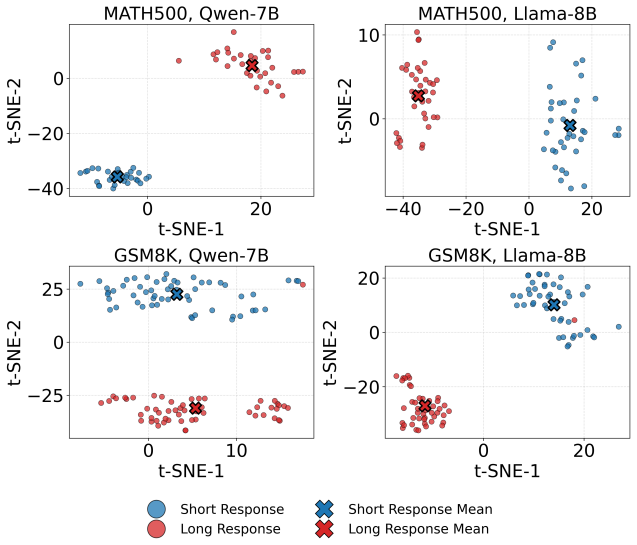

Figures from the paper (4 more)


Forward citations
Cited by 2 Pith papers
-
Video Reasoning without Training
An entropy-guided, inference-time value-cache controller improves video reasoning accuracy and cuts output tokens versus RL-trained baselines.
-
Probing the Difficulty Perception Mechanism of Large Language Models
LLMs linearly encode math-problem difficulty in their final-token representations, and specific final-layer attention heads are specialized for easy vs hard problems.
Reference graph
Works this paper leans on
-
[1]
An introduction to representation engineering: Activation steering
Sam Burns et al. An introduction to representation engineering: Activation steering. Alignment Forum, 2024
work page 2024
-
[2]
Andy Chen et al. Contrastive chain-of-thought prompting. arXiv preprint arXiv:2310.02306, 2023
work page Pith review arXiv 2023
-
[3]
Mui, Silvio Savarese, Caiming Xiong, and Huan Wang
Haolin Chen, Yihao Feng, Zuxin Liu, Weiran Yao, Akshara Prabhakar, Shelby Heinecke, Ricky Ho, Phil L. Mui, Silvio Savarese, Caiming Xiong, and Huan Wang. Language models are hidden reasoners: Unlocking latent reasoning capabilities via self-rewarding. In Interna- tional Conference on Learning Representations (ICLR), under review, 2025. OpenReview ID 4Po8d9GAfQ
work page 2025
-
[4]
Seal: Steer- able reasoning calibration of large language models for free
Runjin Chen, Zhenyu Zhang, Junyuan Hong, Souvik Kundu, and Zhangyang Wang. Seal: Steer- able reasoning calibration of large language models for free. arXiv preprint arXiv:2504.07986, 2025
arXiv 2025
-
[5]
Do not think that much for 2+3=? on the overthinking of o1-like llms, 2025
Xingyu Chen, Jiahao Xu, Tian Liang, Zhiwei He, Jianhui Pang, Dian Yu, Linfeng Song, Qiuzhi Liu, Mengfei Zhou, Zhuosheng Zhang, Rui Wang, Zhaopeng Tu, Haitao Mi, and Dong Yu. Do not think that much for 2+3=? on the overthinking of o1-like llms, 2025. URL https://arxiv.org/abs/2412.21187
arXiv 2025
-
[7]
Compressed chain of thought: Efficient reasoning through dense representations
Jeffrey Cheng and Benjamin Van Durme. Compressed chain of thought: Efficient reasoning through dense representations. arXiv preprint arXiv:2412.13171, 2024
arXiv 2024
-
[8]
Training verifiers to solve math word problems
Karl Cobbe et al. Training verifiers to solve math word problems. arXiv preprint arXiv:2110.14168, 2021
arXiv 2021
-
[9]
DeepSeek-AI. Deepseek -r1-distill-qwen-7b. https://huggingface.co/deepseek-ai/ DeepSeek-R1-Distill-Qwen-7B , 2025
work page 2025
Show all 35 references
-
[10]
Deepseek -r1: Incentivizing reasoning capability in llms via reinforcement learning, 2025
DeepSeek-AI. Deepseek -r1: Incentivizing reasoning capability in llms via reinforcement learning, 2025. URL https://arxiv.org/abs/2501.12948
2025 arXiv
-
[11]
Scaling reasoning, losing control: Evaluating instruction following in large reasoning models
Tingchen Fu, Jiawei Gu, Yafu Li, Xiaoye Qu, and Yu Cheng. Scaling reasoning, losing control: Evaluating instruction following in large reasoning models. arXiv preprint arXiv:2505.14810, 2025
2025 arXiv
-
[12]
Style steering via activation injection in large language models
Aviv Haviv, Sagie Benaim, Asaf Noy, and Lior Wolf. Style steering via activation injection in large language models. arXiv preprint arXiv:2403.00555, 2024
2024 arXiv
-
[13]
Measuring mathematical problem solving with the math dataset
Dan Hendrycks, Steven Basart, Nicholas Carlini, Jacob Steinhardt, and Dawn Song. Measuring mathematical problem solving with the math dataset. In International Conference on Machine Learning (ICML), 2021
2021
-
[14]
Measuring mathematical problem solving with the math dataset
Dan Hendrycks, Collin Burns, Saurav Kadavath, Akul Arora, Steven Basart, Eric Tang, Dawn Song, and Jacob Steinhardt. Measuring mathematical problem solving with the math dataset. NeurIPS Datasets and Benchmarks Track, 2021
2021
-
[15]
Thinkprune: Pruning long chain-of-thought of llms via reinforcement learning
Bairu Hou, Yang Zhang, Jiabao Ji, Yujian Liu, Kaizhi Qian, Jacob Andreas, and Shiyu Chang. Thinkprune: Pruning long chain-of-thought of llms via reinforcement learning. arXiv preprint arXiv:2504.01296, 2025
2025 arXiv
-
[16]
Uncovering latent chain of thought vectors in language models
Yuchen Li et al. Uncovering latent chain of thought vectors in language models. arXiv preprint arXiv:2409.14026, 2024
2024 arXiv
-
[17]
Manipulating large language models with representation editing for fairness
Xuezhe Liang, Haoming Jiang, and Graham Neubig. Manipulating large language models with representation editing for fairness. arXiv preprint arXiv:2311.01543, 2023
2023 arXiv
-
[18]
Locating and editing factual associa- tions in gpt
Kevin Meng, Eric Mitchell, David Bau, and Percy Liang. Locating and editing factual associa- tions in gpt. Advances in Neural Information Processing Systems (NeurIPS), 2023. 9
2023
-
[19]
s1: Simple test-time scaling
Niklas Muennighoff, Zitong Yang, Weijia Shi, Xiang Lisa Li, Li Fei-Fei, Hannaneh Hajishirzi, Luke Zettlemoyer, Percy Liang, Emmanuel Candès, and Tatsunori Hashimoto. s1: Simple test-time scaling. arXiv preprint arXiv:2501.19393, 2025
2025 arXiv
-
[20]
Improving instruction-following in language models through activation steering
Alessandro Stolfo, Vidhisha Balachandran, Safoora Yousefi, Eric Horvitz, and Besmira Nushi. Improving instruction-following in language models through activation steering. arXiv preprint arXiv:2410.12877, 2024
2024 arXiv
-
[21]
Energy and policy considerations for deep learning in nlp
Emma Strubell, Ananya Ganesh, and Andrew McCallum. Energy and policy considerations for deep learning in nlp. In Proc. of ACL, 2019
2019
-
[22]
Qwq -32b: A 32 b reasoning model from the qwen series
Alibaba Qwen Team. Qwq -32b: A 32 b reasoning model from the qwen series. https: //huggingface.co/Qwen/QwQ-32B, 2025. Apache 2.0 licensed, open-weight; competitive reasoning performance
2025
-
[23]
Steering language models with activation engineering
Alexander Matt Turner, Lisa Thiergart, Gavin Leech, David Udell, Juan José Vázquez, Ulisse Mini, and Monte MacDiarmid. Steering language models with activation engineering. OpenRe- view, 2023. URL: https://openreview.net/forum?id=2XBPdPIcFK
2023
-
[24]
Visualizing data using t-sne
Laurens Van der Maaten and Geoffrey Hinton. Visualizing data using t-sne. Journal of machine learning research, 9(11), 2008
2008
-
[25]
Self-consistency improves chain of thought reasoning in language models
Xuezhi Wang, Jason Wei, Jingshu Liu, Dale Schuurmans, Denny Zhou, and Quoc Le. Self-consistency improves chain of thought reasoning in language models. arXiv preprint arXiv:2203.11171, 2023
2023 arXiv
-
[26]
Self-consistency improves chain of thought reasoning in language models
Xuezhi Wang et al. Self-consistency improves chain of thought reasoning in language models. ICLR, 2023
2023
-
[27]
Thoughts are all over the place: On the underthinking of o1-like llms
Yue Wang, Qiuzhi Liu, Jiahao Xu, Tian Liang, Xingyu Chen, Zhiwei He, Linfeng Song, Dian Yu, Juntao Li, Zhuosheng Zhang, et al. Thoughts are all over the place: On the underthinking of o1-like llms. arXiv preprint arXiv:2501.18585, 2025
2025 arXiv
-
[28]
Le, and Ed Chi
Jason Wei, Xuezhi Wang, Dale Schuurmans, Maarten Bosma, Brian Ichter, Quoc V . Le, and Ed Chi. Chain-of-thought prompting elicits reasoning in large language models. arXiv preprint arXiv:2201.11903, 2022
2022 arXiv
-
[29]
Chain-of-thought prompting elicits reasoning in large language models
Jason Wei et al. Chain-of-thought prompting elicits reasoning in large language models. NeurIPS, 2022
2022
-
[30]
Tokenskip: Controllable chain-of-thought compression in llms
Heming Xia, Yongqi Li, Chak Tou Leong, Wenjie Wang, and Wenjie Li. Tokenskip: Controllable chain-of-thought compression in llms. arXiv preprint arXiv:2502.12067, 2025
2025
-
[31]
Chain of draft: Thinking faster by writing less, 2025
Silei Xu, Wenhao Xie, Lingxiao Zhao, and Pengcheng He. Chain of draft: Thinking faster by writing less, 2025. URL https://arxiv.org/abs/2502.18600
2025 arXiv
-
[32]
Dynamic early exit in reasoning models
Chenxu Yang, Qingyi Si, Yongjie Duan, Zheliang Zhu, Chenyu Zhu, Qiaowei Li, Zheng Lin, Li Cao, and Weiping Wang. Dynamic early exit in reasoning models. arXiv preprint arXiv:2504.15895, 2025
2025
-
[33]
Griffiths, Yuan Cao, and Karthik Narasimhan
Shunyu Yao, Dian Yu, Jeffrey Zhao, Izhak Shafran, Thomas L. Griffiths, Yuan Cao, and Karthik Narasimhan. Tree of thoughts: Deliberate reasoning via chain of thought. arXiv preprint arXiv:2305.10601, 2023
2023 arXiv
-
[34]
Compressed chain of thought: Efficient reasoning through dense contemplation tokens
Mingyuan Zhang et al. Compressed chain of thought: Efficient reasoning through dense contemplation tokens. EMNLP, 2024. 10 A KL-Constrained Scaling of Steering Vectors A.1 Bounding the Distributional Shift of Additive Steering We study the output–distribution shift incurred wh...
2024
-
[35]
A.1.5 Putting the pieces together With ˜z − z = δ + r(γ) and the triangle inequality, ∥˜z − z∥2 2 ≤ ∥δ∥2 + ∥r(γ)∥2 2 (8) ≤ ∥δ∥2 2 + 2∥δ∥2∥r(γ)∥2 + ∥r(γ)∥2
(7) This constant 1/4 is tight for our purposes. A.1.5 Putting the pieces together With ˜z − z = δ + r(γ) and the triangle inequality, ∥˜z − z∥2 2 ≤ ∥δ∥2 + ∥r(γ)∥2 2 (8) ≤ ∥δ∥2 2 + 2∥δ∥2∥r(γ)∥2 + ∥r(γ)∥2
-
[36]
Alternatively,
(9) Invoking (4) and ∥δ∥2 = γa with a := ∥Wv∥2, we derive from (7) the corrected steering bound: KL(p∥˜p) ≤ 1 4 γ2a2 + 1 4 La γ3 + 1 16 L2γ4 (10) Safe γ budget with a curvature safety factor. Fix a target divergence ε >0. Ignoring the last term in (10) yields the cubic inequal...
Reviewed August 6, 2026 · model on record in the stance chip above.
Discussion (0). Sign in to comment.