REVIEW 4 major objections 5 minor 59 references
Brill--Noether loci in genus $\leq 12$
T0 review · 4 major / 5 minor · reviewed 2026-08-06 · deepseek-v4-flash
Pith's one-line read For every genus up to 12, the complete containment pattern of Brill–Noether loci is now known, with explicit witnesses for every non-containment.
desk verdict A likely-correct complete classification of Brill–Noether containments through genus 12, with the main gap being unshown exhaustive enumerations that are load-bearing for the non-containments. read the letter →
The pith
A machine-rendered reading of the paper's core claim, the machinery that carries it, and where it could break.
The reading
What carries the argument
The load-bearing object is the Lazarsfeld–Mukai bundle $E_{C,(A,V)}$ attached to a linear series on a smooth curve $C$ inside a K3 surface with Picard lattice $\mathbb{Z}[H] \oplus \mathbb{Z}[L]$; when $\rho < 0$ this bundle is non-simple. Its possible destabilizing subsheaves are organized into terminal filtrations, and the numerical data of such a filtration form an admissible assignment, a Gelfand–Tsetlin pattern of slopes together with the conditions that each quotient is nef and slope-positive. An admissible assignment gives a lower bound on $c_2(E_{C,g^s_e})$, hence a non-containment $M^r_{g,d} \not\subset M^s_{g,e}$; conversely, when a bundle realizing an assignment can be constructed, one obtains a containment. The secondary machinery consists of the gonality stratification function $\kappa(g,r,d)$ from the refined Brill–Noether theory of $k$-gonal curves, secant expected containments via the determinantal cycles $V^{r-s}_{d-e}(g^r_d)$, and classical plane-curve and Castelnuovo-curve constructions.
What would settle it
Re-run the finite enumeration of quotient non-negative, quotient slope-positive admissible assignments for Lazarsfeld–Mukai bundles on K3 surfaces with Picard lattice $\Lambda^r_{g,d}$ for each case in Propositions 3.15, 3.29, and 4.14; for instance, in genus 9 with $\Lambda^2_{9,7}$, an admissible assignment with destabilizing subsheaf other than $H-L$ or $L$ giving $c_2(E_{C,g^2_e}) \leq 6$ would disprove the claimed non-containment $M^2_{9,7} \not\subset M^2_{9,6}$.
Extended reading notes
Core claim
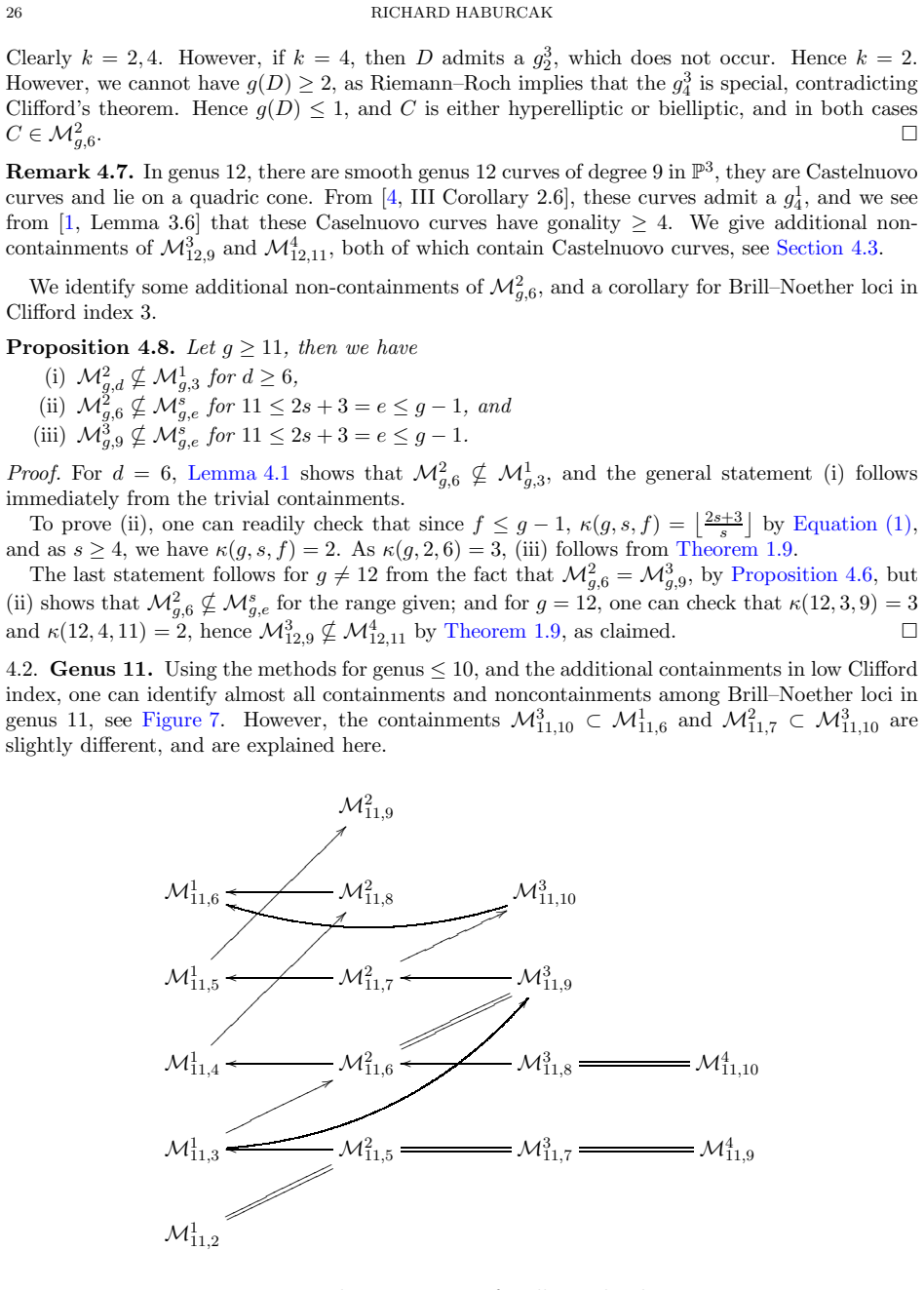
The central claim, Theorem A, is that the relative positions of Brill–Noether loci in genus $g \leq 6$ are governed solely by the trivial containments obtained by adding base points and subtracting non-base points, while for $7 \leq g \leq 12$ the complete set of non-trivial containments is displayed in Figures 2–5, 7, and 8. In particular, every containment among loci with $\rho < 0$ and $d \leq g-1$ is a sequence of the displayed covers, trivial containments, or Serre duality, and every non-containment is witnessed by a specific family of curves. The argument combines the refined Brill–Noether theory for curves of fixed gonality, classical bounds (Castelnuovo, Castelnuovo–Severi, Martens, Coppens), explicit constructions with nodal plane curves and Castelnuovo curves, and an analysis of unstable Lazarsfeld–Mukai bundles on K3 surfaces. On K3 surfaces, the existence of a $g^s_e$ forces an admissible assignment for a terminal filtration of the associated Lazarsfeld–Mukai bundle, and the absence of such assignments yields non-containments; when assignments exist, the bundles can sometimes be built as direct sums, yielding containments such as $M^2_{11,7} \subset M^3_{11,10}$.
Load-bearing premise
The exhaustive enumerations of admissible assignments in the non-containment proofs are assumed complete; if a single admissible assignment was missed, one of the claimed non-containments could fail.
Editorial extensions
If this is right
- For $g \leq 12$, the inclusion partial order among Brill–Noether loci with $\rho < 0$ is finite and explicit: any containment question reduces to reading the appropriate figure together with trivial containments and Serre duality.
- Families realizing the non-containments (smooth plane sextics, bielliptic covers, trigonal curves, Castelnuovo curves, nodal plane curves) certify that the omissions in the figures are genuine.
- The realized K3-expected containments, such as $M^2_{11,7} \subset M^3_{11,10}$ and $M^2_{12,7} \subset M^3_{12,10}$, provide explicit decompositions of Lazarsfeld–Mukai bundles as sums of line bundles and smaller Lazarsfeld–Mukai bundles.
- Conjecture A gives a concrete numerical threshold, $e \geq d - 2r + s + \frac{g-d+r+1}{2} + \frac{(s-2)(r-1)-1}{s-1}$, predicting exactly when $M^r_{g,d} \subset M^s_{g,e}$ in large genus, and Conjecture B predicts that no containments into $M^2_{g,e}$ occur outside the secant range for $r \geq 3$.
Reading between the lines
- The same admissible-assignment calculus should be run in genus 13–15; even a partial run could show where the low-genus pattern breaks and how quickly the Conjecture A threshold becomes accurate.
- The equalities in low Clifford index, e.g. $M^{e-1}_{g,2e}$ all equal for $g \geq 11, e \geq 4$ and $M^4_{g,11}=M^4_{g,10}=M^3_{g,8}$ for $g \geq 13$, suggest a general Clifford-coalescence principle: loci of a fixed small Clifford index eventually coincide, a principle that could be tested by computing $\kappa$ in higher genus.
- The explicit constructions through linear systems on nodal plane curves indicate that many K3-expected containments can be realized without K3 surfaces; this raises the possibility of a purely classical proof of Conjecture A's containment direction.
- If the hand-checked enumerations are replaced by a certified computer enumeration, the non-containment half of Theorem A would be independently verifiable and the method could be extended mechanically to bounded genus.
Editorial analysis
A structured set of objections, weighed in public.
Referee Report
Summary. The paper studies the relative positions (containments and non-containments) of Brill–Noether loci M^r_{g,d} with ρ(g,r,d)<0 in low genus. The main result, Theorem A, asserts that for g≤6 all containments are trivial, while for 7≤g≤12 the complete poset of non-trivial containments is described by the Hasse-like diagrams in Figures 2–5, 7–8. The proof combines classical results (Castelnuovo–Severi, Max Noether, Mori complete intersections), the refined Brill–Noether theory for fixed gonality, chains of elliptic curves, explicit nodal-plane-curve constructions, and an analysis of admissible assignments of terminal filtrations of Lazarsfeld–Mukai bundles on K3 surfaces. The paper also proposes Conjectures A and B on expected containments in large genus and raises questions on irreducibility of Brill–Noether loci.
Significance. If Theorem A is correct, the paper gives the first complete classification of non-trivial containments among Brill–Noether loci in genera 7 through 12, a finite list that should be a benchmark for refined Brill–Noether theory. A notable strength is that many containments are proved by explicit geometric constructions rather than by a black-box computation, and non-containments are often witnessed by concrete curves (smooth plane curves, bielliptic covers, Castelnuovo curves, K3 sections). The K3-admissible-assignment formalism is a useful heuristic and is clearly connected to the Donagi–Morrison circle of ideas. However, the classification is not independently verifiable as written: several load-bearing non-containment proofs rest on assertions of exhaustive finite enumerations for which no tables, code, or detailed case analysis are supplied. The result is plausible and the methods are appropriate, but the missing evidence for these enumerations is a correctness risk that must be addressed before the classification can be accepted.
major comments (4)
- [§3.4, Proposition 3.15] The non-containment proofs for genus 9 depend on the assertion that certain lists of admissible assignments are complete. For instance, Proposition 3.15(i) states that for Λ^2_{9,6} the only possible admissible assignments of a g^1_e are those with c1(E1) ∈ {2H−4L, H−L, 2L, −H+4L}, and Proposition 3.15(ii) states that for Λ^2_{9,7} all admissible assignments of a g^2_e are of type 1⊂3 and have destabilizing sub-line bundle H−L or L. The text gives no derivation, no table of the checked cases, and no code. Since by §2.2 every terminal filtration yields an admissible assignment, an overlooked admissible assignment could directly produce a g^s_e below the asserted c2 threshold and invalidate the claimed non-containment. This is load-bearing for Theorem A in genus 9.
- [§3.5, Proposition 3.29] The same issue occurs in the genus 10 classification. Proposition 3.29 states that for Λ^2_{10,7} the only admissible assignments for g^1_k and g^2_e are as listed, and for Λ^3_{10,9} that the destabilizing classes for g^2_e are exactly {2H−3L, H−L, L, −H+3L}, that the only types for g^3_e are 1⊂4, 2⊂4, and 1⊂2⊂4, and that there are no admissible assignments of type 1⊂2⊂4. These exhaustive statements are asserted with phrases such as “checking all possibilities” and “one can check,” without displaying the enumeration or the inequalities from Equations (4) and (5) that eliminate the remaining cases. An omitted admissible assignment in any of these lists would falsify one of the non-containments (i)–(iv) and hence the genus 10 part of Theorem A.
- [§3.5, Proposition 3.27] The non-containment M^2_{10,7} ⊄ M^3_{10,9} is proved by degenerating to a chain of ten elliptic curves and asserting: “There is no admissible filling with the entries 1,…,10 of a 4×4 square with the same torsion conditions.” This is a finite combinatorial check, but no table of attempted fillings, no explicit obstruction, and no reproducible algorithm is provided. The statement is essential to the proof of the proposition, and the reader cannot verify it from the text. Please provide the complete case analysis or a short script with documented output.
- [§2.3–§2.4, Lemma 2.10 and the enumeration method] The paper would benefit from a precise description of how the “check all possibilities” enumerations are performed. Lemma 2.10 gives finite ranges for the coefficients (x,y) of c1(E/E_i), so an exhaustive search is in principle possible, but the manuscript does not state the algorithm: which terminal filtration types are considered in each genus, how the Gelfand–Tsetlin inequalities together with Equations (4) and (5) are used to prune the search, and how the 'quotient non-negative' and 'quotient slope-positive' conditions of Remark 2.6 are applied. Supplying this information, together with the resulting tables for each Λ^r_{g,d} used in Propositions 3.4(iii), 3.8, 3.15, and 3.29, would make the central classification checkable and would remove the main correctness risk.
minor comments (5)
- [§3.2, Proposition 3.4(iii)] The statement appears as “M^2_{1,6} ⊈ M^1_{7,3}”; the subscript “1,6” should presumably be “7,6”. Please correct this typo.
- [§4.2, Proposition 4.16] The proof says that a basepoint on the g^2_7 sends C into M^2_{12,6} ⊂ M^3_{12,9} “by Proposition 4.14,” but Proposition 4.14 does not state M^2_{12,6} ⊂ M^3_{12,9}. The intended argument is likely via Remark 4.13 together with κ(12,3,9)=3; please fix the reference.
- [§4.2, Proposition 4.16] The phrase “4 dimensional linear system of conics through 2 of the nodes” is ambiguous: the vector space of conics through two fixed points has dimension 4, but the resulting projective linear system has dimension 3, which is what produces the g^3_{10}. Please clarify whether “dimension” refers to the projective system or the vector-space dimension.
- [Figures 2–5, 7–8] The diagrams are difficult to read in the current rendering: many labels and arrows overlap, and in places the arrows are difficult to distinguish from the 'trivial containment' arrows that are intentionally omitted. A larger vector graphic or a separate list of the cover relations would improve usability.
- [Throughout] There are several typographical errors, e.g. “satsify” in Section 1.1 and “Corolalry” in the proof of Proposition 4.14; also the notation for Brill–Noether loci sometimes omits spaces, as in “M2 1,6.” A careful proofreading pass is recommended.
Circularity Check
No significant circularity: K3-expected containments are used only as heuristics, and every asserted containment/non-containment in genus ≤ 12 is justified by explicit constructions or external, parameter-free theorems.
full rationale
The derivation chain in this paper is not circular. The K3-expected containments, defined in Definition 2.12, are explicitly labeled as a heuristic: Section 2.4 states that they are 'a useful heuristic in determining the relative positions of Brill–Noether loci,' and the actual containments are proven independently. For example, the containment M^2_{11,7} ⊂ M^3_{11,10} is first seen as K3-expected in Remark 4.10, but Proposition 4.11 gives an explicit construction using plane septic curves with four nodes; similarly, M^2_{12,7} ⊂ M^3_{12,10} is proven in Proposition 4.16 using conics through nodes of a plane curve, not by the admissible-assignment heuristic of Example 4.15. Non-containments are derived from the necessity of admissible assignments for a terminal filtration of a Lazarsfeld–Mukai bundle: if a g^s_e existed, its LM bundle would have a terminal filtration and hence an admissible assignment producing a c2-bound; the paper then rules out the relevant e by showing all admissible assignments give larger bounds. This does not assume the conclusion. The uses of the author's own prior work are not load-bearing in a circular way. The κ(g,r,d) formula from [7] is used for many non-containments via Proposition 1.10, but [7] derives it from the external refined Brill–Noether theory of Jensen–Ranganathan (Theorem 1.9), and the formula is parameter-free with assumptions not containing Theorem A. The irreducibility and chain-of-elliptic-curves degeneration of M^2_{10,7} cited from [30] in Proposition 3.27 is an independent theorem about the structure of that locus, not a disguised form of the non-containment M^2_{10,7} ⊈ M^3_{10,9} being proved. The cited results [5], [6], and [47] supply definitions, flexible-decomposition rigidity, or generalized LM-bundle facts, but the low-genus classifications are established in this paper by direct constructions and by admissible-assignment computations performed here. The reader's flagged risk—that some enumerations of admissible assignments in Propositions 3.15, 3.29, and elsewhere are asserted without displayed casework—is a completeness/correctness concern about the enumeration, not circularity: the method does not assume the non-containment it proves, and a missed assignment would falsify a claim rather than tautologically confirm it. Accordingly, the paper's central claim is self-contained against external benchmarks and no step reduces by construction to its own inputs.
Assumptions & free parameters
assumptions (4)
- standard math Brill–Noether–Petri theorem
- domain assumption Existence of K3 surfaces with Pic(Λ^r_{g,d}) when ∆ < 0
- domain assumption Theorem 1.9 (Pflueger, Jensen–Ranganathan)
- ad hoc to paper Completeness of admissible-assignment enumerations in §§3.4, 3.5, 4.3
Cite this review
Pith. "Pith review of Brill--Noether loci in genus $\leq 12$." pith.science (2026). https://pith.science/paper/EFD6ULLK
@misc{pith2026250704902,
  author       = {Pith},
  title        = {Pith review of: Brill--Noether loci in genus $\leq 12$},
  year         = {2026},
  howpublished = {\url{https://pith.science/paper/EFD6ULLK}},
  note         = {Machine review of arXiv:2507.04902}
}
abstract
A refined Brill--Noether theory seeks to determine which linear series are admitted by a ``general'' curve in a particular Brill--Noether locus. However, as Brill--Noether loci are not irreducible in general, a coarse answer is given by the relative positions of Brill--Noether loci. Via an analysis of unstable Lazarsfeld--Mukai bundles on K3 surfaces, we distinguish Brill--Noether loci and provide expectations for the relative positions of Brill--Noether loci in general. Together with classical results, the refined Brill--Noether theory for curves of fixed gonality and on Hirzebruch surfaces, and explicit constructions, we identify the relative positions of all Brill--Noether loci in genus $g\leq 12$.
Figures


Figures from the paper (6 more)




Reference graph
Works this paper leans on
-
[1]
Robert D. M. Accola. On Castelnuovo’s inequality for alg ebraic curves. I. Trans. Amer. Math. Soc. , 251:357–373,
-
[2]
Lazarsfeld–Mukai bundles and applicati ons
Marian Aprodu. Lazarsfeld–Mukai bundles and applicati ons. In Commutative algebra, pages 1–23. Springer, New York, 2013. 7
work page 2013
-
[3]
Mu kai’s program for curves on a K3 surface
Enrico Arbarello, Andrea Bruno, and Edoardo Sernesi. Mu kai’s program for curves on a K3 surface. Algebraic Geom., 1(5):532–557, 2014. 15
work page 2014
-
[4]
Enrico Arbarello, Maurizio Cornalba, Phillip A. Griffith s, and Joe Harris. Geometry of Algebraic Curves . Springer-Verlag, 1985. 1, 6, 26, 27, 28
work page 1985
-
[5]
Maximal Brill-Noether loci via K3 surfaces
Asher Auel and Richard Haburcak. Maximal Brill–Noether loci via K3 surfaces, 2022. arXiv:2206.04610. 1, 2, 5, 8, 18, 33
work page Pith review arXiv 2022
-
[6]
Distinguishing Brill-Noether loci
Asher Auel, Richard Haburcak, and Andreas Leopold Knuts en. Distinguishing Brill–Noether loci, 2024. arXiv:2406.19993. 1, 2, 5, 8, 12, 15, 30, 33, 34, 35
work page Pith review arXiv 2024
-
[7]
Maximal Brill--Noether loci via the gonality stratification
Asher Auel, Richard Haburcak, and Hannah Larson. Maxima l Brill–Noether loci via the gonality stratification, 2024, to appear in Michigan Math J. arXiv:2310.09954. 1, 3, 5, 7
work page Pith review arXiv 2024
-
[8]
On linear series on gen eral k-gonal projective curves
Edoardo Ballico and Changho Keem. On linear series on gen eral k-gonal projective curves. Proc. Amer. Math. Soc., 124(1):7–9, 1996. 1
work page 1996
Show all 59 references
-
[9]
Maximal Brill–Noether loci via degenerations and double covers, 2024, to appear in Ann
Andrei Bud and Richard Haburcak. Maximal Brill–Noether loci via degenerations and double covers, 2024, to appear in Ann. Sc. Norm. Super. Pisa Cl. Sci. (5). arXiv:2404 .15066. 4, 5
2024
-
[10]
Una applicazione della geometria e numerativa alle curve algebriche
Guido Castelnuovo. Una applicazione della geometria e numerativa alle curve algebriche. Rendiconti del Circolo Matematico di Palermo (1884-1940) , 3(1):27–37, Dec 1889. 1, 6
1940
-
[11]
Towards a Halphen th eory of linear series on curves
Luca Chiantini and Ciro Ciliberto. Towards a Halphen th eory of linear series on curves. Trans. Amer. Math. Soc., 351(6):2197–2212, 1999. 28, 29
1999
-
[12]
Linear series on a curve of compact type bridged by a chain of elliptic curves
Youngook Choi and Seonja Kim. Linear series on a curve of compact type bridged by a chain of elliptic curves. Indagationes Mathematicae , pages 844–860, 2022. 3 36 RICHARD HABURCAK
2022
-
[13]
Components of Bri ll–Noether loci for curves with fixed gonality
Kaelin Cook-Powell and David Jensen. Components of Bri ll–Noether loci for curves with fixed gonality. Michigan Math. J. , 71(1):19–45, 2022. 1, 7
2022
-
[14]
The gonality of general smooth curves wit h a prescribed plane nodal model
Marc Coppens. The gonality of general smooth curves wit h a prescribed plane nodal model. Math. Ann. , 289(1):89–93, 1991. 1, 6, 31
1991
-
[15]
The gonality of smooth curv es with plane models
Marc Coppens and Takao Kato. The gonality of smooth curv es with plane models. Manuscripta Math. , 70(1):5– 25, 1990. 1, 6, 31
1990
-
[16]
Nontrivial linear systems on smooth plane curves
Marc Coppens and Takao Kato. Nontrivial linear systems on smooth plane curves. Math. Nachr. , 166:71–82,
-
[17]
Linear series on a gen eral k-gonal curve
Marc Coppens and Gerriet Martens. Linear series on a gen eral k-gonal curve. Abh. Math. Sem. Univ. Hamburg , 69:347–371, 1999. 1
1999
-
[18]
Linear series on 4-go nal curves
Marc Coppens and Gerriet Martens. Linear series on 4-go nal curves. Math. Nachr. , 213:35–55, 2000. 1
2000
-
[19]
Very ample linear ser ies on quadrigonal curves
Marc Coppens and Gerriet Martens. Very ample linear ser ies on quadrigonal curves. Bull. Belg. Math. Soc. Simon Stevin , 29(4):423–434, 2022. 1
2022
-
[20]
Brill–Noether theory in codimension-two
Dan Edidin. Brill–Noether theory in codimension-two. J. Algebraic Geom. , 2(1):25–67, 1993. 4
1993
-
[21]
The Kodaira dimension of the moduli space of curves of genus ≥ 23
David Eisenbud and Joe Harris. The Kodaira dimension of the moduli space of curves of genus ≥ 23. Inventiones mathematicae, 90(2):359–387, Jun 1987. 4
1987
-
[22]
Irreducibility of some f amilies of linear series with Brill–Noether number −1
David Eisenbud and Joe Harris. Irreducibility of some f amilies of linear series with Brill–Noether number −1. Annales scientifiques de l’ ´Ecole Normale Sup´ erieure, Ser. 4, 22(1):33–53, 1989. 4
1989
-
[23]
The geometry of the moduli space of curve s of genus 23
Gavril Farkas. The geometry of the moduli space of curve s of genus 23. Mathematische Annalen , 318(1):43–65, Sep 2000. 4
2000
-
[24]
Brill–Noether loci and the gonality str atification of Mg
Gavril Farkas. Brill–Noether loci and the gonality str atification of Mg. J. Reine. Angew. Math. , 2001(539):185– 200, 2001. 1, 4, 31
2001
-
[25]
Higher ramification and varieties of sec ant divisors on the generic curve
Gavril Farkas. Higher ramification and varieties of sec ant divisors on the generic curve. J. Lond. Math. Soc. (2) , 78(2):418–440, 2008. 6, 7
2008
-
[26]
Hurwitz–Brill–Noether theory via K3 surfaces and sta- bility conditions, 2025
Gavril Farkas, Soheyla Feyzbakhsh, and Andr´ es Rojas. Hurwitz–Brill–Noether theory via K3 surfaces and sta- bility conditions, 2025. arXiv:2505.19890. 2
2025 arXiv
-
[27]
Stable curves and special divisors: Pe tri’s conjecture
David Gieseker. Stable curves and special divisors: Pe tri’s conjecture. Invent. Math. , 66(2):251–275, 1982. 1
1982
-
[28]
On the variety of spe cial linear systems on a general algebraic curve
Phillip Griffiths and Joseph Harris. On the variety of spe cial linear systems on a general algebraic curve. Duke Math. J. , 47(1):233–272, 1980. 1
1980
-
[29]
Curves on Brill-Noether special K3 s urfaces
Richard Haburcak. Curves on Brill-Noether special K3 s urfaces. Math. Nachr. , 297(12):4497–4509, 2024. 2
2024
-
[30]
Some reducible and irreducible Brill–Noether loci, 2025
Richard Haburcak and Montserrat Teixidor i Bigas. Some reducible and irreducible Brill–Noether loci, 2025. arXiv:2503.16255. 1, 3, 4, 20, 23, 30, 31, 32
2025
-
[31]
On the Kodaira dimension o f the moduli space of curves
Joe Harris and David Mumford. On the Kodaira dimension o f the moduli space of curves. Invent. Math., 67(1):23– 86, Feb 1982. 23
1982
-
[32]
Algebraic geometry, volume No
Robin Hartshorne. Algebraic geometry, volume No. 52 of Graduate Texts in Mathematics . Springer-Verlag, New York-Heidelberg, 1977. 25
1977
-
[33]
The geometry of moduli spaces of sheaves
Daniel Huybrechts and Manfred Lehn. The geometry of moduli spaces of sheaves . Cambridge Mathematical Library. Cambridge University Press, Cambridge, second ed ition, 2010. 7
2010
-
[34]
Recent developments in Bril l–Noether theory, 2021
David Jensen and Sam Payne. Recent developments in Bril l–Noether theory, 2021. To appear in EMS Volume for the BMS Thematic Einstein Semester on Algebraic Geometr y, arXiv:2111.00351. 1
2021 arXiv
-
[35]
Brill–Noether the ory for curves of a fixed gonality
David Jensen and Dhruv Ranganathan. Brill–Noether the ory for curves of a fixed gonality. Forum of Mathematics, Pi, 9:e1, 2021
2021
-
[36]
Brill–Noether the ory for curves of a fixed gonality
David Jensen and Dhruv Ranganathan. Brill–Noether the ory for curves of a fixed gonality. Forum Math. Pi , 9:Paper No. e1, 33, 2021. 1, 4, 7
2021
-
[37]
Severi varieties and Brill-Noether theory of curves on abelian surfaces
Andreas Leopold Knutsen, Margherita Lelli-Chiesa, an d Giovanni Mongardi. Severi varieties and Brill-Noether theory of curves on abelian surfaces. J. Reine Angew. Math. , 749:161–200, 2019. 4
2019
-
[38]
Moduli spaces of algebraic curves with r ational maps
Herbert Lange. Moduli spaces of algebraic curves with r ational maps. Math. Proc. Cambridge Philos. Soc. , 78(2):283–292, 1975. 5, 6
1975
-
[39]
Global Bri ll–Noether theory over the Hurwitz space
Eric Larson, Hannah Larson, and Isabel Vogt. Global Bri ll–Noether theory over the Hurwitz space. Geom. Topol., 29(1):193–257, 2025. 1, 7
2025
-
[40]
A refined Brill–Noether theory over Hurw itz spaces
Hannah Larson. A refined Brill–Noether theory over Hurw itz spaces. Invent. Math. , 224(3):767–790, 2021. 1, 4, 7
2021
-
[41]
Brill–Noether theory of smooth curves in the plane and on Hirzebruch surfaces, 2024
Hannah Larson and Sameera Vemulapalli. Brill–Noether theory of smooth curves in the plane and on Hirzebruch surfaces, 2024. arXiv:2408.12678. 1, 4, 22, 29
2024 arXiv
-
[42]
Hannah K. Larson. Refined Brill-Noether theory for all t rigonal curves. Eur. J. Math. , 7(4):1524–1536, 2021. 1
2021
-
[43]
Brill–Noether–Petri without dege nerations
Robert Lazarsfeld. Brill–Noether–Petri without dege nerations. J. Differ. Geom. , 23(3):299–307, 1986. 1, 2, 4, 7
1986
-
[44]
Lectures on linear series
Robert Lazarsfeld. Lectures on linear series. In Complex algebraic geometry (Park City, UT, 1993) , volume 3 of IAS/Park City Math. Ser. , pages 161–219. Amer. Math. Soc., Providence, RI, 1997. Wit h the assistance of Guillermo Fern´ andez del Busto.6 BRILL–NOETHER LOCI IN GEN...
1993
-
[45]
The Gieseker–Petri divisor in Mg for g ≤ 13
Margherita Lelli-Chiesa. The Gieseker–Petri divisor in Mg for g ≤ 13. Geom. Dedicata, 158:149–165, 2012. 4
2012
-
[46]
Stability of rank-3 Lazarsf eld–Mukai bundles on K3 surfaces
Margherita Lelli-Chiesa. Stability of rank-3 Lazarsf eld–Mukai bundles on K3 surfaces. Proc. Lond. Math. Soc. (3), 107(2):451–479, 2013. 1, 2, 3, 5, 11, 32
2013
-
[47]
Generalized Lazarsfeld–Mu kai bundles and a conjecture of Donagi and Morrison
Margherita Lelli-Chiesa. Generalized Lazarsfeld–Mu kai bundles and a conjecture of Donagi and Morrison. Adv. Math., 268:529–563, 2015. 2, 7, 8, 11, 12, 33, 35
2015
-
[48]
Le serie lineari speciali sulle curve tr igonali
Arturo Maroni. Le serie lineari speciali sulle curve tr igonali. Ann. Mat. Pura Appl. (4) , 25:343–354, 1946. 1
1946
-
[49]
On curves of odd gonality
Gerriet Martens. On curves of odd gonality. Arch. Math. (Basel) , 67(1):80–88, 1996. 1
1996
-
[50]
Henrik H. Martens. Varieties of special divisors on a cu rve. II. J. Reine Angew. Math. , 233:89–100, 1968. 1, 5, 25
1968
-
[51]
On degrees and genera of curves on smoot h quartic surfaces in P3
Shigefumi Mori. On degrees and genera of curves on smoot h quartic surfaces in P3. Nagoya Math. J. , 96:127–132,
-
[52]
Morrison
David R. Morrison. On K3 surfaces with large Picard number. Invent. Math. , 75(1):105–121, 1984. 8
1984
-
[53]
Viacheslav V. Nikulin. Integral symmetric bilinear fo rms and some of their applications. Math. USSR-Izv. , 14(1):103–167, 1980. 8
1980
-
[54]
Kieran G. O’Grady. Moduli of Abelian and K3 Surfaces . PhD thesis, Brown University, 1986. 8
1986
-
[55]
Brill–Noether varieties of k-gonal curves
Nathan Pflueger. Brill–Noether varieties of k-gonal curves. Adv. Math. , 312:46–63, 2017. 1, 4, 7
2017
-
[56]
Linear series with ρ < 0 via thrifty Lego building
Nathan Pflueger. Linear series with ρ < 0 via thrifty Lego building. J. Reine Angew. Math. , 797:193–228, 2023. 1, 3, 4, 30
2023
-
[57]
On the existence of certain families o f curves
Edoardo Sernesi. On the existence of certain families o f curves. Invent. Math. , 75(1):25–57, 1984. 4
1984
-
[58]
A generalized principal ideal theorem w ith an application to Brill–Noether theory
Frauke Steffen. A generalized principal ideal theorem w ith an application to Brill–Noether theory. Invent. Math. , 132(1):73–89, 1998. 4, 20
1998
-
[59]
Brill–Noether loci
Montserrat Teixidor i Bigas. Brill–Noether loci. Manuscripta Math. , 176(1):Paper No. 14, 17, 2025. 3, 4, 5, 23 Department of Mathematics, The Ohio State University, 100 M ath Tower, Columbus, OH 43210 Email address : haburcak.1@osu.edu
2025
Reviewed August 6, 2026 · model on record in the stance chip above.
Discussion (0). Continue with ORCID to comment.