REVIEW 4 major objections 4 minor 71 references
Monte Carlo Tree Search with Tensor Factorization for Optimization Problems in Robotics
T0 review · 4 major / 4 minor · reviewed 2026-08-06 · deepseek-v4-flash
Pith's one-line read By encoding a discretized decision tree as a tensor train, Tensor Train Tree Search cuts Monte Carlo Tree Search from exponential to linear cost per iteration while keeping asymptotic convergence to the global optimum.
desk verdict TTTS is a useful, broad experimental optimizer, but the asymptotic-global-convergence proof does not match Algorithm 1 as written; the paper needs a major theory revision. read the letter →
The pith
A machine-rendered reading of the paper's core claim, the machinery that carries it, and where it could break.
The reading
What carries the argument
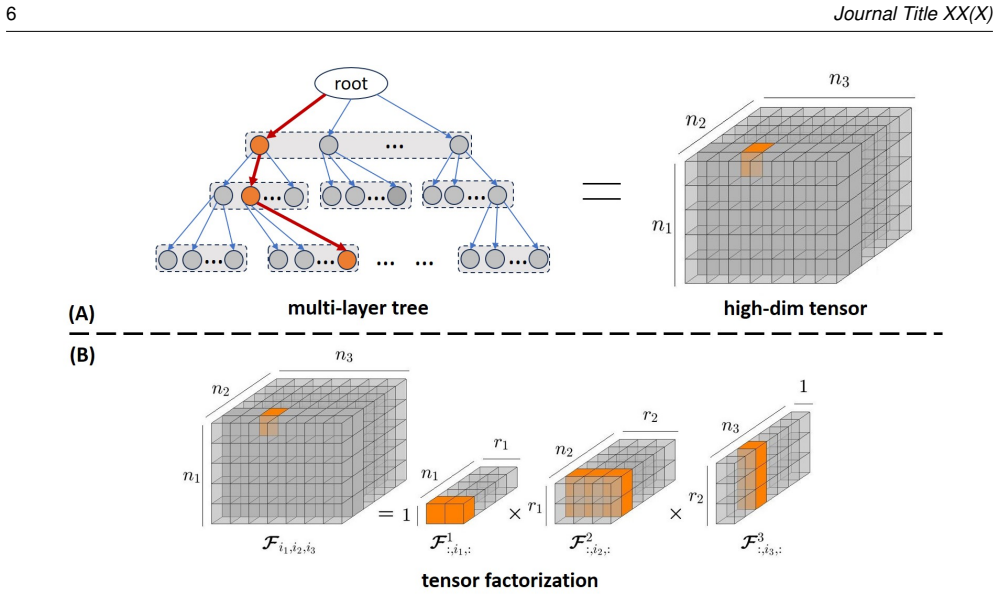
The tensor-train (TT) decomposition of the decision tree is the load-bearing object. Every root-to-leaf path is an index tuple $(i_1,\dots,i_d)$, and the stacked leaf values form a tensor of size $N^d$; TT writes any entry as a product of small third-order cores, $Q^1_{:,i_1,:} Q^2_{:,i_2,:} \cdots Q^d_{:,i_d,:}$, storing the whole tree in linearly many parameters. TT-Cross builds this surrogate from an adaptively chosen, small set of leaf evaluations via the maximum-volume principle, after which the model can be evaluated at any leaf — a global surrogate, not a tabulated subset. The argument then rests on three operations: Eq. (5) marginalizes the value cores over all completions to obtain a node's exploitation term, Eq. (6) does the same for visit counts, and a guided variant of TT-Cross updates the visit-count tensor in one pass per iteration. The UCB (upper confidence bound) rule, the exploration–exploitation score that decides which node MCTS expands next, selects the top-$\tau$ nodes at every layer in parallel, and CMA-ES refines the discrete candidates into continuous solutions.
What would settle it
Construct a synthetic corridor tree in which a leaf is feasible only when each layer's index stays within a window of the previous layer's choice ($|i_{k+1}-i_k|\le w$); this banded dependency forces high TT rank, so TT-Cross at $r_{\max} \le 50$ should fail to localize the corridor and TTTS should degenerate into plain MCTS. The empirical version: rerun the MP1 narrow-passage task while increasing obstacle clutter and record the minimal rank TT-Cross needs to reach its $\epsilon=10^{-3}$ tolerance; if that rank scales with the number of obstacles times the branching factor and the number of objective evaluations approaches the $N^d$ leaves, the linear-complexity claim is falsified for exactly the scenes the method targets.
Extended reading notes
Core claim
The central claim is that decision trees arising from discretized robot optimization are not arbitrary objects: shared kinematics, dynamics, and environmental constraints make their leaf-value tensors low-rank in the tensor-train sense, and that redundancy can be exploited algorithmically. TTTS builds a TT approximation of the reward tensor and the visit-count tensor using TT-Cross, which adaptively queries a small set of leaf evaluations, then computes node statistics via tensor contractions, Eqs. (5)–(6), instead of touching nodes one by one. Three propositions carry the argument: MCTS node values on the surrogate are computed exactly in $O(N d r^2)$ per iteration rather than $O(N^d)$ (Proposition 1); the surrogate's best solution deviates from the true global optimum by at most $2\epsilon$, where $\epsilon$ is the TT approximation error (Proposition 2); and the retained upper-confidence-bound selection visits every node infinitely often, so TTTS converges asymptotically to the global optimum, the same guarantee as MCTS (Proposition 3). The step beyond the earlier TTGO baseline, which samples the TT directly, is keeping the tree search, which corrects the cases where a low-rank prior alone misses the optimum.
Load-bearing premise
The whole efficiency claim rests on real robot decision trees being low-rank enough that a TT-Cross fit at rank 21–50 with error tolerance $10^{-3}$ still shows where the good solutions are; the paper itself notes in Sections 5.3 and 7.1 that obstacle-heavy tasks drift toward high rank, and if a task's required rank grows with its branching factor, the linear-complexity advantage over standard MCTS largely disappears.
Editorial extensions
If this is right
- Search problems previously prohibitive, such as the $4^4 \times 30^4$ hybrid pushing problem, become tractable because per-node bookkeeping is replaced by contractions over cores.
- The first iteration already concentrates search near the optimum whenever the landscape is low-rank: Proposition 2 bounds the warm-start gap by $2\epsilon$.
- Selection, simulation, and backpropagation parallelize without lock contention, because UCB scores for all nodes at a layer are computed simultaneously from the cores.
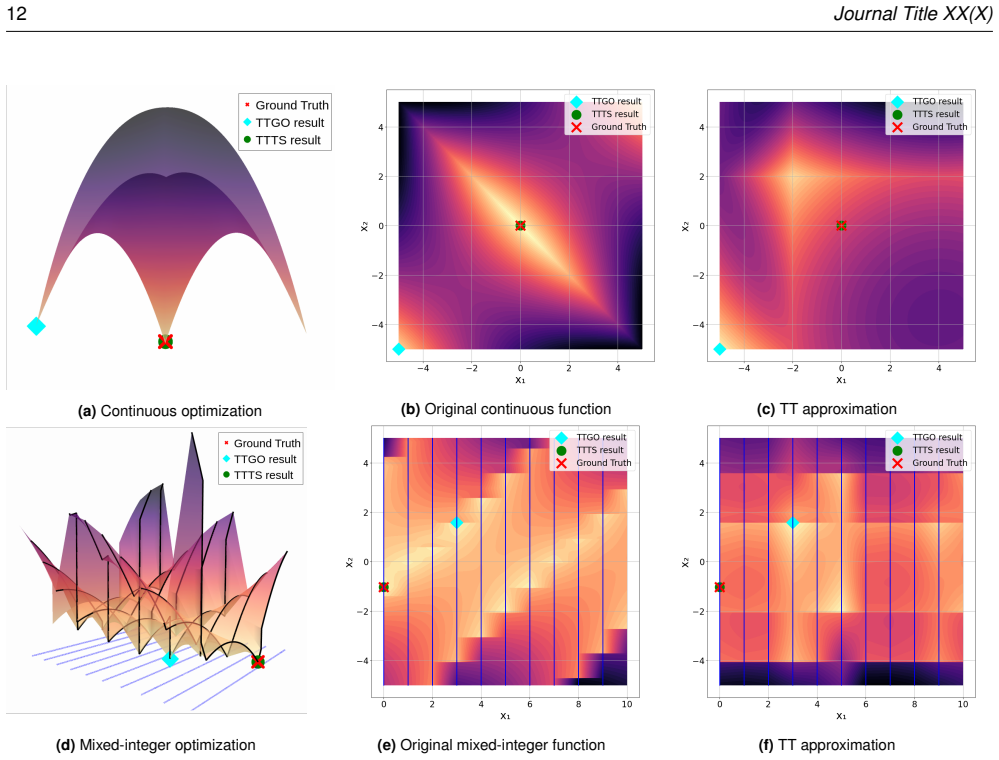
- One formulation covers continuous (NLP), high-dimensional continuous (via basis-function weights), and mixed-integer (MINLP) problems with the same algorithm, eliminating per-task solver engineering.
- The offline–online trade is controllable: heavier TT-Cross pretraining (larger rank) converges in fewer online iterations, and even a light rank-5 budget reaches the same accuracy given enough iterations.
Reading between the lines
- The rank that TT-Cross needs to reach the $\epsilon=10^{-3}$ tolerance is, in effect, a measure of a task's structural difficulty; plotting that rank against clutter level would quantify where the linear-complexity advantage survives, since the paper's own Section 7.1 notes that obstacle avoidance pushes trees toward high rank.
- The deterministic-objective assumption stated in Section 8 is the main scope boundary; replacing the single value tensor with a tensor of expectations or quantiles over stochastic rollouts would give belief-space or robust search with the same contraction machinery.
- Augmenting the tensor with task variables $z$ already amortizes the expensive TT-Cross step across task instances (10.5 seconds of pretraining versus 4.77 hours for a neural policy); indexing over an entire task distribution rather than a scalar $z$ is a natural extension along the same line.
- The QTT (quantized tensor train) reshaping named in the conclusion turns each dimension into binary modes, which would give a coarse-to-fine ladder of surrogates; if the rank behavior transfers, the $2\epsilon$ warm-start becomes a certificate that could drive branch-and-bound at every resolution.
Editorial analysis
A structured set of objections, weighed in public.
Referee Report
Summary. The paper proposes Tensor Train Tree Search (TTTS), a method that represents the decision tree arising from discretized robot optimization as a high-dimensional tensor, approximates it in tensor-train (TT) format via TT-Cross, and then runs an MCTS-like search with UCB statistics computed through tensor contractions. The central claims are: (i) Proposition 1, exact MCTS node values can be computed in O(N d r^2); (ii) Proposition 2, the TT surrogate's best solution is within 2ε of the true optimum; and (iii) Proposition 3, TTTS is asymptotically complete and converges to the global optimum. The paper also reports experiments on inverse kinematics, motion planning around obstacles, legged manipulation, multi-stage planar pushing, and bimanual whole-body manipulation, including real-robot trials. The authors argue that TTTS combines the global-search behavior of MCTS with linear storage/computation, avoiding problem-specific engineering and pre-trained neural heuristics.
Significance. If the theoretical claims were correct and the algorithm were precisely specified, this would be a useful contribution: it would give a general, model-based alternative to TTGO, neural-guided MCTS, and sampling-based optimizers for a broad class of robot optimization problems, with a compact global surrogate and potential for parallel search. The experimental suite is broad and includes a real-robot validation, and the paper is honest about several limitations (low-rank behavior, TT-Cross scalability in high dimensions, deterministic-dynamics assumption). However, the theoretical foundation as written is not sound: the algorithm's own selection rule is undefined at unvisited nodes, the global-convergence proof does not cover the greedy suffix selection actually specified, and Proposition 1 conflates subtree sums with MCTS action values. Those issues are load-bearing for the paper's central claim that TTTS preserves MCTS global optimality at linear complexity.
major comments (4)
- [§5, Algorithm 1, Eq. (2)] The UCB selection rule is ill-defined at the initial and unvisited nodes specified by the algorithm. Algorithm 1 line 12 sets V_0 ← 0, so at depth j=1 Eq. (2) requires log v_i[0] = log 0, and for any node not yet visited v_i[j]=0 makes q_i[j]/v_i[j] = 0/0. Section 5.1's statement that 'all visit counts are zero, so the UCB score is dominated entirely by the exploitation term' is not a consequence of Eq. (2) but rather contradicts it. The algorithm needs an explicit initialization or tie-breaking rule (for example treating v_i[j]=0 as an infinite exploration bonus) and a definition of when a node counts as 'expanded' before any of the subsequent convergence claims can be evaluated.
- [§5, Algorithm 1 lines 16–22 and Proposition 3] Proposition 3's global-convergence proof does not apply to Algorithm 1 as written. Line 16 selects the top-τ partial paths over the entire set I[j], not over children of the node selected at depth j−1, so the standard recursive UCB property that every node is visited infinitely often is not established. Lines 19–22 then complete selected prefixes by argmax of the TT model Q, so leaves are reached greedily rather than by UCB; if Q ranks the true optimum below a sibling, that leaf is never evaluated even as L→∞. The proof of Proposition 3 assumes every leaf is eventually evaluated at its true value, which is exactly what the greedy suffix can prevent. The expansion rule referenced in line 17 ('if i_j is not expanded') is never defined, leaving the algorithm underspecified. The algorithm or the proof must be revised so that the visitation guarantee covers the actual selection procedure.
- [§5.2, Proposition 1 and Eq. (5)] Proposition 1's complexity and equivalence claims are not supported. If 'node values at every layer' means all O(N^j) nodes at each layer, then the claimed O(N d r^2) bound cannot hold because there are exponentially many nodes; if it means only the nodes along one selected root-to-leaf path, then the statement 'at every layer' is misleading and the result does not provide exact MCTS node values for the search tree as MCTS normally explores it. Moreover, q_i[j] in Eq. (5) is defined as the unnormalized sum of leaf values over all completions of the prefix, whereas the UCB rule in Eq. (2) uses an average reward q_i[j]/v_i[j]; these are not interchangeable. A layerwise argmax of subtree sums does not recover the maximum-value leaf of T (a subtree containing many moderately good leaves can have a larger sum than a subtree containing the single global optimum), so the proof's claim that one greedy pass 'recovers the solution that standard MCTS would identify in the limit of infinite simulations' does not follow from the preceding equations. The proposition needs a precise definition of 'MCTS node value' and a correct complexity count.
- [§5.2, Corollary 1 and §5.3 Remark on the low-rank approximation] Corollary 1 states that Proposition 1 provides 'exact MCTS node value computation in O(N d r^2) per iteration', but Proposition 1 as stated does not mention a per-iteration cost; this is an additional, unsupported reading. More importantly, the paper's own Remark on the low-rank approximation says that low-rankness governs speed rather than convergence, and the experiments in §7.1 admit that obstacle avoidance introduces high-rank behavior. That is a reasonable and honest position, but it makes the theoretical section's emphasis on exactness and global optimality particularly dependent on the correctness of Proposition 3, which currently fails. The paper should either prove the convergence claim for the actual algorithm or state a weaker claim about warm-start efficiency, and then adjust the abstract and introduction accordingly.
minor comments (4)
- [§5, Eqs. (5)–(6)] The summation indices in Eqs. (5) and (6) run from i_{j+1}=0 to N, while the index sets defined earlier are {1,…,N_j}; this off-by-one notation should be corrected.
- [§5.2 and §5.3] Section 5.2 refers to 'toy examples in Section 5.2', but the toy examples appear in Section 5.3; likewise, equations (17) and (18) are referenced in Section 5.3.1 but are only defined in Appendix A.2. The cross-references should be fixed.
- [§2.3] There is a typo in 'Rivi`ereet al.addresses this issue' — the citation should be formatted as 'Rivière et al. address this issue'.
- [Table 1 and Algorithm 1] The exploration constant c and the number of maintained solutions τ are listed as defaults in Algorithm 1 line 7, but Table 1 does not report τ or c for the individual tasks, which makes the experiments difficult to reproduce exactly.
Circularity Check
No significant circularity: the TT-Cross fitting is the algorithm's mechanism, not a hidden input; the Proposition 3 proof gap is a soundness problem, not a circular reduction.
full rationale
The paper's derivation chain is not circular. TT-Cross is used to fit a TT surrogate to the true objective J by actively querying function values; this fitting is the method itself (a global prior), not a hidden input to the reported result, because Algorithm 1 line 23 re-evaluates candidate leaves with the true J(x) and line 28 keeps top-τ solutions by J. Proposition 1 is a conditional complexity statement about contractions on a given TT model, not a claim that the true decision tree is low-rank. Proposition 2 is the standard conditional L∞-error argument: if ||T − T̂||∞ ≤ ε, then the true objective at the surrogate optimum is within 2ε of the true optimum; Corollary 1 explicitly states that Propositions 1 and 2 are conditioned on ε. No load-bearing self-citation is present: TTGO (Shetty et al. 2024) is presented as a background method and baseline, while the UCB/MCTS and TT-Cross facts are cited to external literature. The low-rank assumption is openly labeled in Section 5.3's remark as governing speed rather than correctness. One non-circular gap should be flagged for correctness: the proof of Proposition 3 asserts 'Because Ωx is finite and the UCB selection rule guarantees that every node is visited infinitely often,' but Algorithm 1's line 16 selects top-τ over the entire set I[j], line 17 breaks on an undefined expansion condition, and lines 19-22 complete unexpanded branches by greedy argmax of Q rather than UCB; furthermore, Eq. (2) is undefined at zero visit counts while V0 is initialized to 0 in Algorithm 1. The asymptotic-completeness proof therefore does not apply to the pseudocode as written. This is a soundness problem, not a circular reduction of the predicted result to a fitted input, so the circularity score remains minimal.
Assumptions & free parameters
free parameters (4)
- TT rank r_max =
21 or 41 per task
- Discretization resolution =
20 or 50 grid points per continuous dimension
- UCB exploration constant c and top-tau =
c=3, tau=10
- CMA-ES budget =
population 25, iterations 20
assumptions (5)
- domain assumption Decision trees arising from discretized robot optimization are approximately low-rank.
- domain assumption The objective J is evaluable and deterministic.
- standard math UCB selection with an exploration term ensures every node is visited infinitely often in the limit.
- domain assumption TT-Cross with a given rank and error tolerance yields an L-infinity error bounded by epsilon.
- domain assumption CMA-ES refinement from a coarse grid solution converges to a local optimum of the continuous problem.
Cite this review
Pith. "Pith review of Monte Carlo Tree Search with Tensor Factorization for Optimization Problems in Robotics." pith.science (2026). https://pith.science/paper/5VFFNCUX
@misc{pith2026250704949,
  author       = {Pith},
  title        = {Pith review of: Monte Carlo Tree Search with Tensor Factorization for Optimization Problems in Robotics},
  year         = {2026},
  howpublished = {\url{https://pith.science/paper/5VFFNCUX}},
  note         = {Machine review of arXiv:2507.04949}
}
read the original abstract
Many robotic tasks, such as inverse kinematics, motion planning, and contact-rich manipulation, can be formulated as optimization problems. Solving these problems requires addressing inherent nonlinear kinematics, complex contact dynamics, long-horizon correlations, and multi-modal optimization landscapes, each posing distinct challenges for state-of-the-art optimizers. While existing methods tackle these issues through problem-specific strategies, such specialization inherently limits cross-task generalization, requires heavy engineering effort in problem reformulation, and hinders multi-task autonomy. Monte Carlo Tree Search (MCTS) offers a compelling framework that generalizes across diverse robotic tasks via strategic exploration of the solution space. However, it typically suffers from combinatorial complexity when applied naively, resulting in slow convergence and excessive storage space in high-dimensional domains. To address this limitation, we propose Tensor Train Tree Search (TTTS), which leverages tensor factorization to exploit implicit correlations among different branches within the decision tree. By utilizing the resulting compact, linear-complexity representation, TTTS significantly reduces both computation and storage overhead, thereby enabling highly efficient global decision making. Experimental results across inverse kinematics, motion planning around obstacles, legged robot manipulation, multi-stage motion planning, and bimanual whole-body manipulation demonstrate the efficiency of TTTS for generalized robot optimization over a diverse set of tasks.
Figures


Figures from the paper (14 more)




Reference graph
Works this paper leans on
-
[1]
Thinking fast and slow with deep learning and tree search
Thomas Anthony, Zheng Tian, and David Barber. Thinking fast and slow with deep learning and tree search. Advances in neural information processing systems, 30, 2017
2017
-
[2]
A survey of monte carlo tree search methods
Cameron B Browne, Edward Powley, Daniel Whitehouse, Simon M Lucas, Peter I Cowling, Philipp Rohlfshagen, Stephen Tavener, Diego Perez, Spyridon Samothrakis, and Simon Colton. A survey of monte carlo tree search methods. IEEE Transactions on Computational Intelligence and AI in games, 4 0 (1): 0 1--43, 2012
work page 2012
-
[3]
Parallel monte-carlo tree search
Guillaume MJ B Chaslot, Mark HM Winands, and H Jaap van Den Herik. Parallel monte-carlo tree search. In Computers and Games: 6th International Conference, CG 2008, Beijing, China, September 29-October 1, 2008. Proceedings 6, pages 60--71. Springer, 2008
work page 2008
-
[4]
Enhancing dexterity in robotic manipulation via hierarchical contact exploration
Xianyi Cheng, Sarvesh Patil, Zeynep Temel, Oliver Kroemer, and Matthew T Mason. Enhancing dexterity in robotic manipulation via hierarchical contact exploration. IEEE Robotics and Automation Letters ( RA-L ) , 9 0 (1): 0 390--397, 2023
work page 2023
-
[5]
Principles of robot motion: theory, algorithms, and implementations
Howie Choset, Kevin M Lynch, Seth Hutchinson, George A Kantor, and Wolfram Burgard. Principles of robot motion: theory, algorithms, and implementations. MIT press, 2005
work page 2005
-
[6]
Andrzej Cichocki, Namgil Lee, Ivan Oseledets, Anh-Huy Phan, Qibin Zhao, and Danilo P. Mandic. Tensor networks for dimensionality reduction and large-scale optimization: Part 1 low-rank tensor decompositions. Foundations and Trends in Machine Learning , 9 0 (4-5): 0 249--429, 2016
work page 2016
-
[7]
Efficient selectivity and backup operators in monte-carlo tree search
R \'e mi Coulom. Efficient selectivity and backup operators in monte-carlo tree search. In International conference on computers and games, pages 72--83. Springer, 2006
2006
-
[8]
Computing large convex regions of obstacle-free space through semidefinite programming
Robin Deits and Russ Tedrake. Computing large convex regions of obstacle-free space through semidefinite programming. In Workshop on the Algorithmic Foundations of Robotics (WAFR), pages 109--124. Springer, 2015
work page 2015
Show all 71 references
-
[9]
Data-driven tensor train gradient cross approximation for hamilton--jacobi--bellman equations
Sergey Dolgov, Dante Kalise, and Luca Saluzzi. Data-driven tensor train gradient cross approximation for hamilton--jacobi--bellman equations. SIAM Journal on Scientific Computing, 45 0 (5): 0 A2153--A2184, 2023
2023
-
[10]
Fast solution of parabolic problems in the tensor train/quantized tensor train format with initial application to the fokker--planck equation
Sergey V Dolgov, Boris N Khoromskij, and Ivan V Oseledets. Fast solution of parabolic problems in the tensor train/quantized tensor train format with initial application to the fokker--planck equation. SIAM Journal on Scientific Computing, 34 0 (6): 0 A3016--A3038, 2012
2012
-
[11]
Hybrid differential dynamic programming for planar manipulation primitives
Neel Doshi, Francois R Hogan, and Alberto Rodriguez. Hybrid differential dynamic programming for planar manipulation primitives. In Proc. IEEE Intl Conf. on Robotics and Automation ( ICRA ) , pages 6759--6765, 2020
2020
-
[12]
Colloquium: Area laws for the entanglement entropy
Jens Eisert, Marcus Cramer, and Martin B Plenio. Colloquium: Area laws for the entanglement entropy. Reviews of modern physics, 82 0 (1): 0 277--306, 2010
2010
-
[13]
Batch informed trees (bit*): Sampling-based optimal planning via the heuristically guided search of implicit random geometric graphs
Jonathan D Gammell, Siddhartha S Srinivasa, and Timothy D Barfoot. Batch informed trees (bit*): Sampling-based optimal planning via the heuristically guided search of implicit random geometric graphs. In Proc. IEEE Intl Conf. on Robotics and Automation ( ICRA ) , pages 3067--3...
2015
-
[14]
Integrated task and motion planning
Caelan Reed Garrett, Rohan Chitnis, Rachel Holladay, Beomjoon Kim, Tom Silver, Leslie Pack Kaelbling, and Tom \'a s Lozano-P \'e rez. Integrated task and motion planning. Annual review of control, robotics, and autonomous systems, 4 0 (1): 0 265--293, 2021
2021
-
[15]
Path planning and trajectory planning algorithms: A general overview
Alessandro Gasparetto, Paolo Boscariol, Albano Lanzutti, and Renato Vidoni. Path planning and trajectory planning algorithms: A general overview. Motion and operation planning of robotic systems: Background and practical approaches, pages 3--27, 2015
2015
-
[16]
A complete generalized solution to the inverse kinematics of robots
Andrew Goldenberg, Beno Benhabib, and Robert Fenton. A complete generalized solution to the inverse kinematics of robots. IEEE Journal on Robotics and Automation, 1 0 (1): 0 14--20, 2003
2003
-
[17]
Reducing the time complexity of the derandomized evolution strategy with covariance matrix adaptation (cma-es)
Nikolaus Hansen, Sibylle D M \"u ller, and Petros Koumoutsakos. Reducing the time complexity of the derandomized evolution strategy with covariance matrix adaptation (cma-es). Evolutionary computation, 11 0 (1): 0 1--18, 2003
2003
-
[18]
explanatory
Richard A Harshman. Foundations of the parafac procedure: Models and conditions for an “explanatory” multi-modal factor analysis. UCLA working papers in phonetics, 16 0 (1): 0 84, 1970
1970
-
[19]
A formal basis for the heuristic determination of minimum cost paths
Peter E Hart, Nils J Nilsson, and Bertram Raphael. A formal basis for the heuristic determination of minimum cost paths. IEEE transactions on Systems Science and Cybernetics, 4 0 (2): 0 100--107, 1968
1968
-
[20]
Robust planning for multi-stage forceful manipulation
Rachel Holladay, Tom \'a s Lozano-P \'e rez, and Alberto Rodriguez. Robust planning for multi-stage forceful manipulation. International Journal of Robotics Research (IJRR), 43 0 (3): 0 330--353, 2024
2024
-
[21]
Vp-sto: Via-point-based stochastic trajectory optimization for reactive robot behavior
Julius Jankowski, Lara Bruderm \"u ller, Nick Hawes, and Sylvain Calinon. Vp-sto: Via-point-based stochastic trajectory optimization for reactive robot behavior. In Proc. IEEE Intl Conf. on Robotics and Automation ( ICRA ) , pages 10125--10131, 2023
2023
-
[22]
Sampling-based algorithms for optimal motion planning
Sertac Karaman and Emilio Frazzoli. Sampling-based algorithms for optimal motion planning. International Journal of Robotics Research (IJRR), 30 0 (7): 0 846--894, 2011
2011
-
[23]
Probabilistic roadmaps for path planning in high-dimensional configuration spaces
Lydia E Kavraki, Petr Svestka, J-C Latombe, and Mark H Overmars. Probabilistic roadmaps for path planning in high-dimensional configuration spaces. IEEE transactions on Robotics and Automation, 12 0 (4): 0 566--580, 1996
1996
-
[24]
Monte carlo tree search in continuous spaces using voronoi optimistic optimization with regret bounds
Beomjoon Kim, Kyungjae Lee, Sungbin Lim, Leslie Kaelbling, and Tom \'a s Lozano-P \'e rez. Monte carlo tree search in continuous spaces using voronoi optimistic optimization with regret bounds. In Proceedings of the AAAI Conference on Artificial Intelligence, volume 34, pages ...
2020
-
[25]
Planning algorithms
Steven M LaValle. Planning algorithms. Cambridge university press, 2006
2006
-
[26]
Memory of motion for warm-starting trajectory optimization
Teguh Santoso Lembono, Antonio Paolillo, Emmanuel Pignat, and Sylvain Calinon. Memory of motion for warm-starting trajectory optimization. IEEE Robotics and Automation Letters ( RA-L ) , 5 0 (2): 0 2594--2601, 2020
2020
-
[27]
Iterative linear quadratic regulator design for nonlinear biological movement systems
Weiwei Li and Emanuel Todorov. Iterative linear quadratic regulator design for nonlinear biological movement systems. In International Conference on Informatics in Control, Automation and Robotics, volume 2, pages 222--229. SciTePress, 2004
2004
-
[28]
Gpu-accelerated robotic simulation for distributed reinforcement learning
Jacky Liang, Viktor Makoviychuk, Ankur Handa, Nuttapong Chentanez, Miles Macklin, and Dieter Fox. Gpu-accelerated robotic simulation for distributed reinforcement learning. In Conference on Robot Learning, pages 270--282. PMLR, 2018
2018
-
[29]
Undecidability and hardness in mixed-integer nonlinear programming
Leo Liberti. Undecidability and hardness in mixed-integer nonlinear programming. RAIRO-Operations Research, 53 0 (1): 0 81--109, 2019
2019
-
[30]
Sampling-based path planning for uav collision avoidance
Yucong Lin and Srikanth Saripalli. Sampling-based path planning for uav collision avoidance. IEEE Transactions on Intelligent Transportation Systems, 18 0 (11): 0 3179--3192, 2017
2017
-
[31]
Convex optimization for trajectory generation: A tutorial on generating dynamically feasible trajectories reliably and efficiently
Danylo Malyuta, Taylor P Reynolds, Michael Szmuk, Thomas Lew, Riccardo Bonalli, Marco Pavone, and Beh c et A c kme s e. Convex optimization for trajectory generation: A tutorial on generating dynamically feasible trajectories reliably and efficiently. IEEE Control Systems Maga...
2022
-
[32]
Motion planning around obstacles with convex optimization
Tobia Marcucci, Mark Petersen, David von Wrangel, and Russ Tedrake. Motion planning around obstacles with convex optimization. Science robotics, 8 0 (84): 0 eadf7843, 2023
2023
-
[33]
Shortest paths in graphs of convex sets
Tobia Marcucci, Jack Umenberger, Pablo Parrilo, and Russ Tedrake. Shortest paths in graphs of convex sets. SIAM Journal on Optimization, 34 0 (1): 0 507--532, 2024
2024
-
[34]
Mechanics and planning of manipulator pushing operations
Matthew T Mason. Mechanics and planning of manipulator pushing operations. International Journal of Robotics Research (IJRR), 5 0 (3): 0 53--71, 1986
1986
-
[35]
Progress in nonprehensile manipulation
Matthew T Mason. Progress in nonprehensile manipulation. International Journal of Robotics Research (IJRR), 18 0 (11): 0 1129--1141, 1999
1999
-
[36]
A second-order gradient method for determining optimal trajectories of non-linear discrete-time systems
David Mayne. A second-order gradient method for determining optimal trajectories of non-linear discrete-time systems. International Journal of Control, 3 0 (1): 0 85--95, 1966
1966
-
[37]
Non-prehensile planar manipulation via trajectory optimization with complementarity constraints
Jo \ a o Moura, Theodoros Stouraitis, and Sethu Vijayakumar. Non-prehensile planar manipulation via trajectory optimization with complementarity constraints. In Proc. IEEE Intl Conf. on Robotics and Automation ( ICRA ) , pages 970--976, 2022
2022
-
[38]
Continuous-time gaussian process motion planning via probabilistic inference
Mustafa Mukadam, Jing Dong, Xinyan Yan, Frank Dellaert, and Byron Boots. Continuous-time gaussian process motion planning via probabilistic inference. International Journal of Robotics Research (IJRR), 37 0 (11): 0 1319--1340, 2018
2018
-
[39]
Interleaving graph search and trajectory optimization for aggressive quadrotor flight
Ramkumar Natarajan, Howie Choset, and Maxim Likhachev. Interleaving graph search and trajectory optimization for aggressive quadrotor flight. IEEE Robotics and Automation Letters, 6 0 (3): 0 5357--5364, 2021
2021
-
[40]
Tensor-train density estimation
Georgii S Novikov, Maxim E Panov, and Ivan V Oseledets. Tensor-train density estimation. In Uncertainty in artificial intelligence, pages 1321--1331. PMLR, 2021
2021
-
[41]
TT -cross approximation for multidimensional arrays
Ivan Oseledets and Eugene Tyrtyshnikov. TT -cross approximation for multidimensional arrays. Linear Algebra and its Applications, 432 0 (1): 0 70--88, 2010
2010
-
[42]
Tensor-train decomposition
Ivan V Oseledets. Tensor-train decomposition. SIAM Journal on Scientific Computing, 33 0 (5): 0 2295--2317, 2011
2011
-
[43]
Global planning for contact-rich manipulation via local smoothing of quasi-dynamic contact models
Tao Pang, HJ Terry Suh, Lujie Yang, and Russ Tedrake. Global planning for contact-rich manipulation via local smoothing of quasi-dynamic contact models. IEEE Transactions on Robotics, 2023
2023
-
[44]
A direct method for trajectory optimization of rigid bodies through contact
Michael Posa, Cecilia Cantu, and Russ Tedrake. A direct method for trajectory optimization of rigid bodies through contact. International Journal of Robotics Research (IJRR), 33 0 (1): 0 69--81, 2014
2014
-
[45]
Chomp: Gradient optimization techniques for efficient motion planning
Nathan Ratliff, Matt Zucker, J Andrew Bagnell, and Siddhartha Srinivasa. Chomp: Gradient optimization techniques for efficient motion planning. In Proc. IEEE Intl Conf. on Robotics and Automation ( ICRA ) , pages 489--494, 2009
2009
-
[46]
Monte carlo tree search with spectral expansion for planning with dynamical systems
Benjamin Rivi \`e re, John Lathrop, and Soon-Jo Chung. Monte carlo tree search with spectral expansion for planning with dynamical systems. Science Robotics, 9 0 (97): 0 eado1010, 2024
2024
-
[47]
From machine learning to robotics: Challenges and opportunities for embodied intelligence
Nicholas Roy, Ingmar Posner, Tim Barfoot, Philippe Beaudoin, Yoshua Bengio, Jeannette Bohg, Oliver Brock, Isabelle Depatie, Dieter Fox, Dan Koditschek, et al. From machine learning to robotics: Challenges and opportunities for embodied intelligence. arXiv preprint arXiv:2110.1...
-
[48]
Asymptotically near-optimal rrt for fast, high-quality motion planning
Oren Salzman and Dan Halperin. Asymptotically near-optimal rrt for fast, high-quality motion planning. IEEE Transactions on Robotics, 32 0 (3): 0 473--483, 2016
2016
-
[49]
Savostyanov and Ivan V
Dmitry V. Savostyanov and Ivan V. Oseledets. Fast adaptive interpolation of multi-dimensional arrays in tensor train format. The 2011 International Workshop on Multidimensional (nD) Systems, pages 1--8, 2011
2011
-
[50]
Motion planning with sequential convex optimization and convex collision checking
John Schulman, Yan Duan, Jonathan Ho, Alex Lee, Ibrahim Awwal, Henry Bradlow, Jia Pan, Sachin Patil, Ken Goldberg, and Pieter Abbeel. Motion planning with sequential convex optimization and convex collision checking. International Journal of Robotics Research (IJRR), 33 0 (9):...
2014
-
[51]
Tensor train for global optimization problems in robotics
Suhan Shetty, Teguh Lembono, Tobias L\"ow, and Sylvain Calinon. Tensor train for global optimization problems in robotics. International Journal of Robotics Research (IJRR), 43 0 (6): 0 811--839, 2024. doi:10.1177/02783649231217527
2024 doi
-
[52]
Mastering the game of go with deep neural networks and tree search
David Silver, Aja Huang, Chris J Maddison, Arthur Guez, Laurent Sifre, George Van Den Driessche, Julian Schrittwieser, Ioannis Antonoglou, Veda Panneershelvam, Marc Lanctot, et al. Mastering the game of go with deep neural networks and tree search. nature, 529 0 (7587): 0 484-...
2016
-
[53]
Lillicrap, Fan Hui, Laurent Sifre, George van den Driessche, Thore Graepel, and Demis Hassabis
David Silver, Julian Schrittwieser, Karen Simonyan, Ioannis Antonoglou, Aja Huang, Arthur Guez, Thomas Hubert, Lucas Baker, Matthew Lai, Adrian Bolton, Yutian Chen, Timothy P. Lillicrap, Fan Hui, Laurent Sifre, George van den Driessche, Thore Graepel, and Demis Hassabis. Maste...
2017
-
[54]
Ttopt: A maximum volume quantized tensor train-based optimization and its application to reinforcement learning
Konstantin Sozykin, Andrei Chertkov, Roman Schutski, Anh-Huy Phan, Andrzej S Cichocki, and Ivan Oseledets. Ttopt: A maximum volume quantized tensor train-based optimization and its application to reinforcement learning. Advances in neural information processing systems, 35: 0 ...
2022
-
[55]
Riemannian optimization for high-dimensional tensor completion
Michael Steinlechner. Riemannian optimization for high-dimensional tensor completion. SIAM Journal on Scientific Computing, 38 0 (5): 0 S461--S484, 2016
2016
-
[56]
Synthesis and stabilization of complex behaviors through online trajectory optimization
Yuval Tassa, Tom Erez, and Emanuel Todorov. Synthesis and stabilization of complex behaviors through online trajectory optimization. In 2012 IEEE/RSJ International Conference on Intelligent Robots and Systems, pages 4906--4913. IEEE, 2012
2012
-
[57]
Mujoco: A physics engine for model-based control
Emanuel Todorov, Tom Erez, and Yuval Tassa. Mujoco: A physics engine for model-based control. In 2012 IEEE/RSJ international conference on intelligent robots and systems, pages 5026--5033. IEEE, 2012
2012
-
[58]
Logic-geometric programming: an optimization-based approach to combined task and motion planning
Marc Toussaint. Logic-geometric programming: an optimization-based approach to combined task and motion planning. In Proceedings of the 24th International Conference on Artificial Intelligence, pages 1930--1936, 2015
1930
-
[59]
Implications of factor analysis of three-way matrices for measurement of change
Ledyard R Tucker. Implications of factor analysis of three-way matrices for measurement of change. Problems in measuring change, 15 0 (122-137): 0 3, 1963
1963
-
[60]
Constrained trajectory optimization for planetary entry via sequential convex programming
Zhenbo Wang and Michael J Grant. Constrained trajectory optimization for planetary entry via sequential convex programming. Journal of Guidance, Control, and Dynamics, 40 0 (10): 0 2603--2615, 2017
2017
-
[61]
Demonstration-guided optimal control for long-term non-prehensile planar manipulation
Teng Xue, Hakan Girgin, Teguh Santoso Lembono, and Sylvain Calinon. Demonstration-guided optimal control for long-term non-prehensile planar manipulation. In Proc. IEEE Intl Conf. on Robotics and Automation ( ICRA ) , pages 4999--5005, 2023
2023
-
[62]
D-LGP : Dynamic logic-geometric program for reactive task and motion planning
Teng Xue, Amirreza Razmjoo, and Sylvain Calinon. D-LGP : Dynamic logic-geometric program for reactive task and motion planning. In Proc. IEEE Intl Conf. on Robotics and Automation ( ICRA ) , pages 14888--14894, 2024 a
2024
-
[63]
Robust manipulation primitive learning via domain contraction
Teng Xue, Amirreza Razmjoo, Suhan Shetty, and Sylvain Calinon. Robust manipulation primitive learning via domain contraction. In Proc.\ Conference on Robot Learning ( CoRL ) , 2024 b
2024
-
[64]
Logic-Skill Programming: An Optimization-based Approach to Sequential Skill Planning
Teng Xue, Amirreza Razmjoo, Suhan Shetty, and Sylvain Calinon. Logic-Skill Programming: An Optimization-based Approach to Sequential Skill Planning . In Proc.\ Robotics: Science and Systems ( RSS ) , 2024 c
2024
-
[65]
Robust contact-rich manipulation through implicit motor adaptation
Teng Xue, Amirreza Razmjoo, Suhan Shetty, and Sylvain Calinon. Robust contact-rich manipulation through implicit motor adaptation. International Journal of Robotics Research ( IJRR ) , 2025
2025
-
[66]
Genesis: A generative and universal physics engine for robotics and beyond, December 2024
Xian Zhou, Yiling Qiao, Zhenjia Xu, Tsun-Hsuan Wang, Zhehuan Chen, Juntian Zheng, Ziyan Xiong, Yian Wang, Mingrui Zhang, Pingchuan Ma, Yufei Wang, Zhiyang Dou, Byungchul Kim, Yunsheng Tian, Yipu Chen, Xiaowen Qiu, Chunru Lin, Tairan He, Zilin Si, Yunchu Zhang, Zhanlue Yang, Ti...
2024
-
[67]
Efficient object manipulation planning with monte carlo tree search
Huaijiang Zhu, Avadesh Meduri, and Ludovic Righetti. Efficient object manipulation planning with monte carlo tree search. In Proc. IEEE/RSJ Intl Conf. on Intelligent Robots and Systems ( IROS ) , pages 10628--10635, 2023
2023
-
[68]
, " * write output.state after.block = add.period write newline
ENTRY address author booktitle chapter doi edition editor eid howpublished institution isbn journal key month note number organization pages publisher school series title type url volume year label extra.label sort.label short.list INTEGERS output.state before.all mid.sentence...
-
[69]
write newline
" write newline "" before.all 'output.state := FUNCTION n.dashify 't := "" t empty not t #1 #1 substring "-" = t #1 #2 substring "--" = not "--" * t #2 global.max substring 't := t #1 #1 substring "-" = "-" * t #2 global.max substring 't := while if t #1 #1 substring * t #2 gl...
-
[70]
, " * write output.state after.block = add.period write newline
ENTRY address archive author booktitle chapter doi edition editor eid eprint howpublished institution isbn journal key month note number organization pages publisher school series title type url volume year label INTEGERS output.state before.all mid.sentence after.sentence aft...
-
[71]
write newline
" write newline "" before.all 'output.state := FUNCTION n.dashify 't := "" t empty not t #1 #1 substring "-" = t #1 #2 substring "--" = not "--" * t #2 global.max substring 't := t #1 #1 substring "-" = "-" * t #2 global.max substring 't := while if t #1 #1 substring * t #2 gl...
Reviewed August 6, 2026 · model on record in the stance chip above.
Discussion (0). Continue with ORCID to comment.