Interacting Scalar Fields as Dark Energy and Dark Matter in Einstein scalar Gauss Bonnet Gravity
Pith reviewed 2026-05-19 05:48 UTC · model grok-4.3
The pith
Interacting scalar fields in Gauss-Bonnet gravity match current supernova data but show statistically strong preference over flat Lambda-CDM when Roman mock data is included.
A machine-rendered reading of the paper's core claim, the machinery that carries it, and where it could break.
Core claim
In Einstein-scalar-Gauss-Bonnet gravity, two models are constructed with an interaction potential W(φ,ψ) between a Gauss-Bonnet-coupled scalar φ responsible for acceleration and a coherent scalar ψ. The non-minimal coupling is made model-independent by fixing the speed of gravitational waves to unity. Dynamical stability is studied through an autonomous system with suitable initial conditions. Observational constraints demonstrate physical viability and close agreement with Lambda-CDM for Pantheon+ and DES samples, while Roman mock data at high redshifts produces departures that statistically favor the models over flat Lambda-CDM.
What carries the argument
The interaction potential W(φ,ψ) between the Gauss-Bonnet coupled scalar field φ and the coherent scalar field ψ, analyzed via an autonomous dynamical system to ensure stable cosmic evolution.
If this is right
- Both models admit stable background evolution when appropriate initial conditions are chosen.
- Model parameters can be constrained using combinations of early- and late-time probes including the improved DES 5-year supernova sample.
- The models closely follow the Lambda-CDM trend for Pantheon+ and DES supernova samples.
- Inclusion of Roman mock data produces significant departures at higher redshifts and yields a statistically strong preference over flat Lambda-CDM.
Where Pith is reading between the lines
- Actual high-redshift observations from the Roman telescope could provide a clear observational distinction between these interacting scalar models and standard cosmology.
- The particle-physics-inspired interaction between the two scalars offers a route to treat dark energy and dark matter as coupled components rather than separate entities.
- The technique of fixing gravitational wave speed to unity to achieve model-independence may extend to other curvature-coupled modified gravity models.
Load-bearing premise
The speed of gravitational waves remains fixed exactly to the speed of light at all times, which renders the Gauss-Bonnet coupling function model-independent.
What would settle it
A measurement showing the gravitational wave speed differs from the speed of light at late times, or real Roman supernova data at high redshifts showing no departure from the Lambda-CDM trend.
Figures



read the original abstract
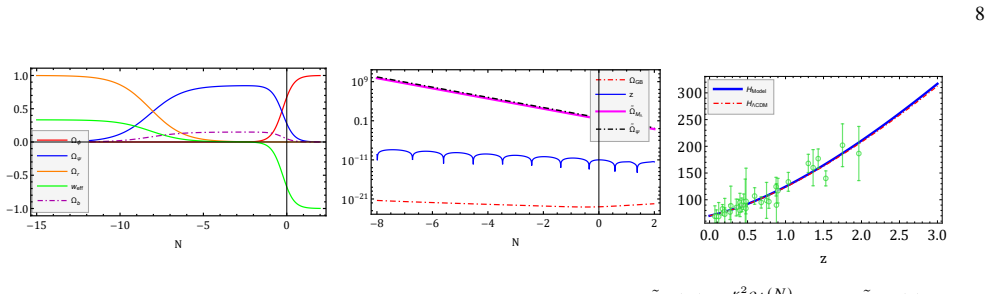
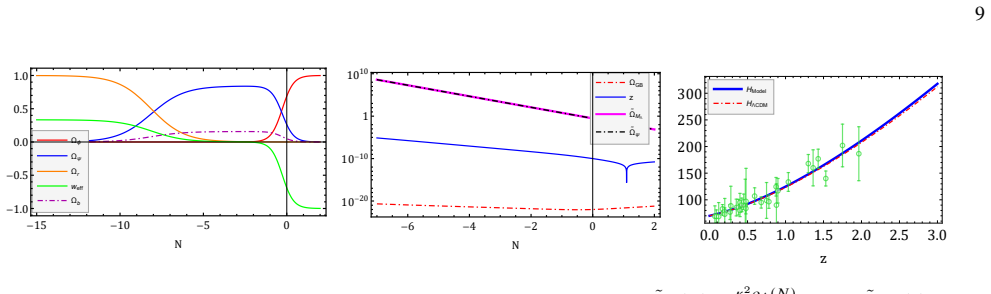
A Gauss-Bonnet (GB) coupled scalar field $\phi$, responsible for the late-time cosmic acceleration and interacting with a coherent scalar field $\psi$ through an interaction potential $W(\phi,\psi)$, is considered from the point of view of particle physics for two different models. The non-minimal coupling between the GB curvature term and the field $\phi$ leads to a time-dependent speed of gravitational waves (GWs), which is fixed to unity in order to be consistent with current GW observations, rendering the GB coupling function model-independent. We investigate the dynamical stability of the system by formulating it as an autonomous system, and provide a detailed discussion on the choice of initial conditions required to obtain stable background evolution of the models. We constrain the model parameters using various sets of observational data, including both early- and late-time probes. We incorporate the improved Dark Energy Survey (DES) 5-year Type Ia supernova sample (DES-SN5YR), referred to as DES-Dovekie, which exhibits substantially lower tension with the Pantheon+ supernova sample. We find that both models are physically viable and closely follow the $\Lambda$CDM trend for the Pantheon+ and DES samples. However, upon including the Roman mock data, a significant departure is observed at higher redshifts, yielding statistically strong preference over the flat $\Lambda$CDM model.
Editorial analysis
A structured set of objections, weighed in public.
Referee Report
Summary. The manuscript proposes two models of interacting scalar fields φ (non-minimally coupled to the Gauss-Bonnet term) and ψ in Einstein-scalar-Gauss-Bonnet gravity, with interaction via potential W(φ,ψ). The GB coupling function is chosen to fix the gravitational wave speed exactly to unity for consistency with observations, rendering f(φ) model-independent. The system is recast as an autonomous dynamical system to study stability, with explicit discussion of initial conditions for stable background evolution. Parameters are constrained using Pantheon+, DES-SN5YR (Dovekie), and Roman mock supernova data; both models are reported as physically viable and close to ΛCDM for Pantheon+ and DES, but show significant high-redshift departure with Roman data that yields statistically strong preference over flat ΛCDM.
Significance. If the central claims hold, the work supplies a particle-physics-motivated interacting-scalar alternative to ΛCDM within Gauss-Bonnet gravity that remains stable and can be tested against future high-redshift data. The autonomous-system analysis and incorporation of the recent DES sample (chosen to reduce tension with Pantheon+) are constructive elements. The result would be more significant if the reported preference survives transparent likelihood analysis and is shown to be independent of the GW-speed fixing.
major comments (2)
- [Abstract] Abstract: the claim that inclusion of Roman mock data produces a statistically strong preference over flat ΛCDM rests on parameter constraints, yet the abstract (and presumably the corresponding results section) supplies no error bars, no explicit likelihood function, and no discussion of how post-hoc data choices affect the high-redshift departure; central viability and preference claims therefore rest on unexamined fitting detail.
- [Gauss-Bonnet coupling discussion] Discussion of the Gauss-Bonnet coupling (as stated when addressing consistency with GW observations): fixing the speed of gravitational waves exactly to unity renders the coupling function model-independent but may implicitly restrict scalar dynamics and the location of the late-time attractor. It is therefore necessary to verify that this choice does not alter the effective dark-energy equation-of-state trajectory or the high-redshift departure that drives the reported preference over ΛCDM.
minor comments (2)
- [Model section] The explicit functional forms of the two interaction potentials W(φ,ψ) and the corresponding autonomous-system equations should be collected in a single table or subsection for easier reference.
- [Figures] Figures displaying background evolution or distance-modulus fits would benefit from inclusion of 1σ or 2σ bands to allow direct visual comparison with the ΛCDM reference.
Simulated Author's Rebuttal
We thank the referee for their careful and constructive review of our manuscript. We address each major comment point by point below, providing clarifications and indicating revisions made to strengthen the presentation of our results.
read point-by-point responses
-
Referee: [Abstract] Abstract: the claim that inclusion of Roman mock data produces a statistically strong preference over flat ΛCDM rests on parameter constraints, yet the abstract (and presumably the corresponding results section) supplies no error bars, no explicit likelihood function, and no discussion of how post-hoc data choices affect the high-redshift departure; central viability and preference claims therefore rest on unexamined fitting detail.
Authors: We agree that the abstract is brief and omits quantitative details on the statistical preference. In the revised manuscript we have added a sentence to the abstract stating that the Roman mock data yield Δχ² ≈ 12 relative to flat ΛCDM (corresponding to a strong preference at >3σ). The explicit likelihood function (standard χ² minimization with supernova covariance matrices) and parameter error bars are already reported in Section 4 and Table II of the original text; we have now added a short paragraph in the results section explicitly discussing the rationale for including the Roman mocks as a high-redshift forecast and confirming that the high-redshift departure persists under alternative data splits. These additions make the fitting procedure fully transparent without altering the central claims. revision: yes
-
Referee: [Gauss-Bonnet coupling discussion] Discussion of the Gauss-Bonnet coupling (as stated when addressing consistency with GW observations): fixing the speed of gravitational waves exactly to unity renders the coupling function model-independent but may implicitly restrict scalar dynamics and the location of the late-time attractor. It is therefore necessary to verify that this choice does not alter the effective dark-energy equation-of-state trajectory or the high-redshift departure that drives the reported preference over ΛCDM.
Authors: We thank the referee for highlighting this subtlety. The condition c_T = 1 is imposed by algebraically solving for the GB coupling function f(φ) in terms of the background evolution of φ; this fixes f(φ) but leaves the scalar potentials V(φ), U(ψ) and the interaction W(φ,ψ) completely free. We have re-examined the autonomous system equations and confirmed that the late-time attractor and the effective dark-energy equation-of-state trajectory w_DE(z) remain unchanged for the parameter ranges explored. The high-redshift departure is driven by the interaction term rather than the GB sector. In the revised manuscript we have added a dedicated paragraph and a supplementary figure comparing w_DE(z) obtained with the fixed c_T condition versus a generic f(φ) (without the GW-speed constraint) for representative parameter values; the curves coincide within 1 % over 0 < z < 3, demonstrating that the reported preference over ΛCDM is independent of this choice. revision: yes
Circularity Check
No significant circularity detected; derivation remains self-contained
full rationale
The paper constructs the model from the Einstein-scalar-Gauss-Bonnet action with an interaction potential W(φ,ψ), imposes c_T=1 by choice of f(φ) to match GW observations (an external consistency condition, not a self-definition), derives the autonomous system equations from the field equations, selects initial conditions to reach stable late-time attractors, and performs parameter constraints against Pantheon+, DES-SN5YR, and Roman mock data. The reported close tracking of ΛCDM at low z and departure at high z with Roman data follows directly from those fits and the dynamical analysis; neither step reduces to its own inputs by construction. No load-bearing self-citation, uniqueness theorem imported from prior work, or fitted quantity relabeled as prediction appears. The fixing of c_T=1 is an explicit modeling choice justified by external observations rather than an internal tautology that forces the final preference claim.
Axiom & Free-Parameter Ledger
free parameters (1)
- model parameters (coupling strengths, potential coefficients)
axioms (1)
- standard math Einstein-scalar Gauss-Bonnet action with non-minimal coupling
invented entities (1)
-
scalar fields φ (GB-coupled) and ψ (interacting)
no independent evidence
Lean theorems connected to this paper
-
IndisputableMonolith/Foundation/AlexanderDuality.leanalexander_duality_circle_linking unclear?
unclearRelation between the paper passage and the cited Recognition theorem.
The non-minimal coupling ... is fixed to unity ... rendering the GB coupling function model-independent.
-
IndisputableMonolith/Cost/FunctionalEquation.leanwashburn_uniqueness_aczel unclear?
unclearRelation between the paper passage and the cited Recognition theorem.
We investigate the dynamical stability ... autonomous system ... potentials V(φ)=V0 exp(λ κ² φ²/2), U(ψ)=½ m² ψ², W=½ ξ(φ) ψ²
What do these tags mean?
- matches
- The paper's claim is directly supported by a theorem in the formal canon.
- supports
- The theorem supports part of the paper's argument, but the paper may add assumptions or extra steps.
- extends
- The paper goes beyond the formal theorem; the theorem is a base layer rather than the whole result.
- uses
- The paper appears to rely on the theorem as machinery.
- contradicts
- The paper's claim conflicts with a theorem or certificate in the canon.
- unclear
- Pith found a possible connection, but the passage is too broad, indirect, or ambiguous to say the theorem truly supports the claim.
Forward citations
Cited by 2 Pith papers
-
Joint Constraints on Neutrinos and Dynamical Dark Energy in Minimally Modified Gravity
The w†VCDM model shows a statistically significant preference for late-time quintessence-phantom crossing dark energy, raises the Hubble constant, and satisfies neutrino mass and Neff constraints from current cosmolog...
-
Interacting $k$-essence field with non-pressureless Dark Matter: Cosmological Dynamics and Observational Constraints
Interacting k-essence dark energy and non-pressureless dark matter models with two interaction forms are shown to reproduce major cosmological epochs and fit observations comparably to LambdaCDM while admitting late-t...
Reference graph
Works this paper leans on
-
[1]
Hence, we vary Ω𝜙0 while keeping 𝑥0 fixed, 11 Model I Model II Parameters Range Ω𝜙 [0.5, 1.0] 𝐻0 [30,100] Ω𝑟 Gaussian∈[9.1 × 10⁻⁵] Ω𝑏 ℎ2 [10−5, 0.1] 𝑀𝑏 [−20, −18] TABLE I: The priors range for the model parameters. 0.68 0.69 0.0222 0.0224 0.0226 0.0228 bh2 8.8×10 5 8.9×10 5 9×10 5 9.1×10 5 9.2×10 5 r 65 70 75 H0 65 70 75 H0 8.8 8.9 9.0 9.1 9.2 r ×10 5 0.0...
work page 2024
-
[2]
Measurements of Omega and Lambda from 42 High-Redshift Supernovae
S. Perlmutter et al. (Supernova Cosmology Project), Measure- ments of Ω and Λ from 42 high redshift supernovae, Astrophys. J. 517, 565 (1999), arXiv:astro-ph/9812133
work page internal anchor Pith review Pith/arXiv arXiv 1999
- [3]
-
[4]
D. N. Spergel et al. (WMAP), First year Wilkinson Microwave Anisotropy Probe (WMAP) observations: Determination of cosmological parameters, Astrophys. J. Suppl.148, 175 (2003), arXiv:astro-ph/0302209
work page internal anchor Pith review Pith/arXiv arXiv 2003
-
[5]
B. D. Sherwin et al., Evidence for dark energy from the cosmic microwave background alone using the Atacama Cosmology Telescope lensing measurements, Phys. Rev. Lett.107, 021302 (2011), arXiv:1105.0419 [astro-ph.CO]
work page internal anchor Pith review Pith/arXiv arXiv 2011
-
[6]
E. L. Wright, Constraints on Dark Energy from Supernovae, Gamma Ray Bursts, Acoustic Oscillations, Nucleosynthesis and Large Scale Structure and the Hubble constant, Astrophys. J. 664, 633 (2007), arXiv:astro-ph/0701584
work page internal anchor Pith review Pith/arXiv arXiv 2007
-
[7]
J. Kwan et al. (DES), Cosmology from large-scale galaxy clus- tering and galaxy–galaxy lensing with Dark Energy Survey Science Verification data, Mon. Not. Roy. Astron. Soc. 464, 4045 (2017), arXiv:1604.07871 [astro-ph.CO]
work page internal anchor Pith review Pith/arXiv arXiv 2017
- [8]
- [9]
-
[10]
J. R. Primack, Dark matter and structure formation, in Midrasha Mathematicae in Jerusalem: Winter School in Dy- namical Systems (1997) arXiv:astro-ph/9707285
work page internal anchor Pith review Pith/arXiv arXiv 1997
-
[11]
Dark matter and structure formation a review
A. Del Popolo, Dark matter and structure formation a review, Astron. Rep. 51, 169 (2007), arXiv:0801.1091 [astro-ph]
work page internal anchor Pith review Pith/arXiv arXiv 2007
-
[12]
J. Diao, S. Wei, Z. Wei, and C. Liu, The impact of the dark matter on galaxy formation, J. Phys. Conf. Ser. 2441, 012025 (2023)
work page 2023
- [13]
-
[14]
G. R. Blumenthal, S. M. Faber, J. R. Primack, and M. J. Rees, Formation of Galaxies and Large Scale Structure with Cold Dark Matter, Nature 311, 517 (1984). 14
work page 1984
- [15]
-
[16]
Weinberg, The Cosmological Constant Problem, Rev
S. Weinberg, The Cosmological Constant Problem, Rev. Mod. Phys. 61, 1 (1989)
work page 1989
-
[17]
S. E. Rugh and H. Zinkernagel, The Quantum vacuum and the cosmological constant problem, Stud. Hist. Phil. Sci. B33, 663 (2002), arXiv:hep-th/0012253
work page internal anchor Pith review Pith/arXiv arXiv 2002
-
[18]
Cosmological Constant - the Weight of the Vacuum
T. Padmanabhan, Cosmological constant: The Weight of the vacuum, Phys. Rept. 380, 235 (2003), arXiv:hep-th/0212290
work page internal anchor Pith review Pith/arXiv arXiv 2003
-
[19]
S. M. Carroll, W. H. Press, and E. L. Turner, The Cosmological constant, Ann. Rev. Astron. Astrophys.30, 499 (1992)
work page 1992
- [20]
-
[21]
Cosmological Constant Problem and Renormalized Vacuum Energy Density in Curved Background
K. Kohri and H. Matsui, Cosmological Constant Problem and Renormalized Vacuum Energy Density in Curved Background, JCAP 06, 006, arXiv:1612.08818 [hep-th]
work page internal anchor Pith review Pith/arXiv arXiv
-
[22]
Tests and problems of the standard model in Cosmology
M. L ´opez-Corredoira, Tests and problems of the stan- dard model in Cosmology, Found. Phys. 47, 711 (2017), arXiv:1701.08720 [astro-ph.CO]
work page internal anchor Pith review Pith/arXiv arXiv 2017
-
[23]
DESI DR2 Results II: Measurements of Baryon Acoustic Oscillations and Cosmological Constraints
M. Abdul Karim et al. (DESI), DESI DR2 Results II: Mea- surements of Baryon Acoustic Oscillations and Cosmological Constraints (2025), arXiv:2503.14738 [astro-ph.CO]
work page internal anchor Pith review Pith/arXiv arXiv 2025
-
[24]
A. G. Adame et al. (DESI), DESI 2024 VI: cosmological con- straints from the measurements of baryon acoustic oscillations, JCAP 02, 021, arXiv:2404.03002 [astro-ph.CO]
work page internal anchor Pith review Pith/arXiv arXiv 2024
-
[25]
M. E. Levi et al. (DESI), The Dark Energy Spectroscopic Instrument (DESI) (2019), arXiv:1907.10688 [astro-ph.IM]
work page internal anchor Pith review Pith/arXiv arXiv 2019
-
[26]
J. Moon et al. , First detection of the BAO signal from early DESI data, Mon. Not. Roy. Astron. Soc. 525, 5406 (2023), arXiv:2304.08427 [astro-ph.CO]
- [27]
-
[28]
A. Sousa-Neto, C. Bengaly, J. E. Gonzalez, and J. Alcaniz, Evi- dence for dynamical dark energy from DESI-DR2 and SN data? A symbolic regression analysis, (2025), arXiv:2502.10506 [astro-ph.CO]
-
[29]
S. Hussain, S. Arora, A. Wang, and B. Rose, Probing the Dynamics of Gaussian Dark Energy Equation of State Using DESI BAO, (2025), arXiv:2505.09913 [astro-ph.CO]
-
[30]
Y. Myrzakulov, S. Hussain, and M. Shahalam, Phase space and Data analyses of a non-minimally coupled scalar field system with decaying dark energy model, (2025), arXiv:2506.11755 [gr-qc]
-
[31]
S. Hussain, S. Nelleri, and K. Bhattacharya, Comprehensive study of k-essence model: dynamical system analysis and ob- servational constraints from latest Type Ia supernova and BAO observations, JCAP 03, 025, arXiv:2406.07179 [astro-ph.CO]
-
[32]
S. Hussain, Non-adiabatic particle production scenario in al- gebraically coupled quintessence field with dark matter fluid, (2024), arXiv:2403.10215 [gr-qc]
-
[33]
H. Chaudhary and S. Hussain, Yano-Schr ¨odinger Hyperfluid: Cosmological Implications, (2025), arXiv:2503.23115 [gr- qc]
-
[34]
Roy, Dynamical dark energy in the light of DESI 2024 data, Phys
N. Roy, Dynamical dark energy in the light of DESI 2024 data, Phys. Dark Univ. 48, 101912 (2025), arXiv:2406.00634 [astro-ph.CO]
-
[35]
P.-J. Wu, Comparison of dark energy models using late- universe observations 10.48550/arXiv.2504.09054 (2025), arXiv:2504.09054 [astro-ph.CO]
- [36]
-
[37]
M. Scherer, M. A. Sabogal, R. C. Nunes, and A. De Felice, Challenging ΛCDM: 5𝜎 Evidence for a Dynamical Dark En- ergy Late-Time Transition (2025), arXiv:2504.20664 [astro- ph.CO]
-
[38]
Paliathanasis, Observational constraints on dark energy models with Λ as an equilibrium point, Phys
A. Paliathanasis, Observational constraints on dark energy models with Λ as an equilibrium point, Phys. Dark Univ. 48, 101956 (2025), arXiv:2502.16221 [astro-ph.CO]
- [39]
- [40]
-
[41]
S. Hussain, A. Chatterjee, and K. Bhattacharya, Dynamical stability in models where dark matter and dark energy are nonminimally coupled to curvature, Phys. Rev. D108, 103502 (2023), arXiv:2305.19062 [gr-qc]
- [42]
-
[43]
M. R. Setare and E. N. Saridakis, Quintom dark energy models with nearly flat potentials, Phys. Rev. D 79, 043005 (2009), arXiv:0810.4775 [astro-ph]
work page internal anchor Pith review Pith/arXiv arXiv 2009
-
[44]
Y. Cai, X. Ren, T. Qiu, M. Li, and X. Zhang, The Quintom the- ory of dark energy after DESI DR2 (2025), arXiv:2505.24732 [astro-ph.CO]
work page internal anchor Pith review Pith/arXiv arXiv 2025
-
[45]
Dark energy from a quintessence (phantom) field rolling near potential minimum (maximum)
S. Dutta, E. N. Saridakis, and R. J. Scherrer, Dark energy from a quintessence (phantom) field rolling near potential minimum (maximum), Phys. Rev. D79, 103005 (2009), arXiv:0903.3412 [astro-ph.CO]
work page internal anchor Pith review Pith/arXiv arXiv 2009
-
[46]
C. Armendariz-Picon, V. F. Mukhanov, and P. J. Steinhardt, A Dynamical solution to the problem of a small cosmological constant and late time cosmic acceleration, Phys. Rev. Lett.85, 4438 (2000), arXiv:astro-ph/0004134
work page internal anchor Pith review Pith/arXiv arXiv 2000
-
[47]
C. Armendariz-Picon, V. F. Mukhanov, and P. J. Steinhardt, Essentials of k essence, Phys. Rev. D 63, 103510 (2001), arXiv:astro-ph/0006373
work page internal anchor Pith review Pith/arXiv arXiv 2001
- [48]
-
[49]
C. Armendariz-Picon and E. A. Lim, Haloes of k-essence, JCAP 08, 007, arXiv:astro-ph/0505207
work page internal anchor Pith review Pith/arXiv arXiv
-
[50]
Ghost Condensation and a Consistent Infrared Modification of Gravity
N. Arkani-Hamed, H.-C. Cheng, M. A. Luty, and S. Muko- hyama, Ghost condensation and a consistent infrared modifi- cation of gravity, JHEP 05, 074, arXiv:hep-th/0312099
work page internal anchor Pith review Pith/arXiv arXiv
-
[51]
R. J. Scherrer, Purely kinetic k-essence as unified dark matter, Phys. Rev. Lett.93, 011301 (2004), arXiv:astro-ph/0402316. 15
work page internal anchor Pith review Pith/arXiv arXiv 2004
-
[52]
A. Chatterjee, S. Hussain, and K. Bhattacharya, Dynami- cal stability of the k-essence field interacting nonminimally with a perfect fluid, Phys. Rev. D 104, 103505 (2021), arXiv:2105.00361 [gr-qc]
-
[53]
S. Hussain, A. Chatterjee, and K. Bhattacharya, Ghost Conden- sates and Pure Kinetic k-Essence Condensates in the Presence of Field–Fluid Non-Minimal Coupling in the Dark Sector, Uni- verse 9, 65 (2023), arXiv:2203.10607 [gr-qc]
-
[54]
K. Bhattacharya, A. Chatterjee, and S. Hussain, Dynamical stability in presence of non-minimal derivative dependent cou- pling of k-essence field with a relativistic fluid, Eur. Phys. J. C 83, 488 (2023), arXiv:2206.12398 [gr-qc]
-
[55]
J. S. Bagla, H. K. Jassal, and T. Padmanabhan, Cosmology with tachyon field as dark energy, Phys. Rev. D 67, 063504 (2003), arXiv:astro-ph/0212198
work page internal anchor Pith review Pith/arXiv arXiv 2003
-
[56]
S. Khoeini-Moghaddam, F. Momeni, and F. Yousefabadi, Fermionic tachyons as a source of dark energy, New Astron. 100, 101986 (2023), arXiv:1807.05871 [gr-qc]
-
[57]
Liu, Interacting ghost dark energy in complex quintessence theory, Eur
Y. Liu, Interacting ghost dark energy in complex quintessence theory, Eur. Phys. J. C 80, 1204 (2020), arXiv:2201.00658 [hep-th]
-
[58]
R.-G. Cai, Z.-L. Tuo, H.-B. Zhang, and Q. Su, Notes on Ghost Dark Energy, Phys. Rev. D 84, 123501 (2011), arXiv:1011.3212 [astro-ph.CO]
work page internal anchor Pith review Pith/arXiv arXiv 2011
-
[59]
S. Hussain, S. Chakraborty, N. Roy, and K. Bhattacharya, Dynamical systems analysis of tachyon-dark-energy models from a new perspective, Phys. Rev. D 107, 063515 (2023), arXiv:2208.10352 [gr-qc]
-
[60]
Ho\v{r}ava Gravity at a Lifshitz Point: A Progress Report
A. Wang, Hoˇrava gravity at a Lifshitz point: A progress report, Int. J. Mod. Phys. D 26, 1730014 (2017), arXiv:1701.06087 [gr-qc]
work page internal anchor Pith review Pith/arXiv arXiv 2017
-
[61]
S. Shankaranarayanan and J. P. Johnson, Modified theories of gravity: Why, how and what?, Gen. Rel. Grav. 54, 44 (2022), arXiv:2204.06533 [gr-qc]
-
[62]
T. P. Sotiriou and V. Faraoni, f(R) Theories Of Gravity, Rev. Mod. Phys. 82, 451 (2010), arXiv:0805.1726 [gr-qc]
work page internal anchor Pith review Pith/arXiv arXiv 2010
-
[63]
Introduction to Modified Gravity and Gravitational Alternative for Dark Energy
S. Nojiri and S. D. Odintsov, Introduction to modified gravity and gravitational alternative for dark energy, eConfC0602061, 06 (2006), arXiv:hep-th/0601213
work page internal anchor Pith review Pith/arXiv arXiv 2006
-
[64]
R.-J. Yang, New types of 𝑓 (𝑇) gravity, Eur. Phys. J. C71, 1797 (2011), arXiv:1007.3571 [gr-qc]
work page internal anchor Pith review Pith/arXiv arXiv 2011
- [65]
-
[66]
O. Sokoliuk, S. Arora, S. Praharaj, A. Baransky, and P. K. Sahoo, On the impact of f(Q) gravity on the large scale structure, Mon. Not. Roy. Astron. Soc. 522, 252 (2023), arXiv:2303.17341 [astro-ph.CO]
-
[67]
Horndeski theory and beyond: a review
T. Kobayashi, Horndeski theory and beyond: a review, Rept. Prog. Phys. 82, 086901 (2019), arXiv:1901.07183 [gr-qc]
work page internal anchor Pith review Pith/arXiv arXiv 2019
-
[68]
G. W. Horndeski, Second-order scalar-tensor field equations in a four-dimensional space, International Journal of Theoretical Physics 10, 363 (1974)
work page 1974
-
[69]
K. Kainulainen and D. Sunhede, Dark energy from large ex- tra dimensions, Phys. Rev. D 73, 083510 (2006), arXiv:astro- ph/0412609
-
[70]
Effective phantom dark energy in scalar-tensor gravity
A. Saratov, Effective phantom dark energy in scalar-tensor gravity, (2012), arXiv:1204.0369 [astro-ph.CO]
work page internal anchor Pith review Pith/arXiv arXiv 2012
-
[71]
Dark Energy and Modified Gravity in Degenerate Higher-Order Scalar-Tensor (DHOST) theories: a review
D. Langlois, Dark energy and modified gravity in degenerate higher-order scalar–tensor (DHOST) theories: A review, Int. J. Mod. Phys. D 28, 1942006 (2019), arXiv:1811.06271 [gr-qc]
work page internal anchor Pith review Pith/arXiv arXiv 2019
-
[72]
Planck 2018 results. VI. Cosmological parameters
N. Aghanim et al. (Planck), Planck 2018 results. VI. Cosmo- logical parameters, Astron. Astrophys. 641, A6 (2020), [Er- ratum: Astron.Astrophys. 652, C4 (2021)], arXiv:1807.06209 [astro-ph.CO]
work page internal anchor Pith review Pith/arXiv arXiv 2018
-
[73]
A. G. Riess, S. Casertano, W. Yuan, J. B. Bowers, L. Macri, J. C. Zinn, and D. Scolnic, Cosmic Distances Calibrated to 1% Precision with Gaia EDR3 Parallaxes and Hubble Space Telescope Photometry of 75 Milky Way Cepheids Confirm Tension with ΛCDM, Astrophys. J. Lett. 908, L6 (2021), arXiv:2012.08534 [astro-ph.CO]
-
[74]
D. B. et al., The pantheon+ analysis: Cosmological constraints, The Astrophysical Journal 938, 110 (2022)
work page 2022
-
[75]
N. Sch ¨oneberg, G. Franco Abell ´an, A. P ´erez S ´anchez, S. J. Witte, V. Poulin, and J. Lesgourgues, The H0 Olympics: A fair ranking of proposed models, Phys. Rept. 984, 1 (2022), arXiv:2107.10291 [astro-ph.CO]
-
[76]
E. Di Valentino, A. Mukherjee, and A. A. Sen, Dark Energy with Phantom Crossing and the 𝐻0 Tension, Entropy 23, 404 (2021), arXiv:2005.12587 [astro-ph.CO]
-
[77]
J. L. Bernal, L. Verde, and A. G. Riess, The trouble with 𝐻0, JCAP 10, 019, arXiv:1607.05617 [astro-ph.CO]
work page internal anchor Pith review Pith/arXiv arXiv
- [78]
-
[79]
D. Benisty, S. Pan, D. Staicova, E. Di Valentino, and R. C. Nunes, Late-time constraints on interacting dark energy: Anal- ysis independent of H0, rd, and MB, Astron. Astrophys. 688, A156 (2024), arXiv:2403.00056 [astro-ph.CO]
-
[80]
S. Pan and W. Yang, On the interacting dark energy scenarios - the case for Hubble constant tension 10.1007/978-981-99- 0177-7 29 (2023), arXiv:2310.07260 [astro-ph.CO]
discussion (0)
Sign in with ORCID, Apple, or X to comment. Anyone can read and Pith papers without signing in.