REVIEW 4 major objections 6 minor 38 references
From General Relation Patterns to Task-Specific Decision-Making in Continual Multi-Agent Coordination
T0 review · 4 major / 6 minor · reviewed 2026-08-06 · deepseek-v4-flash
Pith's one-line read RPG separates relation patterns from task-specific decision-makers to stop forgetting and generalize to unseen tasks.
desk verdict A solid Co-MARL method with a continual-learning story, but the zero-shot claim is under-specified and needs an explicit mechanism. read the letter →
The pith
A machine-rendered reading of the paper's core claim, the machinery that carries it, and where it could break.
The reading
What carries the argument
The central machinery is the two-module RPG architecture. The first module is a scalable relation capturer: cross-attention with agent-own features as query and entity features as keys and values produces relation pattern $z_{t,i}=[z^{se}_{t,i}, z^{te}_{t,i}, z^{oe}_{t,i}]$, regularized by an attention-entropy term to keep only key entities, and protected by a return-aware anti-forgetting penalty $\gamma_p L_{rc}$ computed from a Taylor-expansion parameter importance. The second module is a conditional hypernetwork that generates a decision-maker per task from a learnable task embedding, mapping the historical pattern $h_{t,i}$ to local Q-values split into fixed ego actions and variable interaction actions; a consistency loss $L_{hy}$ keeps newly generated decision-makers close to frozen previous ones. The claim is that this stable-capturer/plastic-decider split is what resolves the stability-plasticity dilemma of Co-MARL.
What would settle it
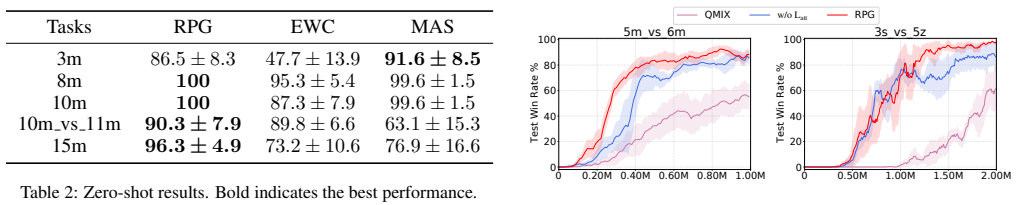
Train RPG on the four-task SMAC sequence from Section 5.4, then test on the five unseen tasks using a task embedding sampled from the same Gaussian initialization used for training tasks, without any per-task tuning; if win rates on 10m vs 11m or 15m fall to near-random levels, the zero-shot generalization claim would be falsified.
Extended reading notes
Core claim
The central claim is that the essence of continual multi-agent coordination lies in relation patterns, which are general across tasks with different entity counts yet task-specific in how they map to actions. RPG operationalizes this by extracting relation patterns with a permutation-invariant cross-attention capturer that decomposes any observation into entity features and attends to teammates versus other entities separately. A conditional hypernetwork then generates an ego decision-maker and an entity-wise interaction decision-maker for each task, so the same relation pattern can produce different Q-values in different task contexts. The empirical discovery reported is that this separation, combined with the two anti-forgetting regularizers, lets RPG surpass existing Co-MARL baselines and generalize zero-shot to unseen tasks better than EWC and MAS.
Load-bearing premise
The zero-shot generalization results assume that an unseen task can be assigned a task embedding that works with the trained conditional hypernetwork, but the paper does not explain how such an embedding should be chosen or obtained; if that embedding must be tuned or trained, the reported zero-shot numbers would not measure true generalization.
Editorial extensions
If this is right
- If a sequence of SMAC tasks is learned in the order 5m vs 6m, 12m, 5m, 8m vs 9m, RPG holds near-100 percent win rates on earlier tasks after later training, matching the stability of L2 regularization while staying more plastic.
- Replacing the hypernetwork decision-maker with a plain MLP drops the final-task win rate from 0.91 to 0.59 on 8m vs 9m, indicating task-specific decision-makers are load-bearing for adaptation.
- The zero-shot results on 10m vs 11m (90.3 percent) and 15m (96.3 percent) suggest the extracted relation patterns are reusable across different entity configurations.
- Removing either the capturer regularization or the hypernetwork regularization degrades forgetting resistance, while removing both destroys it, confirming both terms are needed.
- In single-task super-hard SMAC maps and LBF scenarios, RPG also outperforms value- and policy-based baselines, indicating the relation-pattern design helps even outside continual settings.
Reading between the lines
- A fair reading of the zero-shot experiments requires knowing how task embeddings for unseen tasks are obtained; the paper does not specify this, so a testable extension is to fix a single embedding-initialization rule and check whether the reported win rates survive without per-task tuning.
- Because the relation capturer treats entities via permutation-invariant attention, the architecture could in principle extend to heterogeneous entity types (different unit classes) without retraining the capturer; this is not tested in the paper, which only considers homogeneous units.
- The return-adaptive discount $\gamma_p$ amounts to an automatic plasticity schedule: when early returns are low, regularization is relaxed. A natural follow-up is to learn $\gamma_p$ as a function of task difficulty instead of computing it from normalized returns.
- RPG is evaluated on value-based factorization (QMIX); extending the same relation-pattern decomposition to policy-gradient methods such as MAPPO would test whether the transfer claim holds outside value-based learning.
Editorial analysis
A structured set of objections, weighed in public.
Referee Report
Summary. The paper proposes RPG, a continual multi-agent reinforcement learning method built around two components: a scalable attention-based relation capturer that extracts entity-wise relation patterns from dynamic observation spaces, and a conditional hypernetwork that generates task-specific decision-makers mapping those patterns to action spaces. Regularization terms on both components are introduced to mitigate catastrophic forgetting. The method is evaluated on SMAC and LBF against continual learning baselines, on single-task performance, through ablations, and on zero-shot generalization to unseen SMAC maps. The central claim is that RPG prevents catastrophic forgetting while retaining the ability to generalize to new task configurations.
Significance. If the claims hold, RPG would be a useful contribution to Co-MARL: it decouples observation-space generalization from action-space adaptation, reports a smaller agent parameter size than MACPro, and is evaluated on standard benchmarks with several baselines and ablations. Strengths include the comparison against multiple continual and single-task methods, the ablation of the regularization terms and the sparse-attention term, and the use of external benchmarks rather than a purely constructed environment. The main limitations are that the zero-shot generalization result is not supported by a specified mechanism for obtaining task embeddings for unseen tasks, the central continual-learning curves lack uncertainty quantification, and key hyperparameters and code are not provided.
major comments (4)
- [Section 5.4 and Section 4.2] The zero-shot generalization result is under-specified. In Section 4.2, task embeddings e_c are introduced as learnable parameters: e_1 is randomly initialized and trained, and e_c for each new task is initialized via Eq. (11) and trained. Section 5.4 reports win rates on five unseen SMAC tasks in Table 2 but never states how the embedding for each unseen task was obtained or selected. If those embeddings were hand-picked, copied from a similar seen task, or tuned on the unseen tasks in any way, the reported numbers are not a valid zero-shot evaluation. The authors should state the exact test-time procedure for producing an embedding for a task outside the training sequence, or, if no such procedure exists, revise the zero-shot claim.
- [Figure 3 and Table 1] The main continual-learning results lack error bars. Figure 3 states that each curve is the average win rate over 3 random seeds, but no standard deviation, confidence interval, or per-seed curves are shown. Table 1 reports point estimates only, so differences such as 0.875 versus 0.86 on 5m vs 6m, or 0.91 versus 0.95 on 8m vs 9m, cannot be distinguished from seed noise. The anti-forgetting claim should be supported with variance information or per-seed results.
- [Equations (11)-(12) and experimental setup] Key hyperparameters are not specified. The overall loss in Eq. (12) depends on alpha_att, lambda_rc, gamma_p, and lambda_hy, and Eq. (11) depends on alpha_init, yet none of these values are reported in the paper or appendix. The number of episodes N used in Eq. (9) is also not given. Without these values and without released code, the reported stability-plasticity trade-off cannot be reproduced or assessed for sensitivity to hyperparameter choice.
- [Figure 1(a) and Section 1] The claim that common relation patterns exist across tasks is supported mainly by a t-SNE visualization. A t-SNE plot is a qualitative, non-metric projection, and the caption's description of points as 'tightly clustered' is not a quantitative measure of cross-task overlap. Since the relation patterns themselves are produced by the proposed relation capturer, the figure is only suggestive; a quantitative measure such as cluster separation or a defined overlap statistic would strengthen the conceptual claim.
minor comments (6)
- [Eq. (8)] In Eq. (8), the notation theta*_j is introduced without definition; it seems to denote the current parameter value, and the regularization should be written consistently with the notation in Eq. (7).
- [Section 5.1] The text says 'To evaluate whether RGP performs well', but the method name is RPG; this typo should be corrected.
- [Section 5.4] The phrase 'To end this' in Section 5.4 should be 'To this end'.
- [Figure 5 and Section 5.1] The legend in Figure 5 uses CWQMIX and OWQMIX, while the text refers to WQMIX; the abbreviations should be defined and used consistently.
- [Figure 6 and Section 5.1] The legend in Figure 6 includes IA2C and IQL, but the text lists MAA2C, COMA, MADDPG, MAPPO, and IPPO; the mapping between legend names and described baselines should be clarified.
- [Eq. (7)] The term I(theta_c)_max in Eq. (7) should be defined explicitly as the maximum over j of the unnormalized importance values; otherwise the normalization is ambiguous.
Circularity Check
No significant circularity: RPG is validated on external SMAC/LBF benchmarks, so the core claims are not forced by construction. Score 2 reflects only a non-load-bearing self-citation and self-referential t-SNE evidence; the zero-shot embedding protocol is under-specified but that is a reporting gap, not circularity.
full rationale
The paper's central claims are supported by external benchmark comparisons (SMAC and LBF) against methods like QMIX, MACPro, EWC, MAS, Replay, L2, and Finetuning. The method's losses—Latt (Eq. 3), LTD (Eq. 4), Lrc (Eq. 8), and Lhy (Eq. 10)—are regularizers computed from the agent's own TD errors, gradient-based importance, and hypernetwork output snapshots. None of these defines a target quantity in terms of the quantity it is later claimed to predict; anti-forgetting is measured on previously seen tasks with previously trained task embeddings, which is standard continual-learning evaluation rather than circular. The task embeddings ec are learnable parameters (Section 4.2) and are initialized via Eq. 11, so results on seen tasks are not predictions from fitted parameters. The only self-citation with author overlap is CoDe [Song et al., 2025], cited as inspiration for the attention-entropy sparsification term (Eq. 3); this is not load-bearing for the main result. Figure 1(a)'s t-SNE clustering of relation patterns is self-referential evidence—it visualizes the paper's own learned representation—but the architecture's value is independently assessed by external win rates and returns, so this does not force the conclusion. One genuine weakness, noted in Section 5.4, is that the paper never specifies how task embeddings for the five unseen zero-shot tasks are obtained; without that protocol, the zero-shot claim is under-specified. This is a missing-support/correctness issue, not a demonstrated circularity, because the paper provides no equation or fitting step showing the unseen-task result is equivalent to a trained input. Overall, no step in the derivation reduces to its own input by construction; score 2 reflects the minor self-referential t-SNE evidence and the non-load-bearing self-citation.
Assumptions & free parameters
free parameters (4)
- lambda_rc (relation capturer regularization strength) =
not reported
- lambda_hy (hypernetwork regularization strength) =
not reported
- alpha_att (attention entropy coefficient) =
not reported
- alpha_init (task embedding inheritance coefficient) =
not reported
assumptions (4)
- domain assumption The continual coordination setting is modeled as a sequence of Dec-POMDPs with shared reward and partial observations.
- ad hoc to paper Attention scores over entity features represent the relation between an agent and each entity, and sparsifying them improves coordination.
- domain assumption Parameter importance can be approximated by the squared product of the TD-loss gradient and parameter value, retaining only the quadratic Taylor term.
- ad hoc to paper Initializing a new task embedding as an interpolation of the previous embedding transfers knowledge and smooths task transition.
invented entities (1)
-
task-agnostic relation pattern (z_t,i)
Cite this review
Pith. "Pith review of From General Relation Patterns to Task-Specific Decision-Making in Continual Multi-Agent Coordination." pith.science (2026). https://pith.science/paper/FTXWKSRP
@misc{pith2026250706004,
  author       = {Pith},
  title        = {Pith review of: From General Relation Patterns to Task-Specific Decision-Making in Continual Multi-Agent Coordination},
  year         = {2026},
  howpublished = {\url{https://pith.science/paper/FTXWKSRP}},
  note         = {Machine review of arXiv:2507.06004}
}
read the original abstract
Continual Multi-Agent Reinforcement Learning (Co-MARL) requires agents to address catastrophic forgetting issues while learning new coordination policies with the dynamics team. In this paper, we delve into the core of Co-MARL, namely Relation Patterns, which refer to agents' general understanding of interactions. In addition to generality, relation patterns exhibit task-specificity when mapped to different action spaces. To this end, we propose a novel method called General Relation Patterns-Guided Task-Specific Decision-Maker (RPG). In RPG, agents extract relation patterns from dynamic observation spaces using a relation capturer. These task-agnostic relation patterns are then mapped to different action spaces via a task-specific decision-maker generated by a conditional hypernetwork. To combat forgetting, we further introduce regularization items on both the relation capturer and the conditional hypernetwork. Results on SMAC and LBF demonstrate that RPG effectively prevents catastrophic forgetting when learning new tasks and achieves zero-shot generalization to unseen tasks.
Figures


Figures from the paper (3 more)


Reference graph
Works this paper leans on
-
[1]
Memory aware synapses: Learning what (not) to forget
[Aljundi et al., 2018] Rahaf Aljundi, Francesca Babiloni, Mohamed Elhoseiny, Marcus Rohrbach, and Tinne Tuyte- laars. Memory aware synapses: Learning what (not) to forget. In Proceedings of the European conference on com- puter vision (ECCV), pages 139–154,
work page 2018
-
[4]
On tiny episodic memories in continual learning
[Chaudhry et al., 2019] Arslan Chaudhry, Marcus Rohrbach, Mohamed Elhoseiny, Thalaiyasingam Ajanthan, Puneet K Dokania, Philip HS Torr, and Marc’Aurelio Ranzato. On tiny episodic memories in continual learning. arXiv preprint arXiv:1902.10486,
arXiv 2019
-
[8]
One by one, continual coordinating with humans via hyper- teammate identification
[Guan et al., 2024] Cong Guan, Feng Chen, Ke Xue, Chun- peng Fan, Lichao Zhang, Ziqian Zhang, Pengyao Zhao, Zongzhang Zhang, Chao Qian, Lei Yuan, et al. One by one, continual coordinating with humans via hyper- teammate identification
work page 2024
-
[10]
[Ji et al., 2023] Zhong Ji, Zhishen Hou, Xiyao Liu, Yanwei Pang, and Xuelong Li. Memorizing complementation net- work for few-shot class-incremental learning.IEEE Trans- actions on Image Processing, 32:937–948,
work page 2023
-
[11]
[Jianye et al., 2022] HAO Jianye, Xiaotian Hao, Hangyu Mao, Weixun Wang, Yaodong Yang, Dong Li, Yan Zheng, and Zhen Wang. Boosting multiagent reinforcement learn- ing via permutation invariant and permutation equivariant networks. In The Eleventh International Conference on Learning Representations,
work page 2022
-
[13]
Achieving a better stability-plasticity trade-off via auxiliary networks in con- tinual learning
[Kim et al., 2023] Sanghwan Kim, Lorenzo Noci, Antonio Orvieto, and Thomas Hofmann. Achieving a better stability-plasticity trade-off via auxiliary networks in con- tinual learning. In Proceedings of the IEEE/CVF Confer- ence on Computer Vision and Pattern Recognition , pages 11930–11939,
work page 2023
-
[14]
Deep reinforcement learning for autonomous driving: A survey
[Kiran et al., 2021] B Ravi Kiran, Ibrahim Sobh, Victor Tal- paert, Patrick Mannion, Ahmad A Al Sallab, Senthil Yoga- mani, and Patrick P´erez. Deep reinforcement learning for autonomous driving: A survey. IEEE Transactions on In- telligent Transportation Systems, 23(6):4909–4926,
work page 2021
-
[15]
Overcom- ing catastrophic forgetting in neural networks
[Kirkpatrick et al., 2017] James Kirkpatrick, Razvan Pas- canu, Neil Rabinowitz, Joel Veness, Guillaume Des- jardins, Andrei A Rusu, Kieran Milan, John Quan, Tiago Ramalho, Agnieszka Grabska-Barwinska, et al. Overcom- ing catastrophic forgetting in neural networks. Proceed- ings of the national academy of sciences , 114(13):3521– 3526,
work page 2017
Show all 38 references
-
[17]
Maven: Multi-agent variational exploration
[Mahajan et al., 2019] Anuj Mahajan, Tabish Rashid, Mikayel Samvelyan, and Shimon Whiteson. Maven: Multi-agent variational exploration. Advances in neural information processing systems, 32,
2019
-
[18]
Importance estimation for neural network pruning
[Molchanov et al., 2019] Pavlo Molchanov, Arun Mallya, Stephen Tyree, Iuri Frosio, and Jan Kautz. Importance estimation for neural network pruning. In Proceedings of the IEEE/CVF conference on computer vision and pattern recognition, pages 11264–11272,
2019
-
[19]
Continuous coordination as a realistic scenario for life- long learning
[Nekoei et al., 2021] Hadi Nekoei, Akilesh Badri- naaraayanan, Aaron Courville, and Sarath Chandar. Continuous coordination as a realistic scenario for life- long learning. In International Conference on Machine Learning, pages 8016–8024. PMLR,
2021
-
[20]
A concise introduction to decentralized POMDPs, volume
[Oliehoek et al., 2016] Frans A Oliehoek, Christopher Am- ato, et al. A concise introduction to decentralized POMDPs, volume
2016
-
[22]
Benchmarking multi-agent deep reinforcement learn- ing algorithms in cooperative tasks
[Papoudakis et al., 2020] Georgios Papoudakis, Filippos Christianos, Lukas Sch ¨afer, and Stefano V Albrecht. Benchmarking multi-agent deep reinforcement learn- ing algorithms in cooperative tasks. arXiv preprint arXiv:2006.07869,
2020 arXiv
-
[23]
Catastrophic forgetting, rehearsal and pseudorehearsal
[Robins, 1995] Anthony Robins. Catastrophic forgetting, rehearsal and pseudorehearsal. Connection Science , 7(2):123–146,
1995
-
[25]
The starcraft multi-agent challenge
[Samvelyan et al., 2019] Mikayel Samvelyan, Tabish Rashid, Christian Schroeder De Witt, Gregory Farquhar, Nantas Nardelli, Tim GJ Rudner, Chia-Man Hung, Philip HS Torr, Jakob Foerster, and Shimon Whiteson. The starcraft multi-agent challenge. arXiv preprint arXiv:1902.04043,
2019 arXiv
-
[26]
Resq: A residual q function-based approach for multi-agent reinforcement learning value factoriza- tion
[Shen et al., 2022] Siqi Shen, Mengwei Qiu, Jun Liu, Wei- quan Liu, Yongquan Fu, Xinwang Liu, and Cheng Wang. Resq: A residual q function-based approach for multi-agent reinforcement learning value factoriza- tion. Advances in Neural Information Processing Systems, 35:5471–5483,
2022
-
[27]
Lateral transfer learning for multia- gent reinforcement learning
[Shi et al., 2021] Haobin Shi, Jingchen Li, Jiahui Mao, and Kao-Shing Hwang. Lateral transfer learning for multia- gent reinforcement learning. IEEE Transactions on Cy- bernetics, 53(3):1699–1711,
2021
-
[28]
Qtran: Learn- ing to factorize with transformation for cooperative multi- agent reinforcement learning
[Son et al., 2019] Kyunghwan Son, Daewoo Kim, Wan Ju Kang, David Earl Hostallero, and Yung Yi. Qtran: Learn- ing to factorize with transformation for cooperative multi- agent reinforcement learning. In International conference on machine learning, pages 5887–5896. PMLR,
2019
-
[29]
Code: Communication delay-tolerant multi-agent collaboration via dual alignment of intent and timeliness
[Song et al., 2025] Shoucheng Song, Youfang Lin, Sheng Han, Chang Yao, Hao Wu, Shuo Wang, and Kai Lv. Code: Communication delay-tolerant multi-agent collaboration via dual alignment of intent and timeliness. In AAAI-25, Sponsored by the Association for the Advancement of Ar- t...
2025
-
[31]
Visualizing data using t-sne.Journal of machine learning research, 9(11),
[Van der Maaten and Hinton, 2008] Laurens Van der Maaten and Geoffrey Hinton. Visualizing data using t-sne.Journal of machine learning research, 9(11),
2008
-
[32]
Sample-efficient multiagent reinforcement learning with reset replay
[Yang et al., 2024] Yaodong Yang, Guangyong Chen, HAO Jianye, and Pheng-Ann Heng. Sample-efficient multiagent reinforcement learning with reset replay. In Forty-first In- ternational Conference on Machine Learning,
2024
-
[33]
Optimizing task scheduling in human-robot collaboration with deep multi-agent reinforcement learning
[Yu et al., 2021] Tian Yu, Jing Huang, and Qing Chang. Optimizing task scheduling in human-robot collaboration with deep multi-agent reinforcement learning. Journal of Manufacturing Systems, 60:487–499,
2021
-
[34]
The surprising effectiveness of ppo in cooperative multi-agent games
[Yu et al., 2022] Chao Yu, Akash Velu, Eugene Vinitsky, Ji- axuan Gao, Yu Wang, Alexandre Bayen, and Yi Wu. The surprising effectiveness of ppo in cooperative multi-agent games. Advances in Neural Information Processing Sys- tems, 35:24611–24624,
2022
-
[35]
Multi-agent incentive communication via decentralized teammate modeling
[Yuan et al., 2022] Lei Yuan, Jianhao Wang, Fuxiang Zhang, Chenghe Wang, Zongzhang Zhang, Yang Yu, and Chongjie Zhang. Multi-agent incentive communication via decentralized teammate modeling. In Proceedings of the AAAI Conference on Artificial Intelligence, volume 36, pages 9466–9474,
2022
-
[36]
Multiagent con- tinual coordination via progressive task contextualization
[Yuan et al., 2024] Lei Yuan, Lihe Li, Ziqian Zhang, Fuxi- ang Zhang, Cong Guan, and Yang Yu. Multiagent con- tinual coordination via progressive task contextualization. IEEE Transactions on Neural Networks and Learning Sys- tems,
2024
-
[37]
Vqacl: A novel visual question answering con- tinual learning setting
[Zhang et al., 2023] Xi Zhang, Feifei Zhang, and Chang- sheng Xu. Vqacl: A novel visual question answering con- tinual learning setting. In Proceedings of the IEEE/CVF Conference on Computer Vision and Pattern Recognition, pages 19102–19112,
2023
-
[38]
Enhancing off-policy con- strained reinforcement learning through adaptive ensem- ble c estimation
[Zhang et al., 2024] Hengrui Zhang, Youfang Lin, Shuo Shen, Sheng Han, and Kai Lv. Enhancing off-policy con- strained reinforcement learning through adaptive ensem- ble c estimation. In Proceedings of the AAAI Conference on Artificial Intelligence, volume 38, pages 21770–21778, 2024
2024
-
[1995]
Expe- rience replay for continual learning
[Rolnick et al., 2019] David Rolnick, Arun Ahuja, Jonathan Schwarz, Timothy Lillicrap, and Gregory Wayne. Expe- rience replay for continual learning. Advances in neural information processing systems, 32,
2019
-
[2016]
A review of cooperative multi-agent deep reinforcement learning
[Oroojlooy and Hajinezhad, 2023] Afshin Oroojlooy and Davood Hajinezhad. A review of cooperative multi-agent deep reinforcement learning. Applied Intelligence , 53(11):13677–13722,
2023
-
[2017]
Multi- agent actor-critic for mixed cooperative-competitive envi- ronments
[Lowe et al., 2017] Ryan Lowe, Yi I Wu, Aviv Tamar, Jean Harb, OpenAI Pieter Abbeel, and Igor Mordatch. Multi- agent actor-critic for mixed cooperative-competitive envi- ronments. Advances in neural information processing sys- tems, 30,
2017
-
[2018]
Hypernetworks in meta-reinforcement learning
[Beck et al., 2023] Jacob Beck, Matthew Thomas Jackson, Risto Vuorio, and Shimon Whiteson. Hypernetworks in meta-reinforcement learning. In Conference on Robot Learning, pages 1478–1487. PMLR,
2023
-
[2019]
Is independent learning all you need in the starcraft multi-agent challenge? arXiv preprint arXiv:2011.09533,
[De Witt et al., 2020] Christian Schroeder De Witt, Tarun Gupta, Denys Makoviichuk, Viktor Makoviychuk, Philip HS Torr, Mingfei Sun, and Shimon Whiteson. Is independent learning all you need in the starcraft multi-agent challenge? arXiv preprint arXiv:2011.09533,
2020 arXiv
-
[2020]
Cervera, Alexander Meulemans, Johannes von Oswald, and Benjamin F
[Ehret et al., 2021] Benjamin Ehret, Christian Henning, Maria R. Cervera, Alexander Meulemans, Johannes von Oswald, and Benjamin F. Grewe. Continual learning in re- current neural networks. In 9th International Conference on Learning Representations, ICLR 2021, Virtual Event, ...
2021
-
[2021]
Counterfactual multi-agent policy gradients
[Foerster et al., 2018] Jakob Foerster, Gregory Farquhar, Triantafyllos Afouras, Nantas Nardelli, and Shimon Whiteson. Counterfactual multi-agent policy gradients. In Proceedings of the AAAI conference on artificial intelli- gence, volume 32,
2018
-
[2022]
Same state, different task: Continual reinforcement learning without interference
[Kessler et al., 2022] Samuel Kessler, Jack Parker-Holder, Philip Ball, Stefan Zohren, and Stephen J Roberts. Same state, different task: Continual reinforcement learning without interference. In Proceedings of the AAAI Con- ference on Artificial Intelligence, volume 36, pages...
2022
-
[2023]
Continual learning with dependency preserving hypernetworks
[Chandra et al., 2023] Dupati Srikar Chandra, Sakshi Varsh- ney, PK Srijith, and Sunil Gupta. Continual learning with dependency preserving hypernetworks. In Proceedings of the IEEE/CVF Winter Conference on Applications of Com- puter Vision, pages 2339–2348,
2023
-
[2024]
Rethinking the implementation tricks and monotonicity constraint in cooperative multi-agent rein- forcement learning
[Hu et al., 2023] Jian Hu, Siying Wang, Siyang Jiang, and Weixun Wang. Rethinking the implementation tricks and monotonicity constraint in cooperative multi-agent rein- forcement learning. In The Second Blogpost Track at ICLR 2023,
2023
-
[2025]
Value-decomposition networks for cooperative multi-agent learning
[Sunehag et al., 2017] Peter Sunehag, Guy Lever, Audrunas Gruslys, Wojciech Marian Czarnecki, Vinicius Zambaldi, Max Jaderberg, Marc Lanctot, Nicolas Sonnerat, Joel Z Leibo, Karl Tuyls, et al. Value-decomposition networks for cooperative multi-agent learning. arXiv preprint ar...
2017 arXiv
Reviewed August 6, 2026 · model on record in the stance chip above.
Discussion (0). Continue with ORCID to comment.