REVIEW 5 major objections 4 minor 2 cited by
SD-GS: Structured Deformable 3D Gaussians for Efficient Dynamic Scene Reconstruction
T0 review · 5 major / 4 minor · reviewed 2026-08-06 · deepseek-v4-flash
Pith's one-line read A new dynamic-scene renderer cuts model size by about 60% and doubles frame rate while matching or beating visual quality.
desk verdict A competent synthesis of Scaffold-GS and HexPlane deformation, but the headline efficiency claim is unverified against the closest scaffold-based dynamic baselines. read the letter →
The pith
A machine-rendered reading of the paper's core claim, the machinery that carries it, and where it could break.
The reading
What carries the argument
The method is built on three components: a Canonical Gaussian Model $\mathcal{M}$, which stores the scene as a sparse grid of anchor points initialized from SfM points, each with a context feature $f_v$, position $x$, scale $l$, rotation $q$, and learnable offsets $O$ that generate $k$ neural Gaussians; an Anchor Deformation Field $\mathcal{F}$, which uses a HexPlane-style spatiotemporal encoder and three MLP heads to predict per-anchor changes $\Delta x$, $\Delta l$, $\Delta q$ at each timestamp; and a Neural Gaussian Generation Network $\mathcal{N}$, which predicts opacity, color, rotation, and scale of the neural Gaussians conditioned on anchor features, viewing direction, and a temporal embedding $\phi(t)$. The densification strategy computes a weighted gradient $\nabla_g$ in which each neural Gaussian's 2D positional gradient is weighted by the deformation magnitude of its anchor, measured by the normalized sum of position, scale, and rotation changes (Eqs. 7-9); anchors in high-deformation regions therefore receive larger gradient rewards and are preferentially cloned or split. This machinery jointly delivers the compact representation and the motion-adaptive anchor allocation that the paper argues are responsible for the efficiency and quality gains.
What would settle it
A direct test is to take a scene with a small, fast-moving object over a detailed static background, run SD-GS, and compare per-region anchor density against per-region reconstruction error. If static high-detail regions remain under-covered while the moving object is heavily over-densified, the deformation proxy is misleading. A second test is to ablate the weighting coefficients (set $\alpha=0$ or $\beta=\gamma=0$) across several scenes; if quality does not degrade in a consistent direction, those terms are not load-bearing.
Extended reading notes
Core claim
SD-GS's central claim is that the anchor-based scaffold representation of Scaffold-GS, designed for static scenes, can be extended to dynamic scenes by deforming the anchors themselves rather than the individual Gaussians, and that this representation plus motion-aware densification yields a model that is more compact, renders faster, and matches or exceeds the quality of current 4D Gaussian methods. Concretely, the paper reports an average 60% reduction in model size and an average 100% increase in rendering speed over state-of-the-art baselines on the N3DV and HyperNeRF datasets, with higher PSNR, SSIM, and lower LPIPS than the compared methods on N3DV and competitive numbers on HyperNeRF.
Load-bearing premise
The method assumes that the amount a scene point deforms over time is a reliable signal of where reconstruction is missing detail, so it uses deformation magnitude to decide where to grow new anchors; if deformation and reconstruction error diverge, densification could end up in the wrong places.
Editorial extensions
If this is right
- Storage drops to roughly a third of typical deformation-based models, so dynamic scenes can be distributed as small files and loaded on consumer hardware.
- Rendering speed roughly doubles, making real-time dynamic novel-view synthesis practical on a single RTX 3090-class GPU.
- Training time on N3DV is about 80 minutes, faster than several baselines, which lowers the cost of iterating on dynamic reconstruction.
- The anchor grid's structured nature means the same representation may combine naturally with existing 3DGS compression and pruning techniques.
Reading between the lines
- The deformation-magnitude proxy assumes motion implies under-reconstruction; on scenes with large fast-moving but well-covered objects this could over-densify. A per-region error versus anchor density study would test it.
- The fixed weights ($\alpha=0.8$, $\beta=0.1$, $\gamma=0.1$) and 90th-percentile normalization are untested; a sensitivity analysis would reveal whether position, scale, or rotation deformation terms matter independently.
- Because the densification adapts to motion, it may carry over to other deformation-based dynamic Gaussians formulations beyond anchor scaffolds.
- The approach still relies on SfM for anchor initialization, so scenes with poor texture or sparse views may inherit initialization weaknesses.
Editorial analysis
A structured set of objections, weighed in public.
Referee Report
Summary. SD-GS proposes a compact dynamic-scene representation built from a deformable anchor grid derived from Scaffold-GS, with an anchor deformation field and a neural Gaussian generation network that receives temporal conditioning. A deformation-aware densification strategy (Eqs. 7-9) weights per-iteration gradient accumulation by anchor deformation magnitude to grow anchors in dynamic regions. The paper reports experiments on N3DV and HyperNeRF, claiming an average 60% storage reduction and a 2x FPS improvement over state-of-the-art dynamic Gaussian methods while maintaining or improving quality, supported by Tables 1-2 and ablations in Table 3.
Significance. The technical direction is timely: combining anchor-based compression with deformation fields is a natural way to reduce storage for dynamic 3DGS, and the deformation-aware densification is a plausible mechanism for allocating anchors to moving regions. The main strengths are that evaluation uses public benchmarks (N3DV, HyperNeRF), official baseline code, and reports storage and FPS in addition to image quality. If the comparisons are completed and the quality metric on HyperNeRF is resolved, the method would be a practically useful contribution. The reported gains are, however, currently limited by the absence of the closest scaffold-based baselines and by the absence of variance estimates.
major comments (5)
- [Sec. 2.1, Tables 1-2] Scaffold4D [7] and MoDec-GS [16] are identified in Sec. 2.1 as contemporary scaffold-based dynamic methods, but neither appears in Tables 1 or 2. Since the abstract claims a 60% storage reduction and 2x FPS improvement 'compared to state-of-the-art methods,' the central efficiency claim is not tested against the methods most similar to SD-GS; the comparison set consists mainly of non-anchor baselines plus the storage outlier Realtime-4DGS. Please add these baselines or restrict the claim to the evaluated set.
- [Table 2, Sec. 5.2] On HyperNeRF, our method's SSIM is 0.737 versus 4DGS's 0.744, so the claim in the abstract and Sec. 5.2 that visual quality is 'maintained or even surpassing' is not uniformly supported; the claim is only valid for PSNR/LPIPS on this dataset. The absence of error bars or repeated-run statistics makes it difficult to assess whether the PSNR gain is significant; please report variance or run multiple seeds.
- [Sec. 5.3, Table 3] The ablations in Table 3 are run on a single scene (flame steak) with no repeated trials, and the anchor and storage counts do not align simply with the narrative: 'Ours w/o TIN' uses 40K anchors and 22.13 MB storage, while the final model uses 41K anchors and 22.54 MB, yet the PSNR gap is 1.94 dB. Multi-scene ablations with error bars are needed to support the claim that deformation-aware densification achieves better quality with fewer anchors, since the differences could be within run-to-run variation.
- [Eq. 8, Sec. 4.2] The deformation-aware weight w_i in Eq. 8 is a hand-set convex combination of normalized position, scaling, and rotation deformation magnitudes, with alpha=0.8, beta=0.1, gamma=0.1 chosen without sensitivity analysis. The paper does not provide evidence that large deformation correlates with under-reconstruction (as opposed to, say, large rigid motion of an already well-reconstructed region), so the central mechanism of Sec. 4.2 needs at least a sensitivity study over alpha/beta/gamma and a diagnostic linking w_i to reconstruction error.
- [Table 1, Sec. 5.2] Table 1 includes Realtime-4DGS with 7970 MB storage; the '362x reduction' and the average 60% storage reduction are dominated by this outlier, and a comparison against compact baselines would be more representative. Please report the median or geometric mean storage reduction, or clearly separate the comparison into non-compact and compact baselines.
minor comments (4)
- [Eq. 5, Sec. 4.1] In Eq. 5, the position offset uses l_{1:3}, while Sec. 4.1 states that the first three dimensions of l determine positions and the last three enable anisotropic scaling; please define the index convention consistently.
- [Eq. 9] The quaternion distance formula in Eq. 9 should clarify that the dot product is taken between corresponding anchor quaternions q_orig,i and q_def,i, and that the absolute value makes the angle invariant to sign; the current notation with q_orig, q_def in R^{N x 4} and a sum over k from 1 to 4 is ambiguous.
- [Fig. 2] The diagram labels 'Growing ∇_{...} f' but the method in Sec. 4.2 accumulates 2D positional gradients weighted by deformation; please align the notation in the figure with Eq. 7.
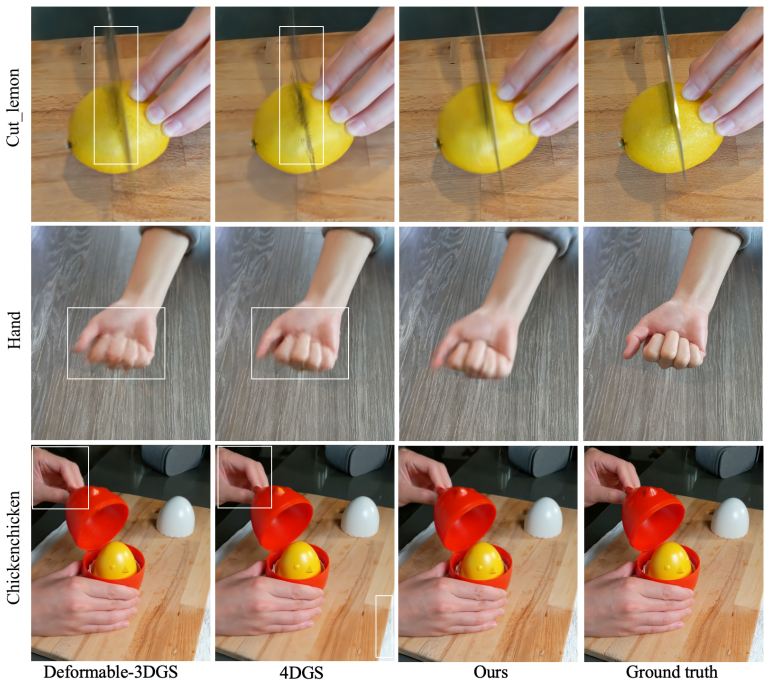
- [Sec. 5.2] The qualitative comparisons in Figs. 3 and 4 use white-box crops but no corresponding error maps or zoomed quantitative regions; adding error maps would make the 'superior fidelity in dynamic regions' claim easier to verify.
Circularity Check
No significant circularity; the derivation is empirical and self-contained against external benchmarks.
full rationale
The paper's core claims are validated against external datasets (N3DV, HyperNeRF) with measured PSNR/SSIM/LPIPS, FPS, and storage numbers, so the headline efficiency and quality results are not derived from the model's own assumptions. The canonical model explicitly builds on Scaffold-GS [21], the deformation field follows the HexPlane/4DGS-style encoder [3, 12, 35], and the deformation-aware densification weighting in Eqs. (7)-(9) is an internal modeling choice: deformation magnitude is proposed as a proxy for where reconstruction is lacking, but the paper does not define 'under-reconstructed' as 'large deformation,' and the Table 3 ablation independently tests whether this weighting helps. Even if the hand-set coefficients (alpha=0.8, beta=0.1, gamma=0.1) are not sensitivity-analyzed, that is a robustness limitation, not circularity, because the ablation could in principle have shown no gain. The self-citations [36, 37, 43, 44] appear only in related-work and motivational contexts and are not load-bearing for the central derivation. The skeptic's concern that MoDec-GS [16] and Scaffold4D [7] are omitted from the comparisons is a scope/validity issue for the comparative headline, not a circularity: those baselines are external methods, and no equation in SD-GS is defined in terms of the claimed 60% size reduction or 100% FPS improvement. No step in the paper reduces to its own inputs by construction.
Assumptions & free parameters
free parameters (6)
- alpha =
0.8
- beta =
0.1
- gamma =
0.1
- lambda_SSIM =
0.2
- lambda_tv =
0.01
- lambda_vol =
0.01
assumptions (4)
- standard math HexPlane spatiotemporal feature decomposition (from [3,12]) captures localized spatial-temporal correlations with a lightweight MLP.
- domain assumption A canonical Gaussian model plus per-timestamp deformation field can represent complex dynamic scenes.
- domain assumption Deformation magnitude of an anchor is a reliable proxy for under-reconstruction in dynamic regions.
- standard math 3DGS differentiable rasterization pipeline (from [14]) correctly renders the generated neural Gaussians.
Cite this review
Pith. "Pith review of SD-GS: Structured Deformable 3D Gaussians for Efficient Dynamic Scene Reconstruction." pith.science (2026). https://pith.science/paper/7OMLEVHU
@misc{pith2026250707465,
  author       = {Pith},
  title        = {Pith review of: SD-GS: Structured Deformable 3D Gaussians for Efficient Dynamic Scene Reconstruction},
  year         = {2026},
  howpublished = {\url{https://pith.science/paper/7OMLEVHU}},
  note         = {Machine review of arXiv:2507.07465}
}
read the original abstract
Current 4D Gaussian frameworks for dynamic scene reconstruction deliver impressive visual fidelity and rendering speed, however, the inherent trade-off between storage costs and the ability to characterize complex physical motions significantly limits the practical application of these methods. To tackle these problems, we propose SD-GS, a compact and efficient dynamic Gaussian splatting framework for complex dynamic scene reconstruction, featuring two key contributions. First, we introduce a deformable anchor grid, a hierarchical and memory-efficient scene representation where each anchor point derives multiple 3D Gaussians in its local spatiotemporal region and serves as the geometric backbone of the 3D scene. Second, to enhance modeling capability for complex motions, we present a deformation-aware densification strategy that adaptively grows anchors in under-reconstructed high-dynamic regions while reducing redundancy in static areas, achieving superior visual quality with fewer anchors. Experimental results demonstrate that, compared to state-of-the-art methods, SD-GS achieves an average of 60\% reduction in model size and an average of 100\% improvement in FPS, significantly enhancing computational efficiency while maintaining or even surpassing visual quality.
Figures


Figures from the paper (2 more)

Forward citations
Cited by 2 Pith papers
-
AdaAnchor4D: Anchor-Conditioned Spatiotemporal Feature Aggregation for Monocular UAV 4D Reconstruction
Anchor-conditioned adaptive aggregation of shared spatiotemporal feature planes improves monocular UAV dynamic Gaussian reconstruction quality while keeping real-time rendering.
-
Does it matter which Gaussians you pick in 4D Gaussian streaming?
A reinforcement-learned plug-in sampler can match or beat IGS@8192 quality on N3DV and MeetingRoom using as few as 256 anchors while reducing per-frame time.
Reference graph
Works this paper leans on
-
[7]
4d scaffold gaussian splatting for memory efficient dynamic scene reconstruction,
CWoong Oh Cho, In Cho, Seoha Kim, Jeongmin Bae, Youngjung Uh, and Seon Joo Kim. 4d scaffold gaussian splatting for memory efficient dynamic scene reconstruction,
-
[16]
Sangwoon Kwak, Joonsoo Kim, Jun Young Jeong, Won- Sik Cheong, Jihyong Oh, and Munchurl Kim. Modec-gs: Global-to-local motion decomposition and temporal interval adjustment for compact dynamic 3d gaussian splatting, 2025. 2
work page 2025
-
[1]
Hyperreel: High-fidelity 6-dof video with ray- conditioned sampling
Benjamin Attal, Jia-Bin Huang, Christian Richardt, Michael Zollhoefer, Johannes Kopf, Matthew O’Toole, and Changil Kim. Hyperreel: High-fidelity 6-dof video with ray- conditioned sampling. InProceedings of the IEEE/CVF Conference on Computer Vision and Pattern Recognition, pages 16610–16620, 2023. 2
work page 2023
-
[2]
Per-gaussian embedding- based deformation for deformable 3d gaussian splatting
Jeongmin Bae, Seoha Kim, Youngsik Yun, Hahyun Lee, Gun Bang, and Youngjung Uh. Per-gaussian embedding- based deformation for deformable 3d gaussian splatting. In European Conference on Computer Vision, pages 321–335. Springer, 2024. 2, 6, 7
work page 2024
-
[3]
Hexplane: A fast representa- tion for dynamic scenes
Ang Cao and Justin Johnson. Hexplane: A fast representa- tion for dynamic scenes. InProceedings of the IEEE/CVF Conference on Computer Vision and Pattern Recognition, pages 130–141, 2023. 3, 5
work page 2023
-
[4]
A survey on 3d gaussian splatting, 2025
Guikun Chen and Wenguan Wang. A survey on 3d gaussian splatting, 2025. 2
work page 2025
-
[5]
Hac: Hash-grid assisted context for 3d gaussian splatting compression
Yihang Chen, Qianyi Wu, Weiyao Lin, Mehrtash Harandi, and Jianfei Cai. Hac: Hash-grid assisted context for 3d gaussian splatting compression. InEuropean Conference on Computer Vision, 2024. 3
work page 2024
-
[6]
Gaussianpro: 3d gaussian splatting with progressive propagation
Kai Cheng, Xiaoxiao Long, Kaizhi Yang, Yao Yao, Wei Yin, Yuexin Ma, Wenping Wang, and Xuejin Chen. Gaussianpro: 3d gaussian splatting with progressive propagation. InForty- first International Conference on Machine Learning, 2024. 3
work page 2024
Show all 47 references
-
[8]
Mvgs: Multi-view- regulated gaussian splatting for novel view synthesis.arXiv preprint arXiv:2410.02103, 2024
Xiaobiao Du, Yida Wang, and Xin Yu. Mvgs: Multi-view- regulated gaussian splatting for novel view synthesis.arXiv preprint arXiv:2410.02103, 2024. 3
2024 arXiv
-
[9]
4d-rotor gaussian splatting: towards efficient novel view synthesis for dynamic scenes
Yuanxing Duan, Fangyin Wei, Qiyu Dai, Yuhang He, Wen- zheng Chen, and Baoquan Chen. 4d-rotor gaussian splatting: towards efficient novel view synthesis for dynamic scenes. InACM SIGGRAPH 2024 Conference Papers, pages 1–11,
2024
-
[10]
Mini-splatting: Repre- senting scenes with a constrained number of gaussians
Guangchi Fang and Bing Wang. Mini-splatting: Repre- senting scenes with a constrained number of gaussians. In European Conference on Computer Vision, pages 165–181. Springer, 2024. 3
2024
-
[11]
Fast dynamic radiance fields with time-aware neural vox- els
Jiemin Fang, Taoran Yi, Xinggang Wang, Lingxi Xie, Xi- aopeng Zhang, Wenyu Liu, Matthias Nießner, and Qi Tian. Fast dynamic radiance fields with time-aware neural vox- els. InSIGGRAPH Asia 2022 Conference Papers, pages 1–9,
2022
-
[12]
K-planes: Explicit radiance fields in space, time, and appearance
Sara Fridovich-Keil, Giacomo Meanti, Frederik Rahbæk Warburg, Benjamin Recht, and Angjoo Kanazawa. K-planes: Explicit radiance fields in space, time, and appearance. In Proceedings of the IEEE/CVF Conference on Computer Vi- sion and Pattern Recognition, pages 12479–12488, 2023. 3
2023
-
[13]
Sc-gs: Sparse-controlled gaussian splatting for editable dynamic scenes
Yi-Hua Huang, Yang-Tian Sun, Ziyi Yang, Xiaoyang Lyu, Yan-Pei Cao, and Xiaojuan Qi. Sc-gs: Sparse-controlled gaussian splatting for editable dynamic scenes. InProceed- ings of the IEEE/CVF conference on computer vision and pattern recognition, pages 4220–4230, 2024. 2
2024
-
[14]
3d gaussian splatting for real-time radiance field rendering.ACM Transactions on Graphics (ToG), 42(4):1–14, 2023
Bernhard Kerbl, Georgios Kopanas, Thomas Leimk ¨uhler, and George Drettakis. 3d gaussian splatting for real-time radiance field rendering.ACM Transactions on Graphics (ToG), 42(4):1–14, 2023. 2, 3, 5
2023
-
[15]
Color-cued efficient densification method for 3d gaussian splatting
Sieun Kim, Kyungjin Lee, and Youngki Lee. Color-cued efficient densification method for 3d gaussian splatting. In Proceedings of the IEEE/CVF Conference on Computer Vi- sion and Pattern Recognition, pages 775–783, 2024. 3
2024
-
[17]
Neural 3d video synthesis from multi-view video
Tianye Li, Mira Slavcheva, Michael Zollhoefer, Simon Green, Christoph Lassner, Changil Kim, Tanner Schmidt, Steven Lovegrove, Michael Goesele, Richard Newcombe, et al. Neural 3d video synthesis from multi-view video. In Proceedings of the IEEE/CVF conference on computer vi- si...
2022
-
[18]
Spacetime gaus- sian feature splatting for real-time dynamic view synthesis
Zhan Li, Zhang Chen, Zhong Li, and Yi Xu. Spacetime gaus- sian feature splatting for real-time dynamic view synthesis. InProceedings of the IEEE/CVF Conference on Computer Vision and Pattern Recognition, pages 8508–8520, 2024. 2
2024
-
[19]
Mvg-splatting: Multi-view guided gaussian splatting with adaptive quantile-based geometric consistency densification
Zhuoxiao Li, Shanliang Yao, Yijie Chu, Angel F Garcia- Fernandez, Yong Yue, Eng Gee Lim, and Xiaohui Zhu. Mvg-splatting: Multi-view guided gaussian splatting with adaptive quantile-based geometric consistency densification. arXiv preprint arXiv:2407.11840, 2024. 3
2024 arXiv
-
[20]
Mix- ture of volumetric primitives for efficient neural rendering
Stephen Lombardi, Tomas Simon, Gabriel Schwartz, Michael Zollhoefer, Yaser Sheikh, and Jason Saragih. Mix- ture of volumetric primitives for efficient neural rendering. ACM Transactions on Graphics (ToG), 40(4):1–13, 2021. 5
2021
-
[21]
Scaffold-gs: Structured 3d gaussians for view-adaptive rendering
Tao Lu, Mulin Yu, Linning Xu, Yuanbo Xiangli, Limin Wang, Dahua Lin, and Bo Dai. Scaffold-gs: Structured 3d gaussians for view-adaptive rendering. InProceedings of the IEEE/CVF Conference on Computer Vision and Pattern Recognition, pages 20654–20664, 2024. 3, 4, 5, 7
2024
-
[22]
Dynamic 3d gaussians: Tracking by per- sistent dynamic view synthesis
Jonathon Luiten, Georgios Kopanas, Bastian Leibe, and Deva Ramanan. Dynamic 3d gaussians: Tracking by per- sistent dynamic view synthesis. In2024 International Con- ference on 3D Vision (3DV), pages 800–809. IEEE, 2024. 2
2024
-
[23]
Taming 3dgs: High-quality radiance fields with limited resources
Saswat Subhajyoti Mallick, Rahul Goel, Bernhard Kerbl, Markus Steinberger, Francisco Vicente Carrasco, and Fer- nando De La Torre. Taming 3dgs: High-quality radiance fields with limited resources. InSIGGRAPH Asia 2024 Con- ference Papers, pages 1–11, 2024. 3
2024
-
[24]
Hypernerf: A higher- dimensional representation for topologically varying neural radiance fields.arXiv preprint arXiv:2106.13228, 2021
Keunhong Park, Utkarsh Sinha, Peter Hedman, Jonathan T Barron, Sofien Bouaziz, Dan B Goldman, Ricardo Martin- Brualla, and Steven M Seitz. Hypernerf: A higher- dimensional representation for topologically varying neural radiance fields.arXiv preprint arXiv:2106.13228, 2021. 2, 7
2021 arXiv
-
[25]
Pytorch: An im- perative style, high-performance deep learning library.Ad- vances in neural information processing systems, 32, 2019
Adam Paszke, Sam Gross, Francisco Massa, Adam Lerer, James Bradbury, Gregory Chanan, Trevor Killeen, Zeming Lin, Natalia Gimelshein, Luca Antiga, et al. Pytorch: An im- perative style, high-performance deep learning library.Ad- vances in neural information processing systems, ...
2019
-
[26]
D-nerf: Neural radiance fields for dynamic scenes
Albert Pumarola, Enric Corona, Gerard Pons-Moll, and Francesc Moreno-Noguer. D-nerf: Neural radiance fields for dynamic scenes. InProceedings of the IEEE/CVF con- ference on computer vision and pattern recognition, pages 10318–10327, 2021. 2
2021
-
[27]
Octree-gs: Towards consistent real-time rendering with lod-structured 3d gaussians.arXiv preprint arXiv:2403.17898, 2024
Kerui Ren, Lihan Jiang, Tao Lu, Mulin Yu, Linning Xu, Zhangkai Ni, and Bo Dai. Octree-gs: Towards consistent real-time rendering with lod-structured 3d gaussians.arXiv preprint arXiv:2403.17898, 2024. 3
2024 arXiv
-
[28]
Revising densification in gaussian splatting
Samuel Rota Bul `o, Lorenzo Porzi, and Peter Kontschieder. Revising densification in gaussian splatting. InEuropean Conference on Computer Vision, pages 347–362. Springer,
-
[29]
Structure- from-motion revisited
Johannes L Schonberger and Jan-Michael Frahm. Structure- from-motion revisited. InProceedings of the IEEE con- ference on computer vision and pattern recognition, pages 4104–4113, 2016. 3, 4
2016
-
[30]
Direct voxel grid optimization: Super-fast convergence for radiance fields reconstruction
Cheng Sun, Min Sun, and Hwann-Tzong Chen. Direct voxel grid optimization: Super-fast convergence for radiance fields reconstruction. InProceedings of the IEEE/CVF conference on computer vision and pattern recognition, pages 5459– 5469, 2022. 5
2022
-
[31]
Dreamgaussian: Generative gaussian splatting for effi- cient 3d content creation.arXiv preprint arXiv:2309.16653,
Jiaxiang Tang, Jiawei Ren, Hang Zhou, Ziwei Liu, and Gang Zeng. Dreamgaussian: Generative gaussian splatting for effi- cient 3d content creation.arXiv preprint arXiv:2309.16653,
-
[32]
Mixed neural voxels for fast multi- view video synthesis
Feng Wang, Sinan Tan, Xinghang Li, Zeyue Tian, Yafei Song, and Huaping Liu. Mixed neural voxels for fast multi- view video synthesis. InProceedings of the IEEE/CVF In- ternational Conference on Computer Vision, pages 19706– 19716, 2023. 2
2023
-
[33]
Contextgs: Compact 3d gaussian splat- ting with anchor level context model
Yufei Wang, Zhihao Li, Lanqing Guo, Wenhan Yang, Alex C Kot, and Bihan Wen. Contextgs: Compact 3d gaussian splat- ting with anchor level context model. InAdvances in neural information processing systems (NeurIPS), 2024. 3
2024
-
[34]
Image quality assessment: from error visibility to structural similarity.IEEE transactions on image processing, 13(4):600–612, 2004
Zhou Wang, Alan C Bovik, Hamid R Sheikh, and Eero P Si- moncelli. Image quality assessment: from error visibility to structural similarity.IEEE transactions on image processing, 13(4):600–612, 2004. 7
2004
-
[35]
4d gaussian splatting for real-time dynamic scene rendering
Guanjun Wu, Taoran Yi, Jiemin Fang, Lingxi Xie, Xiaopeng Zhang, Wei Wei, Wenyu Liu, Qi Tian, and Xinggang Wang. 4d gaussian splatting for real-time dynamic scene rendering. InProceedings of the IEEE/CVF Conference on Computer Vision and Pattern Recognition, pages 20310–20320, ...
2024
-
[36]
Sizegs: Size-aware compression of 3d gaussians with hier- archical mixed precision quantization.arXiv, 2024
Shuzhao Xie, Jiahang Liu, Weixiang Zhang, Shijia Ge, Sicheng Pan, Chen Tang, Yunpeng Bai, and Zhi Wang. Sizegs: Size-aware compression of 3d gaussians with hier- archical mixed precision quantization.arXiv, 2024. 3
2024
-
[37]
Mesongs: Post- training compression of 3d gaussians via efficient attribute transformation
Shuzhao Xie, Weixiang Zhang, Chen Tang, Yunpeng Bai, Rongwei Lu, Shijia Ge, and Zhi Wang. Mesongs: Post- training compression of 3d gaussians via efficient attribute transformation. InEuropean Conference on Computer Vi- sion. Springer, 2024. 3
2024
-
[38]
Deformable 3d gaussians for high-fidelity monocular dynamic scene reconstruction.arXiv preprint arXiv:2309.13101, 2023
Ziyi Yang, Xinyu Gao, Wen Zhou, Shaohui Jiao, Yuqing Zhang, and Xiaogang Jin. Deformable 3d gaussians for high-fidelity monocular dynamic scene reconstruction.arXiv preprint arXiv:2309.13101, 2023. 2, 6, 7
2023 arXiv
-
[39]
Real-time photorealistic dynamic scene representa- tion and rendering with 4d gaussian splatting.arXiv preprint arXiv:2310.10642, 2023
Zeyu Yang, Hongye Yang, Zijie Pan, Xiatian Zhu, and Li Zhang. Real-time photorealistic dynamic scene representa- tion and rendering with 4d gaussian splatting.arXiv preprint arXiv:2310.10642, 2023. 2, 6, 7, 8
2023 arXiv
-
[40]
Absgs: Recovering fine details in 3d gaussian splat- ting
Zongxin Ye, Wenyu Li, Sidun Liu, Peng Qiao, and Yong Dou. Absgs: Recovering fine details in 3d gaussian splat- ting. InProceedings of the 32nd ACM International Confer- ence on Multimedia, pages 1053–1061, 2024. 3
2024
-
[41]
Differentiable surface splatting for point-based geometry processing.ACM Transactions on Graphics (TOG), 38(6):1–14, 2019
Wang Yifan, Felice Serena, Shihao Wu, Cengiz ¨Oztireli, and Olga Sorkine-Hornung. Differentiable surface splatting for point-based geometry processing.ACM Transactions on Graphics (TOG), 38(6):1–14, 2019. 3
2019
-
[42]
The unreasonable effectiveness of deep features as a perceptual metric
Richard Zhang, Phillip Isola, Alexei A Efros, Eli Shecht- man, and Oliver Wang. The unreasonable effectiveness of deep features as a perceptual metric. InProceedings of the IEEE conference on computer vision and pattern recogni- tion, pages 586–595, 2018. 7
2018
-
[43]
Expansive supervision for neural radi- ance field, 2024
Weixiang Zhang, Shuzhao Xie, Shijia Ge, Wei Yao, Chen Tang, and Zhi Wang. Expansive supervision for neural radi- ance field, 2024. 2
2024
-
[44]
Evos: Efficient implicit neural training via evolutionary selector,
Weixiang Zhang, Shuzhao Xie, Chengwei Ren, Siyi Xie, Chen Tang, Shijia Ge, Mingzi Wang, and Zhi Wang. Evos: Efficient implicit neural training via evolutionary selector,
-
[45]
Pixel-gs: Density control with pixel-aware gradient for 3d gaussian splatting
Zheng Zhang, Wenbo Hu, Yixing Lao, Tong He, and Heng- shuang Zhao. Pixel-gs: Density control with pixel-aware gradient for 3d gaussian splatting. InEuropean Conference on Computer Vision, pages 326–342. Springer, 2024. 3
2024
-
[46]
Zwicker, H
M. Zwicker, H. Pfister, J. van Baar, and M. Gross. Ewa vol- ume splatting. InProceedings Visualization, 2001. VIS ’01., pages 29–538, 2001. 3
2001
-
[47]
Surface splatting
Matthias Zwicker, Hanspeter Pfister, Jeroen Van Baar, and Markus Gross. Surface splatting. InProceedings of the 28th annual conference on Computer graphics and interac- tive techniques, pages 371–378, 2001. 3
2001
Reviewed August 6, 2026 · model on record in the stance chip above.
Discussion (0). Sign in to comment.