REVIEW 3 major objections 4 minor 45 references
First-order continuum models for nonlinear dispersive waves in the granular crystal lattice
T0 review · 3 major / 4 minor · reviewed 2026-08-06 · deepseek-v4-flash
Pith's one-line read Two first-order continuum PDEs can stand in for the discrete granular crystal lattice and reproduce its solitary waves, periodic waves, and dispersive shock waves even without precompression.
desk verdict New first-order generalized KdV and BBM-type models for the granular chain are a real step beyond the KdV reduction; the zero-precompression claim is an extrapolation that should be softened, but the paper deserves serious refereeing. read the letter →
The pith
A machine-rendered reading of the paper's core claim, the machinery that carries it, and where it could break.
The reading
What carries the argument
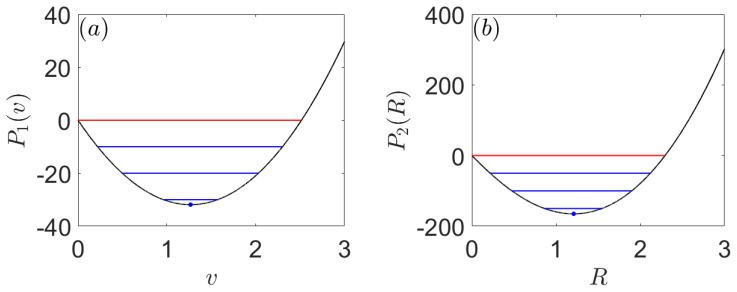
The load-bearing object is the positive branch of the linearized dispersion relation, $\Omega = \sqrt{p}\,A^{(p-1)/2}K\sqrt{1-\epsilon^2K^2/12}$, expanded in its long-wave form (2.11), which converts the ill-posed second-order-in-time PDE into the first-order generalized KdV equation (2.12). Inverting the operator $1+\epsilon^2\partial_X^2/24$ regularizes the model into the BBM-type equation (2.14), whose dispersion relation stays bounded for large wavenumbers. This pair of models carries the argument because their solitary and periodic traveling waves, two conservation laws, and averaged Whitham modulation equations can be written explicitly enough to run the DSW fitting procedure and to predict how the leading and trailing edges of a dispersive shock move.
What would settle it
Run the discrete lattice and both continuum PDEs with exactly zero precompression and a fixed jump, then compare the measured trailing-edge wavenumber and edge speeds; if the PDE values do not approach the lattice values as the numerical smoothing and the artificial $r_+=10^{-5}$ background are removed, the claimed sonic-vacuum validity fails.
Extended reading notes
Core claim
On the paper's own terms, the central discovery is that the strain dynamics of the granular chain, $\ddot r_n = (r_{n+1})^p - 2(r_n)^p + (r_{n-1})^p$, admit two unidirectional continuum limits that keep dispersive effects: the generalized KdV model (2.12) and the regularized BBM analogue (2.14). Both models come from taking the positive branch of the linearized dispersion relation, so they describe right-going waves, and both have enough conservation laws to close a Whitham modulation system by averaging. The DSW fitting procedure then yields explicit formulas for the trailing-edge wavenumber and the leading- and trailing-edge speeds, namely (5.10), (5.12), and (5.16). Numerical comparison shows that the PDE predictions agree with the discrete lattice for precompressed chains and continue to give a reasonable description of the DSW spatial profile at zero precompression, where the KdV model is not available.
Load-bearing premise
The load-bearing premise is that a one-directional, right-going wave description remains valid when the chain has zero precompression, even though the derivation expands around a nonzero background and the linear wave speed vanishes in that limit; the paper relies on numerical agreement there rather than on a controlled asymptotic argument.
Editorial extensions
If this is right
- For granular chains with zero precompression, where the KdV reduction is unavailable, the two PDEs provide quantitative predictions for DSW edge speeds, amplitudes, and wavenumbers.
- For finite but small precompression, the new models approximate the discrete chain noticeably better than KdV; as precompression grows, all models become comparable.
- The explicit edge formulas from DSW fitting, such as $k_- = 4\,\mathrm{arcsec}[(r_-/r_+)^{(p-1)/4}]$ for the lattice, can be used to initialize or interpret numerical and experimental Riemann problems.
- The regularized model has a bounded dispersion relation and runs stably at $r_+=0$, while the non-regularized model needs a small positive background and smoother initial data; this distinction matters for choosing a model in practice.
- The Whitham modulation systems derived here open a route to studying hyperbolicity, genuine nonlinearity, and rarefaction-wave structure in the continuum descriptions of lattices.
Reading between the lines
- A testable extension left implicit in the paper is to use these PDEs as design tools for laboratory granular-chain experiments at zero precompression, where the predicted edge speeds and wavenumbers could be measured directly.
- The same two-step route—selecting the positive branch of the linearized dispersion relation and then regularizing—should transfer to other power-law lattices, including dimers, decorated chains, or two-dimensional packings, giving first-order continuum models for settings where no linear dispersion exists.
- The artificial $r_+=10^{-5}$ required by the non-regularized model in the sonic-vacuum limit suggests a genuine singular limit; a matched-asymptotics analysis as $r_+\to 0$ could show whether the DSW edge quantities obey universal power laws shared by the lattice and the PDEs.
- If the models hold up, equation (5.2) gives a concrete way to prepare lattice initial data so that a laboratory shock experiment follows the continuum prediction from the earliest times.
Editorial analysis
A structured set of objections, weighed in public.
Referee Report
Summary. The paper derives two first-order continuum models for the granular crystal lattice (2.2): a generalized KdV-type model (2.12) and a regularized BBM-type model (2.14). It analyzes their solitary and periodic traveling waves, derives conservation laws and Whitham modulation systems, applies the DSW fitting method to obtain leading- and trailing-edge predictions, and compares those predictions with direct numerical simulations of the discrete lattice. The principal claims are that the new models outperform the classical KdV approximation for small precompression and remain accurate even in the zero-precompression (sonic vacuum) limit.
Significance. If the claims hold, the paper provides a useful intermediate-level unidirectional description of a canonical nonlinear lattice, with parameter-free DSW edge predictions obtained from an established fitting method. The derivation from the discrete equations is transparent, the comparison against the KdV benchmark is appropriate, and the precompression results are convincing. The main weakness is that the zero-precompression claim, which is central to the abstract, rests on a singular limit and on numerical evidence that the authors themselves describe as showing deviations; this part of the claim needs to be either strengthened or carefully qualified.
major comments (3)
- [§2.1, Eqs. (2.10)–(2.12)] The unidirectional reduction selects the positive branch of the linearized dispersion relation (2.10), whose prefactor sqrt(p) A^{(p-1)/2} vanishes at A = r_+ = 0. At r_+ = 0 the linearized dispersion relation (2.3) is identically zero, so there is no distinguished right-going wave direction and the KdV-type scaling used for the reduction becomes singular. Applying (2.12) and (2.14) at r_+ = 0 is therefore a formal extrapolation rather than a justified limit. This is load-bearing because the abstract's central claim concerns exactly this case; please either supply an explicit asymptotic or numerical justification for the limit, or restrict the claim to finite precompression plus a clearly labeled empirical extrapolation.
- [§6.2, Figs. 10–11] The numerical support for the zero-precompression claim is partial. The text states that the trailing-edge DSW features of both continuum models deviate from those of the granular lattice, that solitonic amplitudes deviate as r_- increases, and that agreement is good only for the small jump r_- = 0.05. In addition, the non-regularized model required r_+ = 10^{-5} and δ = 1 instead of the standard δ = 50. The abstract's unconditional statement of 'good agreement ... even in cases where no precompression is present' is therefore stronger than the evidence presented. Please add quantitative error metrics for the edge quantities and revise the summary claims to match the demonstrated regime.
- [§5.3, Eqs. (5.15)–(5.16)] The DSW fitting formulas for the discrete lattice are derived from the linearized dispersion relation around r_+ and contain factors such as (r_-/r_+)^{(p-1)/4}, which diverge as r_+ → 0; the paper acknowledges in §6.2 that the fitting formulas are invalid at r_+ = 0. Consequently, the zero-precompression comparisons rely entirely on direct numerical simulation of the continuum PDEs, without an independent theoretical prediction for the discrete chain. This limitation should be stated in the abstract and conclusions, or a separate zero-precompression prediction should be supplied.
minor comments (4)
- [Eq. (3.10)] The formula for the p = 3/2 solitary wave of the non-regularized model is garbled: the argument of the sine contains malformed square-root factors. Please correct the typesetting so that the expression can be verified against Eq. (3.5c).
- [References] References [18] and [33] cite the same paper (Chong, Geisler, Kevrekidis, Biondini, Wave Motion 130, 2024) and should be consolidated to avoid duplicate citation.
- [§4.3, Eq. (4.15)] The use of K_m for the complete elliptic integral of the first kind alongside K for the wavenumber is potentially confusing even though it is explained in the text; consider using a different symbol such as mathcal{K}(m).
- [§6.2, first paragraph] The sentence reporting numerical instability in the non-regularized model would benefit from stating whether the instability occurs before or after the DSW forms, and whether the choice δ = 1 and r_+ = 10^{-5} changes the measured edge features in a quantifiable way.
Circularity Check
No significant circularity: the continuum models are derived from the lattice equations by Taylor expansion and validated against independent lattice simulations.
full rationale
The derivation chain is self-contained. The discrete granular chain (2.2) is Taylor-expanded at long wavelengths to obtain (2.6)-(2.8); taking the positive branch of the resulting dispersion relation (2.9)-(2.10) and expanding at long wave yields the linearized dispersion (2.11), with which the non-regularized model (2.12) and regularized model (2.14) are associated. No parameter is fitted to the DSW data: epsilon=0.1 is a fixed scale parameter, and the DSW edge predictions (5.8)-(5.12) are computed from the models' own dispersion relations via the standard DSW fitting method, then compared to direct numerical simulations of the discrete lattice in Figs. 8-11. The self-citations, e.g. refs. [18], [19], [22], and [33], are contextual and not load-bearing: the second-order model from [22] is rederived in Eqs. (2.6)-(2.8), and the KdV benchmark is independently classical. The zero-precompression claim is not circular either: Section 6.2 explicitly states that 'the DSW fitting formulas are also invalid since there is no dispersion around the zero state' and therefore relies only on direct numerical comparisons, with r_+=10^-5 and delta=1 for the non-regularized model. That is an acknowledged limitation and an extrapolation of the formal asymptotics, but it does not reduce any prediction to an input by construction. The central validation is external, against the discrete lattice itself, so no fitting-to-target or self-citation chain is present.
Assumptions & free parameters
free parameters (3)
- epsilon (smallness parameter) =
0.1
- r+ floor in non-regularized zero-precompression runs =
1e-5
- initial-profile sharpness delta =
50 (and 1 for zero-precompression non-regularized runs)
assumptions (4)
- domain assumption The discrete lattice dynamics is well approximated by the leading-order Taylor expansion (2.6)-(2.8) for long wavelengths.
- domain assumption The unidirectional reduction obtained by taking the positive branch of the dispersion relation (2.10) remains valid, including at zero precompression.
- domain assumption The periodic traveling waves and the averaging of conservation laws yield a closed Whitham modulation system.
- standard math The DSW fitting method of El (2005) is applicable to these non-integrable models and the discrete lattice.
Cite this review
Pith. "Pith review of First-order continuum models for nonlinear dispersive waves in the granular crystal lattice." pith.science (2026). https://pith.science/paper/WGXRFLJI
@misc{pith2026250707571,
  author       = {Pith},
  title        = {Pith review of: First-order continuum models for nonlinear dispersive waves in the granular crystal lattice},
  year         = {2026},
  howpublished = {\url{https://pith.science/paper/WGXRFLJI}},
  note         = {Machine review of arXiv:2507.07571}
}
read the original abstract
We derive and analyze, analytically and numerically, two first-order continuum models to approximate the nonlinear dynamics of granular crystal lattices, focusing specifically on solitary waves, periodic waves, and dispersive shock waves. The dispersive shock waves predicted by the two continuum models are studied using modulation theory, DSW fitting techniques, and direct numerical simulations. The PDE-based predictions show good agreement with the DSWs generated by the discrete model simulation of the granular lattice itself, even in cases where no precompression is present and the lattice is purely nonlinear. Such an effective description could prove useful for future, more analytically amenable approximations of the original lattice system.
Figures


Figures from the paper (9 more)




Reference graph
Works this paper leans on
-
[1]
V.F. Nesterenko. Dynamics of Heterogeneous Materials. Springer-Verlag, New York, 2001
work page 2001
-
[2]
C. Chong and P. G. Kevrekidis. Coherent Structures in Granular Crystals: From Experiment and Modelling to Computation and Mathematical Analysis. Springer, New York, 2018
work page 2018
-
[3]
Yu. Starosvetsky , K.R. Jayaprakash, M. Arif Hasan, and A.F. Vakakis.Dynamics and Acoustics of Ordered Granular Media. World Scientific, Singapore, 2017
work page 2017
-
[4]
C. Chong, Mason A. Porter, P. G. Kevrekidis, and C. Daraio. Nonlinear coherent structures in granular crystals. J. Phys.: Condens. Matter, 29:413003, 2017
work page 2017
-
[5]
S. Sen, J. Hong, J. Bang, E. Avalos, and R. Doney . Solitary waves in the granular chain. Phys. Rep., 462:21, 2008
work page 2008
-
[6]
Christopher Chong and P. G. Kevrekidis. Dynamics of nonlinear lattices, 2024. 24
work page 2024
-
[7]
M. J. Ablowitz and M. Hoefer. Dispersive shock waves. Scholarpedia, 4(11):5562, 2009
work page 2009
-
[8]
G.A. El and M.A. Hoefer. Dispersive shock waves and modulation theory .Physica D: Nonlinear Phenom- ena, 333:11, 2016
work page 2016
Show all 45 references
-
[9]
G.B. Whitham. Linear and Nonlinear Waves. Wiley , New York, 1974
1974
-
[10]
E. B. Herbold and V. F. Nesterenko. Solitary and shock waves in discrete strongly nonlinear double power-law materials. Appl. Phys. Lett., 90(26):261902, 2007
2007
-
[11]
Molinari and C
A. Molinari and C. Daraio. Stationary shocks in periodic highly nonlinear granular chains. Phys. Rev. E, 80:056602, 2009
2009
-
[12]
Fleischer
Shu Jia, Wenjie Wan, and Jason W. Fleischer. Dispersive shock waves in nonlinear arrays. Phys. Rev. Lett., 99:223901, Nov 2007
2007
-
[13]
H. Kim, E. Kim, C. Chong, P. G. Kevrekidis, and J. Yang. Demonstration of dispersive rarefaction shocks in hollow elliptical cylinder chains. Phys. Rev. Lett., 120:194101, 2018
2018
-
[14]
Observation of ultraslow shock waves in a tunable magnetic lattice
Jian Li, S Chockalingam, and Tal Cohen. Observation of ultraslow shock waves in a tunable magnetic lattice. Phys. Rev. Lett., 127:014302, Jun 2021
2021
-
[15]
A. M. Filip and S. Venakides. Existence and modulation of traveling waves in particles chains. Comm. Pure and Appl. Math., 52(6):693, 1999
1999
-
[16]
Dreyer, M
W. Dreyer, M. Herrmann, and A. Mielke. Micro-macro transition in the atomic chain via Whitham’s modulation equation. Nonlinearity, 19(2):471, 2005
2005
-
[17]
A. M. Bloch and Y. Kodama. Dispersive regularization of the whitham equation for the toda lattice. SIAM Journal on Applied Mathematics, 52(4):909–928, 1992
1992
-
[18]
Kevrekidis, and Gino Biondini
Christopher Chong, Ari Geisler, Panayotis G. Kevrekidis, and Gino Biondini. Integrable approximations of dispersive shock waves of the granular chain. Wave Motion, 130:103352, 2024
2024
-
[19]
Biondini, C
G. Biondini, C. Chong, and P. G. Kevrekidis. On the Whitham modulation equations for the Toda lattice and the quantitative description of its dispersive shocks. Physica D, 469:134315, 2024
2024
-
[20]
G. A. El. Resolution of a shock in hyperbolic systems modified by weak dispersion. Chaos: An Interdis- ciplinary Journal of Nonlinear Science, 15(3), September 2005
2005
-
[21]
Dispersive hydrodynamics of a discrete conservation law
Patrick Sprenger, Christopher Chong, Emmanuel Okyere, Michael Herrmann, Panayotis Kevrekidis, and Mark Hoefer. Dispersive hydrodynamics of a discrete conservation law. arXiv:2404.1675, 2024
2024
-
[22]
Kevrekidis
Su Yang, Gino Biondini, Christopher Chong, and Panayotis G. Kevrekidis. A regularized continuum model for traveling waves and dispersive shocks of the granular chain, 2024
2024
-
[23]
Fermi, J
E. Fermi, J. Pasta, and S. Ulam. Studies of Nonlinear Problems. I. Tech. Rep., (Los Alamos National Laboratory , Los Alamos, NM, USA):LA–1940, 1955
1940
-
[24]
G. P. Berman and F. M. Izrailev. The fermi-pasta-ulam problem: Fifty years of progress. Chaos, 15(1), 2005
2005
-
[25]
Gallavotti
G. Gallavotti. The Fermi–Pasta–Ulam Problem: A Status Report. Springer-Verlag, Berlin, Germany , 2008
2008
-
[26]
Porter, Norman J
Mason A. Porter, Norman J. Zabusky , Bambi Hu, and David K. Campbell. Fermi, pasta, ulam and the birth of experimental mathematics: A numerical experiment that enrico fermi, john pasta, and stanislaw ulam reported 54 years ago continues to inspire discovery . American Scientis...
2009
-
[27]
Friesecke and R
G. Friesecke and R. L. Pego. Solitary waves on Fermi–Pasta–Ulam lattices: II. Qualitative properites, renormalization and continuum limit. Nonlinearity, 12:1601, 1999. 25
1999
-
[28]
Friesecke and R
G. Friesecke and R. L. Pego. Solitary waves on Fermi–Pasta–Ulam lattices: I. Linear implies nonlinear stability .Nonlinearity, 15:1343, 2002
2002
-
[29]
Friesecke and R
G. Friesecke and R. L. Pego. Solitary waves on Fermi–Pasta–Ulam lattices: III. Howland-type Floquet theory .Nonlinearity, 17:207, 2004
2004
-
[30]
Friesecke and R
G. Friesecke and R. L. Pego. Solitary waves on Fermi–Pasta–Ulam lattices: IV. Proof of stability at low energy .Nonlinearity, 17:229, 2004
2004
-
[31]
James and D
G. James and D. Pelinovsky . Gaussian solitary waves and compactons in Fermi–Pasta–Ulam lattices with Hertzian potentials. P. Roy. Soc. A-Math-Phy., 470(2165), 2014
2014
-
[32]
T. B. Benjamin, J. L. Bona, and J. J. Mahony . Model equations for long waves in nonlinear dispersive systems. Philosophical Transactions of the Royal Society of London. Series A, Mathematical and Physical Sciences, 272(1220):47–78, 1972
1972
-
[33]
Kevrekidis, and Gino Biondini
Christopher Chong, Ari Geisler, Panayotis G. Kevrekidis, and Gino Biondini. Integrable approximations of dispersive shock waves of the granular chain. Wave Motion, 130:103352, October 2024
2024
-
[34]
A. V. Gurevich and L. P. Pitaevskii. Nonstationary structure of a collisionless shock wave. Zhurnal Eksperimentalnoi i Teoreticheskoi Fiziki, 65:590–604, 1973
1973
-
[35]
G.A. El, V.V. Geogjaev, A.V. Gurevich, and A.L. Krylov. Decay of an initial discontinuity in the defocusing NLS hydrodynamics. Physica D: Nonlinear Phenomena, 87(1-4):186–192, 1995
1995
-
[36]
Trefethen
Aly-Khan Kassam and Lloyd N. Trefethen. Fourth-order time-stepping for stiff pdes. SIAM Journal on Scientific Computing, 26(4):1214–1233, 2005
2005
-
[37]
Compactons and chaos in strongly nonlinear lattices
Karsten Ahnert and Arkady Pikovsky . Compactons and chaos in strongly nonlinear lattices. Physical Review E, 79(2), February 2009
2009
-
[38]
Hochstrasser, F.G
D. Hochstrasser, F.G. Mertens, and H. Büttner. An iterative method for the calculation of narrow solitary excitations on atomic chains. Physica D: Nonlinear Phenomena, 35(1):259–266, 1989
1989
-
[39]
G. A. El. Resolution of a shock in hyperbolic systems modified by weak dispersion. Chaos: An Interdis- ciplinary Journal of Nonlinear Science, 15(3):037103, 10 2005
2005
-
[40]
M.A. Hoefer. Shock waves in dispersive Eulerian fluids. J. Nonlinear Sci., 24:525–577, 2014
2014
-
[41]
Chong, Y
C. Chong, Y. Wang, D. Marechal, E. G. Charalampidis, Miguel Molerón, Alejandro J. Martínez, Mason A. Porter, P. G. Kevrekidis, and Chiara Daraio. Nonlinear localized modes in two-dimensional hexagonally- packed magnetic lattices. New Journal of Physics, 23:043008, 2021
2021
-
[42]
Leonard, F
A. Leonard, F. Fraternali, and C. Daraio. Directional wave propagation in a highly nonlinear square packing of spheres. Exp. Mech., 53:327, 2013
2013
-
[43]
Leonard, C
A. Leonard, C. Daraio, A. Awasthi, and P. Geubelle. Effects of weak disorder on stress wave anisotropy in centered square nonlinear granular crystals. Phys. Rev. E, 86:031305, 2012
2012
-
[44]
Leonard, C
A. Leonard, C. Chong, P. G. Kevrekidis, and C. Daraio. Traveling waves in 2D hexagonal granular crystal lattices. Granular Matter, 16(4):531, 2014
2014
-
[45]
Ablowitz
Mark J. Ablowitz. Nonlinear Dispersive Waves: Asymptotic Analysis and Solitons. Cambridge University Press, 2011. 26
2011
Reviewed August 6, 2026 · model on record in the stance chip above.
Discussion (0). Continue with ORCID to comment.