REVIEW 2 major objections 4 minor 1 cited by
Fluctuations in Hill's equation parameters and application to cosmic reheating
T0 review · 2 major / 4 minor · reviewed 2026-08-06 · deepseek-v4-flash
Pith's one-line read Random fluctuations in Hill's equation parameters are shown to produce a positive random-walk growth rate in classically stable regions, a noise floor that can complete cosmic reheating where parametric resonance alone stalls.
desk verdict Numerics support a real stochastic-reheating effect, but the advertised analytic derivation in Appendix B has a load-bearing gap and needs fixing or re-attribution before publication. read the letter →
The pith
A machine-rendered reading of the paper's core claim, the machinery that carries it, and where it could break.
The reading
What carries the argument
The load-bearing object is the transfer matrix $M_n$ that evolves the solution across one oscillation cycle, and the load-bearing identity is the split $M_n = h_n C_n$, which divides the growth rate into the averaged single-cycle rate $\gamma_\infty$ and a random-walk contribution $\gamma_R$ arising from the multiplication of the reduced matrices $C_n$. In the regime where the unperturbed equation is stable, $|h_n|<1$, each $M_n$ is an elliptical rotation parametrized by an angle $\theta_n$ and a length parameter $L_n$; fluctuations $\delta L_n$ in that length parameter drive the noise-induced growth $\gamma_R = \tfrac{1}{2T}\langle\delta_L^2\sin^2\theta\rangle$, whose positive definiteness is what converts stable bands of the stability diagram into weak resonators. The derivation is a perturbation expansion of the random matrix product, carried to leading nontrivial order in the fluctuation amplitude $\delta$ and verified by direct numerical multiplication of random transfer matrices.
What would settle it
Keep the pairwise fluctuation products $Q_{nk}$ in the total transfer matrix, dropping only terms of order $\delta^3$ and higher, and compute the Lyapunov exponent for $N \sim 10^5$ cycles at fixed noise amplitude; if the growth rate deviates from $\gamma_\infty + \tfrac{1}{2T}\langle\delta_L^2\sin^2\theta\rangle$ by more than the order-$\delta^4$ remainder, the analytic decomposition is wrong. A lattice simulation of preheating with small coupling and several spectator scalars should show exponential reheat-field growth at the noise-only rate; observing zero growth there would refute the reheating application.
Extended reading notes
Core claim
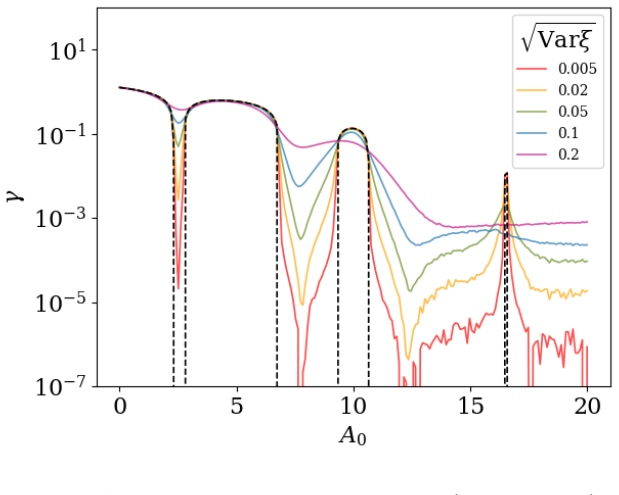
The paper's central mathematical result is that $\gamma_R > 0$ in regions that were stable before noise: fluctuations alone produce exponential growth where the unperturbed growth rate is zero. The mechanism is a random walk in the product of transfer matrices. In the stable regime each cycle contributes an elliptical rotation matrix, and cycle-to-cycle variation in its length parameter $L_n$ makes the product's eigenvalues grow at the rate $\gamma_R = \tfrac{1}{2T}\langle\delta_L^2\sin^2\theta\rangle$ per period, a positive-definite quantity proportional to the variance of the fluctuations. This gives the total growth rate $\gamma = \gamma_\infty + \gamma_R$ (Eq. 21), with $\gamma \approx \gamma_R$ where the unfluctuated system is stable. For Mathieu's equation at small $q$ the formula becomes the closed form $\gamma_R = \tfrac{1}{2\pi}\frac{\mathrm{Var}(q)}{(\omega_0^2-1)^2}\sin^2(\omega_0\pi)$, which the paper checks numerically. The application argument is that a collection of light scalar fields coupled to the inflaton produces exactly this normally distributed, cycle-to-cycle parameter noise, so that trajectories drifting into the broad-stability region, and small couplings that would otherwise give no particle production, acquire a nonzero growth rate that can complete reheating.
Load-bearing premise
The analytic derivation in Appendix B assumes that the products of two first-order fluctuation matrices in the transfer-matrix expansion all average away to zero over many cycles, even though each such product is the same order in the small noise amplitude as the terms that are kept; if those pairwise terms accumulate instead of vanishing, the clean split into a deterministic plus a positive random-walk growth rate is not established, and only the numerics would remain.
Editorial extensions
If this is right
- Reheating no longer requires fine-tuned couplings: even when $2\sigma\Phi \lesssim k^2 + m_\chi^2$ so that the classical growth rate vanishes, the noise floor supplies a small but nonzero growth rate that can complete the inflaton-to-$\chi$ energy transfer over enough oscillations.
- The viable region of the $(A,q)$ stability plane expands: previously stable bands acquire growth $\gamma \approx \gamma_R > 0$, while the strong resonance bands are only slightly suppressed, so the net effect is broader and more certain particle production.
- In quartic-dominated inflaton potentials, where the parameter-space trajectory marches toward increasing $q$ and would inevitably enter the broad-stability region once $m_\chi>0$, the stochastic floor keeps growth alive and adds a blueshifted high-wavenumber component to the reheat field spectrum.
- Because the same formalism applies to any source of fluctuations, the enhanced-reheating effect extends to general ultraviolet scenarios with multiple light scalars and offers a mechanism that can alleviate the cosmological moduli problem by preventing an overlong early matter-dominated phase.
Reading between the lines
- Beyond the paper: the mechanism only requires cycle-to-cycle parameter variation, so the same positive random-walk growth should appear in any periodically driven system with islands of stability; noisy Floquet experiments outside cosmology could test the $\gamma_R$ formula directly.
- Beyond the paper: the paper draws $\xi$ independently each cycle, but real spectator fields oscillate coherently over several inflaton periods; extending the calculation to correlated (colored) noise should interpolate between the white-noise floor and the deterministic stability chart, and would set the noise-model range where the prediction is quantitative.
- Beyond the paper: the positive-definite nature of $\gamma_R$ implies a distinctive signature in simulations, an exponential buildup of reheat-field variance with no underlying band structure in the parameter-space trajectory; full lattice simulations with several spectator scalars could look for exactly this signature.
Editorial analysis
A structured set of objections, weighed in public.
Referee Report
Summary. The paper studies Hill's equation with cycle-to-cycle random fluctuations in its parameters. It argues that the total Lyapunov exponent splits as γ = γ_∞ + γ_R, with γ_R a positive random-walk contribution, and that γ_R > 0 in classically stable bands. This is applied to cosmic reheating, where fluctuations are modeled via light scalar fields coupled to the inflaton, and it is claimed that even modest noise produces exponential growth in otherwise stable regions, broadening the viable reheating parameter space. The paper presents numerical Floquet charts, growth-rate slices, and a numerical transfer-matrix check in support of this claim.
Significance. If the analytic decomposition is established, the result is of clear interest for preheating and for the cosmological moduli problem. The paper provides an explicit microphysical source of fluctuations and a concrete formula in the Mathieu limit, Eq. (B21), which is numerically tested in Fig. 6 by direct transfer-matrix multiplication. The numerical Floquet charts (Figs. 1, 2, 5) independently support the qualitative effect of noise-induced growth in stable regions. However, the advertised analytical derivation in Appendix B contains gaps, so the quantitative random-walk formula is not currently established by this paper alone; the qualitative conclusion rests primarily on the numerics.
major comments (2)
- [Appendix B, Eq. (B9)] The step 'Σ_{n,k} Q_{nk} = 0 + O(δ^4)' is not valid as written. The matrices Q_{nk} defined in Eq. (B6) contain products of two first-order perturbation matrices, e.g., M1_n M1_k, each of order δ, so each Q_{nk} is O(δ^2), the same order as the retained M2_n terms. The fact that ⟨δL⟩ = 0 only eliminates terms linear in δ; products of zero-mean variables do not vanish in expectation, and the diagonal n = k terms are positive quadratic forms. Consequently, the eigenvalue expression (B11) and the growth rate (B14) are not derived by this calculation. Because the manuscript presents this derivation as the analytic support for the headline claim γ_R > 0 in stable regions, it must either be corrected or explicitly attributed to Ref. [34] as a known result.
- [Appendix B, Eq. (B12)] The eigenvalue magnitude formula |λ(N)|^2 = 1 ± N⟨δ_L^2 sin^2 θ⟩ is inconsistent with the symplectic structure det M(N) = 1. Since λ_+ λ_- = 1, writing λ_± = 1 ± Nx/2 gives λ_+ λ_- = 1 - N^2 x^2/4, which differs from unity at O(N^2 δ^4). In the limit N → ∞ used in Eq. (B14), this deviation is not negligible, while the intermediate step (1 + Nx)^{1/N} ≈ 1 + x/2 in Eq. (B13) requires Nx ≪ 1. The argument therefore does not provide a well-defined N → ∞ limit. The derivation should compute the Lyapunov exponent from the average of the logarithm of the eigenvalue pair, or from the trace, rather than from a single eigenvalue magnitude.
minor comments (4)
- [Section VII] There is a typo in the first paragraph: 'Nucleosythesis' should be 'Nucleosynthesis'.
- [References] The Furstenberg–Kesten result appears twice, as Refs. [11] and [32]; these citations should be consolidated.
- [Section II, Eq. (11)] The text says 'the final equality defines the transfer matrix Mn', but Eq. (11) defines the transfer matrix for a single interval, whereas the product notation in Eq. (17) is used later; the wording could be clarified to avoid confusion.
- [Figure 6 caption] The caption states that Eq. (B21) is 'a successful approximation' but the agreement appears qualitative; specifying the parameter values and the typical deviation would strengthen the claim.
Circularity Check
No significant circularity: the headline gamma_R formula is transparently attributed to the authors' own refs. [12,34], but it is re-derived in Appendix B and independently confirmed by direct transfer-matrix numerics (Fig. 6); the main flagged risk is the O(delta^2) Q_nk terms dropped at Eq. (B9), a correctness issue rather than circularity.
full rationale
The central claim of the paper is that a positive random-walk growth rate, gamma_R = (1/(2T))<delta_L^2 sin^2 theta>, appears in otherwise stable regions of parameter space, and the claim is supported three ways: explicit attribution to the authors' own prior work (Section III: 'its calculation, originally from [34], is shown in Appendix B along with a numeric demonstration of its validity in Fig. 6'), the Appendix B re-derivation, and independent numerics. The numerical support is self-contained: Fig. 6 compares Eq. (B21) with direct multiplication of random transfer matrices (red and blue curves), and the Floquet charts of Figs. 1, 2 and 5 are produced by directly evolving the noisy Mathieu parameters A_j = A_0/(1+xi_j), q_j = q_0/(1+xi_j). The result is therefore not obtained by assuming its own conclusion. The self-citations to refs. [12] and [34] (Adams and Bloch, co-authors of this paper) do carry the decomposition gamma = gamma_infinity + gamma_R and the stable-regime trigonometric parametrization of Eq. (B1), but they are transparent, explicitly flagged, and backed by code-reproduced numerical verification, which the reviewing rules count as real evidence rather than circularity. One genuine technical risk is flagged in Appendix B: Eq. (B9) discards the Q_nk sums, which are products of two first-order perturbation matrices and hence O(delta^2), the same order as the retained M2_n terms, with only the justification 'Since <delta L> = 0'; zero mean does not remove the diagonal <delta_L^2> contributions, so the analytic coefficient in Eq. (B14) is not rigorously established by the paper's own steps. That is a correctness concern, not circularity, and the qualitative conclusion survives on the independent numerics. The noise amplitudes (sqrt(Var xi) = 0.05 and 0.1) are inputs, not fitted parameters, and Eq. (B21) is verified rather than fitted, so no prediction is forced by construction. The overall circularity score is therefore 2: self-citation is present in the core decomposition, but the central claim has independent numerical content.
Assumptions & free parameters
free parameters (3)
- Noise amplitude √Var ξ =
0.05
- Number of light scalar fields L =
20
- Distribution of q fluctuations in Appendix B =
uniform q ∈ (0, q0)
assumptions (8)
- standard math Floquet's theorem: solutions to Hill's equation can be written as e^{µt} times periodic functions
- standard math The transfer matrix has determinant unity
- domain assumption Time-reversal symmetry u1(T)=u2'(T) of the oscillator
- domain assumption In the classically stable regime, the transfer matrix can be written as an elliptical rotation with parameters L_n and θ_n and all fluctuations δ small
- ad hoc to paper The second-order fluctuation products Q_nk are negligible (O(δ^4))
- domain assumption The noise ξ is Gaussian, has zero mean, and is uncorrelated between cycles
- domain assumption The inflaton amplitude Φ is constant over each oscillation and decays adiabatically
- domain assumption Backreaction of the reheat field χ and the light fields ψ_i on the inflaton is negligible
invented entities (1)
-
Collection of light scalar fields ψ_i coupled to the inflaton via Vint = (Λψ/2) Σ g_i φ² ψ_i
Cite this review
Pith. "Pith review of Fluctuations in Hill's equation parameters and application to cosmic reheating." pith.science (2026). https://pith.science/paper/LYDSFBMW
@misc{pith2026250708075,
  author       = {Pith},
  title        = {Pith review of: Fluctuations in Hill's equation parameters and application to cosmic reheating},
  year         = {2026},
  howpublished = {\url{https://pith.science/paper/LYDSFBMW}},
  note         = {Machine review of arXiv:2507.08075}
}
read the original abstract
Cosmic inflation provides a compelling framework for explaining several observed features of our Universe, but its viability depends on an efficient reheating phase that converts the inflaton's energy into Standard Model particles. This conversion often proceeds through non-perturbative mechanisms such as parametric resonance, which is described by Hill's equation. In this work, we investigate how stochastic fluctuations in the parameters of Hill's equation can influence particle production during reheating. We show that such fluctuations can arise from couplings to light scalar fields, and can significantly alter the stability bands in the resonance structure, thereby enhancing the growth of fluctuations and broadening the region of efficient energy transfer. Using random matrix theory and stochastic differential equations, we decompose the particle growth rate into deterministic and noise-induced components and demonstrate analytically and numerically that even modest noise leads to substantial particle production in otherwise stable regimes. These results suggest that stochastic effects can robustly enhance the efficacy of reheating across a wide swath of parameter space, with implications for early Universe cosmology, UV completions involving multiple scalar fields, and the resolution of the cosmological moduli problem.
Figures


Figures from the paper (3 more)


Forward citations
Cited by 1 Pith paper
-
Global Asymptotics, the Swampland Conjectures, and Preheating of String Moduli
Global asymptotic shape, not just local curvature, controls tachyonic self-resonant preheating of string moduli, and stochastic light-tower effects mostly smear existing resonance bands.
Reference graph
Works this paper leans on
-
[12]
F. C. Adams and A. M. Bloch, SIAM J. Appl. Math.69, 947 (2008)
work page 2008
-
[34]
F. C. Adams and A. M. Bloch, J. Math. Phys.50, 073501 (2009), 0906.1954
work page Pith review arXiv 2009
-
[1]
A. H. Guth, Phys. Rev. D23, 347 (1981)
1981
-
[2]
J. M. Bardeen, P. J. Steinhardt, and M. S. Turner, Phys. Rev. D28, 679 (1983), URLhttps: //link.aps.org/doi/10.1103/PhysRevD.28.679
-
[3]
Planck Collaboration, A&A641, A10 (2020), URLhttps://doi.org/10.1051/0004-6361/ 201833887
-
[4]
A. Albrecht and P. J. Steinhardt, Phys. Rev. Lett.48, 1220 (1982), URLhttps://link.aps. org/doi/10.1103/PhysRevLett.48.1220
-
[5]
A. D. Linde, Physics Letters B108, 389 (1982)
work page 1982
-
[6]
J. H. Traschen and R. H. Brandenberger, Phys. Rev. D42, 2491 (1990)
work page 1990
Show all 46 references
-
[7]
Kofman, A
L. Kofman, A. Linde, and A. A. Starobinsky, Phys. Rev. Lett.73, 3195 (1994), URLhttps: //link.aps.org/doi/10.1103/PhysRevLett.73.3195
1994 doi
-
[8]
L.Kofman, A.D.Linde, andA.A.Starobinsky, Phys.Rev.D 56, 3258(1997), hep-ph/9704452
1997 arXiv
-
[9]
Zanchin, J
V. Zanchin, J. Maia, A., W. Craig, and R. Brandenberger, Phys. Rev. D57, 4651 (1998), hep-ph/9709273
1998 arXiv
-
[10]
Zanchin, A
V. Zanchin, A. Maia, W. Craig, and R. Brandenberger, Physical Review D60 (1999), ISSN 1089-4918, URL http://dx.doi.org/10.1103/PhysRevD.60.023505
1999 doi
-
[11]
Furstenberg and H
H. Furstenberg and H. Kesten, The Annals of Mathematical Statistics31, 457 (1960), URL https://doi.org/10.1214/aoms/1177705909
1960
-
[13]
A.MurakamiandH.Terao, Nonperturbative evaluation of quantum particle production in parametric resonance enhanced by noise (2016), 1604.01886, URLhttps://arxiv.org/abs/1604.01886
2016 arXiv
-
[14]
P. W. Anderson, Phys. Rev.109, 1492 (1958), URLhttps://link.aps.org/doi/10.1103/ 23 PhysRev.109.1492
1958
-
[15]
Amin and D
M. Amin and D. Baumann, Journal of Cosmology and Astroparticle Physics2016, 045 (2015), URL https://api.semanticscholar.org/CorpusID:85441022
2015
-
[16]
M. Amin, M. A. Garcia, H.-Y. Xie, and O. Wen, Journal of Cosmology and Astroparticle Physics 2017, 015 (2017), URL https://api.semanticscholar.org/CorpusID:118960064
2017
-
[17]
Gu and R
B.-M. Gu and R. Brandenberger, Chinese Physics C44, 015103 (2020), URL https://dx. doi.org/10.1088/1674-1137/44/1/015103
2020 doi
- [18]
-
[19]
Arkani-Hamed, T
N. Arkani-Hamed, T. Cohen, R. T. D’Agnolo, A. Hook, H. D. Kim, and D. Pinner, Phys. Rev. Lett. 117, 251801 (2016), 1607.06821
2016 arXiv
-
[20]
Weinberg, Phys
S. Weinberg, Phys. Rev. D77, 123541 (2008), URL https://link.aps.org/doi/10.1103/ PhysRevD.77.123541
2008
-
[21]
Cheung, P
C. Cheung, P. Creminelli, A. L. Fitzpatrick, J. Kaplan, and L. Senatore, JHEP03, 014 (2008), 0709.0293
2008 arXiv
- [22]
-
[23]
Özsoy, J
O. Özsoy, J. T. Giblin, E. Nesbit, G. Şengör, and S. Watson, Phys. Rev. D96, 123524 (2017), 1701.01455
2017 arXiv
-
[24]
D.LopezNacir, R.A.Porto, L.Senatore, andM.Zaldarriaga, JHEP 01, 075(2012), 1109.4192
2012 arXiv
-
[25]
G. Kane, K. Sinha, and S. Watson, Int. J. Mod. Phys. D24, 1530022 (2015), 1502.07746
2015 arXiv
-
[26]
J. T. Giblin, G. Kane, E. Nesbit, S. Watson, and Y. Zhao, Phys. Rev. D96, 043525 (2017), URL https://link.aps.org/doi/10.1103/PhysRevD.96.043525
2017 doi
-
[27]
R. W. Deal, L. Barrowes, J. John T. Giblin, K. Sinha, S. Watson, and F. C. Adams, Cosmological moduli and non-perturbative production of axions (2025), 2501.17229, URL https://arxiv.org/abs/2501.17229
2025 arXiv
-
[28]
Shuhmaher and R
N. Shuhmaher and R. Brandenberger, Physical Review D73 (2006), ISSN 1550-2368, URL http://dx.doi.org/10.1103/PhysRevD.73.043519
2006 doi
-
[29]
Floquet, Annales scientifiques de l’École Normale Supérieure2e série, 12, 47 (1883), URL https://www.numdam.org/articles/10.24033/asens.220/
G. Floquet, Annales scientifiques de l’École Normale Supérieure2e série, 12, 47 (1883), URL https://www.numdam.org/articles/10.24033/asens.220/
-
[30]
Magnus and S
W. Magnus and S. Winkler,Hill’s Equation, vol. xx (Wiley, New York, 1966)
1966
-
[31]
F. C. Adams and A. M. Bloch, Journal of Mathematical Physics54 (2013), ISSN 1089-7658, URL http://dx.doi.org/10.1063/1.4795351. 24
2013 doi
-
[32]
Furstenberg and H
H. Furstenberg and H. Keston, Ann. Math. Stat.31, 457 (1960)
1960
-
[33]
Furstenberg, Trans
H. Furstenberg, Trans. Amer. Math. Soc.108, 377 (1963)
1963
-
[35]
Lima and M
E. Lima and M. Rahibe, J. Phys. A. Math. Gen.27, 3427 (1994)
1994
-
[36]
F. C. Adams and A. M. Bloch, J. Statist. Phys.139, 139 (2010), 1002.1014
2010 arXiv
-
[37]
J. F. Dufaux, G. N. Felder, L. Kofman, M. Peloso, and D. Podolsky, Journal of Cosmology and Astroparticle Physics2006, 006–006 (2006), ISSN 1475-7516, URLhttp://dx.doi.org/ 10.1088/1475-7516/2006/07/006
2006 doi
-
[38]
Barrowes, F
L. Barrowes, F. C. Adams, A. M. Bloch, J. T. Giblin, and S. Watson, Phys. Rev. D110, 123511 (2024), URLhttps://link.aps.org/doi/10.1103/PhysRevD.110.123511
2024 doi
-
[39]
M. S. Turner, Phys. Rev. D28, 1243 (1983), URL https://link.aps.org/doi/10.1103/ PhysRevD.28.1243
1983
- [40]
-
[41]
Coughlan, W
G. Coughlan, W. Fischler, E. W. Kolb, S. Raby, and G. Ross, Physics Letters B 131, 59 (1983), ISSN 0370-2693, URLhttps://www.sciencedirect.com/science/article/pii/ 0370269383910912
1983
-
[42]
Dimopoulos, S
S. Dimopoulos, S. Kachru, J. McGreevy, and J. G. Wacker, JCAP0808, 003 (2008), hep- th/0507205
2008
- [43]
-
[44]
Dasgupta, R
K. Dasgupta, R. H. Brandenberger, A. R. Frey, and A. Lukas, JCAP 0908, 031 (2009), 0812.3620
2009 arXiv
-
[45]
Allahverdi, R
R. Allahverdi, R. Brandenberger, and A. Mazumdar, Phys. Rev. D70, 083535 (2004), hep- ph/0407230
2004
-
[46]
Allahverdi, R
R. Allahverdi, R. Brandenberger, F.-Y. Cyr-Racine, and A. Mazumdar, Ann. Rev. Nucl. Part. Sci. 60, 27 (2010), 1001.2600. 25
2010 arXiv
Reviewed August 6, 2026 · model on record in the stance chip above.
Discussion (0). Continue with ORCID to comment.