REVIEW 4 major objections 5 minor 15 references
ODIA: Oriented Distillation for Inline Acceleration of LLM-based Function Calling
T0 review · 4 major / 5 minor · reviewed 2026-08-06 · deepseek-v4-flash
Pith's one-line read This paper claims a small distilled model can safely answer 60% of function-calling traffic, cutting expected latency by 45% and median by 78%.
desk verdict Real production routing system with transparent latency numbers, but the accuracy half of the central claim is asserted, not measured. read the letter →
The pith
A machine-rendered reading of the paper's core claim, the machinery that carries it, and where it could break.
The reading
What carries the argument
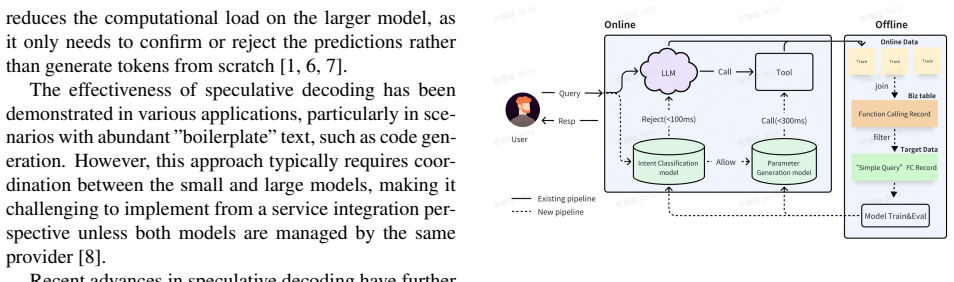
The load-bearing object is the 'simple-query cluster': a group of semantically similar or templated queries in which a single function is called above a threshold share. The paper combines embedding-based hierarchical clustering with named-entity templates to form such clusters, filters out non-dominant calls, trains a classifier-based intent router to recognize them at under 50ms, and trains a 1.3B parameter-generation model to produce the tool call. The latency identity $E(T_{prefc}) = 50 + 300 \cdot p_{\text{small}} + 1600 \cdot (1-p_{\text{small}})$ is the accounting mechanism that converts the fraction of traffic routed to the small model into an expected-latency figure.
What would settle it
Sample the next 1,000 queries the production router sends to the small model, have the large model also answer them offline, and compare tool-name and argument-field correctness; if the small model's error rate is materially above the large model's, the 'negligible degradation' claim is falsified. Separately, replacing the 1600ms constant in Equation (1) with the measured average large-model latency from the same deployment should reproduce the 45% expected reduction within a few points; a large deviation would mean the headline number is an artifact of the assumed baseline.
Extended reading notes
Core claim
The central claim is that consistency of function selection within semantically similar query clusters is a reliable signal of how simple a query is, and that this signal can drive a safe two-tier serving architecture. Queries such as 'play Jay Chou's songs' and 'play some music by Jay Chou' fall into one cluster whose dominant function is audioSearch; ambiguous and context-dependent queries like 'switch' and 'more of these' do not. The paper reports that the resulting intent-routing model routes 60% of traffic to a 1.3B model trained on the large model's outputs for those clusters, with negligible degradation in function selection and parameter extraction. The latency accounting is $E(T_{prefc}) = 50 + 300 \times 60\% + 1600 \times 40\% = 870\text{ms}$, which turns the routing coverage into a concrete expected-latency number.
Load-bearing premise
The speedup rests on the assumption that clusters in which one function clearly dominates are safe to hand to a small model, so that the 60% of traffic routed away from the large model does not carry a hidden rise in wrong tool calls or bad parameters.
Editorial extensions
If this is right
- On 60% of routed traffic, the large model is not invoked at all, so per-request GPU cost for that share drops to the 1.3B model's cost.
- Expected function-calling latency falls to 870ms and median to 350ms, assuming the 1600ms and 300ms latency constants and 60% routing share hold.
- Because clusters and labels come automatically from production interaction data, the pipeline can be refreshed daily without manual annotation.
- The router must stay above 95% accuracy; as long as it does, misrouted hard queries are the main risk and the paper reports them as negligible.
Reading between the lines
- The threshold that defines a 'dominant function' inside a cluster is the real safety dial; the paper does not report its value, so a reasonable next step is to measure routing accuracy as that threshold varies.
- The same cluster-dominance heuristic should transfer to domains where a small set of functions covers most requests, such as travel, shopping, or support, but the threshold would need per-domain calibration before production.
- The reported 45% expected saving is tied to the assumed 1600ms large-model average; sites with faster or slower baselines will see different savings, and recomputing Equation (1) with measured quantiles would make the claim more portable.
- A stronger evaluation would compare the 1.3B model against the large model on the 40% complex traffic as well, to quantify what 'negligible' means near the routing boundary.
Editorial analysis
A structured set of objections, weighed in public.
Referee Report
Summary. The paper proposes ODIA, a dual-model system for accelerating LLM-based function calling in production. It clusters production user queries by semantic similarity and NER-based templates, labels clusters as 'simple' when a dominant function appears frequently, trains a small routing model and a 1.3B parameter-generation model on those clusters, and routes roughly 60% of traffic to the small model with fallback to a large model otherwise. The authors report a 45% expected and 78% median latency reduction with 'negligible' accuracy loss, based on a deployment in a music application. The offline pipeline handles incremental cluster updates, and the system is designed for continuous self-improvement.
Significance. If the accuracy claim holds, ODIA is a practical, low-cost way to reduce function-calling latency for a large fraction of production traffic without replacing the large model. The latency decomposition in Eq. (1) is transparent, and the use of production traffic with automatic clustering and distillation is a plausible route to scalable acceleration. The paper also demonstrates a real deployment, which is valuable evidence for feasibility. However, the central accuracy claim is currently unquantified, and the evaluation lacks the held-out, temporal controls needed to distinguish genuine generalization from memorization of the training distribution. Because the method's value depends entirely on maintaining accuracy on the routed traffic, the missing accuracy evaluation is load-bearing and must be addressed before the claims can be accepted.
major comments (4)
- [§4.1.2] The central claim of 'negligible degradation' is not supported by any quantitative evidence. The section states that the parameter generation model achieved 'accuracy comparable to the large model' but reports no accuracy numbers, no evaluation set size, no error bars, and no comparison baseline. The manuscript also includes no confusion matrices or per-function accuracy. This is load-bearing because if the small model makes systematic errors on the 60% of traffic it handles, the overall system accuracy drops regardless of the fallback. Please report function-selection accuracy and parameter-extraction accuracy on a held-out set, with the large-model performance on the same set as a baseline, ideally with confidence intervals.
- [§4.1.1, Eq. (1)] The latency arithmetic in Eq. (1) uses 1600 ms as the large-model latency, but §1 states that typical latency is 1–2 seconds and P90 is 2–3 seconds. Moreover, the text reports a median reduction from 1600 ms to 350 ms, which treats 1600 ms as the median baseline, while Eq. (1) treats it as the mean in an expected-value calculation. These two uses are inconsistent unless the baseline distribution is degenerate. Please report the measured latency distributions (mean, median, P90) for both models on the same production traffic and derive both the expected and median reductions from those distributions.
- [§3.4, §3.6] The definition of 'simple' clusters depends on two unreported free parameters: the dominant-function percentage threshold in §3.4 and the clustering similarity threshold in §3.3.1/§3.6. The paper does not report the values used, the number of clusters produced, or the fraction of traffic covered at each threshold. Because the same production traffic is used to define the labels, train the router, and report accuracy, the reported 'negligible degradation' could reflect memorization of the evaluation distribution. Please report the threshold values and evaluate on temporally held-out traffic (e.g., data from a later time period than all training data), with an analysis of how accuracy and coverage vary with the thresholds.
- [Table 1] Table 1 is labeled 'Model Performance Evaluation' but only reports GPU type, QPS, P99, average, and maximum latency. It does not state which model was measured, what workload was used, whether these are serving-latency or end-to-end numbers, or whether accuracy was monitored during that latency measurement. As written, the table does not support the coverage and accuracy claims in §4.1.2. Please either remove it or clarify exactly what was measured and how it relates to the accuracy and latency claims.
minor comments (5)
- [§3.5.1] The sentence 'increasing 12% in offline evaluations' is missing the quantity being increased; it should specify coverage or accuracy, and ideally give absolute values before and after the change.
- [§3.5.2] The model name 'qinwen2-1.5B' appears to be a typo for 'Qwen2-1.5B'; please correct it for reproducibility.
- [§4.1.1] The visual comparison 'the small model has already completed four lines' is not a quantitative latency measurement; please supplement or replace it with actual measured generation-time comparisons.
- [§3.7] The token-optimization and prompt-optimization steps are described qualitatively, but no measured impact on latency or accuracy is given; a small table quantifying the effect of each optimization would strengthen the paper.
- [§2.1] The related-work discussion of speculative decoding would benefit from mentioning that ODIA, unlike speculative decoding, routes the entire request and does not require token-level verification, since this difference is what motivates the architecture.
Circularity Check
Accuracy claim is unquantified and its described evaluation is self-referential; the latency calculation is independent and transparent.
-
fitted input called prediction
[Section 3.4 (Filtering Simple Queries) and Section 4.1.2 (Coverage and Accuracy)]
"Clusters where the most frequent function exceeds a threshold percentage are labeled as 'simple' ... Within these clusters, we discard individual queries that call functions other than the dominant one ... Within this subset, the parameter generation model achieved accuracy comparable to the large model, with negligible degradation in function selection and parameter extraction."
The 'subset' on which the negligible-degradation claim is made is the same self-filtered production data used to define and train the simple-query models. Because every retained record in a simple cluster is, by construction, labeled with the cluster's dominant function, a model that learns the cluster-to-dominant-function mapping trivially achieves high function-selection agreement on that distribution; no held-out or temporal split is described. The accuracy 'prediction' is therefore partly a restatement of the filtering step, plus a fit to the same labels, rather than an independent test of whether small models generalize to unseen simple traffic. Parameter extraction is not circular, so the issue is partial; the latency arithmetic in Eq. (1) is independent.
full rationale
The paper's strongest quantitative result, the 45%/78% latency reduction, is a self-contained arithmetic calculation from measured routing fraction (60%), measured small-model latency (300ms), routing overhead (50ms), and assumed large-model latency (1600ms). No fitted parameter is renamed as a prediction in this part, and there is no self-citation chain. The circularity concern is confined to the accuracy half of the central claim. Section 3.4 defines 'simple' clusters by a dominant-function threshold and then discards all non-dominant calls within those clusters; Section 4.1.2 reports 'negligible degradation' in function selection and parameter extraction on exactly this self-defined subset, without giving accuracy numbers, an evaluation set description, or a temporal holdout. Under that described protocol, high function-selection agreement on simple traffic is partly guaranteed by construction: the labels were filtered to a single dominant function per cluster, and the model was trained on those same labels. This makes the 'negligible accuracy loss' claim at least partially self-referential, though parameter extraction accuracy and the latency gains remain independent content. The paper also omits the dominant-function threshold, clustering similarity threshold, and any external benchmark, which are evidence gaps rather than additional circular steps. Overall, the central latency claim stands independently, while the accuracy-maintenance claim reduces in part to the paper's own filtering and training procedure.
Assumptions & free parameters
free parameters (2)
- dominant-function threshold for simple clusters =
not reported
- clustering similarity threshold =
not reported
assumptions (3)
- domain assumption Clusters with a dominant function are learnable by a 1.3B model without accuracy loss.
- domain assumption Large-model production outputs used as training targets are correct.
- domain assumption The selected embedding model captures semantic similarity for the music domain.
Cite this review
Pith. "Pith review of ODIA: Oriented Distillation for Inline Acceleration of LLM-based Function Calling." pith.science (2026). https://pith.science/paper/3NSTOZSH
@misc{pith2026250708877,
  author       = {Pith},
  title        = {Pith review of: ODIA: Oriented Distillation for Inline Acceleration of LLM-based Function Calling},
  year         = {2026},
  howpublished = {\url{https://pith.science/paper/3NSTOZSH}},
  note         = {Machine review of arXiv:2507.08877}
}
read the original abstract
Function Calling is a crucial technique that enables Large Language Models (LLMs) to interact with external systems through APIs. However, the high latency associated with LLM-based Function Calling significantly impacts user experience. This paper presents a novel approach called Oriented Distillation for Inline Acceleration (ODIA) that leverages online user interaction data to accelerate Function Calling. By automatically identifying "simple queries" from production traffic and distilling knowledge from larger models to smaller ones, our method reduces response latency by 45% (expected) and 78% (median) while maintaining accuracy. We demonstrate the effectiveness of our approach through real-world deployment in a music application, where the smaller model successfully handles 60% of traffic with negligible accuracy loss. Our method requires minimal human intervention and continuously improves through automated data collection and model updating, making it a practical solution for production environments.
Figures


Figures from the paper (1 more)

Reference graph
Works this paper leans on
-
[1]
Leviathan, Y ., Kalman, M., & Matias, Y . (2023). Fast Inference from Transformers via Speculative Decoding. International Conference on Machine Learning
work page 2023
-
[2]
Dong, X., Wang, S., Lv, K., Feng, C., Cui, H., & Tang, J. (2022). Semantic Cache: Efficient Language Model Serving with Semantic Similarity. arXiv preprint arXiv:2210.08590
work page Pith review arXiv 2022
-
[3]
Hinton, G., Vinyals, O., & Dean, J. (2015). Distill- ing the Knowledge in a Neural Network. arXiv preprint arXiv:1503.02531
arXiv 2015
-
[4]
B., Mann, B., Ryder, N., Subbiah, M., Kaplan, J., Dhariwal, P.,
Brown, T. B., Mann, B., Ryder, N., Subbiah, M., Kaplan, J., Dhariwal, P., ... & Amodei, D. (2020). Language Mod- els are Few-Shot Learners. Advances in Neural Informa- tion Processing Systems
work page 2020
-
[5]
Reimers, N., & Gurevych, I. (2019). Sentence-BERT: Sentence Embeddings using Siamese BERT-Networks. Proceedings of the 2019 Conference on Empirical Meth- ods in Natural Language Processing
work page 2019
-
[6]
Spector, B., & Re, C. (2023). Accelerating LLM Infer- ence with Staged Speculative Decoding. arXiv preprint arXiv:2308.04623. 6
arXiv 2023
-
[7]
Zhang, L., Wang, X., Huang, Y ., & Xu, R. (2024). Learn- ing Harmonized Representations for Speculative Sam- pling. arXiv preprint arXiv:2408.15766
arXiv 2024
-
[8]
Zhang, Z., Jiang, Z., Jiang, C., Yu, M., Zheng, S., Lin, H., Hoffmann, H., & Liu, X. (2025). SwiftSpec: Ultra- Low Latency LLM Decoding by Scaling Asynchronous Speculative Decoding. arXiv preprint arXiv:2506.11309
work page Pith review arXiv 2025
Show all 15 references
-
[9]
H., Su, Z., & Deng, J
Chen, F., Li, P., Luan, T. H., Su, Z., & Deng, J. (2025). SPIN: Accelerating Large Language Model Inference with Heterogeneous Speculative Models. arXiv preprint arXiv:2503.15921
2025 arXiv
-
[10]
Regmi, S., & Pun, C. P. (2024). GPT Semantic Cache: Reducing LLM Costs and Latency via Semantic Embed- ding Caching. arXiv preprint arXiv:2411.05276
2024 arXiv
-
[11]
Iyengar, A., Kundu, A., Kompella, R., & Mamidi, S. N. (2025). A Generative Caching System for Large Lan- guage Models. arXiv preprint arXiv:2503.17603
2025 arXiv
-
[12]
Zhu, H., Zhu, B., & Jiao, J. (2024). Efficient Prompt Caching via Embedding Similarity. arXiv preprint arXiv:2402.01173
2024 arXiv
-
[13]
Gim, I., Lee, S., & Zhong, L. (2024). Asynchronous LLM Function Calling. arXiv preprint arXiv:2412.07017
2024 arXiv
-
[14]
Liu, J., & Zhang, C. (2025). HAMburger: Accelerat- ing LLM Inference via Token Smashing. arXiv preprint arXiv:2505.20438
2025 arXiv
-
[15]
Chen, G., Feng, Q., Ni, J., Li, X., & Shieh, M. Q. (2025). Long-Context Inference with Retrieval-Augmented Spec- ulative Decoding. arXiv preprint arXiv:2502.20330. 7
2025 arXiv
Reviewed August 6, 2026 · model on record in the stance chip above.
Discussion (0). Sign in to comment.