REVIEW 3 major objections 4 minor 1 cited by
Transformer based Collaborative Reinforcement Learning for Fluid Antenna System (FAS)-enabled 3D UAV Positioning
T0 review · 3 major / 4 minor · reviewed 2026-08-06 · deepseek-v4-flash
Pith's one-line read This paper claims that a recurrent multi-agent reinforcement learning scheme with a transformer-based coordinator reduces average 3D positioning error of a cooperatively tracked target UAV by up to 17.5% over value-decomposition MARL…
desk verdict The 58.5% FAS gain is a reward-penalty artifact: within the paper's own model, the antenna port never touches the positioning error, and the analytic proof in Appendix B does not hold. read the letter →
The pith
A machine-rendered reading of the paper's core claim, the machinery that carries it, and where it could break.
The reading
What carries the argument
The central object is the AR-MARL architecture: each controlled UAV runs an RNN-based local Q function that takes the UAV's local state, action, and previous historical state-action pair; the base station runs a transformer made of attention units that compute softmax-weighted combinations of all agents' historical state-action pairs; and a feed-forward factorization operator aggregates the local Q values and the transformer output into a global Q function. The RNN supplies memory of each UAV's own decision history, the transformer supplies inter-agent weighting of those histories, and the factorization operator replaces the linear sum used by value-decomposition baselines, which is what lets the global Q function approximate the team's shared positioning reward more accurately.
What would settle it
Measure the distribution of active-target-passive distance estimates in a real or ray-traced FAS-enabled tracking flight; if the errors have nonzero mean, are correlated across passive UAVs, or do not scale as the reciprocal of the measured SNR, the shared reward used for training no longer equals the true positioning error and the reported gains should be re-tested in that regime.
Extended reading notes
Core claim
The paper's central claim is that, in a line-of-sight FAS-enabled UAV network, jointly optimizing trajectories and antenna ports as a cooperative multi-agent reinforcement learning problem, with an attention-weighted recurrent factorization of the global Q function, yields lower target positioning error than standard alternatives: 17.5% lower mean squared error than value-decomposition MARL, 31.8% lower than independent Q-learning, and 58.5% lower than the same AR-MARL scheme with random port selection. The mechanism is that an RNN inside each UAV's local Q function remembers its own recent state-action pairs, and a transformer coordinator at the base station weights those histories so the global Q function can be approximated more accurately than by a linear sum of local Q functions. The paper also derives an analytic positioning-error expression: when the passive UAVs sit at equal distances from the target, the error is $\xi_t = \sqrt{\sigma_{k,t}^2 \operatorname{Tr}\left((W^T W)^{-1}\right)}$, and the minimum achievable error scales as $\xi^{\min}_t = \frac{3 d_{0,t} L_{\min} \rho^2}{\alpha_0 \beta_{k,t} \sqrt{p_{0,t}} + B \rho}$, decreasing as the active UAV's transmit power increases.
Load-bearing premise
The load-bearing premise is that every passive UAV's distance estimate misses the truth by an independent, zero-mean bell-shaped error whose spread is exactly the reciprocal of the measured signal-to-noise ratio; the shared reward and the analytic error bound both depend on this, so if real errors are biased, correlated across UAVs, or non-bell-shaped, the claimed margins are not guaranteed.
Editorial extensions
If this is right
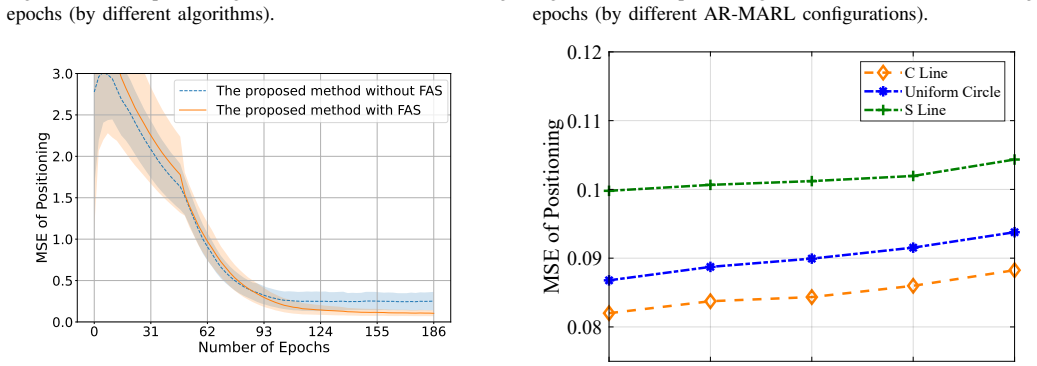
- In the simulated LoS network, AR-MARL reduces average positioning MSE by up to 17.5% over VD-MARL and 31.8% over independent Q-learning at epoch 186.
- The FAS port-selection contribution is the largest tested component: replacing learned port selection with random selection raises positioning MSE by up to 58.5%.
- Ablation results attribute an 11.3% MSE reduction to the transformer coordinator and an 80.6% reduction to the RNN memory in the local Q functions.
- If the analytic bound in Proposition 1 holds, pushing passive UAVs to the minimum allowed equal distance from the target and raising active transmit power drives the positioning error toward $\frac{3 d_{0,t} L_{\min} \rho^2}{\alpha_0 \beta_{k,t} \sqrt{p_{0,t}} + B \rho}$.
- Higher target speed and more erratic target motion (S-line versus C-line) increase positioning MSE in the simulations, so the reported margins are demonstrated for the tested dynamics rather than universally.
Reading between the lines
- Beyond the paper: because the analytic bound says equal target-passive distances are optimal, a geometric formation controller could enforce that condition while the learned policy focuses on antenna-port selection, a decomposition the paper does not test.
- Beyond the paper: the 58.5% FAS gain is tied to the simulated channel with 32 ports, fixed path counts, and AoD spread; a field test with correlated shadowing or fewer ports could shrink the gain, since a simpler instantaneous-SINR port heuristic might match the learned selection.
- Beyond the paper: the attention weights over historical state-action pairs could be inspected to explain which past decisions matter for tracking, giving the coordinator a diagnostic role the paper does not explore.
Editorial analysis
A structured set of objections, weighed in public.
Referee Report
Summary. The manuscript proposes a 3D UAV positioning framework with one active UAV, four FAS-equipped passive UAVs, and a ground BS that localizes a moving target UAV from active-target-passive bistatic distance estimates via TDOA. The authors formulate a joint trajectory and antenna-port-selection problem and solve it with an attention-based recurrent multi-agent reinforcement learning (AR-MARL) scheme using RNN-based local Q-functions and a transformer-based coordinator at the BS. Simulation convergence curves report positioning-MSE reductions of up to 17.5% versus VD-MARL, 31.8% versus independent Q, and 58.5% versus the same scheme without FAS. An analytic section (Theorem 1 and Proposition 1) claims that the positioning error is minimized when the target-passive UAV distances are equal and that the minimum error decreases with active-UAV transmit power.
Significance. The proposed architecture is a plausible engineering combination of existing components: QMIX-style value decomposition, RNN local Q-functions, and a transformer attention module. The paper gives an explicit complexity analysis and evaluates against standard MARL baselines, which is a useful starting point for cooperative UAV localization. If the reported gains were reproducible and the analytic bounds correct, the work would be a solid systems contribution. However, the headline FAS gain is inconsistent with the paper's own model, because port selection does not enter the positioning objective, and the analytic derivation of Proposition 1 contains invalid steps. The empirical claims are also not supported by error bars, seed information, or released code. The MARL algorithm may remain promising, but the current evidence does not establish the paper's central claims.
major comments (3)
- [Section II.D and Section V, Fig. 5] The antenna port n_k,t does not appear in the estimated distance m̂_k,t in Eq. (16) or in the TDOA positioning objective (9); it affects only the UAV-BS SINR (7), the latency (8), and the constraint (9a). Hence, for every action that satisfies (9a), the objective in (9) is independent of n_k,t. The reported 58.5% improvement of "with FAS" over "without FAS" can therefore only arise from the -1e6 penalty in Eq. (10) when random port selection violates (9a), which is a constraint-satisfaction artifact rather than a positioning-accuracy gain. The explanation in Section V that FAS "enhances the SINR of the UAV-ground BS links" does not connect SINR to the distance estimates or to the TDOA error. This invalidates the headline FAS claim and requires either a new model in which port selection affects transmission reliability or accuracy, or removal of the FAS gain claim.
- [Appendix B, proof of Proposition 1] The proof contains load-bearing mathematical errors. Equal distances d_k,t between the target and the passive UAVs do not imply equal eigenvalues of W^T W; W depends on the directions (q_k,t - u_t)/d_k,t and on the active-UAV coordinate terms, so the assertion ς1=ς2=ς3 in Eq. (33) is unsupported. Proposition 1 states e_k,t = A σ^2_k,t, but the proof uses e_k,t = B σ_k,t, and A never appears in the final expression (22). In addition, the matrix W in Eq. (31) drops the (x_t - x_0,t)/d_0,t terms that are present in Eq. (18). Consequently, Theorem 1 and Proposition 1 are not established and should either be proved correctly or removed.
- [Section V, Figs. 4-9] All empirical claims are supported only by single convergence curves, with no error bars, no number of random seeds, no confidence intervals, and no code release. Given that the FAS comparison is internally inconsistent, the simulation results as presented cannot be independently verified. The experimental section must be redone with a corrected model and with statistical reporting of variance across seeds.
minor comments (4)
- [Fig. 9 caption] The Fig. 9 caption reads "MSE of positioning versus the trajectory uncertainty," but the axis is "Number of antenna ports"; this appears to be a copy-paste error from Fig. 8.
- [Throughout] The text contains several typos and spacing inconsistencies, including "Guassian," "UA V," "vechicle," and "is is," which should be corrected.
- [Eq. (31)] The entries x1 - x1,t, y1 - y1,t, etc., in Eq. (31) are presumably x_t - x_k,t, y_t - y_k,t, etc.; please fix the notation.
- [Eq. (14) and Table II] The hyperparameter δ in Eq. (14) is never specified in Table II; the paper should report its value and sensitivity.
Circularity Check
No significant circularity: the central claims are benchmarked externally and the analytic bounds are derived from the stated models rather than fitted to the target result.
full rationale
The paper's central empirical claims are simulation comparisons against VD-MARL, independent Q, and a no-FAS ablation, so they are not derived from the paper's own assumptions by construction. The reward function (10) is the negative of the objective (9), which is a standard optimization encoding and not a hidden equivalence. The analytic results (Theorem 1 and Proposition 1) follow from the Gaussian measurement-error model (16), the channel models (2)-(8), and the distance constraints; no parameter is fitted to the reported positioning error, and the arbitrary constant B in Proposition 1 is not a fitted value. Self-citations [8], [23], and [33] are used only as prior work or baselines and are not load-bearing for the main derivation. A separate concern, not a circularity, is that the FAS improvement in Fig. 5 lacks a causal mechanism in the equations: the antenna-port index n_k,t appears only in the latency constraint (9a), not in the measurement error (16) or objective (9), so the reported gain may be an artifact of the -1e6 penalty in (10). This is a modeling-validity issue rather than a circular derivation, because the comparison is an empirical simulation outcome, not a first-principles prediction. No circular steps are therefore identified.
Assumptions & free parameters
free parameters (2)
- A and B in Proposition 1 =
unspecified constants
- delta (loss weight) =
not reported
assumptions (4)
- domain assumption All active-target and target-passive links are LoS with constant reflection coefficient beta
- domain assumption The distance measurement error e_k,t is zero-mean Gaussian with variance 1/gamma^P_k,t
- ad hoc to paper For equal target-passive distances, the eigenvalues of W^T W are equal
- standard math TDOA estimator at the BS is approximated by the linearized least-squares relation d_u = (W^T W)^-1 W^T d_m
Cite this review
Pith. "Pith review of Transformer based Collaborative Reinforcement Learning for Fluid Antenna System (FAS)-enabled 3D UAV Positioning." pith.science (2026). https://pith.science/paper/XUUTAYSM
@misc{pith2026250709094,
  author       = {Pith},
  title        = {Pith review of: Transformer based Collaborative Reinforcement Learning for Fluid Antenna System (FAS)-enabled 3D UAV Positioning},
  year         = {2026},
  howpublished = {\url{https://pith.science/paper/XUUTAYSM}},
  note         = {Machine review of arXiv:2507.09094}
}
read the original abstract
In this paper, a novel Three dimensional (3D) positioning framework of fluid antenna system (FAS)-enabled unmanned aerial vehicles (UAVs) is developed. In the proposed framework, a set of controlled UAVs cooperatively estimate the real-time 3D position of a target UAV. Here, the active UAV transmits a measurement signal to the passive UAVs via the reflection from the target UAV. Each passive UAV estimates the distance of the active-target-passive UAV link and selects an antenna port to share the distance information with the base station (BS) that calculates the real-time position of the target UAV. As the target UAV is moving due to its task operation, the controlled UAVs must optimize their trajectories and select optimal antenna port, aiming to estimate the real-time position of the target UAV. We formulate this problem as an optimization problem to minimize the target UAV positioning error via optimizing the trajectories of all controlled UAVs and antenna port selection of passive UAVs. Here, an attention-based recurrent multi-agent reinforcement learning (AR-MARL) scheme is proposed, which enables each controlled UAV to use the local Q function to determine its trajectory and antenna port while optimizing the target UAV positioning performance without knowing the trajectories and antenna port selections of other controlled UAVs. Different from current MARL methods, the proposed method uses a recurrent neural network (RNN) that incorporates historical state-action pairs of each controlled UAV, and an attention mechanism to analyze the importance of these historical state-action pairs, thus improving the global Q function approximation accuracy and the target UAV positioning accuracy. Simulation results show that the proposed AR-MARL scheme can reduce the average positioning error by up to 17.5% and 58.5% compared to the VD-MARL scheme and the proposed method without FAS.
Figures


Figures from the paper (4 more)



Forward citations
Cited by 1 Pith paper
-
Advancing Fluid Antenna-Assisted Non-Terrestrial Networks in 6G and Beyond: Fundamentals, State of the Art, and Future Directions
A literature survey of fluid-antenna-assisted non-terrestrial networks; it organizes existing results and identifies future directions but proves no new result.
Reference graph
Works this paper leans on
-
[1]
A tutorial on UA Vs for wireless networks: Applications, challenges, and open problems,
M. Mozaffari, W. Saad, M. Bennis, Y .-H. Nam, and M. Debbah, “A tutorial on UA Vs for wireless networks: Applications, challenges, and open problems,”IEEE Communications Surveys & Tutorials, vol. 21, no. 3, pp. 2334–2360, Third Quarter 2019
work page 2019
-
[2]
A reinforcement learning approach for wildfire tracking with UA V swarms,
C. Diaz-Vilor, A. Lozano, and H. Jafarkhani, “A reinforcement learning approach for wildfire tracking with UA V swarms,”IEEE Transactions on Wireless Communications, to appear, 2025
work page 2025
-
[3]
A survey on millimeter-wave beamforming enabled UA V communications and networking,
Z. Xiao, L. Zhu, Y . Liu, P. Yi, R. Zhang, X.-G. Xia, and R. Schober, “A survey on millimeter-wave beamforming enabled UA V communications and networking,”IEEE Communications Surveys & Tutorials, vol. 24, no. 1, pp. 557–610, First Quarter 2022
work page 2022
-
[4]
6G wireless channel measurements and models: Trends and challenges,
C.-X. Wang, J. Huang, H. Wang, X. Gao, X. You, and Y . Hao, “6G wireless channel measurements and models: Trends and challenges,” IEEE Vehicular Technology Magazine, vol. 15, no. 4, pp. 22–32, Dec. 2020
work page 2020
-
[5]
S. Bi, J. Yu, Z. Yang, X. Lin, and Y . Wu, “Joint 3-D deployment and resource allocation for UA V-assisted integrated communication and localization,”IEEE Wireless Communications Letters, vol. 12, no. 10, pp. 1672–1676, Oct. 2023
work page 2023
-
[6]
Deployment optimization of dual- functional UA Vs for integrated localization and communication,
Z. Yang, S. Bi, and Y .-J. A. Zhang, “Deployment optimization of dual- functional UA Vs for integrated localization and communication,”IEEE Transactions on Wireless Communications, vol. 22, no. 12, pp. 9672– 9687, Dec. 2023
work page 2023
-
[7]
An experimental evaluation of radio models for localizing fixed-wing UA Vs in rural environments,
M. Silic and K. Mohseni, “An experimental evaluation of radio models for localizing fixed-wing UA Vs in rural environments,”IEEE Transac- tions on Vehicular Technology, vol. 72, no. 5, pp. 5576–5586, May 2023
work page 2023
-
[8]
Y . Zhu, M. Chen, S. Wang, Y . Hu, Y . Liu, and C. Yin, “Collaborative reinforcement learning based unmanned aerial vehicle (UA V) trajectory design for 3D UA V tracking,”IEEE Transactions on Mobile Computing, to appear, 2024
work page 2024
Show all 37 references
-
[9]
A vehicle-mounted radar- vision system for precisely positioning clustering UA Vs,
G. Wu, F. Zhou, K. Kit Wong, and X.-Y . Li, “A vehicle-mounted radar- vision system for precisely positioning clustering UA Vs,”IEEE Journal on Selected Areas in Communications, vol. 42, no. 10, pp. 2688–2703, Oct. 2024
2024
-
[10]
Fang-based 3D TDOA localization method for large-scale UA V cluster,
Y . Liu, P. Chen, Z. Chen, and J. Xu, “Fang-based 3D TDOA localization method for large-scale UA V cluster,”IEEE Communications Letters, vol. 28, no. 1, pp. 58–62, Jan. 2024
2024
-
[11]
2D- DOA estimation auxiliary localization of anonymous UA V using EMVS- MIMO radar,
F. Wen, Z. Zhang, H. Sun, G. Gui, H. Sari, and F. Adachi, “2D- DOA estimation auxiliary localization of anonymous UA V using EMVS- MIMO radar,”IEEE Internet of Things Journal, vol. 11, no. 9, pp. 16 255–16 266, May 2024
2024
-
[12]
Resonant-beam- enabled relative localization for UA V swarm,
S. Du, M. Xu, M. Liu, G. Zhang, S. Xia, and Q. Liu, “Resonant-beam- enabled relative localization for UA V swarm,”IEEE Internet of Things Journal, vol. 11, no. 10, pp. 17 827–17 839, May 2024
2024
-
[13]
AI- empowered fluid antenna systems: Opportunities, challenges, and future directions,
C. Wang, Z. Li, K.-K. Wong, R. Murch, C.-B. Chae, and S. Jin, “AI- empowered fluid antenna systems: Opportunities, challenges, and future directions,”IEEE Wireless Communications, vol. 31, no. 5, pp. 34–41, Oct. 2024
2024
-
[14]
A tutorial on fluid antenna system for 6G networks: Encompassing communication theory, optimization methods and hardware designs,
W. K. New, K.-K. Wong, H. Xu, C. Wang, F. R. Ghadi, J. Zhang, J. Rao, R. Murch, P. Ram ´ırez-Espinosa, D. Morales-Jimenez, C.-B. Chae, and K.-F. Tong, “A tutorial on fluid antenna system for 6G networks: Encompassing communication theory, optimization methods and hardware desi...
2024
-
[15]
Shifting the ISAC trade-off with fluid antenna systems,
J. Zou, H. Xu, C. Wang, L. Xu, S. Sun, K. Meng, C. Masouros, and K.-K. Wong, “Shifting the ISAC trade-off with fluid antenna systems,” IEEE Wireless Communications Letters, vol. 13, no. 12, pp. 3479–3483, Dec. 2024
2024
-
[16]
6D movable antenna enhanced interference mitigation for cellular-connected UA V communications,
T. Ren, X. Zhang, L. Zhu, W. Ma, X. Gao, and R. Zhang, “6D movable antenna enhanced interference mitigation for cellular-connected UA V communications,”arXiv:2409.13278v1, Sept. 2024
2024 arXiv
-
[17]
UA V-mounted movable an- tenna: Joint optimization of UA V placement and antenna configuration,
X.-W. Tang, Y . Shi, Y . Huang, and Q. Wu, “UA V-mounted movable an- tenna: Joint optimization of UA V placement and antenna configuration,” arXiv:2409.02469v1, Sept. 2024
2024
-
[18]
UA V-enabled wireless networks with movable-antenna array: Flexible beamforming and trajectory design,
W. Liu, X. Zhang, H. Xing, J. Ren, Y . Shen, and S. Cui, “UA V-enabled wireless networks with movable-antenna array: Flexible beamforming and trajectory design,”IEEE Wireless Communications Letters, to ap- pear, 2024
2024
-
[19]
Movable-antenna array empowered ISAC systems for low-altitude economy,
Z. Kuang, W. Liu, C. Wang, Z. Jin, J. Ren, X. Zhang, and Y . Shen, “Movable-antenna array empowered ISAC systems for low-altitude economy,” inProc. IEEE/CIC International Conference on Communi- cations in China (ICCC Workshops), Hangzhou, China, Aug. 2024, pp. 776–781
2024
-
[20]
Sum-rate maximization for UA V relay-aided fluid antenna system with NOMA,
S. B. S. Abdou, W. K. New, C. Y . Leow, S. Won, K.-K. Wong, and Z. Ding, “Sum-rate maximization for UA V relay-aided fluid antenna system with NOMA,” inProc. IEEE 7th International Symposium on Telecommunication Technologies (ISTT), Langkawi Island, Malaysia, Oct. 2024, pp. 53–58
2024
-
[21]
RIS-aided fluid antenna array-mounted UA V networks,
L.-H. Shen and Y .-H. Chiu, “RIS-aided fluid antenna array-mounted UA V networks,”IEEE Wireless Communications Letters, to appear, 2025
2025
-
[22]
Movable antenna- equipped UA V for data collection in backscatter sensor networks: A deep reinforcement learning-based approach,
Y . Bai, B. Xie, R. Zhu, Z. Chang, and R. Jantti, “Movable antenna- equipped UA V for data collection in backscatter sensor networks: A deep reinforcement learning-based approach,”arXiv:2411.13970v1, Nov. 2024
2024 arXiv
-
[23]
Distributed multi- agent meta learning for trajectory design in wireless drone networks,
Y . Hu, M. Chen, W. Saad, H. V . Poor, and S. Cui, “Distributed multi- agent meta learning for trajectory design in wireless drone networks,” IEEE Journal on Selected Areas in Communications, vol. 39, no. 10, pp. 3177–3192, Oct. 2021
2021
-
[24]
An information-theoretic characterization of MIMO-FAS: Optimization, diversity-multiplexing tradeoff and q-outage capacity,
W. K. New, K.-K. Wong, X. Hao, K.-F. Tong, and C.-B. Chae, “An information-theoretic characterization of MIMO-FAS: Optimization, diversity-multiplexing tradeoff and q-outage capacity,”IEEE Transac- tions on Wireless Communications, vol. 23, no. 6, pp. 5541–5556, Jun. 2024
2024
-
[25]
Capacity maximization for FAS-assisted multiple access channels,
H. Xu, K.-K. Wong, W. K. New, F. R. Ghadi, G. Zhou, R. Murch, C.- B. Chae, Y . Zhu, and S. Jin, “Capacity maximization for FAS-assisted multiple access channels,”IEEE Transactions on Communications, to appear, 2025
2025
-
[26]
Robust localization with minimum number of TDoA measurements,
S. C. K. Herath and P. N. Pathirana, “Robust localization with minimum number of TDoA measurements,”IEEE Signal Processing Letters, vol. 20, no. 10, pp. 949–951, Oct. 2013
2013
-
[27]
Nocedal and S
J. Nocedal and S. Wright,Numerical Optimization, 2nd ed. New York, NY: Springer, 2006
2006
-
[28]
Hivemind: Towards cellular native machine learning model splitting,
S. Wang, X. Zhang, H. Uchiyama, and H. Matsuda, “Hivemind: Towards cellular native machine learning model splitting,”IEEE Journal on Selected Areas in Communications, vol. 40, no. 2, pp. 626–640, Feb. 2022
2022
-
[29]
Attention is all you need,
A. Vaswani, N. Shazeer, N. Parmar, J. Uszkoreit, L. Jones, A. N. Gomez, L. Kaiser, and I. Polosukhin, “Attention is all you need,” inProc. of International Conference on Neural Information Processing Systems, Long Beach, California, USA, Dec. 2017, pp. 6000–6010
2017
-
[30]
Deep recurrent reinforcement learning-based distributed dynamic spec- trum access in multichannel wireless networks with imperfect feedback,
A. Kaur, J. Thakur, M. Thakur, K. Kumar, A. Prakash, and R. Tripathi, “Deep recurrent reinforcement learning-based distributed dynamic spec- trum access in multichannel wireless networks with imperfect feedback,” IEEE Transactions on Cognitive Communications and Networking, vo...
2023
-
[31]
UA V trajectory planning for AoI-minimal data collection in UA V-aided IoT networks by transformer,
B. Zhu, E. Bedeer, H. H. Nguyen, R. Barton, and Z. Gao, “UA V trajectory planning for AoI-minimal data collection in UA V-aided IoT networks by transformer,”IEEE Transactions on Wireless Communica- tions, vol. 22, no. 2, pp. 1343–1358, Feb. 2023
2023
-
[32]
Satellite-terrestrial coordinated multi-satellite beam hopping scheduling based on multi- agent deep reinforcement learning,
Z. Lin, Z. Ni, L. Kuang, C. Jiang, and Z. Huang, “Satellite-terrestrial coordinated multi-satellite beam hopping scheduling based on multi- agent deep reinforcement learning,”IEEE Transactions on Wireless Communications, vol. 23, no. 8, pp. 10 091–10 103, Aug. 2024
2024
-
[33]
Passive inter-satellite localization accuracy optimization in low earth orbit satellite networks,
Y . Zhu, M. Chen, S. Wang, Y . Hu, Y . Liu, C. Yin, and T. Q. S. Quek, “Passive inter-satellite localization accuracy optimization in low earth orbit satellite networks,”IEEE Transactions on Wireless Communica- tions, to appear, 2025
2025
-
[34]
UA V communication against intelligent jamming: A stackelberg game approach with federated reinforcement learning,
Z. Yin, J. Li, Z. Wang, Y . Qian, Y . Lin, F. Shu, and W. Chen, “UA V communication against intelligent jamming: A stackelberg game approach with federated reinforcement learning,”IEEE Transactions on Green Communications and Networking, vol. 8, no. 4, pp. 1796–1808, Dec. 2024
2024
-
[35]
Target localization accuracy gain in MIMO radar-based systems,
H. Godrich, A. M. Haimovich, and R. S. Blum, “Target localization accuracy gain in MIMO radar-based systems,”IEEE Transactions on Information Theory, vol. 56, no. 6, pp. 2783–2803, June 2010
2010
-
[36]
An overview on the time delay estimate in active and passive systems for target localization,
A. Quazi, “An overview on the time delay estimate in active and passive systems for target localization,”IEEE Transactions on Acoustics, Speech, and Signal Processing, vol. 29, no. 3, pp. 527–533, June 1981
1981
-
[37]
A fast satellite selection algorithm: Beyond four satellites,
M. Zhang and J. Zhang, “A fast satellite selection algorithm: Beyond four satellites,”IEEE Journal of Selected Topics in Signal Processing, vol. 3, no. 5, pp. 740–747, Oct. 2009
2009
Reviewed August 6, 2026 · model on record in the stance chip above.
Discussion (0). Continue with ORCID to comment.