REVIEW 3 major objections 4 minor 84 references
CoVAE: Consistency Training of Variational Autoencoders
T0 review · 3 major / 4 minor · reviewed 2026-08-06 · deepseek-v4-flash
Pith's one-line read The paper claims CoVAE, a variational autoencoder trained with a consistency loss over progressively noised latents, can generate competitive images in one or few decoder passes without a learned prior, outperforming equivalent VAEs and…
desk verdict CoVAE is a genuinely new single-stage VAE training scheme with promising FID numbers, but the consistency-model grounding is shakier than the title suggests and the headline comparisons are weakened by single-seed runs and test-set-selected sampling schedules. read the letter →
The pith
A machine-rendered reading of the paper's core claim, the machinery that carries it, and where it could break.
The reading
What carries the argument
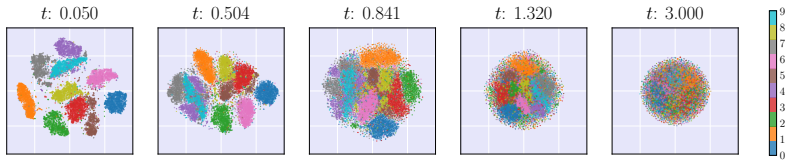
The central object is the CoVAE objective (Eq. 12), a discrete latent consistency loss augmented by a time-dependent KL term: $L=\mathbb{E}[\lambda(t_i)\,\|D_\theta(z_{t_i},t_i)-D_{\theta^-}(z_{t_{i-1}},t_{i-1})\|^2]+\beta(t_i)\,\mathrm{KL}(\mathcal{N}(E^\mu_\phi(x,t_i),E^\sigma_\phi(x,t_i)^2I)\,\|\,\mathcal{N}(0,I))$, with latents $z_t=E^\mu_\phi(x,t)+E^\sigma_\phi(x,t)\epsilon$ drawn using the same noise direction $\epsilon$ at both times and a frozen target network $\theta^-$. The boundary condition, enforced through $D_\theta(z_t,t)=c_{\mathrm{skip}}(t)\hat{x}_{\theta^-}(z_t,t)+c_{\mathrm{out}}(t)r_\theta(z_t,t)$, turns the earliest time step into an ordinary autoencoder reconstruction, so the consistency loss bootstraps one-step decoding from pure noise. The KL weight $\beta(t)=t^2$ is what makes the aggregate latent distribution become Gaussian as time grows, replacing the analytic diffusion forward kernel with a learned one.
What would settle it
Train CoVAE on CIFAR-10 with the same architecture, schedules, and budget, but replace the consistency term $\|D_\theta(z_{t_i},t_i)-D_{\theta^-}(z_{t_{i-1}},t_{i-1})\|^2$ with a plain reconstruction $\|D_\theta(z_{t_i},t_i)-x\|^2$ at every time step, reducing the objective to a time-dependent β-VAE. If the one-step FID stays near CoVAE's 17.21 rather than degrading toward the β-VAE baseline's 66.79, the consistency bootstrap is not what produces the reported gain.
Extended reading notes
Core claim
On its own terms, the paper's discovery is that the reconstruction term of a time-dependent β-VAE can be replaced by a consistency loss over adjacent latent time steps, making the decoder learn the deterministic denoising trajectory jointly with the encoder. The encoder maps each data point to a series of latents $z_t=E^\mu_\phi(x,t)+E^\sigma_\phi(x,t)\epsilon$ with the same noise direction $\epsilon$ across times; the time-dependent KL weight $\beta(t)$ drives the aggregate posterior toward a standard Gaussian as $t$ grows, so the sequence of latents plays the role of a diffusion forward process even though the noise is added by the learned encoder rather than an analytic kernel. The decoder is trained so that $D_\theta(z_{t_i},t_i)$ agrees with the frozen earlier-time prediction $D_{\theta^-}(z_{t_{i-1}},t_{i-1})$, with a boundary condition at $t_0$ that reduces the loss to ordinary autoencoding at the earliest time. After training, sampling starts from $z\sim\mathcal{N}(0,I)$ and decodes directly, or re-encodes intermediate samples for a second denoising pass. The paper reports that this yields substantially lower FID than matched VAE and β-VAE baselines and outperforms the NVAE and DC-VAE one-stage baselines on CIFAR-10 and CelebA-64.
Load-bearing premise
The method assumes the encoder's progressively noisier latent representations form a genuine denoising path, so that the frozen decoder's earlier-time prediction is a valid target for the prediction at a later time; the paper gives empirical SNR and visualization evidence but no proof.
Editorial extensions
If this is right
- No learned prior is needed: sampling begins with $\epsilon\sim\mathcal{N}(0,I)$ and decodes with the time-conditioned decoder, replacing the usual VAE-plus-diffusion prior pipeline.
- Two-step sampling helps consistently: FID drops from 5.62 to 3.83 on MNIST, from 17.21/11.69 to 14.06/9.82 on CIFAR-10, and from 8.27 to 7.15 on CelebA-64.
- Reconstruction does not collapse: reconstruction FID is 2.19 on MNIST, 2.36/2.15 on CIFAR-10, and 4.90 on CelebA-64, so generation quality is not bought by losing autoencoding fidelity.
- The time-indexed latent space exposes a reconstruction–disentanglement knob: interpolation and attribute manipulation work more semantically at larger $t$, which the paper exploits for image editing in a single model.
- The objective transfers beyond images: a binary-MNIST variant trained with cross-entropy reaches 1-step FID 0.58, a proof of concept for discrete data.
Reading between the lines
- Beyond the paper's experiments, the learned forward process invites a theoretical analysis: proving (or disproving) that the $\beta(t)$-scheduled KL defines a self-consistent latent denoising trajectory would turn the empirical bootstrap into a principled generative guarantee.
- Beyond the paper's experiments, hierarchical VAE architectures are the obvious testbed: the paper notes any existing VAE can be time-conditioned, so consistency training could close most of the one-step FID gap of hierarchical models without adversarial or contrastive terms.
- Beyond the paper's experiments, the simplified variant with a fixed latent forward kernel (s-CoVAE) underperforms the learned path, which suggests the learned latent dynamics — not the consistency loss alone — is the component carrying the gain; isolating that component in an ablation would make the mechanism explicit.
- Beyond the paper's experiments, two-step sampling is a self-refinement loop rather than an ODE discretization, so learned schedules and early stopping could turn CoVAE into a controllable iterative refinement model for editing or super-resolution, not just generation.
Editorial analysis
A structured set of objections, weighed in public.
Referee Report
Summary. The paper introduces CoVAE, a single-stage generative autoencoder that replaces the reconstruction loss of a time-dependent beta-VAE with a discrete consistency loss defined in latent space. The encoder produces a time-indexed latent z_t = E^mu_phi(x,t) + E^sigma_phi(x,t) eps, and the decoder is trained with a loss combining a consistency term between neighboring time steps, a KL regularization with time-dependent weight beta(t), and an auxiliary denoising-style reconstruction loss. Sampling can be done in one step from the prior or in a few steps by alternating encoder and decoder calls. Experiments on MNIST, CIFAR-10, and CelebA-64 report substantially better FID than equivalent VAEs and than the single-stage baselines NVAE and DC-VAE, with additional ablations over latent size, batch size, model size, and loss variants.
Significance. If the central claim holds, the contribution is significant: CoVAE would be a competitive one- or few-step generative autoencoder that avoids two-stage training and does not require a learned prior. The paper ships public code, includes useful ablations, and is honest in its stated limitations (no tight ELBO, empirically chosen weighting functions and schedules). However, the load-bearing conceptual claim that CoVAE is a consistency-trained model is not backed by a well-defined latent forward process or boundary condition, and the reported few-step gains are partly selected after inspecting FID values. These issues must be addressed before the paper can be accepted.
major comments (3)
- [§3.1, §3.2, Appendix B.1; Eqs. (11)–(13)] The consistency-model analogy is not established for the latent process. In consistency models, the self-consistency condition refers to a fixed-ODE trajectory and the boundary condition f_theta(x,0)=x is imposed explicitly. In CoVAE, z_t is generated by the learned encoder E^mu_phi(x,t)+E^sigma_phi(x,t) eps, the target latent is computed with the frozen encoder phi^- while the online latent uses phi (Algorithm 1), and the 'path' is redefined during training; there is no proof that z_{t_i} and z_{t_{i-1}} lie on the same well-defined trajectory. Moreover, t0=0 is added to the discretization, but the encoder is only evaluated for t >= sigma_min, and the preconditioning in Eq. (13) with cskip=1 and cout(sigma_min)=0 enforces a learned denoiser at sigma_min rather than the identity at t=0. The consistency term in Eq. (12) is therefore currently a self-distillation objective. Please provide a precise definition of the latent forward path and boundary condition, or add a controlled ablation that replaces the consistency target with a fixed target-network/self-distillation objective while keeping the auxiliary denoiser and adversarial losses, to show that the one/few-step behavior is due to the consistency mechanism rather than to the auxiliary losses and architecture.
- [Appendix B.5, Table 4] The multistep sampling times are selected after inspecting the FID values: the paper states that the best 2-step time is chosen from all available steps, and then 3- and 4-step times are selected keeping earlier choices fixed. This makes the reported 2/3/4-step FIDs in-sample optima rather than predictions of a fixed multistep procedure. Please report the full schedule, apply it without per-dataset selection, or validate on a held-out split. In addition, every configuration is trained once (random seed 42), so no error bars or seed sensitivity are reported; the headline comparisons in Tables 1–2 would be substantially stronger with at least three runs per key configuration.
- [Table 2, §4.3] The CelebA comparison with DC-VAE is not apples-to-apples: Table 2 lists DC-VAE FIDs of 19.9 and 14.3 while the note states that DC-VAE reports results at 128x128 resolution, whereas CoVAE is evaluated at 64x64. FID values are not directly comparable across resolutions, so the claim that CoVAE 'significantly outperforms DC-VAE' on CelebA is not supported by this comparison. Please evaluate DC-VAE at 64x64 or present the DC-VAE numbers only as an approximate reference with an explicit resolution caveat.
minor comments (4)
- [Throughout] There are several typos and spacing artifacts, including 'Consistenct', 'bootsrtapped', 'SRN' for 'SNR', 'trainig', and 'peroformance'; please proofread the manuscript before resubmission.
- [Algorithm 1 and §3.1] The text says that z_{t_i} and z_{t_{i-1}} are obtained from Eq. (11) with the same random direction eps, but Algorithm 1 computes z_{t_{i-1}} with the frozen encoder phi^- and z_{t_i} with the online encoder phi. Please clarify which encoder parameters are used for the target latent and whether the target is intentionally off-policy.
- [Eq. (15) and Appendix B.5] The discretization formula uses indices i in [1, N(k)], while the boundary condition adds t0=0, and the multistep table reports indices in [1,257]. Please define the indexing consistently so that the reported multistep sampling times are reproducible.
- [Appendix E.1.1] The derivation of the average denoiser assumes the data distribution is Gaussian, x ~ N(0, sigma_data^2 I), which does not hold for natural images; this derivation should be labeled as a Gaussian toy case rather than a general justification for the boundary condition in Eq. (13).
Circularity Check
CoVAE's core consistency objective is self-contained; the only clear circularity-like step is localized: the multi-step FID values are obtained by selecting the sampling times against those same FID numbers (Appendix B.5).
-
fitted input called prediction
[Appendix B.5, Multistep sampling (used for Table 4 and the 2/3/4-step FID claims in Section 4)]
"To find the optimal time step for multi-step sampling, we first try all the available steps after training, and select the one that gives the best 2-steps FID. We then repeat the procedure for 3 and 4 steps, keeping fixed the time steps found at the previous iteration."
The reported 2/3/4-step FID values in Table 4 are not evaluations of a fixed, predetermined sampler: the sampling times are chosen to minimize the very FID metric that is then reported. The few-step FID is therefore, by construction, the minimum over the searched grid rather than an independent prediction. This is a direct selection on the evaluation metric, making those specific few-step numbers statistically forced. The one-step FID values are not affected by this particular selection step.
full rationale
The paper's central training objective (Eq. 12) is a self-supervised consistency loss coupling adjacent latent-time reconstructions, plus a KL regularizer and an auxiliary denoiser loss; it is not defined in terms of, nor derived from, the FID values used for evaluation. The one-step FID results and the VAE/CoVAE comparisons are external benchmarks, and the method is presented as an empirical proposal rather than as a theorem. The cited works by the same authors (Silvestri et al. 2025 on VCT and Ventura et al. 2025 on manifold structure) appear in related-work or background contexts and are not load-bearing for CoVAE's design or performance claims. The latent 'forward path' is admittedly an emergent property of the learned encoder and beta(t) schedule, with no direct relationship to time; that is a correctness or robustness concern about the consistency-model analogy, not a circular derivation. The concrete non-independence is confined to Appendix B.5, where multi-step sampling times are selected by optimizing the reported FID values, and to a lesser extent Appendix B.4, where CIFAR-10 hyperparameters were tuned on CIFAR-10 before the headline CIFAR-10 run. These issues compromise the few-step FID numbers as independent evidence, but the central one-step generative objective and its benchmarked results retain substantial independent content. Overall circularity score is moderate, not severe.
Assumptions & free parameters
free parameters (6)
- beta(t) time-dependent KL weight =
beta(t)=t^2
- lambda(t) consistency loss weight =
lambda(t)=1/t
- sigma_min, sigma_max, rho discretization =
sigma_min=0.05, sigma_max=3, rho=7
- multistep sampling times =
CIFAR-10: [1.412, 0.6745]; CIFAR-10 w/Ladv: [2.4343, 2.3447]; CelebA: [1.9376, 2.1193]
- lambda_adv adversarial scaling =
lambda_adv=0.05 with warm-up and gating in Eq. 18
- lambda_d(t) and c_d average-decoder weight =
linear interpolation with c_d=0.1
assumptions (3)
- domain assumption Discrete consistency bootstrapping in a learned latent space converges to a valid denoising mapping.
- domain assumption A learned average decoder x_hat_theta trained by Eq. 10 approximates E[x | z_t] well enough for use as the frozen backbone in Eq. 13.
- domain assumption The aggregate posterior at sigma_max matches the unit Gaussian prior closely enough for one-step decoding.
invented entities (1)
-
Time-dependent latent process z_t
Cite this review
Pith. "Pith review of CoVAE: Consistency Training of Variational Autoencoders." pith.science (2026). https://pith.science/paper/WNJBFTNR
@misc{pith2026250709103,
  author       = {Pith},
  title        = {Pith review of: CoVAE: Consistency Training of Variational Autoencoders},
  year         = {2026},
  howpublished = {\url{https://pith.science/paper/WNJBFTNR}},
  note         = {Machine review of arXiv:2507.09103}
}
abstract
Current state-of-the-art generative approaches frequently rely on a two-stage training procedure, where an autoencoder (often a VAE) first performs dimensionality reduction, followed by training a generative model on the learned latent space. While effective, this introduces computational overhead and increased sampling times. We challenge this paradigm by proposing Consistency Training of Variational AutoEncoders (CoVAE), a novel single-stage generative autoencoding framework that adopts techniques from consistency models to train a VAE architecture. The CoVAE encoder learns a progressive series of latent representations with increasing encoding noise levels, mirroring the forward processes of diffusion and flow matching models. This sequence of representations is regulated by a time dependent $\beta$ parameter that scales the KL loss. The decoder is trained using a consistency loss with variational regularization, which reduces to a conventional VAE loss at the earliest latent time. We show that CoVAE can generate high-quality samples in one or few steps without the use of a learned prior, significantly outperforming equivalent VAEs and other single-stage VAEs methods. Our approach provides a unified framework for autoencoding and diffusion-style generative modeling and provides a viable route for one-step generative high-performance autoencoding. Our code is publicly available at https://github.com/gisilvs/covae.
Figures


Figures from the paper (13 more)


Reference graph
Works this paper leans on
-
[1]
write newline
" write newline "" before.all 'output.state := FUNCTION n.dashify 't := "" t empty not t #1 #1 substring "-" = t #1 #2 substring "--" = not "--" * t #2 global.max substring 't := t #1 #1 substring "-" = "-" * t #2 global.max substring 't := while if t #1 #1 substring * t #2 global.max substring 't := if while FUNCTION format.date year duplicate empty "emp...
-
[2]
Stochastic interpolants with data-dependent couplings
Michael Samuel Albergo, Mark Goldstein, Nicholas Matthew Boffi, Rajesh Ranganath, and Eric Vanden-Eijnden. Stochastic interpolants with data-dependent couplings. In International Conference on Machine Learning, pp.\ 921--937. PMLR, 2024
2024
-
[3]
Jimmy Lei Ba, Jamie Ryan Kiros, and Geoffrey E Hinton. Layer normalization. arXiv preprint arXiv:1607.06450, 2016
arXiv 2016
-
[4]
Naesseth
Grigory Bartosh, Dmitry Vetrov, and Christian A. Naesseth. Neural diffusion models. In Forty-first International Conference on Machine Learning, 2024 a . URL https://openreview.net/forum?id=xzX7kf486K
2024
-
[5]
Naesseth
Grigory Bartosh, Dmitry Vetrov, and Christian A. Naesseth. Neural flow diffusion models: Learnable forward process for improved diffusion modelling. In The Thirty-eighth Annual Conference on Neural Information Processing Systems, 2024 b . URL https://openreview.net/forum?id=Z0wIbVTBXc
2024
-
[6]
Variational Diffusion Auto-encoder: Latent Space Extraction from Pre-trained Diffusion Models
Georgios Batzolis, Jan Stanczuk, and Carola-Bibiane Sch \"o nlieb. Variational diffusion auto-encoder: Latent space extraction from pre-trained diffusion models. arXiv preprint arXiv:2304.12141, 2023
work page Pith review arXiv 2023
-
[7]
Representation learning: A review and new perspectives
Yoshua Bengio, Aaron Courville, and Pascal Vincent. Representation learning: A review and new perspectives. IEEE transactions on pattern analysis and machine intelligence, 35 0 (8): 0 1798--1828, 2013
work page 2013
-
[8]
Tract: Denoising diffusion models with transitive closure time-distillation
David Berthelot, Arnaud Autef, Jierui Lin, Dian Ang Yap, Shuangfei Zhai, Siyuan Hu, Daniel Zheng, Walter Talbott, and Eric Gu. Tract: Denoising diffusion models with transitive closure time-distillation. arXiv preprint arXiv:2303.04248, 2023
arXiv 2023
Show all 84 references
-
[9]
Large scale gan training for high fidelity natural image synthesis
Andrew Brock, Jeff Donahue, and Karen Simonyan. Large scale gan training for high fidelity natural image synthesis. In International Conference on Learning Representations, 2019
2019
-
[10]
Verifying the union of manifolds hypothesis for image data
Bradley CA Brown, Anthony L Caterini, Brendan Leigh Ross, Jesse C Cresswell, and Gabriel Loaiza-Ganem. Verifying the union of manifolds hypothesis for image data. In The Eleventh International Conference on Learning Representations, 2023
2023
-
[11]
Understanding disentangling in beta-vae
Christopher P Burgess, Irina Higgins, Arka Pal, Loic Matthey, Nick Watters, Guillaume Desjardins, and Alexander Lerchner. Understanding disentangling in beta-vae. Advances in neural information processing systems, 2018
2018
-
[12]
Deep compression autoencoder for efficient high-resolution diffusion models
Junyu Chen, Han Cai, Junsong Chen, Enze Xie, Shang Yang, Haotian Tang, Muyang Li, and Song Han. Deep compression autoencoder for efficient high-resolution diffusion models. In The Thirteenth International Conference on Learning Representations, 2025. URL https://openreview.net...
2025
-
[13]
Residual flows for invertible generative modeling
Ricky TQ Chen, Jens Behrmann, David K Duvenaud, and J \"o rn-Henrik Jacobsen. Residual flows for invertible generative modeling. Advances in Neural Information Processing Systems, 32, 2019
2019
-
[14]
Very deep vaes generalize autoregressive models and can outperform them on images
Rewon Child. Very deep vaes generalize autoregressive models and can outperform them on images. In International Conference on Learning Representations, 2021
2021
-
[15]
Quan Dao, Khanh Doan, Di Liu, Trung Le, and Dimitris N. Metaxas. Improved training technique for latent consistency models. In The Thirteenth International Conference on Learning Representations, 2025. URL https://openreview.net/forum?id=PQjZes6vFV
2025
-
[16]
The mnist database of handwritten digit images for machine learning research
Li Deng. The mnist database of handwritten digit images for machine learning research. IEEE Signal Processing Magazine, 29 0 (6): 0 141--142, 2012
2012
-
[17]
Taming transformers for high-resolution image synthesis
Patrick Esser, Robin Rombach, and Bjorn Ommer. Taming transformers for high-resolution image synthesis. In Proceedings of the IEEE/CVF conference on computer vision and pattern recognition, pp.\ 12873--12883, 2021
2021
-
[18]
Scaling rectified flow transformers for high-resolution image synthesis
Patrick Esser, Sumith Kulal, Andreas Blattmann, Rahim Entezari, Jonas M \"u ller, Harry Saini, Yam Levi, Dominik Lorenz, Axel Sauer, Frederic Boesel, et al. Scaling rectified flow transformers for high-resolution image synthesis. In Forty-first international conference on mach...
2024
-
[19]
One step diffusion via shortcut models
Kevin Frans, Danijar Hafner, Sergey Levine, and Pieter Abbeel. One step diffusion via shortcut models. In The Thirteenth International Conference on Learning Representations, 2025. URL https://openreview.net/forum?id=OlzB6LnXcS
2025
-
[20]
Mean flows for one-step generative modeling
Zhengyang Geng, Mingyang Deng, Xingjian Bai, J Zico Kolter, and Kaiming He. Mean flows for one-step generative modeling. arXiv preprint arXiv:2505.13447, 2025 a
2025 arXiv
-
[21]
Consistency models made easy
Zhengyang Geng, Ashwini Pokle, Weijian Luo, Justin Lin, and J Zico Kolter. Consistency models made easy. In The Thirteenth International Conference on Learning Representations, 2025 b . URL https://openreview.net/forum?id=xQVxo9dSID
2025
-
[22]
Generative adversarial nets
Ian Goodfellow, Jean Pouget-Abadie, Mehdi Mirza, Bing Xu, David Warde-Farley, Sherjil Ozair, Aaron Courville, and Yoshua Bengio. Generative adversarial nets. Advances in neural information processing systems, 27, 2014
2014
-
[23]
Gans trained by a two time-scale update rule converge to a local nash equilibrium
Martin Heusel, Hubert Ramsauer, Thomas Unterthiner, Bernhard Nessler, and Sepp Hochreiter. Gans trained by a two time-scale update rule converge to a local nash equilibrium. Advances in neural information processing systems, 30, 2017
2017
-
[24]
beta-vae: Learning basic visual concepts with a constrained variational framework
Irina Higgins, Loic Matthey, Arka Pal, Christopher Burgess, Xavier Glorot, Matthew Botvinick, Shakir Mohamed, and Alexander Lerchner. beta-vae: Learning basic visual concepts with a constrained variational framework. In International conference on learning representations, 2017
2017
-
[25]
Denoising diffusion probabilistic models
Jonathan Ho, Ajay Jain, and Pieter Abbeel. Denoising diffusion probabilistic models. Advances in neural information processing systems, 33: 0 6840--6851, 2020
2020
-
[26]
Video diffusion models
Jonathan Ho, Tim Salimans, Alexey Gritsenko, William Chan, Mohammad Norouzi, and David J Fleet. Video diffusion models. Advances in Neural Information Processing Systems, 35: 0 8633--8646, 2022
2022
-
[27]
Elbo surgery: yet another way to carve up the variational evidence lower bound
Matthew D Hoffman and Matthew J Johnson. Elbo surgery: yet another way to carve up the variational evidence lower bound. In Workshop in advances in approximate Bayesian inference, NIPS, volume 1, 2016
2016
-
[28]
Training generative adversarial networks with limited data
Tero Karras, Miika Aittala, Janne Hellsten, Samuli Laine, Jaakko Lehtinen, and Timo Aila. Training generative adversarial networks with limited data. Advances in neural information processing systems, 33: 0 12104--12114, 2020 a
2020
-
[29]
Analyzing and improving the image quality of stylegan
Tero Karras, Samuli Laine, Miika Aittala, Janne Hellsten, Jaakko Lehtinen, and Timo Aila. Analyzing and improving the image quality of stylegan. In Proceedings of the IEEE/CVF conference on computer vision and pattern recognition, pp.\ 8110--8119, 2020 b
2020
-
[30]
Elucidating the design space of diffusion-based generative models
Tero Karras, Miika Aittala, Timo Aila, and Samuli Laine. Elucidating the design space of diffusion-based generative models. Advances in neural information processing systems, 35: 0 26565--26577, 2022
2022
-
[31]
Analyzing and improving the training dynamics of diffusion models
Tero Karras, Miika Aittala, Jaakko Lehtinen, Janne Hellsten, Timo Aila, and Samuli Laine. Analyzing and improving the training dynamics of diffusion models. In Proceedings of the IEEE/CVF Conference on Computer Vision and Pattern Recognition, pp.\ 24174--24184, 2024
2024
-
[32]
Consistency trajectory models: Learning probability flow ODE trajectory of diffusion
Dongjun Kim, Chieh-Hsin Lai, Wei-Hsiang Liao, Naoki Murata, Yuhta Takida, Toshimitsu Uesaka, Yutong He, Yuki Mitsufuji, and Stefano Ermon. Consistency trajectory models: Learning probability flow ODE trajectory of diffusion. In The Twelfth International Conference on Learning ...
2024
-
[33]
Variational diffusion models
Diederik Kingma, Tim Salimans, Ben Poole, and Jonathan Ho. Variational diffusion models. Advances in neural information processing systems, 34: 0 21696--21707, 2021
2021
-
[34]
Auto-encoding variational bayes
Diederik P Kingma. Auto-encoding variational bayes. International Conference on Learning Representations, 2013
2013
-
[35]
Glow: Generative flow with invertible 1x1 convolutions
Durk P Kingma and Prafulla Dhariwal. Glow: Generative flow with invertible 1x1 convolutions. Advances in neural information processing systems, 31, 2018
2018
-
[36]
Improved variational inference with inverse autoregressive flow
Durk P Kingma, Tim Salimans, Rafal Jozefowicz, Xi Chen, Ilya Sutskever, and Max Welling. Improved variational inference with inverse autoregressive flow. Advances in neural information processing systems, 29, 2016
2016
-
[37]
Normalizing flows: An introduction and review of current methods
Ivan Kobyzev, Simon JD Prince, and Marcus A Brubaker. Normalizing flows: An introduction and review of current methods. IEEE transactions on pattern analysis and machine intelligence, 43 0 (11): 0 3964--3979, 2020
2020
-
[38]
Learning multiple layers of features from tiny images
Alex Krizhevsky, Geoffrey Hinton, et al. Learning multiple layers of features from tiny images. 2009
2009
-
[39]
Minimizing trajectory curvature of ode-based generative models
Sangyun Lee, Beomsu Kim, and Jong Chul Ye. Minimizing trajectory curvature of ode-based generative models. In International Conference on Machine Learning, pp.\ 18957--18973. PMLR, 2023
2023
-
[40]
Truncated consistency models
Sangyun Lee, Yilun Xu, Tomas Geffner, Giulia Fanti, Karsten Kreis, Arash Vahdat, and Weili Nie. Truncated consistency models. In The Thirteenth International Conference on Learning Representations, 2025. URL https://openreview.net/forum?id=ZYDEJEvCbv
2025
-
[41]
Immiscible diffusion: Accelerating diffusion training with noise assignment
Yiheng Li, Heyang Jiang, Akio Kodaira, Masayoshi Tomizuka, Kurt Keutzer, and Chenfeng Xu. Immiscible diffusion: Accelerating diffusion training with noise assignment. In The Thirty-eighth Annual Conference on Neural Information Processing Systems, 2024. URL https://openreview....
2024
-
[42]
Yaron Lipman, Ricky T. Q. Chen, Heli Ben-Hamu, Maximilian Nickel, and Matthew Le. Flow matching for generative modeling. In The Eleventh International Conference on Learning Representations, 2023. URL https://openreview.net/forum?id=PqvMRDCJT9t
2023
-
[43]
Flow straight and fast: Learning to generate and transfer data with rectified flow
Xingchao Liu, Chengyue Gong, and qiang liu. Flow straight and fast: Learning to generate and transfer data with rectified flow. In The Eleventh International Conference on Learning Representations, 2023. URL https://openreview.net/forum?id=XVjTT1nw5z
2023
-
[44]
Deep learning face attributes in the wild
Ziwei Liu, Ping Luo, Xiaogang Wang, and Xiaoou Tang. Deep learning face attributes in the wild. In Proceedings of International Conference on Computer Vision (ICCV), December 2015
2015
-
[45]
Deep generative models through the lens of the manifold hypothesis: A survey and new connections
Gabriel Loaiza-Ganem, Brendan Leigh Ross, Rasa Hosseinzadeh, Anthony L Caterini, and Jesse C Cresswell. Deep generative models through the lens of the manifold hypothesis: A survey and new connections. Transactions on Machine Learning Research, 2024
2024
-
[46]
Simplifying, stabilizing and scaling continuous-time consistency models
Cheng Lu and Yang Song. Simplifying, stabilizing and scaling continuous-time consistency models. In The Thirteenth International Conference on Learning Representations, 2025. URL https://openreview.net/forum?id=LyJi5ugyJx
2025
-
[47]
Dpm-solver: A fast ode solver for diffusion probabilistic model sampling in around 10 steps
Cheng Lu, Yuhao Zhou, Fan Bao, Jianfei Chen, Chongxuan Li, and Jun Zhu. Dpm-solver: A fast ode solver for diffusion probabilistic model sampling in around 10 steps. Advances in Neural Information Processing Systems, 35: 0 5775--5787, 2022
2022
-
[48]
Dpm-solver++: Fast solver for guided sampling of diffusion probabilistic models
Cheng Lu, Yuhao Zhou, Fan Bao, Jianfei Chen, Chongxuan Li, and Jun Zhu. Dpm-solver++: Fast solver for guided sampling of diffusion probabilistic models. Machine Intelligence Research, pp.\ 1--22, 2025
2025
-
[49]
Biva: A very deep hierarchy of latent variables for generative modeling
Lars Maal e, Marco Fraccaro, Valentin Li \'e vin, and Ole Winther. Biva: A very deep hierarchy of latent variables for generative modeling. Advances in neural information processing systems, 32, 2019
2019
-
[50]
Diffenc: Variational diffusion with a learned encoder
Beatrix Miranda Ginn Nielsen, Anders Christensen, Andrea Dittadi, and Ole Winther. Diffenc: Variational diffusion with a learned encoder. In The Twelfth International Conference on Learning Representations, 2024. URL https://openreview.net/forum?id=8nxy1bQWTG
2024
-
[51]
Diffusevae: Efficient, controllable and high-fidelity generation from low-dimensional latents
Kushagra Pandey, Avideep Mukherjee, Piyush Rai, and Abhishek Kumar. Diffusevae: Efficient, controllable and high-fidelity generation from low-dimensional latents. Transactions on Machine Learning Research, 2022
2022
-
[52]
Normalizing flows for probabilistic modeling and inference
George Papamakarios, Eric Nalisnick, Danilo Jimenez Rezende, Shakir Mohamed, and Balaji Lakshminarayanan. Normalizing flows for probabilistic modeling and inference. Journal of Machine Learning Research, 22 0 (57): 0 1--64, 2021
2021
-
[53]
Dual contradistinctive generative autoencoder
Gaurav Parmar, Dacheng Li, Kwonjoon Lee, and Zhuowen Tu. Dual contradistinctive generative autoencoder. In Proceedings of the IEEE/CVF Conference on Computer Vision and Pattern Recognition, pp.\ 823--832, 2021
2021
-
[54]
Sdxl: Improving latent diffusion models for high-resolution image synthesis
Dustin Podell, Zion English, Kyle Lacey, Andreas Blattmann, Tim Dockhorn, Jonas M \"u ller, Joe Penna, and Robin Rombach. Sdxl: Improving latent diffusion models for high-resolution image synthesis. In The Twelfth International Conference on Learning Representations, 2024
2024
-
[55]
Multisample flow matching: Straightening flows with minibatch couplings
Aram-Alexandre Pooladian, Heli Ben-Hamu, Carles Domingo-Enrich, Brandon Amos, Yaron Lipman, and Ricky TQ Chen. Multisample flow matching: Straightening flows with minibatch couplings. In International Conference on Machine Learning, pp.\ 28100--28127. PMLR, 2023
2023
-
[56]
The intrinsic dimension of images and its impact on learning
Phil Pope, Chen Zhu, Ahmed Abdelkader, Micah Goldblum, and Tom Goldstein. The intrinsic dimension of images and its impact on learning. In International Conference on Learning Representations, 2021. URL https://openreview.net/forum?id=XJk19XzGq2J
2021
-
[57]
Variational inference with normalizing flows
Danilo Rezende and Shakir Mohamed. Variational inference with normalizing flows. In International conference on machine learning, pp.\ 1530--1538. PMLR, 2015
2015
-
[58]
Stochastic backpropagation and approximate inference in deep generative models
Danilo Jimenez Rezende, Shakir Mohamed, and Daan Wierstra. Stochastic backpropagation and approximate inference in deep generative models. In International conference on machine learning, pp.\ 1278--1286. PMLR, 2014
2014
-
[59]
High-resolution image synthesis with latent diffusion models
Robin Rombach, Andreas Blattmann, Dominik Lorenz, Patrick Esser, and Bj \"o rn Ommer. High-resolution image synthesis with latent diffusion models. In Proceedings of the IEEE/CVF conference on computer vision and pattern recognition, pp.\ 10684--10695, 2022
2022
-
[60]
U-net: Convolutional networks for biomedical image segmentation
Olaf Ronneberger, Philipp Fischer, and Thomas Brox. U-net: Convolutional networks for biomedical image segmentation. In Medical image computing and computer-assisted intervention--MICCAI 2015: 18th international conference, Munich, Germany, October 5-9, 2015, proceedings, part...
2015
-
[61]
Distribution matching in variational inference
Mihaela Rosca, Balaji Lakshminarayanan, and Shakir Mohamed. Distribution matching in variational inference. arXiv preprint arXiv:1802.06847, 2018
2018 arXiv
-
[62]
Rolling diffusion models
David Ruhe, Jonathan Heek, Tim Salimans, and Emiel Hoogeboom. Rolling diffusion models. In Proceedings of the 41st International Conference on Machine Learning, pp.\ 42818--42835, 2024
2024
-
[63]
Progressive distillation for fast sampling of diffusion models
Tim Salimans and Jonathan Ho. Progressive distillation for fast sampling of diffusion models. In International Conference on Learning Representations, 2022
2022
-
[64]
VCT : Training consistency models with variational noise coupling
Gianluigi Silvestri, Luca Ambrogioni, Chieh-Hsin Lai, Yuhta Takida, and Yuki Mitsufuji. VCT : Training consistency models with variational noise coupling. In Forty-second International Conference on Machine Learning, 2025. URL https://openreview.net/forum?id=CMoX0BEsDs
2025
-
[65]
D2c: Diffusion-decoding models for few-shot conditional generation
Abhishek Sinha, Jiaming Song, Chenlin Meng, and Stefano Ermon. D2c: Diffusion-decoding models for few-shot conditional generation. Advances in Neural Information Processing Systems, 34: 0 12533--12548, 2021
2021
-
[66]
Improving the diffusability of autoencoders
Ivan Skorokhodov, Sharath Girish, Benran Hu, Willi Menapace, Yanyu Li, Rameen Abdal, Sergey Tulyakov, and Aliaksandr Siarohin. Improving the diffusability of autoencoders. In Forty-second International Conference on Machine Learning, 2025. URL https://openreview.net/forum?id=2...
2025
-
[67]
Deep unsupervised learning using nonequilibrium thermodynamics
Jascha Sohl-Dickstein, Eric Weiss, Niru Maheswaranathan, and Surya Ganguli. Deep unsupervised learning using nonequilibrium thermodynamics. In International conference on machine learning, pp.\ 2256--2265. PMLR, 2015
2015
-
[68]
Ladder variational autoencoders
Casper Kaae S nderby, Tapani Raiko, Lars Maal e, S ren Kaae S nderby, and Ole Winther. Ladder variational autoencoders. Advances in neural information processing systems, 29, 2016
2016
-
[69]
Denoising diffusion implicit models
Jiaming Song, Chenlin Meng, and Stefano Ermon. Denoising diffusion implicit models. In International Conference on Learning Representations, 2021 a . URL https://openreview.net/forum?id=St1giarCHLP
2021
-
[70]
Improved techniques for training consistency models
Yang Song and Prafulla Dhariwal. Improved techniques for training consistency models. In The Twelfth International Conference on Learning Representations, 2024
2024
-
[71]
Score-based generative modeling through stochastic differential equations
Yang Song, Jascha Sohl-Dickstein, Diederik P Kingma, Abhishek Kumar, Stefano Ermon, and Ben Poole. Score-based generative modeling through stochastic differential equations. In International Conference on Learning Representations, 2021 b
2021
-
[72]
Consistency models
Yang Song, Prafulla Dhariwal, Mark Chen, and Ilya Sutskever. Consistency models. In International Conference on Machine Learning, pp.\ 32211--32252. PMLR, 2023
2023
-
[73]
Diffusion models encode the intrinsic dimension of data manifolds
Jan Pawel Stanczuk, Georgios Batzolis, Teo Deveney, and Carola-Bibiane Sch \"o nlieb. Diffusion models encode the intrinsic dimension of data manifolds. In International Conference on Machine Learning, 2024
2024
-
[74]
Denoising multi-beta vae: Representation learning for disentanglement and generation, 2025
Anshuk Uppal, Yuhta Takida, Chieh-Hsin Lai, and Yuki Mitsufuji. Denoising multi-beta vae: Representation learning for disentanglement and generation, 2025. URL https://arxiv.org/abs/2507.06613
2025 arXiv
-
[75]
Nvae: A deep hierarchical variational autoencoder
Arash Vahdat and Jan Kautz. Nvae: A deep hierarchical variational autoencoder. Advances in neural information processing systems, 33: 0 19667--19679, 2020
2020
-
[76]
Score-based generative modeling in latent space
Arash Vahdat, Karsten Kreis, and Jan Kautz. Score-based generative modeling in latent space. Advances in neural information processing systems, 34: 0 11287--11302, 2021
2021
-
[77]
Visualizing data using t-sne
Laurens Van der Maaten and Geoffrey Hinton. Visualizing data using t-sne. Journal of machine learning research, 9 0 (11), 2008
2008
-
[78]
Manifolds, random matrices and spectral gaps: The geometric phases of generative diffusion
Enrico Ventura, Beatrice Achilli, Gianluigi Silvestri, Carlo Lucibello, and Luca Ambrogioni. Manifolds, random matrices and spectral gaps: The geometric phases of generative diffusion. International Conference on Learning Representations, 2025
2025
-
[79]
Vaebm: A symbiosis between variational autoencoders and energy-based models
Zhisheng Xiao, Karsten Kreis, Jan Kautz, and Arash Vahdat. Vaebm: A symbiosis between variational autoencoders and energy-based models. In International Conference on Learning Representations, 2021
2021
-
[80]
Dpm-solver-v3: Improved diffusion ode solver with empirical model statistics
Kaiwen Zheng, Cheng Lu, Jianfei Chen, and Jun Zhu. Dpm-solver-v3: Improved diffusion ode solver with empirical model statistics. Advances in Neural Information Processing Systems, 36: 0 55502--55542, 2023
2023
-
[81]
Inductive moment matching
Linqi Zhou, Stefano Ermon, and Jiaming Song. Inductive moment matching. In Forty-second International Conference on Machine Learning, 2025. URL https://openreview.net/forum?id=pwNSUo7yUb
2025
-
[82]
@esa (Ref
\@ifxundefined[1] #1\@undefined \@firstoftwo \@secondoftwo \@ifnum[1] #1 \@firstoftwo \@secondoftwo \@ifx[1] #1 \@firstoftwo \@secondoftwo [2] @ #1 \@temptokena #2 #1 @ \@temptokena \@ifclassloaded agu2001 natbib The agu2001 class already includes natbib coding, so you should ...
-
[83]
\@lbibitem[] @bibitem@first@sw\@secondoftwo \@lbibitem[#1]#2 \@extra@b@citeb \@ifundefined br@#2\@extra@b@citeb \@namedef br@#2 \@nameuse br@#2\@extra@b@citeb \@ifundefined b@#2\@extra@b@citeb @num @parse #2 @tmp #1 NAT@b@open@#2 NAT@b@shut@#2 \@ifnum @merge>\@ne @bibitem@firs...
-
[84]
@open @close @open @close and [1] URL: #1 \@ifundefined chapter * \@mkboth \@ifxundefined @sectionbib * \@mkboth * \@mkboth\@gobbletwo \@ifclassloaded amsart * \@ifclassloaded amsbook * \@ifxundefined @heading @heading NAT@ctr thebibliography [1] @ \@biblabel @NAT@ctr \@bibset...
2025
Reviewed August 6, 2026 · model on record in the stance chip above.
Discussion (0). Sign in to comment.