REVIEW 3 major objections 6 minor 217 references
The Complex Multi-Wavelength Morphology of the Peculiar Compact Galaxy Group IC 2431
T0 review · 3 major / 6 minor · reviewed 2026-08-06 · deepseek-v4-flash
Pith's one-line read A new Chandra study argues that the compact galaxy group IC 2431 is an early-stage collision, with a 20-million-solar-mass hot gas bridge between its two main galaxies and a 4-kpc radio ridge marking shock- or AGN-driven heating.
desk verdict A careful, honest multi-wavelength case study of IC 2431; the morphology is secure and new, but the headline hot-gas excess rests on weakly constrained absorbing columns and should be stress-tested before it is quoted as a factor-of-four. read the letter →
The pith
A machine-rendered reading of the paper's core claim, the machinery that carries it, and where it could break.
The reading
What carries the argument
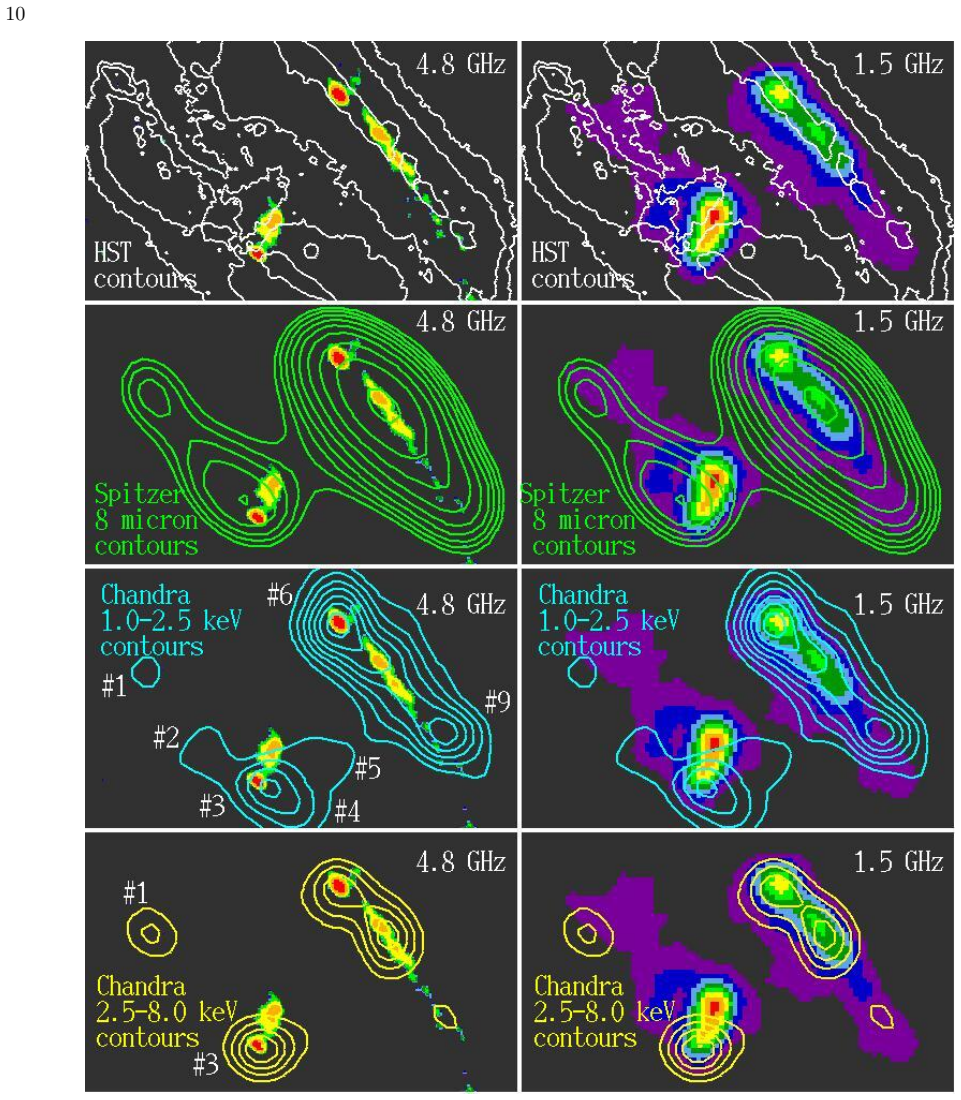
The analysis is carried by Chandra imaging spectroscopy on the ACIS-S3 chip: source and global spectra are fit in xspec with a two-component model, a thermal APEC plasma plus a power law, with the internal hydrogen column density, plasma temperature $kT$, and photon index as free parameters on top of fixed Galactic absorption. The unabsorbed thermal luminosity from these fits is converted to hot-gas mass and cooling time using standard cooling functions, and the resulting $L_X(\mathrm{gas})/\mathrm{SFR}$ ratio is compared with published merger, compact-group, and SINGS samples. The second load-bearing element is the multi-wavelength morphology: HST and DES images for tidal tails and the dust lane, Spitzer 8-$\mu$m maps for the star-forming bridge, and re-reduced VLA 4.86 and 1.49 GHz maps for the radio ridge and its spectral-index gradient.
What would settle it
Observe IC 2431 with a high-throughput X-ray spectrometer (or a much longer Chandra exposure) and measure the Fe K edge or Mg/Si line ratios to determine the intrinsic absorption without relying on the continuum shape. A column for Galaxy B near the CIGALE line value of about $4 \times 10^{21}$ cm$^{-2}$ would remove most of the claimed hot-gas excess; a column near the fitted $9 \times 10^{21}$ cm$^{-2}$ would confirm it.
Extended reading notes
Core claim
On the paper's own terms, the discovery is that IC 2431 contains a large reservoir of hot X-ray-emitting gas that is not tied to ongoing star formation. Spectral decomposition of the Chandra data into a thermal plasma component and a power-law component yields an unabsorbed hot-gas luminosity of about $10^{42}$ erg s$^{-1}$ in the 0.3–8 keV band for the system as a whole, against a total star formation rate of roughly 37–39 $M_\odot$ yr$^{-1}$, placing the $L_X(\mathrm{gas})/\mathrm{SFR}$ ratio about a factor of four above the median for equal-mass merging pairs, with Galaxy B alone about a factor of nine above. A concentration of about $2 \times 10^7\,M_\odot$ of hot gas sits between Galaxies A and B, and a 4-kpc radio continuum ridge emerges from the nucleus of Galaxy A, steepening in spectral index away from the nucleus. The authors conclude that IC 2431 is an early-stage compact group whose peculiar X-ray, infrared, and radio morphologies record shock- or AGN-driven heating of the interstellar and intragroup medium, and they explicitly leave open whether the radio ridge is a distorted AGN jet or a 'splash bridge' produced by a head-on collision.
Load-bearing premise
The hot-gas excess is a consequence of the large internal absorbing columns (about $6 \times 10^{21}$ and $9 \times 10^{21}$ cm$^{-2}$ for Galaxies A and B) fitted from Chandra spectra with only a few hundred net counts; if those columns are overestimated, the absorption-corrected X-ray luminosity, hot-gas mass, and the factor-of-four or factor-of-nine enhancement all shrink toward the normal merger relation.
Editorial extensions
If this is right
- IC 2431 would show that early-stage compact groups can already host multi-million-solar-mass hot gas reservoirs outside the galaxy disks, not just evolved groups with E/S0 populations.
- The factor-of-four (system) and factor-of-nine (Galaxy B) $L_X(\mathrm{gas})/\mathrm{SFR}$ enhancements would make IC 2431 one of the clearest star-forming systems in which gas heating outpaces the star-formation scaling, alongside Stephan's Quintet, NGC 4410, and HCG 62.
- If the radio ridge is a jet, the system joins the short list of radio-AGN groups with hot-gas excess, supporting AGN feedback as a heating channel in compact groups.
- If the radio ridge is a splash bridge, the system extends the Taffy head-on-collision phenomenon to a three-galaxy compact group and predicts shock signatures, such as mid-IR H$_2$ emission and a steep radio spectrum, in the bridge.
- The derived hot-gas cooling times of roughly 10–50 Myr imply that the heating event is recent, consistent with a first disk impact or a newly triggered AGN episode.
Reading between the lines
- Editorial inference: the quantitative excess is only as strong as the fitted absorption columns; if the true $N_H$ for Galaxy B is near the UV/IR value, the claimed factor-of-nine excess would probably fall to near the merger scatter, so the morphological case (bridge, ridge, dust lane) is more robust than the luminosity excess.
- A testable extension: high-resolution X-ray spectroscopy (for example, of the Fe K edge or Mg/Si line ratios) or a far-infrared dust measurement could fix $N_H$ independently and decide whether IC 2431 truly departs from the $L_X(\mathrm{gas})$–SFR relation.
- If the radio ridge is a splash bridge, high-resolution radio polarimetry should reveal ordered magnetic fields aligned with the ridge and a spectral index steepening beyond $\alpha = -1.1$; if it is a jet, one would expect Doppler-boosted one-sidedness and possibly an X-ray cavity or hot-spot at the ridge end.
- The system has not yet been detected in CO; a molecular-gas map would test whether its high HI fraction and early-stage classification survive, and would set the gas mass available for shock heating.
Editorial analysis
A structured set of objections, weighed in public.
Referee Report
Summary. IC 2431 is presented as a triple-disk compact group at 207 Mpc with a strong starburst (SFR ~37 M_sun/yr) and unusual morphologies: a dust lane across Galaxy A, a Spitzer 8-micron bridge to Galaxy B, a Chandra-detected hot-gas concentration between the galaxies, and a 4 kpc radio ridge from the nucleus of Galaxy A. Using new Chandra ACIS-S3 observations and archival UV-to-radio data, the authors fit APEC plus power-law models to low-count X-ray spectra, derive SFRs and extinctions from UV/IR photometry and CIGALE SED fitting, and compare L_X(gas), L_X(power law), sSFR, HI fraction, and Spitzer colors against samples of compact groups, mergers, and SINGS galaxies. They conclude that IC 2431 has an X-ray hot-gas luminosity enhanced by about a factor of four relative to its SFR, and discuss two scenarios: ram-pressure stripping in a head-on collision or an AGN jet interacting with interstellar gas.
Significance. The direct observational findings—dust lane, 8 micron bridge, X-ray knots, 4 kpc radio ridge, kT~0.9 keV thermal component—are well supported by the images and spectra and make IC 2431 an interesting addition to the small set of compact groups with intragroup hot gas. The paper is methodical and honest: it reports Cash statistics and 90% confidence intervals, re-reduces archival VLA data, uses published comparison samples with consistent band conversions, and explicitly acknowledges in Section 4.3 that the large thermal luminosities are a consequence of fitted high absorbing columns. However, the quantitative claim of a factor-of-four hot-gas excess—the element that makes the system a new reference case—rests on low-count spectral fits and is not yet demonstrated at the confidence implied by the abstract. If the requested robustness tests are provided and confirm the excess, the paper would be a valuable benchmark for collision- and AGN-driven gas heating.
major comments (3)
- [Section 4.4, Table 3, Section 4.3] The factor-of-four hot-gas excess is not robust because the absorption-corrected APEC luminosity is driven by weakly constrained internal N_H values. The global 12-arcsecond spectrum has C-stat/DOF = 282.91/274 and N_H = 0.76(+0.21/-0.26) x 10^22 cm^-2; Galaxy B has N_H = 0.90(+0.38/-0.50) x 10^22 cm^-2, 2.3 times the CIGALE line-extinction estimate of 0.47 +/- 0.16 x 10^22 cm^-2. Since the paper itself notes in Section 4.3 that the large L_X(thermal) values follow from these columns, a lower N_H would reduce L_X(gas), the hot-gas mass, and L_X(gas)/SFR. I request an additional fit with N_H fixed to the CIGALE line-extinction values (or to the 90% bounds of the fitted N_H), with the resulting APEC luminosities and L_X(gas)/SFR values reported, and the abstract and Section 6 claim conditioned on that result.
- [Section 3.5.1, Table 3] The APEC/power-law decomposition is under-constrained at the available signal. In the global fit Gamma = 1.06(+0.78/-0.91) and in Galaxy A Gamma = 1.05(+0.64/-0.85), values far below typical AGN/HMXB photon indices, while the 90% ranges on the deconvolved luminosities are large (global log L_APEC = 42.06(+0.14/-0.21)). Because the thermal and power-law components overlap below about 2.5 keV, a steeper power law could absorb part of the thermal luminosity with little change in C-stat. Please provide confidence contours for (N_H, kT, Gamma) or a fit with Gamma fixed to 1.8, and report how L_X(gas) changes; otherwise the value of L_X(gas) used in Figure 17 is model-dependent.
- [Section 4.4, Figure 17, Section 6] The strength of the abstract claim exceeds what the comparison shows for the system as a whole. The text states that the merger scatter is about a factor of 2.3 in L_X(gas)/SFR and that IC 2431 as a whole does not stand out in Figure 17; only Galaxy B is exceptional (L_X(gas)/SFR = 4-5 x 10^40, about 9 times the median), and its SFR differs by roughly a factor of two between CIGALE and FUV+8 micron. The factor of four for the whole system should therefore be presented as a range with a significance (e.g., derived from the 90% bounds on L_APEC and the SFR uncertainty), or the claim should be explicitly restricted to Galaxy B.
minor comments (6)
- [Section 4.4] Please reconcile the quoted ratio with Table 3; the global log L_APEC = 42.06 and SFR = 37-39 M_sun/yr give L_X(gas)/SFR approximately 3 x 10^40, not approximately 2 x 10^40, so the stated factor of four and the quoted ratio are mutually inconsistent.
- [Section 2.4] Because wavedetect was not reliable, the ten X-ray sources were chosen by eye from smoothed maps; please document the selection thresholds and aperture choices in the text or Table 4, since these regions feed the spectral decomposition in Table 4.
- [Section 5.3] In the list of possible explanations for source #10, L_X ~10^42 L_sun should be L_X ~10^42 erg s^-1; the printed units are incorrect.
- [Sections 2.3 and 2.4] There are typographical errors, including Multi-W avelength in the title header and maxium for maximum; these should be corrected in revision.
- [Section 4.3] The sentence quoting the highest N_H values inferred from the UV/IR ratios and obtained from fitting Chandra X-ray spectra is ambiguous about whether both numbers come from UV/IR or one from each; please clarify.
- [Figure 17 and Section 4.4] Please state explicitly that all L_X values are in the 0.3-8 keV band after PIMMS conversion and all SFRs are Kroupa IMF, so that the factor-of-four comparison is reproducible.
Circularity Check
No significant circularity; the hot-gas excess claim rests on a spectral-fitting measurement premise, and the only self-citation is a benchmark comparison, not a derivation input.
full rationale
This paper is an observational multi-wavelength study, not a derivation from first principles. The central quantitative claim, an excess of hot gas relative to star formation rate (LX(gas)/SFR ~ 2e40, about four times the merger median), is obtained by fitting Chandra spectra with an APEC plus power-law model, then comparing the absorption-corrected APEC luminosity with SFRs derived from UV/IR photometry. The paper explicitly acknowledges in Section 4.3 that the large thermal luminosities are a consequence of the fitted high internal absorbing columns, and those columns are weakly constrained by low-count spectra. This is a measurement degeneracy and an honest limitation, not a circular step: the fitted N_H is not recycled as an independent prediction, and the paper states the dependence directly. The comparison benchmark (median LX(gas)/SFR = 5.5e39 for 49 merging pairs) comes from Smith et al. (2018, 2019), which share authors with the present work. However, that benchmark is an external sample of measured systems, not an input to the spectral fits, and no uniqueness theorem or ansatz is imported from the prior work to force the conclusion. The morphological results (dust lane, mid-IR bridge, radio ridge) are independent imaging measurements. Thus the derivation chain is self-contained; the only mild self-citation is the use of the authors' own earlier merger catalog as a comparison sample, which does not make the central claim circular. Score 2 reflects this minor self-citation and the acknowledged measurement caveat, not any structural circularity.
Assumptions & free parameters
free parameters (5)
- Internal absorbing column N_H (X-ray spectral fits) =
0.76 (+0.21/-0.26) x 10^22 cm^-2 global 12''; 0.58 Galaxy A; 0.90 Galaxy B; 0.0 to 4.1 x 10^22 for individual sources…
- Photon index Gamma (power-law component) =
1.06 (+0.78/-0.91) global; 1.05 Galaxy A; 1.80 Galaxy B
- Plasma temperature kT (APEC component) =
0.92 (+0.13/-0.58) keV global; 0.85 Galaxy A; 0.58 Galaxy B; 0.23 to 51 keV for sources (Tables 3, 4)
- Assumed radii of the hot-gas regions =
0.7 to 1.25 arcsec (Table 5)
- CIGALE-derived SFRs and stellar masses =
SFR(B) = 18.3 +/- 9.4 M_sun/yr; SFR(A) = 8.5 +/- 2.1; log M* ~ 10.7 to 10.8 (Table 2)
assumptions (5)
- domain assumption Adopted distance of 207 Mpc (H0 = 72 km/s/Mpc with Virgocentric flow correction)
- domain assumption The X-ray spectra are adequately described by one absorbed APEC thermal component plus one absorbed power law, with solar abundances, Wilms abundance table, and fixed redshift 0.0497
- domain assumption Hot gas masses are derived from luminosity, temperature, cooling functions, and assumed spherical source volumes with an implicit filling factor
- domain assumption Standard UV+8um and CIGALE SFR calibrations are valid for this system
- ad hoc to paper The ten X-ray sources selected by eye from smoothed maps are real, separable emitters
Cite this review
Pith. "Pith review of The Complex Multi-Wavelength Morphology of the Peculiar Compact Galaxy Group IC 2431." pith.science (2026). https://pith.science/paper/DV5SPVHF
@misc{pith2026250710439,
  author       = {Pith},
  title        = {Pith review of: The Complex Multi-Wavelength Morphology of the Peculiar Compact Galaxy Group IC 2431},
  year         = {2026},
  howpublished = {\url{https://pith.science/paper/DV5SPVHF}},
  note         = {Machine review of arXiv:2507.10439}
}
read the original abstract
We present new Chandra X-ray imaging spectroscopy of the compact galaxy group IC 2431, and compare with archival ultraviolet, optical, infrared, and radio images. IC 2431 is a starburst system containing three tidally-distorted disk galaxies. All three galaxies may have active nuclei. One galaxy is classified as an AGN based on its optical spectrum, a second is identified as a possible X-ray AGN based on the Chandra data, and the third galaxy may host a radio AGN. In optical images, a prominent dust lane crosses the southern galaxy, while Spitzer infrared images show a dusty bridge connecting the two brightest galaxies. Chandra maps reveal a massive (2 x 10^7 M(sun)) concentration of hot gas between these two galaxies, as well as several other knots of hot gas and non-thermal emission. The unabsorbed X-ray luminosity of the hot gas in IC 2431 is ~ 1 x 10^42 erg/s, which is enhanced by about a factor of four relative to the star formation rate, compared to other star-forming galaxies. In radio maps, a bright jet/ridge of radio continuum emission extends 4 kpc from one nucleus. We compare the properties of IC 2431 with those of other interacting galaxy systems, and discuss two different scenarios that may account for the peculiarities of IC 2431: ram pressure stripping of the interstellar medium during a head-on collision between two galaxies, or an AGN-powered radio jet that has been distorted by an interaction with interstellar gas during a tidal encounter between galaxies.
Figures


Figures from the paper (17 more)



Reference graph
Works this paper leans on
-
[1]
Alatalo, K., Appleton, P. N., Lisenfeld, U., et al. 2015, ApJ, 812, 117, doi: 10.1088/0004-637X/812/2/117
-
[2]
Antonucci, R. 1993, ARA&A, 31, 473, doi: 10.1146/annurev.aa.31.090193.002353 IC 243135 T able 7.Photometry of Smaller Rectangular Regions in IC 2431a Filter Galaxy Galaxy Galaxy Galaxy Galaxy Galaxy Galaxy A1 A2 A3 A4 B1 B2 B3 shape rectangle rectangle rectangle rectangle rectangle rectangle rectangle RA (2000) 136.147770 136.146630 136.145510 136.144380 ...
arXiv 2000
-
[3]
Appleton, P. N., Xu, K. C., Reach, W., et al. 2006, ApJL, 639, L51, doi: 10.1086/502646
doi:10.1086/502646 2006
-
[4]
N., Lanz, L., Bitsakis, T., et al
Appleton, P. N., Lanz, L., Bitsakis, T., et al. 2015, ApJ, 812, 118, doi: 10.1088/0004-637X/812/2/118
-
[5]
N., Guillard, P., Togi, A., et al
Appleton, P. N., Guillard, P., Togi, A., et al. 2017, ApJ, 836, 76, doi: 10.3847/1538-4357/836/1/76
-
[6]
N., Emonts, B., Lisenfeld, U., et al
Appleton, P. N., Emonts, B., Lisenfeld, U., et al. 2022, ApJ, 931, 121, doi: 10.3847/1538-4357/ac63b2
-
[7]
Armus, L., Bernard-Salas, J., Spoon, H. W. W., et al. 2006, ApJ, 640, 204, doi: 10.1086/500040
doi:10.1086/500040 2006
-
[8]
Ashby, M. L. N., Mahajan, S., Smith, H. A., et al. 2011, PASP, 123, 1011, doi: 10.1086/661920
doi:10.1086/661920 2011
Show all 217 references
-
[9]
A., Walton, D
Bachetti, M., Harrison, F. A., Walton, D. J., et al. 2014, Nature, 514, 202, doi: 10.1038/nature13791
2014 doi
-
[10]
1996, A&A, 309, L35
Bade, N., Komossa, S., & Dahlem, M. 1996, A&A, 309, L35
1996
-
[11]
A., Harris, D
Bahcall, N. A., Harris, D. E., & Rood, H. J. 1984, ApJL, 284, L29, doi: 10.1086/184346
1984 doi
-
[12]
Barnes, J. E. 1989, Nature, 338, 123, doi: 10.1038/338123a0
1989 doi
-
[13]
J., et al
Barra, F., Pinto, C., Walton, D. J., et al. 2022, MNRAS, 516, 3972, doi: 10.1093/mnras/stac2453
2022 doi
-
[14]
K., Williams, T
Belfiore, F., Leroy, A. K., Williams, T. G., et al. 2023, A&A, 678, A129, doi: 10.1051/0004-6361/202347175
2023 doi
-
[15]
A., Irsic, V., Amon, A., & Sijacki, D
Bigwood, L., Bourne, M. A., Irsic, V., Amon, A., & Sijacki, D. 2025, arXiv e-prints, arXiv:2501.16983, doi: 10.48550/arXiv.2501.16983
2025 doi
-
[16]
A., & Povich, M
Binder, B. A., & Povich, M. S. 2018, ApJ, 864, 136, doi: 10.3847/1538-4357/aad7b2 B ˆ ırzan, L., Rafferty, D. A., McNamara, B. R., Wise, M. W., & Nulsen, P. E. J. 2004, ApJ, 607, 800, doi: 10.1086/383519
2018 doi
- [17]
-
[18]
L., Gregg, M
Blanton, E. L., Gregg, M. D., Helfand, D. J., Becker, R. H., & Leighly, K. M. 2001, AJ, 121, 2915, doi: 10.1086/321074
2001 doi
- [19]
-
[20]
W., Cohn, H
Bode, P. W., Cohn, H. N., & Lugger, P. M. 1993, ApJ, 416, 17, doi: 10.1086/173211
1993 doi
-
[21]
Neumann, D. M. 1993, MNRAS, 264, L25, doi: 10.1093/mnras/264.1.L25
1993 doi
-
[22]
C., Savage, B
Bohlin, R. C., Savage, B. D., & Drake, J. F. 1978, ApJ, 224, 132, doi: 10.1086/156357
1978 doi
-
[23]
2019, A&A, 622, A103, doi: 10.1051/0004-6361/201834156
Boquien, M., Burgarella, D., Roehlly, Y., et al. 2019, A&A, 622, A103, doi: 10.1051/0004-6361/201834156
2019 doi
- [24]
-
[25]
G., Benson, A
Bower, R. G., Benson, A. J., Malbon, R., et al. 2006, MNRAS, 370, 645, doi: 10.1111/j.1365-2966.2006.10519.x
2006
-
[26]
H., & Perley, R
Bridle, A. H., & Perley, R. A. 1984, ARA&A, 22, 319, doi: 10.1146/annurev.aa.22.090184.001535
1984
-
[28]
O., Feigelson, E
Burns, J. O., Feigelson, E. D., & Schreier, E. J. 1983, ApJ, 273, 128, doi: 10.1086/161353
1983 doi
- [29]
-
[30]
C., et al
Calzetti, D., Armus, L., Bohlin, R. C., et al. 2000, ApJ, 533, 682, doi: 10.1086/308692
2000 doi
- [31]
-
[32]
2003, ApJL, 586, L133, doi: 10.1086/374879
Chabrier, G. 2003, ApJL, 586, L133, doi: 10.1086/374879
2003 doi
-
[33]
Soderberg, A. M. 2015, ApJ, 810, 32, doi: 10.1088/0004-637X/810/1/32
2015 doi
- [34]
-
[35]
V., Katkov, I
Chilingarian, I. V., Katkov, I. Y., Zolotukhin, I. Y., et al. 2018, ApJ, 863, 1, doi: 10.3847/1538-4357/aad184
2018 doi
-
[36]
Moster, B. P. 2014, MNRAS, 442, 440, doi: 10.1093/mnras/stu874
2014 doi
-
[37]
P., Naab, T., Oser, L., & Moster, B
Choi, E., Ostriker, J. P., Naab, T., Oser, L., & Moster, B. P. 2015, MNRAS, 449, 4105, doi: 10.1093/mnras/stv575
2015 doi
-
[38]
Chomiuk, L., & Povich, M. S. 2011, AJ, 142, 197, doi: 10.1088/0004-6256/142/6/197
2011 doi
-
[39]
E., Appleton, P
Cluver, M. E., Appleton, P. N., Boulanger, F., et al. 2010, ApJ, 710, 248, doi: 10.1088/0004-637X/710/1/248
2010 doi
-
[40]
E., Appleton, P
Cluver, M. E., Appleton, P. N., Ogle, P., et al. 2013, ApJ, 765, 93, doi: 10.1088/0004-637X/765/2/93
2013 doi
-
[41]
M., Negus, J., M¨ uller-S´ anchez, F., et al
Comerford, J. M., Negus, J., M¨ uller-S´ anchez, F., et al. 2020, ApJ, 901, 159, doi: 10.3847/1538-4357/abb2ae
2020 doi
-
[42]
J., Helou, G., Sanders, D
Condon, J. J., Helou, G., Sanders, D. B., & Soifer, B. T. 1993, AJ, 105, 1730, doi: 10.1086/116549
1993 doi
-
[43]
J., Di Matteo, T., Hernquist, L., et al
Cox, T. J., Di Matteo, T., Hernquist, L., et al. 2006, ApJ, 643, 692, doi: 10.1086/503284
2006 doi
-
[44]
2007, AJ, 133, 2630, doi: 10.1086/513514
Coziol, R., & Plauchu-Frayn, I. 2007, AJ, 133, 2630, doi: 10.1086/513514
2007 doi
-
[45]
Crawford, T., Marr, J., Partridge, B., & Strauss, M. A. 1996, ApJ, 460, 225, doi: 10.1086/176964
1996 doi
-
[46]
2009, A&A, 501, 445, doi: 10.1051/0004-6361/200810707
Crivellari, E., Wolter, A., & Trinchieri, G. 2009, A&A, 501, 445, doi: 10.1051/0004-6361/200810707
2009 doi
-
[48]
J., Springel, V., White, S
Croton, D. J., Springel, V., White, S. D. M., et al. 2006, MNRAS, 365, 11, doi: 10.1111/j.1365-2966.2005.09675.x
2006
-
[49]
A., Boquien, M., Turner, J
Dale, D. A., Boquien, M., Turner, J. A., et al. 2023, AJ, 165, 260, doi: 10.3847/1538-3881/accffe 38
2023 doi
- [50]
-
[51]
A., Helou, G., Silbermann, N
Dale, D. A., Helou, G., Silbermann, N. A., et al. 1999, AJ, 118, 2055, doi: 10.1086/301110
1999 doi
-
[52]
A., Cook, D
Dale, D. A., Cook, D. O., Roussel, H., et al. 2017, ApJ, 837, 90, doi: 10.3847/1538-4357/aa6032
2017 doi
-
[53]
D., Gallagher, S
Desjardins, T. D., Gallagher, S. C., Tzanavaris, P., et al. 2013, ApJ, 763, 121, doi: 10.1088/0004-637X/763/2/121
2013 doi
-
[54]
D., Gallagher, S
Desjardins, T. D., Gallagher, S. C., Hornschemeier, A. E., et al. 2014, ApJ, 790, 132, doi: 10.1088/0004-637X/790/2/132
2014 doi
-
[55]
J., Lang, D., et al
Dey, A., Schlegel, D. J., Lang, D., et al. 2019, AJ, 157, 168, doi: 10.3847/1538-3881/ab089d
2019 doi
-
[56]
J., & Stocke, J
Donahue, M., Smith, B. J., & Stocke, J. T. 2002, AJ, 123, 1922, doi: 10.1086/339556
2002 doi
-
[57]
L., Brandt, W
Donley, J. L., Brandt, W. N., Eracleous, M., & Boller, T. 2002, AJ, 124, 1308, doi: 10.1086/342280
2002 doi
-
[58]
R., Garc ´ ıa-Bernete, I., Rigopoulou, D., et al
Donnan, F. R., Garc ´ ıa-Bernete, I., Rigopoulou, D., et al. 2023, MNRAS, 519, 3691, doi: 10.1093/mnras/stac3729
2023 doi
-
[59]
T., Aniano, G., Krause, O., et al
Draine, B. T., Aniano, G., Krause, O., et al. 2014, ApJ, 780, 172, doi: 10.1088/0004-637X/780/2/172 Drevet Mulard, M., Nesvadba, N. P. H., Meenakshi, M., et al. 2023, A&A, 676, A35, doi: 10.1051/0004-6361/202245173
2014 doi
-
[60]
2010, MNRAS, 409, 985, doi: 10.1111/j.1365-2966.2010.17338.x
Dubois, Y., Devriendt, J., Slyz, A., & Teyssier, R. 2010, MNRAS, 409, 985, doi: 10.1111/j.1365-2966.2010.17338.x
2010
-
[61]
Bauer, F. E. 2016, MNRAS, 462, 1101, doi: 10.1093/mnras/stw1717
2016 doi
-
[62]
Eckert, D., Gaspari, M., Gastaldello, F., Le Brun, A. M. C., & O’Sullivan, E. 2021, Universe, 7, 142, doi: 10.3390/universe7050142
2021 doi
-
[63]
2024, Galaxies, 12, 24, doi: 10.3390/galaxies12030024
Eckert, D., Gastaldello, F., O’Sullivan, E., Finoguenov, A., & Brienza, M. 2024, Galaxies, 12, 24, doi: 10.3390/galaxies12030024
2024 doi
-
[64]
W., Gordon, K
Engelbracht, C. W., Gordon, K. D., Rieke, G. H., et al. 2005, ApJL, 628, L29, doi: 10.1086/432613
2005 doi
-
[65]
W., Rieke, G
Engelbracht, C. W., Rieke, G. H., Gordon, K. D., et al. 2008, ApJ, 678, 804, doi: 10.1086/529513
2008 doi
- [66]
-
[67]
Fabian, A. C. 2012, ARA&A, 50, 455, doi: 10.1146/annurev-astro-081811-125521
2012 doi
-
[69]
Rodrigues, J. M. 2009, Nature, 460, 73, doi: 10.1038/nature08083
2009 doi
-
[70]
G., Hora, J
Fazio, G. G., Hora, J. L., Allen, L. E., et al. 2004, ApJS, 154, 10, doi: 10.1086/422843
2004 doi
-
[71]
2016, ApJ, 831, 117, doi: 10.3847/0004-637X/831/2/117
Feng, H., Tao, L., Kaaret, P., & Gris´ e, F. 2016, ApJ, 831, 117, doi: 10.3847/0004-637X/831/2/117
2016 doi
-
[72]
2001, ApJL, 547, L107, doi: 10.1086/318910
Finoguenov, A., & Jones, C. 2001, ApJL, 547, L107, doi: 10.1086/318910
2001 doi
-
[73]
2011, ApJ, 738, 145, doi: 10.1088/0004-637X/738/2/145
Freeland, E., & Wilcots, E. 2011, ApJ, 738, 145, doi: 10.1088/0004-637X/738/2/145
2011 doi
-
[74]
2013, ApJ, 764, 175, doi: 10.1088/0004-637X/764/2/175 Gaia Collaboration, Prusti, T., de Bruijne, J
Fuse, C., & Broming, E. 2013, ApJ, 764, 175, doi: 10.1088/0004-637X/764/2/175 Gaia Collaboration, Prusti, T., de Bruijne, J. H. J., et al. 2016, A&A, 595, A1, doi: 10.1051/0004-6361/201629272
2013 doi
-
[75]
2019, ARA&A, 57, 305, doi: 10.1146/annurev-astro-081817-051819
Gal-Yam, A. 2019, ARA&A, 57, 305, doi: 10.1146/annurev-astro-081817-051819
2019 doi
-
[76]
C., & Hibbard, J
Charlton, J. C., & Hibbard, J. E. 2008, ApJ, 673, 730, doi: 10.1086/524103
2008 doi
-
[77]
C., Durrell, P
Gallagher, S. C., Durrell, P. R., Elmegreen, D. M., et al. 2010, AJ, 139, 545, doi: 10.1088/0004-6256/139/2/545
2010 doi
-
[78]
Y., Yuan, Z
Gao, X. Y., Yuan, Z. S., Han, J. L., Wen, Z. L., & Shan, S. S. 2023, Research in Astronomy and Astrophysics, 23, 035005, doi: 10.1088/1674-4527/acb251
2023 doi
-
[79]
1986, ApJ, 303, 336, doi: 10.1086/164079
Gehrels, N. 1986, ApJ, 303, 336, doi: 10.1086/164079
1986 doi
-
[80]
M., Turner, T
George, I. M., Turner, T. J., Yaqoob, T., et al. 2000, ApJ, 531, 52, doi: 10.1086/308461
2000 doi
-
[81]
2010, ApJ, 714, 758, doi: 10.1088/0004-637X/714/1/758
Gitti, M., O’Sullivan, E., Giacintucci, S., et al. 2010, ApJ, 714, 758, doi: 10.1088/0004-637X/714/1/758
2010 doi
-
[82]
W., Soria, R., Davis, B
Graham, A. W., Soria, R., Davis, B. L., et al. 2021, ApJ, 923, 246, doi: 10.3847/1538-4357/ac34f4
2021 doi
-
[84]
C., Johnson, B
Hao, C.-N., Kennicutt, R. C., Johnson, B. D., et al. 2011, ApJ, 741, 124, doi: 10.1088/0004-637X/741/2/124
2011 doi
-
[85]
P., Giovanelli, R., Kent, B
Haynes, M. P., Giovanelli, R., Kent, B. R., et al. 2018, ApJ, 861, 49, doi: 10.3847/1538-4357/aac956
2018 doi
-
[86]
T., & Rowan-Robinson, M
Helou, G., Soifer, B. T., & Rowan-Robinson, M. 1985, ApJL, 298, L7, doi: 10.1086/184556
1985 doi
-
[87]
Helou, G., & Walker, D. W., eds. 1988, Infrared Astronomical Satellite (IRAS) Catalogs and Atlases.Volume 7: The Small Scale Structure Catalog., Vol. 7
1988
-
[88]
2004, ApJS, 154, 253, doi: 10.1086/422640
Helou, G., Roussel, H., Appleton, P., et al. 2004, ApJS, 154, 253, doi: 10.1086/422640
2004 doi
-
[89]
M., Wilcots, E
Hess, K. M., Wilcots, E. M., & Hartwick, V. L. 2012, AJ, 144, 48, doi: 10.1088/0004-6256/144/2/48
2012 doi
-
[90]
Higdon, J. L. 1996, ApJ, 467, 241, doi: 10.1086/177599
1996 doi
-
[91]
K., Ohyama, Y., et al
Hota, A., Sirothia, S. K., Ohyama, Y., et al. 2011, MNRAS, 417, L36, doi: 10.1111/j.1745-3933.2011.01115.x
2011
-
[92]
G., & van Gorkom, J
Hummel, E., Kotanyi, C. G., & van Gorkom, J. H. 1986, A&A, 155, 161 IC 243139
1986
-
[93]
Hwang, J.-S., Struck, C., Renaud, F., & Appleton, P. N. 2012, MNRAS, 419, 1780, doi: 10.1111/j.1365-2966.2011.19847.x
2012
-
[94]
1908, Annales de l’Observatoire de Nice, 11, D.1
Javelle, S. 1908, Annales de l’Observatoire de Nice, 11, D.1
1908
-
[95]
E., Hibbard, J
Johnson, K. E., Hibbard, J. E., Gallagher, S. C., et al. 2007, AJ, 134, 1522, doi: 10.1086/520921
2007 doi
-
[97]
R., Ponman, T
Jones, L. R., Ponman, T. J., Horton, A., et al. 2003, MNRAS, 343, 627, doi: 10.1046/j.1365-8711.2003.06702.x
2003
-
[98]
G., Verdes-Montenegro, L., Damas-Segovia, A., et al
Jones, M. G., Verdes-Montenegro, L., Damas-Segovia, A., et al. 2019, A&A, 632, A78, doi: 10.1051/0004-6361/201936349
2019 doi
-
[99]
G., Verdes-Montenegro, L., Moldon, J., et al
Jones, M. G., Verdes-Montenegro, L., Moldon, J., et al. 2023, A&A, 670, A21, doi: 10.1051/0004-6361/202244622
2023 doi
-
[100]
A., Appleton, P
Joshi, B. A., Appleton, P. N., Blanc, G. A., et al. 2019, ApJ, 878, 161, doi: 10.3847/1538-4357/ab2124
2019 doi
-
[101]
Kaaret, P., Feng, H., & Roberts, T. P. 2017, ARA&A, 55, 303, doi: 10.1146/annurev-astro-091916-055259
2017 doi
-
[102]
C., Tate, J., Wong, O
Keel, W. C., Tate, J., Wong, O. I., et al. 2022, AJ, 163, 150, doi: 10.3847/1538-3881/ac517d
2022 doi
-
[103]
I., & Owen, F
Kellermann, K. I., & Owen, F. N. 1988, in Galactic and Extragalactic Radio Astronomy, ed. K. I. Kellermann & G. L. Verschuur, 563–602
1988
-
[104]
Kelm, B., Focardi, P., & Palumbo, G. G. C. 1998, A&A, 335, 912
1998
-
[105]
2004, A&A, 418, 25, doi: 10.1051/0004-6361:20034289
Kelm, B., Focardi, P., & Zitelli, V. 2004, A&A, 418, 25, doi: 10.1051/0004-6361:20034289
2004 doi
-
[106]
2003, PASP, 115, 928, doi: 10.1086/376941
Kennicutt, Robert C., J., Armus, L., Bendo, G., et al. 2003, PASP, 115, 928, doi: 10.1086/376941
2003 doi
-
[107]
C., & Evans, N
Kennicutt, R. C., & Evans, N. J. 2012, ARA&A, 50, 531, doi: 10.1146/annurev-astro-081811-125610
2012 doi
-
[108]
2018, Monthly Notices of the Royal Astronomical Society, 481, 1550, doi: 10.1093/mnras/sty2030
Kolokythas, K., O’Sullivan, E., Raychaudhury, S., et al. 2018, Monthly Notices of the Royal Astronomical Society, 481, 1550, doi: 10.1093/mnras/sty2030
2018 doi
-
[109]
2020, MNRAS, 496, 1471, doi: 10.1093/mnras/staa1506
Kolokythas, K., O’Sullivan, E., Giacintucci, S., et al. 2020, MNRAS, 496, 1471, doi: 10.1093/mnras/staa1506
2020 doi
-
[110]
Kong, A. K. H., Garcia, M. R., Primini, F. A., et al. 2002, ApJ, 577, 738, doi: 10.1086/342116
2002 doi
-
[111]
2021, MNRAS, 506, 3079, doi: 10.1093/mnras/stab1917
Kouroumpatzakis, K., Zezas, A., Maragkoudakis, A., et al. 2021, MNRAS, 506, 3079, doi: 10.1093/mnras/stab1917
2021 doi
-
[112]
P., V´ azquez, S
Kraft, R. P., V´ azquez, S. E., Forman, W. R., et al. 2003, ApJ, 592, 129, doi: 10.1086/375533
2003 doi
-
[113]
2003, ApJ, 598, 1076, doi: 10.1086/379105
Kroupa, P., & Weidner, C. 2003, ApJ, 598, 1076, doi: 10.1086/379105
2003 doi
-
[114]
J., Sajina, A., et al
Lacy, M., Storrie-Lombardi, L. J., Sajina, A., et al. 2004, ApJS, 154, 166, doi: 10.1086/422816
2004 doi
-
[115]
J., Owen, F
Ledlow, M. J., Owen, F. N., & Keel, W. C. 1998, ApJ, 495, 227, doi: 10.1086/305251
1998 doi
-
[116]
S., Sohn, J., & Lee, M
Lee, G.-H., Hwang, H. S., Sohn, J., & Lee, M. G. 2017, ApJ, 835, 280, doi: 10.3847/1538-4357/835/2/280
2017 doi
-
[117]
D., Eufrasio, R
Lehmer, B. D., Eufrasio, R. T., Basu-Zych, A., et al. 2022, ApJ, 930, 135, doi: 10.3847/1538-4357/ac63a7
2022 doi
-
[118]
D., Eufrasio, R
Lehmer, B. D., Eufrasio, R. T., Tzanavaris, P., et al. 2019, ApJS, 243, 3, doi: 10.3847/1538-4365/ab22a8 Lenki´ c, L., Tzanavaris, P., Gallagher, S. C., et al. 2016, MNRAS, 459, 2948, doi: 10.1093/mnras/stw779
2019 doi
-
[119]
J., Read, A
Levan, A. J., Read, A. M., Metzger, B. D., Wheatley, P. J., & Tanvir, N. R. 2013, ApJ, 771, 136, doi: 10.1088/0004-637X/771/2/136
2013 doi
-
[120]
2017, A&A, 607, A110, doi: 10.1051/0004-6361/201730898
Lisenfeld, U., Alatalo, K., Zucker, C., et al. 2017, A&A, 607, A110, doi: 10.1051/0004-6361/201730898
2017 doi
-
[121]
Madden, S. C. 2000, NewAR, 44, 249, doi: 10.1016/S1387-6473(00)00050-6
2000 doi
-
[122]
Mahajan, S., Ashby, M. L. N., Willner, S. P., et al. 2019, MNRAS, 482, 560, doi: 10.1093/mnras/sty2699
2019 doi
-
[123]
Y., Owen, F., Duffin, R., et al
Mao, M. Y., Owen, F., Duffin, R., et al. 2015, MNRAS, 446, 4176, doi: 10.1093/mnras/stu2302
2015 doi
-
[124]
2022, ApJ, 935, 114, doi: 10.3847/1538-4357/ac80be
Marchesi, S., Zhao, X., Torres-Alb` a, N., et al. 2022, ApJ, 935, 114, doi: 10.3847/1538-4357/ac80be
2022 doi
-
[125]
D., et al
Margutti, R., Chornock, R., Metzger, B. D., et al. 2018, ApJ, 864, 45, doi: 10.3847/1538-4357/aad2df
2018 doi
-
[126]
E., Lipovetskii, V
Markarian, B. E., Lipovetskii, V. A., & Stepanian, D. A. 1979, Astrofizika, 15, 201
1979
-
[127]
G., Krumpe, M., & Nikutta, R
Markowitz, A. G., Krumpe, M., & Nikutta, R. 2014, MNRAS, 439, 1403, doi: 10.1093/mnras/stt2492
2014 doi
-
[128]
C., Fanson, J., Schiminovich, D., et al
Martin, D. C., Fanson, J., Schiminovich, D., et al. 2005, ApJL, 619, L1, doi: 10.1086/426387
2005 doi
-
[129]
D., Bizyaev, D., Romano, R., Garcia-Barreto, J
Mayya, Y. D., Bizyaev, D., Romano, R., Garcia-Barreto, J. A., & Vorobyov, E. I. 2005, ApJL, 620, L35, doi: 10.1086/428400
2005 doi
-
[130]
M., & Balzano, V
Mazzarella, J. M., & Balzano, V. A. 1986, ApJS, 62, 751, doi: 10.1086/191155
1986 doi
-
[131]
McCray, R. A. 1987, in Spectroscopy of Astrophysical Plasmas, ed. A. Dalgarno & D. Layzer, 255–278
1987
- [132]
-
[133]
2007, in Astronomical Society of the Pacific Conference Series, Vol
Golap, K. 2007, in Astronomical Society of the Pacific Conference Series, Vol. 376, Astronomical Data Analysis Software and Systems XVI, ed. R. A. Shaw, F. Hill, & D. J. Bell, 127
2007
-
[134]
R., & Nulsen, P
McNamara, B. R., & Nulsen, P. E. J. 2012, New Journal of Physics, 14, 055023, doi: 10.1088/1367-2630/14/5/055023
2012 doi
-
[135]
R., Wise, M., Nulsen, P
McNamara, B. R., Wise, M., Nulsen, P. E. J., et al. 2000, ApJL, 534, L135, doi: 10.1086/312662 Mendes de Oliveira, C., & Hickson, P. 1994, ApJ, 427, 684, doi: 10.1086/174175 40 Mendes de Oliveira, C., Plana, H., Amram, P., Bolte, M., &
2000 doi
-
[136]
1998, ApJ, 507, 691, doi: 10.1086/306365
Boulesteix, J. 1998, ApJ, 507, 691, doi: 10.1086/306365
1998 doi
-
[137]
2012a, MNRAS, 426, 1870, doi: 10.1111/j.1365-2966.2012.21831.x —
Mineo, S., Gilfanov, M., & Sunyaev, R. 2012a, MNRAS, 426, 1870, doi: 10.1111/j.1365-2966.2012.21831.x —. 2012b, MNRAS, 419, 2095, doi: 10.1111/j.1365-2966.2011.19862.x
2012
-
[138]
P., Torres-Flores, S., Monachesi, A., et al
Montaguth, G. P., Torres-Flores, S., Monachesi, A., et al. 2023, MNRAS, 524, 5340, doi: 10.1093/mnras/stad2235
2023 doi
-
[139]
S., & Zabludoff, A
Mulchaey, J. S., & Zabludoff, A. I. 1998, ApJ, 496, 73, doi: 10.1086/305356
1998 doi
-
[140]
J., Condon, J
Murphy, E. J., Condon, J. J., Schinnerer, E., et al. 2011, ApJ, 737, 67, doi: 10.1088/0004-637X/737/2/67
2011 doi
- [141]
-
[142]
Nandra, K., & Pounds, K. A. 1994, MNRAS, 268, 405, doi: 10.1093/mnras/268.2.405
1994 doi
-
[143]
Nesvadba, N. P. H., Wagner, A. Y., Mukherjee, D., et al. 2021, A&A, 654, A8, doi: 10.1051/0004-6361/202140544
2021 doi
-
[144]
1973, Uppsala general catalogue of galaxies
Nilson, P. 1973, Uppsala general catalogue of galaxies
1973
-
[145]
A., De Paolis, F., Saxton, R., et al
Nucita, A. A., De Paolis, F., Saxton, R., et al. 2017, ApJ, 850, 111, doi: 10.3847/1538-4357/aa9481
2017 doi
-
[146]
M., L´ opez, I
Ogle, P. M., L´ opez, I. E., Reynaldi, V., et al. 2024, ApJ, 962, 196, doi: 10.3847/1538-4357/ad1242 O’Sullivan, E., Appleton, P. N., Joshi, B. A., et al. 2025, ApJ, 979, 240, doi: 10.3847/1538-4357/ada14b O’Sullivan, E., Giacintucci, S., David, L. P., et al. 2011, ApJ, 735, 1...
2024 doi
-
[147]
R., & Moustakas, J
Pai, A., Blanton, M. R., & Moustakas, J. 2024, ApJ, 977, 102, doi: 10.3847/1538-4357/ad89b8
2024 doi
-
[148]
2020, MNRAS, 497, 2163, doi: 10.1093/mnras/staa2049 Peralta de Arriba, L., Alonso-Herrero, A., Garc ´ ıa-Burillo, S., et al
Pasini, T., Br¨ uggen, M., de Gasperin, F., et al. 2020, MNRAS, 497, 2163, doi: 10.1093/mnras/staa2049 Peralta de Arriba, L., Alonso-Herrero, A., Garc ´ ıa-Burillo, S., et al. 2023, A&A, 675, A58, doi: 10.1051/0004-6361/202245408
2020 doi
-
[149]
W., Appleton, P
Peterson, B. W., Appleton, P. N., Helou, G., et al. 2012, ApJ, 751, 11, doi: 10.1088/0004-637X/751/1/11
2012 doi
-
[150]
O., Armus, L., Flagey, N., et al
Petric, A. O., Armus, L., Flagey, N., et al. 2018, AJ, 156, 295, doi: 10.3847/1538-3881/aaca35
2018 doi
-
[151]
2003, A&A, 412, 689, doi: 10.1051/0004-6361:20031490
Dadina, M. 2003, A&A, 412, 689, doi: 10.1051/0004-6361:20031490
2003 doi
-
[152]
Pietsch, W., Trinchieri, G., Arp, H., & Sulentic, J. W. 1997, A&A, 322, 89
1997
-
[153]
2017, MNRAS, 468, 2865, doi: 10.1093/mnras/stx641
Pinto, C., Alston, W., Soria, R., et al. 2017, MNRAS, 468, 2865, doi: 10.1093/mnras/stx641
2017 doi
-
[154]
J., et al
Pinto, C., Soria, R., Walton, D. J., et al. 2021, MNRAS, 505, 5058, doi: 10.1093/mnras/stab1648
2021 doi
-
[155]
Torres-Papaqui, J. P. 2012, A&A, 546, A48, doi: 10.1051/0004-6361/201219916
2012 doi
-
[156]
P., Bogdan, A., & Marshall, H
Plucinsky, P. P., Bogdan, A., & Marshall, H. L. 2022, in Society of Photo-Optical Instrumentation Engineers (SPIE) Conference Series, Vol. 12181, Space Telescopes and Instrumentation 2022: Ultraviolet to Gamma Ray, ed. J.-W. A. den Herder, S. Nikzad, & K. Nakazawa, 121816X, do...
2022 doi
-
[157]
J., Allan, D
Ponman, T. J., Allan, D. J., Jones, L. R., et al. 1994, Nature, 369, 462, doi: 10.1038/369462a0
1994 doi
-
[158]
G., & Abolmasov, P
Poutanen, J., Lipunova, G., Fabrika, S., Butkevich, A. G., & Abolmasov, P. 2007, MNRAS, 377, 1187, doi: 10.1111/j.1365-2966.2007.11668.x Quirola-V´ asquez, J., Bauer, F. E., Dwarkadas, V. V., et al. 2019, MNRAS, 490, 4536, doi: 10.1093/mnras/stz2858
2007
-
[159]
A., B ˆ ırzan, L., Nulsen, P
Rafferty, D. A., B ˆ ırzan, L., Nulsen, P. E. J., et al. 2013, MNRAS, 428, 58, doi: 10.1093/mnras/sts007
2013 doi
-
[160]
W., Nulsen, P
Randall, S. W., Nulsen, P. E. J., Jones, C., et al. 2015, ApJ, 805, 112, doi: 10.1088/0004-637X/805/2/112
2015 doi
-
[161]
Rees, M. J. 1988, Nature, 333, 523, doi: 10.1038/333523a0
1988 doi
-
[162]
N., & Xu, C
Renaud, F., Appleton, P. N., & Xu, C. K. 2010, ApJ, 724, 80, doi: 10.1088/0004-637X/724/1/80
2010 doi
-
[163]
2023, Nature Astronomy, 7, 1282, doi: 10.1038/s41550-023-02108-4
Ricci, C., & Trakhtenbrot, B. 2023, Nature Astronomy, 7, 1282, doi: 10.1038/s41550-023-02108-4
2023 doi
-
[164]
2002, ApJ, 571, 234, doi: 10.1086/324146
Risaliti, G., Elvis, M., & Nicastro, F. 2002, ApJ, 571, 234, doi: 10.1086/324146
2002 doi
-
[165]
2015, ApJ, 815, 55, doi: 10.1088/0004-637X/815/1/55
Rivers, E., Balokovi´ c, M., Ar´ evalo, P., et al. 2015, ApJ, 815, 55, doi: 10.1088/0004-637X/815/1/55
2015 doi
-
[166]
1991, MNRAS, 253, 485, doi: 10.1093/mnras/253.3.485
Leech, K. 1991, MNRAS, 253, 485, doi: 10.1093/mnras/253.3.485
1991 doi
-
[167]
2023, A&A, 671, A33, doi: 10.1051/0004-6361/202244983
Sacchi, A., Risaliti, G., & Miniutti, G. 2023, A&A, 671, A33, doi: 10.1051/0004-6361/202244983
2023 doi
-
[168]
2016, MNRAS, 462, 1749, doi: 10.1093/mnras/stw1715
Saintonge, A., Catinella, B., Cortese, L., et al. 2016, MNRAS, 462, 1749, doi: 10.1093/mnras/stw1715
2016 doi
-
[169]
2005, ApJ, 621, 256, doi: 10.1086/426536
Sajina, A., Lacy, M., & Scott, D. 2005, ApJ, 621, 256, doi: 10.1086/426536
2005 doi
-
[170]
R., & McHardy, I
Sakelliou, I., Merrifield, M. R., & McHardy, I. M. 1996, MNRAS, 283, 673, doi: 10.1093/mnras/283.2.673
1996 doi
-
[171]
J., Maddox, S
Saunders, W., Sutherland, W. J., Maddox, S. J., et al. 2000, MNRAS, 317, 55, doi: 10.1046/j.1365-8711.2000.03528.x
2000
-
[172]
Saxton, R., Komossa, S., Auchettl, K., & Jonker, P. G. 2020, SSRv, 216, 85, doi: 10.1007/s11214-020-00708-4
2020 doi
-
[173]
2021, MNRAS, 508, 3820, doi: 10.1093/mnras/stab2843
Sazonov, S., Gilfanov, M., Medvedev, P., et al. 2021, MNRAS, 508, 3820, doi: 10.1093/mnras/stab2843
2021 doi
-
[174]
M., Anderson, M
Silverstein, E. M., Anderson, M. E., & Bregman, J. N. 2018, AJ, 155, 14, doi: 10.3847/1538-3881/aa9d2e IC 243141
2018 doi
-
[175]
H., Sievers, J., et al
Singh, V., Ishwara-Chandra, C. H., Sievers, J., et al. 2015, MNRAS, 454, 1556, doi: 10.1093/mnras/stv2071
2015 doi
-
[176]
Smith, B. J. 2000, ApJ, 541, 624, doi: 10.1086/309448
2000 doi
-
[177]
J., Campbell, K., Struck, C., et al
Smith, B. J., Campbell, K., Struck, C., et al. 2018, AJ, 155, 81, doi: 10.3847/1538-3881/aaa1a6
2018 doi
-
[178]
J., Giroux, M
Smith, B. J., Giroux, M. L., & Struck, C. 2022, AJ, 164, 146, doi: 10.3847/1538-3881/ac88c5
2022 doi
-
[179]
J., Nowak, M., Donahue, M., & Stocke, J
Smith, B. J., Nowak, M., Donahue, M., & Stocke, J. 2003, AJ, 126, 1763, doi: 10.1086/378361
2003 doi
-
[180]
J., Swartz, D
Smith, B. J., Swartz, D. A., Miller, O., et al. 2012, AJ, 143, 144, doi: 10.1088/0004-6256/143/6/144
2012 doi
-
[181]
J., Wagstaff, P., Struck, C., et al
Smith, B. J., Wagstaff, P., Struck, C., et al. 2019, AJ, 158, 169, doi: 10.3847/1538-3881/ab3e72
2019 doi
-
[182]
J., Watson, M., Giroux, M
Smith, B. J., Watson, M., Giroux, M. L., & Struck, C. 2024, AJ, 168, 12, doi: 10.3847/1538-3881/ad46fb
2024 doi
-
[183]
A., Herter, T., & Haynes, M
Smith, D. A., Herter, T., & Haynes, M. P. 1998, ApJ, 494, 150, doi: 10.1086/305175
1998 doi
-
[184]
A., Herter, T., Haynes, M
Smith, D. A., Herter, T., Haynes, M. P., Beichman, C. A., & Gautier, T. N., I. 1996, ApJS, 104, 217, doi: 10.1086/192299
1996 doi
-
[185]
J., Hwang, H
Sohn, J., Geller, M. J., Hwang, H. S., Zahid, H. J., & Lee, M. G. 2016, ApJS, 225, 23, doi: 10.3847/0067-0049/225/2/23
2016 doi
-
[186]
S., Lee, M
Sohn, J., Hwang, H. S., Lee, M. G., Lee, G.-H., & Lee, J. C. 2013, ApJ, 771, 106, doi: 10.1088/0004-637X/771/2/106
2013 doi
-
[187]
2017, MNRAS, 469, 886, doi: 10.1093/mnras/stx888
Soria, R., Musaeva, A., Wu, K., et al. 2017, MNRAS, 469, 886, doi: 10.1093/mnras/stx888
2017 doi
-
[188]
Stine, P. C. 1992, ApJS, 81, 49, doi: 10.1086/191686
1992 doi
- [189]
- [190]
-
[191]
W., Rosado, M., Dultzin-Hacyan, D., et al
Sulentic, J. W., Rosado, M., Dultzin-Hacyan, D., et al. 2001, AJ, 122, 2993, doi: 10.1086/324455
2001 doi
-
[192]
A., Ghosh, K
Swartz, D. A., Ghosh, K. K., Tennant, A. F., & Wu, K. 2004, ApJS, 154, 519, doi: 10.1086/422842
2004 doi
-
[193]
A., Soria, R., Tennant, A
Swartz, D. A., Soria, R., Tennant, A. F., & Yukita, M. 2011, ApJ, 741, 49, doi: 10.1088/0004-637X/741/1/49
2011 doi
-
[194]
2016, A&A Rv, 24, 10, doi: 10.1007/s00159-016-0094-x
Tadhunter, C. 2016, A&A Rv, 24, 10, doi: 10.1007/s00159-016-0094-x
2016 doi
-
[195]
2012, ApJ, 752, 154, doi: 10.1088/0004-637X/752/2/154
Ueda, Y. 2012, ApJ, 752, 154, doi: 10.1088/0004-637X/752/2/154
2012 doi
-
[196]
2014, MNRAS, 442, 2188, doi: 10.1093/mnras/stu1002
Torres-Flores, S., Amram, P., Mendes de Oliveira, C., et al. 2014, MNRAS, 442, 2188, doi: 10.1093/mnras/stu1002
2014 doi
-
[197]
2006, A&A, 451, 457, doi: 10.1051/0004-6361:20042592
Tozzi, P., Gilli, R., Mainieri, V., et al. 2006, A&A, 451, 457, doi: 10.1051/0004-6361:20042592
2006 doi
-
[198]
2003, A&A, 401, 173, doi: 10.1051/0004-6361:20030108
Trinchieri, G., Sulentic, J., Breitschwerdt, D., & Pietsch, W. 2003, A&A, 401, 173, doi: 10.1051/0004-6361:20030108
2003 doi
-
[199]
2020, MNRAS, 491, 5406, doi: 10.1093/mnras/stz3286
Trussler, J., Maiolino, R., Maraston, C., et al. 2020, MNRAS, 491, 5406, doi: 10.1093/mnras/stz3286
2020 doi
-
[200]
E., Gallagher, S
Tzanavaris, P., Hornschemeier, A. E., Gallagher, S. C., et al. 2016, ApJ, 817, 95, doi: 10.3847/0004-637X/817/2/95 —. 2010, ApJ, 716, 556, doi: 10.1088/0004-637X/716/1/556
2016 doi
-
[201]
C., Hornschemeier, A
Tzanavaris, P., Gallagher, S. C., Hornschemeier, A. E., et al. 2014, ApJS, 212, 9, doi: 10.1088/0067-0049/212/1/9 van Breugel, W. J. M., Heckman, T. M., Miley, G. K., &
2014 doi
-
[202]
Filippenko, A. V. 1986, ApJ, 311, 58, doi: 10.1086/164754
1986 doi
-
[203]
2021, A&A, 648, A17, doi: 10.1051/0004-6361/202039869
Venturi, G., Cresci, G., Marconi, A., et al. 2021, A&A, 648, A17, doi: 10.1051/0004-6361/202039869
2021 doi
-
[204]
S., Williams, B
Verdes-Montenegro, L., Yun, M. S., Williams, B. A., et al. 2001, A&A, 377, 812, doi: 10.1051/0004-6361:20011127
2001 doi
-
[205]
2021, A&A, 647, A138, doi: 10.1051/0004-6361/202037887
Vollmer, B., Braine, J., Mazzilli-Ciraulo, B., & Schneider, B. 2021, A&A, 647, A138, doi: 10.1051/0004-6361/202037887
2021 doi
-
[206]
M., Johnson, K
Walker, L. M., Johnson, K. E., Gallagher, S. C., et al. 2010, AJ, 140, 1254, doi: 10.1088/0004-6256/140/5/1254 —. 2016, AJ, 151, 30, doi: 10.3847/0004-6256/151/2/30
2010 doi
-
[207]
J., Mackenzie, A
Walton, D. J., Mackenzie, A. D. A., Gully, H., et al. 2022, MNRAS, 509, 1587, doi: 10.1093/mnras/stab3001
2022 doi
-
[208]
E., Salo, H., Laurikainen, E., et al
Watkins, A. E., Salo, H., Laurikainen, E., et al. 2022, A&A, 660, A69, doi: 10.1051/0004-6361/202142627
2022 doi
-
[209]
2018, MNRAS, 479, 4056, doi: 10.1093/mnras/sty1733
Weinberger, R., Springel, V., Pakmor, R., et al. 2018, MNRAS, 479, 4056, doi: 10.1093/mnras/sty1733
2018 doi
-
[210]
2019, SSRv, 215, 5, doi: 10.1007/s11214-018-0571-9
Scannapieco, E. 2019, SSRv, 215, 5, doi: 10.1007/s11214-018-0571-9
2019 doi
-
[211]
W., Lintott, C
Willett, K. W., Lintott, C. J., Bamford, S. P., et al. 2013, MNRAS, 435, 2835, doi: 10.1093/mnras/stt1458
2013 doi
-
[212]
2000, ApJ, 542, 914, doi: 10.1086/317016
Wilms, J., Allen, A., & McCray, R. 2000, ApJ, 542, 914, doi: 10.1086/317016
2000 doi
-
[213]
S., & Colbert, E
Wilson, A. S., & Colbert, E. J. M. 1995, ApJ, 438, 62, doi: 10.1086/175054
1995 doi
- [214]
-
[215]
2004, A&A, 426, 787, doi: 10.1051/0004-6361:20047110
Wolter, A., & Trinchieri, G. 2004, A&A, 426, 787, doi: 10.1051/0004-6361:20047110
2004 doi
-
[216]
2005, ApJL, 632, L79, doi: 10.1086/497961
Wu, H., Cao, C., Hao, C.-N., et al. 2005, ApJL, 632, L79, doi: 10.1086/497961
2005 doi
-
[217]
2007, ApJ, 668, 87, doi: 10.1086/521070
Wu, H., Zhu, Y.-N., Cao, C., & Qin, B. 2007, ApJ, 668, 87, doi: 10.1086/521070
2007 doi
-
[218]
2006, ApJ, 639, 157, doi: 10.1086/499226
Wu, Y., Charmandaris, V., Hao, L., et al. 2006, ApJ, 639, 157, doi: 10.1086/499226
2006 doi
- [219]
-
[220]
R., & Struck, C
Yeager, T. R., & Struck, C. 2020, MNRAS, 492, 4892, doi: 10.1093/mnras/staa121 42
2020 doi
-
[221]
Zaragoza-Cardiel, J., G´ omez-Gonz´ alez, V. M. A., Mayya, D., & Ramos-Larios, G. 2022, MNRAS, 514, 1689, doi: 10.1093/mnras/stac1423
2022 doi
-
[222]
2008, ApJ, 686, 155, doi: 10.1086/591121
Zhu, Y.-N., Wu, H., Cao, C., & Li, H.-N. 2008, ApJ, 686, 155, doi: 10.1086/591121
2008 doi
Reviewed August 6, 2026 · model on record in the stance chip above.
Discussion (0). Continue with ORCID to comment.