REVIEW 4 major objections 7 minor 43 references
LLMATCH: A Unified Schema Matching Framework with Large Language Models
T0 review · 4 major / 7 minor · reviewed 2026-08-06 · deepseek-v4-flash
Pith's one-line read LLMatch, a staged LLM framework with Rollup and Drilldown, improves accuracy on complex multi-table schema matching and accelerates real-world data integration.
desk verdict A modular LLM schema matching framework with a useful Rollup/Drilldown trick and a new multi-table benchmark; the core claim holds up, but the evidence needs error bars and a closer look at the benchmark ground truth. read the letter →
The pith
A machine-rendered reading of the paper's core claim, the machinery that carries it, and where it could break.
The reading
What carries the argument
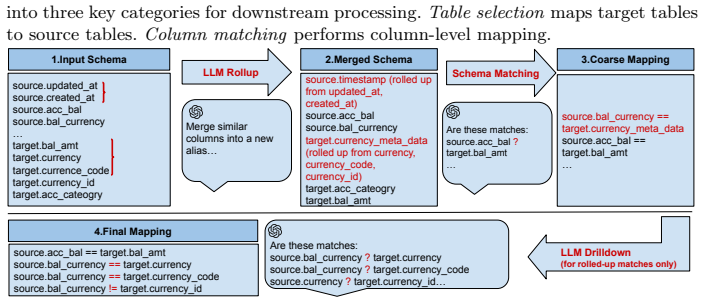
The Rollup and Drilldown pair is the load-bearing mechanism. Rollup is an LLM-driven transformation that merges semantically related columns, for example time fields into a timestamp alias, to shrink the matching problem; Drilldown is the inverse refinement that, for any coarse match involving an alias, re-runs a focused LLM prompt on the original columns and decides which are true correspondences. The surrounding three-stage pipeline, consisting of schema preparation, table-candidate selection, and column-level alignment, makes these transformations composable and lets each component be ablated and evaluated separately.
What would settle it
Independently re-annotate the schema-pair ground truth for the OMOP tasks in SchemaNet, for example mimic_iii-omop and cms-omop, by two domain experts, then recompute F1 for LLMatch and ReMatch; if the corrected mappings shrink or reverse the reported 0.4-versus-0.2 advantage, the central accuracy claim fails.
Extended reading notes
Core claim
On its own terms, the central discovery is that the hard part of complex schema matching is not the semantic matching decision but the schema's scale and interleaving, and that a hierarchy of abstraction fixes it. Rollup compresses many related columns into a few aliases, allowing coarse matches to be found reliably; Drilldown then revisits only those aliases and asks the LLM to resolve the original columns, deliberately allowing some rolled-up candidates to be rejected. The paper claims this two-level procedure is what lets LLMatch beat all baselines on every complex SchemaNet dataset and match or exceed them on simple datasets. It also reports component-level findings, such as that LLM-based table selection outperforms embedding-based vector similarity, and that descriptions plus primary/foreign-key relationships add the most accuracy.
Load-bearing premise
The accuracy claims stand or fall on SchemaNet's ground-truth mappings being accurate and complete, because every complex-task F1 score is computed against them.
Editorial extensions
If this is right
- On complex multi-table benchmarks, a staged LLM pipeline can outperform classical matchers and a strong LLM baseline by large margins, including a doubling of F1 on the largest task.
- Because LLM-based table selection beat vector similarity in the authors' experiments, LLM applications that rely on embedding retrieval for candidate selection may have room to improve by using generative selection instead.
- The Rollup and Drilldown gains grow with schema complexity, so the framework is best suited to fragmented, richly related enterprise schemas rather than flat single tables.
- SchemaNet gives the community a public, multi-domain, multi-table benchmark against which future schema matching work can be measured.
- Assisted annotators reached higher F1 in equal time, indicating the framework can reduce manual data-integration effort in practice.
Reading between the lines
- A direct extension the authors do not pursue is wrapping existing matchers with the same Rollup and Drilldown pre- and post-processing to see whether the accuracy gains transfer without retraining the matcher itself.
- The recall-prioritized n:m mapping definition implies the method is tuned for data-migration use cases; deployments that need high precision would likely need a ranking or thresholding layer on top of the framework.
- The benchmark's ground truth was assembled from prior papers, ETL code, and expert annotation; an independent re-annotation of SchemaNet, especially the OMOP tasks, would test how much of the reported margin is benchmark-specific.
Editorial analysis
A structured set of objections, weighed in public.
Referee Report
Summary. The paper presents LLMatch, a modular schema matching framework that decomposes the task into schema preparation, table-candidate selection, and column-level alignment. A Rollup module abstracts semantically related columns into higher-level concepts, and a Drilldown module re-expands them for fine-grained matching. The authors also introduce SchemaNet, a benchmark of seven real-world complex schema pairs from finance, healthcare, and entertainment, and report experiments on eleven tasks comparing LLMatch with Coma, SF, Cupid, Unicorn, and ReMatch. The paper claims that LLMatch improves F1 scores on complex matching tasks and increases engineer productivity, with code and benchmark released publicly.
Significance. If the empirical claims hold, the paper makes a useful contribution: LLMatch's modular design enables component-level evaluation, the Rollup/Drilldown idea is a plausible approach for large multi-table schemas, and SchemaNet addresses a real gap by providing complex, multi-table benchmark data. The public release of code, prompts, and benchmark is a concrete strength that should facilitate reproducibility and follow-up work. However, the evidence supporting the central accuracy and productivity claims is currently incomplete: the evaluation lacks variance and significance testing, the benchmark ground truth is not independently validated, and the productivity study is very small. These issues are load-bearing for the paper's main conclusions, so the contribution is promising but not yet fully substantiated.
major comments (4)
- [Section 6.2, Tables 2 and 3] All F1 scores are reported as single-run point estimates without variance, confidence intervals, or significance tests. Section 6.2 explicitly acknowledges that LLM outputs are non-deterministic, so the differences supporting the central claim (e.g., Table 2, cms-omop: LLMatch 0.37 vs. ReMatch 0.19; mimic_iii-omop: LLMatch 0.33 vs. ReMatch 0.20) could plausibly fall within run-to-run noise. The paper should report repeated-run means and standard deviations and provide a statistical comparison (e.g., paired tests or effect sizes) at least for the complex tasks.
- [Section 5 and Section 6.1] Every complex-task F1 score in Table 2 is computed against SchemaNet's ground-truth mappings, but Section 5 reports no inter-annotator agreement, annotation protocol, or independent audit. The healthcare pairs are reverse-engineered from ETL code and verified by data scientists, and the entertainment pair was manually annotated, but no evidence is given that these mappings are complete and unbiased. Given Section 6.1's n:m mapping definition and the FK-equal-to-PK scoring rule, small annotation decisions (e.g., whether a source column maps to one OMOP column or several conceptual equivalents) change precision and recall for every method and can reverse the LLMatch/ReMatch ordering. The paper should provide a sensitivity analysis against alternative ground-truth definitions or an independent validation of a sample of mappings.
- [Section 6.9, Figure 7] The productivity claim rests on four participants, a two-minute time cap, and no protocol description, no inter-subject variance, and no statistical test. Figure 7 reports only average F1 under two conditions, so the abstract's claim of 'substantially boosts engineer productivity' is not supported as stated. A properly designed user study with more participants, task descriptions, and measured time or error rates is needed, or the claim should be appropriately downgraded to a preliminary observation.
- [Section 6.7, Figure 6] The Rollup/Drilldown ablation, which is central to the paper's method contribution, does not specify what the 'without Rollup/Drilldown' configuration includes, nor whether table selection and column matching remain identical in both conditions. The reported gains of up to 40% are single-run point estimates. Please provide a precise description of the ablated configuration and variance information so that the contribution of Rollup/Drilldown can be properly assessed.
minor comments (7)
- [Section 6.4] The text states that on mimic_iii-omop LLMatch achieves an F1 of 0.4, double ReMatch's 0.2, but Table 2 reports LLMatch 0.33 and ReMatch 0.20. These numbers should be reconciled.
- [Figure 4] The y-axis label 'Performance Increase (%)' is not defined; the paper should state the formula used to compute the percentage improvement over ReMatch.
- [Section 6.1] The statement that foreign key matches are treated as equal to primary key matches during evaluation is not operationalized; please explain how this rule affects the computation of precision and recall.
- [Section 5] For the pairs 'adapted from prior work' (mimic-omop and synthea-omop), the paper does not state what changes were made to the original ground truth or schema; please clarify the adaptation process.
- [Table 1] The table header uses footnotes 'a' and 'b' but the notation is confusing; please spell out the column meanings in a clearer way.
- [Section 6.2] The model names appear as 'gpt-3.5-turboand gpt-4o-minimodels' (missing spaces) and the temperature/seed settings are not reported; including these details would improve reproducibility.
- [Section 6.9] The reference to [42] reporting an 81% labeling cost reduction is not directly measured in this study; the connection should be clarified.
Circularity Check
No significant circularity found: LLMatch's outputs are not fitted to its benchmarks, and the only self-citation (the release repository) is not load-bearing.
full rationale
I found no step in which a claimed prediction or derivation reduces by construction to its own input. The method uses LLMs with default settings and no parameter fitting: "We use gpt-3.5-turbo and gpt-4o-mini models with default settings, without any parameter modifications or fine-tuning." The complex-task F1 scores are therefore not fitted to SchemaNet. The Rollup and Drilldown procedure is an algorithmic preprocessing/refinement loop, not an equation derived from the evaluation metric; its effect is measured by ablations on the same data ("with without Rollup/Drilldown"), which is standard comparative evaluation rather than circularity. The only self-reference is the release repository [19], used for code, prompts, and dataset availability ("Both LLMatch and SchemaNet are made public to facilitate further research in schema matching [19]"), and it is not load-bearing for the central accuracy claim. The main residual concern is benchmark validity rather than circularity: SchemaNet is authored by the same team, and Section 5 reports no inter-annotator agreement or independent audit for mappings that were "reverse-engineered from ETL code and verified by data scientists" or "manually annotated by experts." That is a threat to external validity and could change F1 for all methods, but it is not a derivation loop: the gold standard is fixed independently of LLMatch's outputs, and no parameter is learned from it. Similarly, Section 6.2's acknowledgement of "limited reproducibility of specific responses" affects all LLM-based methods equally and does not make any reported result equivalent to its input.
Assumptions & free parameters
assumptions (3)
- domain assumption LLMs can reliably perform Rollup grouping and column mapping from schema metadata alone.
- domain assumption SchemaNet ground truth mappings are accurate and complete.
- domain assumption F1 with n:m mapping and FK=PK equivalence is an appropriate evaluation metric.
Cite this review
Pith. "Pith review of LLMATCH: A Unified Schema Matching Framework with Large Language Models." pith.science (2026). https://pith.science/paper/V27WPBAM
@misc{pith2026250710897,
  author       = {Pith},
  title        = {Pith review of: LLMATCH: A Unified Schema Matching Framework with Large Language Models},
  year         = {2026},
  howpublished = {\url{https://pith.science/paper/V27WPBAM}},
  note         = {Machine review of arXiv:2507.10897}
}
read the original abstract
Schema matching is a foundational task in enterprise data integration, aiming to align disparate data sources. While traditional methods handle simple one-to-one table mappings, they often struggle with complex multi-table schema matching in real-world applications. We present LLMatch, a unified and modular schema matching framework. LLMatch decomposes schema matching into three distinct stages: schema preparation, table-candidate selection, and column-level alignment, enabling component-level evaluation and future-proof compatibility. It includes a novel two-stage optimization strategy: a Rollup module that consolidates semantically related columns into higher-order concepts, followed by a Drilldown module that re-expands these concepts for fine-grained column mapping. To address the scarcity of complex semantic matching benchmarks, we introduce SchemaNet, a benchmark derived from real-world schema pairs across three enterprise domains, designed to capture the challenges of multi-table schema alignment in practical settings. Experiments demonstrate that LLMatch significantly improves matching accuracy in complex schema matching settings and substantially boosts engineer productivity in real-world data integration.
Figures


Figures from the paper (2 more)


Reference graph
Works this paper leans on
-
[1]
arXiv preprint arXiv:2303.08774 (2023)
Achiam, J., Adler, S., Agarwal, S., Ahmad, L., Akkaya, I., Aleman, F.L., Almeida, D., Altenschmidt, J., Altman, S., Anadkat, S., et al.: Gpt-4 technical report. arXiv preprint arXiv:2303.08774 (2023)
arXiv 2023
-
[2]
Ackerman, R., Gal, A., Sagi, T., Shraga, R.: A cognitive model of human bias in matching. In: PRICAI 2019: Trends in Artificial Intelligence: 16th Pacific Rim In- ternational Conference on Artificial Intelligence, Cuvu, Yanuca Island, Fiji, August 26–30, 2019, Proceedings, Part I 16. Springer (2019)
work page 2019
-
[3]
International Journal of Advanced Computer Science and Applications8(10) (2017)
Alwan, A.A., Nordin, A., Alzeber, M., Abualkishik, A.Z.: A survey of schema matching research using database schemas and instances. International Journal of Advanced Computer Science and Applications8(10) (2017)
work page 2017
-
[4]
Anadkat, S.: How to make your completions outputs consistent with the new seed parameter (2023),https://cookbook.openai.com/examples/reproducible_ outputs_with_the_seed_parameter, openAI Cookbook
work page 2023
-
[5]
Expert Systems with Applications229 (2023)
Asif-Ur-Rahman,M.,Hossain,B.A.,Bewong,M.,Islam,M.Z.,Zhao,Y.,Groves,J., Judith, R.: A semi-automated hybrid schema matching framework for vegetation data integration. Expert Systems with Applications229 (2023)
work page 2023
-
[6]
Proceedings of the VLDB Endowment4(11) (2011)
Bernstein, P.A., Madhavan, J., Rahm, E.: Generic schema matching, ten years later. Proceedings of the VLDB Endowment4(11) (2011)
work page 2011
-
[7]
In: 29th Italian Symposium on Advanced Database Systems (SEDB), Pizzo Calabro, Italy (2021)
Cappuzzo, R., Papotti, P., Thirumuruganathan, S.: Embdi: generating embeddings for relational data integration. In: 29th Italian Symposium on Advanced Database Systems (SEDB), Pizzo Calabro, Italy (2021)
work page 2021
-
[8]
github.io/ETL-LambdaBuilder/, accessed: 2025-03-01
Development, J.R..: Etl lambdabuilder documentation (2024), https://ohdsi. github.io/ETL-LambdaBuilder/, accessed: 2025-03-01
work page 2024
Show all 43 references
-
[9]
In: VLDB’02: Proceedings of the 28th International Conference on Very Large Databases
Do, H.H., Rahm, E.: Coma—a system for flexible combination of schema matching approaches. In: VLDB’02: Proceedings of the 28th International Conference on Very Large Databases. Elsevier (2002)
2002
-
[10]
In: 2009 Sixth International Conference on Fuzzy Systems and Knowledge Discovery
Feng, J., Hong, X., Qu, Y.: An instance-based schema matching method with attributes ranking and classification. In: 2009 Sixth International Conference on Fuzzy Systems and Knowledge Discovery. vol. 5. IEEE (2009)
2009
-
[11]
Fernandez, R.C., Elmore, A.J., Franklin, M.J., Krishnan, S., Tan, C.: How large language models will disrupt data management. Proc. VLDB Endow. 16(11) (Jul 2023). https://doi.org/10.14778/3611479.3611527, https://doi.org/10. 14778/3611479.3611527
2023
-
[12]
In: 2018 IEEE 34th International Con- ference on Data Engineering (ICDE)
Fernandez, R.C., Mansour, E., Qahtan, A.A., Elmagarmid, A., Ilyas, I., Madden, S., Ouzzani, M., Stonebraker, M., Tang, N.: Seeping semantics: Linking datasets using word embeddings for data discovery. In: 2018 IEEE 34th International Con- ference on Data Engineering (ICDE). IE...
2018
-
[13]
https://www.ft.com/content/ 4138876c-5a10-46d4-b6c6-7d421cbd9df0 (2025), accessed: 2025-03-01
Financial Times: Deutsche Bank struggles with fallout after huge Post- bank IT migration: Regulator makes unprecedented rebuke as many clients locked out of their accounts for weeks. https://www.ft.com/content/ 4138876c-5a10-46d4-b6c6-7d421cbd9df0 (2025), accessed: 2025-03-01
2025
-
[14]
In: The Semantic Web: Research and Applica- tions: First European Semantic Web Symposium, ESWS 2004 Heraklion, Crete, Greece, May 10-12, 2004
Giunchiglia, F., Shvaiko, P., Yatskevich, M.: S-match: an algorithm and an imple- mentation of semantic matching. In: The Semantic Web: Research and Applica- tions: First European Semantic Web Symposium, ESWS 2004 Heraklion, Crete, Greece, May 10-12, 2004. Proceedings 1. Sprin...
2004
-
[15]
Proceedings of the VLDB Endowment
Huang, Z., Guo, J., Wu, E.: Transform table to database using large language models. Proceedings of the VLDB Endowment. ISSN2150 (2024) 12 S. Wang et al
2024
-
[16]
https://www.iso.org/standard/55005.html, accessed: 2025-05-07
International Organization for Standardization: ISO 20022-1:2013 – Financial services – Universal financial industry message scheme – Part 1: Metamodel. https://www.iso.org/standard/55005.html, accessed: 2025-05-07
2013
-
[17]
In: EDBT/ICDT Workshops (2020)
Koutras, C., Fragkoulis, M., Katsifodimos, A., Lofi, C.: Rema: Graph embeddings- based relational schema matching. In: EDBT/ICDT Workshops (2020)
2020
-
[18]
In: ICDE
Koutras, C., Siachamis, G., Ionescu, A., Psarakis, K., Brons, J., Fragkoulis, M., Lofi, C., Bonifati, A., Katsifodimos, A.: Valentine: Evaluating matching techniques for dataset discovery. In: ICDE. IEEE (2021)
2021
-
[19]
https://github.com/knowledge-fusion/ LLMatch (2025)
LLMatch: Llmatch code and dataset. https://github.com/knowledge-fusion/ LLMatch (2025)
2025
-
[20]
In: vldb
Madhavan, J., Bernstein, P.A., Rahm, E.: Generic schema matching with cupid. In: vldb. vol. 1 (2001)
2001
-
[21]
International Arab Journal of Information Technology (IAJIT)14(5) (2017)
Mehdi, O., Ibrahim, H., Affendey, L.: An approach for instance based schema matching with google similarity and regular expression. International Arab Journal of Information Technology (IAJIT)14(5) (2017)
2017
-
[22]
In: Proceedings 18th international conference on data engineering
Melnik, S., Garcia-Molina, H., Rahm, E.: Similarity flooding: A versatile graph matching algorithm and its application to schema matching. In: Proceedings 18th international conference on data engineering. IEEE (2002)
2002
-
[23]
In: 2014 4th International Conference on Engineering Technology and Technopreneuship (ICE2T)
Munir, S., Khan, F., Riaz, M.A.: An instance based schema matching between opaque database schemas. In: 2014 4th International Conference on Engineering Technology and Technopreneuship (ICE2T). IEEE (2014)
2014
-
[24]
OHDSI: Observational Health Data Sciences and Informatics (2019)
2019
-
[25]
OpenAI: Gpt-3.5 turbo fine-tuning and api updates.https://openai.com/index/ gpt-3-5-turbo-fine-tuning-and-api-updates/ (August 22 2023), retrieved Feb 12, 2025
2023
-
[26]
Journal of the American Medical Informatics Association19(1) (2012)
Overhage, J.M., Ryan, P.B., Reich, C.G., Hartzema, A.G., Stang, P.E.: Validation of a common data model for active safety surveillance research. Journal of the American Medical Informatics Association19(1) (2012)
2012
-
[27]
Energy Informatics6(Suppl 1) (2023)
Pan, Z., Yang, M., Monti, A.: Schema matching based on energy domain pre- trained language model. Energy Informatics6(Suppl 1) (2023)
2023
-
[28]
Joint Workshops at the 50th International Conference on Very Large Data Bases (VLDBW’24) — TaDA’24: 2nd International Workshop on Tabular Data Analysis (2024)
Parciak, M., Vandevoort, B., Neven, F., Peeters, L.M., Vansummeren, S.: Schema matching with large language models: An experimental study. Joint Workshops at the 50th International Conference on Very Large Data Bases (VLDBW’24) — TaDA’24: 2nd International Workshop on Tabular ...
2024
-
[29]
JMIR Medical Informatics 9(12) (2021)
Paris, N., Lamer, A., Parrot, A.: Transformation and evaluation of the mimic database in the omop common data model: development and usability study. JMIR Medical Informatics 9(12) (2021)
2021
-
[30]
Journal of the American Medical Informatics Association31(3) (2024)
Reich, C., Ostropolets, A., Ryan, P., Rijnbeek, P., Schuemie, M., Davydov, A., Dymshyts, D., Hripcsak, G.: Ohdsi standardized vocabularies—a large-scale cen- tralized reference ontology for international data harmonization. Journal of the American Medical Informatics Associati...
2024
-
[31]
In: Proceedings of the 2019 Conference on Empirical Methods in Natural Language Processing
Reimers, N., Gurevych, I.: Sentence-bert: Sentence embeddings using siamese bert- networks. In: Proceedings of the 2019 Conference on Empirical Methods in Natural Language Processing. Association for Computational Linguistics (11 2019)
2019
-
[32]
In: The Semantic Web–ISWC 2012: 11th International Semantic Web Conference, Boston, MA, USA, November 11-15, 2012, Proceedings, Part I 11
Rong, S., Niu, X., Xiang, E.W., Wang, H., Yang, Q., Yu, Y.: A machine learning approach for instance matching based on similarity metrics. In: The Semantic Web–ISWC 2012: 11th International Semantic Web Conference, Boston, MA, USA, November 11-15, 2012, Proceedings, Part I 11....
2012
-
[33]
arXiv preprint arXiv:2406.06608 (2024) LLMATCH: a Unified Schema Matching Framework with LLM 13
Schulhoff, S., Ilie, M., Balepur, N., Kahadze, K., Liu, A., Si, C., Li, Y., Gupta, A., Han, H., Schulhoff, S., et al.: The prompt report: A systematic survey of prompting techniques. arXiv preprint arXiv:2406.06608 (2024) LLMATCH: a Unified Schema Matching Framework with LLM 13
2024 arXiv
-
[34]
arXiv preprint arXiv:2403.01567 (2024)
Sheetrit, E., Brief, M., Mishaeli, M., Elisha, O.: Rematch: Retrieval enhanced schema matching with llms. arXiv preprint arXiv:2403.01567 (2024)
2024 arXiv
-
[35]
In: 2021 IEEE 37th International Conference on Data Engineering (ICDE)
Shraga, R., Amir, O., Gal, A.: Learning to characterize matching experts. In: 2021 IEEE 37th International Conference on Data Engineering (ICDE). IEEE (2021)
2021
-
[36]
Proceedings of the VLDB En- dowment 13(9) (2020)
Shraga, R., Gal, A., Roitman, H.: Adnev: Cross-domain schema matching using deep similarity matrix adjustment and evaluation. Proceedings of the VLDB En- dowment 13(9) (2020)
2020
-
[37]
Data & Knowledge Engineering69(12) (2010)
Sorrentino, S., Bergamaschi, S., Gawinecki, M., Po, L.: Schema label normalization for improving schema matching. Data & Knowledge Engineering69(12) (2010)
2010
-
[38]
Annals of internal medicine153(9) (2010)
Stang, P.E., Ryan, P.B., Racoosin, J.A., Overhage, J.M., Hartzema, A.G., Reich, C., Welebob, E., Scarnecchia, T., Woodcock, J.: Advancing the science for active surveillance: rationale and design for the observational medical outcomes partner- ship. Annals of internal medicine...
2010
-
[39]
Proceedings of the ACM on Management of Data1(1) (2023)
Tu, J., Fan, J., Tang, N., Wang, P., Li, G., Du, X., Jia, X., Gao, S.: Unicorn: A unified multi-tasking model for supporting matching tasks in data integration. Proceedings of the ACM on Management of Data1(1) (2023)
2023
-
[40]
Proceedings of the VLDB Endowment 17(12) (2024)
Wornow, D., Suh, G., Elmore, A.J., Krishnan, S., Parameswaran, A.: Automat- ing the enterprise with foundation models. Proceedings of the VLDB Endowment 17(12) (2024)
2024
-
[41]
In: Advances in Databases and Information Systems: 25th European Conference, ADBIS
Zhang, J., Shin, B., Choi, J.D., Ho, J.C.: Smat: An attention-based deep learning solution to the automation of schema matching. In: Advances in Databases and Information Systems: 25th European Conference, ADBIS. Springer (2021)
2021
-
[42]
In: International Conference on Data Engineering (ICDE)
Zhang, Y., Floratou, A., Cahoon, J., Krishnan, S., Müller, A.C., Banda, D., Psal- lidas, F., Patel, J.M.: Schema matching using pre-trained language models. In: International Conference on Data Engineering (ICDE). IEEE (2023)
2023
-
[43]
Data & Knowledge Engineering61(2) (2007)
Zhao, H., Ram, S.: Combining schema and instance information for integrating heterogeneous data sources. Data & Knowledge Engineering61(2) (2007)
2007
Reviewed August 6, 2026 · model on record in the stance chip above.
Discussion (0). Continue with ORCID to comment.