REVIEW 4 major objections 5 minor 1 cited by
EC-Diff: Fast and High-Quality Edge-Cloud Collaborative Inference for Diffusion Models
T0 review · 4 major / 5 minor · reviewed 2026-08-06 · deepseek-v4-flash
Pith's one-line read EC-Diff claims that diffusion models tolerate small per-step noise errors, letting edge-cloud inference replace most cloud denoising calls with extrapolated noise gradients and still match cloud-only output.
desk verdict The paper's latency table is internally impossible; the hybrid idea is plausible but the headline speedup doesn't survive the paper's own arithmetic. read the letter →
The pith
A machine-rendered reading of the paper's core claim, the machinery that carries it, and where it could break.
The reading
What carries the argument
The load-bearing object is the consecutive-step noise gradient $$\delta_\epsilon=\epsilon_\$\theta$(x_i,i,c)-\epsilon_\$\theta$(x_{i+1},i+1,c),$$ which the paper treats as the local slope of the predicted-noise field. During a $k$-step approximation cycle, the $m$-th skipped network call uses $\epsilon_\theta(x_i,i,c)+m\,\delta_\epsilon$ as the predicted noise, and after $k$ steps one real cloud inference corrects the accumulated error; the gradient is then updated with smoothing factor $\alpha$ (Equation 6) to stop error-correcting over-prediction from biasing the next cycle. The other main mechanism is the two-stage greedy search, which maximizes a weighted objective of SSIM-based quality, latency efficiency, and cloud-load burden, first over $(k,\alpha)$ and then over the edge-switching point $s$.
What would settle it
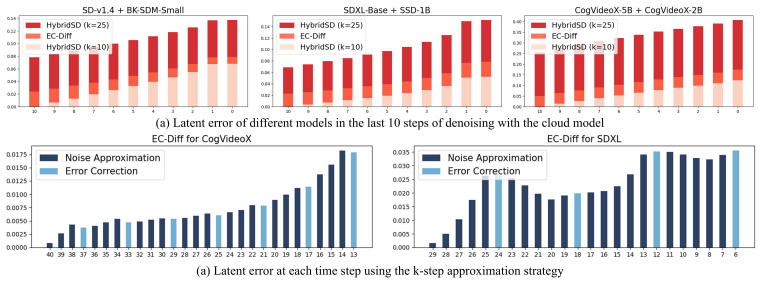
Reproduce the SDXL-base + SSD-1B configuration: if the reported 2.26x speedup at SSIM 0.905 requires more cloud calls than a $k=5$ cycle, or if injecting 0.5% Gaussian noise into the latent at late denoising steps changes the output as much as the 1-2% injections in Figure 1, the quality-preservation claim is falsified. A second check is to run the full trajectory with error correction disabled: Theorem 2 predicts bounded drift that the model can correct, so a latent error at the final ten steps far larger than the Figure 5 values would contradict the bound.
Extended reading notes
Core claim
On its own terms, EC-Diff establishes that most of the cloud model's denoising calls can be replaced by a linear extrapolation of the noise field without changing the final image or video. After a few pre-inference steps, the difference between consecutive noise predictions becomes stable enough to serve as a gradient; extrapolating that gradient for $k$ steps gives approximate noise whose error stays within the model's correction capability, and the cloud is called once per cycle to reset the trajectory. The paper formalizes the accumulated error with Theorems 1 and 2, introduces a smoothing factor $\alpha$ so the corrected gradient does not overshoot, and reports that the resulting trajectories match cloud-only outputs closely (SSIM roughly $0.87$-$0.92$, VBench $81.54$ versus the cloud's $81.57$ on the tested video task) while cutting latency to about $1.05$-$2.77$ seconds on image tasks and about $105.6$ seconds on the tested video task.
Load-bearing premise
The method assumes that diffusion models will faithfully undo small added noise at each denoising step, and that the linear noise-gradient approximation keeps its accumulated error within that correction window for every model, prompt, and timestep it is applied to.
Editorial extensions
If this is right
- If the correction-capacity premise holds, the number of cloud network calls drops by a factor of roughly $k+1$, so edge-cloud diffusion can run near edge speed without sacrificing cloud-grade semantic planning.
- The same recipe applies to video diffusion: the reported CogVideoX run keeps VBench within 0.03 of the cloud model while cutting latency from about 245 seconds (cloud) and 211 seconds (HybridSD, $k=10$) to about 106 seconds.
- Because the objective function is a weighted sum, users can tilt the operating point toward speed, quality, or cloud load by changing $w_1,w_2,w_3$ without changing the method's internals.
- Optimal parameters do not have to be fully re-derived for every edge model: stage 1 fixes the cloud-side $(k,\alpha)$ and stage 2 re-finds only the switching point $s$ for a new edge model.
Reading between the lines
- Not in the paper: the model's error-correction capacity is never measured per timestep, so a natural extension is to measure the largest per-step noise perturbation each model tolerates and use that profile to choose $k$ adaptively along the trajectory.
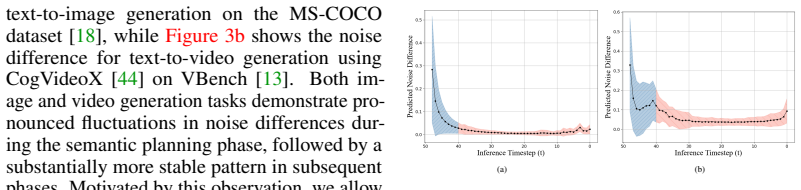
- Not in the paper: the linear gradient assumption is supported mainly in the later, fidelity-refinement phase; the noise-difference plots in Figure 3 show large variance early, suggesting that an adaptive scheme which begins approximation only after a stability detector fires could generalize to more models without a hand-set pre-inference step.
- Not in the paper: EC-Diff optimizes SSIM against the cloud output, so prompts where high-frequency detail or motion coherence matters more than structural similarity might favor different $(k,\alpha,s)$; a prompt-conditional search is a testable extension.
- Not in the paper: the approximation idea is compatible with feature-reuse and caching accelerators, so composing EC-Diff with those techniques could push speedups beyond the reported 2-2.5x without further distillation.
Editorial analysis
A structured set of objections, weighed in public.
Referee Report
Summary. The paper proposes EC-Diff, an edge-cloud collaborative inference framework for diffusion models. The cloud model performs a small number of pre-inference steps, then uses a k-step gradient-based noise approximation with periodic correction calls to reduce the number of cloud denoising steps, before handing off to a lightweight edge model. A two-stage greedy search selects the pre-inference step count p, approximation length k, smoothing factor alpha, and switching point s. The authors report near-cloud quality at up to 2.4-2.5x speedup on SD-v1.4, SDXL, and CogVideoX paired with lightweight edge models.
Significance. If the claims held, this would be a practically useful contribution: edge-cloud diffusion inference is timely, the experimental scope spans image and video generation, and the appendix provides full algorithm listings and per-model latency tables, which enable independent checking. However, the central quantitative claims are not supported. The reported end-to-end latencies violate a simple lower bound derived from the paper's own parameters and per-step costs, and the theoretical error analysis is definitional rather than bounding, with the quality metric doubling as the search objective. The paper therefore does not currently establish its headline speedup or quality-preservation results.
major comments (4)
- [§A.6.1, Tables 5–6] The reported EC-Diff latency is below the lower bound implied by the paper's own parameters and per-step costs. For SDXL-base + SSD-1B (Table 5: p=6, k=5, s=30; T=50; Table 6: cloud 6.25s, edge 4.29s, transfer 0.32s), the per-step costs are 0.125s and 0.0858s. After p pre-inference cloud calls, each cycle of k approximated steps plus one correction call advances the timestep by k+1=6, so three correction calls are needed to reach s=30: total cloud calls are 9 and the edge runs 30 steps. The minimal latency is therefore 9×0.125 + 30×0.0858 + 0.32 = 4.02s, or 3.70s even if transfer is ignored, whereas Table 6 reports 2.77s. For SD-v1.4 + BK-SDM-Small (p=7, k=2, s=34; cloud 1.70s, edge 1.18s, transfer 0.11s) the same calculation gives 10×0.034 + 34×0.0236 + 0.11 = 1.25s versus the reported 1.16s. The headline speedups in Table 1 therefore cannot be produced by the algorithm as specified.
- [§3.2.3, Eqs. (7)–(8); Appendix A.2.2–A.2.3] The theoretical error analysis does not prove that the approximation error stays small. Theorems 1 and 2 write the output error as an O-sum of the per-step approximation errors beta, and Theorem 1 subtracts an invented term beta_prime representing the amount the model 'over-predicts' noise when correcting. No condition is derived under which beta_prime actually cancels the accumulated beta terms; the 'error correction capacity' is asserted and never measured per model, per timestep, or per prompt. The proof of Theorem 2 similarly subtracts (1+m*alpha)*beta_prime_i and m*alpha*beta_{i+1} from beta^Delta, so the displayed bound only holds if those correction terms are assumed to have the right magnitude. Figure 1, the only evidence for the capacity assumption, tests one model with white Gaussian noise of one amplitude, whereas the approximation errors are structured and arise throughout the trajectory. The claim that the error 'will remain within the model's error correction capacity' is thus an assumption, not a theorem.
- [§3.3.1, Eq. (9), Eq. (12); §4.2, Table 1] The quality evaluation is partially circular. The two-stage greedy search selects parameters by maximizing Objective = w1*SSIM(x_cloud, x_ec-diff) + w2*Efficiency + w3*Burden, and Table 1 then reports SSIM/PSNR/LPIPS of EC-Diff versus the cloud output as evidence of quality preservation. Selecting on SSIM inflates the same metric used for evaluation, and no held-out selection protocol, independent metric such as FID, or human study is provided. The VBench scores are the only evaluation not optimized by the search, and they are reported for only one video configuration. The claim of 'nearly identical generation quality' is therefore not independently established.
- [§A.6.1, final paragraph] The text states that 'on the image generation task, the inference time of our model is even less than the inference time of the edge model.' This is impossible under the stated algorithm: EC-Diff replaces a subset of edge-model steps with more expensive cloud-model steps and also incurs a data-transfer cost, so its total time must exceed the edge-alone time by construction. This statement, together with the lower-bound violation in Table 6, indicates that the reported latency numbers are internally inconsistent.
minor comments (5)
- [§4.1, Table 1, §4.3.1] Section 4.1 states that HybridSD's k is set to 10 and 5, but Table 1 and Section 4.3.1 use k=10 and k=25; the labels should be made consistent.
- [Throughout] There are numerous typos, including 'utilzed', 'capablity', 'Noteably', 'comulative', 'ration' (for 'ratio'), and 'Pipline' in the Figure 2 caption; the manuscript should be carefully proofread.
- [Appendix A.2.2, Eq. (20)] Equation (20) and the surrounding proof drop the coefficients f and g by assuming they are at most 1, but no absolute values or norms are introduced; since beta terms can have mixed signs, the displayed '<' inequality is not a valid upper bound on the error magnitude.
- [Algorithm 1] The inner loop uses t−j without updating t inside the loop, and the subsequent t ← t−k−1 is ambiguous about which value of t is being decremented; the indexing of the approximation steps should be clarified.
- [§4.4, Table 2] The ablation reports 'correct errors twice' with nearly identical quality but no latency value; the claim that one correction is sufficient would be stronger with the corresponding end-to-end time.
Circularity Check
The Theorem 1 error bound in Sec. 3.2.3 restates the per-step approximation error by definition; the empirical speedup table is internally inconsistent, but that is a correctness problem rather than circularity.
-
self definitional
[Sec. 3.2.3 (Theorem 1) and Appendix A.2.2 (assumptions and Eq. (20))]
"Assume that the cloud model performs i inference steps to obtain xi−1, then uses k steps of approximated noise to obtain xi−k−1, and applies cloud model inference for error correction to obtain xi−k−2, then the following in-equation holds: ∆xi−k−2 = O(P k−1 m=0 βi−1−m − β′ i−k−1). ... βi denotes the error between the approximated noise and the model-predicted noise obtained at step i; ... When the model's error correction capability is sufficient, it will be able to identify the previously accumulated error noise, making the denoised latent return to the normal condition."
The theorem's right-hand side is literally the accumulated version of the per-step approximation errors β defined in Eq. (2) and Appendix A.2.2 as 'the error between the approximated noise and the model-predicted noise.' Thus the 'error bound' is true by definition and carries no information about whether the accumulated error is small or lies within the model's correction capacity. The proof then invokes 'When the model's error correction capability is sufficient...' to conclude the latent returns to normal, which is exactly the unproved property needed for quality preservation. The claimed theoretical validation therefore reduces to its own input assumption.
full rationale
One genuinely circular step is present and it is definitional: the Theorem 1 error bound restates the per-step approximation errors as an accumulated error and then assumes the model's correction capacity is sufficient. The rest of the method's empirical content is not circular: parameters are selected on a 100-prompt training subset, while quality is reported on a separate 30K validation/benchmark set, so using SSIM in both places is standard tuning/evaluation rather than a fitted prediction; the latency speedups are externally measured quantities. No load-bearing self-citations were found; references to [45] and [19] are external prior works. I separately note a serious internal inconsistency in Table 6: for SDXL-base + SSD-1B with p=6, k=5, s=30 and per-step times 0.125s (cloud) and 0.0858s (edge), the stated algorithm requires at least roughly 3.7-4.0s, yet the table reports 2.77s. This contradiction invalidates the headline speedup, but it is a correctness/consistency failure rather than circularity, so it does not by itself raise the circularity score. Overall, the central theoretical guarantee in Sec. 3.2.3 reduces to a definition, but the main experiments are independent of that theorem; I assign a partial circularity score of 5.
Assumptions & free parameters
free parameters (5)
- k (approximation steps) =
2, 2, 5, 5, 3 per model pair
- alpha (smoothing factor) =
0.3, 0.3, 0.2, 0.2, 0.2
- p (pre-inference steps) =
7, 7, 6, 6, 10
- s (cloud-edge switching point) =
34, 37, 30, 36, 38
- Objective weights w1,w2,w3 and s_prime =
0.3, 0.3, 0.4 and 30
assumptions (4)
- domain assumption Diffusion models have an inherent error-correction capability that absorbs small per-step noises.
- domain assumption Predicted noise varies linearly and smoothly across the k approximated steps after a brief planning phase.
- ad hoc to paper After error correction the model over-predicts noise by a compensating amount beta_prime, and this compensation cancels prior error.
- domain assumption The greedy grid search over k, alpha, and s finds parameters that generalize from 100 prompts to the 30K-prompt test set.
Cite this review
Pith. "Pith review of EC-Diff: Fast and High-Quality Edge-Cloud Collaborative Inference for Diffusion Models." pith.science (2026). https://pith.science/paper/EPSYHPG6
@misc{pith2026250711980,
  author       = {Pith},
  title        = {Pith review of: EC-Diff: Fast and High-Quality Edge-Cloud Collaborative Inference for Diffusion Models},
  year         = {2026},
  howpublished = {\url{https://pith.science/paper/EPSYHPG6}},
  note         = {Machine review of arXiv:2507.11980}
}
abstract
Diffusion Models have shown remarkable proficiency in image and video synthesis. As model size and latency increase limit user experience, hybrid edge-cloud collaborative framework was recently proposed to realize fast inference and high-quality generation, where the cloud model initiates high-quality semantic planning and the edge model expedites later-stage refinement. However, excessive cloud denoising prolongs inference time, while insufficient steps cause semantic ambiguity, leading to inconsistency in edge model output. To address these challenges, we propose EC-Diff that accelerates cloud inference through gradient-based noise estimation while identifying the optimal point for cloud-edge handoff to maintain generation quality. Specifically, we design a K-step noise approximation strategy to reduce cloud inference frequency by using noise gradients between steps and applying cloud inference periodically to adjust errors. Then we design a two-stage greedy search algorithm to efficiently find the optimal parameters for noise approximation and edge model switching. Extensive experiments demonstrate that our method significantly enhances generation quality compared to edge inference, while achieving up to an average $2\times$ speedup in inference compared to cloud inference. Video samples and source code are available at https://ec-diff.github.io/.
Figures


Figures from the paper (5 more)



Forward citations
Cited by 1 Pith paper
-
Edge-Assisted Collaborative Fine-Tuning for Multi-User Personalized Artificial Intelligence Generated Content (AIGC)
A cluster-aware hierarchical federated LoRA aggregation framework for personalized edge AIGC is described, with a reported 40% FID improvement on PACS, though the case study omits the framework's core intra-cluster ag...
Reference graph
Works this paper leans on
-
[1]
ediff-i: Text-to-image diffusion models with an ensemble of expert denoisers
Yogesh Balaji, Seungjun Nah, Xun Huang, Arash Vahdat, Jiaming Song, Qinsheng Zhang, Karsten Kreis, Miika Aittala, Timo Aila, Samuli Laine, et al. ediff-i: Text-to-image diffusion models with an ensemble of expert denoisers. arXiv preprint arXiv:2211.01324, 2022
arXiv 2022
-
[2]
Stable video diffusion: Scaling latent video diffusion models to large datasets
Andreas Blattmann, Tim Dockhorn, Sumith Kulal, Daniel Mendelevitch, Maciej Kilian, Dominik Lorenz, Yam Levi, Zion English, Vikram V oleti, Adam Letts, et al. Stable video diffusion: Scaling latent video diffusion models to large datasets. arXiv preprint arXiv:2311.15127, 2023
arXiv 2023
-
[3]
Align your latents: High-resolution video synthesis with latent diffusion models
Andreas Blattmann, Robin Rombach, Huan Ling, Tim Dockhorn, Seung Wook Kim, Sanja Fidler, and Karsten Kreis. Align your latents: High-resolution video synthesis with latent diffusion models. In Proceedings of the IEEE/CVF conference on computer vision and pattern recognition , pages 22563–22575, 2023
work page 2023
-
[4]
Efficiency-optimized video diffusion models
Zijun Deng, Xiangteng He, and Yuxin Peng. Efficiency-optimized video diffusion models. In Proceedings of the 31st ACM International Conference on Multimedia , pages 7295–7303, 2023
work page 2023
-
[5]
Mv-diffusion: Motion-aware video diffusion model
Zijun Deng, Xiangteng He, Yuxin Peng, Xiongwei Zhu, and Lele Cheng. Mv-diffusion: Motion-aware video diffusion model. In Proceedings of the 31st ACM International Conference on Multimedia , pages 7255–7263, 2023
work page 2023
-
[6]
Cogview: Mastering text-to-image generation via transformers
Ming Ding, Zhuoyi Yang, Wenyi Hong, Wendi Zheng, Chang Zhou, Da Yin, Junyang Lin, Xu Zou, Zhou Shao, Hongxia Yang, et al. Cogview: Mastering text-to-image generation via transformers. Advances in neural information processing systems, 34:19822–19835, 2021
2021
-
[7]
Structural pruning for diffusion models
Gongfan Fang, Xinyin Ma, and Xinchao Wang. Structural pruning for diffusion models. Advances in neural information processing systems, 36, 2024
2024
-
[8]
Generative adversarial networks
Ian Goodfellow, Jean Pouget-Abadie, Mehdi Mirza, Bing Xu, David Warde-Farley, Sherjil Ozair, Aaron Courville, and Yoshua Bengio. Generative adversarial networks. Communications of the ACM, 63(11):139– 144, 2020
2020
Show all 46 references
-
[9]
Progressive knowledge distillation of stable diffusion xl using layer level loss
Yatharth Gupta, Vishnu V Jaddipal, Harish Prabhala, Sayak Paul, and Patrick V on Platen. Progressive knowledge distillation of stable diffusion xl using layer level loss. arXiv preprint arXiv:2401.02677, 2024
2024 arXiv
-
[10]
Denoising diffusion probabilistic models
Jonathan Ho, Ajay Jain, and Pieter Abbeel. Denoising diffusion probabilistic models. Advances in neural information processing systems, 33:6840–6851, 2020
2020
-
[11]
Video diffusion models
Jonathan Ho, Tim Salimans, Alexey Gritsenko, William Chan, Mohammad Norouzi, and David J Fleet. Video diffusion models. Advances in Neural Information Processing Systems , 35:8633–8646, 2022
2022
-
[12]
Prodiff: Progressive fast diffusion model for high-quality text-to-speech
Rongjie Huang, Zhou Zhao, Huadai Liu, Jinglin Liu, Chenye Cui, and Yi Ren. Prodiff: Progressive fast diffusion model for high-quality text-to-speech. In Proceedings of the 30th ACM International Conference on Multimedia, pages 2595–2605, 2022
2022
-
[13]
Vbench: Comprehensive benchmark suite for video generative models
Ziqi Huang, Yinan He, Jiashuo Yu, Fan Zhang, Chenyang Si, Yuming Jiang, Yuanhan Zhang, Tianxing Wu, Qingyang Jin, Nattapol Chanpaisit, et al. Vbench: Comprehensive benchmark suite for video generative models. In Proceedings of the IEEE/CVF Conference on Computer Vision and Pat...
2024
-
[14]
Bk-sdm: A lightweight, fast, and cheap version of stable diffusion
Bo-Kyeong Kim, Hyoung-Kyu Song, Thibault Castells, and Shinkook Choi. Bk-sdm: A lightweight, fast, and cheap version of stable diffusion. In European Conference on Computer Vision, pages 381–399. Springer, 2024. 10
2024
-
[15]
Gan compression: Efficient architectures for interactive conditional gans
Muyang Li, Ji Lin, Yaoyao Ding, Zhijian Liu, Jun-Yan Zhu, and Song Han. Gan compression: Efficient architectures for interactive conditional gans. In Proceedings of the IEEE/CVF conference on computer vision and pattern recognition, pages 5284–5294, 2020
2020
-
[16]
Snapfusion: Text-to-image diffusion model on mobile devices within two seconds
Yanyu Li, Huan Wang, Qing Jin, Ju Hu, Pavlo Chemerys, Yun Fu, Yanzhi Wang, Sergey Tulyakov, and Jian Ren. Snapfusion: Text-to-image diffusion model on mobile devices within two seconds. Advances in Neural Information Processing Systems, 36:20662–20678, 2023
2023
-
[17]
Sdxl-lightning: Progressive adversarial diffusion distillation
Shanchuan Lin, Anran Wang, and Xiao Yang. Sdxl-lightning: Progressive adversarial diffusion distillation. arXiv preprint arXiv:2402.13929, 2024
2024 arXiv
-
[18]
Microsoft coco: Common objects in context
Tsung-Yi Lin, Michael Maire, Serge Belongie, James Hays, Pietro Perona, Deva Ramanan, Piotr Dollár, and C Lawrence Zitnick. Microsoft coco: Common objects in context. In Computer vision–ECCV 2014: 13th European conference, zurich, Switzerland, September 6-12, 2014, proceedings...
2014
-
[19]
Faster diffusion via temporal attention decomposition
Haozhe Liu, Wentian Zhang, Jinheng Xie, Francesco Faccio, Mengmeng Xu, Tao Xiang, Mike Zheng Shou, Juan-Manuel Perez-Rua, and Jürgen Schmidhuber. Faster diffusion via temporal attention decomposition. arXiv preprint arXiv:2404.02747, 2024
2024 arXiv
-
[20]
Dpm-solver++: Fast solver for guided sampling of diffusion probabilistic models
Cheng Lu, Yuhao Zhou, Fan Bao, Jianfei Chen, Chongxuan Li, and Jun Zhu. Dpm-solver++: Fast solver for guided sampling of diffusion probabilistic models. arXiv preprint arXiv:2211.01095, 2022
2022 arXiv
-
[21]
Latent consistency models: Synthesizing high-resolution images with few-step inference
Simian Luo, Yiqin Tan, Longbo Huang, Jian Li, and Hang Zhao. Latent consistency models: Synthesizing high-resolution images with few-step inference. arXiv preprint arXiv:2310.04378, 2023
2023 arXiv
-
[22]
Fastercache: Training-free video diffusion model acceleration with high quality
Zhengyao Lv, Chenyang Si, Junhao Song, Zhenyu Yang, Yu Qiao, Ziwei Liu, and Kwan-Yee K Wong. Fastercache: Training-free video diffusion model acceleration with high quality. arXiv preprint arXiv:2410.19355, 2024
2024 arXiv
-
[23]
Accelerating diffusion models via early stop of the diffusion process
Zhaoyang Lyu, Xudong Xu, Ceyuan Yang, Dahua Lin, and Bo Dai. Accelerating diffusion models via early stop of the diffusion process. arXiv preprint arXiv:2205.12524, 2022
2022 arXiv
-
[24]
Deepcache: Accelerating diffusion models for free
Xinyin Ma, Gongfan Fang, and Xinchao Wang. Deepcache: Accelerating diffusion models for free. In Proceedings of the IEEE/CVF conference on computer vision and pattern recognition , pages 15762–15772, 2024
2024
-
[25]
Early exiting for accelerated inference in diffusion models
Taehong Moon, Moonseok Choi, EungGu Yun, Jongmin Yoon, Gayoung Lee, and Juho Lee. Early exiting for accelerated inference in diffusion models. In ICML 2023 Workshop on Structured Probabilistic Inference {\&} Generative Modeling, 2023
2023
-
[26]
Improved denoising diffusion probabilistic models
Alexander Quinn Nichol and Prafulla Dhariwal. Improved denoising diffusion probabilistic models. In International conference on machine learning , pages 8162–8171. PMLR, 2021
2021
-
[27]
Image transformer
Niki Parmar, Ashish Vaswani, Jakob Uszkoreit, Lukasz Kaiser, Noam Shazeer, Alexander Ku, and Dustin Tran. Image transformer. In International conference on machine learning , pages 4055–4064. PMLR, 2018
2018
-
[28]
Sdxl: Improving latent diffusion models for high-resolution image synthesis
Dustin Podell, Zion English, Kyle Lacey, Andreas Blattmann, Tim Dockhorn, Jonas Müller, Joe Penna, and Robin Rombach. Sdxl: Improving latent diffusion models for high-resolution image synthesis. arXiv preprint arXiv:2307.01952, 2023
2023 arXiv
-
[29]
High-resolution image synthesis with latent diffusion models
Robin Rombach, Andreas Blattmann, Dominik Lorenz, Patrick Esser, and Björn Ommer. High-resolution image synthesis with latent diffusion models. In Proceedings of the IEEE/CVF conference on computer vision and pattern recognition, pages 10684–10695, 2022
2022
-
[30]
Stable diffusion v1-4, 2022
Robin Rombach, Andreas Blattmann, Dominik Lorenz, Patrick Esser, and Björn Ommer. Stable diffusion v1-4, 2022
2022
-
[31]
U-net: Convolutional networks for biomedical image segmentation
Olaf Ronneberger, Philipp Fischer, and Thomas Brox. U-net: Convolutional networks for biomedical image segmentation. In Medical image computing and computer-assisted intervention–MICCAI 2015: 18th international conference, Munich, Germany, October 5-9, 2015, proceedings, part ...
2015
-
[32]
Progressive distillation for fast sampling of diffusion models
Tim Salimans and Jonathan Ho. Progressive distillation for fast sampling of diffusion models. arXiv preprint arXiv:2202.00512, 2022
2022 arXiv
-
[33]
Fast high-resolution image synthesis with latent adversarial diffusion distillation
Axel Sauer, Frederic Boesel, Tim Dockhorn, Andreas Blattmann, Patrick Esser, and Robin Rombach. Fast high-resolution image synthesis with latent adversarial diffusion distillation. In SIGGRAPH Asia 2024 Conference Papers, pages 1–11, 2024. 11
2024
-
[34]
Adversarial diffusion distillation
Axel Sauer, Dominik Lorenz, Andreas Blattmann, and Robin Rombach. Adversarial diffusion distillation. In European Conference on Computer Vision, pages 87–103. Springer, 2024
2024
-
[35]
Denoising diffusion implicit models
Jiaming Song, Chenlin Meng, and Stefano Ermon. Denoising diffusion implicit models. arXiv preprint arXiv:2010.02502, 2020
2010 arXiv
-
[36]
Consistency models
Yang Song, Prafulla Dhariwal, Mark Chen, and Ilya Sutskever. Consistency models. In International Conference on Machine Learning, 2023
2023
-
[37]
Mm-ldm: Multi-modal latent diffusion model for sounding video generation
Mingzhen Sun, Weining Wang, Yanyuan Qiao, Jiahui Sun, Zihan Qin, Longteng Guo, Xinxin Zhu, and Jing Liu. Mm-ldm: Multi-modal latent diffusion model for sounding video generation. In Proceedings of the 32nd ACM International Conference on Multimedia , pages 10853–10861, 2024
2024
-
[38]
Qvd: Post-training quantization for video diffusion models
Shilong Tian, Hong Chen, Chengtao Lv, Yu Liu, Jinyang Guo, Xianglong Liu, Shengxi Li, Hao Yang, and Tao Xie. Qvd: Post-training quantization for video diffusion models. In Proceedings of the 32nd ACM International Conference on Multimedia, pages 10572–10581, 2024
2024
-
[39]
Modelscope text-to-video technical report
Jiuniu Wang, Hangjie Yuan, Dayou Chen, Yingya Zhang, Xiang Wang, and Shiwei Zhang. Modelscope text-to-video technical report. arXiv preprint arXiv:2308.06571, 2023
2023 arXiv
-
[40]
Videolcm: Video latent consistency model
Xiang Wang, Shiwei Zhang, Han Zhang, Yu Liu, Yingya Zhang, Changxin Gao, and Nong Sang. Videolcm: Video latent consistency model. arXiv preprint arXiv:2312.09109, 2023
2023 arXiv
-
[41]
Image quality assessment: from error visibility to structural similarity
Zhou Wang, Alan C Bovik, Hamid R Sheikh, and Eero P Simoncelli. Image quality assessment: from error visibility to structural similarity. IEEE transactions on image processing, 13(4):600–612, 2004
2004
-
[42]
Cache me if you can: Accelerating diffusion models through block caching
Felix Wimbauer, Bichen Wu, Edgar Schoenfeld, Xiaoliang Dai, Ji Hou, Zijian He, Artsiom Sanakoyeu, Peizhao Zhang, Sam Tsai, Jonas Kohler, et al. Cache me if you can: Accelerating diffusion models through block caching. In Proceedings of the IEEE/CVF Conference on Computer Visio...
2024
-
[43]
Hybrid sd: Edge-cloud collaborative inference for stable diffusion models
Chenqian Yan, Songwei Liu, Hongjian Liu, Xurui Peng, Xiaojian Wang, Fangmin Chen, Lean Fu, and Xing Mei. Hybrid sd: Edge-cloud collaborative inference for stable diffusion models. arXiv preprint arXiv:2408.06646, 2024
2024 arXiv
-
[44]
Cogvideox: Text-to-video diffusion models with an expert transformer
Zhuoyi Yang, Jiayan Teng, Wendi Zheng, Ming Ding, Shiyu Huang, Jiazheng Xu, Yuanming Yang, Wenyi Hong, Xiaohan Zhang, Guanyu Feng, et al. Cogvideox: Text-to-video diffusion models with an expert transformer. arXiv preprint arXiv:2408.06072, 2024
2024 arXiv
-
[45]
Training-free adaptive diffusion with bounded difference approximation strategy
Hancheng Ye, Jiakang Yuan, Renqiu Xia, Xiangchao Yan, Tao Chen, Junchi Yan, Botian Shi, and Bo Zhang. Training-free adaptive diffusion with bounded difference approximation strategy. Advances in Neural Information Processing Systems, 37:306–332, 2024
2024
-
[46]
Real-time video generation with pyramid attention broadcast
Xuanlei Zhao, Xiaolong Jin, Kai Wang, and Yang You. Real-time video generation with pyramid attention broadcast. arXiv preprint arXiv:2408.12588, 2024. 12 A Appendix A.1 Algorithm of k-step noise approximation strategy Algorithm 1 K-Step Noise Approximation Strategy. Input: Cl...
2024 arXiv
Reviewed August 6, 2026 · model on record in the stance chip above.
Discussion (0). Sign in to comment.