REVIEW 3 major objections 6 minor 31 references
Style Composition within Distinct LoRA modules for Traditional Art
T0 review · 3 major / 6 minor · reviewed 2026-08-06 · deepseek-v4-flash
Pith's one-line read The paper claims that distinct artistic styles can be assigned to user-chosen regions of a single image by fusing the masked clean latents predicted by separately trained style-specialized LoRA models during flow-matching denoising…
desk verdict A useful extension of TweedieMix to region-specific style composition, but the merging step has a real mathematical glitch and the quantitative evidence is too thin. read the letter →
The pith
A machine-rendered reading of the paper's core claim, the machinery that carries it, and where it could break.
The reading
What carries the argument
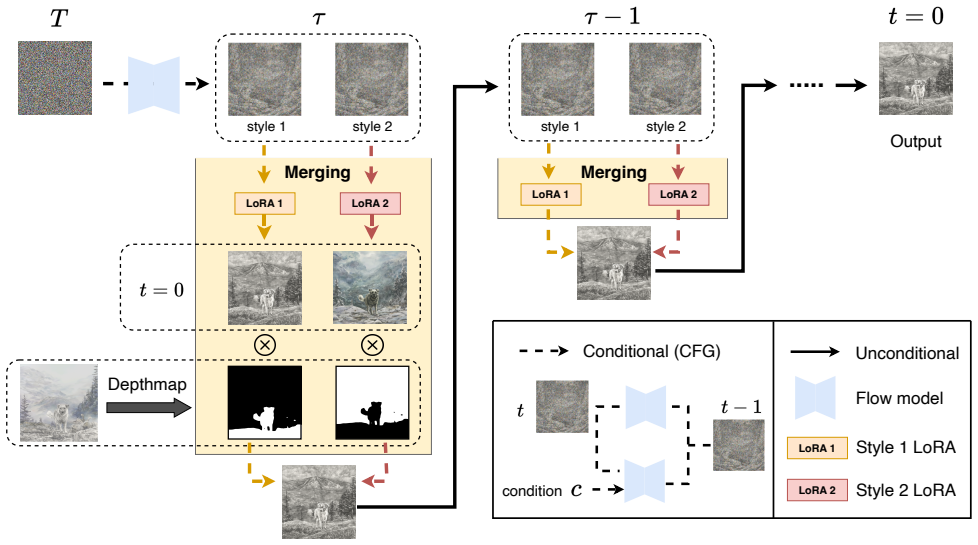
The load-bearing mechanism is clean-latent fusion with per-style unconditional re-noising inside a Flow Matching solve. Each style's model computes its velocity under classifier-free guidance, estimates the clean latent $\hat{z}_0^{s_i} = z_t^{s_i} - \sigma_t v_t^{s_i}$, and the mask-weighted sum $\hat{z}_0 = \sum_i \hat{z}_0^{s_i} M_{s_i}$ forms the merged endpoint; the merged endpoint is then returned to noise level $t$ through each model's unconditional velocity $v_{\theta}^{s_i}(z_t^{s_i}, \emptyset)$, so that the next conditional step is taken by each model from a coherent common state. Binary masks play a structural role: the paper reports that attention at lower timesteps mixes information across regions, so soft masks cause style leakage. The depth-map ControlNet condition supplies the shared geometry that keeps the separately trained models aligned.
What would settle it
Decode the merged latent from the first merging step and compare each masked region's CLIP-Image similarity to the corresponding single-style reference and to a naive LoRA weight fusion; if the region scores do not beat the naive fusion while the unmasked structure stays intact, the clean-latent fusion claim is falsified. Because the printed Algorithm 1 evaluates the unconditional velocity on $z_T^{s_i}$ rather than $z_t^{s_i}$, this test must be run on a corrected implementation of the update described in the prose.
Extended reading notes
Core claim
The central claim is that style composition should be performed on the clean latent predicted by each style model during flow-matching denoising, not on model weights or on final pixels. At every step after a coarse layout appears at timestep $t'$, each LoRA-adapted model $\theta^{s_i}$ predicts its clean endpoint $\hat{z}_0^{s_i}$; the endpoints are combined with binary masks $M_{s_i}$, and the fused latent $\hat{z}_0$ is propagated back to timestep $t$ through each model's unconditional velocity so that the next conditional denoising step starts from a valid latent. The paper reports that this preserves each style's fidelity in its designated region and yields smooth transitions across style boundaries, with better masked-region CLIP-Image similarity than naive LoRA weight fusion. The method is demonstrated on four pairs from a five-style Korean traditional painting dataset, using depth maps to align structure across the separately trained pipelines.
Load-bearing premise
The load-bearing premise is that the clean latents of separately trained style models live on a shared enough manifold that a masked average, re-noised through each model's unconditional velocity, remains a valid starting point for the next conditional denoising step.
Editorial extensions
If this is right
- Artists can generate one image with, say, an ink-wash foreground and a color-painting background from a single prompt plus a mask, without any joint fine-tuning.
- Any Flow Matching-compatible style personalization method can be plugged in, so the set of composable styles is not limited to the five Korean painting techniques trained here.
- Adding more styles costs one LoRA adapter per style rather than a retrained combined model, so the pipeline scales by modular insertion.
- Because composition happens per denoising step rather than as a final cut, the style boundary is produced during generation and can inherit coherent structure from the shared depth map.
- The method sidesteps the need for smooth interpolation in the diffusion latent space, which the paper identifies as a known obstacle to style mixing.
Reading between the lines
- Editorial inference: the same masked clean-latent merge should transfer to other structural ControlNet conditions, such as edges, segmentation maps, or pose, when depth is unavailable, which would directly address the paper's stated limitation.
- Editorial inference: the method implicitly predicts that separately LoRA-adapted models sharing a base checkpoint live on a compatible latent manifold; measuring the reconstruction error of a merged latent after one re-noise step would make this compatibility testable.
- Editorial inference: the 'zero-shot' claim is about inference time only, since per-style LoRA training is still required; the practical overhead is one adapter per style rather than one per style pair.
- Editorial inference: a natural stress test is to use the same pipeline across two different base models or noise schedules; if the clean latents are not calibrated, the merge would likely show artifacts, clarifying the boundary of the zero-shot claim.
Editorial analysis
A structured set of objections, weighed in public.
Referee Report
Summary. This paper proposes a zero-shot pipeline for regional multi-style image generation with the Flux-dev flow-matching model, using per-style LoRA modules and depth-map conditioning. The method runs independent denoising until an early timestep, then alternates between fusing per-style clean-latent predictions by binary spatial masks and re-noising the fused latent through the unconditional velocity of each style model, followed by standard denoising steps. The authors report one averaged CLIP-I number over four style pairs and qualitative comparisons against weighted LoRA fusion.
Significance. If the latent-fusion update were mathematically valid, the modular, zero-shot design would be a useful contribution: styles are trained separately, no joint fine-tuning is needed, and depth-based masks provide user control over regions. These are genuine strengths of the proposal. However, the central algorithm contains a load-bearing inverse-Euler error, and the quantitative support is a single averaged score with no variance, per-pair detail, or significance testing. The paper's claims are therefore not yet established.
major comments (3)
- [Algorithm 1 / Sec. 3.2] The re-noising step in Algorithm 1 is not the inverse of the clean-latent prediction. For rectified flow with interpolation z_t = (1 - σ_t)x0 + σ_t ε, the clean-latent prediction is x̂0 = z_t - σ_t v(z_t, t), and the corresponding point on the same interpolation path with the same noise is x̂0 + σ_t ε, not x̂0 + σ_t v(z_T, ∅). Since v(z_T, ∅) is approximately ε - x0_style, the update produces z_t = (1 - σ_t)x̂0 + σ_t(ε + x̂0 - x0_style), which is off the interpolation path whenever x̂0 is the masked blend of two style-specific clean latents. Repeating this update for t = τ-1 down to 0 compounds the drift. Algorithm 1 also uses z_{s_i}_T in the CFG and re-noising subscripts while the text says the unconditional velocity is 'computed earlier' for the current latent; these inconsistencies make the exact implemented update ambiguous. Section 4 contains no measurement of intermediate-latent on-manifoldness, so the reported CLIP-I scores cannot rule out this drift. This concern is load-bearing because the claimed natural blending rests on the validity of the merging update.
- [Sec. 4.3, Table 1] The quantitative evaluation is too weak to support the central claim. Table 1 reports a single CLIP-I number averaged over four style pairs with no standard deviation, no per-pair breakdown, and no significance test. The difference between LoRA Fusion (0.692) and Ours (0.697) is 0.005, which is small relative to the likely variance of CLIP-I; without error bars or a paired test, this is not evidence of improvement. The authors also list Style1 and Style2 scores but do not describe how the masked-region CLIP-I was computed in a way that rules out trivial confounds such as mask boundary effects or depth-conditioned content alignment. Please provide per-pair results, error bars, and a significance test, and ideally an additional metric such as a user study.
- [Sec. 3.2 and Experiments] The proposed method is distinguished from Tweediemix [15], which also fuses clean latents, but no experimental comparison to [15] is given. Since [15] is the closest prior work on latent fusion for multi-concept generation, a direct comparison is necessary to establish that the new masking and re-noising procedure contributes beyond it. Similarly, the hand-set hyperparameters (mask threshold 0.5, style-mixing timestep τ=8, guidance 3.5) are not ablated; the paper should include a sensitivity analysis for at least τ and the mask threshold.
minor comments (6)
- [Sec. 3.2] The phrase 'which refers applying' should be 'which refers to applying', and the sentence 'In practical, these timesteps are used discretely' should be 'In practice, these timesteps are used discretely'.
- [Sec. 4.2] The sentence 'For LoRA adaptation, we used trained each style for 3500 steps' is ungrammatical; also, the statement that merging updates start at t′=8 'i.e. after the first 20 denoising iterations' is unclear, since 28 total steps with τ=8 does not obviously correspond to 20 iterations. Please clarify the denoising schedule.
- [Algorithm 1] The symbol σ_t is used without an explicit definition; please define the noise schedule and the mapping from discrete steps to continuous t.
- [Figure 3] The captions are dense and the mask overlays are hard to see; consider showing the binary masks explicitly or using colored outlines to indicate the regions for each style.
- [References] Several references are malformed, e.g., '[7] Shuyang et al. Gu' and '[13] Minguk et al. Kang'; these should be corrected to standard author-year format.
- [Sec. 5] The limitation section mentions only the dependency on depth maps; it should also acknowledge the lack of validation for the latent re-noising step and the absence of hyperparameter sensitivity analysis.
Circularity Check
No significant circularity: the style-composition pipeline is a constructive algorithm compared against an external baseline, and no prediction reduces by construction to its own inputs.
full rationale
I walked the derivation chain from LoRA-trained style models (Sec. 3.1) through the simple/merging update loop (Sec. 3.2, Algorithm 1) to the CLIP-I comparison (Sec. 4.3). The merged clean latent is a masked average of two independently predicted per-style endpoints; this is an algorithmic construction, not a quantity derived from the evaluation metric. Hyperparameters such as the merging timestep, guidance scale, and mask threshold are fixed by hand and are not fitted to CLIP-I in any stated loop, so there is no fitted parameter later renamed as a prediction. The cited building blocks (LoRA, DreamBooth, Flow Matching, TweedieMix) are not from the present authors and are not invoked as a uniqueness theorem that forbids alternatives. CLIP-I is an external, standard metric comparing generated images with reference style images under spatial masks; it is a fair comparison against the LoRA Fusion baseline, although the evaluation uses style images from the same dataset used for training, which is an evaluation-design concern rather than circularity. The stated limitation in Sec. 5 (reliance on ControlNet and depth maps) is practical, not circular. Algorithm 1 does contain subscript inconsistencies, e.g., unconditional velocities evaluated at the initial noise inside the merging loop, which raises a technical validity question about whether the re-noising step is a correct flow-matching inverse update; however, a potential implementation bug is not a circular derivation. No load-bearing step in the paper reduces to its own input by definition, so the circularity score is 0.
Assumptions & free parameters
free parameters (5)
- mask_threshold (depth binarization) =
0.5
- style_mixing_timestep tau =
8 (out of 28 steps)
- classifier_free_guidance_scale =
3.5
- lora_training_steps =
3500
- inference_steps =
28
assumptions (5)
- standard math Flow matching clean-latent reconstruction: z0_hat = z_t - sigma_t * v_t is a valid estimate of the final clean latent.
- domain assumption Latents from independently LoRA-adapted style models can be merged at the latent level without leaving the model's valid input manifold.
- ad hoc to paper Lower-noise latents carry stronger stylistic information, so fusion should happen after an early structure-forming phase.
- domain assumption Binary masks obtained by thresholding a depth map at 0.5 capture the user-intended style regions.
- ad hoc to paper Using the unconditional velocity to return from the fused clean latent avoids cross-style artifacts.
Cite this review
Pith. "Pith review of Style Composition within Distinct LoRA modules for Traditional Art." pith.science (2026). https://pith.science/paper/F4D4RAOA
@misc{pith2026250711986,
  author       = {Pith},
  title        = {Pith review of: Style Composition within Distinct LoRA modules for Traditional Art},
  year         = {2026},
  howpublished = {\url{https://pith.science/paper/F4D4RAOA}},
  note         = {Machine review of arXiv:2507.11986}
}
read the original abstract
Diffusion-based text-to-image models have achieved remarkable results in synthesizing diverse images from text prompts and can capture specific artistic styles via style personalization. However, their entangled latent space and lack of smooth interpolation make it difficult to apply distinct painting techniques in a controlled, regional manner, often causing one style to dominate. To overcome this, we propose a zero-shot diffusion pipeline that naturally blends multiple styles by performing style composition on the denoised latents predicted during the flow-matching denoising process of separately trained, style-specialized models. We leverage the fact that lower-noise latents carry stronger stylistic information and fuse them across heterogeneous diffusion pipelines using spatial masks, enabling precise, region-specific style control. This mechanism preserves the fidelity of each individual style while allowing user-guided mixing. Furthermore, to ensure structural coherence across different models, we incorporate depth-map conditioning via ControlNet into the diffusion framework. Qualitative and quantitative experiments demonstrate that our method successfully achieves region-specific style mixing according to the given masks.
Figures


Figures from the paper (1 more)

Reference graph
Works this paper leans on
-
[15]
Tweediemix: Improving multi-concept fusion for diffusion-based image/video gener- ation
Gihyun Kwon and Jong Chul Ye. Tweediemix: Improving multi-concept fusion for diffusion-based image/video gener- ation. In ICLR, 2025. 4
work page 2025
-
[1]
Scaling rectified flow trans- formers for high-resolution image synthesis, 2024
Patrick Esser, Sumith Kulal, Andreas Blattmann, Rahim Entezari, Jonas M ¨uller, Harry Saini, Yam Levi, Dominik Lorenz, Axel Sauer, Frederic Boesel, Dustin Podell, Tim Dockhorn, Zion English, Kyle Lacey, Alex Goodwin, Yan- nik Marek, and Robin Rombach. Scaling rectified flow trans- formers for high-resolution image synthesis, 2024. 1, 2
work page 2024
-
[2]
GLIDE: towards photoreal- istic image generation and editing with text-guided diffusion models
Alexander Quinn Nichol et al. GLIDE: towards photoreal- istic image generation and editing with text-guided diffusion models. In International Conference on Machine Learning, ICML 2022, 17-23 July 2022, Baltimore, Maryland, USA , pages 16784–16804. PMLR, 2022. 1
work page 2022
-
[3]
Learning transferable visual models from natural language supervision
Alec Radford et al. Learning transferable visual models from natural language supervision. In Proceedings of the 38th In- ternational Conference on Machine Learning, ICML 2021, 18-24 July 2021, Virtual Event , pages 8748–8763. PMLR,
work page 2021
-
[4]
Photorealistic text-to-image diffusion models with deep language understanding
Chitwan Saharia et al. Photorealistic text-to-image diffusion models with deep language understanding. In Advances in Neural Information Processing Systems, 2022. 1
work page 2022
-
[5]
SDXL: improving latent diffusion mod- els for high-resolution image synthesis
Dustin Podell et al. SDXL: improving latent diffusion mod- els for high-resolution image synthesis. In The Twelfth In- ternational Conference on Learning Representations, ICLR 2024, Vienna, Austria, May 7-11, 2024 . OpenReview.net, 2024
work page 2024
-
[6]
ediff-i: Text-to-image diffusion models with an ensemble of expert denoisers
Yogesh Balaji et al. ediff-i: Text-to-image diffusion models with an ensemble of expert denoisers. CoRR, abs/2211.01324, 2022
arXiv 2022
-
[7]
Shuyang et al. Gu. Vector quantized diffusion model for text- to-image synthesis. arXiv preprint arXiv:2111.14822, 2021. 1
arXiv 2021
Show all 31 references
-
[8]
Smooth diffusion: Crafting smooth latent spaces in dif- fusion models
Jiayi Guo, Xingqian Xu, Yifan Pu, Zanlin Ni, Chaofei Wang, Manushree Vasu, Shiji Song, Gao Huang, and Humphrey Shi. Smooth diffusion: Crafting smooth latent spaces in dif- fusion models. In Proceedings of the IEEE/CVF Conference on Computer Vision and Pattern Recognition , pag...
2024
-
[9]
Isometric representation learning for disentangled latent space of diffusion models
Jaehoon Hahm, Junho Lee, Sunghyun Kim, and Joonseok Lee. Isometric representation learning for disentangled latent space of diffusion models. In International Conference on Machine Learning, pages 17224–17245. PMLR, 2024. 2
2024
-
[10]
Classifier-free diffusion guidance
Jonathan Ho and Tim Salimans. Classifier-free diffusion guidance. In NeurIPS 2021 Workshop on Deep Generative Models and Downstream Applications, 2021. 4
2021
-
[11]
Denoising dif- fusion probabilistic models
Jonathan Ho, Ajay Jain, and Pieter Abbeel. Denoising dif- fusion probabilistic models. In Advances in Neural Informa- tion Processing Systems 33: Annual Conference on Neural Information Processing Systems 2020, NeurIPS 2020, De- cember 6-12, 2020, virtual, 2020. 2
2020
-
[12]
LoRA: Low-rank adaptation of large language models
Edward J Hu, Yelong Shen, Phillip Wallis, Zeyuan Allen- Zhu, Yuanzhi Li, Shean Wang, Lu Wang, and Weizhu Chen. LoRA: Low-rank adaptation of large language models. In ICLR, 2022. 2, 3, 4, 6
2022
-
[13]
Minguk et al. Kang. Scaling up gans for text-to-image syn- thesis. In Proceedings of the IEEE Conference on Computer Vision and Pattern Recognition (CVPR), 2023. 2
2023
-
[14]
A style-based generator architecture for generative adversarial networks
Tero Karras, Samuli Laine, and Timo Aila. A style-based generator architecture for generative adversarial networks. In Proceedings of the IEEE/CVF conference on computer vi- sion and pattern recognition, pages 4401–4410, 2019. 2
2019
-
[16]
Black Forest Labs. Flux. https://github.com/ black-forest-labs/flux, 2024. 2, 4
2024
-
[17]
Controllable text-to-image generation
Bowen Li, Xiaojuan Qi, Thomas Lukasiewicz, and Philip Torr. Controllable text-to-image generation. Advances in neural information processing systems, 32, 2019. 2
2019
-
[18]
Stylet2i: Toward compositional and high-fidelity text- to-image synthesis
Zhiheng Li, Martin Renqiang Min, Kai Li, and Chenliang Xu. Stylet2i: Toward compositional and high-fidelity text- to-image synthesis. In Proceedings of the IEEE/CVF Confer- ence on Computer Vision and Pattern Recognition (CVPR) ,
-
[19]
Yaron Lipman, Ricky T. Q. Chen, Heli Ben-Hamu, Maxi- milian Nickel, and Matt Le. Flow matching for generative modeling, 2023. 2, 3, 4
2023
-
[20]
Understanding the latent space of diffusion models through the lens of riemannian geometry
Yong-Hyun Park, Mingi Kwon, Jaewoong Choi, Junghyo Jo, and Youngjung Uh. Understanding the latent space of diffusion models through the lens of riemannian geometry. Advances in Neural Information Processing Systems , 36: 24129–24142, 2023. 2
2023
-
[21]
Scalable diffusion models with transformers
William Peebles and Saining Xie. Scalable diffusion models with transformers. In ICCV, 2023. 2, 3, 4
2023
-
[22]
Generative ad- versarial text to image synthesis
Scott Reed, Zeynep Akata, Xinchen Yan, Lajanugen Lo- geswaran, Bernt Schiele, and Honglak Lee. Generative ad- versarial text to image synthesis. In Proceedings of The 33rd International Conference on Machine Learning, pages 1060–1069, New York, New York, USA, 2016. PMLR. 2
2016
-
[23]
High-resolution image syn- thesis with latent diffusion models
Robin Rombach, Andreas Blattmann, Dominik Lorenz, Patrick Esser, and Bj¨orn Ommer. High-resolution image syn- thesis with latent diffusion models. InIEEE/CVF Conference on Computer Vision and Pattern Recognition, CVPR 2022, New Orleans, LA, USA, June 18-24, 2022 , pages 10674–...
2022
-
[24]
U-net: Convolutional networks for biomedical image segmentation,
Olaf Ronneberger, Philipp Fischer, and Thomas Brox. U-net: Convolutional networks for biomedical image segmentation,
-
[25]
RB-modulation: Training-free stylization using reference-based modulation
Litu Rout, Yujia Chen, Nataniel Ruiz, Abhishek Ku- mar, Constantine Caramanis, Sanjay Shakkottai, and Wen- Sheng Chu. RB-modulation: Training-free stylization using reference-based modulation. In ICLR, 2025. 1, 2
2025
-
[26]
Dreambooth: Fine tuning text-to-image diffusion models for subject-driven generation
Nataniel Ruiz, Yuanzhen Li, Varun Jampani, Yael Pritch, Michael Rubinstein, and Kfir Aberman. Dreambooth: Fine tuning text-to-image diffusion models for subject-driven generation. In CVPR, 2023. 2, 3
2023
-
[27]
Denois- ing diffusion implicit models
Jiaming Song, Chenlin Meng, and Stefano Ermon. Denois- ing diffusion implicit models. In International Conference on Learning Representations, 2021. 2
2021
-
[28]
Tao et al. Xu. Attngan: Fine-grained text to image generation with attentional generative adversarial networks. InProceed- ings of the IEEE conference on computer vision and pattern recognition, pages 1316–1324, 2018. 2
2018
-
[29]
Ip- adapter: Text compatible image prompt adapter for text-to- image diffusion models, 2023
Hu Ye, Jun Zhang, Sibo Liu, Xiao Han, and Wei Yang. Ip- adapter: Text compatible image prompt adapter for text-to- image diffusion models, 2023. 1, 2
2023
-
[30]
Cross-modal contrastive learning for text-to- image generation
Han Zhang, Jing Yu Koh, Jason Baldridge, Honglak Lee, and Yinfei Yang. Cross-modal contrastive learning for text-to- image generation. In Proceedings of the IEEE/CVF con- ference on computer vision and pattern recognition , pages 833–842, 2021. 2
2021
-
[31]
Adding conditional control to text-to-image diffusion models, 2023
Lvmin Zhang, Anyi Rao, and Maneesh Agrawala. Adding conditional control to text-to-image diffusion models, 2023. 2, 3, 7
2023
Reviewed August 6, 2026 · model on record in the stance chip above.
Discussion (0). Continue with ORCID to comment.