REVIEW 3 major objections 4 minor 55 references
Learning, fast and slow: a two-fold algorithm for data-based model adaptation
T0 review · 3 major / 4 minor · reviewed 2026-08-06 · deepseek-v4-flash
Pith's one-line read A two-component architecture—an offline-trained ensemble triggered by statistical monitoring plus an online Gaussian-process corrector—adapts a data-based model of a district heating system to new operating conditions and persistent…
desk verdict Well-specified slow/fast adaptation architecture, but the headline FIT gain is a one-step-ahead oracle-corrected fit, not a free-running prediction; evidence is a single simulation. read the letter →
The pith
A machine-rendered reading of the paper's core claim, the machinery that carries it, and where it could break.
The reading
What carries the argument
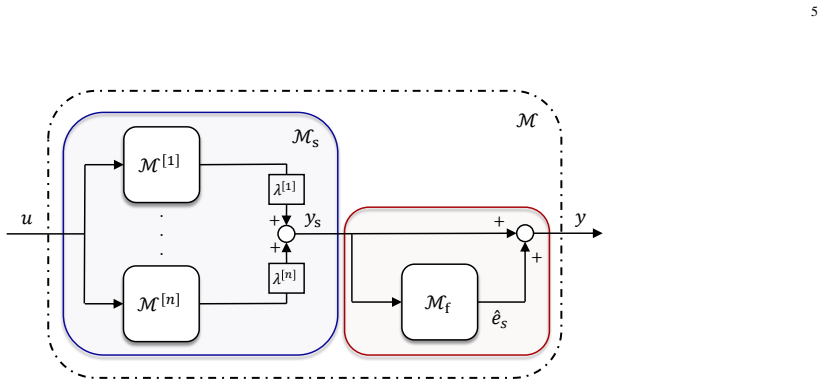
The argument turns on three mechanisms. (i) A Mahalanobis-distance weighting rule, a scale-invariant statistical distance that accounts for the covariance of the training inputs: each ensemble model receives a weight proportional to the inverse of this distance between the current input vector and that model's training inputs, so the locally most relevant model dominates without any output-based optimization. (ii) A Hotelling $T^{2}$ multivariate control-chart monitor with empirically set control limits: modelling errors are monitored online, and when the error statistic exceeds its limit the algorithm checks whether the current inputs also fall outside all known input regions; if they do, a new model is trained offline and added to the ensemble, while if the inputs are old but the errors are new, the ensemble is deemed obsolete and reset. (iii) A fast Gaussian-process corrector in NARX form, one Gaussian process per output, trained online at each step with a sliding window of at most $k_{\max}$ samples and a squared-exponential kernel, which predicts the residual of the slow ensemble and adds it to the final output. Together these implement the paper's metaphor of System 2 (slow, deliberate, offline) and System 1 (fast, automatic, online) thinking.
What would settle it
Run the same two-day benchmark but replace the step-wise jump between seasonal load regimes with a continuous ramp of the thermal demand from one regime to the other, and check whether the control chart still triggers the training of the new ensemble model at the right time; if the trigger fires late or not at all and the final FIT drops toward the 61.4% of the standalone online Gaussian process, then the piecewise-stationary regime assumption is load-bearing for the claimed 94.2%.
Extended reading notes
Core claim
The central claim is that out-of-domain uncertainty (the plant moving to operating conditions absent from the training data) and in-domain uncertainty (residual mismatch even under known conditions) require and reward different adaptation policies, and that a single architecture can serve both. The paper's discovery is a working instantiation: a slow, event-triggered ensemble learner that adds a newly trained model only when Hotelling $T^{2}$ control charts declare the current modelling errors out of control and confirm that the inputs are statistically new, combined with a fast, always-on Gaussian process that learns the mismatch of the ensemble from a sliding window of recent data. On the AROMA district heating system, this two-fold model outperforms each of its parts and the natural baselines: the slow ensemble reaches 69.5% FIT, the best single model 48.6%, simple averaging 54.1%, a standalone online-trained Gaussian process 61.4%, and the full slow-plus-fast model 94.2%. The paper concludes that lifelong adaptation of data-based models is feasible without catastrophic forgetting, because the slow component preserves old knowledge and the fast component absorbs day-to-day variability.
Load-bearing premise
The method assumes that the system's operating point settles into a region and stays there long enough for a batch of data to be collected and a new model trained offline; if the operating point drifts continuously or switches rapidly between regions, the monitoring, batch-collection, and offline-retraining loop cannot do its job, and the remaining accuracy rests almost entirely on the online Gaussian-process correction.
Editorial extensions
If this is right
- A model of a plant with several operating regimes can be kept accurate over long horizons without retraining on all past data at once: new regimes are added incrementally only after they are confirmed as statistically new operating conditions.
- The monitoring rule separates 'new operating regime' from 'plant internals changed', so the adaptation policy distinguishes two different failure modes: add a model or restart the ensemble.
- Because the weights are computed from inputs alone, the ensemble can be used inside model predictive control, where future output data are not available for weighting.
- Limiting the Gaussian process training set with a sliding window keeps online computation practical (about 1.4 seconds per update in the case study) while preserving most of the accuracy gain.
Reading between the lines
- Going beyond the paper, the same architecture should transfer to other plants with piecewise-stationary exogenous conditions, such as seasonal building heating or batch chemical processes, where the control-chart trigger can serve as a drift detector without changing the model class.
- Going beyond the paper, the inverse-distance weighting is a testable proxy for model validity: swapping it for any other input-space kernel of the same data would isolate how much of the accuracy gain comes from the proximity assumption rather than from the ensemble structure itself.
- Going beyond the paper, the reset rule (out-of-control errors with in-control inputs) is a natural process-fault alarm: in an industrial setting it would request maintenance instead of model retraining, since it flags an internal change in the plant.
Editorial analysis
A structured set of objections, weighed in public.
Referee Report
Summary. The paper proposes a two-component adaptive modeling architecture for data-based dynamical models. A 'slow learning' component maintains an ensemble of offline-trained models, weights their outputs by inverse Mahalanobis distance between the current input and each model's training inputs, and uses Hotelling T2 control charts to trigger the offline training and addition of a new model when a new operating condition is detected. A 'fast learning' component is a Gaussian process trained online on recent data that predicts and corrects the residual of the slow ensemble. The method is tested on a simulated district heating system, reporting FIT improvements from 69.5% for the ensemble alone to 94.2% for the combined model in a two-day test (Table I), and 61.4% for a purely online GP baseline.
Significance. If the claimed results hold, the explicit separation of event-triggered offline ensemble learning and continuous online residual correction is a useful conceptual contribution, and the control-chart monitoring rule is a concrete, implementable answer to the 'when to add a model' question that many ensemble methods leave open. The paper is also clearly written: Algorithm 1 is fully specified, and the numerical section gives a step-by-step demonstration on a realistic energy benchmark. However, the empirical evidence is thin: a single simulation run on one benchmark, no error bars or sensitivity analysis, no comparison with standard online adaptation baselines, and, most importantly, an evaluation protocol for the fast component that appears to be one-step-ahead error correction rather than free-running prediction. The central claim that the two-fold architecture improves predictive model accuracy is therefore not yet established as stated.
major comments (3)
- [Section V and Section VI-B, Eq. (12)-(14), Algorithm 1, Table I, Figure 10] The headline comparison is not apples-to-apples. In Algorithm 1, Step 2 computes es(k)=yp(k)-ys(k) from the measured plant output, and the GP regressor in Eq. (12) contains es,j(k), so the prediction es,j(k+1) in Eq. (14) uses yp(k). The overall output y(k+1)=ys(k+1)+es(k+1) is therefore a one-step-ahead error-corrected predictor, not a free-running model prediction. Figure 10 and Table I then compare this one-step-corrected model M against Ms, which in the slow-learning experiment appears to be evaluated as a free-running model. For simulation or MPC, the GP would have to be fed recursively with its own previous predictions, and accuracy would depend on error accumulation over the horizon. Please report the free-run/recursive evaluation of M, or clearly state and justify that the claim is only about one-step-ahead prediction, and provide both numbers for Table I.
- [Section VI, Table I] The empirical claim that the proposed method 'improves model accuracy compared to standard adaptation approaches' rests on a single two-day simulation on one benchmark, with no error bars, no multiple random seeds for the GRU training, no sensitivity analysis with respect to kmin, kmax, nr,e, nr,y, kernel hyperparameters, or the control-chart percentile j, and no comparison with standard online adaptation baselines such as recursive parameter estimation, moving-horizon estimation, or a continuously retrained local linear model. Please add multi-run statistics and at least one conventional online adaptation baseline before drawing the comparative conclusion.
- [Section IV-A, Eq. (9)] The weighting rule w[i](u(k)) = 1/T2(u(k), u[i]) assumes that input-space Mahalanobis proximity is a reliable proxy for model accuracy under the current operating condition. This is a heuristic and is also used in the monitoring logic of Section IV-B. The paper does not test this assumption directly, e.g., by comparing the proposed weighting with output-error-based or learned gating weights on a case where input proximity is misleading. A brief diagnostic or a more cautious claim about the generality of the weighting rule would strengthen the paper.
minor comments (4)
- [Section VI-A] The FIT index is introduced only as 'defined in [55]'; please define it in the paper so that the numerical section is self-contained.
- [Figure 7(c)] The y-axis annotation appears malformed ('0 10 1031'); please correct the formatting.
- [Section V, Eq. (14)-(17)] The GP covariance matrix in Eq. (16) must be inverted at every time step for each of the 17 outputs; please state the linear-algebra routines used (e.g., Cholesky factorization) and any jitter/regularization added to the kernel matrix.
- [Abstract and Section I-B] The phrase 'standard adaptation approaches' is never operationalized; please specify which baselines are considered standard and which are included in the comparison.
Circularity Check
No circular derivation: the residual-correcting GP is an explicit online fit, and the slow ensemble is a heuristic; the one-step-ahead evaluation asymmetry is a correctness concern, not a circularity.
full rationale
The paper makes no first-principles derivation that could collapse into its inputs. Each component is explicitly algorithmic and empirical. The slow ensemble weights are defined by inverse Mahalanobis distance between the current input and each model's training inputs (Eq. 9); this is a stated heuristic, not a prediction deduced from the model. The monitoring step uses control-chart limits computed from benchmark errors and then tests them on separate monitoring batches, so the detection claim is not in-sample by construction. The fast component is openly a Gaussian-process fit to the residual es = yp - ys, trained online from recent data (Alg. 1, Eq. 14). Because the GP regressor in Eq. (12) contains the current measured error es,j(k), the 94.2% FIT for M in Table I is a one-step-ahead measurement-corrected figure rather than an open-loop free-run prediction, and it is compared against a free-running Ms FIT of 69.5%. That asymmetry is a real concern about whether the headline comparison measures what a control-oriented model must predict, and it is best addressed by reporting recursive or free-run evaluation, or by comparing like with like. However, it is an evaluation-protocol issue, not a case in which a claimed prediction is equivalent by construction to a fitted parameter or in which a load-bearing argument reduces to a self-citation. The self-citations ([40], [55]) supply a preliminary algorithm, a base GRU architecture, and the FIT definition; none of these is invoked to forbid alternatives or to justify the main result as a mathematical necessity. No equation-level circularity is present.
Assumptions & free parameters
free parameters (4)
- GP kernel hyperparameters alpha and L =
not reported (optimized online via marginal likelihood)
- Regression horizons nr_e and nr_y =
4
- GP training window sizes kmin and kmax =
25 and 300
- GRU training hyperparameters =
not reported
assumptions (4)
- domain assumption Exogenous signals remain within an operating range for a certain period before transitioning to a new one
- domain assumption Mahalanobis distance between current input and training inputs is a valid measure of model applicability
- domain assumption Empirical control chart limits computed on test/ref subsets characterize in-control performance
- standard math Standard GP regression with zero mean and squared exponential kernel is appropriate for online residual correction
Cite this review
Pith. "Pith review of Learning, fast and slow: a two-fold algorithm for data-based model adaptation." pith.science (2026). https://pith.science/paper/24JPDGSZ
@misc{pith2026250712187,
  author       = {Pith},
  title        = {Pith review of: Learning, fast and slow: a two-fold algorithm for data-based model adaptation},
  year         = {2026},
  howpublished = {\url{https://pith.science/paper/24JPDGSZ}},
  note         = {Machine review of arXiv:2507.12187}
}
read the original abstract
This article addresses the challenge of adapting data-based models over time. We propose a novel two-fold modelling architecture designed to correct plant-model mismatch caused by two types of uncertainty. Out-of-domain uncertainty arises when the system operates under conditions not represented in the initial training dataset, while in-domain uncertainty results from real-world variability and flaws in the model structure or training process. To handle out-of-domain uncertainty, a slow learning component, inspired by the human brain's slow thinking process, learns system dynamics under unexplored operating conditions, and it is activated only when a monitoring strategy deems it necessary. This component consists of an ensemble of models, featuring (i) a combination rule that weights individual models based on the statistical proximity between their training data and the current operating condition, and (ii) a monitoring algorithm based on statistical control charts that supervises the ensemble's reliability and triggers the offline training and integration of a new model when a new operating condition is detected. To address in-domain uncertainty, a fast learning component, inspired by the human brain's fast thinking process, continuously compensates in real time for the mismatch of the slow learning model. This component is implemented as a Gaussian process (GP) model, trained online at each iteration using recent data while discarding older samples. The proposed methodology is tested on a benchmark energy system referenced in the literature, demonstrating that the combined use of slow and fast learning components improves model accuracy compared to standard adaptation approaches.
Figures


Figures from the paper (7 more)


Reference graph
Works this paper leans on
-
[1]
A survey of uncertainty in deep neural networks,
J. Gawlikowski, C. R. N. Tassi, M. Ali, J. Lee, M. Humt, J. Feng, A. Kruspe, R. Triebel, P. Jung, R. Roscher et al., “A survey of uncertainty in deep neural networks,” Artificial Intelligence Review , vol. 56, no. Suppl 1, pp. 1513–1589, 2023
work page 2023
-
[2]
Pitfalls of in-domain uncertainty estimation and ensembling in deep learning,
A. Ashukha, A. Lyzhov, D. Molchanov, and D. Vetrov, “Pitfalls of in-domain uncertainty estimation and ensembling in deep learning,” arXiv preprint arXiv:2002.06470, 2020
arXiv 2002
-
[3]
M. Mundt, I. Pliushch, S. Majumder, and V . Ramesh, “Open set recognition through deep neural network uncertainty: Does out-of-distribution detection require generative classifiers?” in Proceedings of the IEEE/CVF international conference on computer vision workshops , 2019, pp. 0–0
work page 2019
-
[4]
An ensemble learning framework for anomaly detection in building energy consumption,
D. B. Araya, K. Grolinger, H. F. ElYamany, M. A. Capretz, and G. Bitsuamlak, “An ensemble learning framework for anomaly detection in building energy consumption,” Energy and Buildings , vol. 144, pp. 191–206, 2017
work page 2017
-
[5]
A novel ensemble learning approach to support building energy use prediction,
Z. Wang, Y . Wang, and R. S. Srinivasan, “A novel ensemble learning approach to support building energy use prediction,” Energy and Buildings , vol. 159, pp. 109–122, 2018
work page 2018
-
[6]
Bayesian multi-task learning MPC for robotic mobile manipulation,
E. Arcari, M. V . Minniti, A. Scampicchio, A. Carron, F. Farshidian, M. Hutter, and M. N. Zeilinger, “Bayesian multi-task learning MPC for robotic mobile manipulation,” IEEE Robotics and Automation Letters , vol. 8, no. 6, pp. 3222–3229, 2023. 16
work page 2023
-
[7]
Learning-based on-track system identification for scaled autonomous racing in under a minute,
O. Dikici, E. Ghignone, C. Hu, N. Baumann, L. Xie, A. Carron, M. Magno, and M. Corno, “Learning-based on-track system identification for scaled autonomous racing in under a minute,” IEEE Robotics and Automation Letters , 2025
work page 2025
-
[8]
Continual lifelong learning with neural networks: A review,
G. I. Parisi, R. Kemker, J. L. Part, C. Kanan, and S. Wermter, “Continual lifelong learning with neural networks: A review,” Neural networks, vol. 113, pp. 54–71, 2019
2019
Show all 55 references
-
[9]
Zhang and Y
C. Zhang and Y . Ma, Ensemble machine learning: methods and applications . Springer Science & Business Media, 2012
2012
-
[10]
Three types of incremental learning,
G. M. Van de Ven, T. Tuytelaars, and A. S. Tolias, “Three types of incremental learning,” Nature Machine Intelligence , vol. 4, no. 12, pp. 1185–1197, 2022
2022
-
[11]
Explainable data-driven modeling via mixture of experts: Towards effective blending of gray and black-box models,
J. Leoni, V . Breschi, S. Formentin, and M. Tanelli, “Explainable data-driven modeling via mixture of experts: Towards effective blending of gray and black-box models,” Automatica, vol. 173, p. 112066, 2025
2025
-
[12]
Theory on mixture-of-experts in continual learning,
H. Li, S. Lin, L. Duan, Y . Liang, and N. B. Shroff, “Theory on mixture-of-experts in continual learning,” arXiv preprint arXiv:2406.16437 , 2024
2024 arXiv
-
[13]
A neural network nonlinear multimodel ensemble to improve precipitation forecasts over continental US,
V . M. Krasnopolsky and Y . Lin, “A neural network nonlinear multimodel ensemble to improve precipitation forecasts over continental US,” Advances in Meteorology, vol. 2012, no. 1, p. 649450, 2012
2012
-
[14]
Machine learning-based predictive control of nonlinear processes. Part I: theory,
Z. Wu, A. Tran, D. Rincon, and P. D. Christofides, “Machine learning-based predictive control of nonlinear processes. Part I: theory,” AIChE Journal, vol. 65, no. 11, p. e16729, 2019
2019
-
[15]
Coscl: Cooperation of small continual learners is stronger than a big one,
L. Wang, X. Zhang, Q. Li, J. Zhu, and Y . Zhong, “Coscl: Cooperation of small continual learners is stronger than a big one,” in European Conference on Computer Vision . Springer, 2022, pp. 254–271
2022
-
[16]
Adaptive mixtures of local experts,
R. A. Jacobs, M. I. Jordan, S. J. Nowlan, and G. E. Hinton, “Adaptive mixtures of local experts,” Neural computation, vol. 3, no. 1, pp. 79–87, 1991
1991
-
[17]
Hierarchical mixtures of experts and the EM algorithm,
M. I. Jordan and R. A. Jacobs, “Hierarchical mixtures of experts and the EM algorithm,” Neural computation, vol. 6, no. 2, pp. 181–214, 1994
1994
-
[18]
Convergence results for the EM approach to mixtures of experts architectures,
M. I. Jordan and L. Xu, “Convergence results for the EM approach to mixtures of experts architectures,” Neural networks, vol. 8, no. 9, pp. 1409–1431, 1995
1995
-
[19]
A survey of ensemble learning: Concepts, algorithms, applications, and prospects,
I. D. Mienye and Y . Sun, “A survey of ensemble learning: Concepts, algorithms, applications, and prospects,” IEEE Access, vol. 10, pp. 99 129–99 149, 2022
2022
-
[20]
Online learning: A comprehensive survey,
S. C. Hoi, D. Sahoo, J. Lu, and P. Zhao, “Online learning: A comprehensive survey,” Neurocomputing, vol. 459, pp. 249–289, 2021
2021
-
[21]
Robust adaptive MPC using control contraction metrics,
A. Sasfi, M. N. Zeilinger, and J. K ¨ohler, “Robust adaptive MPC using control contraction metrics,” Automatica, vol. 155, p. 111169, 2023
2023
-
[22]
Robust MPC with recursive model update,
M. Lorenzen, M. Cannon, and F. Allg ¨ower, “Robust MPC with recursive model update,” Automatica, vol. 103, pp. 461–471, 2019
2019
-
[23]
Adaptive model predictive safety certification for learning-based control,
A. Didier, K. P. Wabersich, and M. N. Zeilinger, “Adaptive model predictive safety certification for learning-based control,” in 2021 60th IEEE Conference on Decision and Control (CDC) . IEEE, 2021, pp. 809–815
2021
-
[24]
ANN model adaptation algorithm based on extended Kalman filter applied to pH control using MPC,
H. J. Sena, F. V . da Silva, and A. M. F. Fileti, “ANN model adaptation algorithm based on extended Kalman filter applied to pH control using MPC,” Journal of Process Control , vol. 102, pp. 15–23, 2021
2021
-
[25]
Physics-informed online learning of gray-box models by moving horizon estimation,
K. F. Løwenstein, D. Bernardini, L. Fagiano, and A. Bemporad, “Physics-informed online learning of gray-box models by moving horizon estimation,” European Journal of Control , vol. 74, p. 100861, 2023
2023
-
[26]
Towards lifelong learning of recurrent neural networks for control design,
F. Bonassi, J. Xie, M. Farina, and R. Scattolini, “Towards lifelong learning of recurrent neural networks for control design,” in 2022 European Control Conference (ECC). IEEE, 2022, pp. 2018–2023
2022
-
[27]
Hands-on bayesian neural networks—a tutorial for deep learning users,
L. V . Jospin, H. Laga, F. Boussaid, W. Buntine, and M. Bennamoun, “Hands-on bayesian neural networks—a tutorial for deep learning users,” IEEE Computational Intelligence Magazine , vol. 17, no. 2, pp. 29–48, 2022
2022
-
[28]
Meta-learning priors for efficient online bayesian regression,
J. Harrison, A. Sharma, and M. Pavone, “Meta-learning priors for efficient online bayesian regression,” in International Workshop on the Algorithmic Foundations of Robotics. Springer, 2018, pp. 318–337
2018
-
[29]
Bayesian layers: A module for neural network uncertainty,
D. Tran, M. Dusenberry, M. Van Der Wilk, and D. Hafner, “Bayesian layers: A module for neural network uncertainty,” Advances in neural information processing systems, vol. 32, 2019
2019
-
[30]
Gaussian processes for dynamics learning in model predictive control,
A. Scampicchio, E. Arcari, A. Lahr, and M. N. Zeilinger, “Gaussian processes for dynamics learning in model predictive control,” arXiv preprint arXiv:2502.02310, 2025
2025 arXiv
-
[31]
Online learning-based model predictive control with Gaussian process models and stability guarantees,
M. Maiworm, D. Limon, and R. Findeisen, “Online learning-based model predictive control with Gaussian process models and stability guarantees,” International Journal of Robust and Nonlinear Control , vol. 31, no. 18, pp. 8785–8812, 2021
2021
-
[32]
Learning-based model predictive control: Toward safe learning in control,
L. Hewing, K. P. Wabersich, M. Menner, and M. N. Zeilinger, “Learning-based model predictive control: Toward safe learning in control,” Annual Review of Control, Robotics, and Autonomous Systems , vol. 3, no. 1, pp. 269–296, 2020
2020
-
[33]
Cautious model predictive control using gaussian process regression,
L. Hewing, J. Kabzan, and M. N. Zeilinger, “Cautious model predictive control using gaussian process regression,” IEEE Transactions on Control Systems Technology, vol. 28, no. 6, pp. 2736–2743, 2019
2019
-
[34]
Contextual tuning of model predictive control for autonomous racing,
L. P. Fr ¨ohlich, C. K ¨uttel, E. Arcari, L. Hewing, M. N. Zeilinger, and A. Carron, “Contextual tuning of model predictive control for autonomous racing,” in 2022 IEEE/RSJ International Conference on Intelligent Robots and Systems (IROS) . IEEE, 2022, pp. 10 555–10 562
2022
-
[35]
Online learning of MPC for autonomous racing,
G. Costa, J. Pinho, M. A. Botto, and P. U. Lima, “Online learning of MPC for autonomous racing,” Robotics and Autonomous Systems , vol. 167, p. 104469, 2023
2023
-
[36]
Thinking, fast and slow,
D. Kahneman, “Thinking, fast and slow,” Farrar, Straus and Giroux, 2011
2011
-
[37]
Thinking, Fast and Slow by Daniel Kahneman,
ReadinGraphics, “Thinking, Fast and Slow by Daniel Kahneman,” https://readingraphics.com/book-summary-thinking-fast-and-slow, accessed: 2025-06-16
2025
-
[38]
D. C. Montgomery, Statistical quality control . Wiley New York, 2009, vol. 7
2009
-
[39]
Nonlinear optimization of district heating networks,
R. Krug, V . Mehrmann, and M. Schmidt, “Nonlinear optimization of district heating networks,” Optimization and Engineering , vol. 22, no. 2, pp. 783–819, 2021
2021
-
[40]
Lifelong learning for monitoring and adaptation of data-based dynamical models: a statistical process control approach,
L. Boca de Giuli, A. La Bella, G. De Nicolao, and R. Scattolini, “Lifelong learning for monitoring and adaptation of data-based dynamical models: a statistical process control approach,” in 2024 European Control Conference (ECC) . IEEE, 2024, pp. 947–952
2024
-
[41]
Machine thinking, fast and slow,
J.-F. Bonnefon and I. Rahwan, “Machine thinking, fast and slow,” Trends in Cognitive Sciences , vol. 24, no. 12, pp. 1019–1027, 2020
2020
-
[42]
Thinking fast and slow in AI,
G. Booch, F. Fabiano, L. Horesh, K. Kate, J. Lenchner, N. Linck, A. Loreggia, K. Murgesan, N. Mattei, F. Rossi et al., “Thinking fast and slow in AI,” in Proceedings of the AAAI Conference on Artificial Intelligence , vol. 35, no. 17, 2021, pp. 15 042–15 046
2021
-
[43]
Thinking fast and slow with deep learning and tree search,
T. Anthony, Z. Tian, and D. Barber, “Thinking fast and slow with deep learning and tree search,” Advances in neural information processing systems , vol. 30, 2017
2017
-
[44]
McShane-Vaughn, The Probability Handbook
M. McShane-Vaughn, The Probability Handbook . Quality Press, 2016
2016
-
[45]
Model predictive control: Theory and practice—a survey,
C. E. Garcia, D. M. Prett, and M. Morari, “Model predictive control: Theory and practice—a survey,” Automatica, vol. 25, no. 3, pp. 335–348, 1989
1989
-
[46]
On the certainty equivalence principle and the optimal control of partially observed dynamic games,
M. R. James, “On the certainty equivalence principle and the optimal control of partially observed dynamic games,” IEEE Transactions on Automatic Control, vol. 39, no. 11, pp. 2321–2324, 1994
1994
-
[47]
On recurrent neural networks for learning-based control: recent results and ideas for future developments,
F. Bonassi, M. Farina, J. Xie, and R. Scattolini, “On recurrent neural networks for learning-based control: recent results and ideas for future developments,” Journal of Process Control , vol. 114, pp. 92–104, 2022
2022
-
[48]
Learning stable gaussian process state space models,
J. Umlauft, A. Lederer, and S. Hirche, “Learning stable gaussian process state space models,” in 2017 American Control Conference (ACC) . IEEE, 2017, pp. 1499–1504
2017
-
[49]
Using the Nystr ¨om method to speed up kernel machines,
C. Williams and M. Seeger, “Using the Nystr ¨om method to speed up kernel machines,” Advances in neural information processing systems , vol. 13, 2000
2000
-
[50]
Sparse spectrum gaussian process regression,
M. L ´azaro-Gredilla, J. Quinonero-Candela, C. E. Rasmussen, and A. R. Figueiras-Vidal, “Sparse spectrum gaussian process regression,” The Journal of Machine Learning Research , vol. 11, pp. 1865–1881, 2010. 17
2010
-
[51]
Multivariable feedback design: Concepts for a classical/modern synthesis,
J. Doyle and G. Stein, “Multivariable feedback design: Concepts for a classical/modern synthesis,” IEEE Transactions on Automatic Control , vol. 26, no. 1, pp. 4–16, 1981
1981
-
[52]
Heat roadmap europe 4: quantifying the impact of low-carbon heating and cooling roadmaps,
S. Paardekooper, R. S. Lund, B. V . Mathiesen, M. Chang, U. R. Petersen, L. Grundahl, A. David, J. Dahlbæk, I. A. Kapetanakis, H. Lund et al. , “Heat roadmap europe 4: quantifying the impact of low-carbon heating and cooling roadmaps,” 2018. [Online]. Available: https://vbn.aa...
2018
-
[53]
Optimal management and data-based predictive control of district heating systems: The Novate Milanese experimental case-study,
A. La Bella and A. Del Corno, “Optimal management and data-based predictive control of district heating systems: The Novate Milanese experimental case-study,” Control Engineering Practice , vol. 132, p. 105429, 2023
2023
-
[54]
Development and experimental validation of an open-source model library for district heating network simulation,
M. A. M. Alvarado, C. Anderis, R. Lazzari, L. Nigro, and A. La Bella, “Development and experimental validation of an open-source model library for district heating network simulation,” in 2024 Open Source Modelling and Simulation of Energy Systems (OSMSES) . IEEE, 2024, pp. 1–6
2024
-
[55]
Physics-informed neural network modeling and predictive control of district heating systems,
L. Boca de Giuli, A. La Bella, and R. Scattolini, “Physics-informed neural network modeling and predictive control of district heating systems,” IEEE Transactions on Control Systems Technology , vol. 32, no. 4, pp. 1182–1195, 2024
2024
Reviewed August 6, 2026 · model on record in the stance chip above.
Discussion (0). Sign in to comment.