The Nexus between Dataization and Technological Progress in General Equilibrium of Macroeconomics
Pith reviewed 2026-05-22 13:31 UTC · model grok-4.3
The pith
Dataization from firm output negatively moderates how technological progress shifts general equilibrium, and policy promotes positive transitions only by advancing both together.
A machine-rendered reading of the paper's core claim, the machinery that carries it, and where it could break.
Core claim
Data originates from the dataization of firm total output and contributes to the formation and enhancement of technology. Firms use the production function with data to solve the optimal investment, while households use the endogenous interest rate from the firm problem to solve the optimal consumption. Dataization has a negative moderating effect on the transition of general equilibrium affected by technological progress. Policy can only facilitate a positive transition in general equilibrium by simultaneously encouraging dataization and technological progress. When equilibrium capital stock is in a stationary state, dataization enhances technological progress at high levels. However, when
What carries the argument
The production function that incorporates data generated from firm output as an input enhancing technology formation, which determines optimal firm investment and the endogenous interest rate used by households for consumption.
If this is right
- Dataization reduces the size of equilibrium transitions caused by technological progress.
- Only simultaneous encouragement of dataization and technological progress allows policy to produce positive equilibrium transitions.
- At stationary capital stock, dataization strengthens technological progress when levels are already high.
- At stationary consumption, dataization strengthens technological progress at low levels but weakens it at high levels.
Where Pith is reading between the lines
- The model implies that data policies introduced without matching technology investments could slow overall equilibrium adjustment in macro settings.
- The stationary-state thresholds suggest targeted interventions that raise dataization when capital is abundant but restrain it when consumption is already high.
- Extending the framework to open economies would likely alter the moderating role of dataization through trade and capital-flow channels.
Load-bearing premise
Data originates directly from the dataization of firm total output and enters the production function as an input that enhances technology formation.
What would settle it
Empirical observation that technological progress produces larger equilibrium shifts in economies or periods with higher dataization rates, even without joint policy encouragement of both factors.
Figures


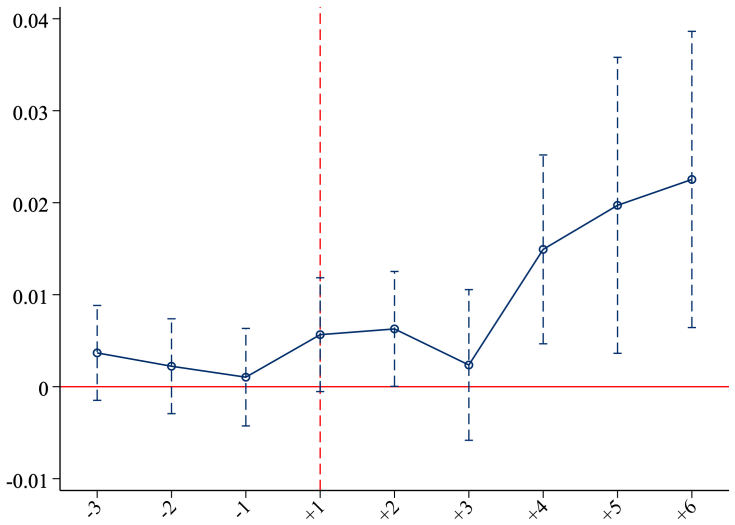

read the original abstract
In this paper, we construct an analytical model of the data economy with empirical evidence to explain the nexus between dataization and technological progress in general equilibrium. Data originates from the dataization of firm total output and contributes to the formation and enhancement of technology. Firms use the production function with data to solve the optimal investment, while households use the endogenous interest rate from the firm problem to solve the optimal consumption. We find that dataization has a negative moderating effect on the transition of general equilibrium affected by technological progress. Policy can only facilitate a positive transition in general equilibrium by simultaneously encouraging dataization and technological progress. Furthermore, when equilibrium capital stock is in a stationary state, dataization enhances technological progress at high levels. However, when equilibrium consumption is in a stationary state, dataization enhances technological progress at low levels while weakening it at high levels. Our empirical analysis uses macroeconomic data and policy from Chinese cities between 2000 and 2021 to verify the theories proposed in this paper. We further apply the Mean Field Games in a continuous-time framework to provide an extended explanation for the nexus between dataization and technological progress in partial equilibrium.
Editorial analysis
A structured set of objections, weighed in public.
Referee Report
Summary. The paper develops an analytical general equilibrium model in which data is generated from the dataization of firm total output and augments technology in the production function. Firms optimize investment and households optimize consumption using the endogenous interest rate. The key results are that dataization has a negative moderating effect on general equilibrium transitions induced by technological progress, that positive transitions require simultaneous policy encouragement of both dataization and technological progress, and that the effect of dataization on technological progress in stationary states varies with the level of capital stock or consumption. These findings are supported by empirical analysis of Chinese city data from 2000 to 2021 and extended using Mean Field Games in continuous time for partial equilibrium.
Significance. If the reported negative moderating effect holds under alternative specifications, the work would contribute to the macroeconomics of the data economy by highlighting policy complementarities between dataization and technological progress. The combination of closed-form equilibrium analysis, empirical verification, and Mean Field Game extension provides a multi-method approach that strengthens the policy relevance of the results.
major comments (3)
- Model setup: The production function assumes data originates directly from firm total output and enters to enhance technology formation. This choice generates the direct output-data-technology feedback that produces the negative moderating effect; the manuscript should show whether the sign of the moderation is preserved under alternative formulations, such as treating data as a separate accumulating stock or as a shifter with different elasticity.
- Stationary state analysis: The claims regarding dataization enhancing technological progress at high capital levels but weakening it at high consumption levels in stationary states rely on the specific functional forms. Explicit derivations of the equilibrium conditions and comparative statics would clarify whether these threshold effects are robust.
- Empirical section: The abstract states that macroeconomic data and policy from Chinese cities (2000-2021) verify the theories, but without reported coefficient estimates, identification strategy, or robustness checks, it is difficult to assess how the empirical exercise isolates the moderating effect of dataization.
minor comments (2)
- Abstract: The term 'dataization' should be defined or linked to existing literature on data as an economic input for clarity.
- Model description: The household's use of the endogenous interest rate from the firm problem to solve optimal consumption would benefit from an explicit equation showing how the interest rate is determined.
Simulated Author's Rebuttal
We thank the referee for the constructive and detailed comments, which will help improve the clarity and robustness of our analysis. We respond to each major comment below and indicate the planned revisions.
read point-by-point responses
-
Referee: Model setup: The production function assumes data originates directly from firm total output and enters to enhance technology formation. This choice generates the direct output-data-technology feedback that produces the negative moderating effect; the manuscript should show whether the sign of the moderation is preserved under alternative formulations, such as treating data as a separate accumulating stock or as a shifter with different elasticity.
Authors: We appreciate this suggestion regarding alternative data formulations. Our baseline specification, in which data is generated directly from firm output and augments technology, is chosen to capture the endogenous feedback loop central to the data economy while preserving analytical tractability in general equilibrium. We agree that exploring robustness is valuable. In the revision we will add a dedicated robustness subsection that examines the sign of the moderating effect under an alternative where data accumulates as a separate stock with its own law of motion, as well as under different elasticity parameters. Preliminary checks indicate that the negative moderation on technological-progress transitions remains qualitatively intact, though we will report the full comparison. revision: partial
-
Referee: Stationary state analysis: The claims regarding dataization enhancing technological progress at high capital levels but weakening it at high consumption levels in stationary states rely on the specific functional forms. Explicit derivations of the equilibrium conditions and comparative statics would clarify whether these threshold effects are robust.
Authors: The threshold effects in stationary states are obtained by solving the system of first-order conditions and market-clearing equations that characterize the general equilibrium. To make these steps fully transparent, we will insert an appendix containing the complete derivations of the equilibrium conditions, the implicit differentiation used for comparative statics, and the resulting threshold conditions on capital stock and consumption. This appendix will also discuss the extent to which the qualitative results depend on the assumed functional forms. revision: yes
-
Referee: Empirical section: The abstract states that macroeconomic data and policy from Chinese cities (2000-2021) verify the theories, but without reported coefficient estimates, identification strategy, or robustness checks, it is difficult to assess how the empirical exercise isolates the moderating effect of dataization.
Authors: We acknowledge that the current draft presents the empirical verification at a summary level. In the revised manuscript we will expand the empirical section substantially: we will report the main coefficient estimates from the interaction regressions, describe the identification strategy that exploits city-level policy shocks as instruments for dataization, and include a battery of robustness checks (alternative dataization measures, different lag structures, subsample splits by city size, and placebo tests). These additions will clarify how the negative moderating effect is isolated from confounding factors. revision: yes
Circularity Check
No significant circularity; analytical results follow from explicit model assumptions and are cross-validated with external data
full rationale
The paper defines data as originating from firm output dataization and entering the production function to enhance technology formation, then derives the negative moderating effect on GE transitions, stationary-state behaviors, and policy implications directly from solving the household and firm optimization problems. These derivations are not self-definitional or fitted-input renamings; they are standard comparative-statics results from the stated functional forms. The claims are further supported by an independent empirical analysis using Chinese city-level macroeconomic data (2000–2021) and an extension via Mean Field Games, providing external benchmarks rather than reducing to the modeling choices by construction. No self-citations, uniqueness theorems, or ansatz smuggling appear in the load-bearing steps.
Axiom & Free-Parameter Ledger
free parameters (2)
- dataization rate from output
- technology enhancement elasticity
axioms (2)
- domain assumption Data originates from dataization of firm total output and contributes to technology formation.
- standard math Households optimize consumption using the endogenous interest rate solved from the firm problem.
Lean theorems connected to this paper
-
IndisputableMonolith/Cost/FunctionalEquation.leanwashburn_uniqueness_aczel unclear?
unclearRelation between the paper passage and the cited Recognition theorem.
d(t)=θy(t), z(t)=d(t)^η, y(t)=(θηk)^{α/(1-αη)} l^{β/(1-αη)} (eq. 2); endogenous r=α/(1-β-αη) π(w) k^{...} (eq. 5); steady-state k*,c* from ċ/c=0, k̇/k=0
-
IndisputableMonolith/Foundation/ArithmeticFromLogic.leanLogicNat recovery and embed_strictMono unclear?
unclearRelation between the paper passage and the cited Recognition theorem.
numerical simulation of θ,η effects on k*,c*; phase diagrams; DID on data-openness policies
What do these tags mean?
- matches
- The paper's claim is directly supported by a theorem in the formal canon.
- supports
- The theorem supports part of the paper's argument, but the paper may add assumptions or extra steps.
- extends
- The paper goes beyond the formal theorem; the theorem is a base layer rather than the whole result.
- uses
- The paper appears to rely on the theorem as machinery.
- contradicts
- The paper's claim conflicts with a theorem or certificate in the canon.
- unclear
- Pith found a possible connection, but the passage is too broad, indirect, or ambiguous to say the theorem truly supports the claim.
Reference graph
Works this paper leans on
-
[1]
S. Abis and L. Veldkamp. The changing economics of knowledge production. The Review of Financial Studies, 37 0 (1): 0 89--118, 2024
work page 2024
- [2]
-
[3]
D. Acemoglu and P. Restrepo. The race between man and machine: Implications of technology for growth, factor shares, and employment. American Economic Review, 108 0 (6): 0 1488--1542, 2018
work page 2018
-
[4]
D. Acemoglu, A. Ozdaglar, and J. Siderius. A model of online misinformation. Review of Economic Studies, 91 0 (6): 0 3117--3150, 2024
work page 2024
-
[5]
D. Acemoglu, A. Makhdoumi, A. Malekian, and A. Ozdaglar. When big data enables behavioral manipulation. American Economic Review: Insights, 7 0 (1): 0 19--38, 2025
work page 2025
-
[6]
I. Arrieta-Ibarra, L. Goff, D. Jiménez-Hernández, J. Lanier, and E. G. Weyl. Should we treat data as labor? moving beyond ``free''. AEA Papers and Proceedings, 108: 0 38--42, 2018
work page 2018
-
[7]
S. Athey. Presidential address: The economist as designer in the innovation process for socially impactful digital products. American Economic Review, 115 0 (4): 0 1059--1099, 2025
work page 2025
- [8]
-
[9]
J. Benhabib, X. Liu, and P. Wang. Endogenous information acquisition and countercyclical uncertainty. Journal of Economic Theory, 165: 0 601--642, 2016
work page 2016
-
[10]
M. Beraja and N. Zorzi. Inefficient automation. Review of Economic Studies, 92 0 (1): 0 69--96, 2025
work page 2025
-
[11]
J. Bessen. Automation and jobs: When technology boosts employment. Economic Policy, 34 0 (100): 0 589--626, 2019
work page 2019
-
[12]
E. Brynjolfsson, D. Li, and L. Raymond. Generative AI at work. The Quarterly Journal of Economics, 140 0 (2): 0 889--942, 2025
work page 2025
-
[13]
A. Caplin. Data engineering for cognitive economics. Journal of Economic Literature, 63 0 (1): 0 164--196, 2025
work page 2025
-
[14]
C. Carnehl and J. Schneider. A quest for knowledge. Econometrica, 93 0 (2): 0 623--659, 2025
work page 2025
-
[15]
D. Comin and M. Mestieri. If technology has arrived everywhere, why has income diverged? American Economic Journal: Macroeconomics, 10 0 (3): 0 137--178, 2018
work page 2018
-
[16]
L. W. Cong and S. Mayer. Data union and regulation in a data economy. Working Paper 30881, National Bureau of Economic Research, 2023
work page 2023
-
[17]
L. W. Cong, D. Xie, and L. Zhang. Knowledge accumulation, privacy, and growth in a data economy. Management Science, 67 0 (10): 0 6480--6492, 2021
work page 2021
-
[18]
C. Corrado, J. Haskel, M. Iommi, C. Jona-Lasinio, and F. Bontadini. Data, intangible capital, and productivity. Nber chapters, National Bureau of Economic Research, 2024
work page 2024
- [19]
- [20]
-
[21]
J. M. David, H. A. Hopenhayn, and V. Venkateswaran. Information, misallocation, and aggregate productivity. The Quarterly Journal of Economics, 131 0 (2): 0 943--1005, 2016
work page 2016
-
[22]
J. Ding, L. Jiang, L. Msall, and M. J. Notowidigdo. Consumer-financed fiscal stimulus: Evidence from digital coupons in china. Working Paper 32376, National Bureau of Economic Research, 2024
work page 2024
-
[23]
L. Einav and J. Levin. Economics in the age of big data. Science, 346 0 (6210): 0 1243089, 2014
work page 2014
-
[24]
R. Fabregas, M. Kremer, M. Lowes, R. On, and G. Zane. Digital information provision and behavior change: Lessons from six experiments in east africa. American Economic Journal: Applied Economics, 17 0 (1): 0 527--566, 2025
work page 2025
-
[25]
M. Farboodi and L. Veldkamp. A model of the data economy. Working Paper 28427, National Bureau of Economic Research, 2021
work page 2021
-
[26]
M. Farboodi, R. Mihet, T. Philippon, and L. Veldkamp. Big data and firm dynamics. AEA Papers and Proceedings, 109: 0 38--42, 2019
work page 2019
-
[27]
J. S. Gans. A quest for AI knowledge. Working Paper 33566, National Bureau of Economic Research, 2025 a
work page 2025
-
[28]
J. S. Gans. AI as strategist. Working Paper 33650, National Bureau of Economic Research, 2025 b
work page 2025
-
[29]
E. L. Glaeser, S. D. Kominers, M. Luca, and N. Naik. Big data and big cities: The promises and limitations of improved measures of urban life. Economic Inquiry, 56 0 (1): 0 114--137, 2018
work page 2018
-
[30]
A. Goldfarb and C. Tucker. Digital economics. Journal of Economic Literature, 57 0 (1): 0 3--43, 2019
work page 2019
-
[31]
G. Graetz and G. Michaels. Robots at work. Review of Economics and Statistics, 100 0 (5): 0 753--768, 2018
work page 2018
-
[32]
M. Hampole, D. Papanikolaou, L. D. Schmidt, and B. Seegmiller. Artificial intelligence and the labor market. Working Paper 33509, National Bureau of Economic Research, 2025
work page 2025
-
[33]
D. Hémous and M. Olsen. The rise of the machines: Automation, horizontal innovation, and income inequality. American Economic Journal: Macroeconomics, 14 0 (1): 0 179--223, 2022
work page 2022
- [34]
-
[35]
C. I. Jones. The AI dilemma: Growth versus existential risk. American Economic Review: Insights, 6 0 (4): 0 575--590, 2024
work page 2024
-
[36]
C. I. Jones. How much should we spend to reduce AI 's existential risk? Working Paper 33602, National Bureau of Economic Research, 2025
work page 2025
-
[37]
C. I. Jones and C. Tonetti. Nonrivalry and the economics of data. American Economic Review, 110 0 (9): 0 2819--2858, 2020
work page 2020
- [38]
-
[39]
C. Lynch. How do your data grow? Nature, 455 0 (7209): 0 28--29, 2008
work page 2008
-
[40]
E. Madsen and N. Vellodi. Insider imitation. Journal of Political Economy, 133 0 (2): 0 652--709, 2025
work page 2025
-
[41]
M. Nose. Inclusive govtech: Enhancing efficiency and equity through public service digitalization. Technical report, International Monetary Fund, 2023
work page 2023
-
[42]
A. Schaefer, D. Schiess, and R. Wehrli. Long-term growth driven by a sequence of general purpose technologies. Economic Modelling, 37: 0 23--31, 2014
work page 2014
-
[43]
H. R. Varian. Artificial intelligence, economics, and industrial organization. Working Paper 24839, National Bureau of Economic Research, 2018
work page 2018
-
[44]
B. Weidmann, Y. X. Xu, and D. J. Deming. Measuring human leadership skills with AI agents. Working Paper 33662, National Bureau of Economic Research, 2025
work page 2025
- [45]
discussion (0)
Sign in with ORCID, Apple, or X to comment. Anyone can read and Pith papers without signing in.