REVIEW 4 major objections 6 minor 1 cited by
Comparing Apples to Oranges: A Dataset & Analysis of LLM Humour Understanding from Traditional Puns to Topical Jokes
T0 review · 4 major / 6 minor · reviewed 2026-08-06 · deepseek-v4-flash
Pith's one-line read This paper claims that LLM humour understanding is much weaker on topical and internet jokes than on puns, so pun-only benchmarks overestimate it.
desk verdict A useful new benchmark with a probably-right difficulty ordering, but the eval loop is self-calibrated and needs independent annotation before the exact numbers are trusted. read the letter →
The pith
A machine-rendered reading of the paper's core claim, the machinery that carries it, and where it could break.
The reading
What carries the argument
The load-bearing object is the dataset itself: 600 jokes in four balanced categories, each paired with an author-written gold explanation and scored by a six-point accuracy and completeness rubric. The joke-type categories operationalise what the paper means by humour complexity: puns require semantics and phonetics, non-topical Reddit humour requires common-sense and social knowledge, and topical humour requires esoteric real-world knowledge. The binary success criterion (both scores at least 4) combined with logistic regression on model size and joke type is what carries the difficulty-ordering claim.
What would settle it
Independently re-annotate all 4,800 explanations with annotators who never see the authors' gold explanations and grade accuracy and completeness from the joke alone; if topical jokes then score as well as homographic puns, or the model ranking reverses, the central claim fails. A sharper version is to test the models on fresh topical jokes written after their training cutoff, so no memorised explanation can leak into the result.
Extended reading notes
Core claim
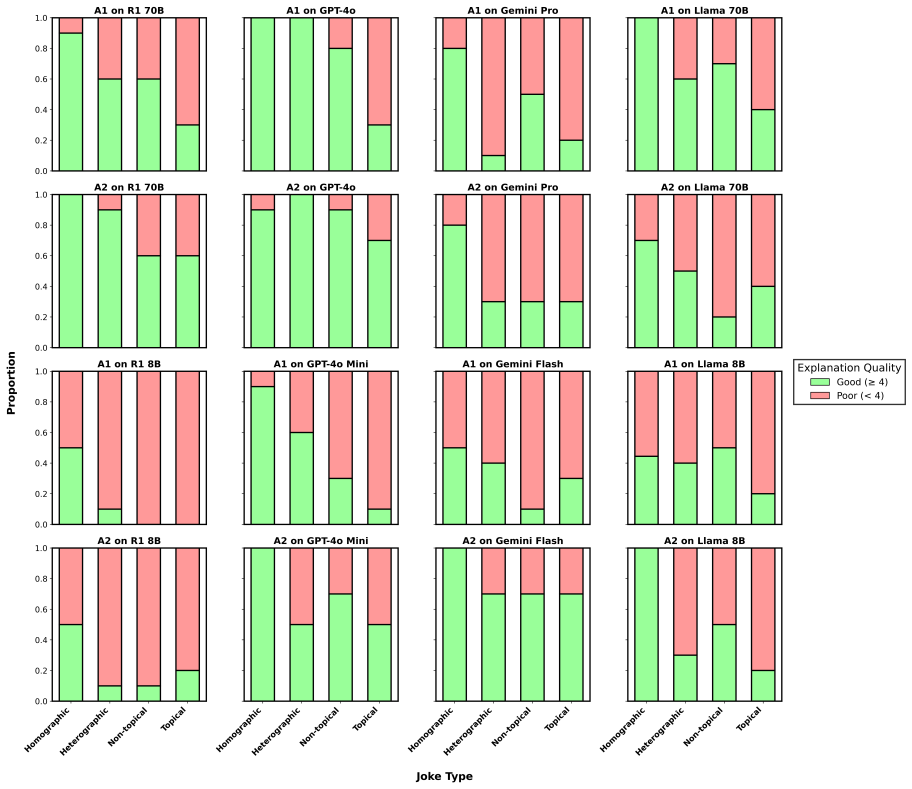
The discovery is that joke format, not just joke content, determines LLM explanation quality, and the four-type ordering holds across models and evaluation methods. Homographic puns, where one spelling carries two meanings, produce the highest proportion of explanations scoring at least 4 out of 5 on both accuracy and completeness. Heterographic puns are harder because they require the model to recognise that two differently spelled words sound alike, and phonetic similarity is not visible in orthographic text. Non-topical Reddit humour is harder still, and topical humour, which requires retrieving named entities and events that are not explicitly stated, is hardest. Larger models outperform smaller variants, with the gap widest on topical jokes, but even the best model does not sustain good explanations across all joke types.
Load-bearing premise
The paper's conclusions depend on the author-written gold explanations and the 0-5 rubric being an unbiased standard for what counts as explaining a joke; if those explanations have a house style, or the rubric silently rewards matching the author's own reading, the difficulty ordering and model rankings could be artifacts of that standard.
Editorial extensions
If this is right
- If the ordering holds, benchmarks built only from puns overstate LLM humour understanding relative to the jokes people actually encounter online.
- Topical humour is the most discriminating test: differences between large and small models are most visible there, so it can serve as a harder evaluation signal than puns.
- Reasoning-specialised models do not automatically beat standard models on joke explanation, suggesting their reasoning style is not tuned to incongruity comprehension.
- Heterographic puns expose a phonetic blind spot in models trained on orthographic text, pointing to phonology-aware training as a needed direction.
Reading between the lines
- If the measured gap is mostly about retrieving named-entity knowledge rather than humour reasoning, then giving models access to the URLs the dataset provides for topical jokes should largely close the gap; this is not tested in the paper.
- A direct extension would be to evaluate the same models on newly written topical jokes from after their training cutoff, removing any chance that memorised explanations leak into the results.
- The author-written gold explanations set the standard for both human and automatic scoring, so a multi-reference or crowd-sourced ground truth would test whether the absolute quality scores are stable even if the difficulty ordering is.
- Because topical humour ages, the benchmark's difficulty ordering may shift over time; a living benchmark would need periodically refreshed jokes and explanations.
Editorial analysis
A structured set of objections, weighed in public.
Referee Report
Summary. The paper presents a dataset of 600 jokes balanced across homographic puns, heterographic puns, non-topical Reddit humour, and topical Reddit humour, each paired with a human-authored gold explanation. Using this dataset, the authors evaluate eight LLMs in a zero-shot joke-explanation setting, scoring 4,800 generated explanations for accuracy and completeness through a single primary evaluator, a third-party reliability subsample, an LLM-as-a-judge, and reference-based automatic metrics. The central finding is a difficulty ordering—homographic puns easiest, then heterographic puns, then non-topical Reddit humour, then topical humour hardest—and that no tested model, including reasoning models, reliably explains all joke types.
Significance. If the difficulty ordering holds, the paper makes a valuable contribution by showing that the field's near-exclusive focus on pun-based humour benchmarks overstates LLM humour understanding. The dataset itself is a useful resource: 600 jokes across four categories with gold explanations, topical-knowledge URLs, and phonetic transcriptions, released with code. The empirical scope is broad (eight models, 4,800 explanations), and the main ordering is corroborated by several complementary evaluation methods. The authors are transparent about their single-evaluator design and include third-party and LLM-judge agreement analyses. However, the validity of the central claim hinges on the objectivity of the gold explanations and the reliability of the human evaluation, which are the weakest points in the current manuscript.
major comments (4)
- [§4.3/§5.1, Figures 3–4] The central difficulty ordering is based on scores assigned by a single evaluator who is also the author of the gold explanations. The third-party reliability check covers only 320 of 4,800 explanations and yields Krippendorff's alpha of 0.574 (accuracy) and 0.553 (completeness), which are below the commonly cited threshold of 0.667 for tentative reliability. The Limitations paragraph's assertion that "agreement statistics in the interval between 0.4 and 0.6 are considered good" is not a standard interpretation for Krippendorff's alpha. To make the main claim load-bearing, the paper needs either a larger independent annotation sample or a clearly justified weaker reliability standard, along with per-joke-type agreement figures to confirm that the ordering is not driven by one annotator's idiosyncratic standard.
- [§A.6/§6] The LLM-as-a-judge is selected for best alignment with the primary author's scores, and it is given the author-written gold explanation as a reference when scoring model outputs. This creates a circular validation loop: the automated judge is calibrated to the same ground truth whose validity is in question. The reference-based automatic metrics in Table 1 are similarly aligned to the same golds, so they cannot independently confirm the difficulty ordering. I recommend reporting agreement of the third-party annotators directly against the gold explanations, and using an LLM judge that was not selected post hoc on the same test set, or evaluating the judge on a held-out set of explanations.
- [§5.1, Figure 4] The binary "good" threshold (scores ≥4 on both accuracy and completeness) is arbitrary, and no sensitivity analysis is provided. Because Figure 4 is the primary visual evidence for the abstract's claim that no model reliably explains all joke types, the paper should either justify this threshold with reference to the task's intended use or demonstrate that the main ordering is robust to reasonable alternative thresholds (e.g., ≥3 on both criteria, or mean score ≥4).
- [§4.3/§A.1] There is a factual inconsistency in the size of the third-party reliability subset: §4.3 states "a subset of 320 explanations (10 jokes * 4 joke types * 8 models)", whereas Appendix A.1 describes "evaluation on a subset of 240 explanations". Since the agreement statistics are central to the reliability argument, this discrepancy must be resolved and the correct number reported consistently.
minor comments (6)
- [Title/Abstract] The title contains a formatting artifact, "T raditional", which should be corrected to "Traditional".
- [Appendix A.1] The model list repeats "DeepSeek-R1-Distill-Llama-8B" for both the 8B and 70B variants; the 70B entry should read "DeepSeek-R1-Distill-Llama-70B".
- [§3.6] The cross-reference "with the rubric presented in Appendix 4.3" is confusing; the rubric appears in Section 4.3, so the reference should be to "§4.3".
- [§5] The observation that "completeness scores are generally lower than accuracy scores across all models" is based on visual inspection of Figure 3; a paired significance test across the 4,800 explanations would strengthen this claim.
- [Table 1/§6] The automatic-metric differences between joke types are small on some metrics (e.g., BERTScore ranges from 0.87 to 0.89), so the statement that these metrics "confirm our originally hypothesised ordering" is stronger than the numbers warrant; report confidence intervals or statistical tests for these comparisons.
- [Limitations] The limitation paragraph acknowledges the single-evaluator design but then claims the reliability is "robustly prove[n]"; given the moderate Krippendorff's alpha values, this wording should be tempered to match the evidence.
Circularity Check
Difficulty ordering is measured by the same author who wrote the gold explanations, and the LLM-judge 'verification' is selected to agree with that author; the evaluation loop is partly self-referential.
-
fitted input called prediction
[Appendix A.6 (LLM judge selection) applied in §4.3]
"Overall, we found Qwen alone to demonstrate the best alignment with our human evaluation (versus a jury ensemble or any other individual judge). ... we additionally leverage the LLM-as-a-judge paradigm using Qwen2.5-72B-Instruct, finding agreement for accuracy (α = .565) and completeness (α = .519) to be substantial."
The LLM judge is chosen because it best matches the primary evaluator's scores, and then its agreement with those same scores is reported as evidence of the evaluator's reliability. This is selection on the evaluation target: the 'substantial' agreement is partly guaranteed by the selection procedure, so it is not an independent confirmation of the human evaluation. The central difficulty ordering does not reduce to this step, but the paper's claim that the evaluation is robustly verified is inflated by this circular validation loop.
-
other
[§3.6 and §5]
"As a central contribution, we write ground-truth explanations for all jokes. Due to being written by an author of this work, we perform quality control using 3 native English-speaking computer science students. ... Due to the significant amount of time required for rating 4800 explanations (≈ 40 hours), 1 author (who is a native speaker of English and holds degrees in Linguistics) rated all explanations."
The author who wrote all 600 gold explanations is also the sole primary evaluator of all 4,800 model explanations, and the gold explanations were themselves validated using the same rubric that is then used to score the models. Completeness is therefore operationalized as the gold author's own standard: model explanations that do not match that standard are downgraded. The measured difficulty ordering (homographic puns < heterographic puns < non-topical Reddit < topical) is thus partly a reflection of one person's explanation standard rather than an intrinsic property of joke types. Independent third-party annotators cover only 320/4,800 explanations with Krippendorff's alpha around 0.55, so this self-referential evaluation loop is only partially mitigated.
full rationale
The paper's central derivation is an empirical measurement, not a mathematical derivation, and no equation in the paper reduces the difficulty ordering to the gold explanations by construction. There is no load-bearing self-citation chain or uniqueness theorem; the citations to the authors' own prior work are related-work context. However, the evaluation loop contains two self-referential elements that undermine the independence of the central claim. First, the primary human evaluator is the same person who authored the gold explanations, making the rubric's completeness standard effectively the gold author's own judgment. Second, the LLM-as-a-judge, used to corroborate the human evaluation, was explicitly selected for best alignment with that human evaluation, so its agreement is not independent evidence. The third-party annotator check (α ≈ 0.55–0.57 on 320 items) and reference-based automatic metrics provide some external anchor, and the paper's limitation statement acknowledges the heavy reliance on one author while asserting that 0.4–0.6 alpha is 'good'—a non-standard claim that is a validity concern rather than a formal circularity. Overall, the results are not forced by definition, but the central difficulty ordering is substantially entangled with the gold author's evaluation standard, warranting a score of 4 rather than 0–2.
Assumptions & free parameters
free parameters (3)
- Good explanation threshold =
4 or above on both Accuracy and Completeness
- Joke subset size =
150 per joke type
- Requested explanation length =
approximately 100 words
assumptions (4)
- domain assumption Gold explanations written by a co-author are correct and complete
- domain assumption The 0-5 rubric for accuracy and completeness is a valid measure of explanation quality
- domain assumption Jokes from SemEval and r/Jokes are representative of their assigned joke categories
- domain assumption The LLMs have sufficient knowledge of the real-world entities and events referenced in the topical jokes
Cite this review
Pith. "Pith review of Comparing Apples to Oranges: A Dataset & Analysis of LLM Humour Understanding from Traditional Puns to Topical Jokes." pith.science (2026). https://pith.science/paper/JPJORAIA
@misc{pith2026250713335,
  author       = {Pith},
  title        = {Pith review of: Comparing Apples to Oranges: A Dataset & Analysis of LLM Humour Understanding from Traditional Puns to Topical Jokes},
  year         = {2026},
  howpublished = {\url{https://pith.science/paper/JPJORAIA}},
  note         = {Machine review of arXiv:2507.13335}
}
read the original abstract
Humour, as a complex language form, is derived from myriad aspects of life. Whilst existing work on computational humour has focussed almost exclusively on short pun-based jokes, we investigate whether the ability of Large Language Models (LLMs) to explain humour depends on the particular form. We compare models' joke explanation abilities from simple puns to complex topical humour that requires esoteric knowledge of real-world entities and events. To this end, we curate a dataset of 600 jokes across 4 joke types and manually write high-quality explanations. These jokes include heterographic and homographic puns, contemporary internet humour, and topical jokes. Using this dataset, we compare the zero-shot abilities of a range of LLMs to accurately and comprehensively explain jokes of different types, identifying key research gaps in the task of humour explanation. We find that none of the tested models (including reasoning models) are capable of reliably generating adequate explanations of all joke types, further highlighting the narrow focus of most existing works on overly simple joke forms.
Figures


Figures from the paper (6 more)




Forward citations
Cited by 1 Pith paper
-
One Joke to Rule them All? On the (Im)possibility of Generalizing Humor
LLMs fine-tuned on one to three humor datasets transfer partially to unseen humor types (up to 75% accuracy); diverse training helps modestly, and dad jokes enable transfer best but resist it as a target.
Reference graph
Works this paper leans on
-
[1]
Josh Achiam, Steven Adler, Sandhini Agarwal, Lama Ahmad, Ilge Akkaya, et al. 2024. https://arxiv.org/abs/2303.08774 Gpt-4 technical report . Preprint, arXiv:2303.08774
arXiv 2024
-
[2]
Xiao Ao, Danae Sanchez Villegas, Daniel Preotiuc-Pietro, and Nikolaos Aletras. 2022. https://doi.org/10.18653/v1/2022.naacl-main.131 Combining humor and sarcasm for improving political parody detection . In Proceedings of the 2022 Conference of the North American Chapter of the Association for Computational Linguistics: Human Language Technologies, pages ...
-
[3]
Salvatore Attardo. 2008. https://doi.org/doi:10.1515/9783110198492.101 A primer for the linguistics of humor , pages 101--156. De Gruyter Mouton, Berlin, New York
-
[4]
Yang Chen, Chong Yang, Tu Hu, Xinhao Chen, Man Lan, Li Cai, Xinlin Zhuang, Xuan Lin, Xin Lu, and Aimin Zhou. 2024. https://aclanthology.org/2024.findings-acl.51 Are U a joke master? pun generation via multi-stage curriculum learning towards a humor LLM . In Findings of the Association for Computational Linguistics ACL 2024, pages 878--890, Bangkok, Thaila...
work page 2024
-
[5]
Abhimanyu Dubey, Abhinav Jauhri, Abhinav Pandey, Abhishek Kadian, Ahmad Al-Dahle, et al. 2024. https://arxiv.org/abs/2407.21783 The llama 3 herd of models . Preprint, arXiv:2407.21783
arXiv 2024
-
[6]
Aparna Garimella, Carmen Banea, Nabil Hossain, and Rada Mihalcea. 2020. https://doi.org/10.18653/v1/2020.coling-main.253 `` judge me by my size (noun), do you? '' Y oda L ib: A demographic-aware humor generation framework . In Proceedings of the 28th International Conference on Computational Linguistics, pages 2814--2825, Barcelona, Spain (Online). Intern...
-
[7]
Petko Georgiev, Ving Ian Lei, Ryan Burnell, Libin Bai, Anmol Gulati, et al. 2024. https://arxiv.org/abs/2403.05530 Gemini 1.5: Unlocking multimodal understanding across millions of tokens of context . Preprint, arXiv:2403.05530
arXiv 2024
-
[8]
Md Kamrul Hasan, Wasifur Rahman, AmirAli Bagher Zadeh, Jianyuan Zhong, Md Iftekhar Tanveer, Louis-Philippe Morency, and Mohammed (Ehsan) Hoque. 2019. https://doi.org/10.18653/v1/D19-1211 UR - FUNNY : A multimodal language dataset for understanding humor . In Proceedings of the 2019 Conference on Empirical Methods in Natural Language Processing and the 9th...
Show all 40 references
-
[9]
He He, Nanyun Peng, and Percy Liang. 2019. https://doi.org/10.18653/v1/N19-1172 Pun generation with surprise . In Proceedings of the 2019 Conference of the North A merican Chapter of the Association for Computational Linguistics: Human Language Technologies, Volume 1 (Long and...
2019 doi
-
[10]
Hwang, Lillian Lee, Jeff Da, Rowan Zellers, Robert Mankoff, and Yejin Choi
Jack Hessel, Ana Marasovic, Jena D. Hwang, Lillian Lee, Jeff Da, Rowan Zellers, Robert Mankoff, and Yejin Choi. 2023. https://doi.org/10.18653/v1/2023.acl-long.41 Do androids laugh at electric sheep? humor `` understanding '' benchmarks from the new yorker caption contest . In...
2023 doi
-
[11]
Tim Highfield. 2015. https://ijoc.org/index.php/ijoc/article/view/3611 Tweeted joke lifespans and appropriated punch lines: Practices around topical humor on social media . International Journal of Communication, 9(0)
2015
- [12]
-
[13]
Feng, Varun Gangal, Malihe Alikhani, and Eduard Hovy
Sedrick Scott Keh, Steven Y. Feng, Varun Gangal, Malihe Alikhani, and Eduard Hovy. 2023. https://doi.org/10.18653/v1/2023.eacl-main.36 PANCETTA : Phoneme aware neural completion to elicit tongue twisters automatically . In Proceedings of the 17th Conference of the European Cha...
2023 doi
-
[14]
Seungone Kim, Juyoung Suk, Shayne Longpre, Bill Yuchen Lin, Jamin Shin, Sean Welleck, Graham Neubig, Moontae Lee, Kyungjae Lee, and Minjoon Seo. 2024. https://doi.org/10.18653/v1/2024.emnlp-main.248 Prometheus 2: An Open Source Language Model Specialized in Evaluating Other La...
2024 doi
-
[15]
Klaus Krippendorff. 2019. https://doi.org/10.4135/9781071878781 Content analysis: An introduction to its methodology
2019 doi
-
[16]
Liisi Laineste. 2002. https://doi.org/10.7592/fejf2002.21.jokes Take it with a grain of salt: The kernel of truth in topical jokes . Folklore: Electronic Journal of Folklore, 21:7–25
2002 doi
-
[17]
Marcio Lima In \'a cio, Gabriela Wick-pedro, and Hugo Goncalo Oliveira. 2023. https://doi.org/10.18653/v1/2023.latechclfl-1.10 What do humor classifiers learn? an attempt to explain humor recognition models . In Proceedings of the 7th Joint SIGHUM Workshop on Computational Lin...
2023 doi
-
[18]
Tyler Loakman, Aaron Maladry, and Chenghua Lin. 2023 a . https://doi.org/10.18653/v1/2023.findings-emnlp.444 The iron(ic) melting pot: Reviewing human evaluation in humour, irony and sarcasm generation . In Findings of the Association for Computational Linguistics: EMNLP 2023,...
2023 doi
-
[19]
Tyler Loakman, Chen Tang, and Chenghua Lin. 2023 b . https://doi.org/10.18653/v1/2023.acl-short.51 T wist L ist: Resources and baselines for tongue twister generation . In Proceedings of the 61st Annual Meeting of the Association for Computational Linguistics (Volume 2: Short ...
2023 doi
-
[20]
Tyler Loakman, Chen Tang, and Chenghua Lin. 2025. https://doi.org/10.1162/coli_a_00544 Train and constrain: Phonologically informed tongue twister generation from topics and paraphrases . Computational Linguistics, 51(2):415--466
2025 doi
-
[21]
J. A. Meaney. 2020. https://doi.org/10.18653/v1/2020.acl-srw.24 Crossing the line: Where do demographic variables fit into humor detection? In Proceedings of the 58th Annual Meeting of the Association for Computational Linguistics: Student Research Workshop, pages 176--181, On...
2020 doi
-
[22]
J. A. Meaney, Steven Wilson, Luis Chiruzzo, Adam Lopez, and Walid Magdy. 2021. https://doi.org/10.18653/v1/2021.semeval-1.9 S em E val 2021 task 7: H a H ackathon, detecting and rating humor and offense . In Proceedings of the 15th International Workshop on Semantic Evaluation...
2021 doi
-
[23]
Tristan Miller, Christian Hempelmann, and Iryna Gurevych. 2017. https://doi.org/10.18653/v1/S17-2005 S em E val-2017 task 7: Detection and interpretation of E nglish puns . In Proceedings of the 11th International Workshop on Semantic Evaluation ( S em E val-2017) , pages 58--...
2017 doi
-
[24]
Anirudh Mittal, Yufei Tian, and Nanyun Peng. 2022. https://doi.org/10.18653/v1/2022.naacl-main.77 A mbi P un: Generating humorous puns with ambiguous context . In Proceedings of the 2022 Conference of the North American Chapter of the Association for Computational Linguistics:...
2022 doi
-
[25]
Karl Pearson . 1895. Note on Regression and Inheritance in the Case of Two Parents . Proceedings of the Royal Society of London Series I, 58:240--242
-
[26]
Sa s a Petrovi \'c and David Matthews. 2013. https://aclanthology.org/P13-2041 Unsupervised joke generation from big data . In Proceedings of the 51st Annual Meeting of the Association for Computational Linguistics (Volume 2: Short Papers), pages 228--232, Sofia, Bulgaria. Ass...
2013
- [27]
-
[28]
Graeme Ritchie. 2005. https://aclanthology.org/W05-1614 Computational mechanisms for pun generation . In Proceedings of the Tenth E uropean Workshop on Natural Language Generation ( ENLG -05) , Aberdeen, Scotland. Association for Computational Linguistics
2005
- [29]
-
[30]
Bach, Lintang Sutawika, Zaid Alyafeai, Antoine Chaffin, Arnaud Stiegler, Teven Le Scao, Arun Raja, Manan Dey, M
Victor Sanh, Albert Webson, Colin Raffel, Stephen H. Bach, Lintang Sutawika, Zaid Alyafeai, Antoine Chaffin, Arnaud Stiegler, Teven Le Scao, Arun Raja, Manan Dey, M. Saiful Bari, Canwen Xu, Urmish Thakker, Shanya Sharma Sharma, Eliza Szczechla, Taewoon Kim, Gunjan Chhablani, N...
-
[31]
Jiao Sun, Anjali Narayan-Chen, Shereen Oraby, Alessandra Cervone, Tagyoung Chung, Jing Huang, Yang Liu, and Nanyun Peng. 2022 a . https://doi.org/10.18653/v1/2022.emnlp-main.304 E x PUN ations: Augmenting puns with keywords and explanations . In Proceedings of the 2022 Confere...
2022 doi
-
[32]
Jiao Sun, Anjali Narayan-Chen, Shereen Oraby, Shuyang Gao, Tagyoung Chung, Jing Huang, Yang Liu, and Nanyun Peng. 2022 b . https://doi.org/10.18653/v1/2022.emnlp-main.306 Context-situated pun generation . In Proceedings of the 2022 Conference on Empirical Methods in Natural La...
2022 doi
-
[33]
Toivanen
Alessandro Valitutti, Hannu Toivonen, Antoine Doucet, and Jukka M. Toivanen. 2013. https://aclanthology.org/P13-2044 `` let everything turn well in your wife '' : Generation of adult humor using lexical constraints . In Proceedings of the 51st Annual Meeting of the Association...
2013
-
[34]
Sven van den Beukel and Lora Aroyo. 2018. https://doi.org/10.18653/v1/W18-6242 Homonym detection for humor recognition in short text . In Proceedings of the 9th Workshop on Computational Approaches to Subjectivity, Sentiment and Social Media Analysis, pages 286--291, Brussels,...
2018 doi
-
[35]
Minghan Wang, Hao Yang, Ying Qin, Shiliang Sun, and Yao Deng. 2020. https://aclanthology.org/2020.eamt-1.7 Unified humor detection based on sentence-pair augmentation and transfer learning . In Proceedings of the 22nd Annual Conference of the European Association for Machine T...
2020
-
[36]
Yang Wang, Chenghao Xiao, Chia-Yi Hsiao, Zi Yan Chang, Chi-Li Chen, Tyler Loakman, and Chenghua Lin. 2025. https://arxiv.org/abs/2509.03867 Drivel-ology: Challenging llms with interpreting nonsense with depth . Preprint, arXiv:2509.03867
2025
-
[37]
Orion Weller, Nancy Fulda, and Kevin Seppi. 2020. https://doi.org/10.18653/v1/2020.figlang-1.25 Can humor prediction datasets be used for humor generation? humorous headline generation via style transfer . In Proceedings of the Second Workshop on Figurative Language Processing...
2020 doi
-
[38]
Orion Weller and Kevin Seppi. 2019. https://doi.org/10.18653/v1/D19-1372 Humor detection: A transformer gets the last laugh . In Proceedings of the 2019 Conference on Empirical Methods in Natural Language Processing and the 9th International Joint Conference on Natural Languag...
2019 doi
-
[39]
Orion Weller and Kevin Seppi. 2020. https://aclanthology.org/2020.lrec-1.753 The r J okes dataset: a large scale humor collection . In Proceedings of the Twelfth Language Resources and Evaluation Conference, pages 6136--6141, Marseille, France. European Language Resources Association
2020
- [40]
Reviewed August 6, 2026 · model on record in the stance chip above.
Discussion (0). Continue with ORCID to comment.