REVIEW 4 major objections 5 minor 32 references
FormulaOne: Measuring the Depth of Algorithmic Reasoning Beyond Competitive Programming
T0 review · 4 major / 5 minor · reviewed 2026-08-06 · deepseek-v4-flash
Pith's one-line read FormulaOne, a benchmark built from Monadic Second-Order logic on graphs, shows frontier reasoning models solve under 1 percent of its hard algorithmic problems, indicating a reasoning-depth gap that competitive-programming scores do not…
desk verdict A genuinely new, verifiable benchmark with a credible <1% model failure rate; the missing human baseline tempers the 'expert-level reasoning' interpretation but doesn't sink the main result. read the letter →
The pith
A machine-rendered reading of the paper's core claim, the machinery that carries it, and where it could break.
The reading
What carries the argument
The carrying object is the pairing of MSO logic with tree-decomposition dynamic programming. MSO logic is a formal language for graph properties in which one may quantify over vertices, edges, and sets of them; an algorithmic meta-theorem guarantees that any MSO-definable problem can be solved in time linear in the graph order once a bounded-width tree decomposition is supplied. The paper's domain-specific language converts MSO formulas into human-readable problem statements, verifying programs, test suites, and state-complexity estimates, and the evaluation interface asks models to supply only the five dynamic-programming transition callbacks. This machinery makes the benchmark simultaneously hard, automatically verifiable, scalable, and in-distribution, which is why the near-total model failure is taken as evidence about reasoning depth rather than about unfamiliar formats.
What would settle it
Run the same 120 problems with a debugging loop in which the model can execute its code on sample tests and revise its five callback implementations before final scoring; if success rises substantially, the under-one-percent result is an artifact of one-shot code generation rather than a reasoning limit. Alternatively, administer the identical benchmark to a panel of top human competitive programmers; if they also solve near 1 percent, the human-expert comparison collapses.
Extended reading notes
Core claim
The central claim is that a benchmark generated from MSO logic on graphs can separate frontier models' competitive-programming competence from expert-level algorithmic reasoning, and that under this separation current models fall far short. Each FormulaOne problem presents a graph, a tree decomposition, and vertex weights, and asks for the sum of weights of all subsets satisfying an MSO-definable constraint, modulo $10^{9}$+7. Because constraints are MSO-definable, every problem is solvable by a fixed-parameter linear dynamic program running over the supplied tree decomposition; the evaluation harness reduces the model's task to implementing five callbacks for leaf, introduce, forget, join, and root extraction. The paper reports that frontier reasoning models solve at most one of the 120 hard problems even with multiple attempts, and argues this failure is fundamental rather than a prompt-engineering artifact. The dataset also connects several of its hardest problems to the Strong Exponential Time Hypothesis, so genuinely better algorithms discovered on it would have theoretical consequences.
Load-bearing premise
The load-bearing premise is that the callback-based interface is a fair test of reasoning depth and that expert human programmers would score far above 1 percent on it; if either premise fails, the low success rate would not establish a reasoning-depth gap.
Editorial extensions
If this is right
- If the under-one-percent result holds, current competitive-programming benchmark scores overstate how close frontier models are to expert algorithmic reasoning, because FormulaOne is deliberately in-distribution.
- The MSO-based generation framework can produce a virtually unlimited stream of new problems with guaranteed correct answers, making FormulaOne a candidate training environment for reinforcement learning with verifiable rewards.
- A model that solves a substantial share of FormulaOne would demonstrate a capability current systems lack, and one that improves on the known algorithm for a SETH-linked problem would carry consequences for complexity theory.
- FormulaOne-Warmup provides a graded ladder of same-distribution problems, allowing incremental measurement of progress before models can attack the hard set.
Reading between the lines
- An obvious test the paper does not run is to let models debug against failing test cases: the reported result is for multiple independent completions with no feedback loop, so part of the gap may reflect inability to find and fix implementation bugs rather than inability to design the dynamic program.
- The human-expert baseline is asserted, not measured; a controlled study giving top human competitive programmers the same five-callback interface would sharpen the claim that the benchmark tracks reasoning depth.
- The connection between reasoning depth and model failure could be tested directly by generating formulas with graded numbers of interdependent state features and checking whether model success decays smoothly with that measure.
- Extending the framework to optimisation objectives, different graph parameters, or requiring models to produce the tree decomposition themselves would likely lower success further, but would also change what the benchmark isolates.
Signed reviews
Editorial analysis
A structured set of objections, weighed in public.
Referee Report
Summary. The paper introduces FormulaOne, a benchmark of 120 problems composed of dynamic programming over graphs of treewidth at most 3, generated from Monadic Second-Order (MSO) logic formulas. Each problem asks the model to compute a weighted model count modulo 1e9+7, given the graph, a tree decomposition, and vertex weights. To focus the task, the authors provide an evaluation environment with five callback functions (leaf, introduce, forget, join, extract), which hides the full graph during DP updates. They evaluate o3, o3-Pro, Gemini 2.5 Pro, and Grok 4 Heavy and report success rates below 1% (0 or 1 of 120), plus a 100-problem warmup set with substantially higher success rates. The paper argues that this demonstrates that frontier models lack the deep algorithmic reasoning needed for real-world research problems and claims connections to SETH-based lower bounds. The authors state they release the full corpus and evaluation framework.
Significance. If the results are properly calibrated, FormulaOne would be a valuable benchmark: it is generated from MSO logic with automated verifiers, it is in-distribution for language models in the sense of being an algorithmic coding task, and it offers a potentially unbounded stream of verifiable hard problems for reinforcement learning with verifiable rewards. The paper's strengths include a carefully described evaluation environment, a thoughtful analysis of common DP failure modes, a detailed worked solution for one problem in Appendix A, and a warmup dataset that spans a difficulty gradient. However, the central interpretation rests on two unverified premises: that expert humans would score far above 1% on the same interface, and that the self-generated DSL verifiers are correct. Both are load-bearing for the claim that the benchmark measures the depth of algorithmic reasoning rather than interface unfamiliarity. Until these are addressed, the benchmark's significance as a measure of reasoning depth remains conditional.
major comments (4)
- [Section 2.1 and Section 5.2] The headline claim that frontier models are 'far from expert-level understanding' depends on the premise, stated in Section 2.1, that a human expert of Codeforces-calibre should 'by rights' score highly on these problems. No human baseline is reported anywhere in the manuscript. The one fully worked solution in Appendix A shows that at least one problem is humanly solvable, but it does not calibrate the other 119 problems. Since the evaluation interface requires implementing five callbacks that operate only on the current bag of the tree decomposition, hides the full graph during DP updates, and does not allow iterative debugging, the <1% success rate could reflect interface unfamiliarity rather than reasoning depth. The authors should add a human baseline using the same interface and time limits, or substantially weaken the expert-level interpretation.
- [Section 4.2 and Section 2.2] The ground truth for the benchmark is generated by the authors' own DSL and verifiers, with no described independent verification. The paper states that the verifier maps any input to the correct answer, but the correctness of those verifiers is itself asserted by the same pipeline. I found no independent brute-force cross-checks, no differential testing against known algorithms, and no manual verification of a random sample. The abstract and introduction say the corpus and evaluation framework are released, but no URL, repository, or artifact is provided in the manuscript. Without code and data, the reported success rates cannot be audited or reproduced. Please release the artifacts and add independent validation (e.g., brute-force checks on small graphs with an independently written verifier, or a manual verification protocol).
- [Section 2.1 and Section 3] The paper claims that 'the best-known time complexity of a large portion of our dataset is, in fact, optimal under SETH' and that algorithmic progress on these problems could refute a central conjecture in theoretical computer science. I could not find a concrete identification of which problems in the dataset have this property, nor citations of the specific lower bounds. This is a strong theoretical claim that goes beyond the benchmark's empirical findings and, as written, overstates the significance. The authors should either specify the dataset problems and cite the relevant SETH lower-bound results, or replace the claim with a more modest statement about conceptual proximity to fine-grained complexity results.
- [Section 5.2 and Table/Figure 8] The model comparison is not apples-to-apples: o3 and Gemini 2.5 Pro are scored with 10 attempts (@10), while o3-Pro and Grok 4 Heavy are scored with one attempt (@1), and Grok was additionally given internet access. With 120 problems, the difference between 0 and 1 solved problems is not statistically meaningful, yet the text describes Grok as 'solving none' in a way that implies a ranking. Please report per-attempt success rates, confidence intervals, and use matched evaluation budgets when comparing models.
minor comments (5)
- [Section 5.1 and Section 3.2] The prompt is said to 'be found in full here' and the dominating-set solution is said to be 'written in Python, here', but no links or appendix content are present in the manuscript. Please include the actual artifacts or remove the pointers.
- [Appendix A] The appendix is titled 'Algorithm for Maximal Cluster Graph' and is described as a full solution, but it contains no runnable code and no formal proof of correctness for the DP transitions, such as the obligation-bit merge rule at join nodes. Consider adding a complete implementation and a correctness argument.
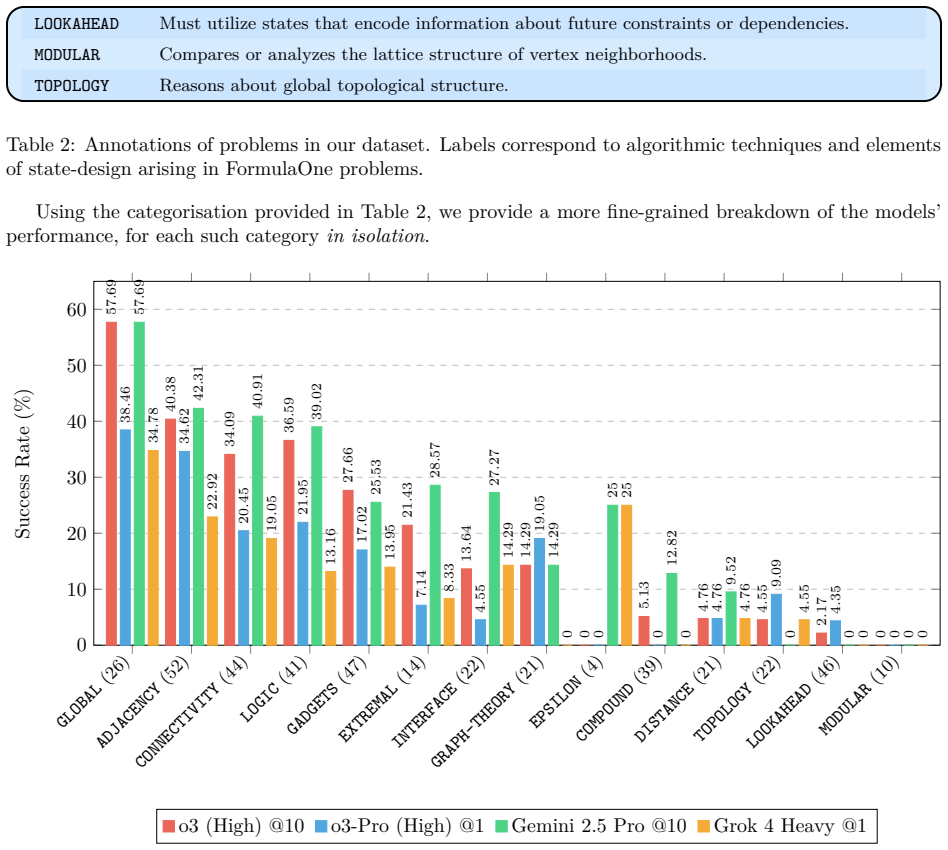
- [Figure 10] The category-level success rates are computed over the combined FormulaOne and FormulaOne-Warmup datasets, but some categories have very small sample sizes (e.g., EPSILON with 4 problems and MODULAR with 10); the displayed rates are therefore noisy and should be interpreted with caution.
- [Section 4.3] The claim that the sampling process ensures that 'with high probability' all possible gadgets are present in the tested graphs is not quantified. Please state what 'all possible gadgets' means and give the probability or a formal argument.
- [Abstract and Introduction] The abstract says 'We release the full corpus along with a comprehensive evaluation framework', while the introduction says 'we will release the full dataset'; please make the release status consistent and, if released, provide a permanent link.
Circularity Check
No circular derivation: the <1% model results are an independent empirical measurement; the missing human baseline is a validity concern, not a circular reduction.
full rationale
The paper's central result is an empirical evaluation, not a derivation that reduces to its inputs. Models are asked to implement five DP callback functions; their completions are run in a purpose-built evaluation harness against independently generated verifiers and test suites, and the reported <1% success rate is a measured outcome. The generation of problems from MSO logic and the guarantee of tractability rest on Courcelle's theorem, an external mathematical result, and the verifiers are constructed from the authors' DSL rather than from the models' outputs. No parameter is fitted to the measured success rates, no prediction is a renamed fit, and no load-bearing self-citation appears in the argument: the cited complexity-theory literature is external and the SETH connection is contextual framing rather than an input to the evaluation. The main interpretive risk, noted in Section 2.1, is that the claim that expert humans 'should, by rights, be able to score highly' is asserted without a human baseline; however, this is an unsupported empirical premise about interpretability, not a circular step in the derivation chain. The Appendix's full worked solution is illustrative, not used to calibrate or fit the benchmark outcomes. Therefore the core measurement is self-contained and no circularity is present.
Assumptions & free parameters
free parameters (5)
- Core dataset size =
120 problems
- Warmup dataset size =
100 problems
- Treewidth bound =
3 (with JOIN bags of width at most 2)
- Time limit per test =
100 seconds
- Sampling attempts =
10 for o3 and Gemini, 1 for o3-Pro and Grok 4
assumptions (5)
- standard math Courcelle's theorem: every MSO-definable graph property is solvable by linear-time DP on bounded-treewidth graphs.
- domain assumption The provided tree decomposition is valid and can be treated as part of the input.
- domain assumption The DSL-generated verifiers correctly compute the weighted model count for each MSO formula.
- domain assumption The stochastic graph sampling covers all relevant small gadgets in all bag-relative positions.
- standard math Every clique of the graph appears inside some bag of the tree decomposition.
Cite this review
Pith. "Pith review of FormulaOne: Measuring the Depth of Algorithmic Reasoning Beyond Competitive Programming." pith.science (2026). https://pith.science/paper/YRAGE2BY
@misc{pith2026250713337,
  author       = {Pith},
  title        = {Pith review of: FormulaOne: Measuring the Depth of Algorithmic Reasoning Beyond Competitive Programming},
  year         = {2026},
  howpublished = {\url{https://pith.science/paper/YRAGE2BY}},
  note         = {Machine review of arXiv:2507.13337}
}
read the original abstract
Frontier AI models demonstrate formidable breadth of knowledge. But how close are they to true human -- or superhuman -- expertise? Genuine experts can tackle the hardest problems and push the boundaries of scientific understanding. To illuminate the limits of frontier model capabilities, we turn away from contrived competitive programming puzzles, and instead focus on real-life research problems. We construct FormulaOne, a benchmark that lies at the intersection of graph theory, logic, and algorithms, all well within the training distribution of frontier models. Our problems are incredibly demanding, requiring an array of reasoning steps. The dataset has three key properties. First, it is of commercial interest and relates to practical large-scale optimisation problems, such as those arising in routing, scheduling, and network design. Second, it is generated from the highly expressive framework of Monadic Second-Order (MSO) logic on graphs, paving the way toward automatic problem generation at scale; ideal for building RL environments. Third, many of our problems are intimately related to the frontier of theoretical computer science, and to central conjectures therein, such as the Strong Exponential Time Hypothesis (SETH). As such, any significant algorithmic progress on our dataset, beyond known results, could carry profound theoretical implications. Remarkably, state-of-the-art models like OpenAI's o3 fail entirely on FormulaOne, solving less than 1% of the questions, even when given 10 attempts and explanatory fewshot examples -- highlighting how far they remain from expert-level understanding in some domains. To support further research, we additionally curate FormulaOne-Warmup, offering a set of simpler tasks, from the same distribution. We release the full corpus along with a comprehensive evaluation framework.
Figures


Figures from the paper (7 more)


Reference graph
Works this paper leans on
-
[1]
Program synthesis with large language models
Jacob Austin, Augustus Odena, Maxwell Nye, Maarten Bosma, Henryk Michalewski, David Dohan, Ellen Jiang, Carrie Cai, Michael Terry, Quoc Le, et al. Program synthesis with large language models. arXiv preprint arXiv:2108.07732 , 2021
arXiv 2021
-
[2]
On non-serial dynamic programming
Umberto Bertele and Francesco Brioschi. On non-serial dynamic programming. J. Comb. Theory, Ser. A , 14(2):137--148, 1973
work page 1973
-
[3]
Hans L Bodlaender, Jitender S Deogun, Klaus Jansen, Ton Kloks, Dieter Kratsch, Haiko M \"u ller, and Zsolt Tuza. Rankings of graphs. SIAM Journal on Discrete Mathematics , 11(1):168--181, 1998
work page 1998
-
[4]
Dynamic programming on graphs with bounded treewidth
Hans L Bodlaender. Dynamic programming on graphs with bounded treewidth. In Automata, Languages and Programming: 15th International Colloquium Tampere, Finland, July 11--15, 1988 Proceedings 15 , pages 105--118. Springer, 1988
1988
-
[5]
A linear time algorithm for finding tree-decompositions of small treewidth
Hans L Bodlaender. A linear time algorithm for finding tree-decompositions of small treewidth. In Proceedings of the twenty-fifth annual ACM symposium on Theory of computing , pages 226--234, 1993
1993
-
[6]
Handle-rewriting hypergraph grammars
Bruno Courcelle, Joost Engelfriet, and Grzegorz Rozenberg. Handle-rewriting hypergraph grammars. Journal of computer and system sciences , 46(2):218--270, 1993
work page 1993
-
[7]
Lower bounds based on the exponential-time hypothesis
Marek Cygan, Fedor V Fomin, ukasz Kowalik, Daniel Lokshtanov, D \'a niel Marx, Marcin Pilipczuk, Micha Pilipczuk, Saket Saurabh, Marek Cygan, Fedor V Fomin, et al. Lower bounds based on the exponential-time hypothesis. Parameterized Algorithms , pages 467--521, 2015
work page 2015
-
[8]
On the measure of intelligence
Fran c ois Chollet. On the measure of intelligence. 2019
work page 2019
Show all 32 references
-
[9]
The complexity of satisfiability of small depth circuits
Chris Calabro, Russell Impagliazzo, and Ramamohan Paturi. The complexity of satisfiability of small depth circuits. In International Workshop on Parameterized and Exact Computation , pages 75--85. Springer, 2009
2009
-
[10]
Training verifiers to solve math word problems
Karl Cobbe, Vineet Kosaraju, Mohammad Bavarian, Mark Chen, Heewoo Jun, Lukasz Kaiser, Matthias Plappert, Jerry Tworek, Jacob Hilton, Reiichiro Nakano, et al. Training verifiers to solve math word problems. 2021
2021
-
[11]
Arc-agi-2: A new challenge for frontier ai reasoning systems
Francois Chollet, Mike Knoop, Gregory Kamradt, Bryan Landers, and Henry Pinkard. Arc-agi-2: A new challenge for frontier ai reasoning systems. arXiv preprint arXiv:2505.11831 , 2025
2025 arXiv
-
[12]
Arc prize 2024: Technical report
Francois Chollet, Mike Knoop, Gregory Kamradt, and Bryan Landers. Arc prize 2024: Technical report. arXiv preprint arXiv:2412.04604 , 2024
2024 arXiv
-
[13]
The monadic second-order logic of graphs
Bruno Courcelle. The monadic second-order logic of graphs. i. recognizable sets of finite graphs. Information and computation , 85(1):12--75, 1990
1990
-
[14]
Competitive programming with large reasoning models
Ahmed ElKishky, Alexander Wei, Andre Saraiva, Borys Minaiev, Daniel Selsam, David Dohan, Francis Song, Hunter Lightman, Ignasi Clavera, Jakub Pachocki, et al. Competitive programming with large reasoning models. 2025
2025
-
[15]
Ruiz, Julian Schrittwieser, Grzegorz Swirszcz, et al
Alhussein Fawzi, Matej Balog, Aja Huang, Thomas Hubert, Bernardino Romera-Paredes, Mohammadamin Barekatain, Alexander Novikov, Francisco J.R. Ruiz, Julian Schrittwieser, Grzegorz Swirszcz, et al. Discovering faster matrix multiplication algorithms with reinforcement learning. ...
2022
-
[16]
Dynasp2.5: Dynamic programming on tree decompositions in action
Johannes K Fichte, Markus Hecher, Michael Morak, and Stefan Woltran. Dynasp2.5: Dynamic programming on tree decompositions in action. Algorithms , 14(3):81, 2021
2021
-
[17]
Faster algorithms for finding and counting subgraphs
Fedor V Fomin, Daniel Lokshtanov, Venkatesh Raman, Saket Saurabh, and BV Raghavendra Rao. Faster algorithms for finding and counting subgraphs. Journal of Computer and System Sciences , 78(3):698--706, 2012
2012
-
[18]
Frontiermath: A benchmark for evaluating advanced mathematical reasoning in ai
Elliot Glazer, Ege Erdil, Tamay Besiroglu, Diego Chicharro, Evan Chen, Alex Gunning, Caroline Falkman Olsson, Jean-Stanislas Denain, Anson Ho, Emily de Oliveira Santos, et al. Frontiermath: A benchmark for evaluating advanced mathematical reasoning in ai. arXiv preprint arXiv:...
2024 arXiv
-
[19]
S-functions for graphs
Rudolf Halin. S-functions for graphs. Journal of geometry , 8:171--186, 1976
1976
-
[20]
F. Harary. Graph Theory . Addison-Wesley, Reading, MA, 1969
1969
-
[21]
Measuring mathematical problem solving with the math dataset
Dan Hendrycks, Collin Burns, Saurav Kadavath, Akul Arora, Steven Basart, Eric Tang, Dawn Song, and Jacob Steinhardt. Measuring mathematical problem solving with the math dataset. 2021
2021
-
[22]
Ale-bench: A benchmark for long-horizon objective-driven algorithm engineering
Yuki Imajuku, Kohki Horie, Yoichi Iwata, Kensho Aoki, Naohiro Takahashi, and Takuya Akiba. Ale-bench: A benchmark for long-horizon objective-driven algorithm engineering. 2025
2025
-
[23]
Livecodebench: Holistic and contamination free evaluation of large language models for code
Naman Jain, King Han, Alex Gu, Wen-Ding Li, Fanjia Yan, Tianjun Zhang, Sida Wang, Armando Solar-Lezama, Koushik Sen, and Ion Stoica. Livecodebench: Holistic and contamination free evaluation of large language models for code. 2024
2024
-
[24]
Enumeration of minimal hitting sets parameterized by treewidth
Batya Kenig and Dan Shlomo Mizrahi. Enumeration of minimal hitting sets parameterized by treewidth. 2024
2024
-
[25]
Known algorithms on graphs of bounded treewidth are probably optimal
Daniel Lokshtanov, D \'a niel Marx, and Saket Saurabh. Known algorithms on graphs of bounded treewidth are probably optimal. In Proceedings of the twenty-second annual ACM-SIAM symposium on Discrete Algorithms , pages 777--789. SIAM, 2011
2011
-
[26]
Mankowitz, Andrea Michi, Anton Zhernov, Marco Gelmi, Marco Selvi, Cosmin Paduraru, Edouard Leurent, Shariq Iqbal, Jean-Baptiste Lespiau, Alex Ahern, et al
Daniel J. Mankowitz, Andrea Michi, Anton Zhernov, Marco Gelmi, Marco Selvi, Cosmin Paduraru, Edouard Leurent, Shariq Iqbal, Jean-Baptiste Lespiau, Alex Ahern, et al. Faster sorting algorithms discovered using deep reinforcement learning. Nature , 618:257--263, 2023
2023
-
[27]
Ruiz, Abbas Mehrabian, M
Alexander Novikov, Ngân Vũ, Marvin Eisenberger, Emilien Dupont, Po-Sen Huang, Adam Zsolt Wagner, Sergey Shirobokov, Borislav Kozlovskii, Francisco J.R. Ruiz, Abbas Mehrabian, M. Pawan Kumar, Abigail See, Swarat Chaudhuri, George Holland, Alex Davies, Sebastian Nowozin, Pushmee...
2025
-
[28]
Humanity's last exam
Long Phan, Alice Gatti, Ziwen Han, Nathaniel Li, Hugh Zhang, Dan Hendrycks, Alexandr Wang, et al. Humanity's last exam. 2025
2025
-
[29]
Codeelo: Benchmarking competition-level code generation of llms with human-comparable elo ratings
Shanghaoran Quan, Jiaxi Yang, Bowen Yu, Bo Zheng, Dayiheng Liu, An Yang, Xuancheng Ren, Bofei Gao, Yibo Miao, Yunlong Feng, et al. Codeelo: Benchmarking competition-level code generation of llms with human-comparable elo ratings. 2025
2025
-
[30]
Graph minors
Neil Robertson and Paul D Seymour. Graph minors. i. excluding a forest. Journal of Combinatorial Theory, Series B , 35(1):39--61, 1983
1983
-
[31]
Graph minors
Neil Robertson and Paul D Seymour. Graph minors. iii. planar tree-width. Journal of Combinatorial Theory, Series B , 36(1):49--64, 1984
1984
-
[32]
k-nlc graphs and polynomial algorithms
Egon Wanke. k-nlc graphs and polynomial algorithms. Discrete Applied Mathematics , 54(2-3):251--266, 1994
1994
Reviewed August 6, 2026 · model on record in the stance chip above.
Discussion (0). Continue with ORCID to comment.