REVIEW 3 major objections 5 minor 86 references
Rethinking Individual Fairness in Deepfake Detection
T0 review · 3 major / 5 minor · reviewed 2026-08-06 · deepseek-v4-flash
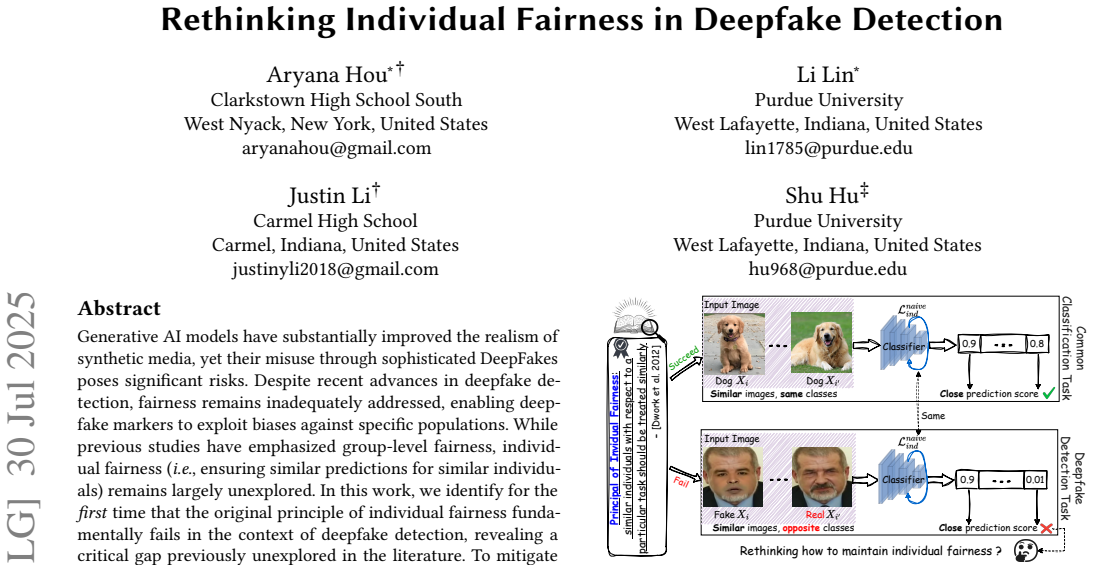
Pith's one-line read A fake face is closer to its real target than to any real donor, so the usual fairness rule would force wrong labels; the paper switches similarity from identity to forgery artifacts and reports gains in both fairness and detection.
desk verdict Novel method, but the headline fairness improvement is measured with the training loss itself, so the central evaluation is circular. read the letter →
The pith
A machine-rendered reading of the paper's core claim, the machinery that carries it, and where it could break.
The reading
What carries the argument
The central object is the semantic-agnostic individual fairness loss $L^*_{\text{ind}}$ (Eq. 3), which penalizes $|h(E(X^a_i)) - h(E(X^a_j))| - \tau \|F(X'_i) - F(X'_j)\|_2$ when two anchored inputs are close in a processing space that is supposed to suppress identity. That space is produced by: (1) patch shuffle, which breaks facial structure into rearranged local patches; (2) residual extraction, subtracting a denoised version $D(X')$ so only high-frequency deviations remain; and (3) the discrete Fourier transform of the residual, which encodes generation-pipeline signatures. Anchor learning supplies $X^a = \text{concat}([\bar{r},\, X-\bar{r}])$ so predictions must stay consistent across reference images, and sharpness-aware minimization (SAM) flattens the loss landscape to help fairness generalize. The paper's ablations rank these components, with the frequency transform contributing most, followed by anchor learning, patch shuffle, and residual extraction.
What would settle it
Measure identity retention directly: run original faces and their processed counterparts (patch-shuffled, residual-extracted, Fourier-transformed) through a face-recognition embedding such as ArcFace and compare cosine similarities. If processed fake-target pairs still match substantially better than processed real-donor pairs, semantic suppression has not occurred. Alternatively, train the proposed loss on pairs with identical targets but different donors and check whether the fairness loss $L^*_{\text{ind}}$ moves; any movement indicates identity leakage.
Extended reading notes
Core claim
The paper identifies, first, that the original individual fairness principle fails in deepfake detection: a fake image $X_f$ is closer to its real target $X_t$ than $X_t$ is to a real donor $X_d$, and the same ordering holds even in the Fourier power spectrum (average distances 13 versus 17). It then claims to resolve the conflict by replacing semantic similarity with forgery-artifact similarity: images are compared by the Fourier spectrum of the denoised residual of patch-shuffled versions, where identity structure is scrambled and synthesis artifacts remain. The new fairness loss $L^*_{\text{ind}}$ (Eq. 3), combined with anchor learning (each input mapped to $[\bar{r},\, X-\bar{r}]$) and sharpness-aware minimization, is claimed to restore individual fairness without sacrificing detection. Experiments on FF++, DFDC, Celeb-DF, DFD, and AI-Face show the method improving AUC (e.g., 92.76% to 98.53% on FF++) while lowering both the naive and new fairness loss values, and the gains persist when the method is grafted onto spatial, frequency, and fairness-aware detectors.
Load-bearing premise
The whole semantic-agnostic claim rests on the untested assumption that patch shuffle, denoising, and Fourier transform actually strip out identity information while preserving every forgery artifact; if identity still leaks through, the fairness loss can keep encoding the very bias it is meant to remove.
Editorial extensions
If this is right
- Deepfake detectors can be trained under individual fairness if 'similarity' is measured on forgery artifacts instead of raw image semantics, so fairness and detection utility need not trade off.
- The proposed fairness loss is plug-and-play: adding it to spatial-based, frequency-based, and fairness-aware detectors (UCF, CORE, RECCE, F3Net, SPSL, SRM, DAW-FDD, DAG-FDD, PG-FDD) improves both utility and fairness in intra-domain and cross-domain evaluations.
- Because the method never requires demographic labels, it offers a practical fairness route for settings where protected attributes are unavailable, incomplete, or noisy.
- Training with anchor learning plus the semantic-agnostic loss steers the model toward forgery cues, which is exactly what deepfake detection needs, explaining why the reported AUC also rises.
- The fairness gains survive common post-processing distortions (JPEG compression, brightness/contrast, rotation, HSV changes, Gaussian blur), suggesting the artifact-based similarity is relatively stable under real-world degradation.
Reading between the lines
- If the semantic-agnostic representation truly removes identity, the same patch-shuffle-plus-residual-plus-Fourier pipeline could serve as a feature extractor for other media-forensics tasks such as source attribution or splicing localization; that extension is untested in the paper.
- The paper's diagnosis generalizes beyond deepfakes: for any binary classification where the two classes are near-duplicates at the pixel level, individual fairness should be defined on the task-relevant signal rather than the raw input.
- The method inherits the known sensitivity of frequency-based cues to heavy resizing and compression; adversarial perturbations that specifically erase spectral peaks could plausibly undermine the fairness loss even where generic robustness experiments look strong.
- A decisive, cheap add-on would be measuring identity retention directly (e.g., ArcFace cosine similarity between original and processed faces); the paper's central assumption would be settled by that single number.
Editorial analysis
A structured set of objections, weighed in public.
Referee Report
Summary. The paper argues that the standard individual-fairness principle of Dwork et al. (similar individuals should receive similar predictions) is fundamentally at odds with deepfake detection, because a fake image is more similar to its real target than to a real donor image. The authors verify this with average pixel and frequency-domain distances (Section 3, Fig. 2), then propose a framework combining anchor learning, a semantic-agnostic similarity measure built from patch shuffling, denoising residual extraction, and Fourier transformation, a new individual-fairness regularizer L*_ind (Eq. 3), and SAM-based optimization (Eq. 4). They report intra-domain, cross-domain, backbone, detector-integration, robustness, and ablation experiments over five datasets, claiming consistent improvements in both AUC and individual fairness.
Significance. The conceptual observation that the original individual-fairness formulation can conflict with the detection goal in deepfake detection is interesting and, if properly supported, could be a useful contribution to the fairness literature. The experimental breadth is a genuine strength: five datasets, three backbones, multiple detector families, robustness checks, and ablations are included, and code is released. However, the central empirical claim that the method 'significantly improves individual fairness' is not currently supported, because the primary fairness metric is the same objective that the method is trained to minimize, and because the metric is evaluated on different input representations for the proposed method versus the baselines. The significance of the paper therefore depends on the authors supplying an independent evaluation protocol.
major comments (3)
- [Section 6.2, Eq. (3), Eq. (4)] The primary fairness metric reported in Tables 1-3, L*_ind, is identical to the proposed training regularizer: Eq. (3) defines L*_ind and Eq. (4) trains by minimizing L = L*_CE + lambda * L*_ind. A lower L*_ind for the proposed method is therefore expected by construction and does not provide independent evidence of improved fairness. I recommend replacing or supplementing this metric with an evaluation criterion that is not optimized during training, such as prediction consistency on semantically matched real/fake pairs or on perturbed inputs, computed with the same input representation and the same similarity function for all compared methods.
- [Appendix 10.2, Tables 1-3] The reported comparisons mix different quantities across methods. For Ori and Naive, L*_ind is adapted to L*'_ind by using original inputs X in the prediction-difference term, while for Ours it is computed on anchored inputs X^a; the same asymmetry applies to the L^naive_ind column. Thus the observed gaps may reflect the difference in input representation rather than a fairness improvement. All methods should be scored under one shared protocol, and if anchored inputs are intrinsic to the proposed method, the metric should still be defined independently of the training loss and applied identically to every method.
- [Section 5.2, Fig. 2] The claim that patch shuffle plus denoising residual extraction plus Fourier transformation suppresses semantic identity is not directly verified. Fig. 2 reports average Euclidean distances between transformed fake, target, and donor representations, which shows the desired ordering, but it does not measure whether identity information remains in the representation. Without a metric such as face identity retention rate or identity-classification accuracy at chance level on the processed residuals, the loss in Eq. (3) may still encode identity bias, which would undermine the method's stated goal of semantic-agnostic fairness.
minor comments (5)
- [Section 6.3] The sentence 'Additionally.' is an incomplete fragment; it should either be removed or completed with the observation it introduces.
- [Fig. 5 caption] The caption contains a typo: 'The the loss landscape' should read 'The loss landscape'.
- [Acknowledgments] The acknowledgment contains a typo: 'fndings' should be 'findings'.
- [Appendix 10.2] The adapted metrics L^naive'_ind and L*'_ind are introduced only in the appendix, but the main text tables use the same notation L^naive_ind and L*_ind without noting that the definitions change by method. This should be clarified in Section 6.2 to avoid confusion.
- [Conclusion, Limitation] The Limitation paragraph says the paper includes 'formal analyses' of the challenges, but Section 3 is an empirical distance measurement rather than a formal analysis. The wording should be tempered or a formal statement should be provided.
Circularity Check
Fairness improvement is reported with the training objective itself as the metric, and the metric is evaluated on different input representations for Ours vs baselines; the central fairness claim therefore reduces, in part, to the training objective.
-
fitted input called prediction
[Section 5.3 Eq. (4); Section 6.1 'Evaluation Metrics'; Section 6.2 Tables 1-3]
"To evaluate individual fairness, we treat L^naive_ind and L*_ind as the traditional and proposed individual fairness metrics, respectively. ... we optimize the following final learning objective formulated as a weighted combination of L*_CE and L*_ind: L = L*_CE + λ L*_ind. (4)"
The quantity reported as the headline fairness improvement, L*_ind, is defined in Eq. (3) and is exactly the regularization term minimized during training through Eq. (4). Tables 1-3 then report lower L*_ind for Ours relative to Ori and Naive as evidence of improved individual fairness. Since Ours is explicitly trained to minimize this same number while the baselines are not, the observed decrease is expected by construction rather than independent evidence that fairness improved.
-
other
[Appendix 10.2 'The Formulation of Evaluation Metrics']
"Specifically, our method leverages anchor training to improve individual fairness, which requires anchored input, so when evaluating L^naive_ind, we adapt it by using the anchored inputs X^a for the term ♠ ... The Naive and Ori method only needs the original image as input, so when evaluating L*_ind, we adapt it by using the original inputs X for the term ♠."
The adapted metrics are not the same function across methods: for Ours, the prediction-difference term in L^naive_ind is computed on anchored inputs X^a, while for Ori and Naive it is computed on original inputs X; likewise, L*_ind is evaluated on X^a for Ours and on X for the baselines. The tables compare these differently-computed quantities as if they were a single fairness metric. The difference between Ours and the baselines therefore conflates a change of input representation with an improvement in fairness, making the reported fairness comparison non-identifiable.
full rationale
The paper's central fairness claim is substantially weakened by a construction-level evaluation issue: L*_ind is both the proposed individual-fairness loss (Eq. 3) and the primary fairness metric reported in Tables 1-3 (Section 6.1), while Eq. (4) trains the model by minimizing exactly that loss. Reporting a reduction in the training objective for the method that was optimized on it, relative to baselines that were not, is a fitted-input-called-prediction pattern rather than independent evidence of fairness. Appendix 10.2 compounds the problem by adapting the metrics so that Ours is evaluated on anchored inputs X^a while Ori and Naive are evaluated on original inputs X, so even the L^naive_ind comparisons are not apples-to-apples. The AUC improvements are independent and do support the claim that detection utility is maintained or improved; they do not, however, independently validate the headline 'significantly improves individual fairness' claim. The motivation that individual fairness 'fails' in deepfake detection is an empirical distance measurement, not circular, and the semantic-suppression preprocessing (patch shuffle, denoising, Fourier transform) is asserted rather than verified, but that is a supportability weakness, not circularity. No load-bearing self-citation chain or imported uniqueness theorem was found. Overall, the fairness-specific result is partially circular and not independently established, yielding a score of 6.
Assumptions & free parameters
free parameters (5)
- lambda (fairness weight) =
0.001
- tau (hinge margin) =
0.00005
- alpha (reference mask probability) =
0.2
- P (patch size) =
32
- gamma (SAM perturbation radius) =
0.05
assumptions (4)
- domain assumption Euclidean distance in pixel space approximates perceptual/semantic similarity for face images
- domain assumption Patch shuffle, denoising residual subtraction, and Fourier transform remove semantic identity while exposing forgery artifacts
- domain assumption Anchor learning from Narayanaswamy et al. transfers to deepfake detection and improves generalization
- domain assumption Sharpness-aware minimization flattens the loss landscape and thereby improves fairness generalization
Cite this review
Pith. "Pith review of Rethinking Individual Fairness in Deepfake Detection." pith.science (2026). https://pith.science/paper/LG7HA3ZU
@misc{pith2026250714326,
  author       = {Pith},
  title        = {Pith review of: Rethinking Individual Fairness in Deepfake Detection},
  year         = {2026},
  howpublished = {\url{https://pith.science/paper/LG7HA3ZU}},
  note         = {Machine review of arXiv:2507.14326}
}
read the original abstract
Generative AI models have substantially improved the realism of synthetic media, yet their misuse through sophisticated DeepFakes poses significant risks. Despite recent advances in deepfake detection, fairness remains inadequately addressed, enabling deepfake markers to exploit biases against specific populations. While previous studies have emphasized group-level fairness, individual fairness (i.e., ensuring similar predictions for similar individuals) remains largely unexplored. In this work, we identify for the first time that the original principle of individual fairness fundamentally fails in the context of deepfake detection, revealing a critical gap previously unexplored in the literature. To mitigate it, we propose the first generalizable framework that can be integrated into existing deepfake detectors to enhance individual fairness and generalization. Extensive experiments conducted on leading deepfake datasets demonstrate that our approach significantly improves individual fairness while maintaining robust detection performance, outperforming state-of-the-art methods. The code is available at https://github.com/Purdue-M2/Individual-Fairness-Deepfake-Detection.
Figures


Figures from the paper (3 more)


Reference graph
Works this paper leans on
-
[1]
Dolhansky Brian et al . 2020. The DeepFake Detection Challenge Dataset. arXiv:2006.07397
arXiv 2020
-
[2]
Junyi Cao, Chao Ma, Taiping Yao, Shen Chen, Shouhong Ding, and Xiaokang Yang. 2022. End-to-end reconstruction-classification learning for face forgery detection. In Proceedings of the IEEE/CVF conference on computer vision and pattern recognition. 4113–4122
2022
-
[3]
Baoying Chen, Jishen Zeng, Jianquan Yang, and Rui Yang. 2024. DRCT: Diffusion Reconstruction Contrastive Training towards Universal Detection of Diffusion Generated Images. In Proceedings of the 41st International Conference on Machine Learning. PMLR, 7621–7639
2024
-
[4]
Shen Chen, Taiping Yao, Hong Liu, Xiaoshuai Sun, Shouhong Ding, Rongrong Ji, et al. 2024. Diffusionfake: Enhancing generalization in deepfake detection via guided stable diffusion. Advances in Neural Information Processing Systems 37 (2024), 101474–101497
2024
-
[5]
Tiewen Chen, Shanmin Yang, Shu Hu, Zhenghan Fang, Ying Fu, Xi Wu, and Xin Wang. 2024. Masked conditional diffusion model for enhancing deepfake detection. arXiv preprint arXiv:2402.00541 (2024)
arXiv 2024
-
[6]
Jongwook Choi, Taehoon Kim, Yonghyun Jeong, Seungryul Baek, and Jongwon Choi. 2024. Exploiting Style Latent Flows for Generalizing Deepfake Video Detection. In Proceedings of the IEEE/CVF Conference on Computer Vision and Pattern Recognition. 1133–1143
2024
-
[7]
François Chollet. 2017. Xception: Deep learning with depthwise separable con- volutions. In Proceedings of the IEEE conference on computer vision and pattern recognition. 1251–1258
2017
-
[8]
Riccardo Corvi, Davide Cozzolino, Giovanni Poggi, Koki Nagano, and Luisa Verdoliva. 2023. Intriguing properties of synthetic images: from generative ad- versarial networks to diffusion models. In Proceedings of the IEEE/CVF conference on computer vision and pattern recognition . 973–982
2023
Show all 86 references
-
[9]
Riccardo Corvi, Davide Cozzolino, Giada Zingarini, Giovanni Poggi, Koki Nagano, and Luisa Verdoliva. 2023. On the detection of synthetic images generated by diffusion models. In ICASSP 2023-2023 IEEE International Conference on Acoustics, Speech and Signal Processing (ICASSP) ...
2023
-
[10]
Davide Cozzolino, Giovanni Poggi, Riccardo Corvi, Matthias Nießner, and Luisa Verdoliva. 2023. Raising the Bar of AI-generated Image Detection with CLIP. arXiv preprint arXiv:2312.00195 (2023)
2023 arXiv
-
[11]
Prafulla Dhariwal and Alexander Nichol. 2021. Diffusion models beat gans on image synthesis. Advances in neural information processing systems 34 (2021), 8780–8794
2021
-
[12]
Alexey Dosovitskiy, Lucas Beyer, Alexander Kolesnikov, Dirk Weissenborn, Xi- aohua Zhai, Thomas Unterthiner, Mostafa Dehghani, Matthias Minderer, Georg Heigold, Sylvain Gelly, Jakob Uszkoreit, and Neil Houlsby. 2021. An image is worth 16x16 words: Transformers for image recogn...
2021
-
[13]
Cynthia Dwork, Moritz Hardt, Toniann Pitassi, Omer Reingold, and Richard Zemel. 2012. Fairness through awareness. In Proceedings of the 3rd innovations in theoretical computer science conference . 214–226
2012
-
[14]
Tarik Dzanic, Karan Shah, and Freddie Witherden. 2020. Fourier spectrum discrepancies in deep network generated images. Advances in neural information processing systems 33 (2020), 3022–3032
2020
-
[15]
Bing Fan, Zihan Jiang, Shu Hu, and Feng Ding. 2023. Attacking identity semantics in deepfakes via deep feature fusion. In 2023 IEEE 6th International Conference on Multimedia Information Processing and Retrieval (MIPR) . IEEE, 114–119
2023
-
[16]
Will Fleisher. 2021. What’s fair about individual fairness?. In Proceedings of the 2021 AAAI/ACM Conference on AI, Ethics, and Society . 480–490
2021
-
[17]
Pierre Foret, Ariel Kleiner, Hossein Mobahi, and Behnam Neyshabur. 2020. Sharpness-aware Minimization for Efficiently Improving Generalization. In In- ternational Conference on Learning Representations
2020
-
[18]
Joel Frank, Thorsten Eisenhofer, Lea Schönherr, Asja Fischer, Dorothea Kolossa, and Thorsten Holz. 2020. Leveraging frequency analysis for deep fake image recognition. In International conference on machine learning . PMLR, 3247–3258
2020
-
[19]
Google and Jigsaw. 2019. Deepfakes dataset by Google & Jigsaw. https://ai. googleblog.com/2019/09/contributing-data-to-deepfakedetection.html
2019
-
[20]
Luca Guarnera, Oliver Giudice, and Sebastiano Battiato. 2024. Level up the deepfake detection: a method to effectively discriminate images generated by gan architectures and diffusion models. In Intelligent Systems Conference. Springer, 615–625
2024
-
[21]
Hui Guo, Shu Hu, Xin Wang, Ming-Ching Chang, and Siwei Lyu. 2022. Eyes tell all: Irregular pupil shapes reveal GAN-generated faces. In ICASSP 2022-2022 IEEE International Conference on Acoustics, Speech and Signal Processing (ICASSP) . IEEE, 2904–2908
2022
-
[22]
Hui Guo, Shu Hu, Xin Wang, Ming-Ching Chang, and Siwei Lyu. 2022. Open-eye: An open platform to study human performance on identifying ai-synthesized faces. In 2022 IEEE 5th International Conference on Multimedia Information Pro- cessing and Retrieval (MIPR) . IEEE, 224–227
2022
-
[23]
Hui Guo, Shu Hu, Xin Wang, Ming-Ching Chang, and Siwei Lyu. 2022. Robust attentive deep neural network for detecting GAN-generated faces. IEEE Access 10 (2022), 32574–32583
2022
-
[24]
Xiao Guo et al . 2023. Hierarchical fine-grained image forgery detection and localization. In Proceedings of the IEEE/CVF Conference on Computer Vision and Pattern Recognition. 3155–3165
2023
-
[25]
Caner Hazirbas, Joanna Bitton, Brian Dolhansky, Jacqueline Pan, Albert Gordo, and Cristian Canton Ferrer. 2021. Towards measuring fairness in ai: the casual conversations dataset. IEEE Transactions on Biometrics, Behavior, and Identity Science 4, 3 (2021), 324–332
2021
-
[26]
Kaiming He, Xiangyu Zhang, Shaoqing Ren, and Jian Sun. 2016. Deep residual learning for image recognition. In Proceedings of the IEEE conference on computer vision and pattern recognition . 770–778
2016
-
[27]
Cheng-Yao Hong, Yen-Chi Hsu, and Tyng-Luh Liu. 2024. Contrastive Learning for DeepFake Classification and Localization via Multi-Label Ranking. InProceedings of the IEEE/CVF Conference on Computer Vision and Pattern Recognition (CVPR) . 17627–17637
2024
-
[28]
Cheng-Yao Hong, Yen-Chi Hsu, and Tyng-Luh Liu. 2024. Contrastive Learning for DeepFake Classification and Localization via Multi-Label Ranking. InProceedings of the IEEE/CVF Conference on Computer Vision and Pattern Recognition . 17627– 17637
2024
-
[29]
Ashish Hooda et al . 2024. D4: Detection of Adversarial Diffusion Deepfakes Using Disjoint Ensembles. W ACV(2024)
2024
-
[30]
Shu Hu, Yuezun Li, and Siwei Lyu. 2021. Exposing GAN-generated faces using inconsistent corneal specular highlights. In ICASSP 2021-2021 IEEE International Conference on Acoustics, Speech and Signal Processing (ICASSP) . IEEE, 2500–2504
2021
-
[31]
Yung Jer Wong and Teck Khim Ng. 2023. Local Statistics for Generative Image Detection. arXiv e-prints (2023), arXiv–2310
2023
-
[32]
Yan Ju et al. 2023. GLFF: Global and Local Feature Fusion for AI-synthesized Image Detection. IEEE Transactions on Multimedia (2023)
2023
-
[33]
Yan Ju, Shu Hu, Shan Jia, George H Chen, and Siwei Lyu. 2024. Improving fairness in deepfake detection. In Proceedings of the IEEE/CVF Winter Conference on Applications of Computer Vision . 4655–4665
2024
-
[34]
Tero Karras, Samuli Laine, Miika Aittala, Janne Hellsten, Jaakko Lehtinen, and Timo Aila. 2020. Analyzing and improving the image quality of stylegan. In Proceedings of the IEEE/CVF conference on computer vision and pattern recognition . 8110–8119
2020
-
[35]
Mahyar Khayatkhoei and Ahmed Elgammal. 2022. Spatial frequency bias in con- volutional generative adversarial networks. InProceedings of the AAAI Conference on Artificial Intelligence, Vol. 36. 7152–7159
2022
-
[36]
Yamini Sri Krubha, Aryana Hou, Braden Vester, Web Walker, Xin Wang, Li Lin, and Shu Hu. 2025. Robust AI-Generated Face Detection with Imbalanced Data. MIPR (2025)
2025
-
[37]
Hanzhe Li, Jiaran Zhou, Yuezun Li, Baoyuan Wu, Bin Li, and Junyu Dong. 2024. FreqBlender: Enhancing DeepFake detection by blending frequency knowledge. In Advances in Neural Information Processing Systems
2024
-
[38]
Yuezun Li, Ming-Ching Chang, and Siwei Lyu. 2018. In ictu oculi: Exposing ai created fake videos by detecting eye blinking. In2018 IEEE International workshop on information forensics and security (WIFS) . IEEE, 1–7
2018
-
[39]
Yuezun Li, Xin Yang, Pu Sun, Honggang Qi, and Siwei Lyu. 2020. Celeb-DF: A New Dataset for Deepfake Forensics. In CVPR. 6,7
2020
-
[40]
Li Lin, Irene Amerini, Xin Wang, Shu Hu, et al. 2024. Robust CLIP-Based Detector for Exposing Diffusion Model-Generated Images. MIPR (2024)
2024
-
[41]
Li Lin, Irene Amerini, Xin Wang, Shu Hu, et al. 2024. Robust CLIP-based detec- tor for exposing diffusion model-generated images. In 2024 IEEE International Conference on Advanced Video and Signal Based Surveillance (A VSS). IEEE, 1–7
2024
-
[42]
Li Lin, Neeraj Gupta, Yue Zhang, Hainan Ren, Chun-Hao Liu, Feng Ding, Xin Wang, Xin Li, Luisa Verdoliva, and Shu Hu. 2024. Detecting Multimedia Generated by Large AI Models: A Survey. arXiv preprint arXiv:2402.00045 (2024)
2024 arXiv
-
[43]
Li Lin, Xinan He, Yan Ju, Xin Wang, Feng Ding, and Shu Hu. 2024. Preserving fairness generalization in deepfake detection. In Proceedings of the IEEE/CVF Conference on Computer Vision and Pattern Recognition . 16815–16825
2024
-
[44]
Li Lin, Xin Wang, Shu Hu, et al. 2024. AI-Face: A Million-Scale Demographically Annotated AI-Generated Face Dataset and Fairness Benchmark. arXiv preprint arXiv:2406.00783 (2024)
2024 arXiv
-
[45]
Honggu Liu, Xiaodan Li, Wenbo Zhou, Yuefeng Chen, Yuan He, Hui Xue, Weiming Zhang, and Nenghai Yu. 2021. Spatial-phase shallow learning: rethinking face forgery detection in frequency domain. In Proceedings of the IEEE/CVF conference MM ’25, October 27–31, 2025, Dublin, Irelan...
2021
-
[46]
Huan Liu, Zichang Tan, Chuangchuang Tan, Yunchao Wei, Jingdong Wang, and Yao Zhao. 2024. Forgery-aware adaptive transformer for generalizable synthetic image detection. In Proceedings of the IEEE/CVF Conference on Computer Vision and Pattern Recognition. 10770–10780
2024
-
[47]
Yuchen Luo, Yong Zhang, Junchi Yan, and Wei Liu. 2021. Generalizing face forgery detection with high-frequency features. In Proceedings of the IEEE/CVF conference on computer vision and pattern recognition . 16317–16326
2021
-
[48]
RuiPeng Ma et al. 2023. Exposing the Fake: Effective Diffusion-Generated Images Detection. In The Second Workshop on New Frontiers in Adversarial Machine Learning
2023
-
[49]
Falko Matern, Christian Riess, and Marc Stamminger. 2019. Exploiting visual artifacts to expose deepfakes and face manipulations. In 2019 IEEE Winter Appli- cations of Computer Vision Workshops (W ACVW). IEEE, 83–92
2019
-
[50]
Debarghya Mukherjee, Mikhail Yurochkin, Moulinath Banerjee, and Yuekai Sun
-
[51]
Aakash Varma Nadimpalli and Ajita Rattani. 2022. GBDF: gender balanced deepfake dataset towards fair deepfake detection. arXiv preprint arXiv:2207.10246 (2022)
2022 arXiv
-
[52]
Thiagarajan
Vivek Narayanaswamy, Kowshik Thopalli, Rushil Anirudh, Yamen Mubarka, Wesam Sakla, and Jayaraman J. Thiagarajan. 2024. On the Use of Anchoring for Training Vision Models. In Advances in Neural Information Processing Systems , A. Globerson, L. Mackey, D. Belgrave, A. Fan, U. Pa...
2024
-
[53]
Yunsheng Ni, Depu Meng, Changqian Yu, Chengbin Quan, Dongchun Ren, and Youjian Zhao. 2022. Core: Consistent representation learning for face forgery detection. In Proceedings of the IEEE/CVF conference on computer vision and pattern recognition. 12–21
2022
-
[54]
Muxin Pu, Meng Yi Kuan, Nyee Thoang Lim, Chun Yong Chong, and Mei Kuan Lim. 2022. Fairness Evaluation in Deepfake Detection Models using Metamorphic Testing. arXiv preprint arXiv:2203.06825 (2022)
2022 arXiv
-
[55]
Wenbo Pu, Jing Hu, Xin Wang, Yuezun Li, Shu Hu, Bin Zhu, Rui Song, Qi Song, Xi Wu, and Siwei Lyu. 2022. Learning a deep dual-level network for robust DeepFake detection. Pattern Recognition 130 (2022), 108832
2022
-
[56]
Yuyang Qian, Guojun Yin, Lu Sheng, Zixuan Chen, and Jing Shao. 2020. Think- ing in frequency: Face forgery detection by mining frequency-aware clues. In European conference on computer vision . Springer, 86–103
2020
-
[57]
Hainan Ren, Lin Li, Chun-Hao Liu, Xin Wang, and Shu Hu. 2024. Improving Generalization for AI-Synthesized Voice Detection. AAAI (2024)
2024
-
[58]
Andreas Rossler, Davide Cozzolino, Luisa Verdoliva, Christian Riess, Justus Thies, and Matthias Nießner. 2019. Faceforensics++: Learning to detect manipulated facial images. In Proceedings of the IEEE/CVF international conference on computer vision. 1–11
2019
-
[59]
Zeyang Sha et al. 2023. De-fake: Detection and attribution of fake images gener- ated by text-to-image generation models. In Proceedings of the 2023 ACM SIGSAC Conference on Computer and Communications Security . 3418–3432
2023
-
[60]
Saeed Sharifi-Malvajerdi, Michael Kearns, and Aaron Roth. 2019. Average indi- vidual fairness: Algorithms, generalization and experiments. Advances in neural information processing systems 32 (2019)
2019
-
[61]
Sergey Sinitsa and Ohad Fried. 2024. Deep Image Fingerprint: Towards Low Budget Synthetic Image Detection and Model Lineage Analysis. In Proceedings of the IEEE/CVF Winter Conference on Applications of Computer Vision (W ACV). 4067–4076
2024
-
[62]
Mingxing Tan and Quoc Le. 2019. Efficientnet: Rethinking model scaling for convolutional neural networks. In International conference on machine learning . PMLR, 6105–6114
2019
-
[63]
Loc Trinh and Yan Liu. 2021. An examination of fairness of AI models for deepfake detection. IJCAI (2021)
2021
-
[64]
Arash Vahdat and Jan Kautz. 2020. NVAE: A deep hierarchical variational autoen- coder. Advances in neural information processing systems 33 (2020), 19667–19679
2020
-
[65]
Sheng-Yu Wang, Oliver Wang, Richard Zhang, Andrew Owens, and Alexei A Efros. 2020. CNN-generated images are surprisingly easy to spot... for now. In Proceedings of the IEEE/CVF conference on computer vision and pattern recognition . 8695–8704
2020
-
[66]
Xin Wang, Hui Guo, Shu Hu, Ming-Ching Chang, and Siwei Lyu. 2023. Gan- generated faces detection: A survey and new perspectives. ECAI 2023 (2023), 2533–2542
2023
-
[67]
Xin Wang, Ting Yu Tsai, Li Lin, Hui Guo, Shu Hu, Ming-Ching Chang, Pradeep K Atrey, and Siwei Lyu. 2024. Spotting the Fakes: A Deep Dive into GAN-Generated Face Detection. ACM Transactions on Multimedia Computing, Communications and Applications (2024)
2024
-
[68]
Zhendong Wang, Jianmin Bao, Wengang Zhou, Weilun Wang, Hezhen Hu, Hong Chen, and Houqiang Li. 2023. Dire for diffusion-generated image detection. In Proceedings of the IEEE/CVF International Conference on Computer Vision . 22445– 22455
2023
-
[69]
Mika Westerlund. 2019. The emergence of deepfake technology: A review. Tech- nology innovation management review 9, 11 (2019)
2019
-
[70]
Mingyang Wu, Li Lin, Wenbin Zhang, Xin Wang, Zhenhuan Yang, and Shu Hu
-
[71]
Qiang Xu et al. 2023. Exposing fake images generated by text-to-image diffusion models. Pattern Recognition Letters (2023)
2023
-
[72]
Ying Xu, Philipp Terhöst, Marius Pedersen, and Kiran Raja. 2024. Analyzing Fairness in Deepfake Detection With Massively Annotated Databases. IEEE Transactions on Technology and Society (2024)
2024
-
[73]
Zhipei Xu, Xuanyu Zhang, Runyi Li, Zecheng Tang, Qing Huang, and Jian Zhang
-
[74]
Zhiyuan Yan, Yuhao Luo, Siwei Lyu, Qingshan Liu, and Baoyuan Wu. 2024. Transcending forgery specificity with latent space augmentation for generalizable deepfake detection. In Proceedings of the IEEE/CVF Conference on Computer Vision and Pattern Recognition. 8984–8994
2024
-
[75]
Zhiyuan Yan, Yong Zhang, Yanbo Fan, and Baoyuan Wu. 2023. UCF: Uncovering Common Features for Generalizable Deepfake Detection. In Proceedings of the IEEE/CVF International Conference on Computer Vision (ICCV) . 22412–22423
2023
-
[76]
In International Conference on Learning Representations
FakeShield: Explainable Image Forgery Detection and Localization via Multi-modal Large Language Models. In International Conference on Learning Representations
-
[77]
Shanmin Yang, Hui Guo, Shu Hu, Bin Zhu, Ying Fu, Siwei Lyu, Xi Wu, and Xin Wang. 2023. CrossDF: Improving Cross-Domain Deepfake Detection with Deep Information Decomposition. arXiv preprint arXiv:2310.00359 (2023)
2023 arXiv
-
[78]
Xin Yang, Yuezun Li, Honggang Qi, and Siwei Lyu. 2019. Exposing GAN- synthesized faces using landmark locations. In Proceedings of the ACM workshop on information hiding and multimedia security . 113–118
2019
-
[79]
Zhiyuan Yan, Yong Zhang, Xinhang Yuan, Siwei Lyu, and Baoyuan Wu. 2023. Deepfakebench: A comprehensive benchmark of deepfake detection. In NeurIPS
2023
-
[80]
Lei Zhang, Hao Chen, Shu Hu, Bin Zhu, Ching-Sheng Lin, Xi Wu, Jinrong Hu, and Xin Wang. 2024. X-Transfer: A Transfer Learning-Based Framework for GAN-Generated Fake Image Detection. In 2024 International Joint Conference on Neural Networks (IJCNN). IEEE, 1–8
2024
-
[81]
Lei Zhang, Hao Chen, Shu Hu, Bin Zhu, Xi Wu, Jinrong Hu, and Xin Wang. 2023. X-transfer: A transfer learning-based framework for robust gan-generated fake image detection. arXiv preprint arXiv:2310.04639 2 (2023)
2023 arXiv
-
[82]
Kai Zhang, Wangmeng Zuo, Yunjin Chen, Deyu Meng, and Lei Zhang. 2017. Beyond a gaussian denoiser: Residual learning of deep cnn for image denoising. IEEE transactions on image processing 26, 7 (2017), 3142–3155
2017
-
[83]
Chende Zheng, Chenhao Lin, Zhengyu Zhao, Hang Wang, Xu Guo, Shuai Liu, and Chao Shen. 2024. Breaking Semantic Artifacts for Generalized AI-generated Image Detection. Advances in Neural Information Processing Systems 37 (2024), 59570–59596. Supplementary Materials: Rethinking I...
2024
-
[85]
Xu Zhang, Svebor Karaman, and Shih-Fu Chang. 2019. Detecting and simulating artifacts in gan fake images. In 2019 IEEE international workshop on information forensics and security (WIFS) . IEEE, 1–6
2019
-
[2020]
In Interna- tional Conference on Machine Learning
Two simple ways to learn individual fairness metrics from data. In Interna- tional Conference on Machine Learning . PMLR, 7097–7107
-
[2025]
In The 42nd International Conference on Machine Learning (ICML)
Preserving AUC Fairness in Learning with Noisy Protected Groups. In The 42nd International Conference on Machine Learning (ICML)
Reviewed August 6, 2026 · model on record in the stance chip above.
Discussion (0). Sign in to comment.