REVIEW 2 major objections 6 minor 57 references
Binary Analysis and Period Study of the Long-Period, High Mass Ratio Contact Binary KIC 7766185
T0 review · 2 major / 6 minor · reviewed 2026-08-06 · deepseek-v4-flash
Pith's one-line read The paper establishes that KIC 7766185 is an A-type W UMa contact binary in a very shallow contact state, with a mass ratio of 0.81 and one of the largest, most massive secondary stars known in such systems.
desk verdict A solid, honest single-object study whose headline fillout factor is prior-enforced rather than fully measured; the mass ratio and masses hold up, and the evolutionary story needs a sensitivity test before being taken at face value. read the letter →
The pith
A machine-rendered reading of the paper's core claim, the machinery that carries it, and where it could break.
The reading
What carries the argument
The central machinery is a forward binary model with Markov chain Monte Carlo sampling, solved separately for the radial-velocity curve (mass ratio, projected semi-major axis, systemic velocity) and for the Kepler light curve (fillout factor, inclination, temperature ratio, mass ratio), with temperatures anchored by Gaia multi-color photometry using updated passbands. The fillout factor f — the fractional amount by which the common envelope overfills the inner critical lobe — is the quantity that carries the 'shallow contact' claim, and the thin connecting neck is resolved by discretizing the stellar surfaces into 6000 triangles. The eclipse-timing variation curve is built from Kepler quarters and TESS sectors and fit with a third-body light-time formula. The load-bearing choice in the light-curve run is a uniform prior on f confined to [0,0.1], imposed specifically to keep solutions out of the semi-detached state.
What would settle it
Re-run the light-curve MCMC with the fillout prior removed or widened to [0,1]; if the posterior moves to a semi-detached configuration or to a fillout factor well above 0.1, the paper's classification of KIC 7766185 as a shallow, recently formed contact binary fails. Alternatively, future TESS eclipse timings over the next several years could test the claimed 6000-day cyclic variation directly.
Extended reading notes
Core claim
On its own terms, the paper reports that KIC 7766185 consists of a primary of 1.97 solar masses at 6095 K and a secondary of 1.58 solar masses at 5860 K, in an orbit inclined at 73.13 degrees, with a mass ratio of 0.81 and a fillout factor of 0.029±0.002 — just barely in contact through a thin neck roughly 0.25 solar radii across. Because the primary is both larger and hotter, the system is classified as A-type; because the mass ratio exceeds 0.72, it is also an H-type high-mass-ratio system. Compared with about 700 individually studied W UMa systems, the secondary sits in the 99.8th percentile of secondary radii and the 98.9th percentile of secondary masses, yet it is not over-luminous for its mass, appearing consistent with detached eclipsing binaries rather than typical W UMa secondaries. The paper also argues that the low fillout factor and near-equal component properties indicate a binary that has recently entered contact, and it reports a possible cyclic eclipse-timing variation with a period near 6000 days that it does not claim to confirm.
Load-bearing premise
The shallow-contact result depends on a prior that forbids the fit from considering semi-detached or deeper-contact configurations; if that prior were removed, the system could turn out to be semi-detached, which would change the evolutionary story.
Editorial extensions
If this is right
- If the paper is right, KIC 7766185 becomes a benchmark for the earliest stage of contact: a system that has just begun sharing a common envelope, with the mass ratio still near unity.
- Its secondary, massive but not over-luminous, supports the idea that energy transfer is less efficient in high-mass-ratio H-type systems, a testable input for contact binary evolution models.
- The A-type classification with such a low fillout factor is unusual, since A-type systems typically have deeper contact; finding more such systems would require revising the expected parameter space of A-type W UMa stars.
- The cyclic ETV signal, if future observations confirm it, would favor a third body or magnetic cycle as the angular-momentum-loss driver that brought this binary into contact.
- The method of using Gaia multi-color photometry with updated EDR3 passbands to pin down component temperatures can be applied to other contact binaries with only light-curve data.
Reading between the lines
- Because the reported fillout factor is prior-limited, the same analysis pipeline applied to other catalog shallow-contact W UMa binaries with uninformative priors could reveal how many apparent shallow-contact classifications are artefacts of similar choices.
- If the 6000-day, high-eccentricity third-body orbit is real, it would provide a concrete pathway for Kozai-Lidov-driven orbital decay and contact formation in a system like this one; that connection is not made explicitly in the paper.
- The normal luminosity of the high-mass secondary suggests testing whether the mass-luminosity relation for W UMa secondaries turns over above roughly 1.5 solar masses, a prediction that could be checked against larger samples.
- A longer spectroscopic campaign, with more than seven spectra, could independently verify the mass ratio and check for the third-body velocity wobble predicted by the 6000-day ETV fit.
Editorial analysis
A structured set of objections, weighed in public.
Referee Report
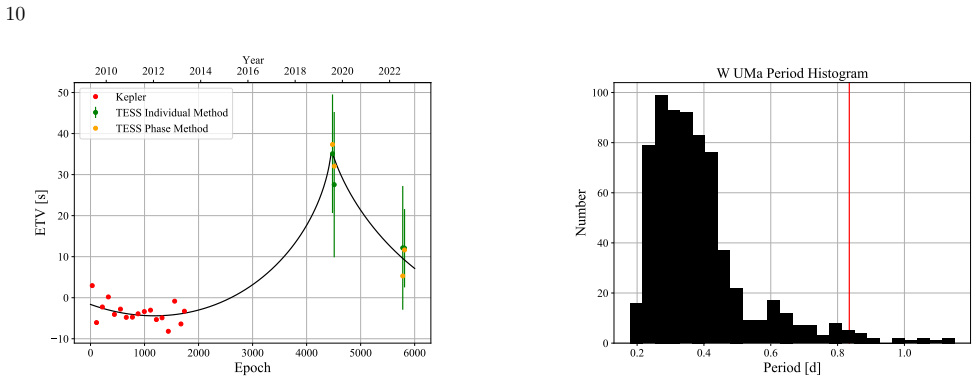
Summary. The paper presents a combined photometric and spectroscopic study of the contact binary KIC 7766185. Radial velocities from seven Mayall 4-m echelle spectra are extracted via broadening functions; Kepler, TESS, and Gaia photometry are used for light-curve modeling and temperature determination. PHOEBE MCMC runs yield a mass ratio q = 0.81 (from both the radial-velocity curve and the light curve), a fillout factor f = 0.029 ± 0.002, inclination i = 73.13 deg, effective temperatures T1 = 6095 K and T2 = 5860 K, and masses M1 = 1.97 and M2 = 1.58 solar masses. A period study of eclipse timings over the ~15 yr Kepler/TESS baseline finds evidence for a cyclic ETV variation, which the authors fit with a demonstrative third-body model but do not claim as a confirmed detection. The system is classified as an A-type, H-type (high mass ratio) W UMa binary, and comparison with the WUMaCat sample places the secondary in the 99.8th percentile of secondary radii and 98.9th of secondary masses, leading to the interpretation that the system may have only recently entered contact.
Significance. If the derived parameters hold, KIC 7766185 is a valuable outlier: a long-period, high-mass-ratio, shallow-contact A-type W UMa system with an unusually massive secondary. The paper is careful in several respects: it independently checks the photometric mass ratio against the spectroscopic value, uses Gaia multi-color photometry with updated passbands to corroborate the temperature ratio, explicitly tests and rejects significant extraneous light in the Kepler aperture, and is appropriately cautious about the third-body interpretation of the ETV variation. The central claims, however, rest on the fillout factor being small, and that smallness is enforced by the prior used in the light-curve MCMC run rather than demonstrated by the data. The evolutionary speculation of recent contact therefore requires additional support. With a reanalysis using a wider fillout prior or a model comparison against semi-detached geometry, the paper could become a solid contribution to the study of extreme W UMa systems.
major comments (2)
- [Section 5, Table 5] The light-curve MCMC run imposes a uniform prior on the fillout factor restricted to [0, 0.1] 'to keep the fillout factor from falling into the semi-detached state.' The reported f = 0.029 ± 0.002 and the associated 'shallow contact' conclusion are therefore conditional on this prior; the posterior cannot explore f > 0.1, so the data have not been shown to prefer shallow contact over deeper contact or a semi-detached configuration. This matters because the Section 7 context comparison and the Section 8 evolutionary interpretation ('recently begun interacting') both depend directly on the small fillout factor. The discrepancy with Cook & Kobulnicky (2023), who used a prior extending to 0.99 and found f = 0.08 ± 0.03, is plausibly due to the different prior, as the authors themselves note. I request a rerun with a wider prior on f (e.g., uniform over [0, 0.6]) or, at minimum, a model comparison between the contact solution and a semi-detached geometry, so that the small fillout is a measured outcome rather than an input assumption.
- [Section 5, Table 4] The paper labels qph as the 'photometric mass ratio' and states 'Both methods produce the same result of 0.81.' However, the LC run explicitly uses the posterior distributions from the RV run as priors on the sampled parameters, including the mass ratio. The light-curve mass ratio is therefore not an independent photometric determination; it is a combined RV+LC estimate. The agreement between qph and qsp is not surprising because one is informed by the other. This does not invalidate the high mass ratio, which is well supported by the RV data alone, but the wording overstates the independence of the two determinations. Please clarify in the text that the LC run incorporates the RV posterior as a prior, and avoid calling qph purely photometric.
minor comments (6)
- [Table 3] The LC run section lists 'Temperature Ratio' twice in the parameter column; this appears to be a typo and should be corrected or one entry relabeled.
- [Section 5.1] The text contains the typo 'efffective temperatures'; please change to 'effective temperatures'.
- [Section 8] The phrase 'radius radio' should be 'radius ratio'.
- [References] The reference 'Conroy et al. 2020' appears twice with slightly different page numbers; consolidate into a single entry.
- [Figure 5] The corner plot labels are small and some panels lack units; increasing the font size and adding units (e.g., degrees for inclination, solar radii for a sin i) would improve readability.
- [Section 6] The description of the 'phase method' for obtaining Kepler ETV points is brief; please specify how many quarters were used and how the phase of minimum was determined from the smoothed phased light curve.
Circularity Check
No significant circularity: independent RV, Kepler, and Gaia constraints drive the fit; the shallow-contact fillout prior is an acknowledged modeling assumption, not a derivation loop.
full rationale
This paper is an observational parameter-estimation study, not a derivation-from-first-principles chain. The reported parameters come from MCMC fits to three independent data sets: radial velocities from seven Mayall echelle spectra, phase-folded Kepler photometry, and Gaia G/BP/RP photometry. The spectroscopic mass ratio qsp=0.81±0.02, a sin i, and gamma are determined from broadening-function RVs; the light-curve run then samples f, i, T2/T1, and q using the RV posteriors as priors; Gaia colors fix T1=6095 K and T2=5860 K with a broad 4000-7000 K prior. No central quantity is defined in terms of another central quantity, and no 'prediction' is a renamed fitted input. The one true modeling assumption is the LC prior: 'a uniform distribution on the fillout factor ranging from 0 to 0.1 to keep the fillout factor from falling into the semi-detached state.' This makes the reported f=0.029±0.002 and the 'shallow contact' description conditional on that prior, and the authors themselves note that Cook & Kobulnicky's wider 0.03-0.99 prior yields f=0.08±0.03. This is a legitimate limitation on the evolutionary 'recently formed contact' speculation, but it is not circular: the data still select f within the allowed interval, and the other headline results (q≈0.81, large secondary radius and mass, A-type classification) rest on independent RV, photometric, and catalog comparisons. Self-citations to PHOEBE, the KEBC, and the TESS-EBs catalog are citations to tools and archival data, not load-bearing circular support. Score 1 reflects only the prior-conditioned shallow-contact inference.
Assumptions & free parameters
free parameters (3)
- Fillout factor prior range =
0 to 0.1 (uniform)
- Primary temperature prior =
6080 ± 125 K (Gaussian)
- Gravity darkening coefficient =
0.32 for both components
assumptions (4)
- domain assumption Circular orbit (e=0)
- domain assumption Contact geometry / Roche potential model
- domain assumption Atmosphere models (Castelli & Kurucz 2004)
- domain assumption Gaia EDR3 passband correction
Cite this review
Pith. "Pith review of Binary Analysis and Period Study of the Long-Period, High Mass Ratio Contact Binary KIC 7766185." pith.science (2026). https://pith.science/paper/CSES7A5Z
@misc{pith2026250714979,
  author       = {Pith},
  title        = {Pith review of: Binary Analysis and Period Study of the Long-Period, High Mass Ratio Contact Binary KIC 7766185},
  year         = {2026},
  howpublished = {\url{https://pith.science/paper/CSES7A5Z}},
  note         = {Machine review of arXiv:2507.14979}
}
abstract
We present an in-depth photometric and spectroscopic study of the contact binary KIC 7766185. Spectroscopic observations were conducted on the Mayall 4-m telescope at Kitt Peak National Observatory and used to extract radial velocities. Using the radial velocity measurements, Kepler photometry, and Gaia multi-color photometry, binary analysis was performed in PHOEBE to determine orbital and stellar parameters. The results classify KIC 7766185 as an A-type W UMa system and reveal one of the largest and most massive secondary stars in the sample of well studied W UMa systems. The two stars are in a shallow contact state, with a small fillout factor of $0.029\pm0.002$. Along with the binary analysis, we conduct a period study that reveals evidence for a cyclic variation in the eclipse timings.
Figures


Figures from the paper (6 more)




Reference graph
Works this paper leans on
-
[1]
, " * write output.state after.block = add.period write newline
ENTRY address archivePrefix author booktitle chapter doi edition editor eprint howpublished institution journal key month number organization pages publisher school series title misctitle type volume year version url label extra.label sort.label short.list INTEGERS output.state before.all mid.sentence after.sentence after.block FUNCTION init.state.consts ...
-
[2]
write newline
" write newline "" before.all 'output.state := FUNCTION format.url url empty "" new.block "" url * "" * if FUNCTION format.eprint eprint empty "" archivePrefix empty "" archivePrefix "arXiv" = new.block " " eprint * " " * new.block " " eprint * " " * if if if FUNCTION format.doi doi empty "" " " doi * " " * if FUNCTION format.pid doi empty eprint empty ur...
-
[3]
89ř 69C s !қ q Ngc u ӱ K CqB> L @e K>- , / aH `E H3 -6
thebibliography [1] 20pt to REFERENCES 6pt =0pt -12pt 10pt plus 3pt =0pt =0pt =1pt plus 1pt =0pt =0pt -12pt =13pt plus 1pt =20pt =13pt plus 1pt \@M =10000 =-1.0em =0pt =0pt 0pt =0pt =1.0em @enumiv\@empty 10000 10000 `\.\@m \@noitemerr \@latex@warning Empty `thebibliography' environment \@ifnextchar \@reference \@latexerr Missing key on reference command E...
arXiv 2021
-
[4]
1970, Vistas in Astronomy, 12, 217, 10.1016/0083-6656(70)90041-3
Binnendijk , L. 1970, Vistas in Astronomy, 12, 217, 10.1016/0083-6656(70)90041-3
-
[5]
Borkovits , T., Elkhateeb , M. M., Csizmadia , S., et al. 2005, , 441, 10.1051/0004-6361:20052805
-
[6]
J., Koch, D., Basri, G., & et al
Borucki, W. J., Koch, D., Basri, G., & et al. 2010, Science, 327, 977, 10.1126/science.1185402
-
[7]
Brown, A. G. A., Vallenari, A., Prusti, T., et al. 2021, , 649, 10.1051/0004-6361/202039657
-
[8]
Brown , T. M., Latham , D. W., Everett , M. E., & Esquerdo , G. A. 2011, , 142, 112, 10.1088/0004-6256/142/4/112
Show all 57 references
-
[9]
Castelli, F., & Kurucz, R. L. 2004, New Grids of ATLAS9 Model Atmospheres. astro-ph/0405087
2004 arXiv
-
[10]
E., Pr s a , A., Stassun , K
Conroy , K. E., Pr s a , A., Stassun , K. G., et al. 2014, , 147, 45, 10.1088/0004-6256/147/2/45
2014 doi
-
[12]
E., Kochoska, A., Hey, D., et al
Conroy, K. E., Kochoska, A., Hey, D., et al. 2020, , 250, 10.3847/1538-4365/abb4e2
2020 doi
-
[13]
M., & Kobulnicky , H
Cook , E. M., & Kobulnicky , H. A. 2023, , 166, 200, 10.3847/1538-3881/acfc47
2023 doi
-
[14]
2004, , 426, 1001–1005, 10.1051/0004-6361:20040430
Csizmadia, S., & Klagyivik, P. 2004, , 426, 1001–1005, 10.1051/0004-6361:20040430
2004 doi
-
[15]
P., et al
Czesla , S., Schr \"o ter , S., Schneider , C. P., et al. 2019, PyA: Python astronomy-related packages
2019
-
[16]
C., & Plez , B
de Laverny , P., Recio-Blanco , A., Worley , C. C., & Plez , B. 2012, , 544, 10.1051/0004-6361/201219330
2012 doi
-
[17]
1991, , 248, 485
Duquennoy , A., & Mayor , M. 1991, , 248, 485
1991
-
[18]
Eggleton , P. P. 2012, Journal of Astronomy and Space Sciences, 29, 10.5140/JASS.2012.29.2.145
2012 doi
-
[19]
2014, , 31, e024, 10.1017/pasa.2014.17
Eker , Z., Bilir , S., Soydugan , F., et al. 2014, , 31, e024, 10.1017/pasa.2014.17
2014 doi
-
[20]
2025, , 695, A109, 10.1051/0004-6361/202452820
Fabry , M., Marchant , P., Langer , N., & Sana , H. 2025, , 695, A109, 10.1051/0004-6361/202452820
2025 doi
-
[21]
2022, , 661, A123, 10.1051/0004-6361/202243094
Fabry , M., Marchant , P., & Sana , H. 2022, , 661, A123, 10.1051/0004-6361/202243094
2022 doi
-
[22]
Flannery , B. P. 1976, , 205, 10.1086/154266
1976 doi
-
[23]
W., Lang , D., & Goodman , J
Foreman-Mackey , D., Hogg , D. W., Lang , D., & Goodman , J. 2013, , 125, 306, 10.1086/670067
2013 doi
-
[24]
2016, , 594, A39, 10.1051/0004-6361/201628337
Frasca , A., Molenda-Zakowicz , J., De Cat , P., et al. 2016, , 594, A39, 10.1051/0004-6361/201628337
2016 doi
-
[25]
2024, Contributions of the Astronomical Observatory Skalnate Pleso, 54, 58, 10.31577/caosp.2024.54.2.58
Gazeas , K. 2024, Contributions of the Astronomical Observatory Skalnate Pleso, 54, 58, 10.31577/caosp.2024.54.2.58
2024 doi
-
[26]
Henneco , J., Schneider , F. R. N., & Laplace , E. 2024, , 682, A169, 10.1051/0004-6361/202347893
2024 doi
-
[27]
W., & Foreman-Mackey, D
Hogg, D. W., & Foreman-Mackey, D. 2018, , 236, 11, 10.3847/1538-4365/aab76e
2018 doi
-
[28]
E., Jones , D., & Pr s a , A
Horvat , M., Conroy , K. E., Jones , D., & Pr s a , A. 2019, , 240, 36, 10.3847/1538-4365/aaffd7
2019 doi
-
[29]
In \'a cio , J. R. P., Mac \^e do , I. M., Ferreira , \'E . V. X., et al. 2024, , 529, 2967, 10.1093/mnras/stae357
2024 doi
-
[30]
2021, , 254, 10.3847/1538-4365/abeb23
Latkovi\' c , O., C eki, A., & Lazarevi\' c , S. 2021, , 254, 10.3847/1538-4365/abeb23
2021 doi
-
[31]
2004, , 355, 1383, 10.1111/j.1365-2966.2004.08457.x
Li , L., Han , Z., & Zhang , F. 2004, , 355, 1383, 10.1111/j.1365-2966.2004.08457.x
2004
-
[32]
2008, , 387, 97, 10.1111/j.1365-2966.2008.12736.x
Li , L., Zhang , F., Han , Z., Jiang , D., & Jiang , T. 2008, , 387, 97, 10.1111/j.1365-2966.2008.12736.x
2008
-
[33]
Lightkurve Collaboration , Cardoso , J. V. d. M., Hedges , C., et al. 2018, Lightkurve: Kepler and TESS time series analysis in Python , Astrophysics Source Code Library
2018
-
[34]
A., Gazeas , K
Loukaidou , G. A., Gazeas , K. D., Palafouta , S., et al. 2022, , 514, 5528, 10.1093/mnras/stab3424
2022 doi
-
[35]
Lucy , L. B. 1968 a , , 151, 1123, 10.1086/149510
1968 doi
- [36]
- [37]
-
[38]
E., et al
Menon , A., Langer , N., de Mink , S. E., et al. 2021, , 507, 5013, 10.1093/mnras/stab2276
2021 doi
-
[39]
2010, , 516, 10.1051/0004-6361/200913932
Palacios , A., Gebran , M., Josselin , E., et al. 2010, , 516, 10.1051/0004-6361/200913932
2010 doi
-
[40]
2016, Astronomische Nachrichten, 337, 239, 10.1002/asna.201512254
Paunzen , E., & Vanmunster , T. 2016, Astronomische Nachrichten, 337, 239, 10.1002/asna.201512254
2016 doi
-
[41]
W., et al
Pr s a, A., Batalha, N., Slawson, R. W., et al. 2011, , 141, 83, 10.1088/0004-6256/141/3/83
2011 doi
-
[42]
Prusti, T., de Bruijne, J. H. J., Brown, A. G. A., et al. 2016, Astronomy & Astrophysics, 595, A1, 10.1051/0004-6361/201629272
2016 doi
-
[43]
F., Devinney , E
Pr s a , A., Guinan , E. F., Devinney , E. J., et al. 2008, , 687, 542, 10.1086/591783
2008 doi
-
[44]
2005, , 628, 426, 10.1086/430591
Pr s a , A., & Zwitter , T. 2005, , 628, 426, 10.1086/430591
2005 doi
-
[45]
E., Horvat , M., et al
Pr s a , A., Conroy , K. E., Horvat , M., et al. 2016, , 227, 29, 10.3847/1538-4365/227/2/29
2016 doi
-
[46]
E., et al
Pr s a , A., Kochoska , A., Conroy , K. E., et al. 2022, , 258, 16, 10.3847/1538-4365/ac324a
2022 doi
-
[47]
2020, Research in Astronomy and Astrophysics, 20, 163, 10.1088/1674-4527/20/10/163
Qian , S.-B., Zhu , L.-Y., Liu , L., et al. 2020, Research in Astronomy and Astrophysics, 20, 163, 10.1088/1674-4527/20/10/163
2020 doi
-
[48]
R., Winn , J
Ricker , G. R., Winn , J. N., Vanderspek , R., et al. 2015, Journal of Astronomical Telescopes, Instruments, and Systems, 1, 014003, 10.1117/1.JATIS.1.1.014003
2015 doi
-
[49]
W., et al
Riello , M., De Angeli , F., Evans , D. W., et al. 2021, , 649, A3, 10.1051/0004-6361/202039587
2021 doi
-
[50]
A., & Eggleton, P
Robertson, J. A., & Eggleton, P. P. 1977, Monthly Notices of the Royal Astronomical Society, 179
1977
-
[51]
1986, Symposium - International Astronomical Union, 118, 159–172, 10.1017/S0074180900151307
Ruci\' n ski, S. 1986, Symposium - International Astronomical Union, 118, 159–172, 10.1017/S0074180900151307
1986 doi
-
[52]
Rucinski , S. M. 2012, in From Interacting Binaries to Exoplanets: Essential Modeling Tools, ed. M. T. Richards & I. Hubeny , Vol. 282, 365--370, 10.1017/S1743921311027840
2012 doi
-
[53]
W., Pr s a , A., Welsh , W
Slawson , R. W., Pr s a , A., Welsh , W. F., et al. 2011, , 142, 10.1088/0004-6256/142/5/160
2011 doi
-
[54]
2012, , 143, 99, 10.1088/0004-6256/143/4/99
Terrell, D., Gross, J., & Cooney, W. 2012, , 143, 99, 10.1088/0004-6256/143/4/99
2012 doi
-
[55]
1986, in Instrumentation in Astronomy VI, ed
Tody, D. 1986, in Instrumentation in Astronomy VI, ed. D. L. Crawford, Vol. 0627, International Society for Optics and Photonics (SPIE), 733 -- 748. https://doi.org/10.1117/12.968154
1986 doi
-
[56]
Tofflemire, B. M. 2019, tofflemire/saphires: Zenodo archive, 0.1.11, Zenodo, 10.5281/zenodo.3497509
2019 doi
-
[57]
1992, in Astronomical Society of the Pacific Conference Series, Vol
Valdes , F. 1992, in Astronomical Society of the Pacific Conference Series, Vol. 25, Astronomical Data Analysis Software and Systems I, ed. D. M. Worrall , C. Biemesderfer , & J. Barnes , 417
1992
-
[58]
2013, , 430, 2029, 10.1093/mnras/stt028
Yildiz , M., & Do g an , T. 2013, , 430, 2029, 10.1093/mnras/stt028
2013 doi
Reviewed August 6, 2026 · model on record in the stance chip above.
Discussion (0). Continue with ORCID to comment.