REVIEW 4 major objections 5 minor 4 cited by
RankMixer: Scaling Up Ranking Models in Industrial Recommenders
T0 review · 4 major / 5 minor · reviewed 2026-08-06 · deepseek-v4-flash
Pith's one-line read RankMixer claims that replacing handcrafted feature-crossing modules with a hardware-aligned token-mixing architecture scales ranking models by 100x in parameters at roughly unchanged inference latency.
desk verdict Solid industrial scaling story worth refereeing, but the headline 100x number is wrong as stated (70x per own table) and the semantic tokenization needs detail. read the letter →
The pith
A machine-rendered reading of the paper's core claim, the machinery that carries it, and where it could break.
The reading
What carries the argument
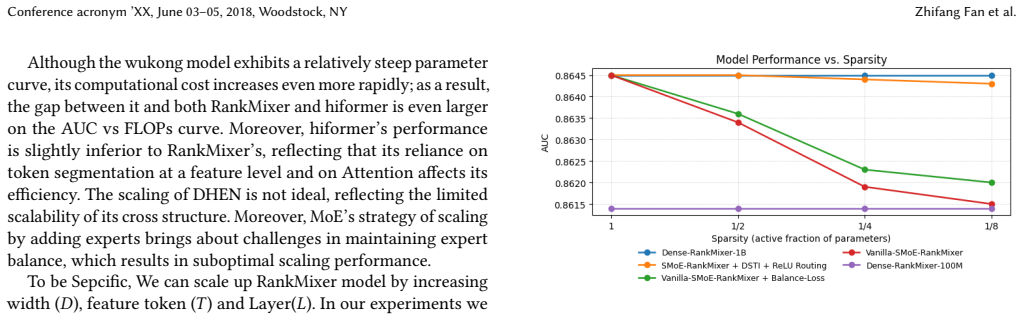
The central mechanism is the RankMixer block, which alternates a multi-head token-mixing layer with a per-token FFN. Token mixing splits each of T tokens into H heads and concatenates the h-th heads of all tokens into new tokens, s^h = Concat(x^h_1, ..., x^h_T), a parameter-free permutation that lets features from different semantic groups interact before the per-token FFNs apply dedicated transformations. The sparse-MoE variant replaces each per-token FFN with experts gated by ReLU routing plus an adaptive $\ell^1$ penalty, and uses a dense-trained router for training and a sparse router for inference, which the paper says prevents expert under-training and imbalance. This machinery decouples parameter growth from FLOPs growth.
What would settle it
Train RankMixer twice on the same public ranking dataset, once with semantic feature grouping and once with a random fixed grouping of the same feature embeddings, keeping all other settings identical; if AUC and the parameter-scaling curves are statistically indistinguishable, the semantic-token assumption is not load-bearing.
Extended reading notes
Core claim
The paper claims that quadratic self-attention is unnecessary for feature interaction in ranking: a parameter-free multi-head token mixing that reshuffles head slices across tokens, followed by per-token feed-forward networks with isolated parameters, captures heterogeneous feature interactions better than attention while keeping compute and memory low. It further claims that replacing shared FFNs with per-token FFNs and extending them to Sparse-MoE with ReLU-based dynamic routing and dense-training/sparse-inference allows parameter count to grow by roughly 70-100x with only about 20x FLOP growth and no latency increase in deployment. The reported online result is that a 1B dense-parameter RankMixer serving full traffic improves active days by 0.3% and app duration by 1.08%.
Load-bearing premise
The whole modeling gain rests on the assumption that the hundreds of input features can be grouped into semantically meaningful tokens by domain knowledge, and the paper gives no procedure for forming those groups.
Editorial extensions
If this is right
- A ranking model can grow from about 16M to about 1B dense parameters with roughly flat serving latency, so model capacity no longer has to be rationed by the serving budget.
- MFU rising from 4.5% to about 45% means the same GPU fleet can carry far more compute, shifting the model from a memory-bound to a compute-bound regime.
- The same RankMixer backbone transfers to feed recommendation and advertising with statistically significant gains, supporting a unified scaling backbone across ranking scenarios.
- The Sparse-MoE variant with ReLU routing retains nearly all dense accuracy down to 1/8 expert activation, opening a path toward 10B-scale ranking without breaching cost limits.
- Model quality scales mainly with total parameters across width, depth, and token-number directions, echoing LLM scaling laws in a multi-field ranking setting.
Reading between the lines
- If semantic-based tokenization really matters, an obvious extension is to learn the feature grouping end-to-end instead of fixing it by domain knowledge, which would make the method portable to new datasets.
- Because token mixing is a parameter-free fixed permutation, it behaves like a linear mixer; testing whether the permutation can be replaced by a learned but cheap mixing matrix would isolate where the gain comes from.
- The same 'decouple parameters from FLOPs, then raise MFU' recipe could transfer to other high-QPS multi-field models, such as search ranking or real-time bidding, where latency is the binding constraint.
- The reported low-active-user gains (1.74% active days) suggest capacity helps most on sparse or long-tail interaction patterns; a targeted study on data frequency strata could confirm this interpretation.
Editorial analysis
A structured set of objections, weighed in public.
Referee Report
Summary. The paper proposes RankMixer, a hardware-aware ranking architecture that replaces heterogeneous handcrafted feature-crossing modules with a unified block combining multi-head token mixing and per-token FFNs, with an optional Sparse-MoE extension. The authors report offline comparisons against several DLRM baselines on a trillion-scale production dataset, scaling-law analyses, ablations, and online A/B tests in Douyin feed recommendation and advertising. The headline claims are that RankMixer raises MFU from 4.5% to 45%, scales parameters by roughly two orders of magnitude at constant inference latency, and improves active days by 0.3% and user duration by 1.08% when deployed as a 1B-parameter model.
Significance. If the reported results are accurate, RankMixer constitutes a significant industrial contribution: it demonstrates that a unified, GPU-aligned architecture can replace heterogeneous CPU-era feature-crossing modules, achieving a tenfold MFU improvement and supporting a large parameter increase at roughly constant serving latency, with positive online metrics across two application scenarios. The paper includes extensive in-house experiments, a deployed 1B-parameter model, and long-running online A/B tests, which are notable strengths. However, all data are proprietary, no error bars or significance details are given for offline results, and the central 100x parameter-scaling claim is internally inconsistent with the paper's own Table 6 and Section 4.6. The semantic tokenization procedure is described only at a high level, which limits reproducibility and transferability of the modeling gains. These issues prevent full acceptance in the current form.
major comments (4)
- [Abstract, §1, §4.6, Table 6] The abstract and introduction claim that RankMixer scales model parameters by '100x' and 'two orders of magnitude' (Abstract; §1: 'over 100×'), but Table 6 reports #Param increasing from 15.8M to 1.1B, which is a factor of 69.6x, and §4.6 explicitly states 'scaled parameters by approximately 70× to 1B' and the contributions say '70×'. This is a load-bearing numerical inconsistency on the central claim; the authors must reconcile the headline figure with the data, either by correcting the abstract/introduction or by providing a different baseline parameter count that justifies 100x.
- [§3.2, Eq. (2)] The semantic-based tokenization is described only as grouping features 'into several semantically coherent clusters' 'with domain knowledge', with no procedure, criterion, or example for forming these groups. Since per-token FFNs and token mixing operate on these tokens, the modeling gains and scaling conclusions depend entirely on this grouping; if the grouping is arbitrary or dataset-specific, the architecture's performance claims may not transfer to other systems. Please specify the grouping mechanism, its reproducibility, and its sensitivity, or at least provide the actual feature-group definitions used in the experiments.
- [§4.2, Tables 1–2, §4.5] All offline AUC/UAUC comparisons are reported as point estimates without error bars, multiple seeds, or significance tests, despite the paper stating that 'an AUC increase of 0.0001 can be regarded as a confidently significant improvement' (§4.1.2). In Table 1, the differences between RankMixer and several baselines (e.g., +0.64% vs +0.48% for HiFormer) are around 0.0016, and in Table 3 the Self-Attention variant is only -0.03% below Multi-Head Token Mixing; without variance information these results cannot be assessed. Please provide confidence intervals or standard deviations over repeated runs.
- [§4.3, Figure 2, §4.4] The scaling-law claim that 'model quality correlates primarily with the total number of parameters' is supported only by two final configurations (100M and 1B) and by Figure 2, whose data points and model sizes are not fully specified. The comparison in Figure 2 mixes architecture, parameter count, and FLOPs without showing the number of points per curve or confidence bands. Please provide the full grid of configurations and per-configuration metrics so the scaling conclusion is verifiable; otherwise, the statement overreaches the presented evidence.
minor comments (5)
- [§4.1.3] The baseline descriptions contain minor inaccuracies: 'RDCN' is listed as 'the Sota of feature cross model' without a proper citation, and 'Hiformer' is referred to inconsistently ('Hiformer' in Table 1 and 'HiFormer' in the text).
- [§4.4, Table 3] Table 3 reports 'Self-Attention' with ΔAUC −0.03% against Multi-Head Token Mixing; this difference is not convincingly below the apparent noise level and the increased FLOPs (+71.8%) is the stronger argument. The text should state this explicitly.
- [§4.6, Eq. (latency)] The latency formula treats latency as proportional to #Param × (FLOPs/Param) / (MFU × Hardware FLOPs), but actual serving latency also depends on memory bandwidth, kernel launch overhead, and batch size; the authors should clarify that this is a simplified first-order decomposition, not an exact latency model.
- [Throughout] There are several typos and formatting issues, e.g., 'To be Sepcific' (§4.3), 'performane' (§4.4), 'siginifantly' (§4.4), 'Quatization' (§4.6), 'duartion' (§5), 'memory bandwith' (§4.6), and 'the three row' (§4.6). The paper also uses '[n. d.]' for two ICML papers (references [36] and [38]) and should supply complete bibliographic details.
- [§4.7, Table 4] Table 4 has a footnote that the results 'were updated on July 24, 2025' and that gains have not converged; please state the exact observation window and whether the reported numbers are cumulative or per-period.
Circularity Check
No significant circularity: RankMixer's headline results are measured benchmarks; sole overlapping-author citation (LONGER, [4]) is non-load-bearing; abstract's '100x/two orders of magnitude' vs body's 70x is an internal factual inconsistency, not a circular reduction.
full rationale
RankMixer's central claims are measured, externally falsifiable outcomes rather than derivations: MFU (4.47% to 44.57%), latency (14.5 to 14.3 ms), FLOPs/Param (6.8 to 1.9 G/M), offline AUC/UAUC (Tables 1-3) and online A/B lifts (Tables 4-5) are reported from deployed experiments, and the scaling curves (Fig. 2) are empirical comparisons at stated parameter and FLOP budgets. Eq. 12 (#Param = 2kLTD^2, FLOPs = 4kLTD^2) is the standard MLP count, and the Section 4.6 latency formula is the definition of MFU rearranged; an accounting identity that decomposes the measured latency into #Param, FLOPs/Param, MFU and hardware factors, not a fitted 'prediction' (70/(3.6*10*2) ≈ 0.97 reproduces the measured flat latency, and the body's 70x is consistent with it). No fitted constant is renamed as a prediction. The only overlapping-author citation, LONGER (ref. [4]), appears in Sec. 3.2 as the source of the sequence-module input e_s and carries none of the load-bearing claims; refs. [15] and [31] are related-work-only self-citations. Sec. 4.3 does set the final shapes (D=768,T=16,L=2; D=1536,T=32,L=2) using the authors' own scaling observations, but this is configuration selection over measured points, and the reported gains are measurements of the selected model, so it is not circular. Flagged for the record as non-circularity concerns: (1) the abstract and introduction claim 'two orders of magnitude'/'over 100x' parameter scaling, contradicted by the contributions ('scale the model parameters by 70x'), Sec. 4.6 ('scaled parameters by approximately 70x to 1B') and Table 6 (15.8M to 1.1B = 69.6x); an internal factual inconsistency and correctness risk; (2) Sec. 3.2 groups features into 'semantically coherent clusters' only 'with domain knowledge', giving no reproducible procedure; an assumption gap for transferability; (3) the Table 4 footnote states gains 'have not yet converged' and 'results presented here are still improving', a transparent non-stationarity caveat. None of these reduce a claimed result to its inputs, so the circularity burden is low; score 2 reflects only the minor, non-load-bearing LONGER self-citation.
Assumptions & free parameters
free parameters (5)
- lambda (MoE sparsity regularization weight) =
not reported
- k (per-token FFN hidden dimension ratio) =
not reported
- Token count T and head count H=T =
16 for 100M, 32 for 1B
- Number of experts per token N_e and sparsity ratio =
not reported
- Model width D and depth L =
D=768, L=2 for 100M; D=1536, L=2 for 1B
assumptions (6)
- domain assumption Semantic-based tokenization groups features into semantically coherent clusters.
- domain assumption Parameter-free multi-head token mixing captures global feature interactions as well as or better than self-attention.
- domain assumption Heterogeneous feature spaces make inner-product attention similarity suboptimal.
- domain assumption Model quality correlates primarily with total parameter count; D, L, and T scaling directions yield near-identical results.
- domain assumption Dense-training, sparse-inference with ReLU routing prevents expert under-training.
- domain assumption GEMM-bound execution and fp16 quantization do not degrade quality in deployment.
Cite this review
Pith. "Pith review of RankMixer: Scaling Up Ranking Models in Industrial Recommenders." pith.science (2026). https://pith.science/paper/ZDSE6WYL
@misc{pith2026250715551,
  author       = {Pith},
  title        = {Pith review of: RankMixer: Scaling Up Ranking Models in Industrial Recommenders},
  year         = {2026},
  howpublished = {\url{https://pith.science/paper/ZDSE6WYL}},
  note         = {Machine review of arXiv:2507.15551}
}
read the original abstract
Recent progress on large language models (LLMs) has spurred interest in scaling up recommendation systems, yet two practical obstacles remain. First, training and serving cost on industrial Recommenders must respect strict latency bounds and high QPS demands. Second, most human-designed feature-crossing modules in ranking models were inherited from the CPU era and fail to exploit modern GPUs, resulting in low Model Flops Utilization (MFU) and poor scalability. We introduce RankMixer, a hardware-aware model design tailored towards a unified and scalable feature-interaction architecture. RankMixer retains the transformer's high parallelism while replacing quadratic self-attention with multi-head token mixing module for higher efficiency. Besides, RankMixer maintains both the modeling for distinct feature subspaces and cross-feature-space interactions with Per-token FFNs. We further extend it to one billion parameters with a Sparse-MoE variant for higher ROI. A dynamic routing strategy is adapted to address the inadequacy and imbalance of experts training. Experiments show RankMixer's superior scaling abilities on a trillion-scale production dataset. By replacing previously diverse handcrafted low-MFU modules with RankMixer, we boost the model MFU from 4.5\% to 45\%, and scale our ranking model parameters by 100x while maintaining roughly the same inference latency. We verify RankMixer's universality with online A/B tests across two core application scenarios (Recommendation and Advertisement). Finally, we launch 1B Dense-Parameters RankMixer for full traffic serving without increasing the serving cost, which improves user active days by 0.3\% and total in-app usage duration by 1.08\%.
Figures


Figures from the paper (1 more)

Forward citations
Cited by 4 Pith papers
-
From Scaling to Structured Expressivity: Rethinking Transformers for CTR Prediction
FAT specializes attention by semantic field and reports +0.51% AUC over baselines on Taobao data, but its power-law scaling law is an empirical fit, not a derived prediction.
-
WHALE: A Scalable Unified Model for Recommendation with Wukong-HSTU Architecture
Layer-wise attention fusion between Wukong-style feature crosses and HSTU-style behavior history improves recommendation quality over each backbone alone at matched FLOPs.
-
MATT-CTR: Unleashing a Model-Agnostic Test-Time Paradigm for CTR Prediction with Confidence-Guided Inference Paths
MATT is a model-agnostic test-time method that estimates feature-combination frequency from training data and uses it to sample and average multiple masked-input CTR predictions.
-
Large Foundation Model for Ads Recommendation
Tencent's LFM4Ads transfers user, item, and user-item cross representations from a pre-trained foundation model into downstream ad models via feature, module, and model-level mechanisms, reporting a 2.45% platform-wid...
Reference graph
Works this paper leans on
-
[1]
Josh Achiam, Steven Adler, Sandhini Agarwal, Lama Ahmad, Ilge Akkaya, Floren- cia Leoni Aleman, Diogo Almeida, Janko Altenschmidt, Sam Altman, Shyamal Anadkat, et al. 2023. Gpt-4 technical report. arXiv preprint arXiv:2303.08774 (2023)
arXiv 2023
-
[2]
Newsha Ardalani, Carole-Jean Wu, Zeliang Chen, Bhargav Bhushanam, and Adnan Aziz. 2022. Understanding scaling laws for recommendation models. arXiv preprint arXiv:2208.08489 (2022)
arXiv 2022
-
[3]
Fedor Borisyuk, Mingzhou Zhou, Qingquan Song, Siyu Zhu, Birjodh Tiwana, Ganesh Parameswaran, Siddharth Dangi, Lars Hertel, Qiang Charles Xiao, Xi- aochen Hou, Yunbo Ouyang, Aman Gupta, Sheallika Singh, Dan Liu, Hailing Cheng, Lei Le, Jonathan Hung, S. Sathiya Keerthi, Ruoyan Wang, Fengyu Zhang, Mohit Kothari, Chen Zhu, Daqi Sun, Yun Dai, Xun Luan, Sirou Z...
work page 2024
-
[4]
Zheng Chai, Qin Ren, Xijun Xiao, Huizhi Yang, Bo Han, Sijun Zhang, Di Chen, Hui Lu, Wenlin Zhao, Lele Yu, Xionghang Xie, Shiru Ren, Xiang Sun, Yaocheng Tan, Peng Xu, Yuchao Zheng, and Di Wu. 2025. LONGER: Scaling Up Long Sequence Modeling in Industrial Recommenders. arXiv:2505.04421 [cs.IR] https: //arxiv.org/abs/2505.04421
arXiv 2025
-
[5]
Heng-Tze Cheng, Levent Koc, Jeremiah Harmsen, Tal Shaked, Tushar Chandra, Hrishi Aradhye, Glen Anderson, Greg Corrado, Wei Chai, Mustafa Ispir, et al
-
[6]
Sharad Chitlangia, Krishna Reddy Kesari, and Rajat Agarwal. 2023. Scaling generative pre-training for user ad activity sequences. (2023)
work page 2023
-
[7]
Paul Covington, Jay Adams, and Emre Sargin. 2016. Deep neural networks for youtube recommendations. In Proceedings of the 10th ACM conference on recommender systems. 191–198
2016
-
[8]
Alexey Dosovitskiy. 2020. An image is worth 16x16 words: Transformers for image recognition at scale. arXiv preprint arXiv:2010.11929 (2020)
arXiv 2020
Show all 44 references
-
[9]
Yan Fang, Jingtao Zhan, Qingyao Ai, Jiaxin Mao, Weihang Su, Jia Chen, and Yiqun Liu. 2024. Scaling laws for dense retrieval. In Proceedings of the 47th International ACM SIGIR Conference on Research and Development in Information Retrieval . 1339–1349
2024
-
[10]
Huan Gui, Ruoxi Wang, Ke Yin, Long Jin, Maciej Kula, Taibai Xu, Lichan Hong, and Ed H Chi. 2023. Hiformer: Heterogeneous Feature Interactions Learning with Transformers for Recommender Systems. arXiv preprint arXiv:2311.05884 (2023). 1This result was updated on July 24, 2025, ...
2023 arXiv
-
[11]
Huifeng Guo, Ruiming Tang, Yunming Ye, Zhenguo Li, and Xiuqiang He. 2017. DeepFM: a factorization-machine based neural network for CTR prediction.arXiv preprint arXiv:1703.04247 (2017)
2017 arXiv
-
[12]
Wei Guo, Hao Wang, Luankang Zhang, Jin Yao Chin, Zhongzhou Liu, Kai Cheng, Qiushi Pan, Yi Quan Lee, Wanqi Xue, Tingjia Shen, et al . 2024. Scal- ing New Frontiers: Insights into Large Recommendation Models. arXiv preprint arXiv:2412.00714 (2024)
2024 arXiv
-
[13]
Kaiming He, Xiangyu Zhang, Shaoqing Ren, and Jian Sun. 2016. Deep residual learning for image recognition. In Proceedings of the IEEE conference on computer vision and pattern recognition . 770–778
2016
-
[14]
Jordan Hoffmann, Sebastian Borgeaud, Arthur Mensch, Elena Buchatskaya, Trevor Cai, Eliza Rutherford, Diego de Las Casas, Lisa Anne Hendricks, Johannes Welbl, Aidan Clark, et al. 2022. Training compute-optimal large language models. arXiv preprint arXiv:2203.15556 (2022)
2022 arXiv
-
[15]
Yanhua Huang, Hangyu Wang, Yiyun Miao, Ruiwen Xu, Lei Zhang, and Weinan Zhang. 2022. Neural statistics for click-through rate prediction. In Proceedings of the 45th International ACM SIGIR Conference on Research and Development in Information Retrieval. 1849–1853
2022
-
[16]
Jared Kaplan, Sam McCandlish, Tom Henighan, Tom B Brown, Benjamin Chess, Rewon Child, Scott Gray, Alec Radford, Jeffrey Wu, and Dario Amodei. 2020. Scaling laws for neural language models. arXiv preprint arXiv:2001.08361 (2020)
2020 arXiv
-
[17]
Zekun Li, Zeyu Cui, Shu Wu, Xiaoyu Zhang, and Liang Wang. 2019. Fi-gnn: Modeling feature interactions via graph neural networks for ctr prediction. In Proceedings of the 28th ACM international conference on information and knowledge management. 539–548
2019
-
[18]
Jianxun Lian, Xiaohuan Zhou, Fuzheng Zhang, Zhongxia Chen, Xing Xie, and Guangzhong Sun. 2018. xdeepfm: Combining explicit and implicit feature in- teractions for recommender systems. In Proceedings of the 24th ACM SIGKDD international conference on knowledge discovery & data ...
2018
-
[19]
Jianghao Lin, Xinyi Dai, Yunjia Xi, Weiwen Liu, Bo Chen, Hao Zhang, Yong Liu, Chuhan Wu, Xiangyang Li, Chenxu Zhu, et al . 2023. How can recommender systems benefit from large language models: A survey. ACM Transactions on Information Systems (2023)
2023
-
[20]
Bin Liu, Ruiming Tang, Yingzhi Chen, Jinkai Yu, Huifeng Guo, and Yuzhou Zhang
-
[21]
Junwei Pan, Wei Xue, Ximei Wang, Haibin Yu, Xun Liu, Shijie Quan, Xueming Qiu, Dapeng Liu, Lei Xiao, and Jie Jiang. 2024. Ads recommendation in a collapsed and entangled world. In Proceedings of the 30th ACM SIGKDD Conference on Knowledge Discovery and Data Mining . 5566–5577
2024
-
[22]
Yanru Qu, Bohui Fang, Weinan Zhang, Ruiming Tang, Minzhe Niu, Huifeng Guo, Yong Yu, and Xiuqiang He. 2018. Product-based neural networks for user response prediction over multi-field categorical data. ACM Transactions on Information Systems (TOIS) 37, 1 (2018), 1–35
2018
-
[23]
Alec Radford, Jong Wook Kim, Chris Hallacy, Aditya Ramesh, Gabriel Goh, Sandhini Agarwal, Girish Sastry, Amanda Askell, Pamela Mishkin, Jack Clark, et al. 2021. Learning transferable visual models from natural language supervision. In International conference on machine learni...
2021
-
[24]
Aditya Ramesh, Mikhail Pavlov, Gabriel Goh, Scott Gray, Chelsea Voss, Alec Radford, Mark Chen, and Ilya Sutskever. 2021. Zero-shot text-to-image generation. In International conference on machine learning . Pmlr, 8821–8831
2021
-
[25]
Steffen Rendle, Walid Krichene, Li Zhang, and John Anderson. 2020. Neural collaborative filtering vs. matrix factorization revisited. In Proceedings of the 14th ACM Conference on Recommender Systems . 240–248
2020
-
[26]
Ying Shan, T Ryan Hoens, Jian Jiao, Haijing Wang, Dong Yu, and JC Mao. 2016. Deep crossing: Web-scale modeling without manually crafted combinatorial features. In Proceedings of the 22nd ACM SIGKDD international conference on knowledge discovery and data mining . 255–262
2016
-
[27]
Kyuyong Shin, Hanock Kwak, Su Young Kim, Max Nihlén Ramström, Jisu Jeong, Jung-Woo Ha, and Kyung-Min Kim. 2023. Scaling law for recommendation models: Towards general-purpose user representations. In Proceedings of the AAAI Conference on Artificial Intelligence , Vol. 37. 4596–4604
2023
-
[28]
Weiping Song, Chence Shi, Zhiping Xiao, Zhijian Duan, Yewen Xu, Ming Zhang, and Jian Tang. 2019. Autoint: Automatic feature interaction learning via self- attentive neural networks. InProceedings of the 28th ACM international conference on information and knowledge management ...
2019
-
[29]
Gemma Team, Thomas Mesnard, Cassidy Hardin, Robert Dadashi, Surya Bhupati- raju, Shreya Pathak, Laurent Sifre, Morgane Rivière, Mihir Sanjay Kale, Juliette Love, et al. 2024. Gemma: Open models based on gemini research and technology. arXiv preprint arXiv:2403.08295 (2024)
2024 arXiv
-
[30]
Hugo Touvron, Louis Martin, Kevin Stone, Peter Albert, Amjad Almahairi, Yas- mine Babaei, Nikolay Bashlykov, Soumya Batra, Prajjwal Bhargava, Shruti Bhos- ale, et al. 2023. Llama 2: Open foundation and fine-tuned chat models. arXiv preprint arXiv:2307.09288 (2023)
2023 arXiv
-
[31]
Hangyu Wang, Jianghao Lin, Xiangyang Li, Bo Chen, Chenxu Zhu, Ruiming Tang, Weinan Zhang, and Yong Yu. 2024. FLIP: Fine-grained Alignment between ID- based Models and Pretrained Language Models for CTR Prediction. InProceedings of the 18th ACM Conference on Recommender Systems...
2024
-
[32]
Ruoxi Wang, Bin Fu, Gang Fu, and Mingliang Wang. 2017. Deep & cross network for ad click predictions. In Proceedings of the ADKDD’17 . 1–7
2017
-
[33]
Ruoxi Wang, Rakesh Shivanna, Derek Cheng, Sagar Jain, Dong Lin, Lichan Hong, and Ed Chi. 2021. Dcn v2: Improved deep & cross network and practical lessons for web-scale learning to rank systems. In Proceedings of the web conference 2021 . 1785–1797
2021
-
[34]
Yunli Wang, Zixuan Yang, Zhen Zhang, Zhiqiang Wang, Jian Yang, Shiyang Wen, Peng Jiang, and Kun Gai. 2024. Scaling Laws for Online Advertisement Retrieval. arXiv preprint arXiv:2411.13322 (2024)
2024
- [35]
-
[36]
Jiaqi Zhai, Lucy Liao, Xing Liu, Yueming Wang, Rui Li, Xuan Cao, Leon Gao, Zhao- jie Gong, Fangda Gu, Jiayuan He, et al. [n. d.]. Actions Speak Louder than Words: Trillion-Parameter Sequential Transducers for Generative Recommendations. In Forty-first International Conference ...
-
[37]
Xiaohua Zhai, Alexander Kolesnikov, Neil Houlsby, and Lucas Beyer. 2022. Scaling vision transformers. In Proceedings of the IEEE/CVF conference on computer vision and pattern recognition. 12104–12113
2022
-
[38]
Buyun Zhang, Liang Luo, Yuxin Chen, Jade Nie, Xi Liu, Shen Li, Yanli Zhao, Yuchen Hao, Yantao Yao, Ellie Dingqiao Wen, et al. [n. d.]. Wukong: Towards a Scaling Law for Large-Scale Recommendation. In Forty-first International Confer- ence on Machine Learning
-
[39]
Buyun Zhang, Liang Luo, Xi Liu, Jay Li, Zeliang Chen, Weilin Zhang, Xiaohan Wei, Yuchen Hao, Michael Tsang, Wenjun Wang, et al. 2022. DHEN: A deep and hierarchical ensemble network for large-scale click-through rate prediction. arXiv preprint arXiv:2203.11014 (2022)
2022 arXiv
-
[40]
Gaowei Zhang, Yupeng Hou, Hongyu Lu, Yu Chen, Wayne Xin Zhao, and Ji- Rong Wen. 2024. Scaling law of large sequential recommendation models. In Proceedings of the 18th ACM Conference on Recommender Systems . 444–453
2024
-
[41]
Weinan Zhang, Jiarui Qin, Wei Guo, Ruiming Tang, and Xiuqiang He. 2021. Deep learning for click-through rate estimation.arXiv preprint arXiv:2104.10584 (2021)
2021 arXiv
-
[42]
Guorui Zhou, Xiaoqiang Zhu, Chenru Song, Ying Fan, Han Zhu, Xiao Ma, Yanghui Yan, Junqi Jin, Han Li, and Kun Gai. 2018. Deep Interest Network for Click- Through Rate Prediction. In Proceedings of the 24th ACM SIGKDD International Conference on Knowledge Discovery & Data Mining...
2018
-
[2016]
In Proceedings of the 1st workshop on deep learning for recommender systems
Wide & deep learning for recommender systems. In Proceedings of the 1st workshop on deep learning for recommender systems . 7–10
-
[2019]
In The World Wide Web Conference
Feature generation by convolutional neural network for click-through rate prediction. In The World Wide Web Conference. 1119–1129
Reviewed August 6, 2026 · model on record in the stance chip above.
Discussion (0). Continue with ORCID to comment.