REVIEW 3 major objections 5 minor 1 cited by
Zak-OTFS based Multiuser Uplink in Doubly-Spread Channels
T0 review · 3 major / 5 minor · reviewed 2026-08-06 · deepseek-v4-flash
Pith's one-line read A phase-twisted delay-Doppler pulse gives each Zak-OTFS user its own time-frequency tile, so a four-user uplink can match single-user bit error rates without any guard bands.
desk verdict The TF-shifting DD pulse in Theorem 1 is a genuinely new and useful tool, but the multiuser superposition analysis assumes a common Zak period that the paper itself lets each user choose differently—this gap needs to be fixed before the MUI claims can be trusted. read the letter →
The pith
A machine-rendered reading of the paper's core claim, the machinery that carries it, and where it could break.
The reading
What carries the argument
The central object is the DD-domain transmit pulse-shaping filter carrying the phase factor $e^{j2\pi(\nu_s\tau - \nu\tau_s)}$, applied through twisted convolution to quasi-periodic Dirac-delta DD pulses that carry information symbols. Twisted convolution is the DD-domain operation that combines a filter with a quasi-periodic DD function while preserving quasi-periodicity, and it is what makes the Zak-transform input-output relation associative and tractable. The receiver uses the matched filter in (37), the conjugate time- and frequency-reversed version of the shifted pulse, and Theorem 2 expresses the effective channel as a sum over paths of two separated integrals, one governing frequency-domain overlap and one governing time-domain overlap. That separation is what turns the no-guard-band claim into a calculable interference ratio.
What would settle it
Simulate two users with identical TF allocations but different delay and Doppler periods, then compare the measured leakage ratio $I_{q,s}/S_{s,s}$ against the paper's formula; if the measured leakage departs from the predicted value once the periods differ, the shared-superposition equation (20) needs a per-user Zak basis. A simpler check is to numerically compute the Zak transform of a sum of two signals with different periods and verify the energy relations used in (42)-(45).
Extended reading notes
Core claim
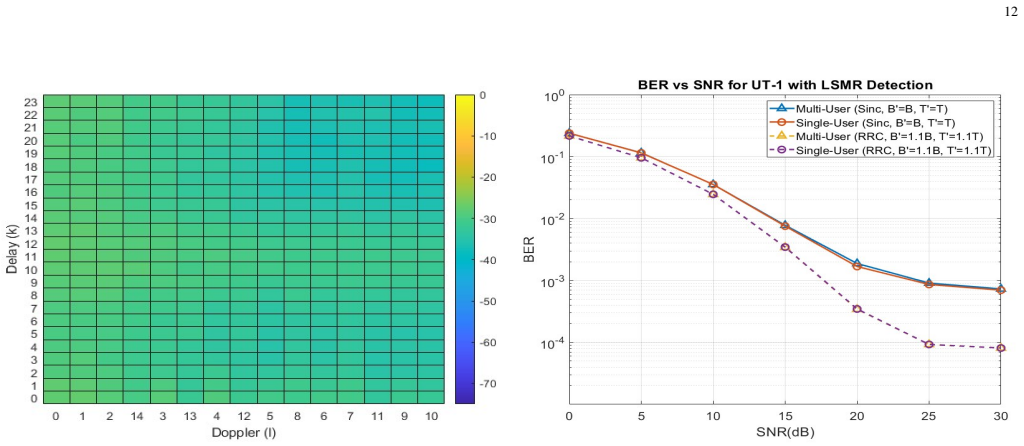
The paper's central claim is that a transmit delay-Doppler filter of the form $\tilde{w}_{tx,s}(\tau,\nu) = w_{tx,s}(\tau,\nu)e^{j2\pi(\nu_s\tau - \nu\tau_s)}$ shifts the TF occupancy of a Zak-OTFS signal to approximately $[\tau_s - T_s/2, \tau_s + T_s/2] \times [\nu_s - B_s/2, \nu_s + B_s/2]$, while leaving each user free to choose its own delay and Doppler periods. At the base station, the received superposition is match-filtered separately for each user, and the paper derives the effective continuous DD-domain channel between every transmit-receive pair as a sum over propagation paths of two overlap integrals. For an ideal channel the leakage from user $s$ into user $q$'s matched-filter output is bounded by $O(1/K^3)$ with $K = \min(M_s N_s, M_q N_q)$. In simulations on a vehicular-A doubly-spread channel the leakage ratio stays below about $-30$ dB at 6 kHz Doppler spread, and the bit error rate and channel-estimation NMSE for UT-1 in a four-user uplink coincide with the single-user curves, even without guard resources.
Load-bearing premise
The receiver-side derivation assumes that one Zak transform of the received signal is enough to produce a single DD-domain superposition on which every user's matched filter can act, even though each user is allowed a different delay and Doppler period; the paper never specifies a common period for that single transform.
Editorial extensions
If this is right
- Users with very different Doppler spreads can be assigned different delay and Doppler periods, so the numerology of one fast-moving user no longer dictates the subcarrier spacing of all users.
- Because the interference-to-useful-signal ratio is below about -30 dB at 6 kHz Doppler spread, at typical SNRs below 30 dB the BER and channel-estimation NMSE are limited by noise rather than by multiuser interference.
- Adjacent time-frequency allocations need no guard bands: interference that is localized at TF boundaries spreads almost uniformly across DD carriers, so no single carrier is hit disproportionately hard.
- The rectangular per-user TF allocations line up with 3GPP-style resource blocks, allowing mixed terrestrial and non-terrestrial users to share one uplink frame.
- Each user's crystallization condition can be satisfied independently, preserving predictable single-pilot channel acquisition for every user.
Reading between the lines
- A testable extension is to push the frame size down: the paper's $O(1/K^3)$ bound implies that for frames with $M_s N_s$ below about a hundred, leakage rises above the -60 dB ideal-channel level, so the no-guard claim should be rechecked in the short-frame regime.
- The same phase-twist shaping could be reused in a downlink broadcast or relay setting, where the base station transmits a superposition and each user's own matched filter extracts its stream without joint decoding.
- Because the residual interference is nearly uniform in the DD domain, per-carrier power allocation or simple interference cancellation at the BS could push the operating point even further below noise-limited performance.
Editorial analysis
A structured set of objections, weighed in public.
Referee Report
Summary. The paper proposes a multiuser uplink scheme based on Zak-OTFS, where each user's transmit pulse is shaped in the delay-Doppler (DD) domain by a phase factor exp(j2π(ν_s τ − ν τ_s)) so that its time-frequency (TF) occupancy is shifted to an allocated, non-overlapping TF region. Users are allowed to choose independent DD periods (τ_p,s, ν_p,s) to satisfy the crystallization condition for their own channels. The base station applies a DD-domain matched filter per user, and the paper derives expressions for the effective channel and for interference-to-useful-signal ratios, claims an O(1/K^3) leakage bound, and presents simulations for a four-user vehicular-A uplink showing that the multiuser BER of UT-1 coincides with the single-user BER without guard TF resources. The central claim is thus that single-user performance can be achieved in a multiuser Zak-OTFS uplink with independently chosen numerologies and no TF guards.
Significance. If the claimed result holds, it is a substantial contribution: it would give Zak-OTFS the TF-resource allocation flexibility of OFDMA while preserving the predictable DD I/O relation, and would allow users with different delay/Doppler spreads to choose independent numerologies. The TF-shifting mechanism of Theorem 1 is elegant and the single-user derivation in Appendices D and E is a strength, as are the self-contained proofs of supporting lemmas. The paper also ships a detailed simulation setup (Table I, Table II, pilot/data frame structure) that would allow reproduction. However, the analytical multiuser model in Section II is not valid for the multi-period setting, because a single Zak transform of the received superposition cannot represent users with different periods simultaneously; this undermines the derived MUI measures. The O(1/K^3) leakage bound is heuristic. The numerical results may well be correct, but the theoretical framework as written does not yet support them, so the central claim is not established in the present form.
major comments (3)
- [Section II, Eqs. (20)-(24)] The derivation of the DD-domain received signal assumes that a single Zak transform of y(t) yields y_dd(τ,ν) equal to the sum of per-user twisted convolutions, but users are explicitly allowed different periods (Eq. (28), Table I: UT-1/2 have ν_p=15 kHz, UT-3/4 have ν_p=30 kHz). The Zak transform in Eq. (7) is defined for a fixed delay period τ_p, and each x_wtx_dd,s is quasi-periodic with period (τ_p,s, ν_p,s). A sum of functions with different quasi-periodicities is not quasi-periodic with any single period, so Eq. (20) cannot hold as an identity in the multi-period setting. Consequently the matched-filter step (21), the effective channel decomposition (22), and the sampling on the lattice Λ_q in (24) are not well-defined for the actual receiver. The paper must either impose a common commensurate period for all users (which would restrict the independent-choice claim made in Section III) or define per-user Zak transforms y_dd,q = Z_{τ_p,q}(y) and re-derive the effective channel and interference expressions accordingly.
- [Section III-C, after Eq. (46)] The O(1/K^3) leakage bound is heuristic. The passage from the support and energy properties of h_eff,q,s to the statement that the DD-domain energy of h~_{q,s}^{k,l} is O(1/K^2) over an area O(1/K) neglects the aliasing arising from the infinite Dirac comb in Eq. (4) and gives no rigorous treatment of overlapping shifted supports; no constants or error terms are provided. This bound is used in the text to assert that the interference-to-useful-signal ratio is at most about 10^-6 for moderate/large frames, so it should either be proved or explicitly identified as an approximation. The numerical claims in Section IV do not rest on this bound, but the presentation should not present a heuristic estimate as a theorem.
- [Section IV, Figs. 5-7] The paper does not state whether the leakage ratios plotted in Figs. 5-7 are computed from the analytical expression (46) together with (41), or by direct time-domain projection of the received signal onto each user's matched-filter prototype. If the former, the simulations inherit the period-mismatch problem of Eqs. (20)-(24); if the latter, the simulation methodology should be described explicitly and its consistency with (46) justified. This clarification is necessary to confirm that the reported -30 dB MUI level and the single-user BER curves are not artifacts of the undefined algebraic framework.
minor comments (5)
- [Section III-A] The text contains a typo: "pulse shaping fillters" should be "pulse shaping filters".
- [Section IV, after Fig. 8] The body text states "ν_max = 815 KHz for all UTs" in two places; the figures and the crystallization-condition calculation in Fig. 12 indicate the intended value is 815 Hz.
- [Abstract and Section IV] The phrase "Doppler spread of 6 kHz" is used inconsistently: Eq. (28) and the discussion in Fig. 12 imply the Doppler spread is 2ν_max (so 6 kHz spread corresponds to ν_max = 3 kHz), whereas Fig. 5 shows ratios at ν_max up to 6 kHz. Please define the term "Doppler spread" explicitly and use it consistently.
- [Eq. (24)] The summation limits in Eq. (24) are written as M-1 and N-1 without subscripts; they should be M_s-1 and N_s-1 to match the per-user notation.
- [Eq. (41)] The double sum in Eq. (41) is missing summation limits; it should be over n,m ∈ Z, and the phase factor should be displayed in a way that makes the quasi-periodicity of the sampled function explicit.
Circularity Check
No significant circularity: the TF-shifting pulse and effective-channel results are derived in appendices, and the key performance claims rest on independent simulations rather than fitted inputs.
full rationale
The paper's new contributions are derived self-containedly: Theorem 1 is proven in Appendix D from the time/frequency shift property of the pulse-shaping windows, and Theorem 2 is proven in Appendix E by direct twisted-convolution algebra. The cited background results from the same authors' prior works [12], [15], [20] are either reproduced in Appendices A-C or are independent mathematical lemmas whose assumptions (e.g., the crystallization condition) do not include the multiuser result being claimed. The channel-estimation method is adopted from [15], but it is an existing algorithm that is then benchmarked through NMSE and BER simulations, so it is not a fitted input renamed as a prediction. The central claim of single-user performance in the multiuser uplink is supported by new simulations (Figs. 5-13) and by an analytic O(1/K^3) leakage bound derived from Theorem 2, not by a parameter fitted to the output. The possible issue that users are assigned different DD periods while Eqs. (20)-(24) apply a single Zak transform to the received superposition is a mathematical correctness concern about whether the superposition model is well-defined, not a circularity: it does not reduce the paper's derivations to their own inputs. Overall, no circular step is present.
Assumptions & free parameters
free parameters (4)
- Pilot/data guard sizes (a1=2, a2=1, g1=3, g2=2) =
a1=2, a2=1, g1=3, g2=2
- RRC roll-off factors beta_tau,q = beta_nu,q = 0.1 =
0.1
- Pilot-to-data power ratio (PDR) =
0 dB for main results
- Per-user Doppler periods =
15, 15, 30, 30 kHz (Table I)
assumptions (4)
- domain assumption The crystallization condition tau_p,s > tau_max,s and nu_p,s > 2 nu_max,s is sufficient for a predictable, non-fading Zak-OTFS I/O relation.
- domain assumption The pulse-shaping filters are approximately time- and bandwidth-limited with energy leakage of order O(1/B_s) and O(1/T_s) (Eqs. (29)-(30)).
- ad hoc to paper A single Zak-transform period can be used at the BS for all users even though users choose different (tau_p,s, nu_p,s); equivalently, y_dd in Eq. (20) is a well-defined common DD-domain signal.
- domain assumption Each user's channel is a finite sum of P_s resolvable paths with independent Doppler angles, and the Veh-A power-delay profile applies to all users.
Cite this review
Pith. "Pith review of Zak-OTFS based Multiuser Uplink in Doubly-Spread Channels." pith.science (2026). https://pith.science/paper/3CBDEDGD
@misc{pith2026250715621,
  author       = {Pith},
  title        = {Pith review of: Zak-OTFS based Multiuser Uplink in Doubly-Spread Channels},
  year         = {2026},
  howpublished = {\url{https://pith.science/paper/3CBDEDGD}},
  note         = {Machine review of arXiv:2507.15621}
}
read the original abstract
Wireless users with different characteristics will be expected to share spectrum in next generation communication networks. One of the great strengths of wireless networks based on Orthogonal Frequency Division Multiplexing (OFDM) is the ease with which different non-overlapping time-frequency (TF) resources can be allocated to different users by simply shifting each user's signal in time and frequency. However, a significant weaknesses of OFDM is the inflexibility of sub-carrier spacing. Since OFDM does not allow users to have different sub-carrier spacing, a single user subject to inter-carrier interference causes carrier spacing to increase for all users. Zak-OTFS is an alternative delay-Doppler (DD) domain modulation scheme, where, in contrast to OFDM, the Input-Output (I/O) relation is predictable. We match the strength of OFDM by designing a novel DD domain method of shaping the transmitted Zak-OTFS pulse on the uplink that enables flexible non-overlapping TF resource allocation. The base station (BS) receives a superposition of uplink signals and applies individual matched filters to obtain the data specific to individual users. We develop theoretical measures of interference between users, and present numerical simulations for a vehicular channel model representative of next generation propagation environments. We demonstrate single-user performance in a multiuser Zak-OTFS uplink system without needing to provision guard bands between TF resources allocated to different users. These performance results demonstrate that the benefits of a predictable Zak-OTFS waveform can be realized within an architecture for uplink communication.
Figures


Figures from the paper (7 more)




Forward citations
Cited by 1 Pith paper
-
Multiuser Zak-OTFS on the Uplink with Superimposed Spread-Pilots
TF-shift multiuser Zak-OTFS with heterogeneous frames and superimposed ZC spread-pilots yields near-single-user IOR estimation and filter-dependent spectral-efficiency gains over embedded pilots.
Reference graph
Works this paper leans on
-
[20]
Zak-OTFS: Pulse Shaping and the Tradeoff between Time/Bandwidth Expansion and Predictability,
J. Jayachandran, R. K. Jaiswal, S. K. Mohammed, R. Hadani, A. Chockalingam and R. Calderbank, “Zak-OTFS: Pulse Shaping and the Tradeoff between Time/Bandwidth Expansion and Predictability,” arXiv:2405.02718, May 2024
arXiv 2024
-
[24]
Zak-OTFS Implementation via Time and Frequency Windowing,
S. Gopalam, I. B. Collings, S. V . Hanly, H. Inaltekin, S. R. B. Pillai and P. Whiting, “Zak-OTFS Implementation via Time and Frequency Windowing,” IEEE Transactions on Communications , vol. 72, no. 7, pp. 3873-3889, July 2024
work page 2024
-
[1]
Framework and Overall Objectives of the Future development of IMT for 2030 and beyond,
“Framework and Overall Objectives of the Future development of IMT for 2030 and beyond,” ITU-R M.2160-0, Nov. 2023. https://www.itu.int/rec/R-REC-M.2160/en
work page 2023
-
[2]
UA V Communications in Integrated Terrestrial and Non-terrestrial Networks,
M. Benzaghta, G. Geraci, R. Nikbakht and D. L ´opez-P´erez, “UA V Communications in Integrated Terrestrial and Non-terrestrial Networks,” GLOBECOM 2022 - 2022 IEEE Global Communications Conference, Rio de Janeiro, Brazil, 2022, pp. 3706-3711
work page 2022
-
[3]
Orthogonal time frequency space modula- tion,
R. Hadani, S. Rakib, M. Tsatsanis, A. Monk, A. J. Goldsmith, A. F. Molisch, and R. Calderbank, “Orthogonal time frequency space modula- tion,” Proc. IEEE WCNC’ 2017 , pp. 1-6, Mar. 2017
work page 2017
-
[4]
P. Raviteja, K. T. Phan and Y . Hong, ”Embedded Pilot-Aided Channel Estimation for OTFS in Delay–Doppler Channels,” IEEE Transactions on Vehicular Technology, vol. 68, no. 5, pp. 4906-4917, May 2019
work page 2019
-
[5]
OTFS-Based Multiple-Access in High Doppler and Delay Spread Wireless Channels,
V . Khammammetti and S. K. Mohammed, “OTFS-Based Multiple-Access in High Doppler and Delay Spread Wireless Channels,” IEEE Wireless Communications Letters, vol. 8, no. 2, pp. 528-531, April 2019
work page 2019
-
[6]
Spectral Efficiency of OTFS Based Orthogonal Multiple Access With Rectangular Pulses,
V . Khammammetti and S. K. Mohammed, “Spectral Efficiency of OTFS Based Orthogonal Multiple Access With Rectangular Pulses,” IEEE Transactions on Vehicular Technology, vol. 71, no. 12, pp. 12989-13006, Dec. 2022
work page 2022
Show all 25 references
-
[7]
A new path division multiple access for the massive MIMO-OTFS networks,
M. Li, S. Zhang, F. Gao, P. Fan, and O. A. Dobre, “A new path division multiple access for the massive MIMO-OTFS networks,” IEEE J. Sel. Areas Commun., vol. 39, no. 4, pp. 903–918, Apr. 2021
2021
-
[8]
SC-FDMA as a Delay-Doppler Domain Modulation Technique,
A. Farhang and M. Bayat, “SC-FDMA as a Delay-Doppler Domain Modulation Technique,” 2024 IEEE International Conference on Com- munications Workshops (ICC Workshops) , Denver, CO, USA, 2024, pp. 69-74
2024
-
[9]
Angle-Delay- Doppler Domain NOMA over Massive MIMO-OTFS Networks,
W. Shao, S. Zhang, C. Zhong, X. Lei and P. Fan, “Angle-Delay- Doppler Domain NOMA over Massive MIMO-OTFS Networks,” 2020 IEEE/CIC International Conference on Communications in China (ICCC), Chongqing, China, 2020, pp. 74-79
2020
-
[10]
Performance Analysis of OTFS-based Uplink Massive MIMO with ZF Receivers,
J. Feng, H. Q. Ngo, M. F. Flanagan and M. Matthaiou, “Performance Analysis of OTFS-based Uplink Massive MIMO with ZF Receivers,” 2021 IEEE International Conference on Communications Workshops (ICC Workshops), Montreal, QC, Canada, 2021, pp. 1-7
2021
-
[11]
Time-Domain to Delay-Doppler Domain Conversion of OTFS Signals in Very High Mobility Scenarios,
S. K. Mohammed, “Time-Domain to Delay-Doppler Domain Conversion of OTFS Signals in Very High Mobility Scenarios,” IEEE Transactions on Vehicular Technology, vol. 70, no. 6, pp. 6178-6183, June 2021
2021
-
[12]
OTFS Modulation: Theory and Applications,
S. K. Mohammed, R. Hadani and A. Chockalingam, “OTFS Modulation: Theory and Applications,” IEEE Press and Wiley, Nov. 2024
2024
-
[13]
Derivation of OTFS Modulation From First Prin- ciples,
S. K. Mohammed, “Derivation of OTFS Modulation From First Prin- ciples,” IEEE Transactions on Vehicular Technology , vol. 70, no. 8, pp. 7619-7636, Aug. 2021
2021
-
[14]
S. K. Mohammed, R. Hadani, A. Chockalingam and R. Calderbank, ”OTFS—A Mathematical Foundation for Communication and Radar Sensing in the Delay-Doppler Domain,” in IEEE BITS the Informa- tion Theory Magazine, vol. 2, no. 2, pp. 36-55, 1 Nov. 2022, doi: 10.1109/MBITS.2022.3216536
2022
-
[15]
S. K. Mohammed, R. Hadani, A. Chockalingam and R. Calderbank, ”OTFS - Predictability in the Delay- Doppler Domain and Its Value to Communication and Radar Sensing,” in IEEE BITS the Information Theory Magazine, doi: 10.1109/MBITS.2023.3319595. 16
-
[16]
Zak-OTFS to Integrate Sensing the I/O Relation and Data Communication,
M. Ubadah, S. K. Mohammed, R. Hadani, S. Kons, A. Chockalingam and R. Calderbank, “Zak-OTFS to Integrate Sensing the I/O Relation and Data Communication,” submitted to IEEE, arXiv:2404.04182v2
-
[17]
Zak-OTFS with Interleaved Pilots to Extend the Region of Predictable Operation,
J. Jayachandran, I. A. Khan, S. K. Mohammed, R. Hadani, A. Chock- alingam and R. Calderbank, “Zak-OTFS with Interleaved Pilots to Extend the Region of Predictable Operation,” IEEE Transactions on Vehicular Technology, Early access, June 2025
2025
-
[18]
Multiple Preamble Detection with ZC Sequences in the Presence of Mobility and Delay Spread,
S. R. Mattu, I. A. Khan, V . Khammammetti, B. Dabak, S. K. Mo- hammed, K. Narayanan and R. Calderbank, “Multiple Preamble Detection with ZC Sequences in the Presence of Mobility and Delay Spread,” IEEE International Symposium on Information Theory ISIT’2025 , June 2025
2025
-
[19]
Guidelines for evaluation of radio transmission tech- nologies for IMT-2000,
ITU-R M.1225, “Guidelines for evaluation of radio transmission tech- nologies for IMT-2000,”Int. Telecom. Union Radio communication, 1997
2000
-
[21]
Characterization of Randomly Time-Variant Linear Chan- nels,
P. A. Bello, “Characterization of Randomly Time-Variant Linear Chan- nels,” IEEE Trans. Comm. Syst. , vol. 11, pp. 360-393, 1963
1963
-
[22]
Haykin, Digital Communication Systems , John Wiley & Sons, 2014
S. Haykin, Digital Communication Systems , John Wiley & Sons, 2014
2014
-
[23]
Optimal Zak- OTFS Receiver and Its Relation to the Radar Matched Filter,
S. Gopalam, H. Inaltekin, I. B. Collings and S. V . Hanly, “Optimal Zak- OTFS Receiver and Its Relation to the Radar Matched Filter,” IEEE Open Journal of the Communications Society , vol. 5, pp. 4462-4482, 2024
2024
-
[25]
Low-Complexity Symbol Detection and Interference Cancellation for OTFS System,
H. Qu, G. Liu, L. Zhang, S. Wen and M. A. Imran, “Low-Complexity Symbol Detection and Interference Cancellation for OTFS System,” IEEE Transactions on Communications , vol. 69, no. 3, pp. 1524-1537, March 2021
2021
Reviewed August 6, 2026 · model on record in the stance chip above.
Discussion (0). Continue with ORCID to comment.