REVIEW 3 major objections 4 minor 31 references
Learning Null Geodesics for Gravitational Lensing Rendering in General Relativity
T0 review · 3 major / 4 minor · reviewed 2026-08-06 · deepseek-v4-flash
Pith's one-line read The paper claims that null geodesics in superposed Kerr spacetimes can be learned by neural networks, so that any point on a light ray is sampled in a single forward pass and black-hole lensing rendering becomes about 15 times faster than…
desk verdict Useful neural surrogate for multi-BH lensing rendering, but accuracy claims are circular because the Euler integrator generates both labels and ground truth; speedup is real, physics is not validated. read the letter →
The pith
A machine-rendered reading of the paper's core claim, the machinery that carries it, and where it could break.
The reading
What carries the argument
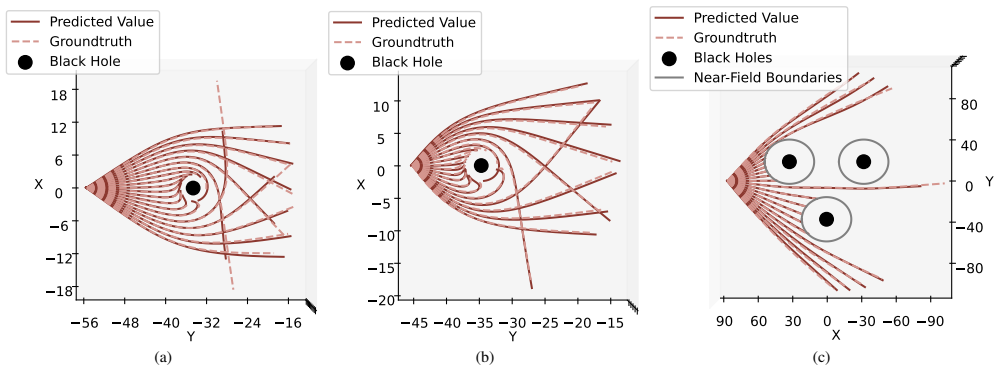
The central object is the learned geodesic map $f_\theta$ composed with a Fourier feature encoding $\gamma(x) = (\sin(2^0 \pi x), \cos(2^0 \pi x), \ldots, \sin(2^{L-1} \pi x), \cos(2^{L-1} \pi x))$, trained with a position loss and a velocity loss in the spirit of physics-informed neural networks. The training labels come from an Euler-method integrator that solves the null geodesic equation in the superposed Kerr metric, the superposition of individual Kerr metrics used to approximate a multi-black-hole spacetime, and that renormalizes the spatial velocity to unit length at every step. The rendering pipeline uses per-region MLPs, one near-field sphere around each black hole plus a far-field network, and steps each ray by the straight-line distance to the next region boundary, so every requested point on the geodesic is obtained by one forward pass through the appropriate network.
What would settle it
Render the same two-black-hole superposed Kerr scene with a high-order geodesic integrator that does not apply the constant-speed renormalization, and compare those geodesics to the Euler-method labels; if the deviation grows with affine parameter or approaches the photon-ring scale, then the network has learned the integrator's systematic error rather than the true geodesics, and the speedup comparison would be against a biased baseline.
Extended reading notes
Core claim
On the paper's own terms, the discovery is that a null geodesic, the spacetime path of a light ray, can be compressed into a neural function. Given a starting position $p$, an initial direction $d$, and an affine parameter $\lambda$, the trained network outputs the geodesic position $\hat{p} = f_\theta(\gamma(p), \gamma(d), \lambda)$, where $\gamma$ is a Fourier feature encoding, and the same network supplies the velocity through automatic differentiation. This converts ray tracing from iterating a differential equation into sampling a trained map, and the paper reports that the resulting renderer is on average 15$\times$ faster than its Euler-method implementation, with PSNR values around 19.5 to 25.0 and low LPIPS scores for two- and three-black-hole scenes. The authors also find that a single global network fits the spacetime poorly, so they train separate near-field and far-field networks for each black hole and assemble each ray from segments crossing these regions.
Load-bearing premise
The load-bearing premise is that the Euler integration inside Algorithm 1, which renormalizes the spatial velocity to unit length after every step, produces correct null geodesics in the superposed Kerr metric, because that same integrator generates the training labels and serves as the evaluation ground truth, so any systematic error in it is inherited by the network and masked in the accuracy comparison.
Editorial extensions
If this is right
- Ray tracing in curved spacetime becomes a query of a trained network, so the cost per pixel no longer grows with the number of integration steps along the ray.
- Multi-black-hole rendering in the superposed Kerr metric, which lacks the semi-analytic elliptic-integral shortcut available for a single Kerr black hole, can be done roughly an order of magnitude faster than the Euler baseline.
- Because any point on a geodesic can be sampled directly, volume-rendering sampling strategies such as hierarchical sampling, empty-space skipping, and proposal networks become applicable in curved spacetime.
- The speed advantage grows with the distance of the viewpoint from the black holes: the paper reports a 15$\times$ average speedup when rendering both accretion disk and sky sphere, and 26$\times$ when rendering the sky sphere alone.
Reading between the lines
- A natural testable extension would be to train the same network on a Schwarzschild or single-Kerr spacetime and compare against analytic geodesics, which would separate the network's approximation error from any systematic error in the Euler-generated labels.
- The approach suggests a general recipe: any spacetime whose geodesics can be computed offline, including dynamical binary spacetimes or perturbed metrics, could have its ray-tracing workload moved into a neural surrogate, with training cost growing roughly linearly in the number of black holes.
- The claimed speedup is measured against the paper's own Euler renderer; comparing against a high-order integrator or an optimized semi-analytic code would clarify how much of the gain comes from the neural representation and how much from the choice of baseline.
Signed reviews
Editorial analysis
A structured set of objections, weighed in public.
Referee Report
Summary. GravLensX trains an MLP with Fourier feature encoding to approximate null geodesics in spacetimes described by a superposed Kerr metric. The training data are generated by a custom Euler integrator (Algorithm 1); the space is split into near-field and far-field regions, each with its own trained network, and at inference the network directly predicts any point along a geodesic from the initial position, initial direction, and affine parameter. The rendering pipeline identifies ray segments by stepping to region boundaries, samples points on accretion disks and the sky sphere, and applies volume rendering. The paper reports quantitative agreement with Euler-method rendering (PSNR 19.47–24.98 dB, LPIPS 0.042–0.168) and speedups of about 15× on average, 26× for sky-sphere-only rendering. The central claims are that the neural surrogate reproduces the reference renderer while being substantially faster and that the resulting images are accurate visualizations of gravitational lensing in multi-black-hole systems.
Significance. If the accuracy claim were validated against a reliable reference for null geodesics, the method would be a useful neural surrogate for multi-black-hole lensing rendering, a regime where semi-analytic Kerr geodesic solvers do not directly apply. The paper has concrete strengths: the algorithm is described in sufficient detail to be reimplemented, the parameter choices are documented in Table A1, and the region-decomposition strategy for fitting spatially localized networks is clearly motivated. However, the current evaluation is self-referential: the same Euler integrator supplies both the training labels and the evaluation ground truth, so the reported PSNR/LPIPS values quantify regression fidelity to that integrator, not physical accuracy. The speedup is an implementation-level comparison and is meaningful as such, but it does not by itself establish that the rendered images are correct general-relativistic images. The reported PSNR values are modest and the paper does not report a convergence study with respect to the affine step size, so the central accuracy claim is not yet supported.
major comments (3)
- [Sections 3.1, 3.2, and 4.2.2; Algorithm 1] The training labels and the evaluation ground truth are both generated by the same custom Euler integrator. Algorithm 1 renormalizes the spatial velocity to unit norm after each step (line 30), while reconstructing the time component from the null constraint (line 19); this is not equivalent to integrating the affine null geodesic equation with the geodesic acceleration, and the resulting systematic error is never quantified. No convergence study with respect to the step size Δλ is reported. Consequently, the PSNR and LPIPS values in Table 1 measure agreement with this particular integrator, not agreement with exact null geodesics. The phrase “Euler method (ground truth)” in Section 4.2.2 should be replaced by “Euler method (reference)” unless the integrator is independently validated. I ask for two additions: (i) a convergence study in which Δλ is halved and the resulting geodesic paths and rendered images are compared, and (ii) a comparison against a high-order or semi-analytic null-geodesic reference at least for the single-black-hole case, and for the superposed-metric case against a high-order integrator that does not impose the ad-hoc velocity normalization.
- [Section 2.1] The statement that “RK4 does not perform better than the Euler method at the same step size” is central to the choice of baseline but is not substantiated. If the same per-step velocity renormalization is applied to RK4, its higher-order accuracy is destroyed, making the statement true but irrelevant to the question of which integrator better approximates null geodesics. The paper should specify the exact integration scheme used for RK4, including whether and how the velocity normalization is applied, and report errors relative to a reference solution over a range of step sizes. Without this, the choice of Euler as the ground truth and as the speed baseline is not justified.
- [Appendix A4, Propositions A4.1 and A4.2] The proof that l_straight ≤ l_geodesic, which underlies the ray-segmentation stepping in Section 3.3, is not rigorous. In Case 2 of Proposition A4.1, the argument assumes that when the acceleration becomes parallel to the velocity at the tangency point C, the trajectory “should be a straight line pointing towards O”; this does not follow from the geodesic equation or from the Newtonian approximation invoked earlier. The convergence proof of Proposition A4.2 assumes the existence of the limiting point B′ and of lim s_t without establishing them. Since this lemma is used to guarantee that the near-field stepping does not overshoot the region boundary, please either provide a correct proof under clearly stated assumptions or explicitly present this step as a heuristic and validate its behavior empirically on the actual geodesics.
minor comments (4)
- [Section 3.1, after Algorithm 1] The text says the velocity normalization appears in “line 26” of Algorithm 1, but the normalization is on line 30; please correct the cross-reference.
- [Section 4.3] The efficiency comparison should specify the hardware and implementation of the Euler-method baseline. If the baseline is not GPU-accelerated while the neural method is, the reported 15× speedup would be an implementation artifact rather than an algorithmic gain; the current text does not rule this out.
- [Throughout] There are numerous typos and minor grammatical issues, including “casted”, “sytstem”, “separete”, “traning”, “filed”, “lamda”, and “iamge”. A careful proofreading pass is needed.
- [Section 4.2.2] The procedure “randomly select 100 points across the entire space” is not fully specified; please list the range of positions, the random seed, and how the viewing directions are sampled, so that the quantitative comparison is reproducible.
Circularity Check
Quality validation is self-referential: Algorithm 1's Euler integrator generates both the network's training targets and the evaluation 'ground truth' used in Table 1, so the PSNR/LPIPS and 'accurate visualizations' claims measure regression fidelity to the training simulator rather than correctness against GR; the 15x runtime claim is independent.
-
fitted input called prediction
[Section 3.1 (Algorithm 1), Section 3.2 (Eqs. 5-7), Section 4.2.2 (Table 1)]
"We implement the Euler method to numerically solve the geodesic equation for each ray from the view point, which generates a series of data points along the geodesic, available for both rendering black holes and traning neural networks. Then we render the image based on GravLensX along with the Euler method (ground truth) and compare their image similarity."
Training data are Euler-generated positions and velocities (§3.1: 'available for both rendering black holes and traning neural networks'); the losses in Eqs. (5)-(7) fit the network to those data; §4.2.2 evaluates PSNR/LPIPS against images 'rendered... with the Euler method (ground truth)'. One algorithm (Algorithm 1) produces both labels and reference, so its systematic errors are shared and invisible; the metric only measures MLP fidelity to Euler output. The reference is not a standard GR solver: Algorithm 1 line 30 renormalizes spatial velocity to unit length each step, an ad-hoc choice not derived from GR, and no convergence study in Δλ or comparison with a high-order null-geodesic solver is given (kgeo: runtime only in Appendix A1).
full rationale
The paper's central quality claim rests on a self-referential validation loop: the Euler-method integrator of Algorithm 1 generates both the neural network's training labels (positions and velocities used in Eqs. 5-7) and the evaluation reference called 'ground truth' in §4.2.2. The PSNR/LPIPS numbers in Table 1 therefore quantify how well the MLP reproduces the training simulator's output, not how close either is to true null geodesics of the superposed Kerr metric. This fits the fitted-input-called-prediction pattern: a fitted model evaluated against the data-generating procedure that defined its targets, with the further complication that the generator itself is not a validated GR solver, since the per-step spatial velocity renormalization (Algorithm 1 line 30) is an ad-hoc reparameterization, and no Δλ convergence study or accuracy comparison against a high-order geodesic solver is reported; the kgeo benchmark in Appendix A1 is runtime-only, and the alignment with Bohn et al. in §4.2.3 is qualitative. The 15x (26x for sky sphere) speedup is measured end-to-end against the Euler pipeline and is independent of the accuracy loop, so the efficiency claim stands. No load-bearing self-citation exists: all references are to external work (Combi et al., Gralla and Lupsasca, Bohn et al., James et al.), so all self-citation patterns are absent. The RK4 claim in §2.1 and the Appendix A4 convergence proof are scientific-validity risks rather than circularity. Overall, the circularity is partial and confined to the accuracy/validation leg; the neural geodesic surrogate architecture itself has genuine independent content.
Assumptions & free parameters
free parameters (7)
- affine step size Δλ for Euler data generation and rendering =
not reported
- velocity-consistency loss weight α =
800
- near-field radius R_bh =
20
- sky sphere radius R_sky =
100
- in-black-hole radius and inner boundary l_in =
1.6/1.8 for 2BH, 2.2/2.25 for 3BH
- near-field inner division coefficient k =
not reported
- Fourier feature level L =
not reported
assumptions (4)
- domain assumption The superposed Kerr metric used to describe multi-black-hole spacetimes is a valid approximation of the true general-relativistic spacetime.
- ad hoc to paper Euler integration with per-step velocity normalization produces numerically accurate null geodesics in this metric.
- standard math Light follows null geodesics parameterized by an affine parameter, and the geodesic equation with Christoffel symbols governs the rays.
- ad hoc to paper The bound l_straight ≤ l_geodesic holds for ray-stepping near a black hole, as proven in Appendix A4.
Cite this review
Pith. "Pith review of Learning Null Geodesics for Gravitational Lensing Rendering in General Relativity." pith.science (2026). https://pith.science/paper/GNEOD3PF
@misc{pith2026250715775,
  author       = {Pith},
  title        = {Pith review of: Learning Null Geodesics for Gravitational Lensing Rendering in General Relativity},
  year         = {2026},
  howpublished = {\url{https://pith.science/paper/GNEOD3PF}},
  note         = {Machine review of arXiv:2507.15775}
}
abstract
We present GravLensX, an innovative method for rendering black holes with gravitational lensing effects using neural networks. The methodology involves training neural networks to fit the spacetime around black holes and then employing these trained models to generate the path of light rays affected by gravitational lensing. This enables efficient and scalable simulations of black holes with optically thin accretion disks, significantly decreasing the time required for rendering compared to traditional methods. We validate our approach through extensive rendering of multiple black hole systems with superposed Kerr metric, demonstrating its capability to produce accurate visualizations with significantly $15\times$ reduced computational time. Our findings suggest that neural networks offer a promising alternative for rendering complex astrophysical phenomena, potentially paving a new path to astronomical visualization.
Figures


Figures from the paper (5 more)


Reference graph
Works this paper leans on
-
[1]
Jason Ansel, Edward Yang, Horace He, Natalia Gimelshein, Animesh Jain, Michael V oznesensky, Bin Bao, Peter Bell, David Berard, Evgeni Burovski, Geeta Chauhan, An- jali Chourdia, Will Constable, Alban Desmaison, Zachary DeVito, Elias Ellison, Will Feng, Jiong Gong, Michael Gschwind, Brian Hirsh, Sherlock Huang, Kshiteej Kalam- barkar, Laurent Kirsch, Mich...
work page 2024
-
[2]
Christopher J Arthurs and Andrew P King. Active training of physics-informed neural networks to aggregate and inter- polate parametric solutions to the navier-stokes equations. Journal of Computational Physics, 438:110364, 2021. 3
work page 2021
-
[3]
What does a binary black hole merger look like? Classical and Quantum Gravity , 32(6):065002,
Andy Bohn, William Throwe, Franc ¸ois H ´ebert, Kather- ine Henriksson, Darius Bunandar, Mark A Scheel, and Nicholas W Taylor. What does a binary black hole merger look like? Classical and Quantum Gravity , 32(6):065002,
-
[4]
Physics-informed neural net- works for heat transfer problems
Shengze Cai, Zhicheng Wang, Sifan Wang, Paris Perdikaris, and George Em Karniadakis. Physics-informed neural net- works for heat transfer problems. Journal of Heat Transfer, 143(6):060801, 2021. 3
work page 2021
-
[5]
Superposed metric for spinning black hole binaries approaching merger
Luciano Combi, Federico G Lopez Armengol, Manuela Campanelli, Brennan Ireland, Scott C Noble, Hiroyuki Nakano, and Dennis Bowen. Superposed metric for spinning black hole binaries approaching merger. Physical Review D, 104(4):044041, 2021. 2
work page 2021
-
[6]
Using physics-informed neural networks to compute quasinormal modes
Alan S Cornell, Anele Ncube, and Gerhard Harmsen. Using physics-informed neural networks to compute quasinormal modes. Physical Review D, 106(12):124047, 2022. 3
work page 2022
-
[7]
Solving the regge-wheeler and teukolsky equations: supervised vs
Alan S Cornell, Sheldon R Herbst, Hajar Noshad, and Anele M Ncube. Solving the regge-wheeler and teukolsky equations: supervised vs. unsupervised physics-informed neural networks. arXiv preprint arXiv:2402.11343, 2024. 3
arXiv 2024
-
[8]
δ-pinns: Physics-informed neural networks on complex geometries
Francisco Sahli Costabal, Simone Pezzuto, and Paris Perdikaris. δ-pinns: Physics-informed neural networks on complex geometries. Engineering Applications of Artificial Intelligence, 127:107324, 2024. 3
work page 2024
Show all 31 references
-
[9]
Electromagnetic emission from supermassive binary black holes approaching merger
St ´ephane d’Ascoli, Scott C Noble, Dennis B Bowen, Manuela Campanelli, Julian H Krolik, and Vassilios Mewes. Electromagnetic emission from supermassive binary black holes approaching merger. The Astrophysical Journal, 865 (2):140, 2018. 12
2018
-
[10]
Die grundlage der allgemeinen rela- tivit¨atstheorie
Albert Einstein. Die grundlage der allgemeinen rela- tivit¨atstheorie. Annalen der Physik , 354(7):769–822, 1916. 1
1916
-
[11]
Physics-informed neural networks for solving reynolds-averaged navier–stokes equations
Hamidreza Eivazi, Mojtaba Tahani, Philipp Schlatter, and Ricardo Vinuesa. Physics-informed neural networks for solving reynolds-averaged navier–stokes equations. Physics of Fluids, 34(7), 2022. 3
2022
-
[12]
Null geodesics of the kerr exterior
Samuel E Gralla and Alexandru Lupsasca. Null geodesics of the kerr exterior. Physical Review D, 101(4):044032, 2020. 2, 11
2020
-
[13]
A physics-informed deep learn- ing framework for inversion and surrogate modeling in solid mechanics
Ehsan Haghighat, Maziar Raissi, Adrian Moure, Hector Gomez, and Ruben Juanes. A physics-informed deep learn- ing framework for inversion and surrogate modeling in solid mechanics. Computer Methods in Applied Mechanics and Engineering, 379:113741, 2021. 3
2021
-
[14]
Taichi: a language for high-performance computation on spatially sparse data structures
Yuanming Hu, Tzu-Mao Li, Luke Anderson, Jonathan Ragan-Kelley, and Fr ´edo Durand. Taichi: a language for high-performance computation on spatially sparse data structures. ACM Transactions on Graphics (TOG) , 38(6): 201, 2019. 11
2019
-
[15]
Gravitational lensing by spinning black holes in astrophysics, and in the movie interstellar
Oliver James, Eug ´enie von Tunzelmann, Paul Franklin, and Kip S Thorne. Gravitational lensing by spinning black holes in astrophysics, and in the movie interstellar. Classical and Quantum Gravity, 32(6):065001, 2015. 2, 12
2015
-
[16]
Kajiya and Brian P V on Herzen
James T. Kajiya and Brian P V on Herzen. Ray tracing vol- ume densities. In Proceedings of the 11th Annual Conference on Computer Graphics and Interactive Techniques , pages 165–174, New York, NY , USA, 1984. Association for Com- puting Machinery. 3
1984
-
[17]
Roy P. Kerr. Gravitational field of a spinning mass as an example of algebraically special metrics. Phys. Rev. Lett. , 11:237–238, 1963. 2, 12
1963
-
[18]
Physics informed neural networks for electromagnetic analysis
Arbaaz Khan and David A Lowther. Physics informed neural networks for electromagnetic analysis. IEEE Transactions on Magnetics, 58(9):1–4, 2022. 3
2022
-
[19]
Gravitationally lensed black hole emission tomography
Aviad Levis, Pratul P Srinivasan, Andrew A Chael, Ren Ng, and Katherine L Bouman. Gravitationally lensed black hole emission tomography. In CVPR, pages 19841–19850, 2022. 2
2022
-
[20]
Solving the teukolsky equation with physics-informed neural networks
Raimon Luna, Juan Calder ´on Bustillo, Juan Jos ´e Seoane Mart ´ınez, Alejandro Torres-Forn ´e, and Jos ´e A Font. Solving the teukolsky equation with physics-informed neural networks. Physical Review D, 107(6):064025, 2023. 3
2023
-
[21]
Custom vulkan engine to render black holes in real time using ray-marching
Roger Meseguer Orrit. Custom vulkan engine to render black holes in real time using ray-marching. 2023. 2
2023
-
[22]
ipole–semi- analytic scheme for relativistic polarized radiative transport
M Mo ´scibrodzka and Charles F Gammie. ipole–semi- analytic scheme for relativistic polarized radiative transport. Monthly Notices of the Royal Astronomical Society , 475(1): 43–54, 2018. 2
2018
-
[23]
Metric of a rotating, charged mass
Ezra T Newman, E Couch, K Chinnapared, A Exton, A Prakash, and R Torrence. Metric of a rotating, charged mass. Journal of mathematical physics, 6(6):918–919, 1965. 2 9
1965
-
[24]
Quasinormal modes of ds and ads black holes: Feedforward neural net- work method
Ali ¨Ovg¨un, ˙Izzet Sakallı, and Halil Mutuk. Quasinormal modes of ds and ads black holes: Feedforward neural net- work method. International Journal of Geometric Methods in Modern Physics, 18(10):2150154, 2021. 3
2021
-
[25]
A parameter study of the electromagnetic signatures of an analytical mini-disk model for supermassive binary black hole systems.arXiv preprint arXiv:2407.04089,
Kaitlyn Porter, Scott C Noble, Eduardo M Gutierrez, Joaquin Pelle, Manuela Campanelli, Jeremy Schnittman, and Bernard J Kelly. A parameter study of the electromagnetic signatures of an analytical mini-disk model for supermassive binary black hole systems.arXiv preprint arXiv:2...
-
[26]
Physics-informed neural networks: A deep learning frame- work for solving forward and inverse problems involving nonlinear partial differential equations
Maziar Raissi, Paris Perdikaris, and George E Karniadakis. Physics-informed neural networks: A deep learning frame- work for solving forward and inverse problems involving nonlinear partial differential equations. Journal of Computa- tional physics, 378:686–707, 2019. 2, 3
2019
-
[27]
Seeing relativity-i: Ray tracing in a schwarzschild metric to explore the maximal analytic ex- tension of the metric and making a proper rendering of the stars
Alain Riazuelo. Seeing relativity-i: Ray tracing in a schwarzschild metric to explore the maximal analytic ex- tension of the metric and making a proper rendering of the stars. International Journal of Modern Physics D , 28(02): 1950042, 2019. 2
2019
-
[28]
¨Uber das gravitationsfeld eines massen- punktes nach der einsteinschen theorie
Karl Schwarzschild. ¨Uber das gravitationsfeld eines massen- punktes nach der einsteinschen theorie. Sitzungsberichte der k¨oniglich preussischen Akademie der Wissenschaften, pages 189–196, 1916. 2, 12
1916
-
[29]
Fourier features let networks learn high frequency functions in low dimen- sional domains
Matthew Tancik, Pratul Srinivasan, Ben Mildenhall, Sara Fridovich-Keil, Nithin Raghavan, Utkarsh Singhal, Ravi Ra- mamoorthi, Jonathan Barron, and Ren Ng. Fourier features let networks learn high frequency functions in low dimen- sional domains. Advances in neural information ...
2020
-
[30]
Single view refractive index tomography with neural fields
Brandon Zhao, Aviad Levis, Liam Connor, Pratul P Srini- vasan, and Katherine L Bouman. Single view refractive index tomography with neural fields. In Proceedings of the IEEE/CVF Conference on Computer Vision and Pattern Recognition, pages 25358–25367, 2024. 3 10 Appendix A1. A...
2024
-
[3090]
For the 3-black-hole scenario, this is equivalent to rendering a 63 minutes video in 30 FPS with Euler method
The time for generating data and training the model on RTX 3090 is around 13.8 GPU hours for every near-field NN and 33.5 GPU hours for the far-field NN. For the 3-black-hole scenario, this is equivalent to rendering a 63 minutes video in 30 FPS with Euler method. For more com...
Reviewed August 6, 2026 · model on record in the stance chip above.
Discussion (0). Continue with ORCID to comment.