REVIEW 6 minor 136 references
The mass of TOI-654 b: A short-period sub-Neptune transiting a mid-M dwarf
T0 review · 0 major / 6 minor · reviewed 2026-08-06 · deepseek-v4-flash
Pith's one-line read TOI-654 b, a 1.53-day sub-Neptune around a mid-M dwarf, is measured to have 8.71 Earth masses and an updated radius of 2.378 Earth radii.
desk verdict A clean, standard RV+transit measurement that gives TOI-654 b its first direct mass; worth a serious referee, with data-release as the main condition. read the letter →
The pith
A machine-rendered reading of the paper's core claim, the machinery that carries it, and where it could break.
The reading
What carries the argument
The load-bearing measurement is the radial-velocity semi-amplitude $K = 8.62^{+1.22}_{-1.23}$ m s$^{-1}$ extracted from 85 Subaru/IRD spectra, combined in a joint transit-plus-RV model and sampled with a Hamiltonian Monte Carlo scheme. The transit side uses TESS photometry from six sectors and ground-based MuSCAT2/MuSCAT3 multicolor light curves, with a Matérn-3/2 Gaussian-process baseline (a smooth, time-correlated noise model) for the ground-based data. Stellar mass and radius come from empirical mass-luminosity and radius-luminosity relations plus spectral energy distribution fitting, giving $M_s = 0.419 \pm 0.009 M_\odot$ and $R_s = 0.430 \pm 0.013 R_\odot$; since $M_p \propto M_s^{2/3}$ and $R_p \propto R_s$, these stellar calibrations directly set the headline planetary values.
What would settle it
A direct measurement of the stellar angular diameter by long-baseline interferometry, or an asteroseismic radius that contradicts $R_s = 0.430 \pm 0.013 R_\odot$, would rescale the planet's radius linearly; likewise, a larger independent RV dataset that moved $K$ outside $8.62^{+1.22}_{-1.23}$ m s$^{-1}$ would change the mass. If either measurement pushed the derived density outside $3.59 \pm 0.65$ g cm$^{-3}$, the composition interpretation would need revision.
Extended reading notes
Core claim
The central result is a measured planetary mass of $M_p = 8.71 \pm 1.25 M_\oplus$ and an updated radius of $R_p = 2.378 \pm 0.089 R_\oplus$ from a joint fit of the transit light curves and the IRD radial velocities, with the circular-orbit model favored slightly over an eccentric one ($\Delta \log Z = 0.158$). The paper reports that the resulting bulk density, $\rho_p = 3.59 \pm 0.65$ g cm$^{-3}$, places TOI-654 b equally close to a rocky core plus roughly 0.3 wt\% hydrogen envelope and to a 50 wt\% rock / 50 wt\% water composition under the relevant temperature. The radius precision improves from 5.3\% to 3.7\% relative to the earlier validation, and the updated Transmission and Emission Spectroscopy Metrics (TSM $= 49 \pm 8$, ESM $= 11 \pm 1$) make the planet a viable emission-spectroscopy target for JWST and Ariel, though not a strong transmission-spectroscopy target.
Load-bearing premise
The adopted stellar mass and radius come from empirical brightness-to-size relations rather than direct measurement, so a systematic error there would shift the planet's mass and radius in lockstep.
Editorial extensions
If this is right
- TOI-654 b's density of $3.59 \pm 0.65$ g cm$^{-3}$ excludes a purely hydrogen-dominated sub-Neptune and restricts any H/He envelope to a small fraction of the planet's mass.
- At $P = 1.53$ days and $R_p = 2.378 R_\oplus$, the planet sits near the M-dwarf radius valley and on the outer edge of the Neptune desert, so its measured mass anchors both population features around a single object.
- The improved stellar radius shrinks the planetary radius uncertainty from 5.3\% to 3.7\%, tightening the target list for JWST and Ariel emission spectroscopy.
- The updated TSM and ESM values ($49 \pm 8$ and $11 \pm 1$) show the planet is better suited to secondary-eclipse emission observations than to transmission spectroscopy.
Reading between the lines
- If the mass holds up, TOI-654 b becomes a useful discriminator for M-dwarf radius-valley models: a dense, sub-Neptune-sized planet close to the valley is more naturally explained by photoevaporative stripping of a primordial envelope than by gas-poor formation, though the paper does not choose between these.
- A single JWST emission spectrum, or one more transit observed in transmission, could break the rock-plus-envelope versus water-world degeneracy that the current density cannot resolve; this is the paper's own suggested next step and is within reach.
- The He I 1083 nm data taken during the MuSCAT3 transit, reported in a forthcoming companion paper, may connect atmospheric escape to the planet's position in the Neptune desert, but that connection is not established here.
Editorial analysis
A structured set of objections, weighed in public.
Referee Report
Summary. The paper reports follow-up characterization of the transiting sub-Neptune TOI-654 b (P = 1.528 d) around a mid-M dwarf. Using TESS and MuSCAT2/MuSCAT3 photometry combined with 85 Subaru/IRD radial-velocity measurements, the authors perform a joint transit+RV fit and derive a planet mass of 8.71 ± 1.25 M_Earth from a 7σ semi-amplitude K = 8.62 ± 1.22 m/s, an updated radius of 2.378 ± 0.089 R_Earth, and a mean density of 3.59 ± 0.65 g/cm3. Stellar parameters are obtained from empirical mass/radius-luminosity relations and an SED fit; activity indicators show no significant signal at the planet period, and a circular orbit is favored over an eccentric one by ΔlnZ = 0.158. The paper discusses the resulting composition degeneracy (rocky core + H/He envelope vs. water-rich), the planet's position near the radius valley and the Neptune desert, and its potential for JWST/Ariel follow-up.
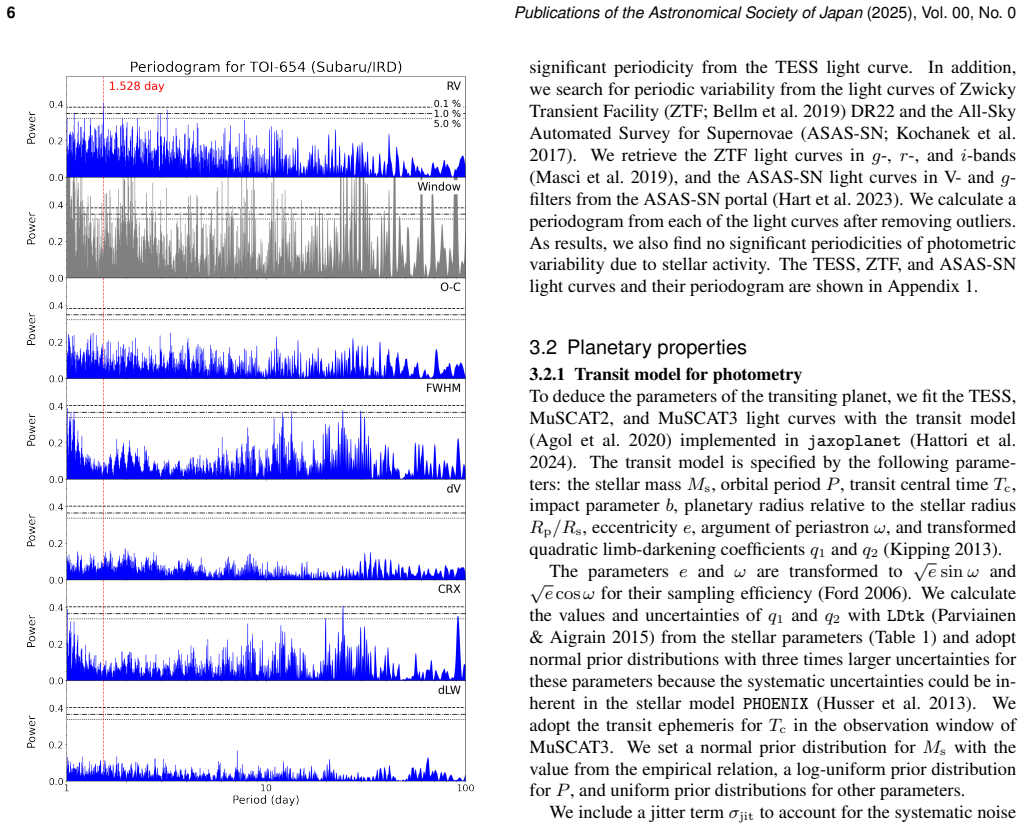
Significance. This is a useful addition to the small sample of M-dwarf sub-Neptunes with precisely measured masses and radii. The RV detection is robust (K = 8.62 ± 1.22 m/s, FAP < 0.1%), the activity analysis is careful, and the circular/eccentric model comparison gives consistent masses, so the central claim is well supported. The paper uses public modeling tools (jaxoplanet, tinygp, emcee, NumPyro) and explicitly reports a model-evidence comparison. I find no circularity: the mass comes from the RV semi-amplitude and an independently adopted stellar mass, not from the same data used to derive the transit parameters. The main limitation is that the adopted stellar radius and mass inherit possible systematics from empirical relations, but the SED-based radius is consistent, and the impact on M_p is small (M_p ∝ M_s^(2/3)). Overall, the paper delivers a solid, timely characterization.
minor comments (6)
- [3.1.2 / Table 1] The SED-derived radius (0.422+0.011/−0.009 R_sun) is statistically consistent with the adopted empirical value (0.430 ± 0.013 R_sun), but the empirical value is chosen without explanation. Please add one sentence justifying this choice, and state whether systematic errors in the Mann et al. mass/radius relations are included in the quoted uncertainties.
- [Data availability] The paper does not include a data availability statement or machine-readable tables of the 85 IRD radial velocities and the TESS/MuSCAT2/MuSCAT3 light curves used in the joint fit. Given that the IRD spectra are not public, releasing the derived RVs (and preferably the jaxoplanet model configuration) would greatly aid independent verification.
- [Abstract] The abstract contains a duplicated word: 'radius valley and and also on the outer edge'.
- [4.1] The phrase 'one of unique planets' should be 'one of the unique planets' or better 'one of a small number of planets'.
- [3.2.3] The ΔlnZ value of 0.158 between the circular and eccentric models corresponds to 'not worth more than a bare mention' in the Kass & Raftery (1995) scale. Please state explicitly that the two models are statistically indistinguishable and that the choice of the circular model as the fiducial model does not affect the quoted mass, only the eccentricity-related caveats.
- [3.1.2] The explicit caveat that the Teff uncertainty does not include stellar-model systematics is appreciated; consider also noting the potential effect on the limb-darkening priors, even though the adopted 3× wider priors should render it negligible.
Circularity Check
No significant circularity: the planet mass and radius rest on independent RV, transit, and stellar-calibration inputs, with no load-bearing self-citation or fitted-input-as-prediction step.
full rationale
The derivation chain for the central claim is self-contained and does not reduce to its own inputs. The planetary mass, M_p = 8.71 +/- 1.25 M_earth, is obtained from the measured RV semi-amplitude K = 8.62 +/- 1.22 m/s (GLS FAP < 0.1%) combined with the adopted stellar mass M_s = 0.419 +/- 0.009 M_sun, which is taken from independent empirical mass-luminosity and metallicity relations (Mann et al. 2015, 2019) and cross-checked with an SED fit; the stellar mass is not fit to the RV or transit data. Similarly, the planet radius, R_p = 2.378 +/- 0.089 R_earth, is the product of the transit-derived ratio R_p/R_s = 0.0510 +/- 0.0008 and the independently adopted stellar radius R_s = 0.430 +/- 0.013 R_sun, which also agrees with the SED-derived radius. The circular-orbit choice is not an input that defines the mass: the eccentric model yields a consistent mass (8.87 +/- 1.23 M_earth), and the circular model is preferred only by a negligible Bayesian evidence difference (Delta log Z = 0.158). Activity indicators (FWHM, dV, CRX, dLW) and archival photometry show no significant signal at the 1.528-day period, so the RV signal is not being driven by a fitted activity model. The paper does use several pipelines and reduction procedures from co-authored prior work (IRD extraction, MuSCAT photometry), but those are data-processing tools rather than the theoretical or empirical claim itself; no stated uniqueness theorem or ansatz is imported from a self-citation to force the result. The acknowledged limitations, such as the Teff uncertainty excluding stellar atmospheric model systematics and the lack of released machine-readable data, affect accuracy and reproducibility but do not constitute circularity. Overall, no derivation step equates the prediction with a fitted parameter or with the authors' own prior assertion by construction.
Assumptions & free parameters
free parameters (8)
- K (RV semi-amplitude) =
8.62 +1.22/-1.23 m/s
- Rp/Rs (planet-to-star radius ratio) =
0.0510 ± 0.0008
- impact parameter b =
0.290 +0.104/-0.112
- orbital period P =
1.527561 ± 0.000001 d
- stellar mass M_s =
0.419 ± 0.009 M_sun
- stellar radius R_s =
0.430 ± 0.013 R_sun
- limb-darkening coefficients q1, q2 =
See Table 4
- jitter and Gaussian-process hyperparameters =
See Table 4
assumptions (5)
- domain assumption Empirical M dwarf mass-luminosity and radius-luminosity relations calibrated on other stars apply to TOI-654.
- domain assumption One-dimensional LTE model atmospheres (MARCS, BT-Settl) adequately represent the stellar spectrum and SED.
- domain assumption The 1.528-day RV signal is planetary rather than stellar activity.
- domain assumption The orbit is circular for the adopted fiducial parameters.
- domain assumption A Matérn-3/2 Gaussian process describes the correlated noise in the ground photometry.
Cite this review
Pith. "Pith review of The mass of TOI-654 b: A short-period sub-Neptune transiting a mid-M dwarf." pith.science (2026). https://pith.science/paper/RJSZPP43
@misc{pith2026250716222,
  author       = {Pith},
  title        = {Pith review of: The mass of TOI-654 b: A short-period sub-Neptune transiting a mid-M dwarf},
  year         = {2026},
  howpublished = {\url{https://pith.science/paper/RJSZPP43}},
  note         = {Machine review of arXiv:2507.16222}
}
abstract
Sub-Neptunes are small planets between the size of the Earth and Neptune. The orbital and bulk properties of transiting sub-Neptunes can provide clues for their formation and evolution of small planets. In this paper, we report on follow-up observations of a planetary system around the mid-M dwarf TOI-654, whose transiting sub-Neptune TOI-654 b ($P=1.53$ day) is validated as a suitable target for the atmospheric observation. We measure the planetary mass and stellar properties with the InfraRed Doppler instrument (IRD) mounted on the Subaru telescope and obtain the stellar and planetary properties from additional transit observations by the Transit Exoplanetary Survey Satellite (TESS) and a series of the Multicolor Simultaneous Camera for studying Atmospheres of Transiting exoplanets (MuSCAT). As a result, the planetary mass of TOI-654 b is determined to be $M_{{\rm p}} = 8.71 \pm 1.25 M_{\oplus}$, and the radius is updated to be $R_{\rm p} = 2.378 \pm 0.089 R_{\oplus}$. The bulk density suggests that the planet is composed of a rocky and volatile-rich core or a rocky core surrounded by a small amount of H/He envelope.TOI-654 b is one of unique planets located around the radius valley and and also on the outer edge of the Neptune desert. The precise mass determination enables us to constrain the atmospheric properties with future spectroscopic observations especially for the emission by the James Webb Space Telescope and Ariel.
Figures


Figures from the paper (7 more)



Reference graph
Works this paper leans on
-
[1]
2020, , 159, 123, 10.3847/1538-3881/ab4fee
Agol , E., Luger , R., & Foreman-Mackey , D. 2020, , 159, 123, 10.3847/1538-3881/ab4fee
-
[2]
Allard , F. 2014, in IAU Symposium, Vol. 299, Exploring the Formation and Evolution of Planetary Systems, ed. M. Booth , B. C. Matthews , & J. R. Graham , 271--272, 10.1017/S1743921313008545
-
[3]
Barkaoui , K., Schwarz , R. P., Narita , N., et al. 2024, , 687, A264, 10.1051/0004-6361/202349127
-
[4]
Batalha , N. M., Rowe , J. F., Bryson , S. T., et al. 2013, , 204, 24, 10.1088/0067-0049/204/2/24
-
[5]
Bellm , E. C., Kulkarni , S. R., Graham , M. J., et al. 2019, , 131, 018002, 10.1088/1538-3873/aaecbe
-
[6]
2019, , 887, L14, 10.3847/2041-8213/ab59dc
Benneke , B., Wong , I., Piaulet , C., et al. 2019, , 887, L14, 10.3847/2041-8213/ab59dc
-
[7]
2024, arXiv e-prints, arXiv:2403.03325, 10.48550/arXiv.2403.03325
Benneke , B., Roy , P.-A., Coulombe , L.-P., et al. 2024, arXiv e-prints, arXiv:2403.03325, 10.48550/arXiv.2403.03325
-
[8]
Bonfanti , A., Brady , M., Wilson , T. G., et al. 2024, , 682, A66, 10.1051/0004-6361/202348180
Show all 136 references
-
[9]
J., Koch , D
Borucki , W. J., Koch , D. G., Basri , G., et al. 2011, , 736, 19, 10.1088/0004-637X/736/1/19
2011 doi
-
[10]
Brande , J., Crossfield , I. J. M., Kreidberg , L., et al. 2024, , 961, L23, 10.3847/2041-8213/ad1b5c
2024 doi
-
[11]
K., et al
Bryson , S., Kunimoto , M., Kopparapu , R. K., et al. 2021, , 161, 36, 10.3847/1538-3881/abc418
2021 doi
-
[12]
2024, Nature Astronomy, 8, 463, 10.1038/s41550-023-02183-7
Burn , R., Mordasini , C., Mishra , L., et al. 2024, Nature Astronomy, 8, 463, 10.1038/s41550-023-02183-7
2024 doi
-
[13]
J., et al
Cadieux , C., Doyon , R., MacDonald , R. J., et al. 2024, , 970, L2, 10.3847/2041-8213/ad5afa
2024 doi
-
[14]
2024, , 689, A250, 10.1051/0004-6361/202450957
Castro-Gonz \'a lez , A., Bourrier , V., Lillo-Box , J., et al. 2024, , 689, A250, 10.1051/0004-6361/202450957
2024 doi
-
[15]
K., Irwin , J., et al
Charbonneau , D., Berta , Z. K., Irwin , J., et al. 2009, , 462, 891, 10.1038/nature08679
2009 doi
-
[16]
2017, , 834, 17, 10.3847/1538-4357/834/1/17
Chen , J., & Kipping , D. 2017, , 834, 17, 10.3847/1538-4357/834/1/17
2017 doi
-
[17]
2021, , 162, 174, 10.3847/1538-3881/ac1584
Cloutier , R., Charbonneau , D., Deming , D., Bonfils , X., & Astudillo-Defru , N. 2021, , 162, 174, 10.3847/1538-3881/ac1584
2021 doi
-
[18]
2020, , 159, 211, 10.3847/1538-3881/ab8237
Cloutier , R., & Menou , K. 2020, , 159, 211, 10.3847/1538-3881/ab8237
2020 doi
-
[19]
2017, , 608, A35, 10.1051/0004-6361/201731558
Cloutier , R., Astudillo-Defru , N., Doyon , R., et al. 2017, , 608, A35, 10.1051/0004-6361/201731558
2017 doi
-
[20]
E., Irwin , J., et al
Cloutier , R., Rodriguez , J. E., Irwin , J., et al. 2020 a , , 160, 22, 10.3847/1538-3881/ab9534
2020 doi
-
[21]
D., Rodriguez , J
Cloutier , R., Eastman , J. D., Rodriguez , J. E., et al. 2020 b , , 160, 3, 10.3847/1538-3881/ab91c2
2020 doi
-
[22]
M., Bonfils , X., et al
Cointepas , M., Almenara , J. M., Bonfils , X., et al. 2021, , 650, A145, 10.1051/0004-6361/202140328
2021 doi
-
[23]
2019, in American Astronomical Society Meeting Abstracts, Vol
Collins , K. 2019, in American Astronomical Society Meeting Abstracts, Vol. 233, American Astronomical Society Meeting Abstracts \#233, 140.05
2019
-
[24]
F., Almenara , J
D \' az , R. F., Almenara , J. M., Santerne , A., et al. 2014, , 441, 983, 10.1093/mnras/stu601
2014 doi
-
[25]
2022, , 164, 15, 10.3847/1538-3881/ac6bf9
Edwards , B., & Tinetti , G. 2022, , 164, 15, 10.3847/1538-3881/ac6bf9
2022 doi
-
[26]
R., Gupta , A., Sotin , C., & Valio , A
Estrela , R., Swain , M. R., Gupta , A., Sotin , C., & Valio , A. 2020, , 898, 104, 10.3847/1538-4357/ab9a4d
2020 doi
-
[27]
Ford , E. B. 2006, , 642, 505, 10.1086/500802
2006 doi
-
[28]
2023, dfm/tinygp: The tiniest of Gaussian Process libraries , v0.2.4rc1, Zenodo, Zenodo, 10.5281/zenodo.7646759
Foreman-Mackey , D. 2023, dfm/tinygp: The tiniest of Gaussian Process libraries , v0.2.4rc1, Zenodo, Zenodo, 10.5281/zenodo.7646759
2023 doi
-
[29]
W., Lang , D., & Goodman , J
Foreman-Mackey , D., Hogg , D. W., Lang , D., & Goodman , J. 2013, , 125, 306, 10.1086/670067
2013 doi
-
[30]
J., et al
Fukui , A., Narita , N., Tristram , P. J., et al. 2011, , 63, 287, 10.1093/pasj/63.1.287
2011 doi
-
[31]
2016, , 819, 27, 10.3847/0004-637X/819/1/27
Fukui , A., Narita , N., Kawashima , Y., et al. 2016, , 819, 27, 10.3847/0004-637X/819/1/27
2016 doi
-
[32]
H., et al
Fukui , A., Korth , J., Livingston , J. H., et al. 2021, , 162, 167, 10.3847/1538-3881/ac13a5
2021 doi
-
[33]
2022, , 74, L1, 10.1093/pasj/psab106
Fukui , A., Kimura , T., Hirano , T., et al. 2022, , 74, L1, 10.1093/pasj/psab106
2022 doi
-
[34]
J., Petigura , E
Fulton , B. J., Petigura , E. A., Blunt , S., & Sinukoff , E. 2018, , 130, 044504, 10.1088/1538-3873/aaaaa8
2018 doi
-
[35]
J., Petigura , E
Fulton , B. J., Petigura , E. A., Howard , A. W., et al. 2017, , 154, 109, 10.3847/1538-3881/aa80eb
2017 doi
-
[36]
Gaia Collaboration , Vallenari , A., Brown , A. G. A., et al. 2023, , 674, A1, 10.1051/0004-6361/202243940
2023 doi
-
[37]
L., & Rowe , J
Gaidos , E., Ali , A., Kraus , A. L., & Rowe , J. F. 2024, , 10.1093/mnras/stae2207
2024 doi
-
[38]
Gao , P., Piette , A. A. A., Steinrueck , M. E., et al. 2023, , 951, 96, 10.3847/1538-4357/acd16f
2023 doi
-
[39]
P., Mather , J
Gardner , J. P., Mather , J. C., Clampin , M., et al. 2006, , 123, 485, 10.1007/s11214-006-8315-7
2006 doi
-
[40]
E., & Sari , R
Ginzburg , S., Schlichting , H. E., & Sari , R. 2018, , 476, 759, 10.1093/mnras/sty290
2018 doi
-
[41]
R., Caballero , J
Gonz \'a lez- \'A lvarez , E., Zapatero Osorio , M. R., Caballero , J. A., et al. 2023, , 675, A177, 10.1051/0004-6361/202346292
2023 doi
-
[42]
T., Irwin , M
Gonz \'a lez-Fern \'a ndez , C., Hodgkin , S. T., Irwin , M. J., et al. 2018, , 474, 5459, 10.1093/mnras/stx3073
2018 doi
-
[43]
M., Seager , S., Huang , C
Guerrero , N. M., Seager , S., Huang , C. X., et al. 2021, , 254, 39, 10.3847/1538-4365/abefe1
2021 doi
-
[44]
Gupta , A., Nicholson , L., & Schlichting , H. E. 2022, , 516, 4585, 10.1093/mnras/stac2488
2022 doi
-
[45]
Gupta , A., & Schlichting , H. E. 2019, , 487, 24, 10.1093/mnras/stz1230
2019 doi
- [46]
-
[47]
2008, , 486, 951, 10.1051/0004-6361:200809724
Gustafsson , B., Edvardsson , B., Eriksson , K., et al. 2008, , 486, 951, 10.1051/0004-6361:200809724
2008 doi
-
[48]
T., Fabrycky , D
Hamann , A., Montet , B. T., Fabrycky , D. C., Agol , E., & Kruse , E. 2019, , 158, 133, 10.3847/1538-3881/ab32e3
2019 doi
-
[49]
2022, , 74, 904, 10.1093/pasj/psac044
Harakawa , H., Takarada , T., Kasagi , Y., et al. 2022, , 74, 904, 10.1093/pasj/psac044
2022 doi
- [50]
-
[51]
2024, exoplanet-dev/jaxoplanet: Astronomical time series analysis with JAX , v0.0.2, Zenodo, 10.5281/zenodo.10736936
Hattori, S., Garcia, L., Murray, C., et al. 2024, exoplanet-dev/jaxoplanet: Astronomical time series analysis with JAX , v0.0.2, Zenodo, 10.5281/zenodo.10736936
2024 doi
-
[52]
2024, , 76, 1131, 10.1093/pasj/psae075
Hayashi , Y., Narita , N., Fukui , A., et al. 2024, , 76, 1131, 10.1093/pasj/psae075
2024 doi
-
[53]
2018, , 155, 127, 10.3847/1538-3881/aaa9c1
Hirano , T., Dai , F., Gandolfi , D., et al. 2018, , 155, 127, 10.3847/1538-3881/aaa9c1
2018 doi
-
[54]
2020 a , , 899, L13, 10.3847/2041-8213/aba6eb
Hirano , T., Krishnamurthy , V., Gaidos , E., et al. 2020 a , , 899, L13, 10.3847/2041-8213/aba6eb
2020 doi
-
[55]
2020 b , , 72, 93, 10.1093/pasj/psaa085
Hirano , T., Kuzuhara , M., Kotani , T., et al. 2020 b , , 72, 93, 10.1093/pasj/psaa085
2020 doi
-
[56]
H., Fukui , A., et al
Hirano , T., Livingston , J. H., Fukui , A., et al. 2021, , 162, 161, 10.3847/1538-3881/ac0fdc
2021 doi
-
[57]
H., et al
Hirano , T., Dai , F., Livingston , J. H., et al. 2023, , 165, 131, 10.3847/1538-3881/acb7e1
2023 doi
-
[58]
2024, , 530, 3117, 10.1093/mnras/stae998
Hirano , T., Gaidos , E., Harakawa , H., et al. 2024, , 530, 3117, 10.1093/mnras/stae998
2024 doi
-
[59]
Ho , C. S. K., Rogers , J. G., Van Eylen , V., Owen , J. E., & Schlichting , H. E. 2024, , 531, 3698, 10.1093/mnras/stae1376
2024 doi
-
[60]
Ho , C. S. K., & Van Eylen , V. 2023, , 519, 4056, 10.1093/mnras/stac3802
2023 doi
-
[61]
D., Gelman, A., et al
Hoffman, M. D., Gelman, A., et al. 2014, J. Mach. Learn. Res., 15, 1593
2014
-
[62]
J., Kempton , E
Hord , B. J., Kempton , E. M. R., Evans-Soma , T. M., et al. 2024, , 167, 233, 10.3847/1538-3881/ad3068
2024 doi
-
[63]
2024, , 167, 289, 10.3847/1538-3881/ad4115
Hori , Y., Fukui , A., Hirano , T., et al. 2024, , 167, 289, 10.3847/1538-3881/ad4115
2024 doi
-
[64]
O., Wende-von Berg , S., Dreizler , S., et al
Husser , T. O., Wende-von Berg , S., Dreizler , S., et al. 2013, , 553, A6, 10.1051/0004-6361/201219058
2013 doi
-
[65]
2012, , 753, 66, 10.1088/0004-637X/753/1/66
Ikoma , M., & Hori , Y. 2012, , 753, 66, 10.1088/0004-637X/753/1/66
2012 doi
-
[66]
2020, , 902, 73, 10.3847/1538-4357/abae5f
Ikuta , K., Maehara , H., Notsu , Y., et al. 2020, , 902, 73, 10.3847/1538-4357/abae5f
2020 doi
-
[67]
K., & Schlichting , H
Inamdar , N. K., & Schlichting , H. E. 2015, , 448, 1751, 10.1093/mnras/stv030
2015 doi
-
[68]
T., Aoki , W., Kotani , T., et al
Ishikawa , H. T., Aoki , W., Kotani , T., et al. 2020, , 72, 102, 10.1093/pasj/psaa101
2020 doi
-
[69]
T., Aoki , W., Hirano , T., et al
Ishikawa , H. T., Aoki , W., Hirano , T., et al. 2022, , 163, 72, 10.3847/1538-3881/ac3ee0
2022 doi
-
[70]
M., Twicken , J
Jenkins , J. M., Twicken , J. D., McCauliff , S., et al. 2016, in Society of Photo-Optical Instrumentation Engineers (SPIE) Conference Series, Vol. 9913, Software and Cyberinfrastructure for Astronomy IV, ed. G. Chiozzi & J. C. Guzman , 99133E, 10.1117/12.2233418
2016 doi
-
[71]
2023, , 75, 713, 10.1093/pasj/psad031
Kagetani , T., Narita , N., Kimura , T., et al. 2023, , 75, 713, 10.1093/pasj/psad031
2023 doi
-
[72]
E., & Raftery, A
Kass, R. E., & Raftery, A. E. 1995, Journal of the American Statistical Association, 90, 773, 10.1080/01621459.1995.10476572
1995
-
[73]
2022, , 666, A4, 10.1051/0004-6361/202243381
Kawauchi , K., Murgas , F., Palle , E., et al. 2022, , 666, A4, 10.1051/0004-6361/202243381
2022 doi
-
[74]
Kempton , E. M. R., Bean , J. L., Louie , D. R., et al. 2018, , 130, 114401, 10.1088/1538-3873/aadf6f
2018 doi
-
[75]
Kempton , E. M. R., Zhang , M., Bean , J. L., et al. 2023, , 620, 67, 10.1038/s41586-023-06159-5
2023 doi
-
[76]
2022, Nature Astronomy, 6, 1296, 10.1038/s41550-022-01781-1
Kimura , T., & Ikoma , M. 2022, Nature Astronomy, 6, 1296, 10.1038/s41550-022-01781-1
2022 doi
-
[77]
Kipping , D. M. 2013, , 435, 2152, 10.1093/mnras/stt1435
2013 doi
-
[78]
S., Shappee , B
Kochanek , C. S., Shappee , B. J., Stanek , K. Z., et al. 2017, , 129, 104502, 10.1088/1538-3873/aa80d9
2017 doi
-
[79]
2018, in Society of Photo-Optical Instrumentation Engineers (SPIE) Conference Series, Vol
Kotani , T., Tamura , M., Nishikawa , J., et al. 2018, in Society of Photo-Optical Instrumentation Engineers (SPIE) Conference Series, Vol. 10702, Ground-based and Airborne Instrumentation for Astronomy VII, ed. C. J. Evans , L. Simard , & H. Takami , 1070211, 10.1117/12.2311836
2018 doi
-
[80]
2023, , 521, 1210, 10.1093/mnras/stad404
Krishnamurthy , V., Hirano , T., Gaidos , E., et al. 2023, , 521, 1210, 10.1093/mnras/stad404
2023 doi
-
[81]
A., Stempels , H
Kupka , F., Piskunov , N., Ryabchikova , T. A., Stempels , H. C., & Weiss , W. W. 1999, , 138, 119, 10.1051/aas:1999267
1999 doi
-
[82]
2018, in Society of Photo-Optical Instrumentation Engineers (SPIE) Conference Series, Vol
Kuzuhara , M., Hirano , T., Kotani , T., et al. 2018, in Society of Photo-Optical Instrumentation Engineers (SPIE) Conference Series, Vol. 10702, Ground-based and Airborne Instrumentation for Astronomy VII, ed. C. J. Evans , L. Simard , & H. Takami , 1070260, 10.1117/12.2311832
2018 doi
-
[83]
H., et al
Kuzuhara , M., Fukui , A., Livingston , J. H., et al. 2024, , 967, L21, 10.3847/2041-8213/ad3642
2024 doi
-
[84]
2024, , 692, A238, 10.1051/0004-6361/202452244
Lacedelli , G., Pall \'e , E., Luque , R., et al. 2024, , 692, A238, 10.1051/0004-6361/202452244
2024 doi
-
[85]
Lam , K. W. F., Korth , J., Masuda , K., et al. 2020, , 159, 120, 10.3847/1538-3881/ab66c9
2020 doi
-
[86]
J., Chiang , E., & Ormel , C
Lee , E. J., Chiang , E., & Ormel , C. W. 2014, , 797, 95, 10.1088/0004-637X/797/2/95
2014 doi
-
[87]
Liu , S.-F., Hori , Y., Lin , D. N. C., & Asphaug , E. 2015, , 812, 164, 10.1088/0004-637X/812/2/164
2015 doi
-
[88]
Lopez , E. D. 2017, , 472, 245, 10.1093/mnras/stx1558
2017 doi
-
[89]
D., & Fortney , J
Lopez , E. D., & Fortney , J. J. 2013, , 776, 2, 10.1088/0004-637X/776/1/2
2013 doi
- [90]
-
[91]
2022, Science, 377, 1211, 10.1126/science.abl7164
Luque , R., & Pall \'e , E. 2022, Science, 377, 1211, 10.1126/science.abl7164
2022 doi
-
[92]
S., Eastman , J
Mahajan , A. S., Eastman , J. D., & Kirk , J. 2024, , 963, L37, 10.3847/2041-8213/ad29f3
2024 doi
-
[93]
W., Feiden , G
Mann , A. W., Feiden , G. A., Gaidos , E., Boyajian , T., & von Braun , K. 2015, , 804, 64, 10.1088/0004-637X/804/1/64
2015 doi
-
[94]
W., Dupuy , T., Kraus , A
Mann , A. W., Dupuy , T., Kraus , A. L., et al. 2019, , 871, 63, 10.3847/1538-4357/aaf3bc
2019 doi
-
[95]
J., Laher , R
Masci , F. J., Laher , R. R., Rusholme , B., et al. 2019, , 131, 018003, 10.1088/1538-3873/aae8ac
2019 doi
-
[96]
2016, , 589, A75, 10.1051/0004-6361/201528065
Mazeh , T., Holczer , T., & Faigler , S. 2016, , 589, A75, 10.1051/0004-6361/201528065
2016 doi
-
[97]
H., Harbeck , D.-R., et al
McCully , C., Volgenau , N. H., Harbeck , D.-R., et al. 2018, in Society of Photo-Optical Instrumentation Engineers (SPIE) Conference Series, Vol. 10707, Software and Cyberinfrastructure for Astronomy V, ed. J. C. Guzman & J. Ibsen , 107070K, 10.1117/12.2314340
2018 doi
-
[98]
H., Leon , J
Mori , M., Livingston , J. H., Leon , J. d., et al. 2022, , 163, 298, 10.3847/1538-3881/ac6bf8
2022 doi
-
[99]
2021, , 653, A60, 10.1051/0004-6361/202140718
Murgas , F., Astudillo-Defru , N., Bonfils , X., et al. 2021, , 653, A60, 10.1051/0004-6361/202140718
2021 doi
-
[100]
2015, Journal of Astronomical Telescopes, Instruments, and Systems, 1, 045001, 10.1117/1.JATIS.1.4.045001
Narita , N., Fukui , A., Kusakabe , N., et al. 2015, Journal of Astronomical Telescopes, Instruments, and Systems, 1, 045001, 10.1117/1.JATIS.1.4.045001
2015 doi
-
[101]
2019, Journal of Astronomical Telescopes, Instruments, and Systems, 5, 015001, 10.1117/1.JATIS.5.1.015001
---. 2019, Journal of Astronomical Telescopes, Instruments, and Systems, 5, 015001, 10.1117/1.JATIS.5.1.015001
2019 doi
-
[102]
2020, in Society of Photo-Optical Instrumentation Engineers (SPIE) Conference Series, Vol
Narita , N., Fukui , A., Yamamuro , T., et al. 2020, in Society of Photo-Optical Instrumentation Engineers (SPIE) Conference Series, Vol. 11447, Ground-based and Airborne Instrumentation for Astronomy VIII, ed. C. J. Evans , J. J. Bryant , & K. Motohara , 114475K, 10.1117/12.2559947
2020 doi
-
[103]
E., Ford , E
Nelson , B. E., Ford , E. B., Buchner , J., et al. 2020, , 159, 73, 10.3847/1538-3881/ab5190
2020 doi
-
[104]
2020, , 642, A173, 10.1051/0004-6361/202037867
Nowak , G., Luque , R., Parviainen , H., et al. 2020, , 642, A173, 10.1051/0004-6361/202037867
2020 doi
-
[105]
E., & Schlichting , H
Owen , J. E., & Schlichting , H. E. 2024, , 528, 1615, 10.1093/mnras/stad3972
2024 doi
- [106]
- [107]
-
[108]
2024, , 688, A59, 10.1051/0004-6361/202449911
Parc , L., Bouchy , F., Venturini , J., Dorn , C., & Helled , R. 2024, , 688, A59, 10.1051/0004-6361/202449911
2024 doi
-
[109]
2015, , 453, 3821, 10.1093/mnras/stv1857
Parviainen , H., & Aigrain , S. 2015, , 453, 3821, 10.1093/mnras/stv1857
2015 doi
-
[110]
2024, , 683, A170, 10.1051/0004-6361/202347431
Parviainen , H., Murgas , F., Esparza-Borges , E., et al. 2024, , 683, A170, 10.1051/0004-6361/202347431
2024 doi
-
[111]
J., & Mamajek , E
Pecaut , M. J., & Mamajek , E. E. 2013, , 208, 9, 10.1088/0067-0049/208/1/9
2013 doi
-
[112]
2024, , 690, A62, 10.1051/0004-6361/202347251
Pel \'a ez-Torres , A., Esparza-Borges , E., Pall \'e , E., et al. 2024, , 690, A62, 10.1051/0004-6361/202347251
2024 doi
-
[113]
A., Rogers , J
Petigura , E. A., Rogers , J. G., Isaacson , H., et al. 2022, , 163, 179, 10.3847/1538-3881/ac51e3
2022 doi
-
[114]
2019, arXiv preprint arXiv:1912.11554
Phan, D., Pradhan, N., & Jankowiak, M. 2019, arXiv preprint arXiv:1912.11554
2019 arXiv
-
[115]
R., Winn , J
Ricker , G. R., Winn , J. N., Vanderspek , R., et al. 2015, Journal of Astronomical Telescopes, Instruments, and Systems, 1, 014003, 10.1117/1.JATIS.1.1.014003
2015 doi
-
[116]
G., Gupta , A., Owen , J
Rogers , J. G., Gupta , A., Owen , J. E., & Schlichting , H. E. 2021, , 508, 5886, 10.1093/mnras/stab2897
2021 doi
-
[117]
G., Owen , J
Rogers , J. G., Owen , J. E., & Schlichting , H. E. 2024, , 529, 2716, 10.1093/mnras/stae563
2024 doi
-
[118]
G., Schlichting , H
Rogers , J. G., Schlichting , H. E., & Owen , J. E. 2023, , 947, L19, 10.3847/2041-8213/acc86f
2023 doi
-
[119]
L., et al
Ryabchikova , T., Piskunov , N., Kurucz , R. L., et al. 2015, , 90, 054005, 10.1088/0031-8949/90/5/054005
2015 doi
-
[120]
F., Almenara , J
Santerne , A., D \' az , R. F., Almenara , J. M., et al. 2015, , 451, 2337, 10.1093/mnras/stv1080
2015 doi
-
[121]
2018, , 155, 257, 10.3847/1538-3881/aac108
Sarkis , P., Henning , T., K \"u rster , M., et al. 2018, , 155, 257, 10.3847/1538-3881/aac108
2018 doi
-
[122]
2011, , 417, 2166, 10.1111/j.1365-2966.2011.19399.x
Southworth , J. 2011, , 417, 2166, 10.1111/j.1365-2966.2011.19399.x
2011
-
[123]
G., Oelkers , R
Stassun , K. G., Oelkers , R. J., Paegert , M., et al. 2019, , 158, 138, 10.3847/1538-3881/ab3467
2019 doi
-
[124]
M., & Kiss , L
Szab \'o , G. M., & Kiss , L. L. 2011, , 727, L44, 10.1088/2041-8205/727/2/L44
2011 doi
-
[125]
2012, in Society of Photo-Optical Instrumentation Engineers (SPIE) Conference Series, Vol
Tamura , N., Takato , N., Iwamuro , F., et al. 2012, in Society of Photo-Optical Instrumentation Engineers (SPIE) Conference Series, Vol. 8446, Ground-based and Airborne Instrumentation for Astronomy IV, ed. I. S. McLean , S. K. Ramsay , & H. Takami , 84460M, 10.1117/12.925831
2012 doi
-
[126]
2018, Experimental Astronomy, 46, 135, 10.1007/s10686-018-9598-x
Tinetti , G., Drossart , P., Eccleston , P., et al. 2018, Experimental Astronomy, 46, 135, 10.1007/s10686-018-9598-x
2018 doi
-
[127]
1978, , 62, 29
Tsuji , T. 1978, , 62, 29
1978
-
[128]
S., et al
Van Eylen , V., Agentoft , C., Lundkvist , M. S., et al. 2018, , 479, 4786, 10.1093/mnras/sty1783
2018 doi
-
[129]
2021, , 507, 2154, 10.1093/mnras/stab2143
Van Eylen , V., Astudillo-Defru , N., Bonfils , X., et al. 2021, , 507, 2154, 10.1093/mnras/stab2143
2021 doi
-
[130]
M., Haldemann , J., Ronco , M
Venturini , J., Guilera , O. M., Haldemann , J., Ronco , M. P., & Mordasini , C. 2020, , 643, L1, 10.1051/0004-6361/202039141
2020 doi
-
[131]
P., Guilera , O
Venturini , J., Ronco , M. P., Guilera , O. M., et al. 2024, , 686, L9, 10.1051/0004-6361/202349088
2024 doi
- [132]
-
[133]
2009, , 496, 577, 10.1051/0004-6361:200811296
Zechmeister , M., & K \"u rster , M. 2009, , 496, 577, 10.1051/0004-6361:200811296
2009 doi
-
[134]
J., et al
Zechmeister , M., Reiners , A., Amado , P. J., et al. 2018, , 609, A12, 10.1051/0004-6361/201731483
2018 doi
-
[135]
B., Sasselov , D
Zeng , L., Jacobsen , S. B., Sasselov , D. D., et al. 2019, Proceedings of the National Academy of Science, 116, 9723, 10.1073/pnas.1812905116
2019 doi
-
[136]
\@bibitem \@bib@author\@prev@author \@set@biblabel \@lbibitem[#1] \@bib@parse#1()\@nil \@set@biblabel \@bib@parse#1(#2)#3\@nil \@bib@author #1 @edef\@bib@year @space#2 \@empty \@set@biblabel#1 \@bib@author\@empty \@latex@warning Author name should be given for reference entry ...
Reviewed August 6, 2026 · model on record in the stance chip above.
Discussion (0). Continue with ORCID to comment.