Thermal correction on the Casimir energy in a Horava-Lifshitz Lorentz-violating scenario
Pith reviewed 2026-05-19 03:33 UTC · model grok-4.3
The pith
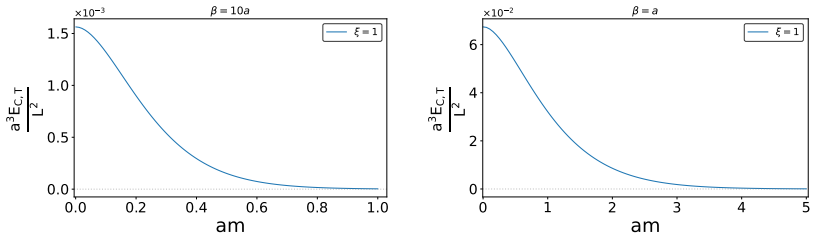
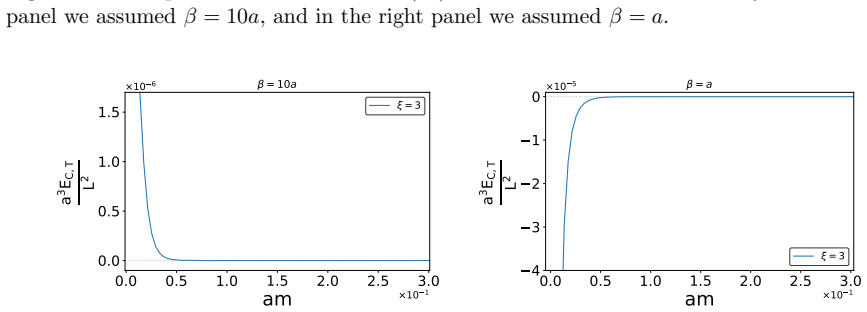
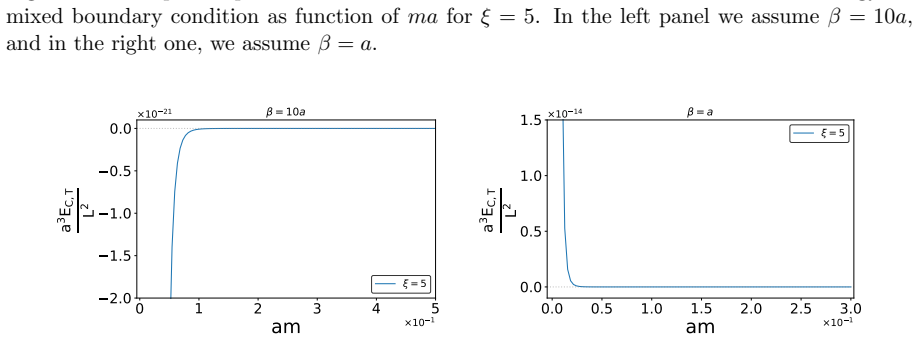
In a Horava-Lifshitz Lorentz-violating scenario, the thermal Casimir energy of a massive scalar field between parallel plates depends on temperature and the violation parameter ξ.
A machine-rendered reading of the paper's core claim, the machinery that carries it, and where it could break.
Core claim
The central discovery is that the Casimir energy in this setup acquires a thermal correction that is sensitive to the Lorentz violation parameter ξ, arising from the altered dispersion relation in the Horava-Lifshitz framework, which changes the allowed modes and thus the regularized sum over zero-point energies at finite temperature.
What carries the argument
The modified dispersion relation from the Horava-Lifshitz Lorentz-violating term, which determines the frequencies of the quantized modes satisfying the boundary conditions on the plates and enters the expression for the thermal Casimir energy.
If this is right
- The Casimir force will exhibit temperature-dependent behavior modified by ξ.
- At zero temperature, the result reduces to a ξ-dependent vacuum energy.
- High-temperature limits may show classical contributions altered by the violation parameter.
- Small ξ allows for perturbative expansions around the standard Casimir result.
Where Pith is reading between the lines
- This approach could be extended to electromagnetic fields or other particles to see if the effect is universal.
- If Lorentz violation is present in nature, it might leave imprints in precision Casimir experiments at elevated temperatures.
- Connections to cosmology could arise if similar mechanisms apply during the early universe when temperatures were high.
Load-bearing premise
The Lorentz-violating Horava-Lifshitz action leads to a dispersion relation that permits a straightforward mode expansion and regularization procedure for the field between the plates.
What would settle it
An explicit calculation showing that the thermal correction vanishes or becomes independent of ξ when the Lorentz violation term is removed from the action would confirm the dependence.
Figures


read the original abstract
The Casimir effect is considered a great triumph of Quantum Field Theory. Originally the Casimir energy was investigated considering the vacuum fluctuation associated with electromagnetic field; however it has also been analyzed considering different type of quantum fields. More recently the Casimir energy was studied in the context of Lorentz symmetry violation. In this work we investigate the effect of finite temperature on the Casmir energy considering a Lorenttz violation symmetry in a Horava-Lifshitz scenario. In this sense we consider a massive scalar quantum field confined in a region between two large and parallel plates. So our main objective is to investigate how, in this Lorentz violation scenario (LV), the Casimir energy depends on the temperature. Another point to be analyzed, is influence of the parameter associated with the LV, $\xi$, in the thermal correction.
Editorial analysis
A structured set of objections, weighed in public.
Referee Report
Summary. The paper computes the finite-temperature Casimir energy for a massive scalar field confined between two parallel plates in a Horava-Lifshitz Lorentz-violating theory. It derives the modified mode spectrum induced by the violation parameter ξ, performs a mode sum with thermal corrections, and analyzes the resulting dependence of the energy on temperature T and ξ after regularization and subtraction of the free-space contribution.
Significance. If the regularization is shown to be robust, the result would provide a concrete example of how higher-derivative dispersion relations from Horava-Lifshitz gravity modify thermal vacuum energies. This is of interest for phenomenological studies of Lorentz violation and for testing the applicability of standard Casimir regularization techniques to non-relativistic UV completions. The explicit ξ and T dependence could serve as a benchmark for future work on modified dispersion relations.
major comments (1)
- The regularization of the mode sum (presumably detailed after the dispersion relation is introduced) must be shown to produce a cutoff-independent finite result after free-space subtraction. The Horava-Lifshitz dispersion introduces higher powers of momentum, which change the large-k asymptotics relative to the standard relativistic case; without an explicit demonstration that residual divergences vanish or that the finite part is scheme-independent, the claimed dependence on ξ and T cannot be considered fully established.
minor comments (1)
- Abstract contains several typographical errors (e.g., 'Casmir', 'Lorenttz', 'symmetry in a Horava-Lifshitz scenario'). These should be corrected for clarity.
Simulated Author's Rebuttal
We thank the referee for the careful reading and constructive feedback on our manuscript concerning the thermal Casimir energy in a Horava-Lifshitz Lorentz-violating background. We address the single major comment below and will revise the manuscript accordingly to strengthen the presentation of our results.
read point-by-point responses
-
Referee: The regularization of the mode sum (presumably detailed after the dispersion relation is introduced) must be shown to produce a cutoff-independent finite result after free-space subtraction. The Horava-Lifshitz dispersion introduces higher powers of momentum, which change the large-k asymptotics relative to the standard relativistic case; without an explicit demonstration that residual divergences vanish or that the finite part is scheme-independent, the claimed dependence on ξ and T cannot be considered fully established.
Authors: We agree that an explicit demonstration of the regularization is essential given the modified large-momentum asymptotics of the Horava-Lifshitz dispersion relation. In the revised manuscript we will insert a dedicated subsection immediately following the derivation of the mode spectrum. There we will (i) expand the dispersion for large transverse momenta, (ii) apply a smooth cutoff regularization to the mode sum, (iii) perform the free-space subtraction analytically, and (iv) verify that all power-law divergences cancel, leaving a cutoff-independent finite remainder. We will also note that the same finite part is recovered when the sum is regularized via the zeta-function method, thereby establishing scheme independence. These additions will make the dependence on ξ and T fully rigorous. revision: yes
Circularity Check
No circularity: model parameter and standard regularization treated as external inputs
full rationale
The paper defines the Lorentz-violating Horava-Lifshitz dispersion relation (with parameter ξ) as an input from the model action, then computes the thermal Casimir energy via mode summation and standard regularization (zeta-function or cutoff) between plates. No equation reduces the final thermal correction to a quantity defined by fitting ξ or by self-citation; the result follows from the imposed boundary conditions and the given spectrum without self-referential closure. The derivation remains self-contained once the action and regularization scheme are accepted as premises.
Axiom & Free-Parameter Ledger
free parameters (1)
- ξ
axioms (2)
- domain assumption The scalar field obeys the wave equation derived from the Horava-Lifshitz action with the chosen Lorentz-violating term.
- domain assumption Boundary conditions are Dirichlet or Neumann on the plates and the regularization (zeta-function or cutoff) is valid for the modified dispersion.
Lean theorems connected to this paper
-
IndisputableMonolith/Foundation/AlexanderDuality.leanalexander_duality_circle_linking unclear?
unclearRelation between the paper passage and the cited Recognition theorem.
The action ... S = 1/2 ∫ dt d^d x (∂0 ϕ ∂0 ϕ − l^{2(ξ−1)} ∂^{i1}...∂^{iξ} ϕ ∂_{i1}...∂_{iξ} ϕ − m² ϕ²) (Eq. 1); modified KG [∂0² + l^{2(ξ−1)} (−1)^ξ (∇²)^ξ + m²] ϕ = 0 (Eq. 2); dispersion ω_{k,n} = l^{ξ−1} √[(k_x² + k_y² + (nπ/a)²)^ξ + v^{2ξ}] (Eq. 11).
-
IndisputableMonolith/Cost/FunctionalEquation.leanwashburn_uniqueness_aczel unclear?
unclearRelation between the paper passage and the cited Recognition theorem.
Thermal correction ET via Abel-Plana on sum over n of ω e^{-jβω} (Eq. 15-16); resulting integrals expressed with K_ν Macdonald functions for arbitrary ξ (Eq. 22,31,38).
What do these tags mean?
- matches
- The paper's claim is directly supported by a theorem in the formal canon.
- supports
- The theorem supports part of the paper's argument, but the paper may add assumptions or extra steps.
- extends
- The paper goes beyond the formal theorem; the theorem is a base layer rather than the whole result.
- uses
- The paper appears to rely on the theorem as machinery.
- contradicts
- The paper's claim conflicts with a theorem or certificate in the canon.
- unclear
- Pith found a possible connection, but the passage is too broad, indirect, or ambiguous to say the theorem truly supports the claim.
Reference graph
Works this paper leans on
-
[1]
H. B. G. Casimir, Indagat. Math 10, 261 (1948); Kon. Ned. Akad. Wetensch. Proc. 51, 793 (1948); Front. Phys. 65, 342 (1987); Kon. Ned. Akad. Wetensch. Proc. 100, N3-4 , 61 (1997)
work page 1948
-
[2]
V. A. Kostelecky and S. Samuel, Phys. Rev. D 39, 683 (1989)
work page 1989
- [3]
-
[4]
Anselmi, Annals of Physics, 874 324 (2009)
D. Anselmi, Annals of Physics, 874 324 (2009)
work page 2009
-
[5]
Anselmi, Annals of Physics, 1058 324 (2009)
D. Anselmi, Annals of Physics, 1058 324 (2009)
work page 2009
-
[6]
M. B. Cruz, E. R. Bezerra de Mello and A. Y. Petrov, Phys. Rev. D 96, 045019 (2017)
work page 2017
-
[7]
M. B. Cruz, E. R. Bezerra De Mello and A. Y. Petrov, Mod. Phys. Lett. A 33, 1850115 (2018)
work page 2018
-
[8]
Andrea Erdas, Int. J. Mod. Phys. A 35, 2050209 (2020)
work page 2020
-
[9]
A. F. Ferrari, H. O. Girotti, M. Gomes, A. Y. Petrov and A. J. da Silva, Mod. Phys. Lett. A 28, 1350052 (2013),
work page 2013
-
[10]
I. J. Morales Ulion, E. R. Bezerra de Mello and A. Y. Petrov, Int. J. Mod. Phys. A 30, 1550220 (2015)
work page 2015
-
[11]
R. V. Maluf, D. M. Dantas and C. A. S. Almeida, Eur. Phys. J. C 80 5, 442 (2020)
work page 2020
-
[12]
A. J. D. Farias, Junior., E. R. B. de Mello and H. Mota, Phys. Rev. D 111 (2025) no.10, 105024
work page 2025
-
[13]
R. A. Dantas, H. F. S. Mota and E. R. Bezerra de Mello, Universe 9, no.5, 241 (2023)
work page 2023
- [14]
-
[15]
Merzbacher, ”Quantum Mechanics”, John Wiley & Sons
E. Merzbacher, ”Quantum Mechanics”, John Wiley & Sons. Inc., New York (1998)
work page 1998
- [16]
-
[17]
A. A. Saharian, The Generalized Abel-Plana formula with applications to Bessel functions and Casimir effect , arXiv:0708.1187
work page internal anchor Pith review Pith/arXiv arXiv
-
[18]
I. S. Gradshteyn and I. M. Ryzhik. Table of Integrals, Series and Products (Academic Press, New York, 1980)
work page 1980
-
[19]
Handbook of Mathematical Functions , edited by M. Abramowitz and I.A. Stegun (Dover, New York, 1972). 16
work page 1972
discussion (0)
Sign in with ORCID, Apple, or X to comment. Anyone can read and Pith papers without signing in.