REVIEW 5 major objections 5 minor 28 references
Diffusion-Modeled Reinforcement Learning for Carbon and Risk-Aware Microgrid Optimization
T0 review · 5 major / 5 minor · reviewed 2026-08-06 · deepseek-v4-flash
Pith's one-line read DiffCarl claims a diffusion-modeled RL controller cuts microgrid cost, carbon, and tail risk together.
desk verdict DiffCarl is a competent engineering application of diffusion policies to microgrid scheduling, but the headline carbon claim is arithmetically wrong and the risk-aware critic update is undefined as written. read the letter →
The pith
A machine-rendered reading of the paper's core claim, the machinery that carries it, and where it could break.
The reading
What carries the argument
The load-bearing object is a Denoising Diffusion Probabilistic Model (DDPM) used as the actor: a generative model that learns to reverse a Markov chain which gradually adds Gaussian noise, so that starting from pure noise and conditioning on the current state it produces a sample from the action distribution. In DiffCarl this actor replaces the standard stochastic policy network of soft actor-critic; the paper also uses double critics, target networks, and soft updates from that framework, and adds a risk-adjusted Q-function whose temporal-difference target applies CVaR to the min over the two critics' target values. The diffusion actor is what carries the expressiveness argument; the CVaR target is what carries the risk argument.
What would settle it
The decisive experiment is a controlled ablation: train DiffCarl on the two-microgrid case with the diffusion actor replaced by a Gaussian stochastic actor while keeping the CVaR-based critic, reward, and all hyper-parameters identical, then compare cost, carbon, and the empirical 5% CVaR of daily costs; if the reported gains vanish, the diffusion-modeled policy is the load-bearing component, and if they persist, the risk-aware critic alone may explain the results.
Extended reading notes
Core claim
On its own terms, DiffCarl is a claim that the policy class matters more than the optimization recipe: replacing a conventional Gaussian policy with a diffusion-modeled policy inside soft actor-critic improves scheduling enough to beat day-ahead optimization, myopic greedy, MPC, DQN, SAC, and DDPG on operating cost across a two-microgrid community and the IEEE 15-bus and 33-bus feeders, while coming within about 2% of an offline optimal schedule on the two-microgrid case. The same framework also reports 28.7% lower carbon emissions than its carbon-unaware counterpart, and risk-averse settings ($\lambda = 1$) reduce the standard deviation of daily cost by 21% relative to the risk-neutral policy at a moderate cost premium. In the paper's formulation, carbon is priced into the reward, and the risk term is the Conditional Value at Risk of the cost distribution, so the policy is trained to avoid the worst 5% of days as well as to minimize average cost. The authors read these results as evidence that generative modeling of action distributions is a practical route to sustainable, resilient microgrid operation.
Load-bearing premise
The paper assumes, without showing a derivation, that its risk-adjusted Q-learning update really minimizes the stated objective of average cost plus a penalty on the worst 5% of days; the risk-awareness results rest entirely on that assumption.
Editorial extensions
If this is right
- DiffCarl's reported 2.3% to 30.1% cost reduction over DQN, SAC, DDPG, day-ahead, myopic, and MPC baselines would mean a learned controller can beat both optimization and prior RL baselines without needing accurate forecasts.
- The 28.7% carbon reduction versus the carbon-unaware variant implies that pricing carbon into the reward changes dispatch behavior substantially, shifting purchases away from carbon-intensive sources.
- The 98.2% approximation of the offline-optimal schedule on the two-microgrid case suggests the model can approach the theoretical cost bound in real time.
- Risk-averse settings cutting cost standard deviation by up to 21% at a modest premium would give operators a tunable knob for worst-case budgeting.
- Consistent improvements on IEEE 15-bus and 33-bus feeders suggest the approach scales with system size.
Reading between the lines
- A direct ablation replacing the diffusion actor with a Gaussian stochastic actor, keeping the same CVaR critic and reward, would isolate whether the reported gains come from diffusion-model expressiveness or from other framework details; the paper does not include this ablation.
- The risk-sensitive update in Eq. (19) is not derived from a distributional RL objective; until it is, the risk results should be read as empirical tuning behavior rather than a proof that the controller minimizes CVaR.
- If the diffusion actor is the source of the advantage, the same module could transfer to other continuous-action energy tasks such as battery storage arbitrage or smart-manufacturing scheduling, since only state, action, and reward need redefining.
- The 28.7% carbon figure is relative to the carbon-unaware variant of the same algorithm, so absolute emissions reductions in deployment would depend on carbon prices and grid carbon intensity.
Editorial analysis
A structured set of objections, weighed in public.
Referee Report
Summary. The paper proposes DIFFCARL, an actor-critic algorithm in which the actor is a denoising diffusion model and the critic is trained with a CVaR-modified target, for scheduling ESS, CDG, and load shedding in a multi-microgrid community. The reward includes an operating-cost term with a carbon price, and the policy is regularized with entropy and risk terms. The authors compare against DAY-AHEAD, MYOPIC, MPC, DQN, SAC, and DDPG on a 2-microgrid case and IEEE 15/33-bus systems, reporting lower cost and carbon, and study risk sensitivity by varying lambda. The central claims are that DIFFCARL reduces cost by 2.3-30.1%, carbon by 28.7% versus its carbon-unaware variant, and performance variability.
Significance. Addressing an important application domain, and combining diffusion-modeled policies with carbon- and risk-aware objectives is a timely idea. The experimental setup is reasonably broad (three test systems, real and synthetic data), and the case study provides a useful qualitative check. However, the paper does not provide a well-defined risk-sensitive Q-target, does not define a valid entropy/log-probability for the continuous diffusion policy, and contains an arithmetic inconsistency in its headline carbon claim. No code, seeds, or error bars are reported. As a result, the significance of the contribution cannot be established on the evidence presented; the manuscript is not ready for publication. The idea may be salvageable with a correct distributional/risk formulation and rigorous experiments, but those are substantial missing elements.
major comments (5)
- [§II.C.2, Eq. (19); Algorithm 1 line 17] The CVaR-based target yCVaR = r + γ·CVaR_α(min_i Q̂(s',a') − α_ent log π̂(s')) applies CVaR to a quantity that, for a single transition, is a scalar; no return distribution over which the CVaR is computed is defined. If the CVaR is estimated across the batch D, then the target for one state-action pair is contaminated by transitions from other states, so the update is not a Bellman-style target for any per-state action-value function; if it is estimated from repeated action samples, it still lacks a derivation connecting it to the day-level CVaR objective in Eq. (3). The risk-awareness and variability-reduction claims in Section III.D.2 are therefore unsupported as written. A correct implementation requires an explicit distributional RL or augmented-state CVaR formulation, together with a derivation that the update optimizes Eq. (3).
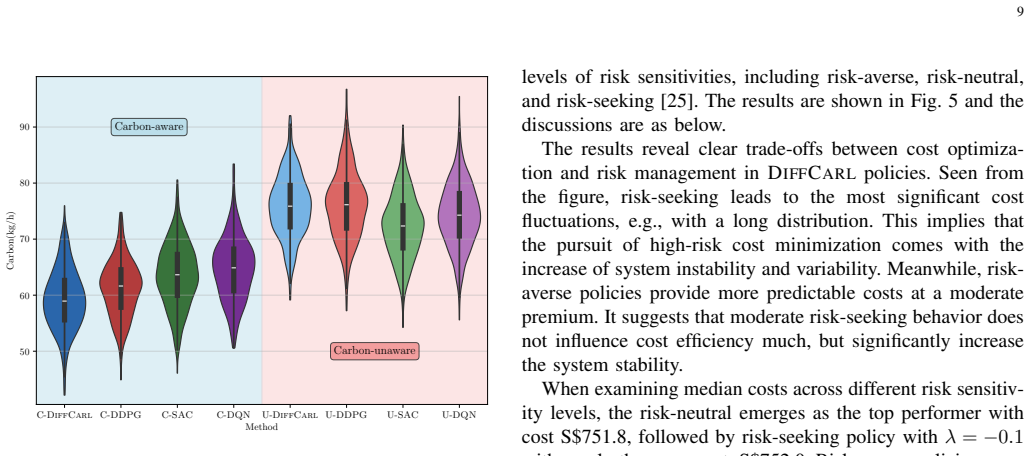
- [Abstract; §III.D.1; §IV] The headline claim of 28.7% lower carbon emissions is contradicted by the paper's own numbers: C-DIFFCARL at 59.3 kg/h versus U-DIFFCARL at 64.7 kg/h is a reduction of about 8.3% (or 9.1% relative to the lower value), not 28.7%. This error appears in the abstract, in Section III.D.1, and in the conclusion, and it changes the paper's principal quantitative claim; it must be corrected and the remaining results re-evaluated.
- [§II.C.1, Eqs. (16)-(17); Algorithm 1 line 11] The actor objective maximizes πθ^T Q^risk + α_ent H with H(πθ) = −πθ^T log πθ, but the paper never defines how the probability density or differential entropy of the continuous diffusion policy is computed. In Algorithm 1, line 11, πθ(s) is said to be calculated from x0 via a softmax function; this is not meaningful for a continuous action vector. A valid diffusion policy update requires either the change-of-variables formula for log πθ over the denoising chain or a reparameterized sample-based objective; without this, Eq. (17) is not a well-defined policy-gradient update.
- [Table IV; Figs. 3-5; §III.C.2] All performance comparisons are presented as single numbers or single distributions, with no number of random seeds, no error bars, and no significance tests. The claims of stable convergence in Fig. 3 and reduced variability in Fig. 5 cannot be assessed from a single run; the 'reduces performance variability' part of the contribution is not statistically supported.
- [§III.D.2] The authors vary the risk coefficient λ and then declare that λ=0.1 is optimal based on the same test results shown in Fig. 5; no hold-out or cross-validation procedure is described. This is a test-set selection step, so the conclusion that a moderate risk preference is optimal is not a predictive statement about generalization.
minor comments (5)
- [Eq. (21)] The relative cost metric is defined as (C_DIFFCARL − C_COMP)/C_DIFFCARL × 100% with negative values meaning DIFFCARL is better, but the table heading 'Improv.' with negative numbers is confusing; please clarify the sign convention or relabel the column as 'Relative cost difference'.
- [Algorithm 1, line 17] The word 'retrun' should be 'return'.
- [Fig. 2b] The legend uses 'DiffCarl' and 'Ideal' rather than 'DIFFCARL' and 'OFFLINE'; please align notation with the rest of the paper.
- [Eq. (12)] The tanh squashing of the noise prediction bounds reconstructed actions to [-1,1], but no explicit action normalization or rescaling to the physical power limits in Table I is described; please clarify.
- [Section II.A.4, Eq. (4)] The CVaR risk term is defined on Cost, while the RL objective in Eq. (3) is written as a maximization over rewards; please state the sign convention relating cost and reward to avoid ambiguity.
Circularity Check
No significant circularity: DiffCarl's cost, carbon, and risk results are empirical simulation outcomes, and the paper's few self-citations are background only; the under-specified CVaR update in Eq. (19) is an omitted justification, not a circular reduction.
full rationale
DiffCarl does not derive its headline results from its own assumptions in a way that makes them true by construction. Table IV and Figures 3-5 compare policies by simulation on a held-out test period, with DIFFCARL trained on separate data; no fitted parameter is renamed as a prediction. The carbon-aware versus carbon-unaware comparison is an ablation: Table I adds a carbon price (ρCarbon = 0.025 S$/kg) and carbon densities to the reward, so lower emissions in C-DiffCarl are aligned with the optimization objective, but the algorithm still has to learn the trade-off, and all carbon-aware baselines are compared under the same reward; this is not an identity such as Eq. X = Eq. Y. The risk-sensitivity analysis varies λ and reports the resulting cost distributions; Eq. (19) applies CVaR to a scalar TD target, and Algorithm 1 says to 'Estimate the αCVaR-quantile of the target retrun distribution for each (s,a)' without defining that distribution, so the link between Eq. (19) and the CVaR objective in Eq. (3) is asserted rather than derived. That is an omitted proof or design gap, but the paper does not claim Eq. (19) is implied by Eq. (3) in a self-referential way; it is an empirical claim about the trained policies. Self-citations ([12], [13], [20]) appear only in the introduction as motivation and background and are not load-bearing; no uniqueness theorem is imported from the authors' prior work. Separately, the abstract's 28.7% carbon claim is inconsistent with the quoted 59.3 and 64.7 kg/h values (about 8.4% reduction), which is a correctness and reproducibility concern, not a circularity.
Assumptions & free parameters
free parameters (6)
- λrisk (risk sensitivity coefficient) =
0.1
- αCVaR (CVaR confidence level) =
0.95
- αent (entropy temperature) =
0.05
- K (denoising steps) =
10
- ρCarbon (carbon price) =
0.025 S$/kg CO2
- Carbon densities [ωCDG, ωGrid] =
[0.9, 0.412] kg CO2/kWh
assumptions (4)
- ad hoc to paper The tanh-modified reverse reconstruction in Eq (12) yields valid samples from the optimal action distribution.
- ad hoc to paper The CVaR target in Eq (19) correctly estimates the Q-function for the risk-sensitive objective in Eq (3).
- domain assumption The microgrid environment in Section III.A (cost coefficients, ramp rates, carbon parameters in Table I) is representative enough to support general performance claims.
- standard math Standard DDPM theory and soft actor-critic convergence properties apply to the proposed architecture.
Cite this review
Pith. "Pith review of Diffusion-Modeled Reinforcement Learning for Carbon and Risk-Aware Microgrid Optimization." pith.science (2026). https://pith.science/paper/U7ZIK2QU
@misc{pith2026250716867,
  author       = {Pith},
  title        = {Pith review of: Diffusion-Modeled Reinforcement Learning for Carbon and Risk-Aware Microgrid Optimization},
  year         = {2026},
  howpublished = {\url{https://pith.science/paper/U7ZIK2QU}},
  note         = {Machine review of arXiv:2507.16867}
}
read the original abstract
This paper introduces DiffCarl, a diffusion-modeled carbon- and risk-aware reinforcement learning algorithm for intelligent operation of multi-microgrid systems. With the growing integration of renewables and increasing system complexity, microgrid communities face significant challenges in real-time energy scheduling and optimization under uncertainty. DiffCarl integrates a diffusion model into a deep reinforcement learning (DRL) framework to enable adaptive energy scheduling under uncertainty and explicitly account for carbon emissions and operational risk. By learning action distributions through a denoising generation process, DiffCarl enhances DRL policy expressiveness and enables carbon- and risk-aware scheduling in dynamic and uncertain microgrid environments. Extensive experimental studies demonstrate that it outperforms classic algorithms and state-of-the-art DRL solutions, with 2.3-30.1% lower operational cost. It also achieves 28.7% lower carbon emissions than those of its carbon-unaware variant and reduces performance variability. These results highlight DiffCarl as a practical and forward-looking solution. Its flexible design allows efficient adaptation to different system configurations and objectives to support real-world deployment in evolving energy systems.
Figures


Figures from the paper (2 more)

Reference graph
Works this paper leans on
-
[1]
Research and prospect of multi- microgrid control strategies,
N. Zhi, X. Xiao, P. Tian, and H. Zhang, “Research and prospect of multi- microgrid control strategies,” Electric Power Automation Equipment , vol. 36, pp. 107–115, 04 2016
work page 2016
-
[2]
Z. Li and Y . Xu, “Optimal coordinated energy dispatch of a multi-energy microgrid in grid-connected and islanded modes,” Applied Energy , vol. 210, pp. 974–986, 2018. [Online]. Available: https://www.sciencedirect.com/science/article/pii/S0306261917312230
work page 2018
-
[3]
Minlp probabilistic scheduling model for demand response programs integrated energy hubs,
M. Alipour, K. Zare, and M. Abapour, “Minlp probabilistic scheduling model for demand response programs integrated energy hubs,” IEEE Transactions on Industrial Informatics , vol. 14, no. 1, pp. 79–88, 2017
work page 2017
-
[4]
Robust optimal power management system for a hybrid ac/dc micro-grid,
M. Hosseinzadeh and F. R. Salmasi, “Robust optimal power management system for a hybrid ac/dc micro-grid,” IEEE Transactions on Sustainable Energy, vol. 6, no. 3, pp. 675–687, 2015
work page 2015
-
[5]
D. Thomas, O. Deblecker, and C. S. Ioakimidis, “Optimal operation of an energy management system for a grid-connected smart building considering photovoltaics’ uncertainty and stochastic electric vehicles’ driving schedule,” Applied Energy, vol. 210, pp. 1188–1206, 2018
work page 2018
-
[6]
A model predictive control approach to microgrid operation optimization,
A. Parisio, E. Rikos, and L. Glielmo, “A model predictive control approach to microgrid operation optimization,” IEEE Transactions on Control Systems Technology, vol. 22, no. 5, pp. 1813–1827, 2014
work page 2014
-
[7]
M. Petrollese, L. Valverde, D. Cocco, G. Cau, and J. Guerra, “Real- time integration of optimal generation scheduling with mpc for the energy management of a renewable hydrogen-based microgrid,” Applied Energy, vol. 166, pp. 96–106, 2016
work page 2016
-
[8]
P. Tian, X. Xiao, K. Wang, and R. Ding, “A hierarchical energy management system based on hierarchical optimization for microgrid community economic operation,” IEEE Transactions on Smart Grid , vol. 7, no. 5, pp. 2230–2241, 2015
work page 2015
Show all 28 references
-
[9]
Distributed optimal energy management of a microgrid community,
Y . Liu, S. Gao, C. Xiang, M. Yu, and K. T. Tan, “Distributed optimal energy management of a microgrid community,” in 2022 IEEE 17th International Conference on Control & Automation (ICCA) . IEEE, 2022, pp. 832–837
2022
-
[10]
Double deep q-learning- based distributed operation of battery energy storage system considering uncertainties,
V .-H. Bui, A. Hussain, and H.-M. Kim, “Double deep q-learning- based distributed operation of battery energy storage system considering uncertainties,” IEEE Transactions on Smart Grid , vol. 11, no. 1, pp. 457–469, 2019
2019
-
[11]
Drl-hems: Deep reinforcement learning agent for demand response in home energy management systems considering customers and operators perspectives,
A. A. Amer, K. Shaban, and A. M. Massoud, “Drl-hems: Deep reinforcement learning agent for demand response in home energy management systems considering customers and operators perspectives,” IEEE Transactions on Smart Grid , vol. 14, no. 1, pp. 239–250, 2022
2022
-
[12]
Online optimal power scheduling of a microgrid via imitation learning,
S. Gao, C. Xiang, M. Yu, K. T. Tan, and T. H. Lee, “Online optimal power scheduling of a microgrid via imitation learning,” IEEE Transac- tions on Smart Grid , vol. 13, no. 2, pp. 861–876, 2021
2021
-
[13]
Online cooper- ative optimal power scheduling of multiple microgrids via hierarchical imitation learning,
Y . Zhao, S. Gao, J. Wang, C. Li, M. Yu, and C. Xiang, “Online cooper- ative optimal power scheduling of multiple microgrids via hierarchical imitation learning,” in 2024 IEEE 18th International Conference on Control & Automation (ICCA) . IEEE, 2024, pp. 30–35
2024
-
[14]
Multi-agent imitation learning based energy management of a microgrid with hybrid energy storage and real-time pricing,
S. Gao, Y . Xu, Z. Zhang, Z. Wang, X. Zhou, and J. Wang, “Multi-agent imitation learning based energy management of a microgrid with hybrid energy storage and real-time pricing,” IEEE Internet of Things Journal , 2025
2025
-
[15]
Imitation learning via off- policy distribution matching,
I. Kostrikov, O. Nachum, and J. Tompson, “Imitation learning via off- policy distribution matching,” arXiv preprint arXiv:1912.05032 , 2019
1912 arXiv
-
[16]
A novel model-free deep reinforcement learning framework for energy manage- ment of a pv integrated energy hub,
A. Dolatabadi, H. Abdeltawab, and Y . A.-R. I. Mohamed, “A novel model-free deep reinforcement learning framework for energy manage- ment of a pv integrated energy hub,” IEEE Transactions on Power Systems, vol. 38, no. 5, pp. 4840–4852, 2022
2022
-
[17]
A data-driven drl-based home energy management system optimization framework considering uncertain household parameters,
K. Ren, J. Liu, Z. Wu, X. Liu, Y . Nie, and H. Xu, “A data-driven drl-based home energy management system optimization framework considering uncertain household parameters,” Applied Energy, vol. 355, p. 122258, 2024
2024
-
[18]
Coordinated operation of active distribution network, networked microgrids, and electric vehicle: A multi-agent ppo optimization method,
W. Shi, D. Zhang, X. Han, X. Wang, T. Pu, and W. Chen, “Coordinated operation of active distribution network, networked microgrids, and electric vehicle: A multi-agent ppo optimization method,” CSEE Journal of Power and Energy Systems , 2023
2023
-
[19]
Scalable and privacy-preserving distributed energy management for multimicrogrid,
Y . Zhang, J. Hu, G. Min, and X. Chen, “Scalable and privacy-preserving distributed energy management for multimicrogrid,” IEEE Transactions on Industrial Informatics , 2024
2024
-
[20]
Diffusion-based Reinforcement Learning for Edge-enabled AI-Generated Content Services,
H. Du, Z. Li, D. Niyato, J. Kang, Z. Xiong, H. Huang, and S. Mao, “Diffusion-based Reinforcement Learning for Edge-enabled AI-Generated Content Services,” Mar. 2023. [Online]. Available: https://arxiv.org/abs/2303.13052v3
2023 arXiv
-
[21]
Two-Step Diffusion Policy Deep Reinforcement Learning Method for Low-Carbon Multi-Energy Microgrid Energy Management,
Y . Zhang, Z. Mei, X. Wu, H. Jiang, J. Zhang, and W. Gao, “Two-Step Diffusion Policy Deep Reinforcement Learning Method for Low-Carbon Multi-Energy Microgrid Energy Management,” IEEE Transactions on Smart Grid , vol. 15, no. 5, pp. 4576–4588, Sep. 2024, conference Name: IEEE T...
2024
-
[22]
Soft actor-critic: Off- policy maximum entropy deep reinforcement learning with a stochastic actor,
T. Haarnoja, A. Zhou, P. Abbeel, and S. Levine, “Soft actor-critic: Off- policy maximum entropy deep reinforcement learning with a stochastic actor,” in International conference on machine learning . PMLR, 2018, pp. 1861–1870
2018
-
[23]
Risk-sensitive reinforcement learning,
Y . Shen, M. J. Tobia, T. Sommer, and K. Obermayer, “Risk-sensitive reinforcement learning,” Neural computation, vol. 26, no. 7, pp. 1298– 1328, 2014
2014
-
[24]
Risk-sensitive soft actor-critic for robust deep reinforcement learning under distribution shifts,
T. Enders, J. Harrison, and M. Schiffer, “Risk-sensitive soft actor-critic for robust deep reinforcement learning under distribution shifts,” arXiv preprint arXiv:2402.09992, 2024
2024 arXiv
-
[25]
Epistemic risk-sensitive reinforce- ment learning,
H. Eriksson and C. Dimitrakakis, “Epistemic risk-sensitive reinforce- ment learning,” arXiv preprint arXiv:1906.06273 , 2019
1906 arXiv
-
[26]
Dsac: Distributional soft actor-critic for risk-sensitive reinforcement learning,
X. Ma, J. Chen, L. Xia, J. Yang, Q. Zhao, and Z. Zhou, “Dsac: Distributional soft actor-critic for risk-sensitive reinforcement learning,” Journal of Artificial Intelligence Research , vol. 83, 2025
2025
-
[27]
Denoising diffusion probabilistic models,
J. Ho, A. Jain, and P. Abbeel, “Denoising diffusion probabilistic models,” Advances in neural information processing systems , vol. 33, pp. 6840– 6851, 2020
2020
-
[28]
Deep-reinforcement-learning-based capacity scheduling for pv-battery storage system,
B. Huang and J. Wang, “Deep-reinforcement-learning-based capacity scheduling for pv-battery storage system,” IEEE Transactions on Smart Grid, vol. 12, no. 3, pp. 2272–2283, 2020
2020
Reviewed August 6, 2026 · model on record in the stance chip above.
Discussion (0). Continue with ORCID to comment.