REVIEW 4 major objections 6 minor 69 references
Scalable DC Optimization via Adaptive Frank-Wolfe Algorithms
T0 review · 4 major / 6 minor · reviewed 2026-08-06 · deepseek-v4-flash
Pith's one-line read This paper claims that a warm-started BPCG with an adaptive error bound solves constrained difference-of-convex problems far more efficiently than standard Frank-Wolfe DCA, with speedups often exceeding 100-fold.
desk verdict Solid computational study showing large speedups from warm-started BPCG with adaptive early stopping for FW-based DCA; the theory is borrowed, the empirical case is strong but needs sensitivity analysis and code. read the letter →
The pith
A machine-rendered reading of the paper's core claim, the machinery that carries it, and where it could break.
The reading
What carries the argument
The load-bearing mechanism is the adaptive error bound (3.3): solve the inner convex subproblem $\min_{x\in P}\hat\Phi_t(x)$ only until its Frank-Wolfe gap at the candidate iterate $y$ is at most $\Phi(x_t)-\hat\Phi_t(y)$. By an arithmetic-geometric crossover, this inexactness preserves a multiplicative factor $1/2$ of the DC gap as guaranteed progress, replacing the additive $\varepsilon$ error of Theorem 3.1 and removing the need to preselect $\varepsilon$. The second piece is BPCG, an active-set Frank-Wolfe variant that supports warm-starting by reusing the active set from the previous DCA subproblem, which is nearly identical near convergence.
What would settle it
Run the DCA-BPCG-WS-ES variant against the fixed-tolerance DCA-FW baseline on the same DC quadratic instances but with the baseline's inner tolerance relaxed to, say, $10^{-3}$; if the LMO-call and wall-clock advantages shrink to a small constant, the reported order-of-magnitude gains depend on the baseline's accuracy setting.
Extended reading notes
Core claim
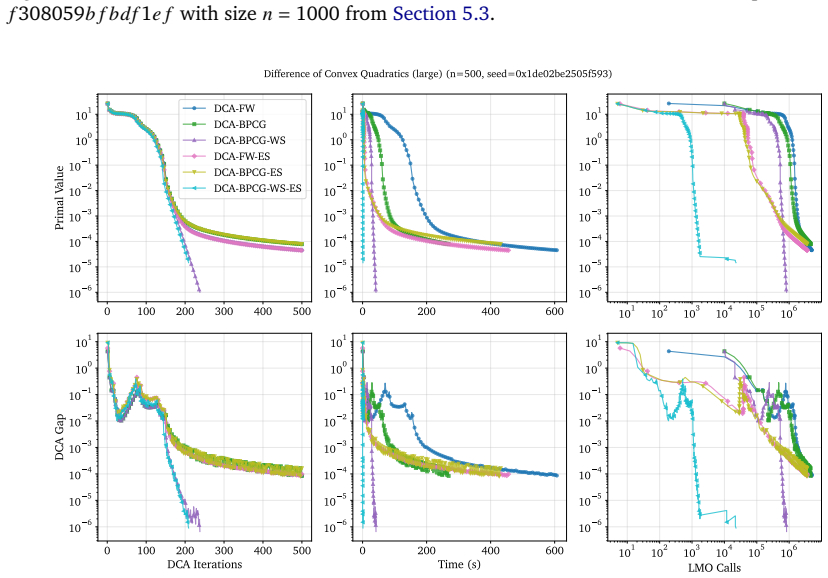
The central claim is that the adaptive error bound criterion (3.3), which stops the inner Frank-Wolfe solver as soon as the subproblem's Frank-Wolfe gap falls below $\Phi(x_t)-\hat\Phi_t(y)$, removes the need to choose a subproblem tolerance $\varepsilon$ while keeping an $O(1/T)$ convergence rate in the DC gap (Theorem 3.2, reproduced from Maskan et al. [2025]). When this criterion is paired with BPCG and warm-starting, reusing the previous iterate and its active set, each DCA iteration becomes very cheap and the number of LMO calls collapses. Across all tested instances excluding QAP, the combined DCA-BPCG-WS-ES variant attains a DC gap below $10^{-6}$ with geometric-mean speedups over DCA-FW exceeding factors of 100 in time and often several orders of magnitude in LMO calls.
Load-bearing premise
The comparison assumes the fixed inner tolerance $10^{-6}/2$ used for the non-early-stopping baselines is representative of typical prior practice; if typical users use a coarser inner tolerance, the adaptive early-stopping advantage would shrink.
Editorial extensions
If this is right
- The adaptive criterion (3.3) removes the need to preset a subproblem tolerance $\varepsilon$, so users no longer trade outer accuracy against inner cost by hand.
- Because warm-starting reuses the previous active set, the method is cheapest exactly where it matters most: the final DCA iterations, when consecutive subproblems are nearly identical.
- The $O(1/T)$ worst-case rate in the DC gap survives the early stopping, with only a factor-2 slowdown in outer iterations that is outweighed by much cheaper inner solves.
- On Quadratic Assignment instances over the Birkhoff polytope, the combined variant reaches the DCA iteration limit with far fewer Hungarian-method LMO calls than the baselines.
Reading between the lines
- The same adaptive early-stopping criterion should transfer to stochastic or block-coordinate Frank-Wolfe subsolvers, since it only requires a Frank-Wolfe gap estimate at each inner iterate.
- Adding lazification to BPCG, which the paper deliberately skipped to keep tight gap control, could reduce LMO calls further when the linear oracle is expensive, such as the Hungarian method in QAP.
- The QAP experiments suggest the relaxed Birkhoff solution might be rounded to feasible assignments, but the paper does not evaluate rounding quality or the gap to the integer optimum.
- The boosted-DCA line search showed no extra gain here, but a line search on the DC gap itself, rather than on the inner convex surrogate, could still cut outer iterations without extra LMO calls.
Editorial analysis
A structured set of objections, weighed in public.
Referee Report
Summary. The paper proposes a practical framework for constrained difference-of-convex (DC) minimization, combining the DCA outer loop with advanced Frank-Wolfe subsolvers, specifically Blended Pairwise Conditional Gradients (BPCG), warm-starting, and an adaptive subproblem stopping criterion attributed to Maskan et al. (2025). It reproduces the adaptive error-bound theorem (Theorem 3.2), presents a modular algorithmic template (Algorithm 2), and reports an extensive computational study on DC quadratics, hard exponential/logistic DC instances, and QAPLIB instances. The central empirical claim is that the DCA-BPCG-WS-ES variant reduces LMO calls by orders of magnitude and runtime by factors exceeding 100 relative to previous Frank-Wolfe-based DCA variants.
Significance. If the reported gains are robust, the paper delivers a practically valuable recipe: a parameter-free adaptive subproblem tolerance, built on the open-source FrankWolfe.jl toolbox, that scales to Birkhoff-polytope problems with n up to 256. The experimental scope is broad and the results are internally consistent across problem classes, and the theoretical backbone (adaptive inexact DCA) is correctly attributed to and reproduced from Maskan et al. (2025). The main open question is whether the headline speedups are an artifact of the asymmetric subproblem tolerances used for the fixed-tolerance baselines; this is a testable empirical issue rather than an internal inconsistency.
major comments (4)
- [Section 5.1 and Tables 1, 3, 4, 5; Figure 1] The comparison between ES and non-ES variants is asymmetric. The non-ES baselines are stopped only when the inner Frank-Wolfe gap is below 10^{-6}/2, while the ES variants stop as soon as condition (3.3) holds, i.e., when the inner FW gap is at most the realized DCA progress Phi(x_t) - hatPhi_t(x_{t+1}), which is at least the DC gap Delta_t and can be orders of magnitude larger than 10^{-6}/2 in early outer iterations. Since FW-type methods require on the order of 1/gap iterations to reach a given gap, the fixed-tolerance baselines are forced to spend many LMO calls on early subproblems that the adaptive rule correctly identifies as needing little accuracy. The reported LMO reductions and runtime speedups may therefore largely reflect the choice of 10^{-6}/2 rather than an intrinsic advantage of the adaptive rule. Please add a sensitivity study in which DCA-BPCG-WS and DCA-FW are run with fixed subproblem tolerances of, e.g., 10^{-3}, 10^{-4}, and 10^{-5}, and report whether the qualitative conclusions of Table 1 and Figure 1 survive.
- [Section 5.5 and Appendix A] The QAP experiment is based on only 97 of the 136 QAPLIB instances; the 39 excluded instances are not a random subsample. The list in Appendix A includes all sko100a-f, sko42-90, several lipa instances, nug30, and ste36a-c, i.e., many of the largest and structurally distinct instances. This selection can bias the performance profiles in Figures 5 and 6 and the corresponding rows of Table 5. Please report the size and family distribution of the excluded instances, and either repair the parser or demonstrate that the parsing failures are independent of instance size and family; ideally rerun the affected families.
- [Section 1 and Section 5] The paper frames the contribution as projection-free scalability and states that traditional projection-based methods are computationally prohibitive, but no projection-based DCA baseline is included in the experiments. On the Birkhoff polytope, projections are expensive but feasible at the tested dimensions (n <= 256), so a comparison against DCA with projected gradient or accelerated projected gradient on the convex subproblems would directly substantiate the scalability claim. Without such a comparison, the 'previously out of reach' claim relative to standard DCA practice is not fully supported by the data.
- [Section 5] The code for the experiments is not released; the paper states that it 'will be made separately available on GitHub.' Since the central contribution is an empirical claim about large speedups, the absence of runnable scripts, exact random seeds (only hashes are shown), and version-pinned dependencies makes the specific numbers in Tables 1-5 difficult to verify. For a computational study, releasing the experiment harness is a necessary condition for the reproducibility of the headline claims.
minor comments (6)
- [Section 3] There is a typo: 'One the one hand' should be 'On the one hand'.
- [Section 5.1] The stopping-rule description is ambiguous: 'we stop with a Frank-Wolfe gap less than 10^{-6}/2 or when the adaptive error bound is satisfied, for those variants using it' could be read as the ES variants also requiring the 10^{-6}/2 gap. Please clarify that the ES variants stop purely on condition (3.3).
- [Section 5.5] There are typos: 'signficantly' should be 'significantly', and 'see Table 2 and Figure 2 and Figure 3' repeats 'Figure 3' in Section 5.3.
- [Table 5] Several rows of Table 5 are misaligned in the text (e.g., n=26, n=50, n=64, n=100, n=128), with apparent duplicate or missing column entries. Please reformat the table.
- [Section 5.2 and Abstract] The claim of 'runtime speedups exceeding factors of 100' is an overgeneralization: in Table 5, several size brackets (e.g., n=128, n=150, n=256) show comparable or worse times for DCA-BPCG-WS-ES relative to the baselines. Suggest adding qualifiers that reflect instance-to-instance variability.
- [Table 1 vs Tables 3 and 4] The composition of the 'all instances (excluding QAP)' set should be described more precisely; for sizes n=600-1000, Table 1 appears to contain only the large-quadratic instances from Table 3, while smaller sizes combine multiple suites. Stating this explicitly would help interpretation.
Circularity Check
No load-bearing circularity: Theorem 3.2 is proved from its stated assumption, and the headline speedups are measured against external benchmarks; the fixed 1e-6/2 baseline is a comparison-protocol concern, not a fitted input.
full rationale
The paper's convergence claim (Theorem 3.2) is not circular: it takes the adaptive stopping condition (3.3) as an explicit assumption, proves by a short algebraic argument that this assumption implies the rate O(1/T), and reproduces the proof in full. This is a standard conditional guarantee, not an import of the conclusion via citation. The theorem is attributed to Maskan et al. [2025], which has no author overlap with the present paper, so the citation is independent evidence. The central empirical claim—that DCA-BPCG-WS-ES reduces LMO calls and runtime—is a measured comparison on random instances and the external QAPLIB benchmark, not a quantity derived from the paper's own assumptions. The many self-citations (BPCG, FrankWolfe.jl, secant line search) justify the choice of algorithmic components and software, but the speedups are observed, not inferred from those references. The skeptic's concern about the fixed Frank-Wolfe subproblem tolerance of 1e-6/2 for non-ES baselines (Section 5.1) is a legitimate question of experimental fairness: a coarser baseline tolerance might reduce the reported speedup magnitudes. However, that is a comparison-protocol issue, not circularity. No equation reduces to its own input by construction, and no fitted parameter is renamed as a prediction. The paper is self-contained against external benchmarks, so it scores in the 0-2 range.
Assumptions & free parameters
free parameters (3)
- Fixed subproblem Frank-Wolfe gap tolerance (non-ES baselines) =
10^{-6}/2
- DCA gap target =
10^{-6}
- Inner iteration limits =
10000 to 50000 depending on experiment
assumptions (4)
- domain assumption Existence of an exact linear minimization oracle over P
- domain assumption f is L_f-smooth convex and g is L_g-Lipschitz convex
- standard math Adaptive error bound theorem (Theorem 3.2) of Maskan et al. [2025]
- standard math BPCG convergence properties from Tsuji et al. [2022] and Braun et al. [2025]
Cite this review
Pith. "Pith review of Scalable DC Optimization via Adaptive Frank-Wolfe Algorithms." pith.science (2026). https://pith.science/paper/2FAL7C5P
@misc{pith2026250717545,
  author       = {Pith},
  title        = {Pith review of: Scalable DC Optimization via Adaptive Frank-Wolfe Algorithms},
  year         = {2026},
  howpublished = {\url{https://pith.science/paper/2FAL7C5P}},
  note         = {Machine review of arXiv:2507.17545}
}
abstract
We consider the problem of minimizing a difference of (smooth) convex functions over a compact convex feasible region $P$, i.e., $\min_{x \in P} f(x) - g(x)$, with smooth $f$ and Lipschitz continuous $g$. This computational study builds upon and complements the framework of Maskan et al. [2025] by integrating advanced Frank-Wolfe variants to reduce computational overhead. We empirically show that constrained DC problems can be efficiently solved using a combination of the Blended Pairwise Conditional Gradients (BPCG) algorithm [Tsuji et al., 2022] with warm-starting and the adaptive error bound from Maskan et al. [2025]. The result is a highly efficient and scalable projection-free algorithm for constrained DC optimization.
Figures


Figures from the paper (16 more)




Reference graph
Works this paper leans on
-
[1]
On the rate of convergence of the difference-of-convex algorithm ( DCA )
Abbaszadehpeivasti, H., de Klerk, E., and Zamani, M. On the rate of convergence of the difference-of-convex algorithm ( DCA ). Journal of Optimization Theory and Applications, pp.\ 1--22, 2023
work page 2023
-
[2]
An, L. T. H. and Tao, P. D. Solving a class of linearly constrained indefinite quadratic problems by DC algorithms. Journal of global optimization, 11: 0 253--285, 1997
work page 1997
-
[3]
An, L. T. H. and Tao, P. D. A branch and bound method via DC optimization algorithms and ellipsoidal technique for box constrained nonconvex quadratic problems. Journal of Global Optimization, 13 0 (2): 0 171--206, 1998
work page 1998
-
[4]
Arag \'o n Artacho, F. J. and Vuong, P. T. The boosted dc algorithm for nonsmooth functions. arXiv e-prints, pp.\ arXiv--1812, 2018
work page 2018
-
[5]
Arag \'o n Artacho, F. J., Fleming, R. M. T., and Vuong, P. T. Accelerating the DC algorithm for smooth functions. Mathematical Programming, 169 0 (1): 0 95--118, May 2018. ISSN 0025-5610, 1436-4646. doi:10.1007/s10107-017-1180-1
-
[6]
Arag \'o n Artacho , F. J., Campoy, R., and Vuong, P. T. The Boosted DC Algorithm for Linearly Constrained DC Programming . Set-Valued and Variational Analysis, 30 0 (4): 0 1265--1289, December 2022. ISSN 1877-0533, 1877-0541. doi:10.1007/s11228-022-00656-x
-
[7]
Argyriou, A., Hauser, R., Micchelli, C. A., and Pontil, M. A DC -programming algorithm for kernel selection. In Proceedings of the 23rd international conference on Machine learning, pp.\ 41--48, 2006
work page 2006
-
[8]
Awasthi, P., Cortes, C., and Mohri, M. Best-effort adaptation. Annals of Mathematics and Artificial Intelligence, pp.\ 1--46, 2024 a
work page 2024
Show all 69 references
-
[9]
DC -programming for neural network optimizations
Awasthi, P., Mao, A., Mohri, M., and Zhong, Y. DC -programming for neural network optimizations. Journal of Global Optimization, pp.\ 1--17, 2024 b
2024
-
[10]
Bashiri, M. A. and Zhang, X. Decomposition-invariant conditional gradient for general polytopes with line search. Advances in neural information processing systems, 30, 2017
2017
-
[11]
Addressing misspecification in contextual optimization
Bennouna, O., Zhang, J., Amin, S., and Ozdaglar, A. Addressing misspecification in contextual optimization. arXiv preprint arXiv:2409.10479, 2024
2024 arXiv
-
[12]
FrankWolfe.jl: a high-performance and flexible toolbox for Frank-Wolfe algorithms and Conditional Gradients
Besan c on, M., Carderera, A., and Pokutta, S. FrankWolfe.jl: a high-performance and flexible toolbox for Frank-Wolfe algorithms and Conditional Gradients . INFORMS Journal on Computing, 2 2022
2022
-
[13]
Improved algorithms and novel applications of the FrankWolfe.jl library
Besan c on, M., Designolle, S., Halbey, J., Hendrych, D., Kuzinowicz, D., Pokutta, S., Troppens, H., Viladrich Herrmannsdoerfer, D., and Wirth, E. Improved algorithms and novel applications of the FrankWolfe.jl library . preprint, 1 2025
2025
-
[14]
Lazifying Conditional Gradient Algorithms
Braun, G., Pokutta, S., and Zink, D. Lazifying Conditional Gradient Algorithms . Proceedings of the International Conference on Machine Learning (ICML) , 2017
2017
-
[15]
Blended Conditional Gradients: the unconditioning of conditional gradients
Braun, G., Pokutta, S., Tu, D., and Wright, S. Blended Conditional Gradients: the unconditioning of conditional gradients . Proceedings of ICML , 2019 a
2019
-
[16]
Blended conditional gradients: the unconditioning of conditional gradients
Braun, G., Pokutta, S., Tu, D., and Wright, S. Blended conditional gradients: the unconditioning of conditional gradients. In Proceedings of the 36th International Conference on Machine Learning, 2019 b
2019
-
[17]
Lazifying Conditional Gradient Algorithms
Braun, G., Pokutta, S., and Zink, D. Lazifying Conditional Gradient Algorithms . Journal of Machine Learning Research (JMLR) , 20 0 (71): 0 1--42, 2019 c
2019
-
[18]
W., Hassani, H., Karbasi, A., Mokthari, A., and Pokutta, S
Braun, G., Carderera, A., Combettes, C. W., Hassani, H., Karbasi, A., Mokthari, A., and Pokutta, S. Conditional Gradient Methods. to appear in MOS-SIAM Series on Optimization, 1 2025
2025
-
[19]
E., Karisch, S
Burkard, R. E., Karisch, S. E., and Rendl, F. Qaplib--a quadratic assignment problem library. Journal of Global Optimization, 10 0 (4): 0 391--403, 1997
1997
-
[20]
Y., and Pokutta, S
Carderera, A., Diakonikolas, J., Lin, C. Y., and Pokutta, S. Parameter-free Locally Accelerated Conditional Gradients . Proceedings of ICML, 2 2021
2021
-
[21]
Combettes, C. W. and Pokutta, S. Blended Matching Pursuit . Proceedings of NeurIPS , 2019
2019
-
[22]
Combettes, C. W. and Pokutta, S. Boosting Frank-Wolfe by Chasing Gradients . Proceedings of ICML , 3 2020
2020
-
[23]
Combettes, C. W. and Pokutta, S. Complexity of Linear Minimization and Projection on Some Sets . Operations Research Letters, 49, 7 2021
2021
-
[24]
T., Padmanabhan, S., and Ye, G
Davis, D., Drusvyatskiy, D., Lee, Y. T., Padmanabhan, S., and Ye, G. A gradient sampling method with complexity guarantees for L ipschitz functions in high and low dimensions. Advances in neural information processing systems, 35: 0 6692--6703, 2022
2022
-
[25]
Dem'yanov, V. F. and Rubinov, A. M. Approximate methods in optimization problems. (No Title), 1970
1970
-
[26]
Locally Accelerated Conditional Gradients
Diakonikolas, J., Carderera, A., and Pokutta, S. Locally Accelerated Conditional Gradients . Proceedings of AISTATS , 2020
2020
-
[27]
P., Santos, E
Ferreira, O. P., Santos, E. M., and Souza, J. C. O. A boosted DC algorithm for non-differentiable DC components with non-monotone line search, June 2022
2022
-
[28]
and Wolfe, P
Frank, M. and Wolfe, P. An algorithm for quadratic programming. Naval Research Logistics Quarterly, 3 0 (1--2): 0 95--110, June 1956. doi:10.1002/nav.3800030109
1956 doi
-
[29]
M., Grigas, P., and Mazumder, R
Freund, R. M., Grigas, P., and Mazumder, R. An extended frank--wolfe method with “in-face” directions, and its application to low-rank matrix completion. SIAM Journal on optimization, 27 0 (1): 0 319--346, 2017
2017
-
[30]
and Hazan, E
Garber, D. and Hazan, E. Faster rates for the frank-wolfe method over strongly-convex sets. In International Conference on Machine Learning, pp.\ 541--549. PMLR, 2015
2015
-
[31]
and Meshi, O
Garber, D. and Meshi, O. Linear-memory and decomposition-invariant linearly convergent conditional gradient algorithm for structured polytopes. Advances in neural information processing systems, 29, 2016
2016
-
[32]
and Marcotte, P
Gu \'e lat, J. and Marcotte, P. Some comments on W olfe's `away step'. Mathematical Programming, 35 0 (1): 0 110--119, 1986
1986
-
[33]
Efficient Quadratic Corrections for Frank-Wolfe Algorithms
Halbey, J., Rakotomandimby, S., Besan c on, M., Designolle, S., and Pokutta, S. Efficient Quadratic Corrections for Frank-Wolfe Algorithms . preprint , 6 2025
2025
-
[34]
Secant Line Search for Frank-Wolfe Algorithms
Hendrych, D., Besan c on, M., Mart \'i nez-Rubio, D., and Pokutta, S. Secant Line Search for Frank-Wolfe Algorithms . to appear in Proceedings of ICML, 5 2025 a
2025
-
[35]
Convex mixed-integer optimization with frank-wolfe methods
Hendrych, D., Troppens, H., Besan c on, M., and Pokutta, S. Convex mixed-integer optimization with frank-wolfe methods. Mathematical Programming Computation , 4 2025 b
2025
-
[36]
T., Tao, P
Hoai An, L. T., Tao, P. D., Nguyen Canh, N., and Van Thoai, N. DC programming techniques for solving a class of nonlinear bilevel programs. Journal of Global Optimization, 44: 0 313--337, 2009
2009
-
[37]
Holloway, C. A. An extension of the frank and wolfe method of feasible directions. Mathematical Programming, 6 0 (1): 0 14--27, 1974
1974
-
[38]
T., Huyen, D
Huong, V. T., Huyen, D. T. K., and Yen, N. D. Generalized polyhedral dc optimization problems. arXiv preprint arXiv:2411.19272, 2024
2024 arXiv
-
[39]
Revisiting Frank -- Wolfe : Projection -free sparse convex optimization
Jaggi, M. Revisiting Frank -- Wolfe : Projection -free sparse convex optimization. In Dasgupta, S. and McAllester, D. (eds.), Proceedings of the 30th International Conference on Machine Learning, volume 28 of ICML'13, pp.\ 427--435, Atlanta, Georgia, USA, June 2013. PMLR. URL ...
2013
-
[40]
Restarting Frank-Wolfe
Kerdreux, T., d'Aspremont, A., and Pokutta, S. Restarting Frank-Wolfe . In Proceedings of the 22nd International Conference on Artificial Intelligence and Statistics, pp.\ 1275--1283. PMLR, 2019
2019
-
[41]
Projection-free optimization on uniformly convex sets
Kerdreux, T., d'Aspremont, A., and Pokutta, S. Projection-free optimization on uniformly convex sets. In Proceedings of the 24th International Conference on Artificial Intelligence and Statistics, pp.\ 19--27. PMLR, 2021
2021
-
[42]
Restarting Frank-Wolfe: Faster Rates under H \"o lderian Error Bounds
Kerdreux, T., d'Aspremont, A., and Pokutta, S. Restarting Frank-Wolfe: Faster Rates under H \"o lderian Error Bounds . Journal of Optimization Theory and Applications , 192: 0 799--829, 2022
2022
-
[43]
Local and Global Uniform Convexity Conditions
Kerdreux, T., d'Aspremont, A., and Pokutta, S. Local and Global Uniform Convexity Conditions . to appear in Special Issue of Fields Institute Communications , 1 2025
2025
-
[44]
and Wainwright, M
Khamaru, K. and Wainwright, M. J. Convergence guarantees for a class of non-convex and non-smooth optimization problems. Journal of Machine Learning Research, 20: 0 1--52, 2019. URL https://jmlr.org/papers/v20/18-762.html
2019
-
[45]
and Lewis, A
Kong, S. and Lewis, A. The cost of nonconvexity in deterministic nonsmooth optimization. Mathematics of Operations Research, 2023
2023
-
[46]
Convergence rate of F rank- W olfe for non-convex objectives
Lacoste-Julien, S. Convergence rate of F rank- W olfe for non-convex objectives. arXiv preprint arXiv:1607.00345, 2016
2016 arXiv
-
[47]
and Jaggi, M
Lacoste-Julien, S. and Jaggi, M. On the global linear convergence of F rank- W olfe optimization variants. In Proceedings of the 29th Conference on Neural Information Processing Systems, pp.\ 566--575. PMLR, 2015
2015
-
[48]
and Zhou, Y
Lan, G. and Zhou, Y. Conditional gradient sliding for convex optimization. volume 26, pp.\ 1379--1409, 2016
2016
-
[49]
Conditional Accelerated Lazy Stochastic Gradient Descent
Lan, G., Pokutta, S., Zhou, Y., and Zink, D. Conditional Accelerated Lazy Stochastic Gradient Descent . Proceedings of the International Conference on Machine Learning (ICML) , 2017
2017
-
[50]
and Sriperumbudur, B
Lanckriet, G. and Sriperumbudur, B. K. On the convergence of the concave-convex procedure. Advances in Neural Information Processing Systems, 22, 2009
2009
-
[51]
Le Thi, H. A. and Pham Dinh, T. DC programming and DCA : T hirty years of developments. Mathematical Programming, 169 0 (1): 0 5--68, 2018
2018
-
[52]
Levitin, E. S. and Polyak, B. T. Constrained minimization methods. USSR Computational Mathematics and Mathematical Physics, 6 0 (5): 0 1--50, 1966
1966
-
[53]
and Sra, S
Mariet, Z. and Sra, S. Fixed-point algorithms for learning determinantal point processes. In International Conference on Machine Learning, pp.\ 2389--2397. PMLR, 2015
2015
-
[54]
Revisiting Frank-Wolfe for Structured Nonconvex Optimization , March 2025
Maskan, H., Hou, Y., Sra, S., and Yurtsever, A. Revisiting Frank-Wolfe for Structured Nonconvex Optimization , March 2025. URL https://arxiv.org/abs/2503.08921
2025
-
[55]
D., Ferreira, O., and Ugon, J
Mill \'a n, R. D., Ferreira, O., and Ugon, J. Frank- W olfe algorithm for DC optimization problem. arXiv preprint arXiv:2308.16444, 2023
2023
-
[56]
Minding the gaps for block frank-wolfe optimization of structured svms
Osokin, A., Alayrac, J.-B., Lukasewitz, I., Dokania, P., and Lacoste-Julien, S. Minding the gaps for block frank-wolfe optimization of structured svms. In international conference on machine learning, pp.\ 593--602. PMLR, 2016
2016
-
[57]
Linearly convergent F rank-- W olfe with backtracking line-search
Pedregosa, F., Negiar, G., Askari, A., and Jaggi, M. Linearly convergent F rank-- W olfe with backtracking line-search. In Proceedings of the 23rd International Conference on Artificial Intelligence and Statistics. PMLR, 2020
2020
-
[58]
The Frank-Wolfe algorithm: a short introduction
Pokutta, S. The Frank-Wolfe algorithm: a short introduction . Jahresbericht der Deutschen Mathematiker-Vereinigung , 126: 0 3--35, 1 2024
2024
-
[59]
Non-convex conditional gradient sliding
Qu, C., Li, Y., and Xu, H. Non-convex conditional gradient sliding. pp.\ 4208--4217, 2018
2018
-
[60]
Tight analysis of difference-of-convex algorithm (dca) improves convergence rates for proximal gradient descent, 2025
Rotaru, T., Patrinos, P., and Glineur, F. Tight analysis of difference-of-convex algorithm (dca) improves convergence rates for proximal gradient descent, 2025. URL https://arxiv.org/abs/2503.04486
2025
-
[61]
Disciplined convex-concave programming
Shen, X., Diamond, S., Gu, Y., and Boyd, S. Disciplined convex-concave programming. In 2016 IEEE 55th conference on decision and control (CDC), pp.\ 1009--1014. IEEE, 2016
2016
-
[62]
Tao, P. D. Convex analysis approach to DC programming: theory, algorithms and applications. Acta mathematica vietnamica, 22 0 (1): 0 289--355, 1997
1997
-
[63]
Tao, P. D. et al. Algorithms for solving a class of nonconvex optimization problems. methods of subgradients. In North-Holland Mathematics Studies, volume 129, pp.\ 249--271. Elsevier, 1986
1986
-
[64]
Learning Cuts via Enumeration Oracles
Thuerck, D., Sofranac, B., Pfetsch, M., and Pokutta, S. Learning Cuts via Enumeration Oracles . Proceedings of NeurIPS , 9 2023
2023
-
[65]
Pairwise Conditional Gradients without Swap Steps and Sparser Kernel Herding
Tsuji, K., Tanaka, K., and Pokutta, S. Pairwise Conditional Gradients without Swap Steps and Sparser Kernel Herding . Proceedings of ICML , 5 2022
2022
-
[66]
T., Conroy, J
Vogelstein, J. T., Conroy, J. M., Lyzinski, V., Podrazik, L. J., Kratzer, S. G., Harley, E. T., Fishkind, D. E., Vogelstein, R. J., and Priebe, C. E. Fast approximate quadratic programming for graph matching. PLOS one, 10 0 (4): 0 e0121002, 2015
2015
-
[67]
Yuille, A. L. and Rangarajan, A. The concave-convex procedure. Neural computation, 15 0 (4): 0 915--936, 2003
2003
-
[68]
and Sra, S
Yurtsever, A. and Sra, S. CCCP is Frank-Wolfe in disguise . Advances in Neural Information Processing Systems, 35: 0 35352--35364, 2022
2022
-
[69]
Complexity of finding stationary points of nonconvex nonsmooth functions
Zhang, J., Lin, H., Jegelka, S., Sra, S., and Jadbabaie, A. Complexity of finding stationary points of nonconvex nonsmooth functions. pp.\ 11173--11182, 2020
2020
Reviewed August 6, 2026 · model on record in the stance chip above.
Discussion (0). Continue with ORCID to comment.