REVIEW 4 major objections 6 minor 1 cited by
Relativistic scalar dark matter drag forces on a black hole binary
T0 review · 4 major / 6 minor · reviewed 2026-08-15 · deepseek-v4-flash
Pith's one-line read The drag that scalar dark matter exerts on a binary black hole is not the sum of the drags on each black hole alone, and the extra torque can dephase the binary's gravitational-wave signal.
desk verdict First relativistic binary scalar-DM drag simulations with solid numerics, but the headline non-superposition claim is not directly tested against single-BH runs. read the letter →
The pith
A machine-rendered reading of the paper's core claim, the machinery that carries it, and where it could break.
The reading
What carries the argument
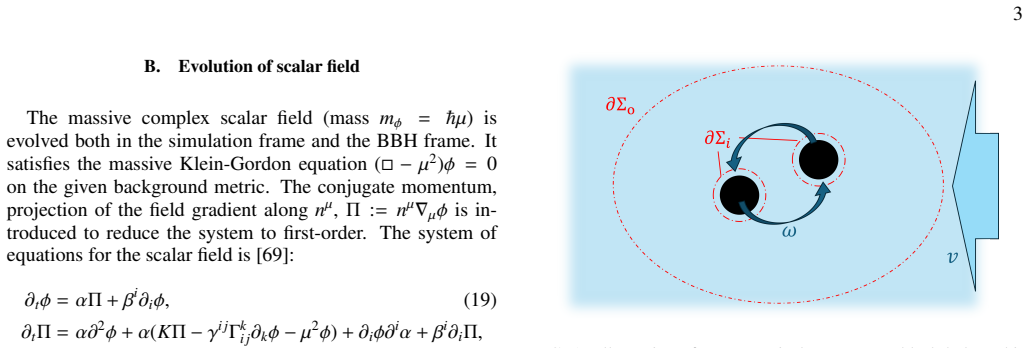
The load-bearing object is the relativistic momentum and angular-momentum balance law built from the scalar stress-energy tensor. For a chosen approximate Killing vector, the paper casts conservation as a continuity equation and decomposes the force on the binary into a volume-integrated drag sourced by the curved spacetime, a surface accretion flux through the two excision spheres, and an outer-boundary flux. Together with the Noether current of the complex scalar, this bookkeeping turns the raw field evolution into the forces, torque, and accretion rates that are compared across parameters. The wind-tunnel setup, an extended conformal thin-sandwich binary spacetime Lie-dragged so the black holes stay on a circular orbit while a plane-wave scalar field streams past, is the stage on which this bookkeeping operates, and the ratio of de Broglie wavelength to binary separation organizes the results into Fraunhofer-like, Fresnel-like, and unimpeded regimes.
What would settle it
Run the same fiducial case (scalar mass times total mass 0.2, binary separation 26M, wind speed 0.5c) in a full three-dimensional general-relativistic scalar-field simulation with identical extraction surfaces, and compare the orbit-averaged drag force and torque; if the three-dimensional values fall outside the quoted error bars of the two-dimensional run, the quantitative claim fails.
Extended reading notes
Core claim
The central claim is that the drag force on a binary black hole in a scalar dark matter wind is nonlinear in the binary: the companion changes the structure of the wake, so the total drag and torque differ from the sum of two isolated black holes. The paper demonstrates this by computing, in a fixed binary spacetime, the momentum and angular-momentum exchange between a complex massive scalar field and the binary, separated into a volume-integrated drag, a horizon accretion flux, and an outer-boundary flux. Over a parameter survey of separation, scalar mass, and wind speed (about 0.2c to 0.7c), the orbit-averaged drag is roughly linear in velocity near 0.5c, saturates for larger velocities, and is suppressed when the scalar de Broglie wavelength is much smaller than the binary separation. The torque always acts to spin the binary down, has a non-monotonic velocity dependence, and there is a transverse anti-Magnus force whose sign can flip in some parameter ranges. Accretion of scalar particles is confirmed by a positive Noether charge flux, and mass accretion becomes important for heavy scalars at low speeds.
Load-bearing premise
The quantitative drag and torque numbers rest on the assumption that a two-dimensional, vertically integrated scalar-field simulation captures the same wake physics a fully three-dimensional simulation would, so a large three-dimensional discrepancy would change the magnitudes.
Editorial extensions
If this is right
- Gravitational-wave models for binaries embedded in scalar dark matter must include a binary-specific drag and torque; summing single-black-hole forces will not reproduce the dephasing.
- The environmental correction is strongest when the scalar de Broglie wavelength is comparable to the binary separation and for wind speeds near 0.5c, and suppressed when the wavelength is much shorter than the separation.
- The scalar field consistently removes orbital energy and angular momentum, so it accelerates the inspiral and acts as a spin-down torque on the binary.
- Under typical galactic dark matter densities the effect is tiny compared with gravitational-wave energy loss, but in dense scalar clouds or spikes the induced dephasing could be detectable by future space-based detectors.
- The transverse Magnus-like force and its possible sign change mean scalar environments can also deflect the binary's motion, not just slow it down.
Reading between the lines
- Beyond the paper, the 3D question is the first test: if a fully three-dimensional wake changes the orbit-averaged numbers, the magnitudes here are estimates even if the qualitative non-additivity survives.
- Beyond the paper, the diffraction analogy points to a searchable parameter window: binaries with separation within roughly one de Broglie wavelength of the scalar should show the largest dephasing, which future space-based detectors could target.
- Beyond the paper, the half-orbital-period alternation tied to the mass asymmetry of the binary suggests that a measured beat in the environmental dephasing could carry information about both the dark matter and the binary's mass ratio.
- Beyond the paper, since the authors use a complex scalar to avoid Compton-frequency oscillations, a real scalar field would add a periodic modulation of the drag; this could be tested with a straightforward modification of their setup.
Signed reviews
Editorial analysis
A structured set of objections, weighed in public.
Referee Report
Summary. The paper presents two-dimensional general-relativistic simulations of a complex scalar field on a fixed, constraint-satisfying binary black hole spacetime, with the binary placed in a 'wind tunnel' of asymptotically homogeneous scalar dark matter. The authors extract the drag force, torque, mass accretion, and scalar charge accretion as functions of the background velocity, scalar mass, and binary separation, covering four parameter regimes. Their central qualitative claim is that the drag on a binary is not the simple superposition of the drags on two isolated black holes, since the companion modifies the gravitational wake and produces nonlinear interference effects; they further argue that this additional force and torque could, in principle, dephase gravitational wave signals. The results include a parameter survey (Fig. 5), a Magnus-force measurement (Fig. 6), and conservation checks of linear and angular momentum (Appendix C).
Significance. If the central claim holds, this is the first relativistic treatment of scalar dark matter dynamical friction on a binary black hole, and it provides a concrete starting point for environmental corrections to waveform models in ultralight scalar dark matter scenarios. The paper's strengths include explicit conservation checks (Appendix C) showing momentum and angular momentum balance to numerical precision, a resolution study (Appendix A) and an extraction-radius study (Appendix B), and a systematic parameter survey across velocity, scalar mass, and separation. The simulations are also run for many orbital periods, giving a well-defined steady state for the orbital averages. However, as detailed below, the headline non-superposition claim is not directly tested, the 2D reduction is not validated against 3D for scalar fields, and the validation tests are run on configurations different from the production runs. These issues are load-bearing for the quantitative and qualitative conclusions, so the paper needs major revision.
major comments (4)
- [Abstract and Sec. III (Figs. 3-5)] The central claim that 'the binary's drag is not a simple superposition of two isolated black holes' is asserted in the abstract and conclusion but is never directly tested. No comparison is made between the binary force/torque and the sum of two single-black-hole wind-tunnel results at the same masses, velocity, scalar mass, resolution, and extraction prescription, nor against the single-BH results of Refs. [21,56,57]. The evidence offered—orbital-period flux modulation, a dual beat frequency attributed to q=0.8, and separation/velocity trends in Fig. 5—is consistent with a superposition of independent single-BH wakes, since even two separated, unequal-mass single-BH drag forces would produce orbit-modulated, separation-dependent total forces and a nonzero net torque. I recommend adding a direct control: a single-BH run with the same code and extraction at mass M1 and M2, summing the two forces, and comparing to the binary run. Unless such a test is performed, the phrase 'significant nonlinearities' remains an interpretation rather than a measured result.
- [Sec. II.F and Conclusion] The quantitative results rest on a two-dimensional (vertically integrated) reduction of the scalar field problem, as stated in Sec. II.F: 'we follow similar works for hydrodynamic torque calculations... using vertically integrated accretion flows.' This approximation is reasonable for thin hydrodynamic disks, but the scalar wake and its interference around a relativistic binary are genuinely three-dimensional phenomena, and the manuscript provides no 3D scalar-field comparison or estimate of the resulting error. The Conclusion acknowledges this only as a future direction. Since the drag and torque values in Fig. 5 are the main quantitative output, the 2D reduction should either be validated with at least one representative 3D run or be accompanied by a clear statement of the expected magnitude of 3D corrections.
- [Appendix A, Appendix B, and Sec. II.F] The numerical validation does not cover the production configurations from which the headline results are drawn. Appendix A describes a convergence test on an equal-mass, non-spinning binary with mu M_tot = 0.05, while the production runs use q = 0.8 and mu M = 0.2, 0.8, and 0.05. Appendix B tests extraction-radius sensitivity using a spinning BH with a/M = 0.7, although the production binaries are non-spinning. Moreover, Sec. II.F states that the reference convergence simulation has mu M = 0.2, d_BBH = 26M, v = 0.5c, which contradicts the equal-mass mu M_tot = 0.05 setup described in Appendix A. As a result, there is no convergence or inner-boundary study at the actual mass ratio, spin, and scalar mass of the runs that support the central claims. I request a resolution study (at least two additional resolutions) and an extraction-radius test for a representative production configuration, e.g., q = 0.8, mu M = 0.2, d_BBH = 26M, v = 0.5c.
- [Sec. III (Fig. 5 and text)] The velocity dependence of the drag force is described as 'approximately linear' near v ~ 0.5 and 'saturating' above v = 0.7c, but no fit or quantitative criterion is provided beyond a blue dashed line in the top-left panel of Fig. 5. Since the paper later invokes 'a modified dynamical friction law,' the functional form of the velocity dependence should be stated explicitly (e.g., the best-fit power-law or the analytic expression from Ref. [56]) so that the claim can be checked. The current presentation leaves the velocity scaling ambiguous and the 'saturation' claim unsupported without error bars on the fit.
minor comments (6)
- [Sec. II.A] In Sec. II.A, 'helliptical Killing vector' should be 'elliptical Killing vector.'
- [Sec. II.F] In Sec. II.F, 'Table II F' should be 'Table I' (or a proper table number), and the table caption should be self-contained.
- [Sec. III] In Sec. III, 'T he accretion is generally small' contains a spacing typo and should read 'The accretion is generally small.'
- [Sec. IV (Conclusion)] In the Conclusion, 'It would be interested to systematically compare' should be 'It would be interesting to systematically compare.'
- [Sec. III (Fig. 4)] The 'dual beat frequency' attributed to the mass ratio q = 0.8 is not defined quantitatively; the text should state the expected beat frequency or the period of the amplitude modulation so that the reader can verify the claim from the plotted time series.
- [References] Reference [12] appears with odd spacing ('M uffled murmurs') in the bibliography; this is a formatting artifact that should be cleaned before publication.
Circularity Check
No circularity found: the drag, torque, and accretion rates are direct simulation diagnostics rather than fitted or self-cited inputs.
full rationale
I find no circular step that meets the required standard of quoting the paper and exhibiting a specific reduction. The central quantities (Fdrag, τz, Ṁacc, Q̇acc) are computed directly from the evolved scalar field stress-energy via the integral identities in Eqs. (34)–(42), not from a parameter fitted to the claimed result; the linear fit in Fig. 5 is a descriptive summary of the velocity dependence, not an input that forces the drag result. The headline claim that the binary drag is not a simple superposition is an interpretation of the measured orbital modulation and wake structure, and the paper indeed does not present an explicit sum-of-two-single-BH comparison, but that is an evidentiary gap rather than a circularity. Self-citations to the authors' earlier code infrastructure (Refs. [74–76]) and to the FUKA initial-data framework (Ref. [68]) are used as numerical tools, not as the source of the physical drag prediction, and the appendices provide independent convergence and conservation checks. The validation configurations in Appendices A and B do not exactly match the production runs (equal-mass, µM=0.05 and spinning a/M=0.7 versus q=0.8, non-spinning), which is a limitation in convergence coverage, but again not circular. The derivation is therefore self-contained with respect to the quantities it reports, and the circularity score is 0.
Assumptions & free parameters
assumptions (4)
- domain assumption The complex scalar field is a test field; its stress-energy does not source Einstein's equations, valid to first order in field strength.
- domain assumption The binary spacetime is fixed on a quasi-circular orbit with no inspiral from gravitational wave emission during the simulation.
- ad hoc to paper The 2D (vertically integrated) reduction captures the relevant scalar field wake physics of the 3D problem.
- standard math Standard 3+1 decomposition, the massive Klein-Gordon equation, and Noether charge conservation hold.
Cite this review
Pith. "Pith review of Relativistic scalar dark matter drag forces on a black hole binary." pith.science (2026). https://pith.science/paper/U6VJKXSL
@misc{pith2026250718934,
  author       = {Pith},
  title        = {Pith review of: Relativistic scalar dark matter drag forces on a black hole binary},
  year         = {2026},
  howpublished = {\url{https://pith.science/paper/U6VJKXSL}},
  note         = {Machine review of arXiv:2507.18934}
}
read the original abstract
Dark matter around black holes can induce drag forces through dynamical friction and accretion, potentially affecting the orbital evolution and gravitational wave emission of binary systems. While dynamical friction from scalar field dark matter has been studied in the relativistic regime for single black holes, the case of a binary black hole (BBH) has remained unexplored. As a first step, we present a series of two-dimensional general-relativistic simulations of BBH in a wind tunnel for an asymptotically homogeneous scalar field background. We extract the drag forces, torque, mass and charge accretion acting on the binary, and analyze their dependence on the binary separation, velocity and the scalar field parameters. We find that the binary's drag is not a simple superposition of two isolated black holes; the presence of a companion modifies the gravitational wake and yields significant nonlinearities. This additional force and torque can (in principle) modify the inspiral and induce a dephasing of the gravitational wave signal.
Figures


Figures from the paper (6 more)


Forward citations
Cited by 1 Pith paper
-
Ultralight Boson Ionization from Comparable-Mass Binary Black Holes
Ionization of boson molecules bound to a black hole binary can dominate gravitational-wave losses during early inspiral, imprinting a turnover in the nanohertz GW background and circularizing the orbit.
Reference graph
Works this paper leans on
-
[56]
Dina Traykova, Katy Clough, Thomas Helfer, Emanuele Berti, Pedro G. Ferreira, and Lam Hui. Dynamical friction from 13 scalar dark matter in the relativistic regime. Phys. Rev. D , 104(10):103014, 2021
work page 2021
-
[1]
We then find that the linear momentum, Pi, Pi = Z Σ √γQid3x, (33) changes according to ∂tPi = Z Σo−Σi Tµ ν∇µ(δν i)√−g d3x | {z } Fdrag i + Z ∂Σi α T j i dA j | {z } Faccretion i
Gravitational momentum drag To compute the change in linear momentum of the binary, i.e., the drag exerted by the scalar field, we choose ζν i = δν i corresponding to the unit vector in the xi direction. We then find that the linear momentum, Pi, Pi = Z Σ √γQid3x, (33) changes according to ∂tPi = Z Σo−Σi Tµ ν∇µ(δν i)√−g d3x | {z } Fdrag i + Z ∂Σi α T j i ...
-
[2]
The total angular momentum Lz inside Σ satisfies a balance law, Eq
Angular momentum conservation We perform an analogous check for angular momentum around the z-axis. The total angular momentum Lz inside Σ satisfies a balance law, Eq. 43, with the drag torque and accretion torques replacing the linear momentum forces. In Fig. 10 we plot the time-integrated outward flux ofLz, the drag torque, and the angular momentum accr...
-
[3]
We consider a control volume Σ that excludes the two black hole horizons (bounded by inner excision surfaces and an outer spherical boundary at rout)
Momentum conservation and flux balance As a further validation, we monitor conservation of the total linear momentum in our simulation. We consider a control volume Σ that excludes the two black hole horizons (bounded by inner excision surfaces and an outer spherical boundary at rout). The continuum balance law for the x-momentum in Σ is −∂ ∂t Z Σ √γ S x ...
-
[4]
Advanced Virgo: a second-generation interferometric gravitational wave detector
F Acernese, M Agathos, K Agatsuma, D Aisa, N Alleman- dou, A Allocca, J Amarni, P Astone, G Balestri, G Ballardin, et al. Advanced Virgo: a second-generation interferometric gravitational wave detector. Classical and Quantum Gravity , 32(2):024001, 2014
work page 2014
-
[5]
First m87 event horizon telescope results
Event Horizon Telescope Collaborat. First m87 event horizon telescope results. i. the shadow of the supermassive black hole. Astrophysical Journal Letters, 875(1):L1, 2019
2019
-
[6]
B. P. et al. Abbott. Observation of gravitational waves from a binary black hole merger. Phys. Rev. Lett. , 116:061102, Feb 2016
2016
-
[7]
Ad- vanced ligo: the next generation of gravitational wave detectors
Gregory M Harry and the LIGO Scientific Collaboration. Ad- vanced ligo: the next generation of gravitational wave detectors. Classical and Quantum Gravity , 27(8):084006, 2010
work page 2010
Show all 86 references
-
[8]
Lisa: laser inter- ferometer space antenna for gravitational wave measurements
Karsten Danzmann and the LISA study team. Lisa: laser inter- ferometer space antenna for gravitational wave measurements. Classical and Quantum Gravity , 13(11A):A247, 1996
1996
-
[9]
et al.Punturo
M. et al.Punturo. The Einstein Telescope: a third-generation gravitational wave observatory. Class. Quantum Gravity , 27:194002, 2010
2010
-
[10]
et al.Reitze
D. et al.Reitze. Cosmic Explorer: The US contribution to gravitational-wave astronomy beyond LIGO. Bulletin of the AAS, 51(7):035, 2019
2019
-
[11]
The Next Generation Global Gravitational Wave Observatory: The Science Book
Vicky Kalogera et al. The Next Generation Global Gravitational Wave Observatory: The Science Book. 11 2021
2021
-
[12]
Mu ffled murmurs: Envi- ronmental effects in the lisa stochastic signal from stellar-mass black hole binaries
Ran Chen, Rohit S Chandramouli, Federico Pozzoli, Riccardo Buscicchio, and Enrico Barausse. Mu ffled murmurs: Envi- ronmental effects in the lisa stochastic signal from stellar-mass black hole binaries. arXiv preprint arXiv:2507.00694, 2025
2025
-
[13]
The Gravitational Universe
Pau Amaro Seoane et al. The Gravitational Universe. 5 2013
2013
-
[14]
TianQin: a space-borne gravitational wave de- tector
Jun et al.Luo. TianQin: a space-borne gravitational wave de- tector. Class. Quantum Gravity, 33:035010, 2016. 12
2016
-
[15]
The Taiji program: a concise overview
Ziren et al.Luo. The Taiji program: a concise overview. Prog. Theor . Exp. Phys., 2020:05A108, 2020
2020
-
[16]
Ferreira, and Lam Hui
Dina Traykova, Katy Clough, Thomas Helfer, Emanuele Berti, Pedro G. Ferreira, and Lam Hui. Dynamical friction from scalar dark matter in the relativistic regime.Phys. Rev. D, 104:103014, Nov 2021
2021
-
[17]
Chandrasekhar
S. Chandrasekhar. Dynamical friction. i. general considera- tions: The coe fficient of dynamical friction. Astrophys. J. , 97:255–262, 1943
1943
-
[18]
Bondi and F
H. Bondi and F. Hoyle. On the mechanism of accretion by stars. Mon. Not. R. Astron. Soc. , 104:273–282, 1944
1944
-
[19]
H. Bondi. On spherically symmetrical accretion. Mon. Not. R. Astron. Soc., 112:195–204, 1952
1952
-
[20]
Filipe O
L. Filipe O. Costa, Rita Franco, and Vitor Cardoso. Gravita- tional magnus effect. Phys. Rev. D, 98:024026, Jul 2018
2018
-
[21]
Ferreira, and Lam Hui
Dina Traykova, Rodrigo Vicente, Katy Clough, Thomas Helfer, Emanuele Berti, Pedro G. Ferreira, and Lam Hui. Relativistic drag forces on black holes from scalar dark matter clouds of all sizes. Phys. Rev. D, 108:L121502, Dec 2023
2023
-
[22]
Continuity equations for general matter: applica- tions in numerical relativity
Katy Clough. Continuity equations for general matter: applica- tions in numerical relativity. Classical and Quantum Gravity , 38(16):167001, 2021
2021
-
[23]
Aurrekoetxea, Katy Clough, and Pe- dro G
Jamie Bamber, Josu C. Aurrekoetxea, Katy Clough, and Pe- dro G. Ferreira. Black hole merger simulations in wave dark matter environments. Phys. Rev. D, 107(2):024035, 2023
2023
-
[24]
Rosa and Sam R
Jo ˜ao G. Rosa and Sam R. Dolan. Massive vector fields on the schwarzschild spacetime: Quasinormal modes and bound states. Phys. Rev. D, 85:044043, Feb 2012
2012
-
[25]
Gravitational Magnus e ffect from scalar dark matter
Zipeng Wang, Thomas Helfer, Dina Traykova, Katy Clough, and Emanuele Berti. Gravitational Magnus e ffect from scalar dark matter. 2 2024
2024
-
[26]
Ferreira, Caio F
Miguel C. Ferreira, Caio F. B. Macedo, and Vitor Cardoso. Or- bital fingerprints of ultralight scalar fields around black holes. Phys. Rev. D, 96:083017, Oct 2017
2017
-
[27]
Gnedin and Joel R
Oleg Y . Gnedin and Joel R. Primack. Dark matter profile in the galactic center. Phys. Rev. Lett., 93:061302, Aug 2004
2004
-
[28]
Massive vector fields in rotating black-hole spacetimes: separability and quasinormal modes
Valeri P Frolov, Pavel Krtou ˇs, David Kubiz ˇn´ak, and Jorge E Santos. Massive vector fields in rotating black-hole spacetimes: separability and quasinormal modes. Physical Review Letters , 120(23):231103, 2018
2018
-
[29]
Superradiance: New frontiers in black hole physics
Brito Richard, Cardoso Vitor, and Pani Paolo. Superradiance: New frontiers in black hole physics. Lect. Notes Phys , 906:1– 237, 2015
2015
-
[30]
Discovering the qcd axion with black holes and gravitational waves
Asimina Arvanitaki, Masha Baryakhtar, and Xinlu Huang. Discovering the qcd axion with black holes and gravitational waves. Physical Review D, 91(8):084011, 2015
2015
-
[31]
Black hole merg- ers and the qcd axion at advanced ligo
Asimina Arvanitaki, Masha Baryakhtar, Savas Dimopoulos, Sergei Dubovsky, and Robert Lasenby. Black hole merg- ers and the qcd axion at advanced ligo. Physical Review D , 95(4):043001, 2017
2017
-
[32]
Axions in string theory
Peter Svrcek and Edward Witten. Axions in string theory. Jour- nal of High Energy Physics , 2006(06):051, 2006
2006
-
[33]
Instability of the proca field on kerr spacetime
Sam R Dolan. Instability of the proca field on kerr spacetime. Physical Review D, 98(10):104006, 2018
2018
-
[34]
Gravitational wave signa- tures of ultralight vector bosons from black hole superradiance
Nils Siemonsen and William E East. Gravitational wave signa- tures of ultralight vector bosons from black hole superradiance. Physical Review D, 101(2):024019, 2020
2020
-
[35]
Laleh Sadeghian, Francesc Ferrer, and Cli fford M. Will. Dark- matter distributions around massive black holes: A general rel- ativistic analysis. Phys. Rev. D, 88(6):063522, 2013
2013
-
[36]
L. F. Abbott and P. Sikivie. A cosmological bound on the invis- ible axion. Phys. Lett. B, 120:133–136, 1983
1983
-
[37]
et al.Graham
Peter W. et al.Graham. Experimental searches for the axion and axion-like particles. Ann. Rev. Nucl. Part. Sci. , 65:485–514, 2015
2015
-
[38]
David J. E. Marsh. Axion cosmology. Phys. Rept., 643:1–79, 2016
2016
-
[39]
Wise, and Frank Wilczek
John Preskill, Mark B. Wise, and Frank Wilczek. Cosmology of the invisible axion. Phys. Lett. B, 120:127–132, 1983
1983
-
[40]
Particle dark matter: evidence, candidates and constraints
Gianfranco Bertone, Dan Hooper, and Joseph Silk. Particle dark matter: evidence, candidates and constraints. Phys. Rept., 405:279–390, 2005
2005
-
[41]
The not-so-harmless axion
Michael Dine and Willy Fischler. The not-so-harmless axion. Phys. Lett. B, 120:137–141, 1983
1983
-
[42]
Gravitational wave searches for ultralight bosons with ligo and lisa
Richard Brito, Shrobana Ghosh, Enrico Barausse, Emanuele Berti, Vitor Cardoso, Irina Dvorkin, Antoine Klein, and Paolo Pani. Gravitational wave searches for ultralight bosons with ligo and lisa. Physical Review D, 96(6):064050, 2017
2017
-
[43]
Supersymmetric dark matter
Gerard Jungman, Marc Kamionkowski, and Katherine Griest. Supersymmetric dark matter. Phys. Rept., 267:195–373, 1996
1996
-
[44]
String Axiverse
Asimina Arvanitaki, Savas Dimopoulos, Sergei Dubovsky, Ne- manja Kaloper, and John March-Russell. String Axiverse. Phys. Rev. D, 81:123530, 2010
2010
-
[45]
Non-baryonic dark matter: observational evi- dence and detection methods
Lars Bergstr ¨om. Non-baryonic dark matter: observational evi- dence and detection methods. Rept. Prog. Phys. , 63:793–841, 2000
2000
-
[46]
Dark matter annihilation at the galactic center
Paolo Gondolo and Joseph Silk. Dark matter annihilation at the galactic center. Phys. Rev. Lett., 83:1719–1722, 1999
1999
-
[47]
Gravitational waves as a probe of dark matter minispikes.Phys
Kazunori Eda, Yuiti Itoh, Sachiko Kuroyanagi, and Joseph Silk. Gravitational waves as a probe of dark matter minispikes.Phys. Rev. Lett., 110:221101, 2013
2013
-
[48]
R. A. Konoplya. Massive vector field perturbations in the Schwarzschild background: Stability and quasinormal spec- trum. Phys. Rev. D, 73(2):024009, 2006
2006
-
[49]
Black hole superradiance signatures of ultralight vectors
Masha Baryakhtar, Robert Lasenby, and Mae Teo. Black hole superradiance signatures of ultralight vectors. Physical Review D, 96(3):035019, 2017
2017
-
[50]
Rosa and Sam R
Jo ˜ao G. Rosa and Sam R. Dolan. Massive vector fields on the Schwarzschild spacetime: quasinormal modes and bound states. Phys. Rev. D, 85(4):044043, 2012
2012
-
[51]
Black-hole bombs and photon-mass bounds
Paolo Pani, Vitor Cardoso, Leonardo Gualtieri, Emanuele Berti, and Akihiro Ishibashi. Black-hole bombs and photon-mass bounds. Phys. Rev. Lett., 109(13):131102, 2012
2012
-
[52]
S. T. H. Hartman, H. A. Winther, and D. F. Mota. Dynamical friction in bose-einstein condensed self-interacting dark matter. Astron. Astrophys., 647:A70, 2021
2021
-
[53]
Bar-Or, J.-B
B. Bar-Or, J.-B. Fouvry, and S. Tremaine. Relaxation in a fuzzy dark matter halo. Astrophys. J., 871:28, 2019
2019
-
[54]
Lancaster, C
L. Lancaster, C. Giovanetti, P. Mocz, Y . Kahn, M. Lisanti, and D. N. Spergel. Dynamical friction in a fuzzy dark matter uni- verse. J. Cosmol. Astropart. Phys., 01:001, 2020
2020
-
[55]
Berezhiani, B
L. Berezhiani, B. Elder, and J. Khoury. Dynamical friction in superfluids. J. Cosmol. Astropart. Phys., 10:074, 2019
2019
-
[57]
Annulli, V
L. Annulli, V . Cardoso, and R. Vicente. Stirred and shaken: Dynamical behavior of boson stars and dark matter cores.Phys. Lett. B, 811:135944, 2020
2020
-
[58]
Annulli, V
L. Annulli, V . Cardoso, and R. Vicente. Response of ultralight dark matter to supermassive black holes and binaries. Phys. Rev. D, 102:063022, 2020
2020
-
[59]
Vicente, V
R. Vicente, V . Cardoso, and M. Zilh ˜ao. Dynamical friction in slab geometries and accretion discs. Mon. Not. R. Astron. Soc. , 489:5424–5435, 2019
2019
-
[60]
Yoonsoo Kim and Elias R. Most. General relativistic mag- netized Bondi-Hoyle-Lyttleton accretion with a spin-field mis- alignment: Jet nutation, polarity reversals, and Magnus drag. Phys. Rev. D, 111(8):083025, 2025
2025
-
[61]
Ferreira, and Lam Hui
Dina Traykova, Rodrigo Vicente, Katy Clough, Thomas Helfer, Emanuele Berti, Pedro G. Ferreira, and Lam Hui. Relativistic drag forces on black holes from scalar dark matter clouds of all sizes. Phys. Rev. D, 108(12):L121502, 2023
2023
-
[62]
Relativistic aerodynamics of spinning black holes
Conor Dyson, Jaime Redondo-Yuste, Maarten van de Meent, and Vitor Cardoso. Relativistic aerodynamics of spinning black holes. Phys. Rev. D, 109(10):104038, 2024
2024
-
[63]
Gravitational magnus e ffect from scalar dark matter
Zipeng Wang, Thomas Helfer, Dina Traykova, Katy Clough, and Emanuele Berti. Gravitational magnus e ffect from scalar dark matter. Phys. Rev. D, 110(2):024009, 2024
2024
-
[64]
Dittmann, Adam M
Alexander J. Dittmann, Adam M. Dempsey, and Hui Li. The Evolution of Inclined Binary Black Holes in the Disks of Active Galactic Nuclei. Astrophys. J., 964(1):61, 2024
2024
-
[65]
Hydrodynamical evolution of black hole binaries embedded in AGN discs: II
Rixin Li and Dong Lai. Hydrodynamical evolution of black hole binaries embedded in AGN discs: II. dependence on equa- tion of state, binary mass, and separation scales.Mon. Not. Roy. Astron. Soc., 522(2):1881–1894, 2023
2023
-
[66]
Hydrodynamical evolution of black- hole binaries embedded in AGN discs
Rixin Li and Dong Lai. Hydrodynamical evolution of black- hole binaries embedded in AGN discs. Mon. Not. Roy. Astron. Soc., 517(2):1602–1624, 2022
2022
-
[67]
Hydrodynamical evolution of black- hole binaries embedded in AGN discs – III
Rixin Li and Dong Lai. Hydrodynamical evolution of black- hole binaries embedded in AGN discs – III. The e ffects of vis- cosity. Mon. Not. Roy. Astron. Soc., 529(1):348–359, 2024
2024
-
[68]
Jens Papenfort, Samuel D
L. Jens Papenfort, Samuel D. Tootle, Philippe Grandcl ´ement, Elias R. Most, and Luciano Rezzolla. New public code for initial data of unequal-mass, spinning compact-object binaries. Phys. Rev. D, 104(2):024057, 2021
2021
-
[69]
Dittmann, Adam M
Alexander J. Dittmann, Adam M. Dempsey, and Hui Li. The Multiple Paths to Merger of Unequal-Mass Black Hole Binaries in the Disks of Active Galactic Nuclei. 5 2025
2025
-
[70]
3 + 1 formalism and bases of numerical rel- ativity
Eric Gourgoulhon. 3 + 1 formalism and bases of numerical rel- ativity. arXiv preprint gr-qc/0703035, 2007
2007 arXiv
-
[71]
Ferreira, and Lam Hui
Dina Traykova, Katy Clough, Thomas Helfer, Emanuele Berti, Pedro G. Ferreira, and Lam Hui. Dynamical friction from scalar dark matter in the relativistic regime. Phys. Rev. D , 104(10):103014, 2021
2021
-
[72]
Jens Papenfort, Samuel D
L. Jens Papenfort, Samuel D. Tootle, Philippe Grandclement, Elias R. Most, and Luciano Rezzolla. New public code for initial data of unequal-mass, spinning compact-object binaries. Phys. Rev. D, 104:024057, 2021
2021
-
[73]
Stein, Mark A
Maria Okounkova, Leo C. Stein, Mark A. Scheel, and Daniel A. Hemberger. Numerical binary black hole mergers in dy- namical Chern-Simons gravity: Scalar field. Phys. Rev. D , 96(4):044020, 2017
2017
-
[74]
Local continuity of angular momentum and noether charge for matter in general relativity
Robin Croft. Local continuity of angular momentum and noether charge for matter in general relativity. Classical and Quantum Gravity, 40(10):105007, 2023
2023
-
[75]
Cook, Jason D
Matthew Caudill, Gregory B. Cook, Jason D. Grigsby, and Har- ald P. Pfeiffer. Circular orbits and spin in black-hole initial data. Phys. Rev. D, 74:064011, 2006
2006
-
[76]
Most, Yoonsoo Kim, Katerina Chatziioannou, and Isaac Legred
Elias R. Most, Yoonsoo Kim, Katerina Chatziioannou, and Isaac Legred. Nonlinear Alfv´en-wave Dynamics and Premerger Emission from Crustal Oscillations in Neutron Star Mergers. Astrophys. J. Lett., 973(2):L37, 2024
2024
-
[77]
KADATH: A spectral solver for theo- retical physics
Philippe Grandcl ´ement. KADATH: A spectral solver for theo- retical physics. J. Comput. Phys., 229:3334–3357, 2010
2010
-
[78]
anti-Magnus
and AGN disk [79], which have calculated drag forces and torques using using vertically integrated accretion flows. This allows us to provide a systematic coverage of the large relevant parameter space, while simulating su fficiently many orbits to obtain converged results in ...
-
[79]
Most and Alexander A
Elias R. Most and Alexander A. Philippov. Electromagnetic precursor flares from the late inspiral of neutron star binaries. Mon. Not. R. Astron. Soc. , 515(2):2710–2724, 2022
2022
-
[80]
Most and Alexander A
Elias R. Most and Alexander A. Philippov. Electromagnetic Precursors to Black Hole–Neutron Star Gravitational Wave Events: Flares and Reconnection-powered Fast Radio Tran- sients from the Late Inspiral. Astrophys. J. Lett. , 956(2):L33, 2023
2023
-
[81]
Katz, Andrew Myers, Tan Nguyen, Andrew Nonaka, Michele Rosso, Samuel Williams, and Michael Zingale
Weiqun Zhang, Ann Almgren, Vince Beckner, John Bell, Johannes Blaschke, Cy Chan, Marcus Day, Brian Friesen, Kevin Gott, Daniel Graves, Max P. Katz, Andrew Myers, Tan Nguyen, Andrew Nonaka, Michele Rosso, Samuel Williams, and Michael Zingale. AMReX: a framework for block- struc...
2019
-
[82]
Circumbinary accretion from finite and infinite disks
Diego J Mu ˜noz, Dong Lai, Kaitlin Kratter, and Ryan Miranda. Circumbinary accretion from finite and infinite disks. The As- trophysical Journal, 889(2):114, 2020
2020
-
[83]
Hydrodynamical simulations of black hole binary formation in agn disks
Jiaru Li, Adam M Dempsey, Hui Li, Dong Lai, and Shengtai Li. Hydrodynamical simulations of black hole binary formation in agn disks. The Astrophysical Journal Letters , 944(2):L42, 2023
2023
-
[84]
High-accuracy numerical simulation of black-hole binaries: Computation of the gravitational-wave energy flux and comparisons with post-newtonian approximants
Michael Boyle, Alessandra Buonanno, Lawrence E Kidder, Abdul H Mrou ´e, Yi Pan, Harald P Pfei ffer, and Mark A Scheel. High-accuracy numerical simulation of black-hole binaries: Computation of the gravitational-wave energy flux and comparisons with post-newtonian approximants....
2008
-
[85]
Probing the existence of ultralight bosons with a single gravitational-wave measurement
Otto A Hannuksela, Kaze WK Wong, Richard Brito, Emanuele Berti, and Tjonnie GF Li. Probing the existence of ultralight bosons with a single gravitational-wave measurement. Nature Astronomy, 3(5):447–451, 2019
2019
-
[86]
Dong Lai and Diego J. Mu ˜noz. Circumbinary Accretion: From Binary Stars to Massive Binary Black Holes. Ann. Rev. Astron. Astrophys., 61:517–560, 2023
2023
Reviewed August 15, 2026 · model on record in the stance chip above.
Discussion (0). Continue with ORCID to comment.