REVIEW 4 major objections 3 minor 1 cited by
Barren-plateau free variational quantum simulation of Z2 lattice gauge theories
T0 review · 4 major / 3 minor · reviewed 2026-08-15 · deepseek-v4-flash
Pith's one-line read Variational quantum eigensolvers can find ground states and string breaking in a Z2 lattice gauge theory on a two-leg ladder, with gradient statistics that avoid barren plateaus and no penalty-term enforcement of gauge invariance.
desk verdict Solid small-system VQE demonstration for Z2 LGT on a two-leg ladder, but the barren-plateau-free claim is an extrapolation that the paper's own DLA data does not support. read the letter →
The pith
A machine-rendered reading of the paper's core claim, the machinery that carries it, and where it could break.
The reading
What carries the argument
The load-bearing objects are the Gauss law operators $G_l$ of the $\mathbb{Z}_2$ lattice gauge theory (products of link and matter Pauli operators that define local charge sectors), and the two ansatz circuits built to respect them: the GI ansatz, a Hamiltonian variational ansatz whose parametrized unitaries are drawn from the gauge-invariant Hamiltonian terms; and the ZZ ansatz, a hardware-efficient ansatz of single-qubit rotations and multi-qubit $Z$ rotations that still overlaps the gauge-invariant subspace when initialized with angles near $\pi$. The paper uses the dimension of the dynamical Lie algebra (DLA) generated by the ansatz gates as the diagnostic: a polynomial DLA would mean barren-plateau-free but classically simulable, while an exponentially growing DLA is taken as evidence that the favorable gradient scaling does not come at the price of classical simulability.
What would settle it
Compute the gradient variance for the GI and ZZ ansätze on a four- and five-plaquette two-leg ladder (23 and 28 qubits) using shot-based or exact simulation, and determine the DLA dimension for the two-leg ladder at 9-12 qubits: if the variance declines exponentially with qubit number, or the DLA dimension fits a polynomial rather than an exponential, the paper's central claims are contradicted.
Extended reading notes
Core claim
The paper claims that a VQE can simulate $\mathbb{Z}_2$ lattice gauge theory with Kogut-Susskind staggered fermions on a two-leg ladder geometry without imposing gauge invariance through penalty terms. With two ansätze—a gauge-invariant Hamiltonian variational ansatz (GI) and a hardware-efficient MBQC-inspired ansatz built from multi-qubit $Z$ rotations (ZZ)—and with initialization in a fixed Gauss law sector, the optimization reaches the gauge-invariant ground state, reproduces the static potential of confined charges, and exhibits string breaking as the charge separation crosses a critical distance. The authors further claim that the gradient variance does not decay with system size up to 23 qubits, and that the dynamical Lie algebra of the ansätze grows exponentially rather than polynomially, which they take as evidence that the problem avoids barren plateaus while remaining hard to simulate classically. Hardware experiments on a 156-qubit superconducting processor recover the qualitative string-breaking signal, with the two phases distinguished by a constant energy offset.
Load-bearing premise
The central scaling conclusion assumes that the gradient-variance results for 8 to 23 qubits and the growth of the ansatz's dynamical Lie algebra up to 7 qubits represent the asymptotic behavior of the two-leg ladder; if the variance begins to drop exponentially or that algebra growth saturates to a polynomial at larger sizes, the barren-plateau-free and classical-hardness claims do not follow.
Editorial extensions
If this is right
- A VQE can be run on a $\mathbb{Z}_2$ lattice gauge theory without penalty terms: Gauss law is respected by the ansatz or recovered during optimization, as measured by fidelity with the Gauss law operators.
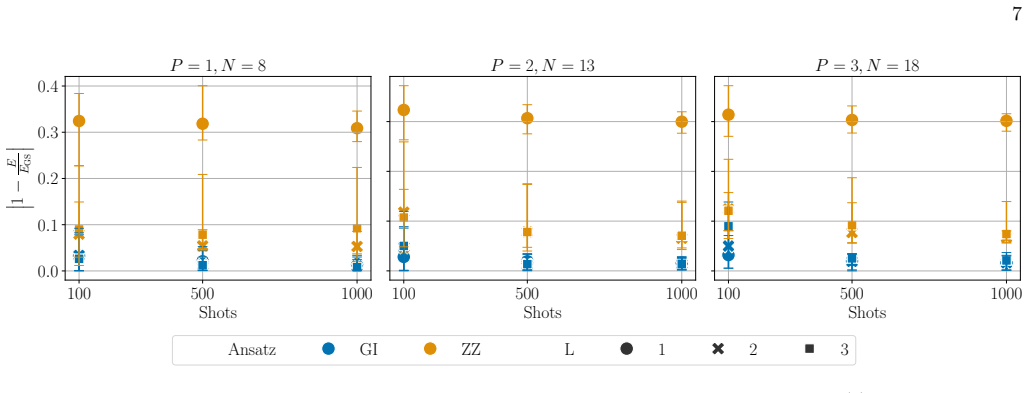
- Gradient variance remains roughly flat from 8 to 23 qubits for both ansätze across one to three layers, so the cost function stays trainable in the numerically accessible regime.
- The exponential growth of the DLA dimension with qubits suggests that the ansätze are not efficiently classically simulable by Lie-algebraic methods, separating this problem from barren-plateau-free but classically easy ones.
- Static string breaking, including the transition from a confining flux tube to a broken string, is reproduced by the VQE and the qualitative two-phase behavior survives on current superconducting hardware with standard error mitigation.
- The problem instance where tensor networks get stuck in a local minimum but the VQE escapes indicates that the LGT landscape offers a nontrivial testbed for variational quantum algorithms.
Reading between the lines
- If the favourable gradient scaling extends to larger two-leg ladders, $\mathbb{Z}_2$ lattice gauge theory could become a standard benchmark for near-term variational algorithms, because it supplies a physically motivated initialization (the Gauss law sector) and a clear failure signal (Gauss law violation) when the optimization goes wrong.
- The recipe generalizes in a natural direction: any lattice gauge theory with known Gauss law sectors and a small local Hilbert space may inherit the same barren-plateau avoidance, so the same ansatz-and-initialization strategy should be tried for $\mathbb{Z}_3$ or $\mathbb{Z}_4$ and for truncated $\mathrm{U}(1)$ models.
- The link between small-system variance and classical hardness is delicate: the paper's own numbers leave open that gradient variance may eventually decay at larger sizes, or that a classical simulation exploiting the concrete ansatz structure exists even though the DLA grows exponentially.
- A direct next test would run the same two ansätze on four- and five-plaquette ladders with a shot-based optimizer and measure both gradient variance and Gauss law fidelity, checking whether the flat scaling and gauge-invariant convergence persist beyond 23 qubits.
Signed reviews
Editorial analysis
A structured set of objections, weighed in public.
Referee Report
Summary. The manuscript presents a variational quantum eigensolver (VQE) study of a Z2 lattice gauge theory coupled to Kogut-Susskind staggered fermions on a two-leg ladder lattice. Two ansatz circuits are introduced: a gauge-invariant Hamiltonian variational ansatz (GI) and a hardware-efficient MBQC-inspired ansatz (ZZ). The authors initialize the optimization in Gauss law sectors, compare VQE ground-state energies against tensor network (MPS) calculations, observe static string breaking in noisy simulations and on IBM hardware, and assess trainability through gradient-variance scaling and dynamical Lie algebra (DLA) dimensions. The central claims are that the gradient variance scales favorably with system size, so the Z2 LGT VQE avoids barren plateaus, and that the problem is nontrivial to simulate classically.
Significance. If the central scaling claim held, this would be a valuable example of a physically motivated variational quantum simulation that is trainable at sizes where classical simulation is difficult. The paper's strengths include numerical verification of VQE energies against tensor networks, observation of string breaking on IBM hardware, and a physically motivated initialization from Gauss law sectors that is not circularly extracted from the target energies. The main limitation is that the barren-plateau-free and classical-hardness conclusions rest on small-system extrapolations that are not yet supported by the data presented.
major comments (4)
- [Sec. III.A, Fig. 3] The claim that gradients remain non-vanishing "beyond classical simulation" is an extrapolation from 8–23 qubits and at most three layers. The paper presents no gradient-variance data for larger systems and does not state this extrapolation as an explicit assumption; since the two-leg ladder geometry only acquires all Hamiltonian terms at the plaquette level, the asymptotic behavior could differ qualitatively. Please either provide gradient-variance data at larger system sizes or for more layers, or explicitly restrict the barren-plateau-free claim to the tested sizes.
- [Sec. III.A, Fig. 5] The DLA scaling fits are performed on the one-dimensional chain only, and the text explicitly states that the two-leg-ladder points cannot be used to compute the scaling because the eighth qubit introduces a plaquette term. The exponential fits therefore do not support the barren-plateau-free claim for the ladder geometry, which is the geometry for which the central claim is made. There is also a quantitative inconsistency: the text reports dim(g)=4080 for the 8-qubit GI ansatz, whereas the printed exponential fit dim(g)≈3.49×10^{-12}(1.50)^n evaluates to about 10^{-10} at n=8, indicating that the fit is not describing the ladder DLA data.
- [Sec. IV] The statement that the Z2 LGT "can be nontrivial to classically simulate" is not supported by a concrete hardness witness. An exponentially large DLA dimension does not by itself preclude efficient classical simulation, as tensor-network or other structural methods may still apply, and the tensor-network comparisons in the paper concern small systems. Please specify the claimed hardness regime and provide either a classical-simulation lower-bound argument or a concrete classically hard instance, or substantially weaken the classical-hardness claim.
- [Sec. III.A] The inference from DLA dimension to gradient variance relies on the conjecture of Ref. [37], but the paper does not verify that the ansatz and initialization satisfy the assumptions of that conjecture. Even with an exponentially growing DLA, the gradient variance for fixed or logarithmically growing depth can still decay exponentially with qubit number. The direct variance data in Fig. 3 are the relevant evidence, and they currently stop at 23 qubits, so the asymptotic conclusion is not established.
minor comments (3)
- [Fig. 5 caption] The exponential fits are printed ambiguously as "3.49×10−121.50n" and "5.47×10−121.98n"; please format them unambiguously, e.g., dim(g)≈3.49×10^{-12}·1.50^n and dim(g)≈5.47×10^{-12}·1.98^n.
- [Sec. III.A] The caveat that "we cannot use these points to compute the scaling" for the two-leg ladder is explicit, but the discussion in Section IV draws conclusions for the ladder as if the one-dimensional fits applied; please align the wording between the results and the discussion.
- [Sec. III.A] The sentence "For the simulations we have averaged over 100 samples and find favorable scaling of the variance up to system sizes of four plaquettes" would be clearer if it stated the exact system sizes used in Fig. 3, since the figure axis shows 8, 13, 18, and 23 qubits rather than a plaquette count.
Circularity Check
No circularity: the barren-plateau-free and DLA-scaling claims are direct numerical diagnostics, and the only self-citation is a non-load-bearing initialization reference.
full rationale
The paper's central claims are supported by direct numerical measurements rather than by reusing fitted inputs or importing conclusions from the authors' prior work. The Gauss-law-sector initialization follows Ref. [15], which shares an author, but that initialization is a physical construction from the Gauss-law constraint, is independently published and falsifiable, and is not used to define or fit the quantities being predicted. The barren-plateau-free claim rests on measured gradient variances in Fig. 3 and on DLA dimensions in Fig. 5; the DLA fits are curve fits to independently computed Lie-algebra dimensions, not parameters extracted from the target energies, so no 'prediction' reduces by construction to an input. The paper explicitly acknowledges the main extrapolation limitation for the two-leg ladder ('we cannot use these points to compute the scaling'), which is a correctness/extrapolation concern, not a circularity. No self-definitional reduction, fitted-input-as-prediction, or self-citation chain is present, so no circular step is identified.
Assumptions & free parameters
free parameters (5)
- DLA exponential prefactor for GI ansatz =
3.49e-12
- DLA exponential base for GI ansatz =
1.50
- DLA exponential prefactor for ZZ ansatz =
5.47e-12
- DLA exponential base for ZZ ansatz =
1.98
- DLA polynomial fit coefficients =
GI: 5.71e-7 n^10.33; ZZ: 1.04e-3 n^8.17
assumptions (5)
- domain assumption The Z2 Hamiltonian Eqs. (1)-(2) with Kogut-Susskind staggered fermions correctly describes the lattice gauge theory.
- domain assumption Gauss law sectors with charges placed by penalty terms are the physical Hilbert space.
- domain assumption The conjectured relation between DLA dimension and gradient variance (Larocca et al., Ref. [37]) holds.
- domain assumption DMRG/tensor network results with sufficient bond dimension are the reference ground states.
- standard math Jordan-Wigner transformation and the linear qubit ordering preserve the spectrum of the matter Hamiltonian.
Cite this review
Pith. "Pith review of Barren-plateau free variational quantum simulation of Z2 lattice gauge theories." pith.science (2026). https://pith.science/paper/QS34P34W
@misc{pith2026250719203,
  author       = {Pith},
  title        = {Pith review of: Barren-plateau free variational quantum simulation of Z2 lattice gauge theories},
  year         = {2026},
  howpublished = {\url{https://pith.science/paper/QS34P34W}},
  note         = {Machine review of arXiv:2507.19203}
}
abstract
In this work, we design a variational quantum eigensolver (VQE) suitable for investigating ground states and static string breaking in a $\mathbb{Z}_2$ lattice gauge theory (LGT). We consider a two-leg ladder lattice coupled to Kogut-Susskind staggered fermions and verify the results of the VQE simulations using tensor network methods. We find that for varying Hamiltonian parameter regimes and in the presence of external charges, the VQE is able to arrive at the gauge-invariant ground state without explicitly enforcing gauge invariance through penalty terms. Additionally, experiments showing string breaking are performed on IBM's quantum platform. Thus, VQEs are seen to be a promising tool for $\mathbb{Z}_2$ LGTs, and could pave the way for studies of other gauge groups. We find that the scaling of gradients with the number of qubits is favorable for avoiding barren plateaus. At the same time, it is not clear how to efficiently simulate the LGT using classical methods. Furthermore, strategies that avoid barren plateaus arise naturally as features of LGTs, such as choosing the initialization by setting the Gauss law sector and restricting the Hilbert space to the gauge-invariant subspace.
Figures


Figures from the paper (5 more)



Forward citations
Cited by 1 Pith paper
-
Ground state preparation in $(2+1)$-dimensional pure $\mathbb{Z}_2$ lattice gauge theory via deterministic quantum imaginary time evolution
Deterministic QITE with a Gauss-law-reduced Pauli pool reproduces DMRG ground-state energies of (2+1)-D pure Z2 lattice gauge theory to within 0.1% for ladders of up to 32 qubits and coupling λ ∈ [0.5, 5].
Reference graph
Works this paper leans on
-
[37]
Cerezo, A
M. Cerezo, A. Arrasmith, R. Babbush, S. C. Benjamin, S. Endo, K. Fujii, J. R. McClean, K. Mitarai, X. Yuan, L. Cincio, and P. J. Coles, Variational quantum algo- rithms, Nature Reviews Physics3, 625 (2021)
2021
-
[1]
K. G. Wilson, Confinement of quarks, Phys. Rev. D10, 2445 (1974)
1974
-
[2]
E. A. Martinez, C. A. Muschik, P. Schindler, D. Nigg, A. Erhard, M. Heyl, P. Hauke, M. Dalmonte, T. Monz, P. Zoller, and R. Blatt, Real-time dynamics of lattice gauge theories with a few-qubit quantum computer, Na- ture534, 516 (2016)
2016
-
[3]
Y. Atas, J. Zhang, R. Lewis, A. Jahanpour, J. F. Haase, and C. A. Muschik, Su(2) hadrons on a quantum com- puter, Nat Commun.12, 6499 (2021)
work page 2021
-
[4]
Y. Y. Atas, J. F. Haase, J. Zhang, V. Wei, S. M.- L. Pfaendler, R. Lewis, and C. A. Muschik, Simulating one-dimensional quantum chromodynamics on a quan- tum computer: Real-time evolutions of tetra- and pen- taquarks, Phys. Rev. Res.5, 033184 (2023)
2023
-
[5]
Here we see that the one-dimensional problem of both GI and ZZ ansatz show exponential scaling, and show some data for the two-leg ladder lattice. The LGT framework provides natural parallels with the features of VQEs that escape barren plateaus. For the average case it is not known how best to initialize in the cost landscape, while in LGT this is answer...
-
[6]
R. C. Farrell, M. Illa, A. N. Ciavarella, and M. J. Savage, Scalable circuits for preparing ground states on digital quantum computers: The Schwinger model vacuum on 11 100 qubits, PRX Quantum5, 020315 (2024)
work page 2024
-
[7]
R. C. Farrell, M. Illa, A. N. Ciavarella, and M. J. Sav- age, Quantum simulations of hadron dynamics in the Schwinger model using 112 qubits, Phys. Rev. D109, 114510 (2024)
2024
Show all 61 references
-
[8]
N. Klco, E. F. Dumitrescu, A. J. McCaskey, T. D. Mor- ris, R. C. Pooser, M. Sanz, E. Solano, P. Lougovski, and M. J. Savage, Quantum-classical computation of Schwinger model dynamics using quantum computers, Phys. Rev. A98, 032331 (2018)
2018
-
[9]
N. Klco, J. R. Stryker, and M. J. Savage, SU(2) non- abelian gauge field theory in one dimension on digital quantum computers, Phys. Rev. D101, 074512 (2020)
2020
-
[10]
Kokail, C
C. Kokail, C. Maier, R. van Bijnen, T. Brydges, M. K. Joshi, P. Jurcevic, C. A. Muschik, P. Silvi, R. Blatt, C. F. Roos, and P. Zoller, Self-verifying variational quantum simulation of the lattice schwinger model, Nature569, 355 (2019)
2019
-
[11]
M. Meth, J. F. Haase, J. Zhang, C. Edmunds, L. Postler, A. Steiner, A. J. Jena, L. Dellantonio, R. Blatt, P. Zoller, T. Monz, P. Schindler, C. Muschik, and M. Ringbauer, Simulating two-dimensional lattice gauge theories on a qudit quantum computer, Nature Phys.21, 570 (2025)
2025
-
[12]
T. A. Cochran, B. Jobst, E. Rosenberg, Y. D. Lensky, G. Gyawali, N. Eassa, M. Will, A. Szasz, D. Abanin, R. Acharya, L. Aghababaie Beni, T. I. Andersen, M. Ansmann, F. Arute, K. Arya, A. Asfaw, J. Ata- laya, R. Babbush, B. Ballard, J. C. Bardin, A. Bengts- son, A. Bilmes, A. B...
2025
-
[13]
Cobos, J
J. Cobos, J. Fraxanet, C. Benito, F. di Marcanto- nio, P. Rivero, K. Kap´ as, M. A. Werner, O. Legeza, A. Bermudez, and E. Rico, Real-time dynamics in a (2+1)-d gauge theory: The stringy nature on a super- conducting quantum simulator (2025), arXiv:2507.08088 [quant-ph]
2025 arXiv
-
[14]
Mildenberger, W
J. Mildenberger, W. Mruczkiewicz, J. C. Halimeh, Z. Jiang, and P. Hauke, Confinement in aZ2 lattice gauge theory on a quantum computer, Nature Physics21, 312 (2025)
2025
-
[15]
A. N. Ciavarella, String breaking in the heavy quark limit with scalable circuits, Phys. Rev. D111, 054501 (2025)
2025
-
[16]
Alexandrou, A
C. Alexandrou, A. Athenodorou, K. Blekos, G. Polykratis, and S. K¨ uhn, Realizing string breaking dynamics in aZ 2 lattice gauge theory on quantum hardware (2025), arXiv:2504.13760 [hep-lat]
2025 arXiv
-
[17]
Crippa, K
A. Crippa, K. Jansen, and E. Rinaldi, Analysis of the confinement string in (2 + 1)-dimensional quantum electrodynamics with a trapped-ion quantum computer, arXiv:2411.05628 , (2024)
2024 arXiv
-
[18]
Davoudi, C.-C
Z. Davoudi, C.-C. Hsieh, and S. V. Kadam, Scattering wave packets of hadrons in gauge theories: Preparation on a quantum computer, Quantum8, 1520 (2024)
2024
-
[19]
N. A. Zemlevskiy, Scalable quantum simulations of scattering in scalar field theory on 120 qubits (2024), arXiv:2411.02486 [quant-ph]
2024 arXiv
-
[20]
Y. Chai, A. Crippa, K. Jansen, S. K¨ uhn, V. R. Pascuzzi, F. Tacchino, and I. Tavernelli, Fermionic wave packet scattering: a quantum computing approach, Quantum 9, 1638 (2025)
2025
-
[21]
Y. Chai, J. Gibbs, V. R. Pascuzzi, Z. Holmes, S. K¨ uhn, F. Tacchino, and I. Tavernelli, Resource-Efficient Simula- tions of Particle Scattering on a Digital Quantum Com- puter (2025), arXiv:2507.17832 [quant-ph]
2025 arXiv
-
[22]
M. C. Ba˜ nuls and K. Cichy, Review on novel methods for lattice gauge theories, Rep. Prog. Phys.83, 024401 (2020)
2020
-
[23]
M. C. Ba˜ nuls, R. Blatt, J. Catani, A. Celi, J. I. Cirac, M. Dalmonte, L. Fallani, K. Jansen, M. Lewenstein, S. Montangero, C. A. Muschik, B. Reznik, E. Rico, L. Tagliacozzo, K. V. Acoleyen, F. Verstraete, U.-J. Wiese, M. Wingate, J. Zakrzewski, and P. Zoller, Sim- ulating la...
2020
-
[24]
Funcke, T
L. Funcke, T. Hartung, K. Jansen, and S. K¨ uhn, Review on Quantum Computing for Lattice Field Theory, PoS LA TTICE2022, 228 (2023)
2023
-
[25]
J. C. Halimeh, N. Mueller, J. Knolle, Z. Papi´ c, and Z. Davoudi, Quantum simulation of out-of-equilibrium dynamics in gauge theories, arXiv:2509.03586 (2025)
2025 arXiv
-
[26]
D. Horn, M. Weinstein, and S. Yankielowicz, Hamiltonian approach toZ(N) lattice gauge theories, Phys. Rev. D 19, 3715 (1979)
1979
-
[27]
Kogut and L
J. Kogut and L. Susskind, Hamiltonian formulation of Wilson’s lattice gauge theories, Phys. Rev. D11, 395 (1975)
1975
-
[28]
F. D. Marcantonio, S. Pradhan, S. Vallecorsa, M. C. Ba˜ nuls, and E. R. Ortega, Roughening and dynamics of an electric flux string in a (2+1)D lattice gauge theory 12 (2025), arXiv:2505.23853 [hep-lat]
2025 arXiv
-
[29]
Cerezo, M
M. Cerezo, M. Larocca, D. Garc´ ıa-Mart´ ın, N. L. Diaz, P. Braccia, E. Fontana, M. S. Rudolph, P. Bermejo, A. Ijaz, S. Thanasilp, E. R. Anschuetz, and Z. Holmes, Does provable absence of barren plateaus im- ply classical simulability?, Nature Communications16, 10.1038/s41467-...
2025 doi
-
[30]
R. Puig, M. Drudis, S. Thanasilp, and Z. Holmes, Varia- tional quantum simulation: A case study for understand- ing warm starts, PRX Quantum6, 010317 (2025)
2025
-
[31]
K. M. Nakanishi, K. Mitarai, and K. Fujii, Subspace- search variational quantum eigensolver for excited states, Phys. Rev. Res.1, 033062 (2019)
2019
-
[32]
P. V. Buividovich and M. I. Polikarpov, Entanglement entropy in lattice gauge theories, Journal of Physics A: Mathematical and Theoretical42, 304005 (2009)
2009
-
[33]
Tagliacozzo, A
L. Tagliacozzo, A. Celi, and M. Lewenstein, Tensor net- works for lattice gauge theories with continuous groups, Phys. Rev. X4, 041024 (2014)
2014
-
[34]
Lumia, P
L. Lumia, P. Torta, G. B. Mbeng, G. E. Santoro, E. Erco- lessi, M. Burrello, and M. M. Wauters, Two-dimensional 𭟋2 lattice gauge theory on a near-term quantum simula- tor: Variational quantum optimization, confinement, and topological order, PRX Quantum3, 020320 (2022)
2022
-
[35]
K. Xu, U. Borla, S. Moroz, and J. C. Halimeh, String breaking dynamics and glueball formation in a 2 + 1d lattice gauge theory, arXiv:2507.01950 , (2025)
2025 arXiv
-
[36]
C. J. Hamer, Z. Weihong, and J. Oitmaa, Series expan- sions for the massive schwinger model in hamiltonian lat- tice theory, Phys. Rev. D56, 55 (1997)
1997
-
[38]
Larocca, P
M. Larocca, P. Czarnik, K. Sharma, G. Muraleedharan, P. J. Coles, and M. Cerezo, Diagnosing Barren Plateaus with Tools from Quantum Optimal Control, Quantum6, 824 (2022)
2022
-
[39]
M. L. Goh, M. Larocca, L. Cincio, M. Cerezo, and F. Sauvage, Lie-algebraic classical simulations for quan- tum computing (2025), arXiv:2308.01432 [quant-ph]
2025
-
[40]
Schuster, C
T. Schuster, C. Yin, X. Gao, and N. Y. Yao, A polynomial-time classical algorithm for noisy quantum circuits (2024), arXiv:2407.12768 [quant-ph]
2024 arXiv
-
[41]
Angrisani, A
A. Angrisani, A. Schmidhuber, M. S. Rudolph, M. Cerezo, Z. Holmes, and H.-Y. Huang, Classically esti- mating observables of noiseless quantum circuits (2024), arXiv:2409.01706 [quant-ph]
2024
-
[42]
Wecker, M
D. Wecker, M. B. Hastings, and M. Troyer, Progress to- wards practical quantum variational algorithms, Phys. Rev. A92, 042303 (2015)
2015
-
[43]
Wiersema, C
R. Wiersema, C. Zhou, Y. de Sereville, J. F. Carrasquilla, Y. B. Kim, and H. Yuen, Exploring entanglement and optimization within the hamiltonian variational ansatz, PRX Quantum1, 020319 (2020)
2020
-
[44]
C.-Y. Park, M. Kang, and J. Huh, Hardware-efficient ansatz without barren plateaus in any depth (2024), arXiv:2403.04844 [quant-ph]
2024 arXiv
-
[45]
Park and N
C.-Y. Park and N. Killoran, Hamiltonian variational ansatz without barren plateaus, Quantum8, 1239 (2024)
2024
-
[46]
Zhang, S
H.-K. Zhang, S. Liu, and S.-X. Zhang, Absence of bar- ren plateaus in finite local-depth circuits with long-range entanglement, Phys. Rev. Lett.132, 150603 (2024)
2024
-
[47]
Or´ us, A practical introduction to tensor networks: Matrix product states and projected entangled pair states, Ann
R. Or´ us, A practical introduction to tensor networks: Matrix product states and projected entangled pair states, Ann. Phys.349, 117 (2014)
2014
-
[48]
J. C. Bridgeman and C. T. Chubb, Hand-waving and in- terpretive dance: an introductory course on tensor net- works, J. Phys. A: Math. Theor.50, 223001 (2017)
2017
-
[49]
Fishman, S
M. Fishman, S. White, and E. Stoudenmire, The itensor software library for tensor network calculations, SciPost Physics Codebases , 4 (2022)
2022
-
[50]
Fishman, S
M. Fishman, S. R. White, and E. M. Stoudenmire, Code- base release 0.3 for ITensor, SciPost Phys. Codebases , 4 (2022)
2022
-
[51]
Schollw¨ ock, The density-matrix renormalization group in the age of matrix product states, Ann
U. Schollw¨ ock, The density-matrix renormalization group in the age of matrix product states, Ann. Phys.326, 96 (2011)
2011
-
[52]
Mazzola, S
G. Mazzola, S. V. Mathis, G. Mazzola, and I. Tavernelli, Gauge-invariant quantum circuits forU(1) and Yang- Mills lattice gauge theories, Phys. Rev. Res.3, 043209 (2021)
2021
-
[53]
Raussendorf and H
R. Raussendorf and H. J. Briegel, A one-way quantum computer, Phys. Rev. Lett.86, 5188 (2001)
2001
-
[54]
Z. Qin, X. Li, Y. Zhou, S. Zhang, R. Li, C. Du, and Z. Xiao, Applicability of measurement-based quantum computation towards physically-driven variational quan- tum eigensolver, New Journal of Physics26, 073040 (2024)
2024
-
[55]
N. L. Diaz, D. Garc´ ıa-Mart´ ın, S. Kazi, M. Larocca, and M. Cerezo, Showcasing a barren plateau theory be- yond the dynamical lie algebra (2023), arXiv:2310.11505 [quant-ph]
2023 arXiv
-
[56]
Bergholm, J
V. Bergholm, J. Izaac, M. Schuld, C. Gogolin, S. Ahmed, V. Ajith, M. S. Alam, G. Alonso-Linaje, B. Akash- Narayanan, A. Asadi, J. M. Arrazola, U. Azad, S. Ban- ning, C. Blank, T. R. Bromley, B. A. Cordier, J. Ceroni, A. Delgado, O. D. Matteo, A. Dusko, T. Garg, D. Guala, A. Ha...
2022 arXiv
-
[57]
Javadi-Abhari, M
A. Javadi-Abhari, M. Treinish, K. Krsulich, C. J. Wood, J. Lishman, J. Gacon, S. Martiel, P. D. Na- tion, L. S. Bishop, A. W. Cross, B. R. Johnson, and J. M. Gambetta, Quantum computing with qiskit (2024), arXiv:2405.08810 [quant-ph]
2024 arXiv
-
[58]
van den Berg, Z
E. van den Berg, Z. K. Minev, and K. Temme, Model-free readout-error mitigation for quantum expectation values, Phys. Rev. A105, 032620 (2022)
2022
-
[59]
Sørensen and K
A. Sørensen and K. Mølmer, Entanglement and quantum computation with ions in thermal motion, Phys. Rev. A 62, 022311 (2000)
2000
-
[60]
J. M. Baker, A. Litteken, C. Duckering, H. Hoffman, H. Bernien, and F. T. Chong, Exploiting long-distance in- teractions and tolerating atom loss in neutral atom quan- tum architectures (2021), arXiv:2111.06469 [quant-ph]
2021 arXiv
-
[61]
R. R. Ferguson, L. Dellantonio, A. A. Balushi, K. Jansen, W. D¨ ur, and C. A. Muschik, Measurement-based varia- 13 tional quantum eigensolver, Phys. Rev. Lett.126, 220501 (2021)
2021
Reviewed August 15, 2026 · model on record in the stance chip above.
Discussion (0). Continue with ORCID to comment.