Recognition: unknown
Ground state preparation in (2+1)-dimensional pure mathbb{Z}₂ lattice gauge theory via deterministic quantum imaginary time evolution
Pith reviewed 2026-05-10 03:50 UTC · model grok-4.3
The pith
Deterministic quantum imaginary time evolution prepares the ground state of a 2+1-dimensional Z2 lattice gauge theory with relative error below 0.1 percent up to twelve plaquettes.
A machine-rendered reading of the paper's core claim, the machinery that carries it, and where it could break.
Core claim
By constructing the set of Pauli operators that commute with Gauss's law constraints, the deterministic QITE algorithm is made gauge-invariant. Classical tensor-network simulations of this gauge-invariant QITE achieve relative errors less than 0.1% compared to DMRG results for systems with up to twelve plaquettes and for the coupling values studied. The error scaling with the number of time steps is also analyzed.
What carries the argument
The set of Pauli operators commuting with Gauss's law constraints, which generalizes a previous result and renders the deterministic QITE both gauge-invariant and lower in cost.
If this is right
- The algorithm significantly reduces measurement and gate costs without introducing extra errors.
- Accuracy better than 0.1% relative error holds for varying system sizes and coupling regimes.
- The dependence of error on the number of imaginary time steps allows optimization of the evolution.
- Classical simulations confirm the method's performance before quantum hardware implementation.
Where Pith is reading between the lines
- Success in classical tensor network simulations suggests the method could run efficiently on near-term quantum devices for similar gauge theories.
- Extending this to larger lattices or other gauge groups might require only modest increases in resources due to the gauge invariance.
- Comparing to other ground state methods like variational quantum eigensolvers could highlight advantages in error scaling.
Load-bearing premise
The classical tensor-network simulation accurately captures the performance and error scaling of the actual quantum algorithm without introducing artifacts from the classical approximation or truncation.
What would settle it
Running the deterministic QITE on a quantum computer for a twelve-plaquette system and finding that the achieved energy or overlap differs from the DMRG value by more than 0.1% relative error would falsify the claim of high accuracy.
Figures


read the original abstract
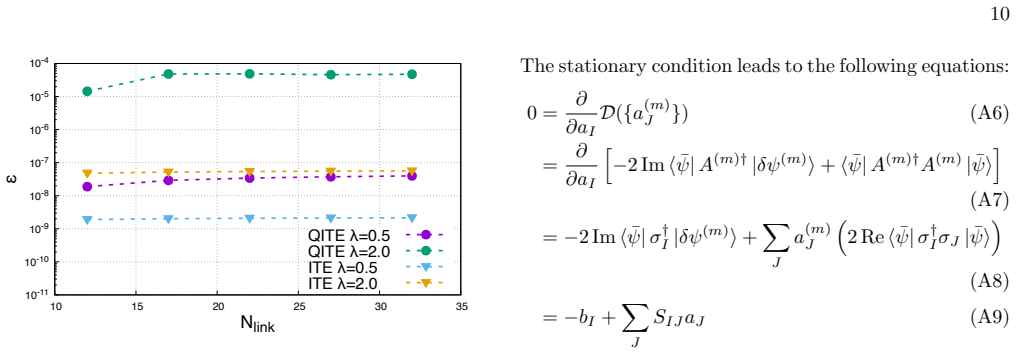
In this paper, we apply the deterministic quantum imaginary time evolution (QITE) algorithm to obtain the ground state of a $2+1$-dimensional pure $\mathbb{Z}_2$ lattice gauge theory. We first construct the set of Pauli operators commuting with Gauss's law constraints, generalizing a previous result. This makes the deterministic QITE gauge-invariant and reduces both the measurement and gate costs significantly without adding extra algorithm errors in the QITE. Then, the classical numerical simulation of the deterministic QITE using tensor networks is performed, and the results are compared with the density matrix renormalization group (DMRG) to evaluate the accuracy of the algorithm. Specifically, we investigate the coupling and system size dependence, and find that the deterministic QITE can achieve a relative error of less than $0.1\%$ up to a twelve-plaquette system and coupling values in a regime that we study. Furthermore, the error dependence on the number of time steps is studied and discussed.
Editorial analysis
A structured set of objections, weighed in public.
Referee Report
Summary. The manuscript develops a gauge-invariant formulation of deterministic quantum imaginary time evolution (QITE) for preparing the ground state of (2+1)D pure Z_2 lattice gauge theory. It constructs Pauli operators that commute with the Gauss-law constraints, reducing measurement and gate overhead, then performs classical tensor-network simulations of the resulting QITE circuit and benchmarks the obtained energies against DMRG, reporting relative errors below 0.1% for lattices up to twelve plaquettes over the studied coupling range. The dependence of the error on the number of imaginary-time steps is also examined.
Significance. If the accuracy claims hold, the work supplies a concrete, gauge-invariant quantum algorithm for ground-state preparation in lattice gauge theories together with classical evidence of its performance on moderate system sizes. The reduction in operator support and the explicit construction of commuting Pauli strings constitute reusable technical contributions for quantum simulation of gauge theories.
major comments (2)
- The central accuracy claim (relative error <0.1% up to twelve plaquettes) rests entirely on classical tensor-network simulation of the QITE circuit being compared with DMRG. Because both the QITE evolution and the DMRG reference are approximated by tensor networks, agreement could reflect shared truncation or contraction biases rather than fidelity to ideal quantum QITE. The manuscript must supply the bond dimensions, truncation thresholds, Trotter step sizes, and an explicit error-propagation analysis used in the QITE simulation to demonstrate that these artifacts do not dominate or cancel the reported error.
- The abstract states that the error bound holds 'up to a twelve-plaquette system and coupling values in a regime that we study,' yet neither the precise range of couplings nor an independent exact benchmark for intermediate sizes (e.g., exact diagonalization on small lattices) is provided. Without these, it is impossible to separate algorithmic error from simulation artifacts or to assess how the accuracy scales beyond the reported regime.
Simulated Author's Rebuttal
Thank you for your thorough review and constructive feedback on our manuscript. We address each of the major comments below and outline the revisions we plan to implement.
read point-by-point responses
-
Referee: The central accuracy claim (relative error <0.1% up to twelve plaquettes) rests entirely on classical tensor-network simulation of the QITE circuit being compared with DMRG. Because both the QITE evolution and the DMRG reference are approximated by tensor networks, agreement could reflect shared truncation or contraction biases rather than fidelity to ideal quantum QITE. The manuscript must supply the bond dimensions, truncation thresholds, Trotter step sizes, and an explicit error-propagation analysis used in the QITE simulation to demonstrate that these artifacts do not dominate or cancel the reported error.
Authors: We agree that detailed simulation parameters are necessary to rule out shared biases. In the revised version, we will explicitly report the bond dimensions, truncation thresholds, and Trotter step sizes used in the tensor-network simulations of the QITE circuit. We will also include an error-propagation analysis to show that the reported relative errors are not artifacts of the approximations. revision: yes
-
Referee: The abstract states that the error bound holds 'up to a twelve-plaquette system and coupling values in a regime that we study,' yet neither the precise range of couplings nor an independent exact benchmark for intermediate sizes (e.g., exact diagonalization on small lattices) is provided. Without these, it is impossible to separate algorithmic error from simulation artifacts or to assess how the accuracy scales beyond the reported regime.
Authors: We thank the referee for pointing this out. We will revise the abstract to specify the precise range of coupling values studied. Furthermore, we will add comparisons with exact diagonalization results for smaller system sizes (e.g., up to 4-6 plaquettes) where feasible, to better isolate algorithmic errors from tensor-network artifacts and to provide insight into the scaling behavior. revision: yes
Circularity Check
No circularity; accuracy claim rests on independent DMRG benchmark
full rationale
The paper constructs gauge-invariant Pauli operators (generalizing a prior result) then simulates deterministic QITE classically via tensor networks and directly compares the resulting energies to separate DMRG calculations. This comparison supplies an external benchmark whose ground-state approximation is obtained by an unrelated algorithm, not by fitting or re-deriving quantities internal to the QITE evolution. No equation reduces a reported error or prediction to a fitted parameter, self-citation, or ansatz taken from the same work; the derivation chain therefore remains self-contained against the stated external reference.
Axiom & Free-Parameter Ledger
Reference graph
Works this paper leans on
-
[1]
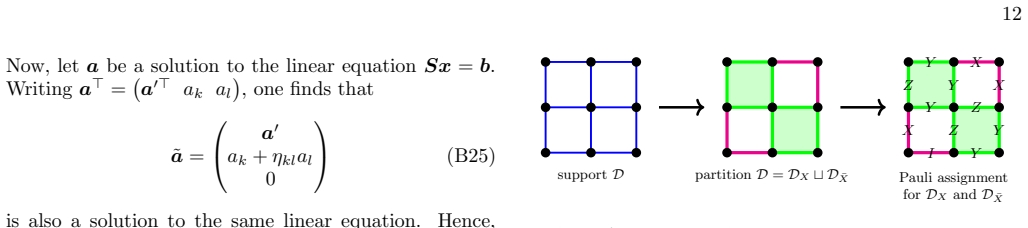
Partition the support asD=D X ⊔ D ¯X, where DX := supp(σX) andD ¯X := supp(σ ¯X)
-
[2]
supportD partitionD=DX ⊔ D¯X YY Y Y Z Z Z Y YX I X X Pauli assignment forDX andD¯X FIG
AssignI, XandY, Zfor each qubitq∈ D X and q∈ D ¯X, respectively. supportD partitionD=DX ⊔ D¯X YY Y Y Z Z Z Y YX I X X Pauli assignment forDX andD¯X FIG. 7: An example of a partition and Pauli assignment for a four plaquette supportD, shown as blue links. Green links denote a specific partitionD ¯X = supp(σ ¯X)∈Γ and green plaquettes denote the correspondi...
- [3]
- [4]
-
[5]
A. Di Meglioet al., Quantum Computing for High- Energy Physics: State of the Art and Challenges, PRX Quantum5, 037001 (2024), arXiv:2307.03236 [quant-ph]
-
[6]
Z. Davoudi, Tasi/cern/kitp lecture notes on” toward quantum computing gauge theories of nature”, arXiv preprint arXiv:2507.15840 (2025)
- [7]
-
[8]
Variational ansatz-based quantum simulation of imaginary time evolution
S. McArdle, T. Jones, S. Endo, Y. Li, S. C. Benjamin, and X. Yuan, Variational ansatz-based quantum simula- tion of imaginary time evolution, npj Quantum Inf.5, 75 (2019), arXiv:1804.03023 [quant-ph]
-
[9]
Gomes, A
N. Gomes, A. Mukherjee, F. Zhang, T. Iadecola, C.-Z. Wang, K.-M. Ho, P. P. Orth, and Y.-X. Yao, Adaptive variational quantum imaginary time evolution approach for ground state preparation, Advanced Quantum Tech- nologies4, 2100114 (2021)
2021
-
[10]
Gacon, J
J. Gacon, J. Nys, R. Rossi, S. Woerner, and G. Car- leo, Variational quantum time evolution without the quantum geometric tensor, Physical Review Research6, 013143 (2024)
2024
-
[11]
M. Motta, C. Sun, A. T. K. Tan, M. J. O. Rourke, E. Ye, A. J. Minnich, F. G. S. L. Brand˜ ao, and G. K.-L. Chan, Determining eigenstates and thermal states on a quan- tum computer using quantum imaginary time evolution, 14 Nature Phys.16, 205 (2019), arXiv:1901.07653 [quant- ph]
-
[12]
T. L. Silva, M. M. Taddei, S. Carrazza, and L. Aolita, Fragmented imaginary-time evolution for early-stage quantum signal processors, Scientific Reports13, 18258 (2023)
2023
- [13]
- [14]
-
[15]
Gluza, J
M. Gluza, J. Son, B. H. Tiang, R. Zander, R. Seidel, Y. Suzuki, Z. Holmes, and N. H. Ng, Double-bracket quantum algorithms for quantum imaginary-time evolu- tion, Physical review letters136, 020601 (2026)
2026
- [16]
-
[17]
S.-H. Lin, R. Dilip, A. G. Green, A. Smith, and F. Poll- mann, Real-and imaginary-time evolution with com- pressed quantum circuits, PRX Quantum2, 010342 (2021)
2021
-
[18]
Kosugi, Y
T. Kosugi, Y. Nishiya, H. Nishi, and Y.-i. Matsushita, Imaginary-time evolution using forward and backward real-time evolution with a single ancilla: First-quantized eigensolver algorithm for quantum chemistry, Physical Review Research4, 033121 (2022)
2022
-
[19]
K. Yeter-Aydeniz, E. Moschandreou, and G. Siopsis, Quantum imaginary-time evolution algorithm for quan- tum field theories with continuous variables, Phys. Rev. A105, 012412 (2022), arXiv:2107.00791 [quant-ph]
-
[20]
Yeter-Aydeniz, R
K. Yeter-Aydeniz, R. C. Pooser, and G. Siopsis, Practi- cal quantum computation of chemical and nuclear energy levels using quantum imaginary time evolution and lanc- zos algorithms, npj Quantum Information6, 63 (2020)
2020
-
[21]
Gomes, F
N. Gomes, F. Zhang, N. F. Berthusen, C.-Z. Wang, K.- M. Ho, P. P. Orth, and Y. Yao, Efficient step-merged quantum imaginary time evolution algorithm for quan- tum chemistry, Journal of Chemical Theory and Compu- tation16, 6256 (2020)
2020
-
[22]
Nishi, T
H. Nishi, T. Kosugi, and Y.-i. Matsushita, Implemen- tation of quantum imaginary-time evolution method on nisq devices by introducing nonlocal approximation, npj Quantum Information7, 85 (2021)
2021
-
[23]
Huang, Y
Y. Huang, Y. Shao, W. Ren, J. Sun, and D. Lv, Efficient quantum imaginary time evolution by drifting real-time evolution: An approach with low gate and measurement complexity, Journal of Chemical Theory and Computa- tion19, 3868 (2023)
2023
-
[24]
A. A. Mel´ endez, C. G. Almud´ ever, M. A. Garcia-March, R. G´ omez-Lurbe, L. Ion, M. L. Bera, R. M. Sanz, S. Mehrabankar, T. Pandit, A. P´ erez,et al., Adaptive time compressed qite (acq) and its geometrical interpre- tation, arXiv preprint arXiv:2510.15781 (2025)
work page internal anchor Pith review Pith/arXiv arXiv 2025
- [25]
- [26]
-
[27]
Z. Davoudi, N. Mueller, and C. Powers, Towards Quan- tum Computing Phase Diagrams of Gauge Theories with Thermal Pure Quantum States, Phys. Rev. Lett.131, 081901 (2023), arXiv:2208.13112 [hep-lat]
-
[28]
R. Maeno, Efficient construction ofZ 2 gauge-invariant bases for the quantum minimally entangled typical ther- mal states algorithm, arXiv preprint arXiv:2603.10932 (2026)
- [29]
- [30]
-
[31]
S. R. White, Density matrix formulation for quantum renormalization groups, Phys. Rev. Lett.69, 2863 (1992)
1992
-
[32]
F. J. Wegner, Duality in Generalized Ising Models and Phase Transitions Without Local Order Parameters, J. Math. Phys.12, 2259 (1971)
1971
-
[33]
J. B. Kogut, An introduction to lattice gauge theory and spin systems, Rev. Mod. Phys.51, 659 (1979)
1979
- [34]
- [35]
-
[36]
T. Sugihara, Matrix product representation of gauge in- variant states in aZ2 lattice gauge theory, JHEP07, 022, arXiv:hep-lat/0506009
-
[37]
L. Tagliacozzo and G. Vidal, Entanglement Renormal- ization and Gauge Symmetry, Phys. Rev. B83, 115127 (2011), arXiv:1007.4145 [cond-mat.str-el]
- [38]
-
[39]
Y. Wu and W.-Y. Liu, Accurate Gauge-Invariant Tensor- Network Simulations for Abelian Lattice Gauge The- ory in (2+1)D: Ground-State and Real-Time Dynamics, Phys. Rev. Lett.135, 130401 (2025), arXiv:2503.20566 [cond-mat.str-el]
- [40]
- [41]
-
[42]
A. Yamamoto, Real-time simulation of (2+1)- dimensional lattice gauge theory on qubits, PTEP 2021, 013B06 (2021), arXiv:2008.11395 [hep-lat]
-
[43]
Alexandrou, A
C. Alexandrou, A. Athenodorou, K. Blekos, G. Polykratis, and S. K¨ uhn, Realizing string breaking dynamics in aZ 2 lattice gauge theory on quantum hardware, Physical Review D112, 114506 (2025)
2025
- [44]
-
[45]
K. Xu, U. Borla, K. Hemery, R. Joshi, H. Dreyer, E. Ri- naldi, and J. C. Halimeh, Observation of glueball excita- tions and string breaking in a 2+1DZ 2 lattice gauge the- ory on a trapped-ion quantum computer, arXiv e-prints , arXiv:2604.07435 (2026), arXiv:2604.07435 [hep-lat]
work page internal anchor Pith review Pith/arXiv arXiv 2026
-
[46]
Emonts, A
P. Emonts, A. Kelman, U. Borla, S. Moroz, S. Gazit, and E. Zohar, Finding the ground state of a lattice gauge the- ory with fermionic tensor networks: A 2+1d z2 demon- stration, Physical Review D107, 014505 (2023)
2023
-
[47]
Irmejs, M.-C
R. Irmejs, M.-C. Ba˜ nuls, and J. I. Cirac, Quantum simu- lation of z 2 lattice gauge theory with minimal resources, Physical Review D108, 074503 (2023)
2023
-
[48]
Lumia, P
L. Lumia, P. Torta, G. B. Mbeng, G. E. Santoro, E. Erco- lessi, M. Burrello, and M. M. Wauters, Two-dimensional z 2 lattice gauge theory on a near-term quantum sim- ulator: Variational quantum optimization, confinement, and topological order, PRX Quantum3, 020320 (2022)
2022
-
[49]
J. Cobos, J. Fraxanet, C. Benito, F. di Marcanto- nio, P. Rivero, K. Kap´ as, M. A. Werner, ¨O. Legeza, A. Bermudez, and E. Rico, Real-time dynamics in a (2+ 1)-d gauge theory: The stringy nature on a superconduct- ing quantum simulator, arXiv preprint arXiv:2507.08088 (2025)
-
[50]
Mueller, T
N. Mueller, T. Wang, O. Katz, Z. Davoudi, and M. Cetina, Quantum computing universal thermalization dynamics in a (2+ 1) d lattice gauge theory, Nature Com- munications16, 5492 (2025)
2025
- [51]
-
[52]
Wiese, Ultracold quantum gases and lattice sys- tems: quantum simulation of lattice gauge theories, An- nalen der Physik525, 777 (2013)
U.-J. Wiese, Ultracold quantum gases and lattice sys- tems: quantum simulation of lattice gauge theories, An- nalen der Physik525, 777 (2013)
2013
-
[53]
F. Di Marcantonio, S. Pradhan, S. Vallecorsa, M. C. Ba˜ nuls, and E. R. Ortega, Roughening and dynamics of an electric flux string in a (2+ 1) d lattice gauge theory, arXiv preprint arXiv:2505.23853 (2025)
-
[54]
Homeier, A
L. Homeier, A. Bohrdt, S. Linsel, E. Demler, J. C. Hal- imeh, and F. Grusdt, Realistic scheme for quantum simu- lation of z 2 lattice gauge theories with dynamical matter in (2+ 1) d, Communications Physics6, 127 (2023)
2023
-
[55]
Gonz´ alez-Cuadra, L
D. Gonz´ alez-Cuadra, L. Tagliacozzo, M. Lewenstein, and A. Bermudez, Robust topological order in fermionic z 2 gauge theories: From aharonov-bohm instability to soliton-induced deconfinement, Physical Review X10, 041007 (2020)
2020
-
[56]
Sukeno and T
H. Sukeno and T. Okuda, Measurement-based quan- tum simulation of abelian lattice gauge theories, SciPost Physics14, 129 (2023)
2023
-
[57]
Borla, S
U. Borla, S. Gazit, and S. Moroz, Deconfined quantum criticality in ising gauge theory entangled with single- component fermions, Physical Review B110, L201110 (2024)
2024
-
[58]
W.-T. Xu, F. Pollmann, and M. Knap, Critical behavior of fredenhagen-marcu string order parameters at topolog- ical phase transitions with emergent higher-form symme- tries, npj Quantum Information11, 74 (2025)
2025
-
[59]
Kogut and L
J. Kogut and L. Susskind, Hamiltonian formulation of wilson’s lattice gauge theories, Phys. Rev. D11, 395 (1975)
1975
- [60]
- [61]
-
[62]
Vidal, Efficient simulation of one-dimensional quan- tum many-body systems, Phys
G. Vidal, Efficient simulation of one-dimensional quan- tum many-body systems, Phys. Rev. Lett.93, 040502 (2004), arXiv:quant-ph/0310089
-
[63]
Fishman, S
M. Fishman, S. R. White, and E. M. Stoudenmire, The ITensor Software Library for Tensor Network Calcula- tions, SciPost Phys. Codebases , 4 (2022)
2022
discussion (0)
Sign in with ORCID, Apple, or X to comment. Anyone can read and Pith papers without signing in.