REVIEW 3 major objections 4 minor 96 references
A unified diagrammatic formulation of single-reference and multi-reference random phase approximations: the particle-hole and particle-particle channels
T0 review · 3 major / 4 minor · reviewed 2026-08-15 · deepseek-v4-flash
Pith's one-line read The paper defines multi-reference RPA with exchange (MR-RPAx) and particle-particle RPA (MR-ppRPA) as infinite diagram resummations whose energy equations unify with — and reduce to — their single-reference counterparts.
desk verdict A credible, careful extension of the authors' MR-dRPA framework to RPAx and ppRPA; the open unresolved point is the unproven positive-definiteness condition behind the MR-ppRPA eigenvalue formula. read the letter →
The pith
A machine-rendered reading of the paper's core claim, the machinery that carries it, and where it could break.
The reading
What carries the argument
The load-bearing object is the generalized Feynman diagram of a multi-reference many-body perturbation theory in which Wick's theorem is replaced by a cumulant expansion of time-ordered Green's functions: diagram lines are zeroth-order Green's functions of an interacting $\hat{H}_0$, and four-legged vertices can meet at a connected two-body cumulant (the red square in the paper's figures) that carries the active-space correlation. Two generalized propagators do the work: the particle-hole polarizability $i\Pi^{0}_{pr,qs} = G^{0}_{rq}G^{0}_{sp} - G^{0,c}_{rs,pq}$ feeding the RPAx ring sum, and the particle-particle pair propagator $K^{0}_{rs,pq} = G^{0}_{rq}G^{0}_{sp} - G^{0}_{rp}G^{0}_{sq} - G^{0,c}_{rs,pq}$ feeding the ppRPA ladder sum. Substituting these into logarithm-of-determinant energy integrals and evaluating the frequency integrals analytically converts each resummation into a paired-eigenvalue ('plasmon') trace from a non-Hermitian generalized eigenvalue problem, Eqs. (25) and (46), or into a coupled-cluster-like Riccati equation whose order-by-order solution provides the perturbative energy analysis. With a Dyall Hamiltonian as $\hat{H}_0$ and a CASSCF wavefunction as the reference, the eigenvalue problems take a block form whose elements are written through active-space transition density matrices.
What would settle it
Take a molecule with a small or ill-defined highest-occupied/lowest-unoccupied gap (the case where the chemical-potential rule of Eq. (51) is most strained), build the matrix $E_{\alpha} = \Delta + \alpha V$ of Eq. (S27) from its MR-ppRPA data, and track its smallest eigenvalue for $\alpha\in[0,1]$ while verifying that $\omega^{N+2}_P - 2\mu$ and $\omega^{N-2}_H + 2\mu$ stay positive: if any eigenvalue crosses zero or any shifted gap turns negative, the eigenvalue formula (50) is silent about the correct energy, and the method should visibly break or jump there. For MR-RPAx, the analogous test is to diagonalize the generalized eigenvalue problem (25) along the dissociation curve of a molecule not among the four tested and look for the imaginary roots that already appear for HF, ScH, and $\mathrm{N_2}$ at stretched geometries.
Extended reading notes
Core claim
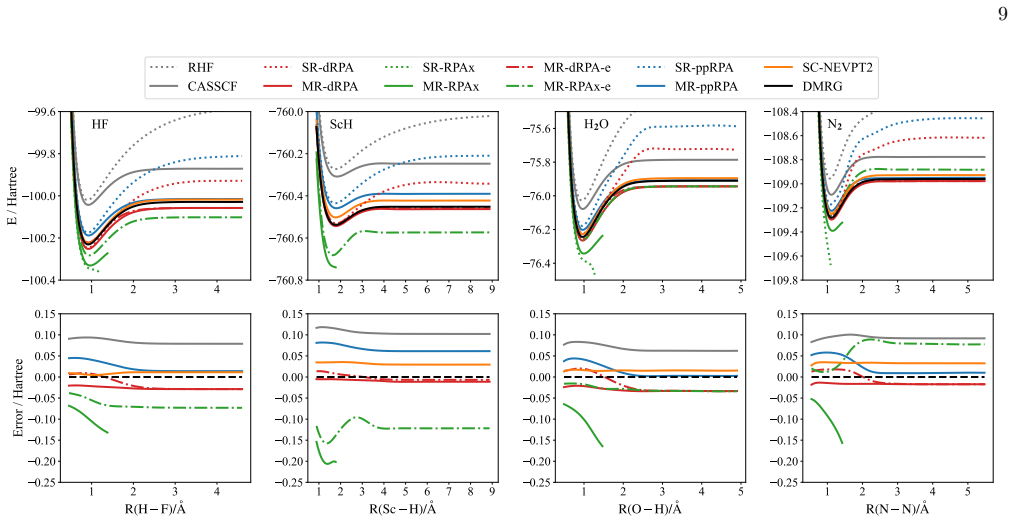
The central discovery is a unified set of energy expressions for two further RPA channels. For the particle-hole channel, the infinite resummation of ring diagrams with antisymmetrized Coulomb vertices, corrected at second order by subtracting one diagram with the wrong symmetry factor, yields $\Delta E_{\mathrm{RPAx}} = \int \frac{d\omega}{2\pi} \frac{1}{2}\mathrm{tr}\,[\ln(I - \bar{v}\Pi^{0}(i\omega)) + \bar{v}\Pi^{0}(i\omega)] - \Delta E^{(2),a}$, which is also the plasmon formula $\frac{1}{2}(\mathrm{tr}\,\bar{\Omega} - \mathrm{tr}\,\bar{A}) - \Delta E^{(2),a}$ from the non-Hermitian generalized eigenvalue problem (25) and, equivalently, a coupled-cluster-like Riccati equation. For the particle-particle channel, the resummation of generalized ladder diagrams built from the pair propagator $K^{0}$ gives $\Delta E_{\mathrm{ppRPA}} = \int \frac{d\omega}{2\pi} \mathrm{tr}\,[\ln(I - \tfrac{1}{4}\bar{g}K^{0}(i\omega)) + \tfrac{1}{4}\bar{g}K^{0}(i\omega)] = \mathrm{tr}\,\Omega_{+} - \mathrm{tr}\,A_{+}$, evaluated from the eigenvalue problem (46) in the $(N+2)$- and $(N-2)$-electron spaces. All of these reduce to the standard single-reference dRPA, RPAx, and ppRPA formulas when the reference is a single determinant, because each generalized propagator then collapses to products of ordinary one-body Green's functions. On HF, ScH, $\mathrm{H_2O}$, and $\mathrm{N_2}$, MR-ppRPA gives the most accurate dissociation limits among the three MR variants but underestimates correlation near equilibrium; full MR-RPAx develops imaginary roots at stretched geometries, an instability avoided by leaving out active-space screening (MR-RPAx-e); MR-dRPA remains the most balanced overall.
Load-bearing premise
The load-bearing premise is that the auxiliary matrix $E_{\alpha} = \Delta + \alpha V$ stays positive definite for all $\alpha\in[0,1]$ and that the two-electron addition and removal energies $\omega^{N+2}_P - 2\mu$ and $\omega^{N-2}_H + 2\mu$ remain positive for the chosen chemical potential, so that the ppRPA summation can be evaluated as a paired-eigenvalue trace; the paper proposes a practical rule for $\mu$ but does not prove it always enforces these conditions for arbitrary systems, and the RPAx variant separately assumes the generalized eigenvalue problem (25) has real roots, which the paper reports fails at stretched geometries of several molecules.
Editorial extensions
If this is right
- Any existing single-reference RPAx or ppRPA implementation can be promoted to a multi-reference one by redefining diagram lines through the active-space cumulant Green's functions, with the algebraic structure of the equations unchanged.
- MR-ppRPA gives the most accurate correlation energies at dissociation among the three MR variants, beating SC-NEVPT2 for $\mathrm{H_2O}$ and $\mathrm{N_2}$ at large bond lengths, though it underestimates correlation near equilibrium.
- Full MR-RPAx inherits the imaginary-root instability of single-reference RPAx at stretched geometries, but omitting active-space screening (MR-RPAx-e) removes the instability and yields qualitatively correct dissociation curves.
- Error cancellation between the second and third orders is the reason both SR-RPA and MR-RPA succeed, so accurate correlation energies do not require each perturbative order to be small.
- Because the particle-hole and particle-particle channels err in opposite directions, combining the two channels into a single method is the paper's concrete route to better accuracy.
Reading between the lines
- Editorial inference: because the particle-hole and particle-particle channels over- and under-estimate correlation, a unified resummation mixing ring and ladder diagrams is a natural next method; a concrete check is whether the opposite-signed errors persist for larger active spaces, open-shell ground states, and molecules beyond the four tested, all of which the paper leaves open.
- Editorial inference: the same cumulant-diagram prescription is not tied to RPA, so it could define multi-reference generalizations of other single-reference resummable methods (for example GW self-energies or coupled-cluster doubles style sums) by the same route of replacing propagator lines with cumulant-corrected ones.
- Editorial inference: the order-by-order sign pattern is a cheap diagnostic — RPAx contributes negatively at every order and diverges, while dRPA and ppRPA alternate and decay; watching the first few perturbative orders of a new RPA variant could predict whether the full resummation will be stable before running it.
- Editorial inference: Eq. (50) predicts the MR-ppRPA energy is exactly independent of the chemical potential, so computing the same molecule with several different $\mu$ values that satisfy the two restrictions would simultaneously validate the contour-integration derivation and stress the positive-definiteness assumption.
Signed reviews
Editorial analysis
A structured set of objections, weighed in public.
Referee Report
Summary. This paper develops a diagrammatic multi-reference generalization of two RPA variants, RPAx and ppRPA, building on the authors' earlier cumulant-based generalized Feynman diagram framework. For each method the authors derive three formally equivalent expressions for the correlation energy: an imaginary-frequency integral, a plasmon-type eigenvalue formula, and a coupled-cluster-like Riccati equation, and they show that these reduce to the standard single-reference formulas. The methods are implemented with a CASSCF/Dyall zeroth-order Hamiltonian and benchmarked on the Li4 size-extensivity model and on potential energy curves for HF, ScH, H2O, and N2 against DMRG and SC-NEVPT2 data. A perturbative analysis up to fifth order attributes the numerical behavior of the three MR-RPA variants to error cancellation between second and higher orders. The paper reports that MR-dRPA offers the most balanced treatment, MR-ppRPA performs best at the dissociated limit but underestimates correlation near equilibrium, and MR-RPAx suffers from imaginary roots at stretched geometries, which is partially rescued by the active-space-screening-neglected variant MR-RPAx-e.
Significance. If the derivations are valid, the paper extends the diagrammatic MR many-body framework to two additional RPA channels and provides a unified set of equations that hold at both single- and multi-reference levels, which is a genuine methodological step beyond the previous MR-dRPA work. The treatment of the second-order diagrams in RPAx with the correction term is a careful and nontrivial detail that the authors handle correctly. The perturbative analysis, the size-extensivity test, and the benchmark data against DMRG and SC-NEVPT2 are useful contributions, and the paper is clearly written. However, the MR-ppRPA eigenvalue formula rests on an unproven positive-definiteness condition for the matrix E_α, and the instability of MR-RPAx at strong correlation limits the scope of the central claim that the methods provide accurate energies for strongly correlated systems. These issues are fixable but currently leave the MR-ppRPA derivation incomplete and the MR-RPAx claim overstated.
major comments (3)
- [Sec. II.C and Supplemental Material, Eqs. (S27)-(S34)] The derivation of the MR-ppRPA eigenvalue formula Eq. (50) requires that E_α = Δ + αV be positive definite for α in [0,1], so that the eigenpairs in Eq. (S28) split into N_pp positive and N_hh negative branches and the normalization (S30) and spectral representation (S31) hold. The paper states two restrictions on the chemical potential μ (positive diagonals of Δ and positive definiteness of E_1) but provides no proof that the heuristic choice in Eq. (51) satisfies them in the multi-reference case. The single-reference guarantee, where 2μ is the HOMO-LUMO midpoint, does not carry over because ω^{N+2}_P - 2μ and ω^{N-2}_H + 2μ involve interacting active-space energies. If E_1 is not positive definite, the sign pairing and the contour integration used to obtain Eq. (50) break down, and Eq. (50) is not equivalent to the defining integral in Eq. (45). The numerical sections do not report any check of positive definiteness or a direct comparison of tr(Ω+) - tr(A+) with -tr(Ω-) - tr(A-), leaving this load-bearing gap unaddressed.
- [Sec. III.B and Fig. 5] The central claim that MR-RPAx provides accurate correlation energies for strongly correlated systems is contradicted by the paper's own data: at stretched geometries, Eq. (25) gives imaginary roots and MR-RPAx fails for all four molecules. The rescue via MR-RPAx-e drops the active-space screening terms and is a different approximation, not the resummation of generalized ring diagrams with antisymmetrized vertices that defines MR-RPAx. The abstract and introduction should therefore be tempered: the numerical evidence supports MR-RPAx only in the regime where Eq. (25) has real paired eigenvalues, and the strong-correlation performance claim should be restricted accordingly.
- [Sec. II.B, Eqs. (20) and (28)] The paper uses the plasmon formula Eq. (28) for all numerical results, but the equivalence between Eq. (28) and the defining imaginary-frequency expression Eq. (20) relies on the non-Hermitian eigenvalue problem (25) having real paired eigenvalues. The paper reports imaginary roots at stretched geometries but does not discuss whether Eq. (20) remains meaningful in that case, whether Eq. (28) is undefined, or what stability condition would guarantee real roots. This is a load-bearing point for the applicability of MR-RPAx as defined, and the authors should either provide a stability analysis or explicitly state that Eq. (20) itself is only defined when Eq. (25) is well-behaved.
minor comments (4)
- [Tables S5-S8] The symbol '/' appears in the SR-RPAx and MR-RPAx columns at large bond distances without explanation; presumably these entries are absent because the eigenvalue problem has imaginary roots, but this should be stated explicitly in the table captions or in the main text.
- [Eq. (22)] The second term in Eq. (22) sums over states labeled |Φ^{N-1}_I>, whereas the first term uses |Φ^{N-1}_H>; the index naming should be made consistent throughout the equation and the following definitions.
- [Abstract and Sec. III.C] The abbreviation MR-phRPA is introduced in the abstract and used in Sec. III.C, but it is defined only later in Sec. II.A; please define the abbreviation at first use in the abstract or restructure the introduction.
- [Fig. 1 caption] The caption contains the stray text '79' in the sentence describing the interaction vertices; this appears to be a citation artifact and should be removed or properly formatted as a reference.
Circularity Check
No significant circularity: the new MR-RPAx and MR-ppRPA equations are derived from explicit diagrammatic resummations and benchmarked against independent DMRG and SC-NEVPT2 data.
full rationale
The paper's central derivations start from explicit diagrammatic definitions: MR-RPAx is defined by resumming generalized ring diagrams with antisymmetrized vertices (Eq. 20), and MR-ppRPA by resumming generalized ladder diagrams (Eq. 45). The algebraic forms, such as the plasmon formula for RPAx (Eq. 28) and the eigenvalue formula for ppRPA (Eqs. 46-50), are obtained from these definitions by contour integration and the Feynman-Hellmann theorem, so they are mathematical equivalences rather than restatements of inputs. No parameter is fitted to the target DMRG or SC-NEVPT2 data; the numerical comparisons are external benchmarks. The heuristic chemical potential in Eq. (51) and the unproven positive-definiteness of the matrix in Eq. (S27) are well-definedness and correctness concerns, not circular reductions, because the defining correlation energy Eq. (45) does not presuppose those conditions. The self-citation to the authors' prior work (Ref. 10) supplies the generalized Feynman-diagram vocabulary and the MR-dRPA template, but the new channel derivations are carried out explicitly in the paper and Supplemental Material, with detailed matrix elements. No prediction reduces by construction to a fitted input or to a self-citation chain.
Assumptions & free parameters
free parameters (1)
- chemical potential mu =
Eq. (51): (min omega^{N+1} - min omega^{N-1}) / 2
assumptions (4)
- domain assumption Cumulant expansion of time-ordered Green's functions (Eq. 8) holds for an interacting H0 and can replace Wick's theorem.
- domain assumption The matrix E_alpha = Delta + alpha V (Eq. S27) is positive definite for the chosen chemical potential, ensuring eigenvalue pairing.
- domain assumption The infinite resummation of generalized ring (RPAx) and ladder (ppRPA) diagrams defines the correlation energy.
- domain assumption A CASSCF reference with the Dyall Hamiltonian as H0 is sufficient to capture the strong correlation in the active space.
Cite this review
Pith. "Pith review of A unified diagrammatic formulation of single-reference and multi-reference random phase approximations: the particle-hole and particle-particle channels." pith.science (2026). https://pith.science/paper/4TSEYYS2
@misc{pith2026250719876,
  author       = {Pith},
  title        = {Pith review of: A unified diagrammatic formulation of single-reference and multi-reference random phase approximations: the particle-hole and particle-particle channels},
  year         = {2026},
  howpublished = {\url{https://pith.science/paper/4TSEYYS2}},
  note         = {Machine review of arXiv:2507.19876}
}
read the original abstract
A diagrammatic multi-reference generalization of many-body perturbation theory was recently introduced [J. Phys. Chem. Lett., 2025, 16, 3047]. This framework allows us to extend single-reference (SR) Green's function methods defined at the diagrammatic level naturally into multi-reference case, as previously exemplified by the formulation of multi-reference direct random phase approximation (MR-dRPA) and the multi-reference second-order screened exchange approximation (MR-SOSEX). In this work, we further elaborate this framework and use it to develop MR generalizations of two other RPA variants, namely, particle-hole (ph) RPA with exchange (MR-RPAx) and particle-particle RPA (MR-ppRPA). We define these two MR generalizations by infinite order resummations of the generalized `ring' and `ladder' diagrams with antisymmetrized interaction vertices, respectively, which incorporate the contributions from the active-space connected two-body Green's functions. As for MR-dRPA, we derive unified sets of equations that hold at both SR and MR levels for RPAx and ppRPA, respectively. We perform numerical studies of prototypical systems using the three MR-RPA methods and carry out a perturbative analysis to gain a deeper understanding of their behaviors. We find that error cancellation between the second and third orders is a key factor for both SR-RPA and MR-RPA. In addition, we observe that MR-phRPA (MR-dRPA and MR-RPAx) and MR-ppRPA tend to overestimate and underestimate correlation energies, respectively, suggesting that a better accuracy can be achieved by further combining these two channels in the future.
Figures


Figures from the paper (2 more)

Reference graph
Works this paper leans on
-
[1]
author author J. W. \ Park , author R. Al-Saadon , author M. K. \ MacLeod , author T. Shiozaki ,\ and\ author B. Vlaisavljevich ,\ https://doi.org/10.1021/acs.chemrev.9b00496 journal journal Chem. Rev. \ volume 120 ,\ pages 5878 ( year 2020 ) NoStop
-
[2]
author author K. Andersson , author P. Malmqvist ,\ and\ author B. O. \ Roos ,\ https://doi.org/10.1063/1.462209 journal journal J. Chem. Phys. \ volume 96 ,\ pages 1218 ( year 1992 ) NoStop
doi:10.1063/1.462209 1992
-
[3]
author author C. Angeli , author R. Cimiraglia , author S. Evangelisti , author T. Leininger ,\ and\ author J.-P. \ Malrieu ,\ https://doi.org/10.1063/1.1361246 journal journal J. Chem. Phys. \ volume 114 ,\ pages 10252 ( year 2001 ) NoStop
-
[4]
author author D. I. \ Lyakh , author M. Musiał , author V. F. \ Lotrich ,\ and\ author R. J. \ Bartlett ,\ https://doi.org/10.1021/cr2001417 journal journal Chem. Rev. \ volume 112 ,\ pages 182 ( year 2012 ) NoStop
-
[5]
author author F. A. \ Evangelista ,\ https://doi.org/10.1063/1.5039496 journal journal J. Chem. Phys. \ volume 149 ,\ pages 030901 ( year 2018 ) NoStop
-
[6]
author author R. G. \ Adam , author A. Waigum ,\ and\ author A. K \"o hn ,\ @noop journal journal WIREs Comput. Mol. Sci. \ volume 15 ,\ pages e70023 ( year 2025 ) NoStop
2025
-
[7]
Fetter \ and\ author J
author author A. Fetter \ and\ author J. Walecka ,\ @noop title Quantum Theory of Many - Particle System ,\ International Series in Pure and Applied Physics \ ( publisher MacGraw-Hill ,\ address New York ,\ year 1971 ) NoStop
1971
-
[8]
author author J. W. \ Negele \ and\ author H. Orland ,\ https://doi.org/10.1201/9780429497926 title Quantum Many -particle Systems \ ( publisher CRC Press ,\ address Boca Raton ,\ year 1998 ) NoStop
Show all 96 references
-
[9]
author author R. M. \ Martin , author L. Reining ,\ and\ author D. M. \ Ceperley ,\ @noop title Interacting Electrons : Theory and Computational Approaches \ ( publisher Cambridge University Press ,\ year 2016 ) NoStop
2016
-
[10]
Wang , author W.-H
author author Y. Wang , author W.-H. \ Fang ,\ and\ author Z. Li ,\ https://doi.org/10.1021/acs.jpclett.5c00258 journal journal J. Phys. Chem. Lett. \ volume 16 ,\ pages 3047 ( year 2025 ) NoStop
2025 doi
-
[11]
Furche ,\ https://doi.org/10.1103/PhysRevB.64.195120 journal journal Phys
author author F. Furche ,\ https://doi.org/10.1103/PhysRevB.64.195120 journal journal Phys. Rev. B \ volume 64 ,\ pages 195120 ( year 2001 ) NoStop
2001 doi
-
[12]
Zhu , author J
author author W. Zhu , author J. Toulouse , author A. Savin ,\ and\ author J. G. \ Ángyán ,\ https://doi.org/10.1063/1.3431616 journal journal J. Chem. Phys. \ volume 132 ,\ pages 244108 ( year 2010 ) NoStop
2010 doi
-
[13]
Eshuis \ and\ author F
author author H. Eshuis \ and\ author F. Furche ,\ https://doi.org/10.1021/jz200238f journal journal J. Phys. Chem. Lett. \ volume 2 ,\ pages 983 ( year 2011 ) NoStop
2011 doi
-
[14]
Paier , author X
author author J. Paier , author X. Ren , author P. Rinke , author G. E. \ Scuseria , author A. Grüneis , author G. Kresse ,\ and\ author M. Scheffler ,\ https://doi.org/10.1088/1367-2630/14/4/043002 journal journal New J. Phys. \ volume 14 ,\ pages 043002 ( year 2012 ) NoStop
-
[15]
Harl \ and\ author G
author author J. Harl \ and\ author G. Kresse ,\ https://doi.org/10.1103/PhysRevB.77.045136 journal journal Phys. Rev. B \ volume 77 ,\ pages 045136 ( year 2008 ) NoStop
2008 doi
-
[16]
Harl \ and\ author G
author author J. Harl \ and\ author G. Kresse ,\ https://doi.org/10.1103/PhysRevLett.103.056401 journal journal Phys. Rev. Lett. \ volume 103 ,\ pages 056401 ( year 2009 ) NoStop
2009 doi
-
[17]
Lu , author Y
author author D. Lu , author Y. Li , author D. Rocca ,\ and\ author G. Galli ,\ https://doi.org/10.1103/PhysRevLett.102.206411 journal journal Phys. Rev. Lett. \ volume 102 ,\ pages 206411 ( year 2009 ) NoStop
2009 doi
-
[18]
Ren , author P
author author X. Ren , author P. Rinke ,\ and\ author M. Scheffler ,\ https://doi.org/10.1103/PhysRevB.80.045402 journal journal Phys. Rev. B \ volume 80 ,\ pages 045402 ( year 2009 ) NoStop
2009 doi
-
[19]
Schimka , author J
author author L. Schimka , author J. Harl , author A. Stroppa , author A. Grüneis , author M. Marsman , author F. Mittendorfer ,\ and\ author G. Kresse ,\ https://doi.org/10.1038/nmat2806 journal journal Nat. Mater. \ volume 9 ,\ pages 741 ( year 2010 ) NoStop
-
[20]
Harl , author L
author author J. Harl , author L. Schimka ,\ and\ author G. Kresse ,\ https://doi.org/10.1103/PhysRevB.81.115126 journal journal Phys. Rev. B \ volume 81 ,\ pages 115126 ( year 2010 ) NoStop
2010 doi
-
[21]
Lebègue , author J
author author S. Lebègue , author J. Harl , author T. Gould , author J. G. \ Ángyán , author G. Kresse ,\ and\ author J. F. \ Dobson ,\ https://doi.org/10.1103/PhysRevLett.105.196401 journal journal Phys. Rev. Lett. \ volume 105 ,\ pages 196401 ( year 2010 ) NoStop
-
[22]
Mittendorfer , author A
author author F. Mittendorfer , author A. Garhofer , author J. Redinger , author J. Klimeš , author J. Harl ,\ and\ author G. Kresse ,\ https://doi.org/10.1103/PhysRevB.84.201401 journal journal Phys. Rev. B \ volume 84 ,\ pages 201401 ( year 2011 ) NoStop
-
[23]
Olsen , author J
author author T. Olsen , author J. Yan , author J. J. \ Mortensen ,\ and\ author K. S. \ Thygesen ,\ https://doi.org/10.1103/PhysRevLett.107.156401 journal journal Phys. Rev. Lett. \ volume 107 ,\ pages 156401 ( year 2011 ) NoStop
2011 doi
-
[24]
Casadei , author X
author author M. Casadei , author X. Ren , author P. Rinke , author A. Rubio ,\ and\ author M. Scheffler ,\ https://doi.org/10.1103/PhysRevLett.109.146402 journal journal Phys. Rev. Lett. \ volume 109 ,\ pages 146402 ( year 2012 ) NoStop
-
[25]
Neuhauser , author E
author author D. Neuhauser , author E. Rabani ,\ and\ author R. Baer ,\ https://doi.org/10.1021/jz3021606 journal journal J. Phys. Chem. Lett. \ volume 4 ,\ pages 1172 ( year 2013 ) NoStop
2013 doi
-
[26]
Casadei , author X
author author M. Casadei , author X. Ren , author P. Rinke , author A. Rubio ,\ and\ author M. Scheffler ,\ https://doi.org/10.1103/PhysRevB.93.075153 journal journal Phys. Rev. B \ volume 93 ,\ pages 075153 ( year 2016 ) NoStop
2016 doi
-
[27]
Schäfer , author Z
author author T. Schäfer , author Z. Fan , author M. Grünwald ,\ and\ author G. Kresse ,\ https://doi.org/10.1103/PhysRevB.98.144103 journal journal Phys. Rev. B \ volume 98 ,\ pages 144103 ( year 2018 ) NoStop
2018 doi
-
[28]
Pines \ and\ author D
author author D. Pines \ and\ author D. Bohm ,\ https://doi.org/10.1103/PhysRev.85.338 journal journal Phys. Rev. \ volume 85 ,\ pages 338 ( year 1952 ) NoStop
1952 doi
-
[29]
Bohm \ and\ author D
author author D. Bohm \ and\ author D. Pines ,\ https://doi.org/10.1103/PhysRev.92.609 journal journal Phys. Rev. \ volume 92 ,\ pages 609 ( year 1953 ) NoStop
1953 doi
-
[30]
Gell-Mann \ and\ author K
author author M. Gell-Mann \ and\ author K. A. \ Brueckner ,\ https://doi.org/10.1103/PhysRev.106.364 journal journal Phys. Rev. \ volume 106 ,\ pages 364 ( year 1957 ) NoStop
1957 doi
-
[31]
Goldstone ,\ https://api.semanticscholar.org/CorpusID:123005551 journal journal Proc
author author J. Goldstone ,\ https://api.semanticscholar.org/CorpusID:123005551 journal journal Proc. R. Soc. A \ volume 239 ,\ pages 267 ( year 1957 ) NoStop
1957
-
[32]
author author A. D. \ McLachlan \ and\ author M. A. \ Ball ,\ https://doi.org/10.1103/RevModPhys.36.844 journal journal Rev. Mod. Phys. \ volume 36 ,\ pages 844 ( year 1964 ) NoStop
1964 doi
-
[33]
Furche ,\ https://doi.org/10.1063/1.2977789 journal journal J
author author F. Furche ,\ https://doi.org/10.1063/1.2977789 journal journal J. Chem. Phys. \ volume 129 ,\ pages 114105 ( year 2008 ) NoStop
2008 doi
-
[34]
Hesselmann \ and\ author A
author author A. Hesselmann \ and\ author A. Görling ,\ https://doi.org/10.1080/00268976.2011.614282 journal journal Mol. Phys. \ volume 109 ,\ pages 2473 ( year 2011 ) NoStop
2011
-
[35]
Ren , author P
author author X. Ren , author P. Rinke , author C. Joas ,\ and\ author M. Scheffler ,\ https://doi.org/10.1007/s10853-012-6570-4 journal journal J. Mater. Sci. \ volume 47 ,\ pages 7447 ( year 2012 ) NoStop
2012 doi
-
[36]
author author G. P. \ Chen , author V. K. \ Voora , author M. M. \ Agee , author S. G. \ Balasubramani ,\ and\ author F. Furche ,\ https://doi.org/10.1146/annurev-physchem-040215-112308 journal journal Annu. Rev. Phys. Chem. \ volume 68 ,\ pages 421 ( year 2017 ) NoStop
-
[37]
Chatterjee \ and\ author K
author author K. Chatterjee \ and\ author K. Pernal ,\ https://doi.org/10.1063/1.4766934 journal journal J. Chem. Phys. \ volume 137 ,\ pages 204109 ( year 2012 ) NoStop
2012 doi
-
[38]
Pernal ,\ https://doi.org/10.1021/ct500478t journal journal J
author author K. Pernal ,\ https://doi.org/10.1021/ct500478t journal journal J. Chem. Theory Comput. \ volume 10 ,\ pages 4332 ( year 2014 ) NoStop
2014 doi
-
[39]
Pastorczak \ and\ author K
author author E. Pastorczak \ and\ author K. Pernal ,\ https://doi.org/10.1021/acs.jctc.8b00213 journal journal J. Chem. Theory Comput. \ volume 14 ,\ pages 3493 ( year 2018 ) NoStop
2018 doi
-
[40]
Pernal ,\ https://doi.org/10.1103/PhysRevLett.120.013001 journal journal Phys
author author K. Pernal ,\ https://doi.org/10.1103/PhysRevLett.120.013001 journal journal Phys. Rev. Lett. \ volume 120 ,\ pages 013001 ( year 2018 ) NoStop
2018 doi
-
[41]
Guo \ and\ author K
author author Y. Guo \ and\ author K. Pernal ,\ https://doi.org/10.1039/D4FD00054D journal journal Faraday Discuss. \ volume 254 ,\ pages 332 ( year 2024 ) NoStop
2024 doi
-
[42]
Tucholska , author Y
author author A. Tucholska , author Y. Guo ,\ and\ author K. Pernal ,\ https://doi.org/10.1021/acs.jpclett.4c02788 journal journal J. Phys. Chem. Lett. \ volume 15 ,\ pages 12001 ( year 2024 ) NoStop
2024 doi
-
[43]
Szabados \ and\ author \'A
author author \'A . Szabados \ and\ author \'A . Marg\' o csy ,\ https://doi.org/10.1080/00268976.2017.1317111 journal journal Mol. Phys. \ volume 115 ,\ pages 2731 ( year 2017 ) NoStop
2017
-
[44]
Marg\' o csy \ and\ author \'A
author author \'A . Marg\' o csy \ and\ author \'A . Szabados ,\ https://doi.org/10.1063/5.0005075 journal journal J. Chem. Phys. \ volume 152 ,\ pages 204114 ( year 2020 ) NoStop
2020 doi
-
[45]
Mori-Sánchez , author A
author author P. Mori-Sánchez , author A. J. \ Cohen ,\ and\ author W. Yang ,\ https://doi.org/10.1103/PhysRevA.85.042507 journal journal Phys. Rev. A \ volume 85 ,\ pages 042507 ( year 2012 ) NoStop
2012 doi
-
[46]
Grüneis , author M
author author A. Grüneis , author M. Marsman , author J. Harl , author L. Schimka ,\ and\ author G. Kresse ,\ https://doi.org/10.1063/1.3250347 journal journal J. Chem. Phys. \ volume 131 ,\ pages 154115 ( year 2009 ) NoStop
2009 doi
-
[47]
Heßelmann ,\ https://doi.org/10.1063/1.3590916 journal journal J
author author A. Heßelmann ,\ https://doi.org/10.1063/1.3590916 journal journal J. Chem. Phys. \ volume 134 ,\ pages 204107 ( year 2011 ) NoStop
2011 doi
-
[48]
author author J. E. \ Bates \ and\ author F. Furche ,\ https://doi.org/10.1063/1.4827254 journal journal J. Chem. Phys. \ volume 139 ,\ pages 171103 ( year 2013 ) NoStop
2013 doi
-
[49]
author author G. P. \ Chen , author M. M. \ Agee ,\ and\ author F. Furche ,\ https://doi.org/10.1021/acs.jctc.8b00777 journal journal J. Chem. Theory Comput. \ volume 14 ,\ pages 5701 ( year 2018 ) NoStop
2018 doi
-
[50]
Hummel , author A
author author F. Hummel , author A. Grüneis , author G. Kresse ,\ and\ author P. Ziesche ,\ https://doi.org/10.1021/acs.jctc.8b01247 journal journal J. Chem. Theory Comput. \ volume 15 ,\ pages 3223 ( year 2019 ) NoStop
2019 doi
-
[51]
Ren , author A
author author X. Ren , author A. Tkatchenko , author P. Rinke ,\ and\ author M. Scheffler ,\ https://doi.org/10.1103/PhysRevLett.106.153003 journal journal Phys. Rev. Lett. \ volume 106 ,\ pages 153003 ( year 2011 ) NoStop
2011 doi
-
[52]
Fuchs \ and\ author X
author author M. Fuchs \ and\ author X. Gonze ,\ https://doi.org/10.1103/PhysRevB.65.235109 journal journal Phys. Rev. B \ volume 65 ,\ pages 235109 ( year 2002 ) NoStop
2002 doi
-
[53]
Jiang \ and\ author E
author author H. Jiang \ and\ author E. Engel ,\ https://doi.org/10.1063/1.2795707 journal journal J. Chem. Phys. \ volume 127 ,\ pages 184108 ( year 2007 ) NoStop
2007 doi
-
[54]
Toulouse , author I
author author J. Toulouse , author I. C. \ Gerber , author G. Jansen , author A. Savin ,\ and\ author J. G. \ Ángyán ,\ https://doi.org/10.1103/PhysRevLett.102.096404 journal journal Phys. Rev. Lett. \ volume 102 ,\ pages 096404 ( year 2009 ) NoStop
-
[55]
Hesselmann \ and\ author A
author author A. Hesselmann \ and\ author A. Görling ,\ https://doi.org/10.1080/00268970903476662 journal journal Mol. Phys. \ volume 108 ,\ pages 359 ( year 2010 ) NoStop
2010 doi
-
[56]
Toulouse , author W
author author J. Toulouse , author W. Zhu , author J. G. \ Ángyán ,\ and\ author A. Savin ,\ https://doi.org/10.1103/PhysRevA.82.032502 journal journal Phys. Rev. A \ volume 82 ,\ pages 032502 ( year 2010 ) NoStop
2010 doi
-
[57]
Paier , author B
author author J. Paier , author B. G. \ Janesko , author T. M. \ Henderson , author G. E. \ Scuseria , author A. Grüneis ,\ and\ author G. Kresse ,\ https://doi.org/10.1063/1.3317437 journal journal J. Chem. Phys. \ volume 132 ,\ pages 094103 ( year 2010 ) NoStop
-
[58]
Heßelmann \ and\ author A
author author A. Heßelmann \ and\ author A. Görling ,\ https://doi.org/10.1103/PhysRevLett.106.093001 journal journal Phys. Rev. Lett. \ volume 106 ,\ pages 093001 ( year 2011 ) NoStop
2011 doi
-
[59]
Trushin , author A
author author E. Trushin , author A. Thierbach ,\ and\ author A. Görling ,\ https://doi.org/10.1063/5.0026849 journal journal J. Chem. Phys. \ volume 154 ,\ pages 014104 ( year 2021 ) NoStop
2021 doi
-
[60]
Riemelmoser , author C
author author S. Riemelmoser , author C. Verdi , author M. Kaltak ,\ and\ author G. Kresse ,\ https://doi.org/10.1021/acs.jctc.3c00848 journal journal J. Chem. Theory Comput. \ volume 19 ,\ pages 7287 ( year 2023 ) NoStop
2023 doi
-
[61]
Klopper , author A
author author W. Klopper , author A. M. \ Teale , author S. Coriani , author T. B. \ Pedersen ,\ and\ author T. Helgaker ,\ https://doi.org/10.1016/j.cplett.2011.04.101 journal journal Chem. Phys. Lett. \ volume 510 ,\ pages 147 ( year 2011 ) NoStop
2011 doi
-
[62]
author author J. G. \ Ángyán , author R.-F. \ Liu , author J. Toulouse ,\ and\ author G. Jansen ,\ https://doi.org/10.1021/ct200501r journal journal J. Chem. Theory Comput. \ volume 7 ,\ pages 3116 ( year 2011 ) NoStop
2011 doi
-
[63]
Heßelmann ,\ https://doi.org/10.1103/PhysRevA.85.012517 journal journal Phys
author author A. Heßelmann ,\ https://doi.org/10.1103/PhysRevA.85.012517 journal journal Phys. Rev. A \ volume 85 ,\ pages 012517 ( year 2012 ) NoStop
2012 doi
-
[64]
Eshuis , author J
author author H. Eshuis , author J. E. \ Bates ,\ and\ author F. Furche ,\ https://doi.org/10.1007/s00214-011-1084-8 journal journal Theor. Chem. Acc. \ volume 131 ,\ pages 1084 ( year 2012 ) NoStop
2012 doi
-
[65]
author author G. E. \ Scuseria , author T. M. \ Henderson ,\ and\ author I. W. \ Bulik ,\ https://doi.org/10.1063/1.4820557 journal journal J. Chem. Phys. \ volume 139 ,\ pages 104113 ( year 2013 ) NoStop
2013 doi
-
[66]
van Aggelen , author Y
author author H. van Aggelen , author Y. Yang ,\ and\ author W. Yang ,\ https://doi.org/10.1103/PhysRevA.88.030501 journal journal Phys. Rev. A \ volume 88 ,\ pages 030501 ( year 2013 ) NoStop
2013 doi
-
[67]
van Aggelen , author Y
author author H. van Aggelen , author Y. Yang ,\ and\ author W. Yang ,\ https://doi.org/10.1063/1.4865816 journal journal J. Chem. Phys. \ volume 140 ,\ pages 18A511 ( year 2014 ) NoStop
2014 doi
-
[68]
Mussard , author P
author author B. Mussard , author P. Reinhardt , author J. G. \ Ángyán ,\ and\ author J. Toulouse ,\ https://doi.org/10.1063/1.4918710 journal journal J. Chem. Phys. \ volume 142 ,\ pages 154123 ( year 2015 ) NoStop
2015 doi
-
[69]
author author M. N. \ Tahir \ and\ author X. Ren ,\ https://doi.org/10.1103/PhysRevB.99.195149 journal journal Phys. Rev. B \ volume 99 ,\ pages 195149 ( year 2019 ) NoStop
2019 doi
-
[70]
Yang , author H
author author Y. Yang , author H. van Aggelen ,\ and\ author W. Yang ,\ https://doi.org/10.1063/1.4834875 journal journal J. Chem. Phys. \ volume 139 ,\ pages 224105 ( year 2013 ) NoStop
2013 doi
-
[71]
Yang , author D
author author Y. Yang , author D. Peng , author E. R. \ Davidson ,\ and\ author W. Yang ,\ https://doi.org/10.1021/jp512727a journal journal J. Phys. Chem. A \ volume 119 ,\ pages 4923 ( year 2015 ) NoStop
2015 doi
-
[72]
Yang , author A
author author Y. Yang , author A. Dominguez , author D. Zhang , author V. Lutsker , author T. A. \ Niehaus , author T. Frauenheim ,\ and\ author W. Yang ,\ https://doi.org/10.1063/1.4977928 journal journal J. Chem. Phys. \ volume 146 ,\ pages 124104 ( year 2017 ) NoStop
-
[73]
Li , author Y
author author J. Li , author Y. Jin , author J. Yu , author W. Yang ,\ and\ author T. Zhu ,\ https://doi.org/10.1021/acs.jpclett.4c00184 journal journal J. Phys. Chem. Lett. \ volume 15 ,\ pages 2757 ( year 2024 a ) NoStop
2024 doi
-
[74]
Li , author Y
author author J. Li , author Y. Jin , author J. Yu , author W. Yang ,\ and\ author T. Zhu ,\ https://doi.org/10.1021/acs.jctc.4c00829 journal journal J. Chem. Theory Comput. \ volume 20 ,\ pages 7979 ( year 2024 b ) NoStop
2024 doi
-
[75]
Yu , author J
author author J. Yu , author J. Li , author T. Zhu ,\ and\ author W. Yang ,\ https://doi.org/10.1063/5.0251418 journal journal J. Chem. Phys. \ volume 162 ,\ pages 094101 ( year 2025 ) NoStop
2025 doi
-
[76]
author author G. C. \ Wick ,\ https://doi.org/10.1103/PhysRev.80.268 journal journal Phys. Rev. \ volume 80 ,\ pages 268 ( year 1950 ) NoStop
1950 doi
-
[77]
Metzner ,\ https://doi.org/10.1103/PhysRevB.43.8549 journal journal Phys
author author W. Metzner ,\ https://doi.org/10.1103/PhysRevB.43.8549 journal journal Phys. Rev. B \ volume 43 ,\ pages 8549 ( year 1991 ) NoStop
1991 doi
-
[78]
Kutzelnigg \ and\ author D
author author W. Kutzelnigg \ and\ author D. Mukherjee ,\ @noop journal journal J. Chem. Phys. \ volume 107 ,\ pages 432 ( year 1997 ) NoStop
1997
-
[79]
author author N. M. \ Hugenholtz ,\ https://doi.org/10.1016/S0031-8914(57)92950-6 journal journal Physica \ volume 23 ,\ pages 481 ( year 1957 ) NoStop
1957 doi
-
[80]
author author D. J. \ Rowe ,\ https://doi.org/10.1103/RevModPhys.40.153 journal journal Rev. Mod. Phys. \ volume 40 ,\ pages 153 ( year 1968 ) NoStop
1968 doi
-
[81]
author author G. E. \ Scuseria , author T. M. \ Henderson ,\ and\ author D. C. \ Sorensen ,\ https://doi.org/10.1063/1.3043729 journal journal J. Chem. Phys. \ volume 129 ,\ pages 231101 ( year 2008 ) NoStop
2008 doi
-
[82]
Fukuda , author F
author author N. Fukuda , author F. Iwamoto ,\ and\ author K. Sawada ,\ https://doi.org/10.1103/PhysRev.135.A932 journal journal Phys. Rev. \ volume 135 ,\ pages A932 ( year 1964 ) NoStop
1964 doi
-
[83]
author author B. O. \ Roos , author P. R. \ Taylor ,\ and\ author P. E. \ Sigbahn ,\ https://doi.org/10.1016/0301-0104(80)80045-0 journal journal Chem. Phys. \ volume 48 ,\ pages 157 ( year 1980 ) NoStop
1980 doi
-
[84]
author author K. G. \ Dyall ,\ https://doi.org/10.1063/1.469539 journal journal J. Chem. Phys. \ volume 102 ,\ pages 4909 ( year 1995 ) NoStop
1995 doi
-
[85]
Peng , author S
author author D. Peng , author S. N. \ Steinmann , author H. van Aggelen ,\ and\ author W. Yang ,\ https://doi.org/10.1063/1.4820556 journal journal J. Chem. Phys. \ volume 139 ,\ pages 104112 ( year 2013 ) NoStop
2013 doi
-
[86]
Sun , author X
author author Q. Sun , author X. Zhang , author S. Banerjee , author P. Bao , author M. Barbry , author N. S. \ Blunt , author N. A. \ Bogdanov , author G. H. \ Booth , author J. Chen , author Z.-H. \ Cui , author J. J. \ Eriksen , author Y. Gao , author S. Guo , author J. Her...
-
[87]
author author S. R. \ White ,\ https://doi.org/10.1103/PhysRevLett.69.2863 journal journal Phys. Rev. Lett. \ volume 69 ,\ pages 2863 ( year 1992 ) NoStop
1992 doi
-
[88]
author author G. K.-L. \ Chan \ and\ author S. Sharma ,\ https://doi.org/10.1146/annurev-physchem-032210-103338 journal journal Annu. Rev. Phys. Chem. \ volume 62 ,\ pages 465 ( year 2011 ) NoStop
2011 doi
-
[89]
Xiang , author W
author author C. Xiang , author W. Jia , author W.-H. \ Fang ,\ and\ author Z. Li ,\ https://doi.org/10.1021/acs.jctc.3c01228 journal journal J. Chem. Theory Comput. \ volume 20 ,\ pages 775 ( year 2024 ) NoStop
2024 doi
-
[90]
Zou ,\ https://gitlab.com/jxzou/mokit title Molecular Orbital Kit ( MOKIT ) ( year 2024 ) NoStop
author author J. Zou ,\ https://gitlab.com/jxzou/mokit title Molecular Orbital Kit ( MOKIT ) ( year 2024 ) NoStop
2024
-
[91]
author author T. H. \ Dunning , Jr. ,\ https://doi.org/10.1063/1.456153 journal journal J. Chem. Phys. \ volume 90 ,\ pages 1007 ( year 1989 ) NoStop
1989 doi
-
[92]
Nakatsuji \ and\ author K
author author H. Nakatsuji \ and\ author K. Yasuda ,\ https://doi.org/10.1103/PhysRevLett.76.1039 journal journal Phys. Rev. Lett. \ volume 76 ,\ pages 1039 ( year 1996 ) NoStop
1996 doi
-
[93]
author author D. A. \ Mazziotti ,\ https://doi.org/10.1016/S0009-2614(98)00470-9 journal journal Chem. Phys. Lett. \ volume 289 ,\ pages 419 ( year 1998 ) NoStop
1998 doi
-
[94]
Kutzelnigg \ and\ author D
author author W. Kutzelnigg \ and\ author D. Mukherjee ,\ https://doi.org/10.1063/1.478189 journal journal J. Chem. Phys. \ volume 110 ,\ pages 2800 ( year 1999 ) NoStop
1999 doi
-
[95]
Hanauer \ and\ author A
author author M. Hanauer \ and\ author A. Köhn ,\ https://doi.org/10.1016/j.chemphys.2011.09.024 journal journal Chem. Phys. \ volume 401 ,\ pages 50 ( year 2012 ) NoStop
2011 doi
-
[96]
author author J. P. \ Misiewicz , author J. M. \ Turney ,\ and\ author H. F. I. \ Schaefer ,\ https://doi.org/10.1021/acs.jctc.0c00422 journal journal J. Chem. Theory Comput. \ volume 16 ,\ pages 6150 ( year 2020 ) NoStop
2020 doi
Reviewed August 15, 2026 · model on record in the stance chip above.
Discussion (0). Continue with ORCID to comment.