REVIEW 4 major objections 5 minor 2 cited by
Detecting Visual Information Manipulation Attacks in Augmented Reality: A Multimodal Semantic Reasoning Approach
T0 review · 4 major / 5 minor · reviewed 2026-08-06 · deepseek-v4-flash
Pith's one-line read This paper claims that visual information manipulation attacks in augmented reality can be detected at 88.94% accuracy by combining OCR-extracted scene text with staged vision-language reasoning, and demonstrates this with a new 452-pair…
desk verdict Useful first benchmark for semantic AR attacks, but the 88.94% accuracy is a self-referential number until the ground-truth and prompt assumptions get external validation. read the letter →
The pith
A machine-rendered reading of the paper's core claim, the machinery that carries it, and where it could break.
The reading
What carries the argument
The central mechanism is a taxonomy formalized through set relations over “information sets” that collect textual tokens and visual patterns. Character manipulation is defined as $m=n \wedge \exists i: c_i^r \neq c_i^a$; phrase manipulation as $P_r \neq P_a$; pattern manipulation via absence of a semantic-preserving mapping $\varphi$. Purposes are defined by subset relations: replacement as $(m=n)\wedge \exists i\, t_i^r \not\equiv t_i^a$; obfuscation as $T_a \subset T_r$; extra wrong information as $(T_r \subset T_a)\wedge \exists t\in T_a\setminus T_r: \text{Contra}(t,T_r)$. Carrying detection is VIM-Sense: an edge server runs an OCR engine on the raw and AR frames, fills a prompt template with the extracted text, and asks the cloud vision-language model four staged questions ending in a Yes/No judgment; post-processing takes the last Yes/No token. The load-bearing design choice is the prompt's explicit user model—the instruction that the user is moderately resilient and will not be fooled by obviously inconsistent virtual content—which sets the threshold between benign and harmful overlay.
What would settle it
Run an in-situ user study where participants experience the AR-VIM non-attacked and lightly-attacked scenes through the AR view alone, without being told that virtual content is present, and measure whether they are misled; if a substantial fraction of cases the system labels “non-attack” misleads users, or a substantial fraction of labeled “attacks” does not, the attack definition behind VIM-Sense is miscalibrated and the 88.94% accuracy no longer reflects actual safety.
Extended reading notes
Core claim
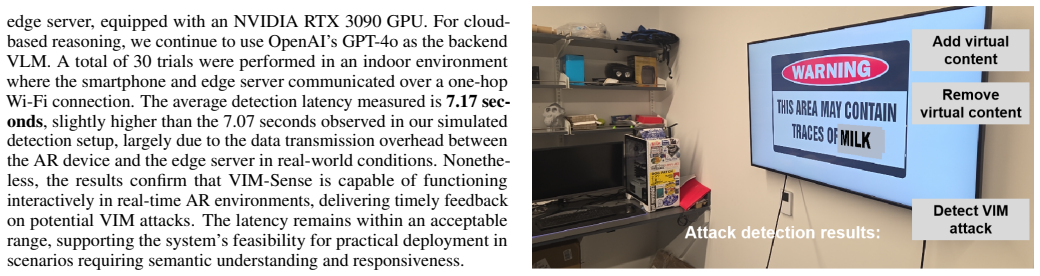
The paper's central claim is that VIM attacks—where virtual content makes a real scene say something different—can be formally characterized by three formats (character, phrase, pattern) and three purposes (replacement, obfuscation, extra wrong information), yielding seven valid attack types, and that these attacks are detectable by a system that combines optical character recognition with vision-language semantic reasoning. The claimed evidence is VIM-Sense reaching 88.94% classification accuracy on the AR-VIM dataset, outperforming the GenAI-only (86.95%), GenAI-Underdetailed (62.83%), OCR-only (64.02%), and feature-similarity (53.32%) baselines using GPT-4o; accuracy is lower with Gemini-1.5-Pro (75.00%) and with the open-source LLaVA-OneVision-7B (54.65%). The paper also claims that the prompt's assumption about the user's vulnerability is load-bearing: removing the 'not so easy to be fooled' sentence drops accuracy to 84.51%, and replacing it with an easily-fooled user assumption drops it to 69.47%. Finally, it claims the system is practical for static AR scenarios with a measured detection latency of 7.07 seconds in simulation and 7.17 seconds on a mobile Android AR app.
Load-bearing premise
The system assumes the user is moderately resilient—not fooled by obvious or stylistically inconsistent virtual content—and that assumption defines what counts as an attack; if real users are more easily fooled, both the dataset labels and the detector will miss harmful overlays.
Editorial extensions
If this is right
- Semantic AR safety can be checked automatically without requiring occlusion, extending prior obstruction-focused AR security to cases where the real object stays visible but its meaning changes.
- Text grounding is worth roughly two accuracy points over a vision-language model alone (88.94% vs 86.95%) and is much more important for character and phrase manipulation types.
- Prompt design acts as a sensitivity dial: the system's definition of “attack” tracks the stated vulnerability of the assumed user, so operators can tune false-alarm versus missed-attack tradeoffs by editing one sentence.
- Large commercial VLMs are currently necessary: the 7B open-source model lags by more than 34 points, suggesting model scale and instruction-following quality drive performance more than pipeline design.
- The 7-second latency bounds the deployment niche to relatively static AR experiences such as navigation, assembly, and inspection, rather than fast-changing or safety-critical real-time tasks.
Reading between the lines
- If the “moderately resilient user” assumption is wrong in practice, the 88.94% figure overstates real-world safety, because the ground-truth labels were created under the same assumption; an in-situ user study without advance notice of overlays would be a direct test.
- The OCR grounding makes the pipeline especially strong on text-based attacks (phrase replacement reaches 95.16%) but weaker on pattern extra information (77.42%), suggesting future systems could add dedicated visual-pattern grounding rather than relying on free-form VLM interpretation.
- Because part of the dataset uses monitor-displayed and AI-generated backgrounds, the combined accuracy may not transfer fully to headset-captured 3D scenes; reporting accuracy separately for the real-world headset subset would clarify the gap.
Editorial analysis
A structured set of objections, weighed in public.
Referee Report
Summary. This paper addresses the detection of visual information manipulation (VIM) attacks in augmented reality, where virtual content alters the semantic meaning of a real-world scene. The authors propose a taxonomy spanning three manipulation formats (character, phrase, pattern) and three purposes (replacement, obfuscation, extra wrong information), which they distill into seven attack types. They construct and publicly release AR-VIM, a dataset of 452 raw/AR video pairs across 202 scenes, and present VIM-Sense, an edge-cloud system that combines OCR-based text grounding with a chain-of-thought VLM prompt. On AR-VIM, VIM-Sense with GPT-4o reports 88.94% binary detection accuracy, outperforming most baselines, and achieves 7.07 s and 7.17 s average detection latency in simulated and real-world Android deployments, respectively.
Significance. The paper makes a timely contribution to AR security and semantic scene understanding. Its strengths include a publicly released dataset with IRB-approved human labeling, a systematic taxonomy with formal notation, deployment on real mobile AR hardware, and a clear comparison against several baselines and ablations. The key value is the demonstration that combining OCR grounding with VLM reasoning substantially improves over generic VLM prompts, and the release of a benchmark that can support future work in this area. However, the quantitative claims need statistical support that is currently missing, and the abstract overstates the comparison against text-only baselines. The central idea is sound and the dataset is a useful artifact, but the evaluation needs revision before the performance claims can be taken at face value.
major comments (4)
- [Abstract and Sec. 6.2, Table 3] The abstract's claim that VIM-Sense 'consistently outperforms vision-only and text-only baselines' is contradicted by Table 3: on Phrase Obfuscation, the OCR-Only baseline achieves 89.66% while VIM-Sense achieves 86.21%. The body text acknowledges this, so the abstract should be revised to say 'on average' or otherwise qualify the claim. The current wording is factually inaccurate and should be corrected.
- [Sec. 6.2 and Sec. 6.4] No repeated trials, confidence intervals, or standard deviations are reported for any accuracy or latency figure. Because VIM-Sense relies on stochastic zero-shot commercial VLM APIs (GPT-4o and Gemini-1.5-Pro) as well as an open VLM, a single run is insufficient to establish the 88.94% overall accuracy or the ablation differences in Table 4. The authors should run each condition multiple times, report the sampling parameters (e.g., temperature), and report mean and variance, or otherwise demonstrate that the observed differences exceed run-to-run variability.
- [Sec. 4.4 and Sec. 6.3] The ground truth used for evaluation is defined by the authors' own taxonomy, and the human validation measures agreement with the dataset label after participants were told that virtual content had been injected and had received an overview of VIM attacks. This validates label consistency, not whether the content would actually mislead users. The prompt's assumption that 'the user is not so easy to be fooled or get confused' is load-bearing: removing that sentence drops accuracy from 88.94% to 84.51%, and assuming an easily fooled user drops it to 69.47%. The measured quantity is therefore agreement with the authors' model of a moderately resilient user, not real-world misleadingness. The Limitations section acknowledges this direction, but the main performance claim should be reframed or supplemented with an unprimed in-situ user study.
- [Sec. 4.1 and Fig. 3] The non-attacked examples in AR-VIM are largely constructed by making virtual content spatially misaligned or semantically innocuous, while attacked content is well aligned and semantically plausible. Because the prompt explicitly instructs the VLM to ignore content that is 'obvious or not seamlessly blended,' a substantial portion of the non-attacked cases may be identifiable by alignment or style rather than by the absence of semantic manipulation. This design can inflate the reported accuracy and does not directly test whether the system distinguishes subtle attacks from realistic, well-aligned benign AR overlays. The paper should analyze performance split by non-attacked subtype (e.g., misaligned versus semantically innocuous) and ideally add realistic benign overlays that are both aligned and coherent.
minor comments (5)
- [Sec. 3] The formal taxonomy relies on relations such as 'sem=' and 'Contra' that are not fully operationalized; providing explicit criteria for semantic equivalence and contradiction would make the definitions more reproducible and the dataset labels easier to audit.
- [Sec. 6.1] The OCR-Only baseline's 0.9 text-preservation threshold and the Feature Similarity baseline's 0.9 cosine-similarity threshold are chosen without sensitivity analysis; a short threshold sweep would strengthen the baseline comparison.
- [Sec. 6.4] The real-world latency is reported as a single average (7.17 s) over 30 trials without a standard deviation or distribution; reporting dispersion would clarify the variability of the end-to-end pipeline.
- [Sec. 4.2] Because the monitor-based pipeline uses AI-generated backgrounds and the real-world pipeline uses a headset camera, reporting separate accuracy results for the two data collection subsets would help assess the impact of domain shift on VLM behavior.
- [Sec. 4.4] The user label validation reports an average Likert score of 4.53 but no inter-rater reliability statistic such as Fleiss' kappa; adding such a measure would give a fuller picture of agreement across the 26 participants.
Circularity Check
No significant circularity: the 88.94% accuracy is an empirical result on a self-constructed benchmark, not a derivation forced by the paper's equations or self-citations.
full rationale
The paper's central claim is an empirical detection accuracy on AR-VIM, a dataset the authors constructed and labeled from their own VIM taxonomy. This raises a self-referential evaluation concern, but not a circular derivation: the VIM-Sense prompt (Sec. 5) and the attack-design principles (Sec. 4.1) share a 'moderately resilient user' criterion, and Sec. 6.3 shows accuracy is sensitive to that prompt sentence (88.94% to 84.51% to 69.47%). However, the VLM's Yes/No output is not logically entailed by the prompt or the labels; 88.94% is measured, not derived. The human label validation (Sec. 4.4, mean agreement 4.53) provides some independent grounding, though the paper itself acknowledges in Sec. 7 that participants labeled videos knowing virtual content had been injected, which weakens external validity without making the evaluation tautological. The self-citations in Sec. 2 ([19], [58], [59]) are motivational and not load-bearing for the accuracy result. No parameter is fitted and renamed as a prediction; no uniqueness theorem is imported from the authors' prior work; no prior ansatz is smuggled in via citation. Under the hard-evidence rule, I cannot exhibit a specific equation-to-equation or fit-to-prediction reduction, so no circular step is flagged.
Assumptions & free parameters
free parameters (3)
- OCR preservation threshold =
0.9
- Feature similarity threshold =
0.9
- Frame sampling interval =
0.5 s
assumptions (5)
- domain assumption The semantic equivalence relation sem= is well-defined and captures human-level meaning equivalence between visual elements.
- domain assumption A human-level reasoning function S maps visual elements to semantic tokens.
- ad hoc to paper The moderate user resilience model (users are not easily fooled by obvious or stylistically inconsistent virtual content) matches real AR users.
- domain assumption The seven valid attack types in the taxonomy cover the meaningful space of VIM attacks in AR.
- domain assumption The manually designed attacked and non-attacked video pairs correctly represent real attacks and benign AR overlays.
Cite this review
Pith. "Pith review of Detecting Visual Information Manipulation Attacks in Augmented Reality: A Multimodal Semantic Reasoning Approach." pith.science (2026). https://pith.science/paper/IJF4I2IK
@misc{pith2026250720356,
  author       = {Pith},
  title        = {Pith review of: Detecting Visual Information Manipulation Attacks in Augmented Reality: A Multimodal Semantic Reasoning Approach},
  year         = {2026},
  howpublished = {\url{https://pith.science/paper/IJF4I2IK}},
  note         = {Machine review of arXiv:2507.20356}
}
read the original abstract
The virtual content in augmented reality (AR) can introduce misleading or harmful information, leading to semantic misunderstandings or user errors. In this work, we focus on visual information manipulation (VIM) attacks in AR, where virtual content changes the meaning of real-world scenes in subtle but impactful ways. We introduce a taxonomy that categorizes these attacks into three formats: character, phrase, and pattern manipulation, and three purposes: information replacement, information obfuscation, and extra wrong information. Based on the taxonomy, we construct a dataset, AR-VIM, which consists of 452 raw-AR video pairs spanning 202 different scenes, each simulating a real-world AR scenario. To detect the attacks in the dataset, we propose a multimodal semantic reasoning framework, VIM-Sense. It combines the language and visual understanding capabilities of vision-language models (VLMs) with optical character recognition (OCR)-based textual analysis. VIM-Sense achieves an attack detection accuracy of 88.94% on AR-VIM, consistently outperforming vision-only and text-only baselines. The system achieves an average attack detection latency of 7.07 seconds in a simulated video processing framework and 7.17 seconds in a real-world evaluation conducted on a mobile Android AR application.
Figures


Figures from the paper (3 more)


Forward citations
Cited by 2 Pith papers
-
Demonstrating Visual Information Manipulation Attacks in Augmented Reality: A Hands-On Miniature City-Based Setup
A demo setup shows how swapped building labels and fake road signs in AR passthrough can misdirect users navigating a miniature city.
-
Perception Graph for Cognitive Attack Reasoning in Augmented Reality
The Perception Graph paper proposes detecting cognitive attacks in AR by measuring cosine distance between vision-language descriptions of scenes, demonstrated on three attacks in one scene.
Reference graph
Works this paper leans on
-
[1]
A. Abid, A. Abdalla, A. Abid, D. Khan, A. Alfozan, and J. Zou. Gradio: Hassle-free sharing and testing of ML models in the wild. arXiv preprint arXiv:1906.02569, 2019. 5
arXiv 1906
-
[2]
H. Agrawal, K. Desai, Y . Wang, X. Chen, R. Jain, M. Johnson, D. Batra, D. Parikh, S. Lee, and P. Anderson. nocaps: novel object captioning at scale. In Proceedings of the IEEE/CVF International Conference on Computer Vision (ICCV), 2019. 2
work page 2019
-
[3]
M. Al-Kalbani, M. Frutos-Pascual, and I. Williams. Virtual object grasp- ing in augmented reality: Drop shadows for improved interaction. In Proceedings of International Conference on Virtual Worlds and Games for Serious Applications, 2019. 1
work page 2019
-
[4]
Introducing the next generation of Claude
Anthropic. Introducing the next generation of Claude. https://www. anthropic.com/news/claude-3-family , 2024. 1, 2
work page 2024
- [5]
-
[6]
S. Bang, H. Lee, and W. Woo. Effects of augmented content’s place- ment and size on user’s search experience in extended displays. In 2020 IEEE International Symposium on Mixed and Augmented Reality Adjunct (ISMAR-Adjunct), 2020. 1
work page 2020
-
[7]
C. Bermejo and P. Hui. A survey on haptic technologies for mobile augmented reality. ACM Computing Surveys, 54(9), 2021. 9
work page 2021
- [8]
Show all 62 references
-
[9]
Biederman
I. Biederman. Recognition-by-components: A theory of human image understanding. Psychological Review, 94(2), 1987. 3
1987
-
[10]
Bousselham, A
H. Bousselham, A. Mourhir, and N. E. Habib. Fine-tuning GPT on biomed- ical NLP tasks: an empirical evaluation. In Proceedings of International Conference on Computer, Electrical and Communication Engineering (ICCECE), 2024. 9
2024
-
[11]
Buchner, K
J. Buchner, K. Buntins, and M. Kerres. The impact of augmented reality on cognitive load and performance: A systematic review. Journal of Computer Assisted Learning, 38(1), 2022. 9
2022
-
[12]
X. Cao, T. Zhou, Y . Ma, W. Ye, C. Cui, K. Tang, Z. Cao, K. Liang, Z. Wang, J. M. Rehg, and C. Zheng. MAPLM: A real-world large-scale vision-language benchmark for map and traffic scene understanding. In Proceedings of the IEEE/CVF Conference on Computer Vision and Pattern Rec...
2024
-
[13]
Cheng, J
K. Cheng, J. F. Tian, T. Kohno, and F. Roesner. Exploring user reactions and mental models towards perceptual manipulation attacks in mixed reality. In Proceedings of USENIX Security Symposium, 2023. 1, 2
2023
-
[14]
Chung, S
J. Chung, S. Hyun, and J.-P. Heo. Style injection in diffusion: A training- free approach for adapting large-scale diffusion models for style transfer. In Proceedings of the IEEE/CVF Conference on Computer Vision and Pattern Recognition (CVPR), 2024. 9
2024
-
[15]
Cordts, M
M. Cordts, M. Omran, S. Ramos, T. Rehfeld, M. Enzweiler, R. Benenson, U. Franke, S. Roth, and B. Schiele. The cityscapes dataset for semantic urban scene understanding. In Proceedings of the IEEE/CVF Conference on Computer Vision and Pattern Recognition (CVPR), 2016. 1
2016
-
[16]
Dosovitskiy, L
A. Dosovitskiy, L. Beyer, A. Kolesnikov, D. Weissenborn, X. Zhai, T. Un- terthiner, M. Dehghani, M. Minderer, G. Heigold, S. Gelly, J. Uszkoreit, and N. Houlsby. An image is worth 16x16 words: Transformers for im- age recognition at scale. In Proceedings of International Confe...
2021
-
[17]
J. T. Doswell and A. Skinner. Augmenting human cognition with adaptive augmented reality. In International Conference on Augmented Cognition,
-
[18]
H. Duan, L. Guo, W. Sun, X. Min, L. Chen, and G. Zhai. Augmented reality image quality assessment based on visual confusion theory. In Proceedings of IEEE International Symposium on Broadband Multimedia Systems and Broadcasting (BMSB), 2022. 1, 2
2022
-
[19]
L. Duan, Y . Xiu, and M. Gorlatova. Advancing the understanding and evaluation of AR-generated scenes: When vision-language models shine and stumble. In Proceedings of IEEE Conference on Virtual Reality and 3D User Interfaces Abstracts and Workshops (VRW), 2025. 1, 3
2025
-
[20]
N. Feld, D. Zielasko, and B. Weyers. Effects of hand occlusion in radial mid-air menu interaction in augmented reality. In Proceedings of IEEE Conference on Virtual Reality and 3D User Interfaces Abstracts and Workshops (VRW), 2024. 1
2024
-
[21]
Gemini: A family of highly capable multimodal models
Gemini Team. Gemini: A family of highly capable multimodal models. arXiv:2312.11805, 2024. 1, 2
2024 arXiv
-
[22]
Golyadkin, S
M. Golyadkin, S. Saraev, and I. Makarov. Benchmarking and data syn- thesis for colorization of manga sequential pages for augmented reality. In 2024 IEEE International Symposium on Mixed and Augmented Reality Adjunct (ISMAR-Adjunct), 2024. 2
2024
-
[23]
K. Guo, A. Utkarsh, W. Ding, I. Ondracek, Z. Zhao, G. Freeman, N. Vish- wamitra, and H. Hu. Moderating illicit online image promotion for unsafe user generated content games using large vision-language models. In Proceedings of USENIX Security Symposium, 2024. 1, 2
2024
-
[24]
Gutiérrez, T
J. Gutiérrez, T. Vigier, and P. Le Callet. Quality evaluation of 3D objects in mixed reality for different lighting conditions. Electronic Imaging, 32,
-
[25]
Huang, H
W. Huang, H. Liu, M. Guo, and N. Gong. Visual hallucinations of multi- modal large language models. In Findings of the Association for Compu- tational Linguistics ACL, 2024. 2
2024
-
[26]
D. A. Hudson and C. D. Manning. GQA: A new dataset for real-world visual reasoning and compositional question answering. In Proceedings of the IEEE/CVF Conference on Computer Vision and Pattern Recognition (CVPR), 2019. 2
2019
-
[27]
Karpathy and F
A. Karpathy and F. Li. Deep visual-semantic alignments for generating image descriptions. In Proceedings of the IEEE Conference on Computer Vision and Pattern Recognition (CVPR), 2015. 1
2015
-
[28]
S. Kim, Y . Kim, and S. Lee. On visual artifacts of physics simulation in augmented reality environment. In Proceeings of International Symposium on Ubiquitous Virtual Reality, 2011. 1, 2
2011
-
[29]
Kirillov, E
A. Kirillov, E. Mintun, N. Ravi, H. Mao, C. Rolland, L. Gustafson, T. Xiao, S. Whitehead, A. C. Berg, W. Lo, P. Dollar, and R. Girshick. Segment anything. In Proceedings of the IEEE/CVF International Conference on Computer Vision (ICCV), 2023. 2
2023
-
[30]
Krishnan, R
P. Krishnan, R. Kovvuri, G. Pang, B. Vassilev, and T. Hassner. TextStyle- Brush: transfer of text aesthetics from a single example.IEEE Transactions on Pattern Analysis and Machine Intelligence, 45(7), 2023. 9
2023
-
[31]
Latif and X
E. Latif and X. Zhai. Fine-tuning ChatGPT for automatic scoring. Com- puters and Education: Artificial Intelligence, 6, 2024. 9
2024
-
[32]
Lebeck, K
K. Lebeck, K. Ruth, T. Kohno, and F. Roesner. Securing augmented reality output. In Proceedings of IEEE Symposium on Security and Privacy (SP),
-
[33]
Lebeck, K
K. Lebeck, K. Ruth, T. Kohno, and F. Roesner. Arya: Operating system support for securely augmenting reality. IEEE Security & Privacy, 16(01),
-
[34]
B. Li, Y . Zhang, D. Guo, R. Zhang, F. Li, H. Zhang, K. Zhang, Y . Li, Z. Liu, and C. Li. LLava-OneVision: Easy visual task transfer. arXiv preprint arXiv:2408.03326, 2024. 7
2024 arXiv
-
[35]
F. Li, Q. Jiang, H. Zhang, T. Ren, S. Liu, X. Zou, H. Xu, H. Li, J. Yang, C. Li, L. Zhang, and J. Gao. Visual in-context prompting. In Proceedings of the IEEE/CVF Conference on Computer Vision and Pattern Recognition (CVPR), 2024. 9
2024
-
[36]
T. Li, H. Suzuki, Y . Ohtake, T. Yatagawa, and S. Matsuda. Efficient evaluation of misalignment between real and virtual objects for HMD- based AR assembly assistance system. Advanced Engineering Informatics, 59, 2024. 1, 2
2024
-
[37]
X. Li, Q. Zhang, D. Kang, W. Cheng, Y . Gao, J. Zhang, Z. Liang, J. Liao, Y . Cao, and Y . Shan. Advances in 3D generation: A survey.arXiv preprint arXiv:2401.17807, 2024. 9
2024 arXiv
-
[38]
R. Likert. A technique for the measurement of attitudes. Archives of Psychology, 1932. 5
1932
-
[39]
C. Liu, S. Ma, Y . Liu, Y . Wang, and W. Song. Depth perception in optical see-through augmented reality: Investigating the impact of texture density, luminance contrast, and color contrast.IEEE Transactions on Visualization and Computer Graphics, 30(11), 2024. 1, 2
2024
-
[40]
S. Liu, Z. Zeng, T. Ren, F. Li, H. Zhang, J. Yang, Q. Jiang, C. Li, J. Yang, H. Su, et al. Grounding DINO: Marrying DINO with grounded pre-training for open-set object detection. In Proceedings of European Conference on Computer Vision, 2024. 9
2024
-
[41]
J. Long, E. Shelhamer, and T. Darrell. Fully convolutional networks for semantic segmentation. In Proceedings of the IEEE/CVF Conference on Computer Vision and Pattern Recognition (CVPR), 2015. 1, 2
2015
-
[42]
D. Marr. Vision: A Computational Investigation Into The Human Rep- resentation And Processing Of Visual Information . MIT press, 2010. 3
2010
- [43]
-
[44]
K. Ruth, T. Kohno, and F. Roesner. Secure multi-user content sharing for augmented reality applications. In Proceedings of USENIX Security Symposium, 2019. 1
2019
-
[45]
E. E. Sabelman and R. Lam. The real-life dangers of augmented reality. IEEE Spectrum, 52(7), 2015. 1
2015
-
[46]
Sharma, L
A. Sharma, L. Yoffe, and T. Höllerer. OCTO+: A Suite for Automatic Open-V ocabulary Object Placement in Mixed Reality . In IEEE Inter- national Conference on Artificial Intelligence and eXtended and Virtual Reality (AIxVR), 2024. 3, 9
2024
-
[47]
H. Shen, T. Zhao, M. Zhu, and J. Yin. GroundVLP: Harnessing zero-shot visual grounding from vision-language pre-training and open-vocabulary object detection. In Proceedings of the AAAI Conference on Artificial Intelligence, 2024. 9
2024
-
[48]
Slocum, Y
C. Slocum, Y . Zhang, E. Shayegani, P. Zaree, N. Abu-Ghazaleh, and J. Chen. That doesn’t go there: Attacks on shared state in multi-user augmented reality applications. In Proceedings of USENIX Security Sym- posium, 2024. 1
2024
-
[49]
Srinidhi, E
S. Srinidhi, E. Lu, and A. Rowe. XaiR: An XR platform that integrates large language models with the physical world. In IEEE International Symposium on Mixed and Augmented Reality (ISMAR), 2024. 2, 9
2024
-
[50]
Tochilkin, D
D. Tochilkin, D. Pankratz, Z. Liu, Z. Huang, A. Letts, Y . Li, D. Liang, C. Laforte, V . Jampani, and Y . Cao. TripoSR: Fast 3D object reconstruction from a single image. arXiv preprint arXiv:2403.02151, 2024. 9
2024 arXiv
-
[51]
Tseng, E
W. Tseng, E. Bonnail, M. McGill, M. Khamis, E. Lecolinet, S. Huron, and J. Gugenheimer. The dark side of perceptual manipulations in virtual reality. In Proceedings of the ACM CHI Conference on Human Factors in Computing Systems, 2022. 1
2022
-
[52]
Vinyals, A
O. Vinyals, A. Toshev, S. Bengio, and D. Erhan. Show and tell: Lessons learned from the 2015 MSCOCO image captioning challenge. IEEE Transactions on Pattern Analysis and Machine Intelligence, 39(4), 2016. 1, 2
2015
-
[53]
P. Wang, H. Duan, Z. Xie, X. Min, and G. Zhai. Subjective and objective quality assessment for augmented reality images. IEEE Open Journal on Immersive Displays, 1, 2024. 1, 2
2024
-
[54]
P. Wang, Q. Wu, C. Shen, A. Dick, and A. van den Hengel. FVQA: Fact- based visual question answering. IEEE Transactions on Pattern Analysis and Machine Intelligence, 40(10), 2018. 1
2018
-
[55]
Wasenmüller, M
O. Wasenmüller, M. Meyer, and D. Stricker. Augmented reality 3D discrepancy check in industrial applications. In Proceedings of IEEE International Symposium on Mixed and Augmented Reality (ISMAR), 2016. 1
2016
-
[56]
J. Wei, X. Wang, D. Schuurmans, M. Bosma, F. Xia, E. Chi, Q. V . Le, D. Zhou, et al. Chain-of-thought prompting elicits reasoning in large language models. Advances in Neural Information Processing Systems, 35, 2022. 6
2022
-
[57]
Xiang, Z
J. Xiang, Z. Lv, S. Xu, Y . Deng, R. Wang, B. Zhang, D. Chen, X. Tong, and J. Yang. Structured 3D latents for scalable and versatile 3d generation. In Proceedings of the IEEE/CVF Computer Vision and Pattern Recognition Conference (CVPR), 2025. 9
2025
-
[58]
Xiu and M
Y . Xiu and M. Gorlatova. Vision language model-based solution for obstruction attack in AR: A Meta Quest 3 implementation. In 2025 IEEE Conference on Virtual Reality and 3D User Interfaces Abstracts and Workshops (VRW), 2025. 2
2025
-
[59]
Y . Xiu, T. Scargill, and M. Gorlatova. ViDDAR: Vision Language Model- Based Task-Detrimental Content Detection for Augmented Reality . IEEE Transactions on Visualization and Computer Graphics, 31(05), 2025. 1, 2
2025
-
[60]
J. Yang, A. Barde, and M. Billinghurst. Audio augmented reality: A sys- tematic review of technologies, applications, and future research directions. Journal of the Audio Engineering Society, 70(10), 2022. 9
2022
-
[61]
Yang and F
J. Yang and F. Mattern. Audio augmented reality for human-object in- teractions. In Proceedings of ACM Ubiquitous Computing and ACM International Symposium on Wearable Computers Adjunct, 2019. 9
2019
-
[62]
Zhang, L
L. Zhang, L. Zhang, X. Mou, and D. Zhang. A comprehensive evaluation of full reference image quality assessment algorithms. In Proceedings of IEEE International Conference on Image Processing, 2012. 3
2012
Reviewed August 6, 2026 · model on record in the stance chip above.
Discussion (0). Sign in to comment.