REVIEW 3 major objections 5 minor 4 references
FMimic: Foundation Models are Fine-grained Action Learners from Human Videos
T0 review · 3 major / 5 minor · reviewed 2026-08-06 · deepseek-v4-flash
Pith's one-line read FMimic claims that a robot can acquire generalizable, fine-grained manipulation skills from one to five human videos, without predefined motion primitives, and can execute high-precision tasks via contact-aided refinement.
desk verdict A substantial extension of VLMimic with genuinely new modules, but the headline human-video claim is only tested on thin real-world data; the RLBench numbers use robot videos. read the letter →
The pith
A machine-rendered reading of the paper's core claim, the machinery that carries it, and where it could break.
The reading
What carries the argument
The load-bearing representation is the keypoint-waypoint interaction: keypoints are 6D frames rigidly attached to objects at contact or affordance locations, and waypoints are the compressed relative trajectory of those keypoints, compressed with the SQUISHE algorithm. Everything else, including grounding, VLM prompting, skill transfer, iterative adaptation, and contact refinement, exists to produce and consume this representation. Keypoints are computed from master-slave contact geometry, and waypoints are generated from keypoint trajectories in the master object frame, so the skill is expressed relative to objects rather than in absolute coordinates. The second mechanism that carries the high-precision claim is the contact-based pose optimizer: the paper reframes the absolute pose error of two objects as a single in-hand relative pose error, estimates it with a particle filter over contact observations, and selects which contact to make by maximizing information gain.
What would settle it
Measure the actual grounding error on the demonstration videos, for example by comparing estimated hand and object poses against AprilTag or kinematic ground truth in the real scenes, and check whether the reported success rates survive at the measured error level instead of the injected-noise proxy.
Extended reading notes
Core claim
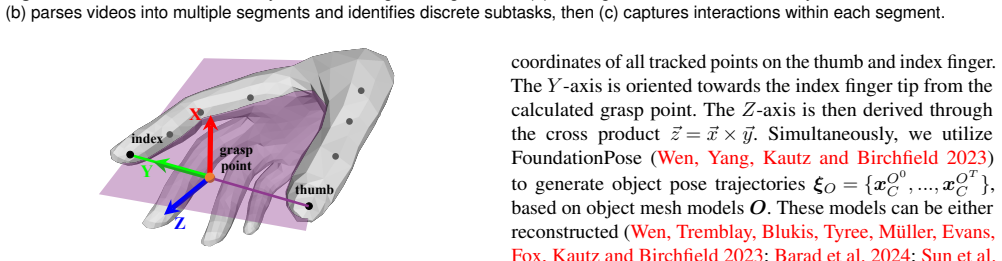
The central discovery, stated on its own terms, is that fine-grained manipulation skills can be represented as hierarchical constraints on distilled interaction points, rather than as full trajectories or predefined primitives. From a human video, FMimic grounds human-object contacts by estimating hand poses, object poses, and masks, then distills the motion into keypoints attached to objects and waypoints tracing relative motion. A vision-language model reads visualizations of these keypoints and waypoints, together with their numerical values, to produce semantic constraints (what the motion means) and geometric constraints (math and code that regenerate the motion from current object properties). In a novel scene, keypoints are transferred via region-to-keypoint mapping and the constraints are revised by iteratively comparing rendered adapted interactions with the retrieved demonstration. For high-precision tasks, a skill refiner minimizes collisions in the extracted interaction and optimizes the relative pose through master-slave contact iterations. The paper reports that this is the difference between 51% and 82% success on seen high-precision insertion tasks and between 45% and 73% on unseen ones.
Load-bearing premise
The whole method assumes that the initial stage estimating hand poses, object poses, and hand-object segmentations from the videos is accurate enough to yield reliable keypoints and waypoints, even though the paper's robustness experiments inject artificial noise rather than measuring the real error of that stage.
Editorial extensions
If this is right
- A single demonstration video can give a usable skill: FMimic reports 75% average success on 12 RLBench tasks with one video, comparable to diffusion policies trained on 100 robot demonstrations.
- Five videos push performance to 87% in RLBench single-task, 83% in multi-task, and 84% in seen real-world tasks, suggesting the representation extracts most of what it needs from very few examples.
- Skills generalize to unseen scenes and tasks: success rates of 75% in unseen real-world environments and 67% on unseen tasks, versus roughly 10% and 7% to 35% for the compared baselines.
- Long-horizon tasks decompose into subtask skills: FMimic succeeds on six long-horizon tasks at 60% overall, where baselines are near zero.
- Contact-aided refinement is what unlocks precision: on high-precision insertion tasks, adding the skill refiner raises seen-environment success from 51% to 82% and unseen-environment success from 45% to 73%.
Reading between the lines
- If the reported gains hold, the bottleneck for imitation learning shifts from data volume to the quality of grounding, so research effort should concentrate on hand and object pose estimators and segmentation rather than on policy networks.
- The keypoint-waypoint representation suggests a testable unification with relational keypoint methods: because both encode constraints relative to objects, a shared library of interaction primitives could transfer across embodiments by re-estimating keypoints instead of retraining policies.
- The contact-based pose optimizer could be separated from the video-learning pipeline and applied to any visuomotor system with force sensing, with the information-gain contact selection reducing the number of exploratory touches needed.
- Limits the paper itself acknowledges, such as vision foundation models struggling to distinguish object parts like a pan surface from its handle and object reconstruction needing extra recordings for transparent or thin objects, point to open-vocabulary part segmentation and single-view 3D reconstruction as the next bottlenecks.
Editorial analysis
A structured set of objections, weighed in public.
Referee Report
Summary. FMimic is a visual imitation learning framework that aims to learn fine-grained robot manipulation skills from a small number of human demonstration videos without relying on predefined motion primitives. The pipeline consists of four main components: (i) human-object interaction grounding built on FrankMocap hand pose estimation, FoundationPose object pose estimation, SAM-Track segmentation, and ORB-SLAM3 camera tracking; (ii) a skill learner that distills grounded interactions into keypoints and waypoints and extracts semantic and geometric constraints using VLMs; (iii) a skill adapter that transfers keypoints to novel objects and updates skills through iterative comparison; and (iv) a skill refiner with collision-minimal interaction optimization and contact-based pose optimization for high-precision tasks. The manuscript reports experiments on RLBench simulation, 14 real-world manipulation tasks, unseen-task generalization, long-horizon tasks, high-precision peg-insertion tasks, and practical tasks such as socket insertion and battery placement. The paper also includes ablations, efficiency measurements, and robustness analyses. The central quantitative claims are improvements exceeding 39% on RLBench, 29% on real-world manipulation, 34% on high-precision tasks, and 47% on long-horizon tasks over the compared baselines.
Significance. If the central claim is fully supported, FMimic would represent a meaningful advance: it would show that foundation models can learn fine-grained, generalizable manipulation skills from very few human videos, thereby removing a key bottleneck that forces current VLM-based methods to rely on hand-coded primitives. The paper's strengths include broad benchmark coverage, detailed ablation studies on each design choice, an honest limitations section with real failure cases, and robustness experiments covering viewpoint changes, partial visibility, injected noise, and environmental perturbations. The paper does not provide machine-checked proofs, reproducible code, or released data, so its contribution is entirely empirical. The largest weakness is that the headline RLBench results are obtained from robot videos with known gripper trajectories rather than from human videos, so the simulation evidence does not directly test the paper's central 'human-video' premise. The real-world results use 10 trials per condition with human evaluation, and no code or data are released for independent verification.
major comments (3)
- [Manipulation Task Learning, Experimental setup] The manuscript states: 'Due to the unavailability of human videos in simulations, Demo2code and our method utilize robot videos captured from a single-camera perspective during demonstrations, incorporating robot gripper trajectories.' Because of this, Tables 1 and 2—the quantitative basis for the abstract's claim of over 39% improvement on RLBench—evaluate a version of FMimic that bypasses the entire human-object interaction grounding module, including FrankMocap hand pose estimation, SAM-Track hand/object segmentation, and the conversion from hand pose to gripper pose. The simulation results therefore support a weaker claim: FMimic can learn skills from robot demonstration trajectories with known gripper states. To substantiate the actual human-video claim, the authors should either run the complete pipeline on human videos in a suitable simulation environment, or at least quantify the accuracy of the human-object grounding stage on real human videos and show that the downstream skills remain effective under realistic grounding errors.
- [Real-world experimental setup; Tables 3-7] Success rates in the real-world experiments are computed from 10 randomized trials per condition and evaluated by human assessors, but the paper does not report inter-annotator agreement, per-task confidence intervals, or released code and data for independent replication. With n=10, a success rate of 0.8 has a binomial standard error of approximately 0.13, which means that several of the reported gaps between FMimic and the baselines are not statistically distinguishable; for example, in Table 3 the SE result for Ours 1v is 0.73 versus 0.43 for Demo2Code, a difference of 0.30 that is within the range of sampling variability at this trial count. The authors should report exact trial counts, per-task binomial confidence intervals, and ideally pre-registered success criteria. If the 10-trial protocol is retained, the conclusions should be phrased accordingly.
- [Robustness against cumulative errors; Table 10] The robustness analysis injects Gaussian noise with σ=5 cm and σ=5° into pose estimates, but it never measures the actual accuracy of FrankMocap, FoundationPose, or SAM-Track on the human demonstration videos used in the real-world experiments. Since the entire pipeline is conditioned on the correctness of these grounding stages, a noise-injection study with arbitrary noise parameters does not close the gap. The authors should provide an evaluation of grounding accuracy—for example, keypoint and waypoint errors against manual annotations, or pose errors against a motion-capture reference—on representative human videos, and then connect that measured error to the perturbation levels studied in Table 10. Without such a measurement, the reader cannot tell whether the 5 cm/5° noise level is representative of the system's actual operating conditions.
minor comments (5)
- [Abstract and Tables 1-2] The abstract says the method works 'with a single human video,' but in the RLBench experiments the videos are robot videos with gripper trajectories. Please make the demonstration type explicit in the abstract and in the table captions, e.g., 'Ours (robot video)' for simulation and 'Ours (human video)' for real-world experiments, to avoid ambiguity.
- [Experimental setup, Baselines] The sentence 'These methods are trained on robot demonstrations using default hyper-parameters, robot demonstrations consist of paired observation and action sequences' is ungrammatical and should be split into two sentences, with the second clarifying what the robot demonstrations consist of.
- [Skill Refiner with Contact-aided Optimization] The sentence 'the robot is incrementally advanced toward the designated position of the master object until contact is confirmed by force detection' is missing an article before 'master object'; additionally, the paper should specify whether force detection is performed by the Franka's built-in torque sensors or by an external force-torque sensor.
- [Discussion and Limitations, Hand grasp representation] The subsection on hand grasp representation describes a VLM-based finger-to-gripper mapping and a verification module, but it is not stated whether this module is used in the main experiments or only proposed as a future extension; please clarify its role in the evaluated system.
- [Related Work and Experiments] The related work discusses keypoint-based methods such as KALM and ReKep, which are conceptually close to FMimic's keypoint-centric representation, but these methods are not included in the experimental comparison; adding them as baselines would strengthen the claim that FMimic outperforms existing foundation-model-based manipulation approaches.
Circularity Check
No circular derivation; the pipeline is a composition of external components and benchmarks, with self-citations that are not load-bearing.
full rationale
FMimic is an engineering pipeline rather than a derivation. The claimed skill learning is operationalized through human-object grounding (FrankMocap, FoundationPose, SAM-Track), keypoint-waypoint extraction, VLM-generated constraints, keypoint transfer, and contact-based refinement. None of the reported equations define the target result in terms of itself: the pose-optimization filter (Eqs. 10-19) estimates relative pose from contact measurements; the keypoint transfer (Eqs. 5-8) uses registration; the information-gain contact selection (Eqs. 20-21) is a decision rule. No fitted parameter is renamed as a prediction. The paper cites the authors' prior VLMimic/GraphMimic work, including the NeurIPS 2024 predecessor, but these citations motivate the extension rather than supply the experimental numbers; the benchmarks (RLBench, FMB, real-world tasks) are external and success rates are measured outcomes. The main validity concern is not circularity: the RLBench setup explicitly says 'Due to the unavailability of human videos in simulations, Demo2code and our method utilize robot videos captured from a single-camera perspective during demonstrations, incorporating robot gripper trajectories,' so the headline human-video claim is not tested there; this is a scope/claim gap, not an equation-level reduction. The paper's own Limitations section also concedes VFM limitations, reconstruction constraints, and IK/collision failures, which are consistent with an honest non-circular report.
Assumptions & free parameters
free parameters (6)
- Contact detection threshold epsilon =
2 cm
- Hand trajectory length filter gamma =
5 cm
- Maximum skill adapter iterations NI =
4
- Particle filter sample count M =
500
- Contact strategy samples Np and No =
4 positions, 12 orientations
- Particle filter noise sigma =
1.0 mm, 0.01 rad
assumptions (4)
- domain assumption VLMs are capable of reliably generating semantic and geometric constraints from rendered keypoints and waypoints.
- domain assumption FoundationPose, FrankMocap, and SAM-Track provide sufficiently accurate pose and segmentation outputs.
- domain assumption Object 3D models are available or can be reconstructed from videos.
- domain assumption The gripper-object contact model and the in-hand pose stability assumption hold during refinement.
Cite this review
Pith. "Pith review of FMimic: Foundation Models are Fine-grained Action Learners from Human Videos." pith.science (2026). https://pith.science/paper/ONP2L35F
@misc{pith2026250720622,
  author       = {Pith},
  title        = {Pith review of: FMimic: Foundation Models are Fine-grained Action Learners from Human Videos},
  year         = {2026},
  howpublished = {\url{https://pith.science/paper/ONP2L35F}},
  note         = {Machine review of arXiv:2507.20622}
}
read the original abstract
Visual imitation learning (VIL) provides an efficient and intuitive strategy for robotic systems to acquire novel skills. Recent advancements in foundation models, particularly Vision Language Models (VLMs), have demonstrated remarkable capabilities in visual and linguistic reasoning for VIL tasks. Despite this progress, existing approaches primarily utilize these models for learning high-level plans from human demonstrations, relying on pre-defined motion primitives for executing physical interactions, which remains a major bottleneck for robotic systems. In this work, we present FMimic, a novel paradigm that harnesses foundation models to directly learn generalizable skills at even fine-grained action levels, using only a limited number of human videos. Extensive experiments demonstrate that our FMimic delivers strong performance with a single human video, and significantly outperforms all other methods with five videos. Furthermore, our method exhibits significant improvements of over 39% and 29% in RLBench multi-task experiments and real-world manipulation tasks, respectively, and exceeds baselines by more than 34% in high-precision tasks and 47% in long-horizon tasks.
Figures


Figures from the paper (23 more)


Reference graph
Works this paper leans on
-
[1]
, " * write output.state after.block = add.period write newline
ENTRY address author booktitle chapter doi edition editor eid howpublished institution isbn journal key month note number organization pages publisher school series title type url volume year label extra.label sort.label short.list INTEGERS output.state before.all mid.sentence after.sentence after.block FUNCTION init.state.consts #0 'before.all := #1 'mid...
-
[2]
write newline
" write newline "" before.all 'output.state := FUNCTION n.dashify 't := "" t empty not t #1 #1 substring "-" = t #1 #2 substring "--" = not "--" * t #2 global.max substring 't := t #1 #1 substring "-" = "-" * t #2 global.max substring 't := while if t #1 #1 substring * t #2 global.max substring 't := if while FUNCTION word.in bbl.in capitalize ":" * " " *...
-
[3]
, " * write output.state after.block = add.period write newline
ENTRY address archive author booktitle chapter doi edition editor eid eprint howpublished institution isbn journal key month note number organization pages publisher school series title type url volume year label INTEGERS output.state before.all mid.sentence after.sentence after.block FUNCTION init.state.consts #0 'before.all := #1 'mid.sentence := #2 'af...
-
[4]
write newline
" write newline "" before.all 'output.state := FUNCTION n.dashify 't := "" t empty not t #1 #1 substring "-" = t #1 #2 substring "--" = not "--" * t #2 global.max substring 't := t #1 #1 substring "-" = "-" * t #2 global.max substring 't := while if t #1 #1 substring * t #2 global.max substring 't := if while FUNCTION word.in bbl.in capitalize " " * FUNCT...
Reviewed August 6, 2026 · model on record in the stance chip above.
Discussion (0). Continue with ORCID to comment.