REVIEW 4 major objections 5 minor 2 cited by
The Emergence and Ionizing Feedback of Pop III.1 Stars as Progenitors for Supermassive Black Holes
T0 review · 4 major / 5 minor · reviewed 2026-08-06 · deepseek-v4-flash
Pith's one-line read The paper establishes Pop III.1 stars—supermassive first-generation stars in isolated minihalos—as viable progenitors of early supermassive black holes, with a predicted seed density of about $10^{-1}\,\mathrm{cMpc}^{-3}$ that matches…
desk verdict The HII region simulations are the real result; the n_SMBH number is not established because it assumes 100% seeding efficiency. read the letter →
The pith
A machine-rendered reading of the paper's core claim, the machinery that carries it, and where it could break.
The reading
What carries the argument
The two load-bearing elements are the R-type expansion of the HII region around a Pop III.1 star and the isolation-distance criterion it sets. The comoving front radius $r_R=(3 t_* Q_{\rm H}/4\pi n_{\rm H})^{1/3}$ is nearly redshift-independent because the cosmic density evolution cancels in comoving units, giving $r_{\rm HII}\simeq 1$ cMpc for the fiducial photon rate $Q_{\rm H}=10^{53}\,\mathrm{s}^{-1}$ and lifetime $t_*=10$ Myr. This single number is then applied as a constant exclusion radius of 1 cMpc in dark-matter-only boxes: halos above $10^6\,M_\odot$ with no neighbor within that radius are counted as SMBH seeds, and the halo mass function is converted into a predicted seed number density.
What would settle it
One decisive check is to run the same radiation-hydrodynamics setup for a sample of Pop III.1 stars across several environments and compare their HII bubbles: if the spread in $r_{\rm HII}$ around 1 cMpc is large, the constant-exclusion-radius counting breaks down. A second check is observational: a JWST census that puts the high-redshift black hole abundance several times below $n_{\rm SMBH}\sim 10^{-1}\,\mathrm{cMpc}^{-3}$ would rule out the assumed perfect seeding efficiency.
Extended reading notes
Core claim
The central claim is that Pop III.1 progenitors are viable candidates for the formation of the first supermassive black holes: a $10^5\,M_\odot$ star in an isolated minihalo, emitting about $10^{53}$ H-ionizing photons per second for roughly 10 Myr, drives an R-type ionization front that reaches a comoving radius $r_{\rm HII}\sim 1$ cMpc. When this radius is used as the minimum separation between seed halos in cosmological volumes, the resulting number density is $n_{\rm SMBH}\sim 10^{-1}\,\mathrm{cMpc}^{-3}$ by $z=14$, consistent with the abundances inferred from recent observations of the local and high-redshift universe.
Load-bearing premise
The bubble radius measured around one simulated star in one zoom-in region is treated as a universal, redshift-independent exclusion radius for every minihalo in the universe, and every halo that passes the mass and isolation cuts is assumed to form a $10^5\,M_\odot$ Pop III.1 star with perfect efficiency.
Editorial extensions
If this is right
- The predicted seed density of about $10^{-1}\,\mathrm{cMpc}^{-3}$ by redshift 14 matches observational estimates at both high and low redshift, so the early supermassive black hole population can be explained without super-Eddington accretion.
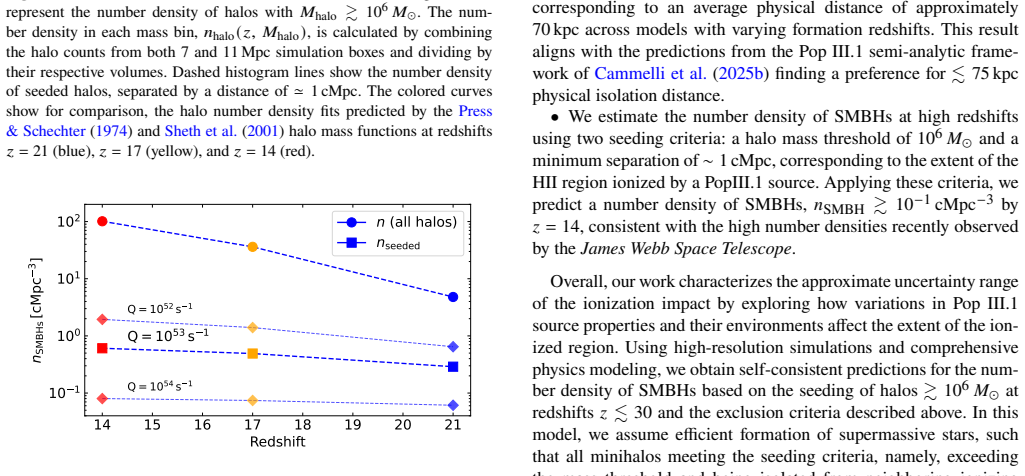
- Because the comoving isolation distance is nearly redshift-independent, the seeded fraction of halos stays low and roughly constant, growing from about 5 to 6 percent of halos above $10^6\,M_\odot$ between $z=21$ and $z=14$.
- Varying the ionizing photon rate from $10^{52}$ to $10^{54}\,\mathrm{s}^{-1}$ shifts the HII radius from about 0.6 to 2.3 cMpc and moves the predicted seed density by roughly an order of magnitude.
- A single Pop III.1 star suppresses further heavy-seed formation around it: the relic HII region persists for about 30 Myr after the star dies, keeping nearby minihalos from producing another supermassive star.
Reading between the lines
- If the isolation radius were recalibrated from a population of zoom-in regions rather than one, the predicted seed density could shift outside the observed range; this is a direct test with existing simulation tools.
- The assumed perfect seeding efficiency is an upper bound, so fragmenting irradiated minihalos into lower-mass Pop III.2 stars would lower the seed density, and matching the observed abundance would then require a narrower range of permitted efficiencies.
- The same isolation prescription could be extended to predict the black hole mass function at redshifts 6 to 9, connecting the seed density to the JWST AGN luminosity function without invoking any specific accretion-growth model.
Editorial analysis
A structured set of objections, weighed in public.
Referee Report
Summary. The paper uses cosmological zoom-in radiation-magnetohydrodynamical simulations with the Ramses-RT code to follow the HII regions produced by a 10^5 Msun Population III.1 star formed in a primordial minihalo, varying the ionizing photon rate (Q_H = 10^52, 10^53, 10^54 s^-1) and the large-scale environment (average, overdense, underdense). It reports that the R-type ionized bubble reaches roughly redshift-independent comoving radii around 1 cMpc, and then uses this radius as an isolation distance d_iso in two dark-matter-only boxes to count minihalos above 10^6 Msun that are separated by more than d_iso. The resulting seeded-halo number density is n_SMBH ~ 0.3-0.6 cMpc^-3 between z = 21 and z = 14, from which the authors claim n_SMBH ~ 10^-1 cMpc^-3, consistent with JWST-based observational estimates, and conclude that Pop III.1 stars are viable SMBH progenitors.
Significance. If the central claim holds, the paper provides a physically motivated heavy-seed route to the early SMBH population without invoking super-Eddington accretion. The simulations are technically substantial: they combine radiative transfer with MHD in a cosmological setting, resolve the escape of ionizing radiation from the minihalo, and the analytic R-type formula in Eq. (4) provides an independent cross-check on the simulated bubble radii. The exploration of Q_H and environment is a useful step beyond the semi-analytic PINOCCHIO-based estimates of earlier Pop III.1 work. However, the headline number density is an order-of-magnitude estimate whose value depends on an unmeasured 100% seeding efficiency, a hand-set isolation distance that is smaller than the simulated values, and small single-realization DMO volumes. These points need to be addressed before the consistency claim is established.
major comments (4)
- [§3.4, Table 1] The adopted isolation distance d_iso = 1.0 cMpc is not the simulated r_HII for the fiducial Q_H = 10^53 s^-1 model. Table 1 lists r_HII = 1.49 cMpc (average-density), 1.29 cMpc (overdense), and 1.35 cMpc (underdense), while Eq. (4) gives r_R = 1.10 cMpc. Since seeded-halo counts scale roughly as d_iso^-3, replacing 1.0 cMpc with the simulated ~1.3-1.5 cMpc lowers n_SMBH by a factor of about 2-3. The text in §3.4 calls the method conservative relative to applying no isolation criterion, but the rounding to 1.0 cMpc is not conservative for the high-n_SMBH claim; the estimate should propagate the simulated d_iso and its environment dependence.
- [§4, §3.4] The central estimate assumes that 'all minihalos meeting the seeding criteria ... form a Pop III.1 star', i.e., 100% seeding efficiency. The zoom-in runs do not measure a formation fraction: the star is placed in the first collapsing minihalo by construction, and the DMO boxes contain no gas cooling, radiation, or collapse criteria. Because n_SMBH is linear in this efficiency, a 10% efficiency moves the prediction to ~10^-2 cMpc^-3, near the observational lower limit quoted in §1, and a 1% efficiency would make the scenario non-viable. The paper should either justify a formation efficiency from Pop III.1 physics or present n_SMBH as an explicit function of this unknown parameter.
- [§3.4, Table 2, Fig. 7] The number-density estimate rests on two small DMO boxes of side 11 and 7 cMpc, each a single realization. At z = 21 the seeded fraction differs by a factor of four between boxes (about 5% in the 11 Mpc box versus 20% in the 7 Mpc box), and the combined n_SMBH is an average over just two volumes. This level of sample variance is comparable to the factor of 2-3 introduced by the d_iso choice, so the claimed consistency with observations is currently only order-of-magnitude; additional realizations or larger volumes are needed to support a specific value.
- [§3.2] The isolation radius is operationally defined by the extent of roughly 1% ionization, but the paper itself notes that overdense minihalos within the HII region can maintain lower ionization fractions and 'could potentially form new Pop III.1 stars'. Since d_iso is the parameter that sets n_SMBH, the predicted number density should be tested against alternative ionization thresholds (for example, the ~50 kpc nearly fully ionized zone versus the 74 kpc 1% boundary) rather than adopting a single boundary without a model for how partial ionization suppresses Pop III.1 formation.
minor comments (5)
- [§3.2] The text 'about 74 pc (i.e., the size r_HII reported in Table 1)' should read 74 kpc; Table 1 reports 74.0 kpc.
- [Eq. (3)] The numerical coefficient 61.3 kpc for fiducial parameters is inconsistent with Table 1's r_S = 106.46 kpc; please verify the normalization of alpha_B and the derived constant.
- [Table 1] For the Avrg53 model, r_HII = 74.0 kpc proper at z_form = 22.5 corresponds to about 1.74 cMpc, not the listed 1.49 cMpc; please specify the redshift at which the proper radius is evaluated.
- [Fig. 7] The legend indicates that diamonds correspond to different Q_H values, but the text does not state whether the same halo selection is used for the diamonds as for the squares; please clarify whether only d_iso changes.
- [Eq. (3)] The two consecutive lines containing ((1+z_form)/31) and ((1+z_form)/31)^-1 appear to contain a typographical inconsistency; please check the redshift conversion.
Circularity Check
No significant circularity: the n_SMBH estimate is conditional on explicit scenario assumptions and simulation-measured r_HII, not fitted to the observed abundance.
full rationale
The central claim is an estimate of the cosmic number density of SMBHs from Pop III.1 progenitors. The derivation chain is: (1) adopt a Pop III.1 source with Q_H ~ 10^53 s^-1 and t_* = 10 Myr; (2) run RT-MHD zoom-in simulations that measure an r_HII of about 1 cMpc; (3) apply this as an isolation distance d_iso = 1 cMpc to dark-matter-only halo catalogs with a mass threshold of 10^6 Msun; (4) count isolated halos, obtaining n_SMBH ~ 0.1-0.6 cMpc^-3; (5) compare with external observational estimates. The isolation distance is a genuine simulation output, and Eq. (4) provides an independent analytic cross-check that the simulation reproduces. n_SMBH is not obtained by inverting the observed number density; the observational value is not used to select d_iso or the mass threshold. The main caveats are that the fiducial Q_H and t_* come from the same group's prior review (Tan et al. 2024), and the 100% seeding efficiency is assumed rather than measured. The paper explicitly discloses the efficiency assumption in Section 4 and notes that overdense minihalos inside the HII region could still form Pop III.1 stars in Section 3.2. These are robustness limitations, not circular reductions: the simulation could in principle have produced a very different r_HII, and the DMO halo counts are independent of the observed SMBH abundance. The self-citation for source parameters is a provenance concern but does not make the prediction equivalent to its inputs.
Assumptions & free parameters
free parameters (5)
- Q_H (Pop III.1 H-ionizing photon rate) =
10^53 s^-1 (fiducial); 10^52-10^54 s^-1 explored
- t_* (Pop III.1 lifetime) =
10 Myr
- M_* (Pop III.1 star mass) =
10^5 Msun
- d_iso (isolation distance) =
1.0 cMpc
- M_halo,min (seeding halo mass threshold) =
10^6 Msun
assumptions (5)
- domain assumption Pop III.1 stars of ~10^5 Msun exist and emit Q_H ~ 10^53 s^-1 for ~10 Myr
- ad hoc to paper Every halo with M > 10^6 Msun and no neighbor within d_iso = 1 cMpc forms a Pop III.1 star
- domain assumption The HII region radius (at ~1% ionization) is a hard exclusion zone that prevents further Pop III.1 formation
- domain assumption The reduced speed of light approximation (0.2c) is adequate for R-type ionization front propagation
- domain assumption The 7 and 11 cMpc DMO boxes are representative for estimating the cosmic n_SMBH
Cite this review
Pith. "Pith review of The Emergence and Ionizing Feedback of Pop III.1 Stars as Progenitors for Supermassive Black Holes." pith.science (2026). https://pith.science/paper/3Q6T3Y2Z
@misc{pith2026250723004,
  author       = {Pith},
  title        = {Pith review of: The Emergence and Ionizing Feedback of Pop III.1 Stars as Progenitors for Supermassive Black Holes},
  year         = {2026},
  howpublished = {\url{https://pith.science/paper/3Q6T3Y2Z}},
  note         = {Machine review of arXiv:2507.23004}
}
abstract
Recent observations by JWST reveal an unexpectedly abundant population of rapidly growing supermassive black holes (SMBHs) in the early Universe, underscoring the need for improved models for their origin and growth. Employing new full radiative transfer hydrodynamical simulations of galaxy formation, we investigate the local and intergalactic feedback of SMBH progenitors for the Population III.1 scenario, i.e., efficient formation of supermassive stars from pristine, undisturbed dark matter minihalos. Our cosmological simulations capture the R-type expansion phase of these Pop III.1 stars, with their H-ionizing photon luminosities of $\sim10^{53}\,{\rm s}^{-1}$ generating HII regions that extend deep into the intergalactic medium, reaching comoving radii of $r_{\rm HII}\sim 1\,{\rm cMpc}$. We vary both the Pop III.1 ionization flux and cosmological formation environments, finding the former regulates their final $r_{\rm HII}$, whereas the latter is more important in setting their formation redshift. We use the results from our radiation-hydrodynamics simulations to estimate the cosmic number density of SMBHs, $n_{\rm SMBH}$, expected from Pop III.1 progenitors. We find $n_{\rm SMBH}\sim10^{-1}\,{\rm cMpc}^{-3}$, consistent with the results inferred from recent observations of the local and high redshift universe. Overall, this establishes Pop III.1 progenitors as viable candidates for the formation of the first SMBHs, and emphasises the importance of exploring heavy mass seed scenarios.
Figures


Figures from the paper (4 more)


Forward citations
Cited by 2 Pith papers
-
Flash Ionization of the Early Universe by Pop III.1 Supermassive Stars
Pop III.1 supermassive stars flash-ionize much of the early universe at z~20-30, adding tau~0.04 to the CMB optical depth and potentially easing Hubble tension and DESI anomalies.
-
The Impact of Population III.1 Flash Reionization for CMB Polarization and Thomson Scattering Optical Depth
An early 'Pop III.1 Flash' reionization phase shifts CMB polarization power from l<8 to l>8, allowing a higher optical depth τ≈0.08–0.09 while staying closer to Planck's low-l EE data than a standard tanh reionization model.
Reference graph
Works this paper leans on
-
[1]
Abel T., Bryan G. L., Norman M. L., 2002, @doi [Science] 10.1126/science.1063991 , 295, 93
-
[2]
Ba \ n ados E., et al., 2018, @doi [ ] 10.1038/nature25180 , https://ui.adsabs.harvard.edu/abs/2018Natur.553..473B 553, 473
-
[3]
Banik N., Tan J. C., Monaco P., 2019, @doi [Monthly Notices of the Royal Astronomical Society] 10.1093/mnras/sty3298 , 483, 3592
-
[4]
Barai P., Gallerani S., Pallottini A., Ferrara A., Marconi A., Cicone C., Maiolino R., Carniani S., 2018, @doi [ ] 10.1093/mnras/stx2563 , https://ui.adsabs.harvard.edu/abs/2018MNRAS.473.4003B 473, 4003
-
[6]
Bogd \'a n \'A ., et al., 2024, @doi [Nature Astronomy] 10.1038/s41550-023-02111-9 , https://ui.adsabs.harvard.edu/abs/2024NatAs...8..126B 8, 126
-
[7]
Bromm V., Loeb A., 2003, @doi [ ] 10.1086/377529 , https://ui.adsabs.harvard.edu/abs/2003ApJ...596...34B 596, 34
doi:10.1086/377529 2003
-
[8]
Bromm V., Coppi P. S., Larson R. B., 2002, @doi [ ] 10.1086/323947 , https://ui.adsabs.harvard.edu/abs/2002ApJ...564...23B 564, 23
doi:10.1086/323947 2002
-
[9]
Buchert T., Ehlers J., 1993, @doi [ ] 10.1093/mnras/264.2.375 , https://ui.adsabs.harvard.edu/abs/1993MNRAS.264..375B 264, 375
Show all 90 references
- [10]
-
[11]
C., Singh J., Fontanot F., De Lucia G., Hirschmann M., Xie L., 2025b, @doi [ ] 10.1093/mnras/stae2663 , https://ui.adsabs.harvard.edu/abs/2025MNRAS.536..851C 536, 851
Cammelli V., Monaco P., Tan J. C., Singh J., Fontanot F., De Lucia G., Hirschmann M., Xie L., 2025b, @doi [ ] 10.1093/mnras/stae2663 , https://ui.adsabs.harvard.edu/abs/2025MNRAS.536..851C 536, 851
-
[12]
Catelan P., 1995, @doi [ ] 10.1093/mnras/276.1.115 , https://ui.adsabs.harvard.edu/abs/1995MNRAS.276..115C 276, 115
1995 doi
-
[13]
Chiaki G., Chon S., Omukai K., Trinca A., Schneider R., Valiante R., 2023, @doi [ ] 10.1093/mnras/stad689 , https://ui.adsabs.harvard.edu/abs/2023MNRAS.521.2845C 521, 2845
2023 doi
-
[14]
G., 2018, @doi [Monthly Notices of the Royal Astronomical Society] 10.1093/mnras/sty1514 , 479, 2079
Costa T., Rosdahl J., Sijacki D., Haehnelt M. G., 2018, @doi [Monthly Notices of the Royal Astronomical Society] 10.1093/mnras/sty1514 , 479, 2079
2018 doi
-
[15]
Dubroca B., Feugeas J., 1999, @doi [Academie des Sciences Paris Comptes Rendus Serie Sciences Mathematiques] 10.1016/S0764-4442(00)87499-6 , https://ui.adsabs.harvard.edu/abs/1999CRASM.329..915D 329, 915
1999 doi
-
[16]
J., Izzard R
Eldridge J. J., Izzard R. G., Tout C. A., 2008, @doi [ ] 10.1111/j.1365-2966.2007.12738.x , https://ui.adsabs.harvard.edu/abs/2008MNRAS.384.1109E 384, 1109
2008
-
[17]
A., 2023, @doi [ ] 10.1146/annurev-astro-052920-102455 , https://ui.adsabs.harvard.edu/abs/2023ARA&A..61..373F 61, 373
Fan X., Ba \ n ados E., Simcoe R. A., 2023, @doi [ ] 10.1146/annurev-astro-052920-102455 , https://ui.adsabs.harvard.edu/abs/2023ARA&A..61..373F 61, 373
2023 doi
-
[18]
arXiv:2504.08041
Farcy M., et al., 2025, @doi [arXiv e-prints] 10.48550/arXiv.2504.08041 , https://ui.adsabs.harvard.edu/abs/2025arXiv250408041F p. arXiv:2504.08041
2025 doi
-
[19]
S., 2012, @doi [Astrophysical Journal] 10.1088/0004-637X/761/2/156 , 761, 156
Federrath C., Klessen R. S., 2012, @doi [Astrophysical Journal] 10.1088/0004-637X/761/2/156 , 761, 156
2012 doi
-
[20]
J., Korista K
Ferland G. J., Korista K. T., Verner D. A., Ferguson J. W., Kingdon J. B., Verner E. M., 1998, @doi [Publications of the Astronomical Society of the Pacific] 10.1086/316190 , 110, 761
1998 doi
-
[21]
Fragione G., Pacucci F., 2023, @doi [ ] 10.3847/2041-8213/ad09e5 , https://ui.adsabs.harvard.edu/abs/2023ApJ...958L..24F 958, L24
2023 doi
-
[22]
A., Spolyar D., 2009, @doi [ ] 10.1088/0004-637X/693/2/1563 , https://ui.adsabs.harvard.edu/abs/2009ApJ...693.1563F 693, 1563
Freese K., Gondolo P., Sellwood J. A., Spolyar D., 2009, @doi [ ] 10.1088/0004-637X/693/2/1563 , https://ui.adsabs.harvard.edu/abs/2009ApJ...693.1563F 693, 1563
2009 doi
-
[23]
Fromang S., Hennebelle P., Teyssier R., 2006, @doi [ ] 10.1051/0004-6361:20065371 , https://ui.adsabs.harvard.edu/abs/2006A&A...457..371F 457, 371
2006 doi
-
[24]
Y., Abel T., 2001, @doi [ ] 10.1016/S1384-1076(01)00068-9 , https://ui.adsabs.harvard.edu/abs/2001NewA....6..437G 6, 437
Gnedin N. Y., Abel T., 2001, @doi [ ] 10.1016/S1384-1076(01)00068-9 , https://ui.adsabs.harvard.edu/abs/2001NewA....6..437G 6, 437
2001 doi
-
[25]
E., Strader J., Ho L
Greene J. E., Strader J., Ho L. C., 2020, @doi [ ] 10.1146/annurev-astro-032620-021835 , https://ui.adsabs.harvard.edu/abs/2020ARA&A..58..257G 58, 257
2020 doi
-
[26]
E., et al., 2024, @doi [ ] 10.3847/1538-4357/ad1e5f , https://ui.adsabs.harvard.edu/abs/2024ApJ...964...39G 964, 39
Greene J. E., et al., 2024, @doi [ ] 10.3847/1538-4357/ad1e5f , https://ui.adsabs.harvard.edu/abs/2024ApJ...964...39G 964, 39
2024 doi
-
[27]
A., Freitag M., Rasio F
G \"u rkan M. A., Freitag M., Rasio F. A., 2004, @doi [ ] 10.1086/381968 , https://ui.adsabs.harvard.edu/abs/2004ApJ...604..632G 604, 632
2004 doi
-
[28]
Hahn O., Abel T., 2011, @doi [ ] 10.1111/j.1365-2966.2011.18820.x , https://ui.adsabs.harvard.edu/abs/2011MNRAS.415.2101H 415, 2101
2011
-
[29]
Harikane Y., et al., 2023, A JWST / NIRSpec First Census of Broad - Line AGNs at z=4-7: Detection of 10 Faint AGNs with M \_BH 10 6-10 8 M \_sun and Their Host Galaxy Properties , http://arxiv.org/abs/2303.11946
2023 arXiv
-
[30]
J., et al., 2024, Glimmers in the Cosmic Dawn : A Census of the Youngest Supermassive Black Holes by Photometric Variability , http://arxiv.org/abs/2403.16138
Hayes M. J., et al., 2024, Glimmers in the Cosmic Dawn : A Census of the Youngest Supermassive Black Holes by Photometric Variability , http://arxiv.org/abs/2403.16138
2024 arXiv
-
[31]
G., Roper W
Hu s ko F., Lacey C. G., Roper W. J., Schaye J., Briggs J. M., Schaller M., 2025, @doi [ ] 10.1093/mnras/staf146 , https://ui.adsabs.harvard.edu/abs/2025MNRAS.537.2559H 537, 2559
2025 doi
- [32]
-
[33]
Irodotou D., et al., 2022, @doi [ ] 10.1093/mnras/stac1143 , https://ui.adsabs.harvard.edu/abs/2022MNRAS.513.3768I 513, 3768
2022 doi
-
[34]
L., Bromm V., 2006, @doi [ ] 10.1111/j.1365-2966.2005.09846.x , https://ui.adsabs.harvard.edu/abs/2006MNRAS.366..247J 366, 247
Johnson J. L., Bromm V., 2006, @doi [ ] 10.1111/j.1365-2966.2005.09846.x , https://ui.adsabs.harvard.edu/abs/2006MNRAS.366..247J 366, 247
2006
-
[35]
L., Bromm V., 2007, @doi [Monthly Notices of the Royal Astronomical Society] 10.1111/j.1365-2966.2006.11275.x , 374, 1557
Johnson J. L., Bromm V., 2007, @doi [Monthly Notices of the Royal Astronomical Society] 10.1111/j.1365-2966.2006.11275.x , 374, 1557
2007
-
[36]
P., Cadiou C., Kimm T., Agertz O., 2024, @doi [arXiv e-prints] 10.48550/arXiv.2411.07282 , https://ui.adsabs.harvard.edu/abs/2024arXiv241107282K p
Katz H., Rey M. P., Cadiou C., Kimm T., Agertz O., 2024, @doi [arXiv e-prints] 10.48550/arXiv.2411.07282 , https://ui.adsabs.harvard.edu/abs/2024arXiv241107282K p. arXiv:2411.07282
2024 doi
-
[37]
Kimm T., Cen R., 2014, @doi [ ] 10.1088/0004-637X/788/2/121 , https://ui.adsabs.harvard.edu/abs/2014ApJ...788..121K 788, 121
2014 doi
-
[38]
Kimm T., Katz H., Haehnelt M., Rosdahl J., Devriendt J., Slyz A., 2017, @doi [Monthly Notices of the Royal Astronomical Society] 10.1093/mnras/stx052 , 466, stx052
2017 doi
-
[39]
Kokorev V., et al., 2024, @doi [ ] 10.3847/1538-4357/ad4265 , https://ui.adsabs.harvard.edu/abs/2024ApJ...968...38K 968, 38
2024 doi
-
[41]
A., Whalen D
Latif M. A., Whalen D. J., Khochfar S., Herrington N. P., Woods T. E., 2022, @doi [ ] 10.1038/s41586-022-04813-y , https://ui.adsabs.harvard.edu/abs/2022Natur.607...48L 607, 48
2022 doi
-
[42]
D., 1984, @doi [ ] 10.1016/0022-4073(84)90112-2 , https://ui.adsabs.harvard.edu/abs/1984JQSRT..31..149L 31, 149
Levermore C. D., 1984, @doi [ ] 10.1016/0022-4073(84)90112-2 , https://ui.adsabs.harvard.edu/abs/1984JQSRT..31..149L 31, 149
1984 doi
-
[43]
A., 2024, @doi [ ] 10.1051/0004-6361/202348788 , https://ui.adsabs.harvard.edu/abs/2024A&A...686A.256L 686, A256
Lupi A., Quadri G., Volonteri M., Colpi M., Regan J. A., 2024, @doi [ ] 10.1051/0004-6361/202348788 , https://ui.adsabs.harvard.edu/abs/2024A&A...686A.256L 686, A256
2024 doi
-
[44]
The diverse population of infant Black Holes at 4 z 11: merging, tiny, poor, but mighty, http://arxiv.org/abs/2308.01230
Maiolino R., et al., 2023, JADES . The diverse population of infant Black Holes at 4 z 11: merging, tiny, poor, but mighty, http://arxiv.org/abs/2308.01230
2023 arXiv
-
[45]
Martin-Alvarez S., Slyz A., Devriendt J., G \' o mez-Guijarro C., 2020, @doi [Monthly Notices of the Royal Astronomical Society] 10.1093/mnras/staa1438 , 495, 4475
2020 doi
-
[46]
Martin-Alvarez S., Katz H., Sijacki D., Devriendt J., Slyz A., 2021, @doi [ ] 10.1093/mnras/stab968 , https://ui.adsabs.harvard.edu/abs/2021MNRAS.504.2517M 504, 2517
2021 doi
-
[47]
Matthee J., et al., 2024, @doi [ ] 10.3847/1538-4357/ad2345 , https://ui.adsabs.harvard.edu/abs/2024ApJ...963..129M 963, 129
2024 doi
-
[48]
McCaffrey J., Regan J., Smith B., Wise J., O'Shea B., Norman M., 2025, @doi [The Open Journal of Astrophysics] 10.33232/001c.129138 , https://ui.adsabs.harvard.edu/abs/2025OJAp....8E..11M 8, 11
2025 doi
-
[49]
F., Tan J
McKee C. F., Tan J. C., 2008, @doi [ ] 10.1086/587434 , https://ui.adsabs.harvard.edu/abs/2008ApJ...681..771M 681, 771
2008 doi
-
[50]
Monaco A., 2002, @doi [Journal of Marine Systems] 10.1016/S0924-7963(02)00049-0 , https://ui.adsabs.harvard.edu/abs/2002JMS....33....1M 33-34, 1
2002 doi
-
[51]
K., Theuns T., 2013, @doi [ ] 10.1093/mnras/stt907 , https://ui.adsabs.harvard.edu/abs/2013MNRAS.433.2389M 433, 2389
Monaco P., Sefusatti E., Borgani S., Crocce M., Fosalba P., Sheth R. K., Theuns T., 2013, @doi [ ] 10.1093/mnras/stt907 , https://ui.adsabs.harvard.edu/abs/2013MNRAS.433.2389M 433, 2389
2013 doi
-
[52]
I., et al., 2009, @doi [ ] 10.1088/0004-637X/699/2/L125 , https://ui.adsabs.harvard.edu/abs/2009ApJ...699L.125M 699, L125
Moretti M. I., et al., 2009, @doi [ ] 10.1088/0004-637X/699/2/L125 , https://ui.adsabs.harvard.edu/abs/2009ApJ...699L.125M 699, L125
2009 doi
-
[53]
J., et al., 2011, @doi [ ] 10.1038/nature10159 , https://ui.adsabs.harvard.edu/abs/2011Natur.474..616M 474, 616
Mortlock D. J., et al., 2011, @doi [ ] 10.1038/nature10159 , https://ui.adsabs.harvard.edu/abs/2011Natur.474..616M 474, 616
2011 doi
-
[54]
M., Bouchet F
Moutarde F., Alimi J. M., Bouchet F. R., Pellat R., Ramani A., 1991, @doi [ ] 10.1086/170728 , https://ui.adsabs.harvard.edu/abs/1991ApJ...382..377M 382, 377
1991 doi
- [55]
-
[56]
G., Anselmi S., Borgani S., 2017, @doi [ ] 10.1093/mnras/stw3085 , https://ui.adsabs.harvard.edu/abs/2017MNRAS.465.4658M 465, 4658
Munari E., Monaco P., Sefusatti E., Castorina E., Mohammad F. G., Anselmi S., Borgani S., 2017, @doi [ ] 10.1093/mnras/stw3085 , https://ui.adsabs.harvard.edu/abs/2017MNRAS.465.4658M 465, 4658
2017 doi
-
[57]
C., O'Shea B
Natarajan A., Tan J. C., O'Shea B. W., 2009, @doi [ ] 10.1088/0004-637X/692/1/574 , https://ui.adsabs.harvard.edu/abs/2009ApJ...692..574N 692, 574
2009 doi
-
[58]
A., Power C., Ward S., Brennan J., McCaffrey J., 2024, @doi [The Open Journal of Astrophysics] 10.33232/001c.126010 , 7
O'Brennan H., Regan J. A., Power C., Ward S., Brennan J., McCaffrey J., 2024, @doi [The Open Journal of Astrophysics] 10.33232/001c.126010 , 7
2024 doi
- [59]
-
[60]
W., Abel T., Whalen D., Norman M
O'Shea B. W., Abel T., Whalen D., Norman M. L., 2005, @doi [ ] 10.1086/432683 , https://ui.adsabs.harvard.edu/abs/2005ApJ...628L...5O 628, L5
2005 doi
-
[61]
Padoan P., Nordlund A ., 2011, @doi [ ] 10.1088/0004-637X/730/1/4010.48550/arXiv.0907.0248 , https://ui.adsabs.harvard.edu/abs/2011ApJ...730...40P 730, 40
2011
-
[62]
Planck Collaboration et al., 2020, @doi [ ] 10.1051/0004-6361/201833910 , https://ui.adsabs.harvard.edu/abs/2020A&A...641A...6P 641, A6
2020 doi
-
[63]
H., Schechter P., 1974, @doi [ ] 10.1086/152650 , https://ui.adsabs.harvard.edu/abs/1974ApJ...187..425P 187, 425
Press W. H., Schechter P., 1974, @doi [ ] 10.1086/152650 , https://ui.adsabs.harvard.edu/abs/1974ApJ...187..425P 187, 425
1974 doi
-
[64]
Rasera Y., Teyssier R., 2006, @doi [Astronomy & Astrophysics] 10.1051/0004-6361:20053116 , 445, 1
2006 doi
-
[65]
E., Comastri A., 2016, @doi [ ] 10.1017/pasa.2016.46 , https://ui.adsabs.harvard.edu/abs/2016PASA...33...54R 33, e054
Reines A. E., Comastri A., 2016, @doi [ ] 10.1017/pasa.2016.46 , https://ui.adsabs.harvard.edu/abs/2016PASA...33...54R 33, e054
2016 doi
-
[66]
H., Freese K., Winget D
Rindler-Daller T., Montgomery M. H., Freese K., Winget D. E., Paxton B., 2015, @doi [ ] 10.1088/0004-637X/799/2/210 , https://ui.adsabs.harvard.edu/abs/2015ApJ...799..210R 799, 210
2015 doi
-
[67]
Rosdahl J., Teyssier R., 2015, @doi [ ] 10.1093/mnras/stv567 , https://ui.adsabs.harvard.edu/abs/2015MNRAS.449.4380R 449, 4380
2015 doi
-
[68]
Rosdahl J., Blaizot J., Aubert D., Stranex T., Teyssier R., 2013, @doi [Monthly Notices of the Royal Astronomical Society] 10.1093/mnras/stt1722 , 436, 2188
2013 doi
-
[69]
N., 1995, @doi [The Astrophysical Journal] 10.1086/175303 , 440, 634
Rosen A., Bregman J. N., 1995, @doi [The Astrophysical Journal] 10.1086/175303 , 440, 634
1995 doi
-
[70]
Schaye J., et al., 2015, @doi [ ] 10.1093/mnras/stu2058 , https://ui.adsabs.harvard.edu/abs/2015MNRAS.446..521S 446, 521
2015 doi
-
[71]
Schleicher D. R. G., et al., 2022, @doi [ ] 10.1093/mnras/stac926 , https://ui.adsabs.harvard.edu/abs/2022MNRAS.512.6192S 512, 6192
2022 doi
-
[72]
Schmidt M., 1959, @doi [The Astrophysical Journal] 10.1086/146614 , 129, 243
1959 doi
-
[73]
Scholtz J., et al., 2024, Net-zero gas inflow: deconstructing the gas consumption history of a massive quiescent galaxy with JWST and ALMA , http://arxiv.org/abs/2405.19401
2024
-
[74]
K., Mo H
Sheth R. K., Mo H. J., Tormen G., 2001, @doi [ ] 10.1046/j.1365-8711.2001.04006.x , https://ui.adsabs.harvard.edu/abs/2001MNRAS.323....1S 323, 1
2001
-
[75]
C., 2023, @doi [Monthly Notices of the Royal Astronomical Society] 10.1093/mnras/stad2346 , 525, 969
Singh J., Monaco P., Tan J. C., 2023, @doi [Monthly Notices of the Royal Astronomical Society] 10.1093/mnras/stad2346 , 525, 969
2023 doi
-
[76]
Spolyar D., Freese K., Gondolo P., 2008, @doi [Physical Review Letters] 10.1103/PhysRevLett.100.051101 , 100, 051101
2008 doi
-
[77]
R., Eldridge J
Stanway E. R., Eldridge J. J., Becker G. D., 2016, @doi [ ] 10.1093/mnras/stv2661 , https://ui.adsabs.harvard.edu/abs/2016MNRAS.456..485S 456, 485
2016 doi
-
[78]
C., 2008, in Hunt L
Tan J. C., 2008, in Hunt L. K., Madden S. C., Schneider R., eds, IAU Symposium Vol. 255, Low-Metallicity Star Formation: From the First Stars to Dwarf Galaxies. pp 24--32 ( @eprint arXiv 0808.3918 ), @doi 10.1017/S174392130802454X
2008 arXiv
- [79]
-
[80]
Teyssier R., 2002, @doi [Astronomy & Astrophysics] 10.1051/0004-6361:20011817 , 385, 337
2002 doi
-
[81]
Teyssier R., Fromang S., Dormy E., 2006, @doi [Journal of Computational Physics] 10.1016/j.jcp.2006.01.042 , https://ui.adsabs.harvard.edu/abs/2006JCoPh.218...44T 218, 44
2006 doi
-
[82]
Trakhtenbrot B., Lira P., Netzer H., Cicone C., Maiolino R., Shemmer O., 2017, @doi [ ] 10.3847/1538-4357/836/1/8 , https://ui.adsabs.harvard.edu/abs/2017ApJ...836....8T 836, 8
2017 doi
-
[83]
Trebitsch M., Blaizot J., Rosdahl J., Devriendt J., Slyz A., 2017, @doi [Monthly Notices of the Royal Astronomical Society] 10.1093/mnras/stx1060 , 470, 224
2017 doi
-
[84]
R., Pontzen A., Anderson L., Bellovary J., 2017, @doi [ ] 10.1093/mnras/stx1160 , https://ui.adsabs.harvard.edu/abs/2017MNRAS.470.1121T 470, 1121
Tremmel M., Karcher M., Governato F., Volonteri M., Quinn T. R., Pontzen A., Anderson L., Bellovary J., 2017, @doi [ ] 10.1093/mnras/stx1160 , https://ui.adsabs.harvard.edu/abs/2017MNRAS.470.1121T 470, 1121
2017 doi
-
[85]
Trinca A., Schneider R., Valiante R., Graziani L., Zappacosta L., Shankar F., 2022, @doi [ ] 10.1093/mnras/stac062 , https://ui.adsabs.harvard.edu/abs/2022MNRAS.511..616T 511, 616
2022 doi
-
[86]
Villaescusa-Navarro F., et al., 2020, @doi [ ] 10.3847/1538-4365/ab9d82 , https://ui.adsabs.harvard.edu/abs/2020ApJS..250....2V 250, 2
2020 doi
-
[87]
Vogelsberger M., Zavala J., Simpson C., Jenkins A., 2014, @doi [ ] 10.1093/mnras/stu1713 , http://adsabs.harvard.edu/abs/2014MNRAS.444.3684V 444, 3684
2014 doi
-
[88]
Wang F., et al., 2021, @doi [ ] 10.3847/2041-8213/abd8c6 , https://ui.adsabs.harvard.edu/abs/2021ApJ...907L...1W 907, L1
2021 doi
-
[89]
Wellons S., et al., 2023, @doi [ ] 10.1093/mnras/stad511 , https://ui.adsabs.harvard.edu/abs/2023MNRAS.520.5394W 520, 5394
2023 doi
-
[90]
H., Regan J
Wise J. H., Regan J. A., O'Shea B. W., Norman M. L., Downes T. P., Xu H., 2019, @doi [ ] 10.1038/s41586-019-0873-4 , https://ui.adsabs.harvard.edu/abs/2019Natur.566...85W 566, 85
2019 doi
-
[91]
Wu Q., Shen Y., 2022, @doi [ ] 10.3847/1538-4365/ac9ead , https://ui.adsabs.harvard.edu/abs/2022ApJS..263...42W 263, 42
2022 doi
-
[92]
Zeltyn G., et al., 2024, @doi [ ] 10.3847/1538-4357/ad2f30 , https://ui.adsabs.harvard.edu/abs/2024ApJ...966...85Z 966, 85
2024 doi
Reviewed August 6, 2026 · model on record in the stance chip above.
Discussion (0). Sign in to comment.