REVIEW 3 major objections 6 minor 1 cited by
Agentic Personalized Fashion Recommendation in the Age of Generative AI: Challenges, Opportunities, and Evaluation
T0 review · 3 major / 6 minor · reviewed 2026-08-15 · deepseek-v4-flash
Pith's one-line read The paper claims that fashion recommendation must move from static, retrieval-only search to an agentic, generative pipeline, and that its AMMR architecture handles mixed-modality refinement—“like this, but X”—better than existing…
desk verdict A well-grounded industrial perspective paper whose AMMR architecture is a plausible design sketch, not a delivered system, and the conclusion overstates what is shown. read the letter →
The pith
A machine-rendered reading of the paper's core claim, the machinery that carries it, and where it could break.
The reading
What carries the argument
The central mechanism is the four-layer AMMR pipeline: an interface that takes an anchor image plus a text delta; a query-analysis layer with vision and text encoders and an LLM planner that translates vague language into structured vocabulary; a composition-retrieval layer in which the composer $g_\theta$ fuses image vector $v$ and text constraints $t$ into a query vector $q$, ensemble cheap rankers boost tail attributes, and an attribute guard verifies compliance; and an agentic planning layer running a Thought–Action–Critic–Speak loop with dual session memory and external tools. The key design principle is that the composed query vector keeps latency-critical ANN search fast while all semantic ambiguity is resolved before search by the LLM. This separation is what the paper claims lets AMMR handle negation, unseen attributes, and trend drift that static composition operators cannot.
What would settle it
Run AMMR against retrieval-only composition baselines on a long-tail fashion retrieval set: if median serving latency over a ten-million-item index exceeds roughly 200 ms, or if recall on rare-attribute and negated queries does not beat the TIRG-style baseline, the central claim that the agentic pipeline meets production requirements falls. The authors themselves flag the adaptive composer and real-time critic as open problems, so a negative latency or tail-recall result would settle it.
Extended reading notes
Core claim
On its own terms, the paper’s central claim is that mixed-modality refinement—retrieving catalog items that preserve a user’s reference image while satisfying textual modifications such as “darker + belt” or “Bridgerton vibes”—cannot be solved by a static embedding plus a small composition operator. It asserts that the bottleneck is not the ANN index but the representation: universal embeddings miss long-tail attributes, conflate negation and compositionality, and go stale as trends turn over. The proposed remedy is AMMR, which pushes linguistic vagueness out of the vector space into an LLM planner that rewrites colloquial or negated requests into structured constraints, then composes those constraints with the image via an adaptive composer $g_\theta$, retrieves a candidate set, verifies attributes with a lightweight model, and re-ranks with an agentic loop that consults trend APIs, session memory, and a multi-objective critic. The paper claims this division of labor keeps the ANN index fast while achieving semantic coverage that retrieval-only systems cannot.
Load-bearing premise
The load-bearing premise is that a GPT-4o driven agent loop, combined with a learned composer and a post-retrieval attribute verifier, can run inside industrial latency budgets—under 200 ms median over tens of millions of items—while still parsing colloquial, negated, and compositional requests into accurate retrieval constraints.
Editorial extensions
If this is right
- Users can search by “this look, but X,” with the system returning items that keep the visual anchor while obeying textual edits; searches like “no stripes” or “change color to navy, keep everything else” become tractable.
- Long-tail and newly emerged attributes can be captured through a pool of attribute-specialist rankers plus a lightweight attribute verifier, without retraining the universal embedding.
- Trend shifts can be absorbed at query time: the planner calls a trend API and session memory injects recent style tokens into the composer, so the catalog need not wait for retraining.
- Recommendations come with explanations: the agent’s Speak step provides concise rationales, which the paper argues builds trust and reduces return-driven uncertainty.
- Multiple stakeholders can be balanced at ranking time: the critic enforces safety, fairness, and return-on-investment constraints alongside user relevance.
Reading between the lines
- Testable extension: benchmark AMMR against retrieval-only composition baselines on a composed-image-retrieval dataset with long-tail attribute splits; the claim that the agent loop adds accuracy without breaking the latency budget is the empirical crux.
- Likely transfer: the same “anchor image plus text delta” architecture probably applies to other visually driven e-commerce verticals such as home decor, makeup, and furniture, though the paper only argues it for fashion.
- Implicit consequence: evaluation protocols for fashion recommendation will need to measure compositionality and trend adaptability explicitly, since standard offline metrics on static benchmarks will not expose the failure modes AMMR targets.
- Modular implication: separating language understanding from the vector space suggests a cheaper research program—improve the LLM planner and attribute verifier independently of the embedding—rather than retraining universal models.
Signed reviews
Editorial analysis
A structured set of objections, weighed in public.
Referee Report
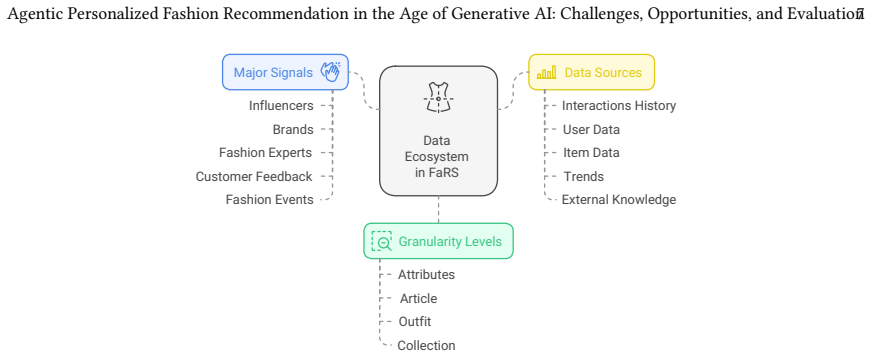
Summary. This perspective paper argues that fashion recommender systems (FaRS) require more than static, retrieval-only pipelines. It provides a layered taxonomy of the FaRS output space and stakeholder ecosystem, compares fashion with music and general e-commerce across several dimensions, and identifies five representative recommendation scenarios. The paper focuses on mixed-modality refinement (image anchor plus textual modification), reviews existing retrieval-only composition operators, and proposes an Agentic Mixed-Modality Refinement (AMMR) pipeline that combines multimodal encoders, a learned composer g_theta, ANN retrieval, an attribute guard, a GPT-4o-based planner, session memory, external tools, and a critic. The conclusion claims that AMMR addresses previously unfulfilled requirements including fine-grained and long-tail attributes, compositional and ambiguous queries, and real-time trend adaptation. The manuscript contains no experiments, data, or benchmark evaluation.
Significance. The paper's taxonomy and problem framing are valuable: the comparison across fashion, music, and general e-commerce (Table 1), the five-scenario summary (Table 2), and the explicit production constraints (median latency below 200 ms, scalability to tens of millions of items) give researchers a concrete picture of the industrial requirements. The open-challenges list in Section 6.4 is honest and useful. The AMMR proposal is a coherent design hypothesis, and if validated it would be a relevant contribution to composed image retrieval and agentic recommender systems. However, no implementation, measurements, or benchmarks are provided, so the central efficacy claim in Section 7 is not established. The paper's current contribution is a well-grounded research agenda rather than a demonstrated system.
major comments (3)
- [Sec. 7, Conclusion] The statement that AMMR 'addresses several previously unfulfilled requirements in fashion recommendation' is the central claim of the paper and is load-bearing. The AMMR pipeline is described as a design in Section 6, but no implementation, latency measurements, cost figures, or benchmark evaluation are provided anywhere in the manuscript. Section 5.2 sets the production baseline as median latency below 200 ms over tens of millions of items, and Figure 4 places an LLM planner, an attribute guard, ensemble rankers, and a critic on the latency-critical path; without a component-wise budget decomposition or measurements, the claim that AMMR actually addresses those requirements is unsupported. I recommend reframing the conclusion as a proposal whose feasibility is to be demonstrated, and adding at least a back-of-the-envelope latency/cost analysis or a small proof-of-concept experiment.
- [Sec. 6.3 vs. Sec. 6.4] There is an internal tension about real-time trend adaptation. Table 3 states that rapid trend drift is solved because the 'Planner accesses external trend API; Memory injects recent style tokens into composer g_theta', yet Section 6.4 lists 'Efficient Adaptive Composer' as one of the open research problems, and Section 7 repeats that an efficient adaptive composer remains to be developed. The manuscript should either treat the memory-conditioned composer as an unvalidated component of the proposal or explain how the claimed capability is achieved despite the open problem.
- [Sec. 6.2.1] The paper does not specify which components of AMMR are existing techniques and which are new contributions, and it does not offer an evaluation protocol for the claimed capabilities (fine-grained attribute recall, negation handling, real-time adaptation). Since the paper explicitly identifies a 'Holistic Evaluation Protocol' as an open challenge in Section 6.4, the manuscript should at least sketch a concrete evaluation plan for AMMR (data, baselines, metrics, and constraints) so that the central claim is falsifiable in future work.
minor comments (6)
- [Sec. 5.2] The paragraph beginning 'Figure 3 makes the problem with fine-grained fashion attributes tangible with a hoodie query' is repeated word-for-word later in the same section; the duplicate should be removed.
- [Sec. 3] The sentence 'While conversational tool is useful for iterative suggestions...' is missing an article and reads as a fragment; it should be rewritten.
- [Sec. 3] The text 'it is also ageometrical property' should read 'it is also a geometrical property' (missing space).
- [Sec. 6.2.1 / Fig. 4] The attribute verifier is called 'Bliva-3' in the figure and 'BLIP-2' in the text; the naming should be made consistent.
- [Sec. 7] The acronym AMMR is expanded as 'Agentic Mixed-Modality Refinement' in Section 6 but as 'Agentic Multimodal Modular Recommender' in Section 7; the expansions should be harmonized.
- [Sec. 7] The phrase 'demonstrated potential' overstates the manuscript's evidence; 'proposed potential' or 'intended capabilities' would be more accurate given the absence of experiments.
Circularity Check
No significant circularity: the paper is a position proposal without a fitted derivation loop; its self-citations are contextual framing, not load-bearing premises.
full rationale
This is a perspective/position paper that proposes the AMMR pipeline but implements and benchmarks nothing, so the main circularity mechanisms (fitted inputs renamed as predictions, parameters defined in terms of target outputs, equations reducing to inputs) are absent. The paper's claims that AMMR addresses fine-grained attributes, compositional queries, and real-time trend adaptation are architectural hypotheses, not derived results; the conclusion restates the proposed design rather than deriving it from prior fitted evidence. The only potentially relevant issue is self-citation: references [28] and [41], both involving the authors, are cited for agentic recommender-system framing and RAG-based verification, respectively, and [12] for evaluation protocols. These are used as conceptual pointers in the open-challenges section and Table 3, not as uniqueness theorems or fitted parameters that force the AMMR conclusion. The internal tension between the 200 ms production-latency requirement and the admission in Section 6.4 that an efficient adaptive composer and real-time multi-objective critic are open research problems is a feasibility/correctness concern, not circularity. Accordingly the paper is substantially self-contained with respect to external benchmarks, and the circularity burden is minimal.
Assumptions & free parameters
assumptions (6)
- domain assumption Mixed-modality refinement is a particularly critical task for real-world deployment.
- domain assumption An LLM planner (GPT-4o) can reliably parse colloquial, negated, and compositional queries into structured constraints.
- domain assumption Agentic planning, retrieval, and attribute verification can meet production latency and throughput (sub-200ms, tens of millions of items).
- domain assumption An attribute verifier (BLIP-2) can enforce fine-grained constraints with acceptable false-positive rates.
- domain assumption Text-conditioned composition operators (e.g., gated FiLM, delta shift) preserve visual anchor identity while applying requested modifications.
- domain assumption Fairness, safety, ROI, and revenue can be reconciled by a multi-objective critic.
Cite this review
Pith. "Pith review of Agentic Personalized Fashion Recommendation in the Age of Generative AI: Challenges, Opportunities, and Evaluation." pith.science (2026). https://pith.science/paper/HPVX64D2
@misc{pith2026250802342,
  author       = {Pith},
  title        = {Pith review of: Agentic Personalized Fashion Recommendation in the Age of Generative AI: Challenges, Opportunities, and Evaluation},
  year         = {2026},
  howpublished = {\url{https://pith.science/paper/HPVX64D2}},
  note         = {Machine review of arXiv:2508.02342}
}
read the original abstract
Fashion recommender systems (FaRS) face distinct challenges due to rapid trend shifts, nuanced user preferences, intricate item-item compatibility, and the complex interplay among consumers, brands, and influencers. Traditional recommendation approaches, largely static and retrieval-focused, struggle to effectively capture these dynamic elements, leading to decreased user satisfaction and elevated return rates. This paper synthesizes both academic and industrial viewpoints to map the distinctive output space and stakeholder ecosystem of modern FaRS, identifying the complex interplay among users, brands, platforms, and influencers, and highlighting the unique data and modeling challenges that arise. We outline a research agenda for industrial FaRS, centered on five representative scenarios spanning static queries, outfit composition, and multi-turn dialogue, and argue that mixed-modality refinement-the ability to combine image-based references (anchors) with nuanced textual constraints-is a particularly critical task for real-world deployment. To this end, we propose an Agentic Mixed-Modality Refinement (AMMR) pipeline, which fuses multimodal encoders with agentic LLM planners and dynamic retrieval, bridging the gap between expressive user intent and fast-changing fashion inventories. Our work shows that moving beyond static retrieval toward adaptive, generative, and stakeholder-aware systems is essential to satisfy the evolving expectations of fashion consumers and brands.
Figures


Figures from the paper (1 more)

Forward citations
Cited by 1 Pith paper
-
Autonomous Information Seeking: A Roadmap for Agentic Recommender Systems
Agentic recommender systems are organized by agent role (assisted, as-recommender, as-simulator) crossed with autonomy levels L2–L5, yielding a roadmap of architectures, evaluation limits, and open challenges.
Reference graph
Works this paper leans on
-
[1]
Amazon. 2024. How Amazon Fashion is using AI to help you find the perfect fit. https://www.aboutamazon.com/news/retail/how-amazon-is-using- ai-to-help-customers-shop. Accessed: February 17, 2025
work page 2024
-
[2]
Muhammad Umer Anwaar, Egor Labintcev, and Martin Kleinsteuber. 2021. Compositional learning of image-text query for image retrieval. In Proceedings of the IEEE/CVF Winter conference on Applications of Computer Vision . 1140–1149
work page 2021
-
[3]
Alberto Baldrati, Marco Bertini, Tiberio Uricchio, and Alberto Del Bimbo. 2022. Conditioned and composed image retrieval combining and partially fine-tuning CLIP-based features. In 2022 IEEE/CVF Conference on Computer Vision and Pattern Recognition Workshops (CVPRW) . 4955–4964. doi:10.1109/CVPRW56347.2022.00543
arXiv 2022
-
[4]
Ashmi Banerjee, Adithi Satish, Fitri Nur Aisyah, Wolfgang Wörndl, and Yashar Deldjoo. 2025. SynthTRIPs: A Knowledge-Grounded Framework for Benchmark Query Generation for Personalized Tourism Recommenders. In SIGIR’25
work page 2025
-
[5]
Giuseppe Cartella, Alberto Baldrati, Davide Morelli, Marcella Cornia, Marco Bertini, and Rita Cucchiara. 2023. OpenFashionCLIP: Vision-and- Language Contrastive Learning with Open-Source Fashion Data. In Proceedings of the International Conference on Image Analysis and Processing
work page 2023
-
[6]
Marjan Celikik, Ana Peleteiro Ramallo, and Jacek Wasilewski. 2022. Reusable Self-Attention Recommender Systems in Fashion Industry Applications. In Proceedings of the 16th ACM Conference on Recommender Systems (Seattle, WA, USA) (RecSys ’22). Association for Computing Machinery, New York, NY, USA, 448–451. doi:10.1145/3523227.3547377
arXiv 2022
-
[7]
Saiful Hoque, Naimur Rahman Jeem, Manik Chandra Biswas, Deepayan Bardhan, and Edgar J
Samit Chakraborty, Md. Saiful Hoque, Naimur Rahman Jeem, Manik Chandra Biswas, Deepayan Bardhan, and Edgar J. Lobaton. 2021. Fashion Recommendation Systems, Models and Methods: A Review. Informatics 8 (2021), 49. https://api.semanticscholar.org/CorpusID:237700831
work page 2021
-
[8]
Samit Chakraborty, SM Azizul Hoque, and SM Fijul Kabir. 2020. Predicting fashion trend using runway images: application of logistic regression in trend forecasting. International Journal of Fashion Design, Technology and Education 13, 3 (2020), 376–386
work page 2020
Show all 50 references
-
[9]
Qianqian Chen, Tianyi Zhang, Maowen Nie, Zheng Wang, Shihao Xu, Wei Shi, and Zhao Cao. 2023. Fashion-GPT: Integrating LLMs with Fashion Retrieval System. In Proceedings of the 1st Workshop on Large Generative Models Meet Multimodal Applications (Ottawa ON, Canada) (LGM3A ’23)....
2023
-
[10]
Yanke Chen, Yunhao Ma, Huhai Zou, et al. 2025. Multifactorial modality fusion network for multimodal recommendation. Applied Intelligence 55, 2 (2025), 1–17
2025
-
[11]
Patrick John Chia, Giuseppe Attanasio, Federico Bianchi, Silvia Terragni, Ana Rita Magalhães, Diogo Goncalves, Ciro Greco, and Jacopo Tagliabue
-
[12]
Yashar Deldjoo, Nikhil Mehta, Maheswaran Sathiamoorthy, Shuai Zhang, Pablo Castells, and Julian J. McAuley. 2025. Toward Holistic Evaluation of Recommender Systems Powered by Generative Models. In Proceedings of the 48th International ACM SIGIR Conference on Research and Devel...
2025
-
[13]
Yashar Deldjoo, Fatemeh Nazary, Arnau Ramisa, Julian Mcauley, Giovanni Pellegrini, Alejandro Bellogin, and Tommaso Di Noia. 2023. A Review of Modern Fashion Recommender Systems. Comput. Surveys 56, 4 (2023), 1–37
2023
-
[14]
Eric Dodds, Jack Culpepper, Simao Herdade, Yang Zhang, and Kofi Boakye. 2020. Modality-agnostic attention fusion for visual search with text feedback. arXiv preprint arXiv:2007.00145 (2020). Manuscript submitted to ACM 16 Deldjoo et al
2020 arXiv
-
[15]
Doha Eldemerdash, Khalid AL shikh, and Maha Abou-Ghali. 2023. Fashion Recommendation System and its Impact on Consumers’ Purchase Decision Making. International Design Journal (2023). https://api.semanticscholar.org/CorpusID:255367182
2023
-
[16]
Jiabao Fang, Shen Gao, Pengjie Ren, Xiuying Chen, Suzan Verberne, and Zhaochun Ren. 2024. A multi-agent conversational recommender system. arXiv preprint arXiv:2402.01135 (2024)
2024 arXiv
-
[17]
George T Friedlob and Franklin J Plewa Jr. 1996. Understanding return on investment . John Wiley & Sons
1996
-
[18]
Hajer Ghodhbani, Mohamed Neji, Imran Razzak, and Adel M. Alimi. 2022. You can try without visiting: a comprehensive survey on virtually try-on outfits. Multimedia Tools Appl. 81, 14 (June 2022), 19967–19998. doi:10.1007/s11042-022-12802-6
2022 doi
-
[19]
Akshat Gour, Harsh Gupta, Mohit Gupta, and Himanshu Agrawal. 2023. Augmented Reality Based Fashion Store. In Proceedings of the 2023 Fifteenth International Conference on Contemporary Computing (Noida, India) (IC3-2023). Association for Computing Machinery, New York, NY, USA, ...
2023
-
[20]
Kasra Hosseini, Thomas Kober, Josip Krapac, Roland Vollgraf, Weiwei Cheng, and Ana Peleteiro Ramallo. 2025. Retrieve, Annotate, Evaluate, Repeat: Leveraging Multimodal LLMs for Large-Scale Product Retrieval Evaluation. In European Conference on Information Retrieval . Springer
2025
-
[21]
Fortune Business Insights. 2023. Apparel Market Size, Share and COVID-19 Impact Analysis. (2023). https://www.fortunebusinessinsights.com/ apparel-market-110718 Accessed: 2025-01-20
2023
-
[22]
Maria Iso and Ikuko Shimizu. 2021. Fashion Recommendation System Reflecting Individual’s Preferred Style. In 2021 IEEE 10th Global Conference on Consumer Electronics (GCCE). 434–435. doi:10.1109/GCCE53005.2021.9622080
2021
-
[23]
Jannach and Himan Abdollahpouri
D. Jannach and Himan Abdollahpouri. 2023. A survey on multi-objective recommender systems. Frontiers in Big Data 6 (2023). https://api. semanticscholar.org/CorpusID:257708223
2023
-
[24]
Li and Z
L. Li and Z. Li. 2022. Exploring Multi-Stakeholder Perspectives in Fashion E-Commerce: Brand Identity and Consumer Trust. Journal of Retailing and Consumer Services 66 (2022), 102943. doi:10.1016/j.jretconser.2021.102943
2022
-
[25]
Yang Li, Yadan Luo, and Zi Huang. 2020. Fashion recommendation with multi-relational representation learning. InAdvances in Knowledge Discovery and Data Mining: 24th Pacific-Asia Conference, PAKDD 2020, Singapore, May 11–14, 2020, Proceedings, Part I 24 . Springer, 3–15
2020
-
[26]
Zheyuan Liu, Cristian Rodriguez-Opazo, Damien Teney, and Stephen Gould. 2021. Image Retrieval on Real-life Images with Pre-trained Vision-and- Language Models. In 2021 IEEE/CVF International Conference on Computer Vision (ICCV) . 2105–2114. doi:10.1109/ICCV48922.2021.00213
2021
-
[27]
Jianxin Ma, Chang Zhou, Peng Cui, Hongxia Yang, and Wenwu Zhu. 2019. Learning disentangled representations for recommendation. Advances in neural information processing systems 32 (2019)
2019
-
[28]
Reza Yousefi Maragheh and Yashar Deldjoo. 2025. The Future is Agentic: Definitions, Perspectives, and Open Challenges of Multi-Agent Recommender Systems. arXiv preprint arXiv:2507.02097 (2025)
2025 arXiv
-
[29]
Kevin Matzen, Kavita Bala, and Noah Snavely. 2017. Streetstyle: Exploring world-wide clothing styles from millions of photos. arXiv preprint arXiv:1706.01869 (2017)
2017 arXiv
-
[30]
Soumaya Mersni and Hechmi Najjar. 2024. When good meets fashion brand: from cause-related marketing to Gen Z loyalty. International Review on Public and Nonprofit Marketing (2024). https://api.semanticscholar.org/CorpusID:274848983
2024
-
[31]
Siti Nurfadila and Setyo Riyanto. 2020. The impact of influencers in consumer decision-making: The fashion industry. Interdisciplinary journal on law, social sciences and humanities 1, 2 (2020), 1–13
2020
-
[32]
Alec Radford, Jong Wook Kim, Chris Hallacy, Aditya Ramesh, Gabriel Goh, Sandhini Agarwal, Girish Sastry, Amanda Askell, Pamela Mishkin, Jack Clark, Gretchen Krueger, and Ilya Sutskever. 2021. Learning Transferable Visual Models From Natural Language Supervision. In Internation...
2021
-
[33]
Kuniaki Saito, Kihyuk Sohn, Xiang Zhang, Chun-Liang Li, Chen-Yu Lee, Kate Saenko, and Tomas Pfister. 2023. Pic2Word: Mapping Pictures to Words for Zero-shot Composed Image Retrieval. 2023 IEEE/CVF Conference on Computer Vision and Pattern Recognition (CVPR) (2023), 19305–19314...
2023
-
[34]
Krishna Sayana, Raghavendra Vasudeva, Yuri Vasilevski, Kun Su, Liam Hebert, James Pine, Hubert Pham, Ambarish Jash, and Sukhdeep Sodhi. 2024. Beyond Retrieval: Generating Narratives in Conversational Recommender Systems. arXiv preprint arXiv:2410.16780 (2024)
2024 arXiv
-
[35]
Abdul-Saboor Sheikh, Romain Guigourès, Evgenii Koriagin, Yuen King Ho, Reza Shirvany, Roland Vollgraf, and Urs Bergmann. 2019. A deep learning system for predicting size and fit in fashion e-commerce. In Proceedings of the 13th ACM Conference on Recommender Systems (Copenhagen...
2019
-
[36]
Minchul Shin, Yoonjae Cho, Byungsoo Ko, and Geonmo Gu. 2021. Rtic: Residual learning for text and image composition using graph convolutional network. arXiv preprint arXiv:2104.03015 (2021)
2021 arXiv
-
[37]
Yong-Goo Shin, Yoon-Jae Yeo, Min-Cheol Sagong, Seo-Won Ji, and Sung-Jea Ko. 2019. Deep Fashion Recommendation System with Style Feature Decomposition. In 2019 IEEE 9th International Conference on Consumer Electronics (ICCE-Berlin). 301–305. doi:10.1109/ICCE-Berlin47944.2019.8966228
2019
-
[38]
Shaghayegh Shirkhani, Hamam Mokayed, Rajkumar Saini, and Hum Yan Chai. 2023. Study of AI-Driven Fashion Recommender Systems. SN Computer Science 4 (2023). https://api.semanticscholar.org/CorpusID:259336713
2023
-
[39]
Xuemeng Song, Chun Wang, Changchang Sun, Shanshan Feng, Min Zhou, and Liqiang Nie. 2023. MM-FRec: Multi-Modal Enhanced Fashion Item Recommendation. IEEE Transactions on Knowledge and Data Engineering 35, 10 (2023), 10072–10084. doi:10.1109/TKDE.2023.3266423
2023
-
[40]
Yuxin Tian, Shawn Newsam, and Kofi Boakye. 2023. Fashion image retrieval with text feedback by additive attention compositional learning. In Proceedings of the IEEE/CVF winter conference on applications of computer vision . 1011–1021. Manuscript submitted to ACM Agentic Person...
2023
-
[41]
Ali Tourani, Fatemeh Nazary, and Yashar Deldjoo. 2025. RAG-VisualRec: An Open Resource for Vision- and Text-Enhanced Retrieval-Augmented Generation in Recommendation. arXiv preprint arXiv:2506.20817 (2025)
2025 arXiv
-
[42]
Maya Varma, Jean-Benoit Delbrouck, Sarah Hooper, Akshay Chaudhari, and Curtis Langlotz. 2023. ViLLA: Fine-Grained Vision-Language Representation Learning from Real-World Data. In Proceedings of the IEEE/CVF International Conference on Computer Vision . 22225–22235
2023
-
[43]
Nam Vo, Lu Jiang, Chen Sun, Kevin Murphy, Li-Jia Li, Li Fei-Fei, and James Hays. 2019. Composing Text and Image for Image Retrieval - an Empirical Odyssey. In 2019 IEEE/CVF Conference on Computer Vision and Pattern Recognition (CVPR) . 6432–6441. doi:10.1109/CVPR.2019.00660
2019
-
[44]
Nam Vo, Lu Jiang, Chen Sun, Kevin Murphy, Li-Jia Li, Li Fei-Fei, and James Hays. 2019. Composing text and image for image retrieval-an empirical odyssey. In Proceedings of the IEEE/CVF conference on computer vision and pattern recognition . 6439–6448
2019
-
[45]
Yongquan Wan, Guobing Zou, Cairong Yan, and Bofeng Zhang. 2023. Dual attention composition network for fashion image retrieval with attribute manipulation. Neural Computing and Applications 35, 8 (2023), 5889–5902
2023
-
[46]
Tianlu Wang, Jieyu Zhao, Mark Yatskar, Kai-Wei Chang, and Vicente Ordonez. 2019. Balanced Datasets Are Not Enough: Estimating and Mitigating Gender Bias in Deep Image Representations. In Proceedings of the IEEE/CVF International Conference on Computer Vision (ICCV)
2019
-
[47]
Yunzhu Wang, Li Liu, Xiaodong Fu, and Lijun Liu. 2024. MCCP: multi-modal fashion compatibility and conditional preference model for personalized clothing recommendation. Multimedia Tools and Applications 83, 4 (2024), 9621–9645
2024
-
[48]
Yiyan Xu, Wenjie Wang, Fuli Feng, Yunshan Ma, Jizhi Zhang, and Xiangnan He. 2024. Diffusion Models for Generative Outfit Recommendation. In Proceedings of the 47th International ACM SIGIR Conference on Research and Development in Information Retrieval (Washington DC, USA) (SIG...
2024
-
[49]
Zalando. 2023. Zalando to Launch A Fashion Assistant Powered by ChatGPT. https://corporate.zalando.com/en/technology/zalando-launch- fashion-assistant-powered-chatgpt Accessed: 2025-01-23. Manuscript submitted to ACM
2023
-
[2022]
Scientific Reports 12, 1 (2022), 18958
Contrastive language and vision learning of general fashion concepts. Scientific Reports 12, 1 (2022), 18958
2022
Reviewed August 15, 2026 · model on record in the stance chip above.
Discussion (0). Continue with ORCID to comment.