REVIEW 1 major objections 5 minor 7 references
A Deep VLA Search for a Persistent Radio Counterpart to the One-off FRB 20250316A
T0 review · 1 major / 5 minor · reviewed 2026-08-05 · deepseek-v4-flash
Pith's one-line read FRB 20250316A, one of the brightest nearby one-off fast radio bursts, has no persistent radio counterpart down to 8.4 microJy at 15 GHz; if correct, luminous magnetar nebulae are not a universal FRB product.
desk verdict Solid non-detection and a clean upper limit; the environmental claims rest on a model the paper itself says may not apply at the low densities it constrains. read the letter →
The pith
A machine-rendered reading of the paper's core claim, the machinery that carries it, and where it could break.
The reading
What carries the argument
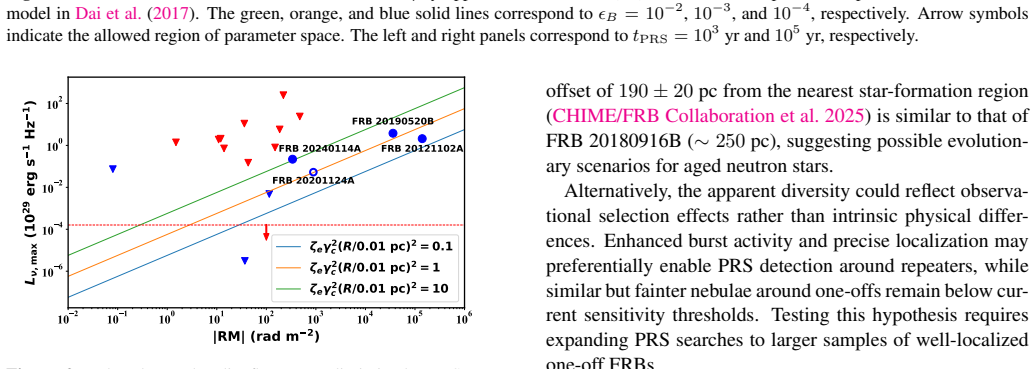
The central instrument is the Very Large Array observing at 15 GHz in D-configuration, reaching a thermal-noise floor of $2.8\,\mu\mathrm{Jy\,beam^{-1}}$; the non-detection is converted into a luminosity bound using the host distance. The physical interpretation is carried by the pulsar-wind-nebula synchrotron model adopted from the paper's references, whose peak-flux formula maps the microjansky upper limit into excluded regions in the ambient-density ($n_0$) versus engine-power ($L_w$) plane, and by the empirical PRS-luminosity–rotation-measure relation, which converts the flux limit into a rotation-measure bound.
What would settle it
A polarimetric measurement of the burst or of a background source through the same sight line that finds $|\mathrm{RM}| > 30\,\mathrm{rad\,m^{-2}}$ would contradict the clean-environment picture while leaving the non-detection intact; alternatively, an image reaching $\sim1\,\mu\mathrm{Jy}$ at 2–6 GHz that reveals a compact source at the FRB position would overturn the no-PRS claim.
Extended reading notes
Core claim
Using deep 15 GHz imaging of FRB 20250316A with the Very Large Array on 2025 April 5 and 9, the authors find no persistent radio source at the sub-arcsecond CHIME/Outriggers position. The deepest image reaches an rms of $2.8\,\mu\mathrm{Jy\,beam^{-1}}$, giving a $3\sigma$ upper limit of $<8.4\,\mu\mathrm{Jy}$, which at the host distance of $\sim40$ Mpc corresponds to a monochromatic luminosity $\nu L_\nu < 2.4\times10^{35}\,\mathrm{erg\,s^{-1}}$ (for a flat spectrum). This is roughly three to four orders of magnitude below the luminosities of the persistent sources associated with repeating FRBs such as FRB 20121102A and FRB 20190520B. The authors further show that interpreting this limit wi
Load-bearing premise
The environmental interpretation rests on a pulsar-wind-nebula formula that the authors themselves flag as possibly invalid at the sparse densities ($n_0<10^{-2}\,\mathrm{cm^{-3}}$) they infer, so if that formula breaks down only the raw luminosity limit remains, and the RM bound further assumes a relation calibrated on only three repeating FRBs.
Editorial extensions
If this is right
- The $3\sigma$ limit $\nu L_\nu < 2.4\times10^{35}\,\mathrm{erg\,s^{-1}}$ is among the deepest for a one-off FRB and excludes any persistent counterpart brighter than roughly a thousandth of the repeater PRS luminosities.
- Under the pulsar-wind-nebula model, the allowed parameter space favors $n_0 \lesssim 0.1\,\mathrm{cm^{-3}}$ for energetic engines or a substantially weaker spin-down luminosity, consistent with an evolved neutron star rather than a young magnetar.
- If the empirical PRS–RM trend extends to one-off FRBs, the limit predicts $|\mathrm{RM}| \lesssim 30\,\mathrm{rad\,m^{-2}}$ and a mean line-of-sight magnetic field of at most a few $\mu$G.
- The null result strengthens the emerging dichotomy between repeating FRBs, which host luminous persistent radio sources, and one-off FRBs, which do not, though the authors note selection effects could mimic this split.
Reading between the lines
- A direct test would be a polarimetric measurement of FRB 20250316A itself or of a background source through the same sight line; an $|\mathrm{RM}|$ well above $30\,\mathrm{rad\,m^{-2}}$ would invalidate the clean-environment conclusion even if the non-detection stands.
- The paper's 4-day variability null is too short to rule out an episodic or restarted nebula; month-to-year monitoring could catch late-time re-brightening, which would reconcile the non-detection with a young magnetar that was simply quiescent in April 2025.
- If the dichotomy is real, the number density of bright persistent radio sources should scale with the repeating fraction of the FRB population; future wide-field surveys that localize large samples of one-off bursts should recover essentially no PRSs above $\sim10^{35}\,\mathrm{erg\,s^{-1}}$, a prediction that would be testable within the decade.
Editorial analysis
A structured set of objections, weighed in public.
Referee Report
Summary. This paper reports deep VLA follow-up observations of the one-off FRB 20250316A, a bright (~1.7 kJy ms) burst localized by CHIME/Outriggers to a ~40 Mpc galaxy. Using D-array observations at 6, 10, and 15 GHz on 2025 April 5 and at 15 GHz on April 9, the authors find no persistent radio source at the FRB position. Their deepest image reaches an rms of 2.8 uJy/beam at 15 GHz, giving a 3-sigma upper limit of <8.4 uJy and a luminosity limit of nu L_nu < 2.4e35 erg/s. The paper interprets this non-detection through the Dai et al. (2017) pulsar wind nebula model to constrain ambient density and engine power, and through an empirical PRS-RM relation to suggest a low |RM| environment. The central observational result is a robust upper limit, but the quantitative environmental conclusions depend on model extrapolations that the paper itself flags as potentially invalid in the relevant regime.
Significance. If the raw upper limit is taken as the result, this is a valuable addition to the PRS search literature: it is among the deepest constraints for a one-off FRB and lies roughly three orders of magnitude below the persistent radio luminosities of repeater-associated PRSs. The data processing is standard and carefully described, the achieved noise is consistent with thermal expectations, and the non-detection is an independent observable, so the core claim is secure. The paper also earns credit for explicitly acknowledging several model caveats. However, the abstract and summary present the 'low-density, weakly magnetized environments' conclusion as more established than the model validity allows; as written, that conclusion rests on extrapolating Eq. (1) outside its stated range. The diversity argument is plausible but should be framed as illustrative rather than quantitative.
major comments (1)
- [Section 4.1, Eq. (1), Fig. 1, and Abstract] The quantitative environmental conclusion is load-bearing and needs revision. The Abstract states the results are 'pointing to low-density, weakly magnetized environments,' but this is derived from Eq. (1), which the paper itself says assumes n0 >= 0.1 cm^-3 and may be invalid for n0 < 10^-2 cm^-3. Since Eq. (1) scales as n0^(33/50), extrapolating two decades below the validity range overpredicts synchrotron flux if adiabatic losses dominate. The exclusion regions in Fig. 1 are therefore not a reliable lower bound on n0 in the sparse regime. Please restrict the model-based exclusion to the valid density range or explicitly label it as an illustrative extrapolation, and soften the Abstract and Section 5 wording accordingly. The raw <8.4 uJy limit is unaffected and should remain the primary result.
minor comments (5)
- [Section 4.2] The sentence 'This range covers the measured value of +16.79 +/- 0.85 rad m^-2' is misleading: the 0.3 and 3 rad m^-2 curves do not cover 16.79; only the most permissive 30 rad m^-2 curve does. Please clarify which normalization is consistent with the measured RM.
- [Section 4.2] Typographical and grammatical errors: 'dipole fileds' should be 'dipole fields'; 'and are are predicted' should be 'and are predicted'; 'upper limit specific radio luminosities' in the Fig. 2 caption needs rewording.
- [Section 3] The false-positive probability claim ('total false positive probability remains below 0.4%') would be easier to verify if the number of independent beams searched were stated explicitly rather than only the per-beam 0.13% value.
- [Appendix A.1] J1219+4829 and J1152+4939 are two calibrators; 'for its proximity' should be 'for their proximity' or the sentence should be restructured.
- [Section 5] The phrase 'ruling out ... any transient variability on 4-day timescales' is too strong; the observations rule out variability above the 3-sigma sensitivity limit on that timescale. Please rephrase.
Circularity Check
No significant circularity: the non-detection is an independent observable and the interpretive models are applied parameter-free, with their own limitations explicitly flagged.
full rationale
The paper's central result is a measured VLA non-detection with an rms of 2.8 microJy/beam, giving a 3-sigma upper limit of <8.4 microJy and nu L_nu < 2.4e35 erg/s. This is an independent observational quantity, not derived from a model or from a fitted parameter. The interpretation in Section 4.1 uses the Dai et al. (2017) pulsar wind nebula model to convert this upper limit into constraints on n0 and Lw. Although Dai is a co-author of the present paper, the model is an external, published physical framework with fixed parameters (epsilon_e = 0.1, epsilon_B from PIC simulations, p = 1.4 taken from FRB 121102A); no parameter is fitted to FRB 20250316A, and the model does not contain the target result. The paper explicitly flags its limitation: 'This model assumes efficient energy transfer in dense environments (n0 >= 0.1 cm^-3); for the sparse conditions we constrain (n0 < 10^-2 cm^-3), adiabatic expansion losses likely dominate over radiative cooling, potentially invalidating these predictions.' That is a validity/robustness caveat, not circularity. Similarly, the PRS-RM extrapolation in Section 4.2 is called 'highly speculative' by the authors and is not presented as a forced conclusion. The raw luminosity upper limit, which is the primary claim, remains self-contained and does not reduce to any model input or self-citation. Therefore no circular step exists; the self-citation is not load-bearing in the sense of replacing independent evidence.
Assumptions & free parameters
free parameters (5)
- electron energy fraction epsilon_e =
0.1
- magnetic field energy fraction epsilon_B =
1e-2, 1e-3, 1e-4
- electron spectral index p =
1.4 (and 2.5 alternative)
- PWN age t_PRS =
1e3 and 1e5 yr
- PRS-RM normalization factor zeta_e gamma_c^2 (R/0.01 pc)^2 =
0.1, 1, 10
assumptions (5)
- domain assumption FRB 20250316A is at ~40 Mpc in NGC 4141, with the CHIME/Outriggers VLBI localization of 68 mas x 57 mas (CHIME/FRB Collaboration et al. 2025).
- domain assumption The burst is one-off, based on continued CHIME monitoring and FAST/uGMRT/European follow-up upper limits (Li et al. 2025; Ould-Boukattine et al. 2025).
- standard math The VLA flux scale (Perley & Butler 2017) and CASA calibration steps are reliable as applied.
- domain assumption The Dai et al. (2017) PWN model is applicable at the constrained low densities.
- domain assumption The empirical PRS-RM relation (Yang et al. 2020, 2022; Bruni et al. 2024) extends to one-off FRBs.
Cite this review
Pith. "Pith review of A Deep VLA Search for a Persistent Radio Counterpart to the One-off FRB 20250316A." pith.science (2026). https://pith.science/paper/XJGMYTML
@misc{pith2026250805552,
  author       = {Pith},
  title        = {Pith review of: A Deep VLA Search for a Persistent Radio Counterpart to the One-off FRB 20250316A},
  year         = {2026},
  howpublished = {\url{https://pith.science/paper/XJGMYTML}},
  note         = {Machine review of arXiv:2508.05552}
}
abstract
Fast Radio Burst (FRB) 20250316A, detected by CHIME on 2025 March 16 with a fluence of $1.7\pm0.1~\mathrm{Jy\,ms}$ and a dispersion measure of $161.3\pm0.4~\mathrm{pc\,cm^{-3}}$, ranks among the brightest extragalactic FRBs at $\sim 40$ Mpc. We obtained deep Karl G. Jansky Very Large Array follow-up at 15~GHz on 2025 April 5 and 9 and find no persistent radio source (PRS). Our best image reaches an rms of $2.8~\mu\mathrm{Jy\,beam^{-1}}$, yielding a $3\sigma$ upper limit of $<8.4~\mu\mathrm{Jy}$ at the FRB position, corresponding to $\nu L_\nu < 2.4\times10^{35}~\mathrm{erg\,s^{-1}}$. These results represent among the most stringent constraints for a non-repeating FRB, lying $\gtrsim 3$ orders of magnitude below the $\nu L_\nu$ of compact persistent radio sources around well-studied repeaters, thereby disfavoring bright magnetar-nebula scenarios and pointing to low-density, weakly magnetized environments. Interpreting our limit through pulsar-/magnetar-wind synchrotron frameworks places joint constraints on ambient density and engine power. If the empirical PRS--rotation-measure trend reported for repeaters extends to one-off sources, our limit implies $\vert \mathrm{RM} \vert \lesssim 30~\mathrm{rad\,m^{-2}}$, consistent with a clean magneto-ionic sight line and progenitor channels such as neutron-star mergers or giant flares from older magnetars.
Figures


Reference graph
Works this paper leans on
-
[1]
Aggarwal, K., Budav´ari, T., Deller, A. T., et al. 2021, ApJ, 911, 95, doi: 10.3847/1538-4357/abe8d2 An, T., Wu, X., Lao, B., et al. 2022, Science China Physics, Mechanics, and Astronomy, 65, 129501, doi: 10.1007/s11433-022-1981-8 An, T., Wu, X.-P., & Hong, X. 2019, Nature Astronomy, 3, 1030, doi: 10.1038/s41550-019-0943-4 Andrew, S., & Chime/Frb Collabor...
-
[2]
(GHz) ( µJy beam−1) 2025-04-04 D 3.2 13.6 CHIME/FRB Collaboration et al
Comparison of VLA Observations for FRB 20250316A Date Array Frequency RMS Noise Reference Config. (GHz) ( µJy beam−1) 2025-04-04 D 3.2 13.6 CHIME/FRB Collaboration et al. (2025) 2025-04-04 D 6.1 5.6 CHIME/FRB Collaboration et al. (2025) 2025-04-04 D 9.9 5.2 CHIME/FRB Collaboration et al. (2025) 2025-04-04 D 21.8 6.9 CHIME/FRB Collaboration et al. (2025) 2...
work page 2025
-
[3]
Top left: C-band (6 GHz, 2025 April
VLA images demonstrating the non-detection of persistent radio emission at the FRB 20250316A position across different bands and epochs. Top left: C-band (6 GHz, 2025 April
work page 2025
-
[5]
Top right: X-band (10 GHz, 2025 April
with synthesized beam 14′′ × 9′′ and rms noise 5.3 µJy beam−1. Top right: X-band (10 GHz, 2025 April
work page 2025
-
[6]
Bottom left: Ku-band (15 GHz, 2025 April
with synthesized beam 9′′ × 6′′ and rms noise 5.7 µJy beam−1. Bottom left: Ku-band (15 GHz, 2025 April
work page 2025
-
[7]
Bottom right: Ku-band (15 GHz, 2025 April
with synthesized beam 7′′ × 4′′ and rms noise 5.9 µJy beam−1. Bottom right: Ku-band (15 GHz, 2025 April
work page 2025
-
[2025]
and would limit dynamic range and confuse compact-source searches. Observations used short phase-referencing cycles (7–10 min on-source bracketed by ∼1 min on a nearby calibrator) to track atmospheric phase variations. Scans were constrained to elevations > 30◦ to minimise airmass-dependent systematics. A.2. Calibration Strategy and Imaging Primary calibr...
work page 2017
Reviewed August 5, 2026 · model on record in the stance chip above.
Discussion (0). Continue with ORCID to comment.