REVIEW 2 major objections 5 minor 1 cited by
Dark Sector Electroweak Baryogenesis In Light Of The Galactic Center Excess
T0 review · 2 major / 5 minor · reviewed 2026-08-05 · deepseek-v4-flash
Pith's one-line read This paper claims that a single dark-sector extension of the Standard Model can explain the baryon asymmetry, the dark matter relic density, and the galactic center gamma-ray excess, while producing gravitational waves detectable in the nea
desk verdict A serious, constraint-rich update of the authors' own dark-sector EWBG model, with a real GCE link at ~2 sigma, but the baryogenesis claim leans on an imported wall velocity that the authors themselves flag as provisional. read the letter →
The pith
A machine-rendered reading of the paper's core claim, the machinery that carries it, and where it could break.
The reading
What carries the argument
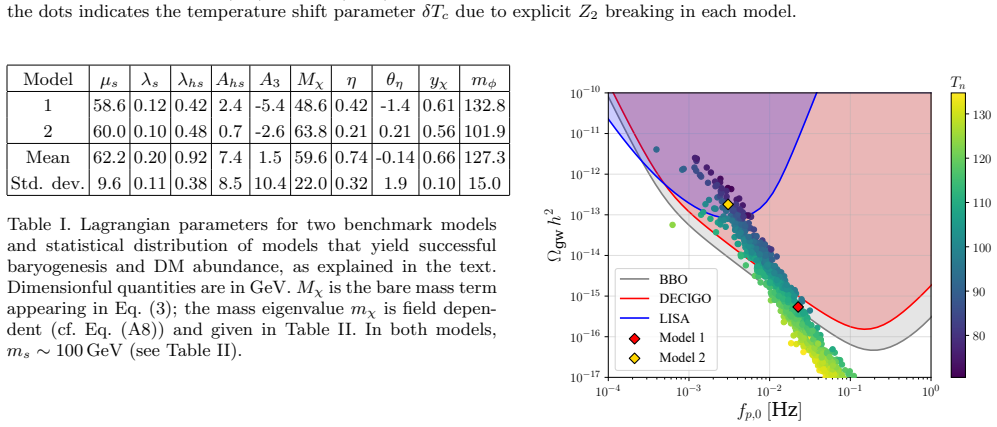
The mechanism is the spatially varying CP-violating phase of the dark fermion mass, \[\theta_\chi(z) = \arctan\left(\frac{\eta \sin\theta_\eta\, s(z)}{M_\chi + \eta \cos\theta_\eta\, s(z)}\right),\] induced by the singlet field profile s(z) across the bubble wall. This position-dependent phase creates a CP-violating force that produces a helicity asymmetry in the Majorana fermion chi; inverse decays and scattering transfer the asymmetry to tau leptons, and electroweak sphalerons convert the lepton number into baryons. The strength of the first-order phase transition is controlled by the explicit Z2-breaking parameters A_hs and A_3, which lower the nucleation temperature and raise v_n/T_n, an
What would settle it
Compute the bubble wall velocity from first principles for the benchmark parameters, especially Model 1 with alpha around 0.1: if v_w approaches 1 rather than ~0.6, the baryogenesis claim is falsified. A second test is the Higgs invisible width: Model 1 predicts Gamma_inv = 0.30 MeV, just below the current ATLAS bound, so a future limit below about 0.1 MeV would exclude this benchmark.
Extended reading notes
Core claim
The central claim is that explicit breaking of the Z2 symmetry in the singlet sector strengthens the electroweak phase transition while keeping CP violation sequestered in the dark sector, making it possible to reproduce the observed baryon asymmetry, the dark matter relic density, and—at about the 2-$\sigma$ level—the galactic center excess. Benchmark Model 1 (with m_chi = 49.3 GeV, m_s = 97.6 GeV, and |sin theta_eta| near 1) gives eta_B/eta_B,obs = 0.95 and Omega_chi $h^{2}$ = 0.121 via b-quark-dominated annihilation, an effective galactic-center cross section near the GCE best-fit band, an invisible Higgs width of 0.30 MeV, and gravitational wave peaks above the BBO sensitivity curve. Model 2 gi
Load-bearing premise
The baryon asymmetry calculation assumes bubble walls move at about 0.6 times the speed of light, a value taken from an earlier study of a closely related model; if the walls actually move at near-light speed, the predicted matter-antimatter asymmetry drops to zero.
Editorial extensions
If this is right
- The benchmark Model 1 yields the observed baryon asymmetry and dark matter relic density while placing the galactic-center annihilation cross section within 2 sigma of the GCE best-fit band.
- Both benchmark models predict a strongly first-order electroweak phase transition with v_n/T_n > 1.1, satisfying the sphaleron washout condition.
- Gravitational wave spectra from the transition lie above the BBO sensitivity curve for Model 1 and above LISA, DECIGO, and BBO for Model 2.
- The model predicts a dark matter direct-detection cross section just below the LUX-ZEPLIN limit and a Higgs invisible width Gamma_inv = 0.30 MeV for Model 1, close to current bounds.
- The inert doublet phi (m_phi > 100 GeV) mimics stau production at the LHC, giving a concrete collider signature.
Reading between the lines
- If the bubble wall velocity turns out to be closer to unity than the assumed ~0.6, the baryon asymmetry would drop sharply; a first-principles computation of v_w in the explicit-Z2-breaking potential would settle the model's viability.
- The electron-coupled variants, though mostly excluded, may have a narrow allowed window near two-loop EDM cancellations; the authors note that a precise two-loop calculation is needed to decide.
- The model can be extended to generate radiative neutrino masses (scotogenic), with a coupling around 10^-10 giving neutrino masses near 0.05 eV, linking the dark sector to the neutrino mass puzzle.
- If the galactic center excess turns out to have a pulsar origin, the model's other cosmological predictions survive; the GCE is a bonus rather than a load-bearing part of the framework.
Editorial analysis
A structured set of objections, weighed in public.
Referee Report
Summary. This paper revisits the dark-sector electroweak baryogenesis model of Ref. [9], extending it with explicit Z2 breaking of the singlet s, a full one-loop finite-temperature potential with counterterms, updated moment-expanded transport equations valid at high wall velocities, and an MCMC scan over the model parameters. The model contains a singlet scalar s, an inert SU(2) doublet phi, and a Majorana fermion chi; CP violation in the spatially varying chi mass during the phase transition generates a helicity asymmetry that is converted into a lepton and then baryon asymmetry. The central claims are that the model can simultaneously explain the baryon asymmetry of the Universe, the dark matter relic density, and (marginally, at the ~2 sigma level) the Galactic Center gamma-ray excess, while producing gravitational waves detectable by BBO for Model 1 and by LISA, DECIGO and BBO for Model 2. The paper also derives predictions for direct detection, Higgs invisible decays, and LHC stau-like signatures.
Significance. If the central claims hold, this is a valuable demonstration that a single, moderately extended dark-sector model can connect several otherwise unrelated observables: the BAU, the DM relic density, the GCE, gravitational waves, direct detection, and Higgs physics. The paper's strengths are that the headline quantities (eta_B, Omega_chi h^2, sigma_chiN, Gamma_inv, GW amplitudes) are genuine outputs of the scanned Lagrangian parameters and are compared with external constraints rather than being fit by construction, and that the numerical pipeline uses standard tools (CosmoTransitions, moment-expanded transport, PISC sensitivity curves). The authors are also honest about the marginality of the GCE fit and about the wall-velocity assumption. The main unresolved issue is the dependence of the BAU and GW predictions on the adopted bubble wall velocity; this is currently imported from a non-Z2-symmetric study rather than computed in the present model.
major comments (2)
- [Sec. IV and Sec. VI; Eq. (26), Eqs. (43)-(44), Table II] The baryogenesis prediction rests on the assumed wall velocity v_w ~ v_J ~ 0.6, imported from the non-Z2-symmetric study of Ref. [12] (Sec. IV). This is load-bearing: v_w enters Eq. (44) through the prefactor 1/(v_w gamma_w) and through the sphaleron washout exponent, and it controls whether the CP-violating source is adiabatic or decoupled. The paper itself notes that v_w -> 1 'leads to vanishing BAU', and Ref. [23] finds runaway detonations for part of the same alpha range populated by the scan. Table II does not report alpha or beta_H for the two benchmarks, so the reader cannot tell whether they lie in the hybrid regime (where v_w ~ v_J is plausible) or the runaway regime. I request either a model-specific computation of v_w or a sensitivity study showing eta_B/eta_obs as a function of v_w (e.g. 0.4-0.9) for the benchmarks, together with the values of alpha and beta_H. Without this,
- [Sec. IV and Table II; Eq. (27)] The gravitational-wave detectability claims also depend on the same wall-velocity assumption and on alpha and beta_H. The benchmark entries in Table II report Tn, vn, vn/Tn, masses, mixing angles, relic density, BAU, branching ratio, and Gamma_inv, but not alpha, beta_H, or L_w. Since the GW spectrum in Eq. (27) is determined by alpha, beta_H, and v_w through H*R* ~ v_w/beta_H, the positions of Model 1 and Model 2 in Fig. 4 cannot be checked from the tables. Please report alpha, beta_H, and L_w for the two benchmarks and for the successful scan region, and state how the quoted SNR/detectability conclusions change if v_w is varied over the range suggested by the literature.
minor comments (5)
- [Abstract and Sec. X] The abstract says the model 'can explain' the Galactic Center excess, while the body (Sec. VIII) states that Model 1 lies 'just outside the 2 sigma region' of one fit and 'could marginally explain' the excess, and the conclusion says 'within ~2 sigma'. The wording should be harmonized so the abstract reflects the marginality.
- [Appendix C, Eq. (C4)] The two-loop EDM estimate used to argue against electron/muon couplings is schematic (order-of-magnitude, with a possible cancellation proportional to m_s^2 - m_h^2). It is fine as a motivation for focusing on tau couplings, but the text should more explicitly label it as an estimate rather than a rigorous exclusion, especially since Sec. X notes that a refined calculation could allow electron couplings.
- [Appendix A] The tree-level coupling between phi and the SM Higgs doublet is set to zero 'for simplicity'. Since this coupling could affect both the phase transition and DM annihilation if nonzero, a brief justification or a statement of the implied upper bound would be helpful.
- [Sec. V] The wall-thickness estimate L_w is extracted from Eq. (33) with numerical constants from Ref. [29], and the authors state that the uncertainty affects the BAU at the few-percent level. It would be useful to report the actual L_w values for the two benchmarks, since Fig. 5 shows only an example profile.
- [General] There are several typos and minor grammatical errors, e.g. 'vaccum' in Sec. III A and 'distingish' in the Introduction. A careful proofread would improve presentation.
Circularity Check
No significant circularity: computed observables are genuine outputs of scanned Lagrangian parameters and are checked against independent data.
full rationale
The central claim is that a particular dark-sector extension can reproduce the baryon asymmetry, the DM relic density, and marginally the GCE, while predicting GW, direct-detection, and collider signals. In the paper these quantities are not defined in terms of one another or fitted to the data being 'predicted.' The Monte Carlo scan varies the Lagrangian parameters and computes the phase-transition properties, BAU, relic density, direct-detection cross section, Higgs invisible width, and GW spectrum from the stated equations (e.g., Eqs. (27), (43)-(44), (50), (52), (56)-(57)). The cuts in Eq. (55) are selection criteria for displaying viable benchmarks, not fits: the benchmark values η_B/η_B,obs = 0.95 and Ω_χ h^2 = 0.121 are outputs of the numerical transport and freeze-out calculations for chosen parameters, not parameters adjusted to reproduce those exact numbers. The one externally imported quantity with acknowledged uncertainty is the bubble wall velocity v_w ≈ v_J ≈ 0.6, taken from Ref. [12]; the paper explicitly flags that 'a more accurate treatment could be necessary' and notes that v_w → 1 'leads to vanishing BAU.' This is a reliance on an external assumption and a possible correctness risk, but it is not a circular reduction: the BAU is still computed from Eq. (44) given v_w, not set equal to a fitted constant. Self-citations to Refs. [9], [28], and [31] supply previously published transport equations and wall-profile methods; these are independent, externally peer-reviewed computational frameworks, and the paper even cites Ref. [23] for a competing runaway-wall result rather than suppressing it. No step reduces to its own input by construction, so the circularity score is 0.
Assumptions & free parameters
free parameters (12)
- mu_s (singlet mass parameter) =
58.6 GeV (Model 1), 60.0 GeV (Model 2)
- lambda_s (singlet quartic) =
0.12 (Model 1), 0.10 (Model 2)
- lambda_hs (Higgs-singlet quartic coupling) =
0.42 (Model 1), 0.48 (Model 2)
- A_hs (Z2-breaking trilinear h^2 s) =
2.4 GeV (Model 1), 0.7 GeV (Model 2)
- A_3 (Z2-breaking cubic s^3) =
-5.4 GeV (Model 1), -2.6 GeV (Model 2)
- M_chi (bare Majorana mass) =
48.6 GeV (Model 1), 63.8 GeV (Model 2)
- eta (singlet-chi coupling strength) =
0.42 (Model 1), 0.21 (Model 2)
- theta_eta (CP phase) =
-1.4 rad (Model 1), 0.21 rad (Model 2)
- y_chi (Yukawa coupling to tau doublet) =
0.61 (Model 1), 0.56 (Model 2)
- m_phi (inert doublet mass) =
132.8 GeV (Model 1), 101.9 GeV (Model 2)
- sigma_v^2 (galactic center DM velocity dispersion) =
10^-2 (fixed, 'spike' scenario of Ref. [35])
- v_w (bubble wall velocity) =
approx v_J approx 0.6 (adopted from Ref. [12])
assumptions (9)
- domain assumption One-loop effective potential with Parwani daisy resummation and the renormalization conditions of Ref. [10], with counterterm coefficients as modified in Appendix B
- domain assumption Transport machinery of Ref. [31]: moment expansion truncated at m = 0, 1 (Eq. 37) with collision rates from Ref. [9] Appendices B-D
- domain assumption Sphaleron rate Gamma_sph = 1.0 x 10^-6 T and washout criterion v_n/T_n > 1.1 (Eqs. 44-45)
- ad hoc to paper Bubble wall velocity v_w approx v_J (Chapman-Jouguet, Eq. 26), adopted from Ref. [12]
- ad hoc to paper tanh Higgs wall profile (Eq. 30) and potential-minimized, P5-polynomial-fitted singlet profile (Eq. 31)
- ad hoc to paper tau-only coupling of chi, enforced by an approximate tau-lepton-number symmetry; couplings to e and mu forbidden
- domain assumption Galactic center velocity dispersion sigma_v^2 = 10^-2 (cusp/spike scenario of Ref. [35])
- domain assumption GCE signal definition and best-fit regions taken from Refs. [3], [7], [8]; dark matter interpretation treated as the target
- ad hoc to paper Omitted |H|^2|phi|^2 Higgs-inert doublet coupling ('for simplicity')
invented entities (3)
-
Majorana fermion chi (dark matter)
independent evidence
-
Inert SU(2) doublet phi (hypercharge -1)
independent evidence
-
Gauge-singlet scalar s with explicit Z2 breaking (A_hs, A_3)
independent evidence
Cite this review
Pith. "Pith review of Dark Sector Electroweak Baryogenesis In Light Of The Galactic Center Excess." pith.science (2026). https://pith.science/paper/TMUXMG55
@misc{pith2026250806373,
  author       = {Pith},
  title        = {Pith review of: Dark Sector Electroweak Baryogenesis In Light Of The Galactic Center Excess},
  year         = {2026},
  howpublished = {\url{https://pith.science/paper/TMUXMG55}},
  note         = {Machine review of arXiv:2508.06373}
}
read the original abstract
We revisit a model of electroweak baryogenesis that includes a dark matter candidate, and sequesters the new CP violation required to produce the baryon asymmetry in a dark sector. The model can explain the baryon asymmetry, dark matter relic density, and the long-standing excess of gamma rays from the galactic center. The first order electroweak phase transition induced by the new physics can give rise to gravitational waves that may be observed in future experiments. The model predicts dark matter signals in direct detectors, and a significant contribution to the Higgs boson invisible decay width.
Figures


Figures from the paper (9 more)


Forward citations
Cited by 1 Pith paper
-
Galactic Center gamma-ray excess from a generic triaxial halo
Fermi-LAT fits show the Galactic Center gamma-ray excess keeps its spectrum and cuspiness under triaxial/tilted dark matter halo templates, but its morphology prefers a flipped-tilt halo and disfavors a stellar-halo profile.
Reference graph
Works this paper leans on
-
[23]
A. Beniwal, M. Lewicki, M. White, and A. G. Williams, “Gravitational waves and electroweak baryogenesis in a global study of the extended scalar singlet model,” JHEP 02 (2019) 183, arXiv:1810.02380 [hep-ph]
arXiv 2019
-
[9]
Electroweak baryogenesis from a dark sector,
J. M. Cline, K. Kainulainen, and D. Tucker-Smith, “Electroweak baryogenesis from a dark sector,” Phys. Rev. D 95 no. 11, (2017) 115006, arXiv:1702.08909 [hep-ph]
arXiv 2017
-
[12]
The scalar singlet extension of the Standard Model: gravitational waves versus baryogenesis,
J. Ellis, M. Lewicki, M. Merchand, J. M. No, and M. Zych, “The scalar singlet extension of the Standard Model: gravitational waves versus baryogenesis,” JHEP 01 (2023) 093, arXiv:2210.16305 [hep-ph]
arXiv 2023
-
[1]
K i 0 is a factor that was introduced in [31] as a result of the particular nor- malization of the moment average we used. Γ d is the ϕ → χL decay rate, Γ hf is the helicity-flipping rate due 6 The CP-odd equation is obtained by subtracting the h = +1 equation from the −1 equation. 9 to χϕ → χϕ scattering, Γ × is the ϕL → ϕ∗L scatter- ing rate, Γ i tot is...
work page 2022
-
[2]
The status of the galactic center gamma-ray excess,
D. Hooper, “The status of the galactic center gamma-ray excess,” SciPost Phys. Proc. 12 (2023) 006, arXiv:2209.14370 [astro-ph.HE]
arXiv 2023
-
[3]
[8], both assuming a b quark annihilation channel
while the cyan cross is from Ref. [8], both assuming a b quark annihilation channel. The two diamonds represent the benchmark models of Table I; their branching ratios are given in Table II. In our scan, 2,197 models satisfied the bounds 1 2 ≤ ηb ηb,obs ≤ 2 , (55) Ωχh2 ΩDMh2 ≤ 2 . We found that, with small adjustments, these models can generally achieve t...
work page 2022
-
[4]
On the morphology of the gamma-ray galactic centre excess,
S. D. McDermott, Y.-M. Zhong, and I. Cholis, “On the morphology of the gamma-ray galactic centre excess,” Mon. Not. Roy. Astron. Soc. 522 no. 1, (2023) L21–L25, arXiv:2209.00006 [astro-ph.HE]
arXiv 2023
-
[5]
Robustness of the Galactic Center excess morphology against masking,
Y.-M. Zhong and I. Cholis, “Robustness of the Galactic Center excess morphology against masking,” Phys. Rev. D 109 no. 12, (2024) 123017, arXiv:2401.02481 [astro-ph.HE]
arXiv 2024
Show all 68 references
-
[6]
Possible Evidence For Dark Matter Annihilation In The Inner Milky Way From The Fermi Gamma Ray Space Telescope,
L. Goodenough and D. Hooper, “Possible Evidence For Dark Matter Annihilation In The Inner Milky Way From The Fermi Gamma Ray Space Telescope,” arXiv:0910.2998 [hep-ph]
-
[7]
Search for dark matter lines at the Galactic Center with 14 years of Fermi data,
J. W. Foster, Y. Park, B. R. Safdi, Y. Soreq, and W. L. Xu, “Search for dark matter lines at the Galactic Center with 14 years of Fermi data,” Phys. Rev. D 107 no. 10, (2023) 103047, arXiv:2212.07435 [hep-ph]
2023 arXiv
-
[8]
Return of the templates: Revisiting the Galactic Center excess with multimessenger observations,
I. Cholis, Y.-M. Zhong, S. D. McDermott, and J. P. Surdutovich, “Return of the templates: Revisiting the Galactic Center excess with multimessenger observations,” Phys. Rev. D 105 no. 10, (2022) 103023, arXiv:2112.09706 [astro-ph.HE]. 9 We ignored a partial cancellation ∝ (m2 ...
2022 arXiv
-
[10]
Strong Electroweak Phase Transitions in the Standard Model with a Singlet,
J. R. Espinosa, T. Konstandin, and F. Riva, “Strong Electroweak Phase Transitions in the Standard Model with a Singlet,” Nucl. Phys. B 854 (2012) 592–630, arXiv:1107.5441 [hep-ph]
2012 arXiv
-
[11]
Cherenkov Telescope Array will test whether pulsars generate the Galactic Center gamma-ray excess,
C. Keith, D. Hooper, and T. Linden, “Cherenkov Telescope Array will test whether pulsars generate the Galactic Center gamma-ray excess,” Phys. Rev. D 107 no. 10, (2023) 103001, arXiv:2212.08080 [astro-ph.HE]
2023 arXiv
-
[13]
Multimessenger constraints on the dark matter interpretation of the Fermi-LAT Galactic center excess,
M. Di Mauro and M. W. Winkler, “Multimessenger constraints on the dark matter interpretation of the Fermi-LAT Galactic center excess,” Phys. Rev. D 103 18 no. 12, (2021) 123005, arXiv:2101.11027 [astro-ph.HE]
2021 arXiv
-
[14]
Singlet Higgs phenomenology and the electroweak phase transition,
S. Profumo, M. J. Ramsey-Musolf, and G. Shaughnessy, “Singlet Higgs phenomenology and the electroweak phase transition,” JHEP 08 (2007) 010, arXiv:0705.2425 [hep-ph]
2007 arXiv
-
[15]
Singlet-catalyzed electroweak phase transitions and precision Higgs boson studies,
S. Profumo, M. J. Ramsey-Musolf, C. L. Wainwright, and P. Winslow, “Singlet-catalyzed electroweak phase transitions and precision Higgs boson studies,” Phys. Rev. D 91 no. 3, (2015) 035018, arXiv:1407.5342 [hep-ph]
2015 arXiv
-
[16]
Electroweak bubble wall expansion: gravitational waves and baryogenesis in Standard Model-like thermal plasma,
M. Lewicki, M. Merchand, and M. Zych, “Electroweak bubble wall expansion: gravitational waves and baryogenesis in Standard Model-like thermal plasma,” JHEP 02 (2022) 017, arXiv:2111.02393 [astro-ph.CO]
2022 arXiv
-
[17]
Gravitational waves at aLIGO and vacuum stability with a scalar singlet extension of the Standard Model,
C. Balazs, A. Fowlie, A. Mazumdar, and G. White, “Gravitational waves at aLIGO and vacuum stability with a scalar singlet extension of the Standard Model,” Phys. Rev. D 95 no. 4, (2017) 043505, arXiv:1611.01617 [hep-ph]
2017 arXiv
-
[18]
Bubbles in the supersymmetric standard model,
J. M. Moreno, M. Quiros, and M. Seco, “Bubbles in the supersymmetric standard model,” Nucl. Phys. B 526 (1998) 489–500, arXiv:hep-ph/9801272
1998 arXiv
-
[19]
First-Order Electroweak Phase Transition and Baryogenesis from a Naturally Light Singlet Scalar,
K. Harigaya and I. R. Wang, “First-Order Electroweak Phase Transition and Baryogenesis from a Naturally Light Singlet Scalar,” arXiv:2207.02867 [hep-ph]
-
[20]
Electroweak baryogenesis and gravitational waves from a real scalar singlet,
V. Vaskonen, “Electroweak baryogenesis and gravitational waves from a real scalar singlet,” Phys. Rev. D 95 no. 12, (2017) 123515, arXiv:1611.02073 [hep-ph]
2017 arXiv
-
[21]
Gravitational waves and Higgs boson couplings for exploring first order phase transition in the model with a singlet scalar field,
K. Hashino, M. Kakizaki, S. Kanemura, P. Ko, and T. Matsui, “Gravitational waves and Higgs boson couplings for exploring first order phase transition in the model with a singlet scalar field,” Phys. Lett. B 766 (2017) 49–54, arXiv:1609.00297 [hep-ph]
2017 arXiv
-
[22]
Baryogenesis and gravity waves from a UV-completed electroweak phase transition,
J. M. Cline, A. Friedlander, D.-M. He, K. Kainulainen, B. Laurent, and D. Tucker-Smith, “Baryogenesis and gravity waves from a UV-completed electroweak phase transition,” Phys. Rev. D 103 no. 12, (2021) 123529, arXiv:2102.12490 [hep-ph]
2021 arXiv
-
[24]
Phase transitions in the early universe,
M. B. Hindmarsh, M. L¨ uben, J. Lumma, and M. Pauly, “Phase transitions in the early universe,” SciPost Phys. Lect. Notes 24 (2021) 1, arXiv:2008.09136 [astro-ph.CO]
2021 arXiv
-
[25]
Energy Budget of Cosmological First-order Phase Transitions,
J. R. Espinosa, T. Konstandin, J. M. No, and G. Servant, “Energy Budget of Cosmological First-order Phase Transitions,” JCAP 06 (2010) 028, arXiv:1004.4187 [hep-ph]
2010 arXiv
-
[26]
The Electroweak phase transition and baryogenesis,
G. W. Anderson and L. J. Hall, “The Electroweak phase transition and baryogenesis,” Phys. Rev. D 45 (1992) 2685–2698
1992
-
[27]
New Sensitivity Curves for Gravitational-Wave Signals from Cosmological Phase Transitions,
K. Schmitz, “New Sensitivity Curves for Gravitational-Wave Signals from Cosmological Phase Transitions,” JHEP 01 (2021) 097, arXiv:2002.04615 [hep-ph]
2021 arXiv
-
[28]
For simplicity, we therefore 7 −3 −2 −1 0 1 2 3 z/Lw 0.0 0.5 1.0 1.5 2.0 h/Tn |s/Tn| Figure 5
proposed a self-consistent algorithm to obtain the wall shape in strong EWPTs with a scalar singlet and found that the fields could be described by a tanh pro- file, to a good approximation. For simplicity, we therefore 7 −3 −2 −1 0 1 2 3 z/Lw 0.0 0.5 1.0 1.5 2.0 h/Tn |s/Tn| F...
-
[29]
First principles determination of bubble wall velocity,
B. Laurent and J. M. Cline, “First principles determination of bubble wall velocity,” Phys. Rev. D 106 no. 2, (2022) 023501, arXiv:2204.13120 [hep-ph]
2022 arXiv
-
[30]
An efficient approach to electroweak bubble velocities,
S. J. Huber and M. Sopena, “An efficient approach to electroweak bubble velocities,” arXiv:1302.1044 [hep-ph]
-
[31]
A fresh look at the gravitational-wave signal from cosmological phase transitions,
T. Alanne, T. Hugle, M. Platscher, and K. Schmitz, “A fresh look at the gravitational-wave signal from cosmological phase transitions,” JHEP 03 (2020) 004, arXiv:1909.11356 [hep-ph]
2020 arXiv
-
[32]
A new mesh selection algorithm, based on conditioning, for two-point boundary value codes,
J. Cash and F. Mazzia, “A new mesh selection algorithm, based on conditioning, for two-point boundary value codes,” Journal of Computational and Applied Mathematics 184 no. 2, (2005) 362–381. https://www.sciencedirect.com/science/article/ pii/S0377042705000373
2005
-
[33]
Wall speed and shape in singlet-assisted strong electroweak phase transitions,
A. Friedlander, I. Banta, J. M. Cline, and D. Tucker-Smith, “Wall speed and shape in singlet-assisted strong electroweak phase transitions,” Phys. Rev. D 103 no. 5, (2021) 055020, arXiv:2009.14295 [hep-ph]
2021 arXiv
-
[34]
Electroweak Baryogenesis in Non-minimal Composite Higgs Models,
J. R. Espinosa, B. Gripaios, T. Konstandin, and F. Riva, “Electroweak Baryogenesis in Non-minimal Composite Higgs Models,” JCAP 01 (2012) 012, arXiv:1110.2876 [hep-ph]
2012 arXiv
-
[35]
Search for gamma-ray emission from p-wave dark matter annihilation in the Galactic Center,
C. Johnson, R. Caputo, C. Karwin, S. Murgia, S. Ritz, and J. Shelton, “Search for gamma-ray emission from p-wave dark matter annihilation in the Galactic Center,” Phys. Rev. D 99 no. 10, (2019) 103007, arXiv:1904.06261 [astro-ph.HE]
2019 arXiv
-
[36]
Electroweak baryogenesis at high bubble wall velocities,
J. M. Cline and K. Kainulainen, “Electroweak baryogenesis at high bubble wall velocities,” Phys. Rev. D 101 no. 6, (2020) 063525, arXiv:2001.00568 [hep-ph]
2020 arXiv
-
[37]
Combination of searches for invisible decays of the Higgs boson using 139 fb−1 of proton-proton collision data at s=13 TeV collected with the ATLAS experiment,
A TLASCollaboration, G. Aad et al. , “Combination of searches for invisible decays of the Higgs boson using 139 fb−1 of proton-proton collision data at s=13 TeV collected with the ATLAS experiment,” Phys. Lett. B 842 (2023) 137963, arXiv:2301.10731 [hep-ex]
2023 arXiv
-
[38]
Handbook of LHC Higgs Cross Sections: 4. Deciphering the Nature of the Higgs Sector,
LHC Higgs Cross Section W orking Group Collaboration, D. de Florian et al. , “Handbook of LHC Higgs Cross Sections: 4. Deciphering the Nature of the Higgs Sector,” CERN Yellow Rep. Monogr. 2 (2017) 1–869, arXiv:1610.07922 [hep-ph]
2017 arXiv
-
[39]
E. W. Kolb, The Early Universe , vol. 69. Taylor and Francis, 5, 2019
2019
-
[40]
Search for electroweak production of supersymmetric particles in final states with two τ -leptons in √s = 13 TeV pp collisions with the ATLAS detector,
A TLASCollaboration, G. Aad et al. , “Search for electroweak production of supersymmetric particles in final states with two τ -leptons in √s = 13 TeV pp collisions with the ATLAS detector,” JHEP 05 (2024) 150, arXiv:2402.00603 [hep-ex]
2024 arXiv
-
[41]
CosmoTransitions: Computing Cosmological Phase Transition Temperatures and Bubble Profiles with Multiple Fields,
C. L. Wainwright, “CosmoTransitions: Computing Cosmological Phase Transition Temperatures and Bubble Profiles with Multiple Fields,” Comput. Phys. Commun. 183 (2012) 2006–2013, arXiv:1109.4189 [hep-ph]
2012 arXiv
-
[42]
Searches for supersymmetric particles in e+ e- collisions up to 208-GeV and interpretation of the results within the MSSM,
DELPHI Collaboration, J. Abdallah et al. , “Searches for supersymmetric particles in e+ e- collisions up to 208-GeV and interpretation of the results within the MSSM,” Eur. Phys. J. C 31 (2003) 421–479, arXiv:hep-ex/0311019
2003 arXiv
-
[43]
Dark Matter Search Results from 4.2 Tonne-Years of Exposure of the LUX-ZEPLIN (LZ) Experiment,
LZ Collaboration, J. Aalbers et al. , “Dark Matter Search Results from 4.2 Tonne-Years of Exposure of the LUX-ZEPLIN (LZ) Experiment,” arXiv:2410.17036 [hep-ex]
-
[44]
Search for 19 electroweak production of supersymmetric particles in final states with two or three leptons at √s = 13 TeV with the ATLAS detector,
A TLASCollaboration, M. Aaboud et al. , “Search for 19 electroweak production of supersymmetric particles in final states with two or three leptons at √s = 13 TeV with the ATLAS detector,” Eur. Phys. J. C 78 no. 12, (2018) 995, arXiv:1803.02762 [hep-ex]
2018 arXiv
-
[45]
Review of particle physics,
Particle Data Group Collaboration, S. Navas et al. , “Review of particle physics,” Phys. Rev. D 110 no. 3, (2024) 030001
2024
-
[46]
Absolute mass lower limit for the lightest neutralino of the MSSM from e+ e- data at s**(1/2) up to 209-GeV,
ALEPH Collaboration, A. Heister et al. , “Absolute mass lower limit for the lightest neutralino of the MSSM from e+ e- data at s**(1/2) up to 209-GeV,” Phys. Lett. B 583 (2004) 247–263
2004
-
[47]
Has the Origin of the Third-Family Fermion Masses been Determined?,
M. J. Baker, P. Cox, and R. R. Volkas, “Has the Origin of the Third-Family Fermion Masses been Determined?,” JHEP 04 (2021) 151, arXiv:2012.10458 [hep-ph]
2021 arXiv
-
[48]
Search for scalar leptons and scalar quarks at LEP,
L3 Collaboration, P. Achard et al. , “Search for scalar leptons and scalar quarks at LEP,” Phys. Lett. B 580 (2004) 37–49, arXiv:hep-ex/0310007
2004 arXiv
-
[49]
if one includes the lepton number-violating interac- tion ∼ λ′(ϕ†H)2 + h.c. (63) Extending our model to include multiple Majorana fermions χm and/or inert doublet ϕn, this interaction 14 would lead to one-loop neutrino mass terms of order mij ≃ X m,n yimnyjmn 16π2 λ′v2 0mχm m2...
-
[50]
Search for anomalous production of dilepton events with missing transverse momentum in e+ e- collisions at s**(1/2) = 183-Gev to 209-GeV,
OP ALCollaboration, G. Abbiendi et al. , “Search for anomalous production of dilepton events with missing transverse momentum in e+ e- collisions at s**(1/2) = 183-Gev to 209-GeV,” Eur. Phys. J. C 32 (2004) 453–473, arXiv:hep-ex/0309014
2004 arXiv
-
[51]
A large muon EDM from dark matter,
K. S. Khaw, Y. Nakai, R. Sato, Y. Shigekami, and Z. Zhang, “A large muon EDM from dark matter,” JHEP 02 (2023) 234, arXiv:2212.02891 [hep-ph]
2023 arXiv
-
[52]
The Lightest Higgs boson mass in the minimal supersymmetric standard model,
J. A. Casas, J. R. Espinosa, M. Quiros, and A. Riotto, “The Lightest Higgs boson mass in the minimal supersymmetric standard model,” Nucl. Phys. B 436 (1995) 3–29, arXiv:hep-ph/9407389. [Erratum: Nucl.Phys.B 439, 466–468 (1995)]
1995 arXiv
-
[53]
General calculation of the cross section for dark matter annihilations into two photons,
C. Garcia-Cely and A. Rivera, “General calculation of the cross section for dark matter annihilations into two photons,” JCAP 03 (2017) 054, arXiv:1611.08029 [hep-ph]
2017 arXiv
-
[54]
Verifiable radiative seesaw mechanism of neutrino mass and dark matter,
E. Ma, “Verifiable radiative seesaw mechanism of neutrino mass and dark matter,” Phys. Rev. D 73 (2006) 077301, arXiv:hep-ph/0601225
2006 arXiv
-
[55]
Electric dipole moments in the minimal scotogenic model,
A. Abada and T. Toma, “Electric dipole moments in the minimal scotogenic model,” JHEP 04 (2018) 030, arXiv:1802.00007 [hep-ph]. [Erratum: JHEP 04, 060 (2021)]
2018 arXiv
-
[56]
However, those pre- dictions are in tension at the level of 1 ppt (10 −12) with each other, which dominates over the experimental pre- cision
and Cs [57] atoms respectively. However, those pre- dictions are in tension at the level of 1 ppt (10 −12) with each other, which dominates over the experimental pre- cision. Our dark sector could therefore contribute to the electron magnetic moment up to |δae| ∼10−12 without ...
-
[57]
Electric dipole moments in the extended scotogenic models,
M. Fujiwara, J. Hisano, C. Kanai, and T. Toma, “Electric dipole moments in the extended scotogenic models,” JHEP 04 (2021) 114, arXiv:2012.14585 [hep-ph]
2021 arXiv
-
[58]
Electroweak phase transition in two Higgs doublet models,
J. M. Cline and P.-A. Lemieux, “Electroweak phase transition in two Higgs doublet models,” Phys. Rev. D 55 (1997) 3873–3881, arXiv:hep-ph/9609240
1997 arXiv
-
[59]
Taming Infrared Divergences in the Effective Potential,
J. Elias-Miro, J. R. Espinosa, and T. Konstandin, “Taming Infrared Divergences in the Effective Potential,” JHEP 08 (2014) 034, arXiv:1406.2652 [hep-ph]
2014 arXiv
-
[60]
Measurement of the Electron Magnetic Moment,
X. Fan, T. G. Myers, B. A. D. Sukra, and G. Gabrielse, “Measurement of the Electron Magnetic Moment,” Phys. Rev. Lett. 130 no. 7, (2023) 071801, arXiv:2209.13084 [physics.atom-ph]
2023 arXiv
-
[61]
Determination of the fine-structure constant with an accuracy of 81 parts per trillion,
L. Morel, Z. Yao, P. Clad´ e, and S. Guellati-Kh´ elifa, “Determination of the fine-structure constant with an accuracy of 81 parts per trillion,” Nature 588 no. 7836, (2020) 61–65
2020
-
[62]
Measurement of the fine-structure constant as a test of the Standard Model,
R. H. Parker, C. Yu, W. Zhong, B. Estey, and H. M¨ uller, “Measurement of the fine-structure constant as a test of the Standard Model,” Science 360 (2018) 191, arXiv:1812.04130 [physics.atom-ph]
2018 arXiv
-
[63]
Measurement of the Positive Muon Anomalous Magnetic Moment to 0.46 ppm,
Muon g-2 Collaboration, B. Abi et al. , “Measurement of the Positive Muon Anomalous Magnetic Moment to 0.46 ppm,” Phys. Rev. Lett. 126 no. 14, (2021) 141801, arXiv:2104.03281 [hep-ex]
2021
-
[64]
The anomalous magnetic moment of the muon in the Standard Model: an update,
R. Aliberti et al. , “The anomalous magnetic moment of the muon in the Standard Model: an update,” arXiv:2505.21476 [hep-ph]
-
[65]
Measurement of the Positive Muon Anomalous Magnetic Moment to 127 ppb,
Muon g-2 Collaboration, D. P. Aguillard et al. , “Measurement of the Positive Muon Anomalous Magnetic Moment to 127 ppb,” arXiv:2506.03069 [hep-ex]
-
[66]
Models for the Electric Dipole Moment and Anomalous Magnetic Moment of the Tau Lepton,
Y. Nakai, Y. Shigekami, P. Sun, and Z. Zhang, “Models for the Electric Dipole Moment and Anomalous Magnetic Moment of the Tau Lepton,” arXiv:2508.05935 [hep-ph]
-
[67]
Improved limit on the electric dipole moment of the electron,
ACME Collaboration, V. Andreev et al. , “Improved limit on the electric dipole moment of the electron,” Nature 562 no. 7727, (2018) 355–360
2018
-
[68]
Left-Handed Physics is not right for EDMs,
M. Ardu, S. Davidson, and N. Valori, “Left-Handed Physics is not right for EDMs,” arXiv:2507.19421 [hep-ph]
Reviewed August 5, 2026 · model on record in the stance chip above.
Discussion (0). Sign in to comment.