REVIEW 4 major objections 7 minor 22 references
GS4Buildings: Prior-Guided Gaussian Splatting for 3D Building Reconstruction
T0 review · 4 major / 7 minor · reviewed 2026-08-05 · deepseek-v4-flash
Pith's one-line read The paper shows that LoD2 building models can replace SfM and supervise 2DGS optimization, lifting completeness by 20.5% and cutting surface deviation by 32.8%.
desk verdict LoD2-prior 2DGS is a sensible, genuinely new engineering recipe, but the headline completeness gain is partly a construct of evaluating against a reference that is structurally coherent with the prior. read the letter →
The pith
A machine-rendered reading of the paper's core claim, the machinery that carries it, and where it could break.
The reading
What carries the argument
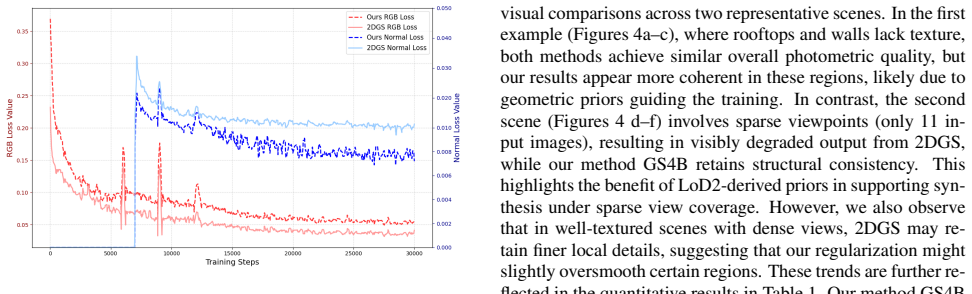
The load-bearing object is the LoD2 building mesh used as a geometric prior. From it, the method derives (i) a visibility-filtered sample cloud that initializes 2D Gaussian splats and (ii) per-view depth maps $D_j$ and normal maps $N_j$ via raycasting. The optimization objective augments standard 2DGS losses with $L_{db}$ (absolute depth difference) and $L_{nb}$ (normal cosine distance), applied only where the raycast mask is valid, with weights scheduled from a prior-dominated first phase to a fine-tuning second phase.
What would settle it
Take a test scene with a precisely surveyed building, deliberately perturb the LoD2-to-camera alignment by 5 to 20 cm, and rerun optimization. If completeness and M3C2 degrade monotonically with perturbation size, the priors are doing the work and alignment is the critical risk; if they survive, some other component is carrying the result. Alternatively, use an outdated LoD2 model that no longer matches the photographed building: if the reconstruction faithfully reproduces the obsolete model instead of the image evidence, the prior is over-driving the data.
Extended reading notes
Core claim
The central claim is that LoD2 building meshes—lightweight, planar, city-wide models—carry enough geometric truth to guide a splat-based reconstruction without SfM. The paper samples Gaussian initial positions directly from the mesh, filters them by multi-view visibility, and renders per-view depth and normal priors by raycasting. Two additional losses, $L_{db}$ and $L_{nb}$, pull rendered depth and normals toward those priors during a two-phase training schedule. On the TUM2TWIN dataset, this lifts average completeness from 0.318 to 0.369 at the 0.5 m threshold and from 0.185 to 0.223 in voxel occupancy, while reducing average M3C2 error from 0.405 to 0.272. The ablation attributes most of
Load-bearing premise
The entire prior guidance assumes the LoD2 mesh can be placed in the camera coordinate system accurately; the paper states this transformation but does not describe how it is computed, so a small misalignment would systematically pull the Gaussians toward incorrect surfaces.
Editorial extensions
If this is right
- Under occlusions and sparse viewpoints, building surfaces that image-only methods leave missing are recovered because the prior supervises invisible regions directly.
- The method stays SfM-free: if camera intrinsics and extrinsics are known, no sparse reconstruction is needed for initialization, removing a common failure point in urban scenes.
- Building-only mode concentrates Gaussians on architecturally relevant areas, cutting primitive count by 71.8% without sacrificing reconstruction quality.
- Novel-view synthesis remains comparable to 2DGS, so the geometric prior is not bought at the cost of rendering fidelity.
- Because LoD2 priors are coarse, fine details such as windows, doors, and eaves are smoothed; the paper identifies adaptive weighting as the natural next step.
Reading between the lines
- The same prior-guided recipe may transfer to other structured priors, such as LoD1 footprints, CAD models, or cadastral maps, which would widen applicability beyond the 215 million LoD2 models the paper cites.
- The method's dependence on camera poses suggests a natural test: fusing LoD2 priors with pose optimization could make the pipeline robust when GPS or inertial metadata is inaccurate.
- One could turn the prior losses into an online alignment objective, treating the LoD2-to-camera transform as learnable, which would remove the registration assumption and allow the mesh to be corrected against imagery.
- The reported M3C2 reduction is a local surface-deviation claim; a per-facade coverage comparison would clarify whether the prior improves full building shells or mainly the observed sides.
Editorial analysis
A structured set of objections, weighed in public.
Referee Report
Summary. The paper presents GS4Buildings, a method that integrates LoD2 semantic building models into 2D Gaussian Splatting (2DGS) for building reconstruction. Instead of SfM-based initialization, Gaussians are initialized from points sampled on the LoD2 mesh and filtered by multi-view visibility. Per-view depth and normal priors are rendered from the same LoD2 geometry by raycasting and are added as losses L_db and L_nb on top of the 2DGS objective. An optional building-only mode restricts training to building pixels. Experiments on nine subsets of the TUM2TWIN dataset compare against Pix4Dmatic MVS and vanilla 2DGS using NVS metrics, Chamfer distance and M3C2 against laser-scanned point clouds, and threshold-based/VOC completeness against LoD3-derived point clouds. The paper reports a 20.5% improvement in completeness and a 32.8% improvement in M3C2 over 2DGS, with comparable NVS quality.
Significance. The core idea—using ubiquitous open CityGML LoD2 models as geometric priors for Gaussian Splatting—is timely and potentially impactful for urban digital twinning and large-scale building reconstruction. The paper has concrete strengths: it uses a public dataset, releases code, avoids SfM initialization, and introduces a practical building-only efficiency mode. If the quantitative claims are validated, the method would be a useful step toward robust urban reconstruction from sparse or occluded imagery. However, the current evaluation does not cleanly separate image-driven reconstruction from conformity to the LoD2 prior, because the completeness reference (LoD3) is structurally coherent with that same prior. The independent laser-scanned accuracy results are also mixed across scenes. Thus the headline claims are not yet fully established.
major comments (4)
- [Sec. 4.1, Table 3, Abstract] The completeness reference is explicitly described as 'structurally coherent with the LoD2 models.' Since the method's initialization and prior losses (Secs. 3.1–3.2, Eqs. 10–11) are derived from the same LoD2 models, the reported 20.5% VOC improvement over 2DGS may largely measure how strongly the optimization is pulled toward the prior, rather than how well the images reconstruct the scene. The independent laser-scan reference in Table 2 shows inconsistent gains (e.g., Scene 1 M3C2: 0.384 vs 0.376; Scene 6: 0.161 vs 0.059), so the average completeness gain is not robust evidence of general reconstruction capability. Please add a control: evaluate completeness against a reference not derived from LoD2/LoD3 (e.g., completeness of laser-scanned surfaces after occlusion completion), restrict completeness evaluation to regions outside the LoD2 prior footprint, or include a baseline that use
- [Sec. 3.2, Eq. (4)] The method assumes that 'we transform the LoD2 mesh M_raw into the global scene coordinate system defined by the camera poses,' but the registration procedure is never described. The raycasted priors D_j and N_j are used in Eqs. (10)–(11) with hard validity masks; any alignment error (rotation or translation) systematically biases these losses and can pull Gaussians toward incorrect surfaces. This is load-bearing because the claimed robustness under sparse views and occlusions relies entirely on the correctness of these priors. Please specify the alignment method (manual control points, ICP, co-registration) and provide a sensitivity analysis showing how reconstruction quality degrades as a function of alignment error.
- [Sec. 3.3, Eqs. (10)–(12), Sec. 4.2] The scale adjustment factor α in Eq. (10) and the time-dependent loss weights in Eq. (12) are never given. The text only says 'all loss weights λ are time-dependent and scheduled,' and Sec. 4.2 refers to a 'two-stage loss scheduling strategy' without reporting the schedule, transition point, decay form, or final values. Without these details, the two-phase training is not reproducible, and the contribution of each loss cannot be independently assessed. Please report the exact schedule and all hyperparameter values in Sec. 4.2 or a supplementary table.
- [Table 2, Sec. 4.4] The headline M3C2 improvement of 32.8% is an average over nine scenes, but in several scenes GS4B is worse than 2DGS (Scene 1: 0.384 vs 0.376; Scene 6: 0.161 vs 0.059), and the aggregate is driven by a few large relative gains with small absolute values. With only nine scenes and no per-scene variance, confidence intervals, or paired significance test, the aggregate claim is not statistically supported. Please provide a paired test or per-scene error bars, and discuss the failure cases explicitly.
minor comments (7)
- [Sec. 4.1] The phrase 'structurally coherent with the LoD2 models' is vague. Please define it precisely (e.g., same footprint, same roof topology, LoD3 as a refinement of LoD2) since it is central to the completeness evaluation.
- [Table 3 / Table 4] Typos in headers: 'V oxel Occupancy Completeness' and 'V oC' should be 'Voxel Occupancy Completeness' and 'VOC'.
- [Eq. (3)] The summation notation appears malformed ('MX' without a lower subscript). Please fix the typesetting.
- [Sec. 3.3] The statement 'all loss weights λ are time-dependent' conflicts with 'all 2DGS hyperparameters kept unchanged' in Sec. 4.2. Clarify which λ are time-varying and which are fixed.
- [Table 4] The 'With SfM Init' row is not a clean ablation of initialization alone unless it is stated whether the depth/normal priors are still active in that configuration. Please clarify.
- [Sec. 3.3 / Sec. 4.3] The terminology is inconsistent: 'building-enhanced mode' and 'building-focused mode' are used interchangeably. Define both terms once and use them consistently.
- [Sec. 3.3] The extracted mesh is described as 'watertight,' but TSDF fusion on partial scenes does not guarantee watertightness. Please qualify this claim.
Circularity Check
Completeness claim is confounded by LoD2-LoD3 coherence; accuracy claim remains independent.
-
renaming known result
[Section 4.1, Dataset and Evaluation Metrics; Table 3]
"The second was LoD3-derived point clouds, which are structurally coherent with the LoD2 models and served as a reference for assessing structural completeness."
The method's optimization is driven by LoD2 priors: Section 3.1 initializes Gaussians by sampling the LoD2 mesh, and Eqs. (10)-(11) add depth and normal losses derived from LoD2 raycasting. Table 3's completeness metrics, including VOC, use LoD3-derived reference point clouds that the paper itself says are 'structurally coherent with the LoD2 models.' A reconstruction that simply projected the LoD2 prior would score highly on this completeness metric regardless of image evidence. The reported 20.5% VOC improvement therefore partially measures LoD2-LoD3 coherence, not an independent image-driven reconstruction result. The paper does not use the independent laser-scanned reference for completeness (it is used only for accuracy in Table 2), so the headline completeness gain is partially force
full rationale
The paper's central accuracy improvement (32.8% M3C2 reduction over 2DGS, Table 2) is measured against laser-scanned point clouds that are independent of the LoD2 prior, so that claim is not circular. The NVS comparison is also independent. The completeness claim, however, is evaluated against LoD3-derived point clouds that the paper itself calls 'structurally coherent with the LoD2 models,' while the method's Gaussian initialization and depth/normal supervision (Eqs. 10-11, Sections 3.1-3.3) are derived from LoD2. A mesh that simply projects the LoD2 prior would score well on this completeness metric without any image-driven reconstruction, so the reported 20.5% VOC improvement partially measures LoD2-LoD3 agreement rather than reconstruction quality. The paper does not use the independent laser-scan reference for completeness, and its limitation section does not control for this coherence. No load-bearing self-citation chain or imported uniqueness theorem is present; the only significant circularity is the confounded completeness benchmark. Score 6 reflects partial circularity: one of the two headline claims is forced by the prior-reference relationship, while the other retains independent empirical content.
Assumptions & free parameters
free parameters (5)
- alpha (scale adjustment factor in depth loss) =
not reported
- loss weights lambda_db, lambda_nb, lambda_d, lambda_n =
not reported
- visibility threshold epsilon =
e.g., 5 cm
- minimum number of observing views k =
not reported
- point sampling density on mesh surface =
not reported
assumptions (4)
- domain assumption LoD2 mesh can be accurately transformed into the camera coordinate frame
- domain assumption Camera poses from Pix4Dmatic are sufficiently accurate to render prior depth and normal maps and to back-project sampled points
- domain assumption LoD3-derived point clouds are an appropriate completeness reference
- standard math Standard 2DGS formulation (Eqs. 5-9) and photometric loss are correct
Cite this review
Pith. "Pith review of GS4Buildings: Prior-Guided Gaussian Splatting for 3D Building Reconstruction." pith.science (2026). https://pith.science/paper/CZFFTSGA
@misc{pith2026250807355,
  author       = {Pith},
  title        = {Pith review of: GS4Buildings: Prior-Guided Gaussian Splatting for 3D Building Reconstruction},
  year         = {2026},
  howpublished = {\url{https://pith.science/paper/CZFFTSGA}},
  note         = {Machine review of arXiv:2508.07355}
}
read the original abstract
Recent advances in Gaussian Splatting (GS) have demonstrated its effectiveness in photo-realistic rendering and 3D reconstruction. Among these, 2D Gaussian Splatting (2DGS) is particularly suitable for surface reconstruction due to its flattened Gaussian representation and integrated normal regularization. However, its performance often degrades in large-scale and complex urban scenes with frequent occlusions, leading to incomplete building reconstructions. We propose GS4Buildings, a novel prior-guided Gaussian Splatting method leveraging the ubiquity of semantic 3D building models for robust and scalable building surface reconstruction. Instead of relying on traditional Structure-from-Motion (SfM) pipelines, GS4Buildings initializes Gaussians directly from low-level Level of Detail (LoD)2 semantic 3D building models. Moreover, we generate prior depth and normal maps from the planar building geometry and incorporate them into the optimization process, providing strong geometric guidance for surface consistency and structural accuracy. We also introduce an optional building-focused mode that limits reconstruction to building regions, achieving a 71.8% reduction in Gaussian primitives and enabling a more efficient and compact representation. Experiments on urban datasets demonstrate that GS4Buildings improves reconstruction completeness by 20.5% and geometric accuracy by 32.8%. These results highlight the potential of semantic building model integration to advance GS-based reconstruction toward real-world urban applications such as smart cities and digital twins. Our project is available: https://github.com/zqlin0521/GS4Buildings.
Figures


Figures from the paper (3 more)


Reference graph
Works this paper leans on
-
[1]
" write newline "" before.all 'output.state := FUNCTION list.label.output make.list.label ", " * write FUNCTION article output.bibitem list.label.output list.year output new.block title output new.block journal emphasize output format.volume.number output pages output new.block url output new.block note output fin.entry FUNCTION book output.bibitem list.l...
-
[2]
Uav laser scanning and photogrammetry of tum downtown campus
Anders, K., Wang, J., Wysocki, O., Huang, X., Liu, S., 2025. Uav laser scanning and photogrammetry of tum downtown campus. Zenodo. https://doi.org/10.5281/zenodo.14899378
-
[3]
Trimesh: A python library for triangular meshes
Dawson-Haggerty, M., 2019. Trimesh: A python library for triangular meshes. https://trimsh.org/ (24 April 2025)
work page 2019
-
[4]
Gaussian Building Mesh (GBM): Extract a Building's 3D Mesh with Google Earth and Gaussian Splatting
Gao, K., Li, L., He, H., Lu, D., Xu, L., Li, J., 2024. Gaussian Building Mesh (GBM): Extract a Building's 3D Mesh with Google Earth and Gaussian Splatting. arXiv preprint arXiv:2501.00625
-
[5]
oger, G., Kolbe, T. H., Nagel, C., H\
Gr\"oger, G., Kolbe, T. H., Nagel, C., H\"afele, K.-H., 2012. OGC City Geography Markup Language CityGML Encoding Standard
work page 2012
-
[6]
An update on automatic 3D building reconstruction
Haala, N., Kada, M., 2010. An update on automatic 3D building reconstruction. ISPRS Journal of Photogrammetry and Remote Sensing , 65(6), 570--580
work page 2010
-
[7]
2d gaussian splatting for geometrically accurate radiance fields
Huang, B., Yu, Z., Chen, A., Geiger, A., Gao, S., 2024. 2d gaussian splatting for geometrically accurate radiance fields. ACM SIGGRAPH 2024 conference papers, 1--11
work page 2024
-
[8]
LOD3 building reconstruction from multi-source images
Huang, H., Michelini, M., Schmitz, M., Roth, L., Mayer, H., 2020. LOD3 building reconstruction from multi-source images. The International Archives of the Photogrammetry, Remote Sensing and Spatial Information Sciences , 43, 427--434
work page 2020
Show all 22 references
-
[9]
3d density-gradient based edge detection on neural radiance fields (nerfs) for geometric reconstruction
J \"a ger, M., Jutzi, B., 2023. 3d density-gradient based edge detection on neural radiance fields (nerfs) for geometric reconstruction. arXiv preprint arXiv:2309.14800
2023 arXiv
-
[10]
3d gaussian splatting for real-time radiance field rendering
Kerbl, B., Kopanas, G., Leimk \"u hler, T., Drettakis, G., 2023. 3d gaussian splatting for real-time radiance field rendering. ACM Trans. Graph. , 42(4), 139--1
2023
-
[11]
Tanks and temples: Benchmarking large-scale scene reconstruction
Knapitsch, A., Park, J., Zhou, Q.-Y., Koltun, V., 2017. Tanks and temples: Benchmarking large-scale scene reconstruction. ACM Transactions on Graphics (ToG) , 36(4), 1--13
2017
-
[12]
Accurate 3D comparison of complex topography with terrestrial laser scanner: Application to the Rangitikei canyon (NZ)
Lague, D., Brodu, N., Leroux, J., 2013. Accurate 3D comparison of complex topography with terrestrial laser scanner: Application to the Rangitikei canyon (NZ). ISPRS journal of photogrammetry and remote sensing , 82, 10--26
2013
-
[13]
Dngaussian: Optimizing sparse-view 3d gaussian radiance fields with global-local depth normalization
Li, J., Zhang, J., Bai, X., Zheng, J., Ning, X., Zhou, J., Gu, L., 2024. Dngaussian: Optimizing sparse-view 3d gaussian radiance fields with global-local depth normalization. Proceedings of the IEEE/CVF conference on computer vision and pattern recognition, 20775--20785
2024
-
[14]
P., Tancik, M., Barron, J
Mildenhall, B., Srinivasan, P. P., Tancik, M., Barron, J. T., Ramamoorthi, R., Ng, R., 2021. Nerf: Representing scenes as neural radiance fields for view synthesis. Communications of the ACM , 65(1), 99--106
2021
-
[15]
Pix4Dmatic Software, Version 1.71.0
Pix4D SA , 2024. Pix4Dmatic Software, Version 1.71.0 . https://www.pix4d.com/product/pix4dmatic (24 April 2025)
2024
-
[16]
L., Frahm, J.-M., 2016
Schonberger, J. L., Frahm, J.-M., 2016. Structure-from-motion revisited. Proceedings of the IEEE conference on computer vision and pattern recognition, 4104--4113
2016
-
[17]
DN-Splatter: Depth and Normal Priors for Gaussian Splatting and Meshing
Turkulainen, M., Ren, X., Melekhov, I., Seiskari, O., Rahtu, E., Kannala, J., 2024. DN-Splatter: Depth and Normal Priors for Gaussian Splatting and Meshing. arXiv preprint arXiv:2403.17822
2024 arXiv
-
[18]
Tum2twin project: High-accuracy digital representations of the tum campus
Wysocki, O., Schwab, B., 2025. Tum2twin project: High-accuracy digital representations of the tum campus. https://tum2t.win/ (24 April 2025)
2025
-
[19]
H., 2024
Wysocki, O., Schwab, B., Beil, C., Holst, C., Kolbe, T. H., 2024. Reviewing Open Data Semantic 3D City Models to Develop Novel 3D Reconstruction Methods. The International Archives of the Photogrammetry, Remote Sensing and Spatial Information Sciences , 48, 493--500
2024
-
[20]
Scan2lod3: Reconstructing semantic 3d building models at lod3 using ray casting and bayesian networks
Wysocki, O., Xia, Y., Wysocki, M., Grilli, E., Hoegner, L., Cremers, D., Stilla, U., 2023. Scan2lod3: Reconstructing semantic 3d building models at lod3 using ray casting and bayesian networks. Proceedings of the IEEE/CVF Conference on Computer Vision and Pattern Recognition, ...
2023
-
[21]
CDGS: Confidence-Aware Depth Regularization for 3D Gaussian Splatting
Zhang, Q., Wysocki, O., Urban, S., Jutzi, B., 2025. CDGS: Confidence-Aware Depth Regularization for 3D Gaussian Splatting. arXiv preprint arXiv:2502.14684
2025 arXiv
-
[22]
Open3D: A modern library for 3D data processing
Zhou, Q.-Y., Park, J., Koltun, V., 2018. Open3D: A modern library for 3D data processing. arXiv preprint arXiv:1801.09847
2018 arXiv
Reviewed August 5, 2026 · model on record in the stance chip above.
Discussion (0). Continue with ORCID to comment.