REVIEW 3 major objections 4 minor 86 references
EgoLoc: A Generalizable Solution for Temporal Interaction Localization in Egocentric Videos
T0 review · 3 major / 4 minor · reviewed 2026-08-15 · deepseek-v4-flash
Pith's one-line read EgoLoc localizes hand-object contact and separation frames in egocentric video with no training, using 3D wrist-speed dips to guide a vision-language model; it reports large gains over prior zero-shot baselines.
desk verdict EgoLoc is a solid systems paper for a genuinely useful new task (temporal interaction localization), and the hand-dynamics-guided sampling works on the tested benchmarks; the real weakness is that the key assumption is only validated in the regime where it is known to hold, so the ‘generalizable’ label overreaches. read the letter →
The pith
A machine-rendered reading of the paper's core claim, the machinery that carries it, and where it could break.
The reading
What carries the argument
The load-bearing machinery is the self-adaptive sampling strategy built on 3D wrist dynamics. An off-the-shelf hand reconstruction model provides wrist keypoints; depth images and camera registration convert them to global 3D positions; per-frame speeds are computed, smoothed, and fit with a cubic spline; local minima of the spline (zero acceleration) become anchor candidates. Candidates are sampled with weight $\omega(V_m)=e^{-\lambda V_m}/\sum_{n=1}^{N_{ac}}e^{-\lambda V_n}$, so slower hands are more likely to be chosen. This turns a long-video search into a small set of localized VLM lookups, and the same anchor neighborhood is then used to build the grid image, identify contact versus separation, and trigger closed-loop refinement. Removing this module drops the five-frame-tolerance success rate from 0.819 to 0.412 on EgoPAT3D-DT, which is the paper's evidence that the dynamics prior, not the VLM alone, carries the result.
What would settle it
Run EgoLoc unchanged on egocentric videos of actions whose contact events lack a wrist-velocity dip, such as quick taps, continuous swipes, or catching a falling object, and compare its predicted timestamps with manual annotations using the paper's five-frame success metric. If most of the zero-acceleration anchor candidates fall outside that tolerance, the hand-dynamics prior that carries the method is falsified for those action classes.
Extended reading notes
Core claim
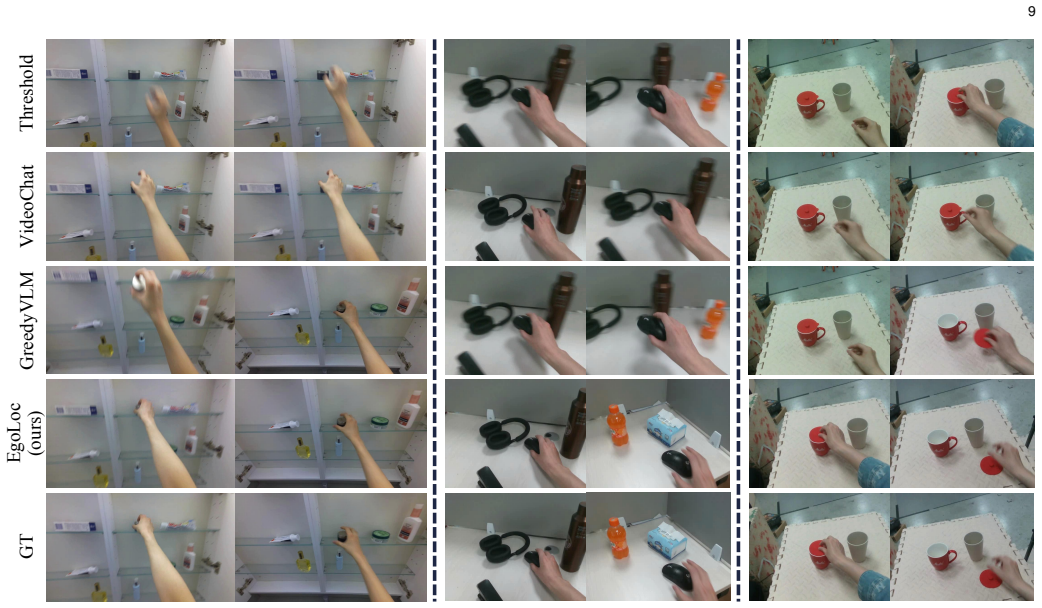
The central claim is that hand-object contact and separation timestamps can be localized accurately in a zero-shot, category-agnostic way by combining 3D hand dynamics with a general-purpose vision-language model. EgoLoc registers 3D wrist positions in a fixed global frame, computes wrist speeds, and uses local minima of the speed spline (zero-acceleration points) as "lighthouses" for interaction transitions. Around each lighthouse it samples an anchor frame with a speed-weighted distribution, tiles neighboring frames into a grid image, and asks the VLM to identify the transition attribute and return the earliest frame index. A checker then verifies the first-round result visually; rejected results become negative in-context examples for a second round. The experiments support that this design generalizes across desk, cabinet, drawer, and pouring scenes with multiple interactions per video, and that the gains are driven by the 3D sampling and the feedback loop rather than by brute-force context.
Load-bearing premise
The load-bearing premise is that the hand's wrist speed has a local minimum, with acceleration near zero, at the moments it touches and releases an object; if a motion reaches the object without such a speed dip, the sampled anchor frames can mislead the vision-language model and the pipeline has nothing to correct.
Editorial extensions
If this is right
- Temporal interaction localization can be solved zero-shot: no object masks, no verb-noun taxonomies, and no per-dataset training are needed, so the same prompts and pipeline transfer to new scenes with only RGB-D video.
- The 3D dynamics prior is the main accuracy lever: removing self-adaptive sampling drops success at five-frame tolerance on EgoPAT3D-DT from 0.819 to 0.412, and using 2D rather than 3D wrist dynamics yields 0.726.
- Smaller visual prompts are better: with two adjacent frames EgoLoc beats all baselines and its own three- and four-frame variants, which the paper attributes to the VLM's attention being diluted by more visually similar frames.
- Closed-loop feedback reduces both error and variance: on DeskTIL it raises five-frame success to 1.000 and lowers mean absolute error from 1.485 to 0.611 frames, and EgoLoc has the lowest run-to-run standard deviation among the VLM-based methods.
- The localized timestamps transfer to downstream use: in the paper's deployments they set gripper open/close moments for robot pick-and-place (8/10 simulated, 10/10 real-world), provide VR contact-countdown hints, and improve egocentric action recognition accuracy.
Reading between the lines
- The method's scope is effectively grasp-and-release manipulation: continuous-contact actions such as stirring, wiping, or dragging keep wrist speed low throughout and may not produce a fresh local minimum at the transition, so a natural stress test is to measure anchor recall on such motions.
- Because EgoLoc needs no masks or category names, it could be run as a bulk annotator on unlabeled human demonstration video to generate gripper open/close labels for imitation learning; the paper's robotic experiments show the label quality but do not discuss scale-up costs or failure modes.
- A direct extension of the closed-loop idea is to accumulate multiple rejected first-round frames across trials and use them as a growing set of negative in-context examples, which would turn the VLM checker from a binary gate into a ranking signal for candidate timestamps.
Signed reviews
Editorial analysis
A structured set of objections, weighed in public.
Referee Report
Summary. The paper proposes EgoLoc, a zero-shot method for temporal interaction localization (TIL) in egocentric videos, defined as localizing the contact and separation timestamps between a hand and an object. The method first extracts 3D wrist positions via HaMeR and depth-based point cloud registration, then computes wrist velocities and accelerations. A self-adaptive sampling strategy (Sec. 3.3) uses local minima of the wrist-velocity spline as anchor candidates for possible interaction transitions, samples an anchor frame with weights inversely proportional to velocity (Eq. 1), and constructs a grid image of neighboring frames. A VLM-based module (Sec. 3.4) first classifies the interaction attribute (contact/separation/neither) using boundary-frame hand crops, then localizes the transition timestamp within the grid. A closed-loop feedback mechanism (Sec. 3.5) checks the first-round result and, if rejected, performs a second-round localization with the rejected frame as a negative in-context example. The paper introduces two benchmarks, DeskTIL and ManiTIL, and evaluates against T-PIVOT, VideoChat, GreedyVLM, Threshold, and HOIMask on EgoPAT3D-DT, DeskTIL, and ManiTIL. It also reports downstream applications in robotic manipulation, VR overlay hints, and egocentric action recognition.
Significance. If the results hold, EgoLoc is a meaningful step: it formulates a new task (TIL), avoids object masks and verb-noun taxonomies, and demonstrates consistent improvements over the evaluated baselines on three datasets, with ablations showing that both the self-adaptive sampling and the closed-loop feedback contribute to performance. The release of code and benchmarks is a positive contribution that could facilitate future work. The downstream robotic and VR experiments, while preliminary, illustrate practical value. However, the central claim of a 'generalizable solution' is currently supported only within a restricted distribution: the method explicitly excludes bimanual interactions and rapid non-impulsive actions (Sec. 3.1), and the sampling prior that wrist-velocity local minima coincide with contact/separation is not validated on events where the prior fails. The main comparison tables lack error bars, so the statistical strength of the reported margins is not established. These issues are addressable but require additional analysis or a careful narrowing of the scope claim.
major comments (3)
- [Sec. 3.3.1, Eq. (1), and Table 1] The core sampling assumption that hand-object contact and separation coincide with local minima of the 3D wrist-velocity spline (zero acceleration) is load-bearing for the reported gains, but the paper does not provide per-event evidence that this prior holds. The supplementary statistics (Supp. A) show a high proportion of zero-velocity frames in DeskTIL and ManiTIL, which is a favorable regime for the prior, and Sec. 3.1 explicitly excludes rapid non-impulsive actions and bimanual interactions. The fallback to uniform sampling for strictly monotonic velocities (Sec. 3.3.2) is not separately evaluated. I therefore ask for an analysis of how often the anchor candidates lie near the ground-truth transition timestamps (e.g., recall within a few frames), or an experiment on a subset of events that violate the velocity-dip assumption, or an explicit statement that the method is only claimed for motions with a clear pre-contact deceleration. Without this, the 'generalizable solution' claim is conditional on an untested distribution.
- [Table 1 and Tables 3–6] The main evaluation reports only averaged metrics over five trials, without standard deviations or significance tests. Given that GPT-4o is stochastic and that Table 5 itself shows nontrivial trial-to-trial variation (e.g., SR standard deviation of 0.041 for EgoLoc without feedback), the superiority over the best baseline in Table 1 (e.g., SR 0.819 vs. 0.755 for T-PIVOT Nadj=4 on EgoPAT3D-DT) may not be statistically robust. The authors should report standard deviations or confidence intervals for the main results on all datasets, or at least for the highest-performing configuration, and ideally perform a matched-pair test across videos.
- [Sec. 4.1.1 and Table 1] The baseline adaptations may disadvantage the comparison. T-PIVOT is not evaluated on ManiTIL because it is 'not trivial to adapt' to multiple HOI stages, and VideoChat is described as lacking TIL-specific optimization. While EgoLoc's ablations isolate the sampling and feedback contributions, the headline claim of outperforming T-PIVOT and VideoChat is clouded by unequal tuning. I recommend either providing an equally prompt-optimized T-PIVOT variant for ManiTIL, or explicitly framing the baseline comparison as 'method with available zero-shot adaptation' rather than as a claim of superiority over the best possible version of each baseline.
minor comments (4)
- [Figures and captions] Figure captions and figure images contain Chinese annotations and editing instructions (e.g., '图片示例用的是 20 40 75', 'desktil 右侧所有图亮度', '加一个亮度 一个对比度'). These must be removed or replaced with English labels before publication.
- [Sec. 3.4 and 4.1.3] The hyperparameters λ, Nac, ϵw, ϵh, and Nadj are fixed without sensitivity analysis. Nadj is varied in Table 1, but λ controls the whole weighted sampling in Eq. (1) and deserves at least a short ablation or a discussion of its robustness.
- [Sec. 3.5] The sentence 'Its holistic inference process can also be automatically performed without pertaining with manual annotations' appears to contain a typo; likely 'without pretraining' or 'without pertaining to' was intended.
- [References] The paper cites its own prior IROS version [31] and several arXiv preprints; for a journal submission, the authors should update citations to peer-reviewed versions where available, especially for T-PIVOT [25] and MMTwin [81] if they have been published by the time of final submission.
Circularity Check
No significant circularity: the sampling prior is an external assumption, and final timestamps come from VLM localization against manual annotations.
full rationale
EgoLoc's derivation chain is self-contained: 3D wrist positions are extracted from RGB-D via HaMeR and camera poses; velocities are computed and fit with a cubic spline; local minima with zero acceleration define anchor candidates; Eq. (1) only reweights those candidates; the VLM discriminator, localizer, and checker produce the final timestamps from grid images and text prompts. The target timestamps are not defined as the anchor candidates or as the weighted-sample outputs; they are manually annotated ground-truth contact/separation instants compared through SR, MAE, MoF, and IoU. The velocity-minimum prior is an external empirical assumption supported by citations [69,70], not a conclusion derived from the data being predicted. The ablation in Table 2 shows that removing the self-adaptive sampling strategy degrades SR from 0.819 to 0.412, which indicates the sampling is a genuine input to the pipeline rather than a fitted output. The closed-loop feedback uses a VLM checker to decide acceptance and uses a rejected first-round frame as a negative in-context example; this is a refinement mechanism, not a circular re-use of the final answer as its own justification. Self-citations to the IROS predecessor [31] and to MMTwin [81] are extension/downstream references and are not load-bearing evidence for EgoLoc's core localization claim. The paper does explicitly limit its scope to non-rapid actions and one visible hand (Sec. 3.1), and Supp. A notes a high proportion of zero-velocity frames in the proposed benchmarks; these are distributional scope and robustness concerns about how well the velocity prior generalizes, not circularity. No equation, fitted parameter, or self-citation reduces a predicted quantity to an input by construction, so the circularity score is 0.
Assumptions & free parameters
free parameters (4)
- lambda =
not specified
- Nac =
5
- epsilon_w and epsilon_h =
10
- Nadj =
2, 3, 4
assumptions (5)
- domain assumption Local minima of 3D hand wrist velocity (zero acceleration) coincide with hand-object contact and separation.
- domain assumption Only one hand is visible in the video.
- domain assumption Rapid non-impulsive actions and severe motion blur are not present.
- domain assumption The VLM (GPT-4o) can reliably reason about contact/separation from boundary frames, grid images, and single frames.
- domain assumption HaMeR and the depth-based registration provide accurate 3D wrist positions.
Cite this review
Pith. "Pith review of EgoLoc: A Generalizable Solution for Temporal Interaction Localization in Egocentric Videos." pith.science (2026). https://pith.science/paper/G7XAWWJ6
@misc{pith2026250812349,
  author       = {Pith},
  title        = {Pith review of: EgoLoc: A Generalizable Solution for Temporal Interaction Localization in Egocentric Videos},
  year         = {2026},
  howpublished = {\url{https://pith.science/paper/G7XAWWJ6}},
  note         = {Machine review of arXiv:2508.12349}
}
read the original abstract
Analyzing hand-object interaction in egocentric vision facilitates VR/AR applications and human-robot policy transfer. Existing research has mostly focused on modeling the behavior paradigm of interactive actions (i.e., ``how to interact''). However, the more challenging and fine-grained problem of capturing the critical moments of contact and separation between the hand and the target object (i.e., ``when to interact'') is still underexplored, which is crucial for immersive interactive experiences in mixed reality and robotic motion planning. Therefore, we formulate this problem as temporal interaction localization (TIL). Some recent works extract semantic masks as TIL references, but suffer from inaccurate object grounding and cluttered scenarios. Although current temporal action localization (TAL) methods perform well in detecting verb-noun action segments, they rely on category annotations during training and exhibit limited precision in localizing hand-object contact/separation moments. To address these issues, we propose a novel zero-shot approach dubbed EgoLoc to localize hand-object contact and separation timestamps in egocentric videos. EgoLoc introduces hand-dynamics-guided sampling to generate high-quality visual prompts. It exploits the vision-language model to identify contact/separation attributes, localize specific timestamps, and provide closed-loop feedback for further refinement. EgoLoc eliminates the need for object masks and verb-noun taxonomies, leading to generalizable zero-shot implementation. Comprehensive experiments on the public dataset and our novel benchmarks demonstrate that EgoLoc achieves plausible TIL for egocentric videos. It is also validated to effectively facilitate multiple downstream applications in egocentric vision and robotic manipulation tasks. Code and relevant data will be released at https://github.com/IRMVLab/EgoLoc.
Figures


Figures from the paper (10 more)




Reference graph
Works this paper leans on
-
[31]
Zero- shot temporal interaction localization for egocentric videos,
E. Zhang, J. Ma, Y.-D. Zheng, Y. Zhou, and H. Wang, “Zero- shot temporal interaction localization for egocentric videos,” in IEEE/RSJ International Conference on Intelligent Robots and Systems (IROS), 2025
work page 2025
-
[1]
The evolution of first person vision methods: A survey,
A. Betancourt, P . Morerio, C. S. Regazzoni, and M. Rauterberg, “The evolution of first person vision methods: A survey,” IEEE TCSVT, vol. 25, no. 5, pp. 744–760, 2015
2015
-
[2]
An outlook into the future of egocentric vision,
C. Plizzari, G. Goletto, A. Furnari, S. Bansal, F. Ragusa, G. M. Farinella, D. Damen, and T. Tommasi, “An outlook into the future of egocentric vision,” IJCV, pp. 1–57, 2024
2024
-
[3]
Analysis of the hands in egocentric vision: A survey,
A. Bandini and J. Zariffa, “Analysis of the hands in egocentric vision: A survey,” IEEE transactions on pattern analysis and machine intelligence, vol. 45, no. 6, pp. 6846–6866, 2020
2020
-
[4]
Bigs: Bimanual category-agnostic interaction reconstruction from monocular videos via 3d gaussian splatting,
J. On, K. Gwak, G. Kang, J. Cha, S. Hwang, H. Hwang, and S. Baek, “Bigs: Bimanual category-agnostic interaction reconstruction from monocular videos via 3d gaussian splatting,” in CVPR, 2025
2025
-
[5]
Y. Liu, X. Long, Z. Yang, Y. Liu, M. Habermann, C. Theobalt, Y. Ma, and W. Wang, “Easyhoi: Unleashing the power of large models for reconstructing hand-object interactions in the wild,” arXiv preprint arXiv:2411.14280, 2024
arXiv 2024
-
[6]
Diffusion-guided reconstruction of everyday hand-object interaction clips,
Y. Ye, P . Hebbar, A. Gupta, and S. Tulsiani, “Diffusion-guided reconstruction of everyday hand-object interaction clips,” inICCV, pp. 19717–19728, October 2023
2023
-
[7]
Hoid- iffusion: Generating realistic 3d hand-object interaction data,
M. Zhang, Y. Fu, Z. Ding, S. Liu, Z. Tu, and X. Wang, “Hoid- iffusion: Generating realistic 3d hand-object interaction data,” in CVPR, pp. 8521–8531, 2024
2024
Show all 86 references
-
[8]
Gears: Local geometry-aware hand-object interaction synthesis,
K. Zhou, B. L. Bhatnagar, J. E. Lenssen, and G. Pons-Moll, “Gears: Local geometry-aware hand-object interaction synthesis,” in Pro- ceedings of the IEEE/CVF Conference on Computer Vision and Pattern Recognition, pp. 20634–20643, 2024
2024
-
[9]
Reconstructing hands in 3d with transformers,
G. Pavlakos, D. Shan, I. Radosavovic, A. Kanazawa, D. Fouhey, and J. Malik, “Reconstructing hands in 3d with transformers,” in CVPR, pp. 9826–9836, 2024
2024
-
[10]
Consistent 3d hand reconstruction in video via self-supervised learning,
Z. Tu, Z. Huang, Y. Chen, D. Kang, L. Bao, B. Yang, and J. Yuan, “Consistent 3d hand reconstruction in video via self-supervised learning,” IEEE Transactions on Pattern Analysis and Machine Intelli- gence, vol. 45, no. 8, pp. 9469–9485, 2023
2023
-
[11]
Pyramid deep fusion network for two-hand reconstruction from rgb-d images,
J. Ren and J. Zhu, “Pyramid deep fusion network for two-hand reconstruction from rgb-d images,” IEEE TCSVT, 2024
2024
-
[12]
Hhmr: Holistic hand mesh recovery by enhancing the multimodal con- trollability of graph diffusion models,
M. Li, H. Zhang, Y. Zhang, R. Shao, T. Yu, and Y. Liu, “Hhmr: Holistic hand mesh recovery by enhancing the multimodal con- trollability of graph diffusion models,” in CVPR, pp. 645–654, 2024
2024
-
[13]
Recovering 3d human mesh from monocular images: A survey,
Y. Tian, H. Zhang, Y. Liu, and L. Wang, “Recovering 3d human mesh from monocular images: A survey,” TP AMI, vol. 45, no. 12, pp. 15406–15425, 2023
2023
-
[14]
Fine-grained egocentric hand-object segmentation: Dataset, model, and applications,
L. Zhang, S. Zhou, S. Stent, and J. Shi, “Fine-grained egocentric hand-object segmentation: Dataset, model, and applications,” in ECCV, pp. 127–145, 2022
2022
-
[15]
Egocentric prediction of action target in 3d,
Y. Li, Z. Cao, A. Liang, B. Liang, L. Chen, H. Zhao, and C. Feng, “Egocentric prediction of action target in 3d,” in CVPR, 2022
2022
-
[16]
Precision-enhanced human-object contact detection via depth-aware perspective interaction and object tex- ture restoration,
Y. Wang, W. Neng, Z. Wei, Y. Lei, W. Xue, N. Zhuang, Y. Xu, X. Jiang, and Q. Liu, “Precision-enhanced human-object contact detection via depth-aware perspective interaction and object tex- ture restoration,” in Proceedings of the AAAI Conference on Artificial Intelligence, 2025
2025
-
[17]
Interaction region visual transformer for egocentric action anticipation,
D. Roy, R. Rajendiran, and B. Fernando, “Interaction region visual transformer for egocentric action anticipation,” in Proceedings of the IEEE/CVF Winter Conference on Applications of Computer Vision , pp. 6740–6750, 2024
2024
-
[18]
Under- standing atomic hand-object interaction with human intention,
H. Fan, T. Zhuo, X. Yu, Y. Yang, and M. Kankanhalli, “Under- standing atomic hand-object interaction with human intention,” IEEE TCSVT, vol. 32, no. 1, pp. 275–285, 2021
2021
-
[19]
Graph convolutional module for temporal action lo- calization in videos,
R. Zeng, W. Huang, M. Tan, Y. Rong, P . Zhao, J. Huang, and C. Gan, “Graph convolutional module for temporal action lo- calization in videos,” IEEE Transactions on Pattern Analysis and Machine Intelligence, vol. 44, no. 10, pp. 6209–6223, 2021
2021
-
[20]
Vectorized evidential learning for weakly-supervised temporal action localization,
J. Gao, M. Chen, and C. Xu, “Vectorized evidential learning for weakly-supervised temporal action localization,” IEEE TP AMI, vol. 45, no. 12, pp. 15949–15963, 2023
2023
-
[21]
Opental: Towards open set temporal action localization,
W. Bao, Q. Yu, and Y. Kong, “Opental: Towards open set temporal action localization,” in CVPR, pp. 2979–2989, 2022
2022
-
[22]
Detal: Open-vocabulary temporal action localization with decoupled networks,
Z. Li, Y. Zhong, R. Song, T. Li, L. Ma, and W. Zhang, “Detal: Open-vocabulary temporal action localization with decoupled networks,” IEEE TP AMI, pp. 1–14, 2024
2024
-
[23]
Transferable unintentional action localization with language-guided intention translation,
J. Xu, Y. Rao, J. Zhou, and J. Lu, “Transferable unintentional action localization with language-guided intention translation,” IEEE Transactions on Pattern Analysis and Machine Intelligence, 2025
2025
-
[24]
Ual- bench: The first comprehensive unusual activity localization benchmark,
H. M. Abdullah, T. Liu, K. Wei, S. Kong, and R. Huang, “Ual- bench: The first comprehensive unusual activity localization benchmark,” in 2025 IEEE/CVF Winter Conference on Applications of Computer Vision (WACV), pp. 5801–5811, IEEE, 2025
2025
-
[25]
Open-vocabulary action localization with iterative visual prompting,
N. Wake, A. Kanehira, K. Sasabuchi, J. Takamatsu, and K. Ikeuchi, “Open-vocabulary action localization with iterative visual prompting,” arXiv preprint arXiv:2408.17422, 2024
2024 arXiv
-
[26]
Open-vocabulary temporal action localization using mul- timodal guidance,
A. Gupta, A. Arora, S. Narayan, S. Khan, F. S. Khan, and G. W. Taylor, “Open-vocabulary temporal action localization using mul- timodal guidance,” arXiv preprint arXiv:2406.15556, 2024
2024 arXiv
-
[27]
Motion tracks: A unified representation for human-robot transfer in few-shot imitation learning,
J. Ren, P . Sundaresan, D. Sadigh, S. Choudhury, and J. Bohg, “Motion tracks: A unified representation for human-robot transfer in few-shot imitation learning,” arXiv preprint arXiv:2501.06994 , 2025
2025
-
[28]
Vlmimic: Vision language models are visual imitation learner for fine-grained actions,
G. Chen, M. Wang, T. Cui, Y. Mu, H. Lu, T. Zhou, Z. Peng, M. Hu, H. Li, L. Yuan, et al. , “Vlmimic: Vision language models are visual imitation learner for fine-grained actions,” Advances in Neural Information Processing Systems , vol. 37, pp. 77860–77887, 2024
2024
-
[29]
Vlm see, robot do: Human demo video to robot action plan via vision language model,
B. Wang, J. Zhang, S. Dong, I. Fang, and C. Feng, “Vlm see, robot do: Human demo video to robot action plan via vision language model,” arXiv preprint arXiv:2410.08792, 2024
2024
-
[30]
Grounded sam: Assembling open-world models for diverse visual tasks,
T. Ren, S. Liu, A. Zeng, J. Lin, K. Li, H. Cao, J. Chen, X. Huang, Y. Chen, F. Yan, Z. Zeng, H. Zhang, F. Li, J. Yang, H. Li, Q. Jiang, and L. Zhang, “Grounded sam: Assembling open-world models for diverse visual tasks,” arXiv preprint arXiv:2401.14159, 2024
2024 arXiv
-
[32]
Graph convolutional networks for temporal action lo- calization,
R. Zeng, W. Huang, M. Tan, Y. Rong, P . Zhao, J. Huang, and C. Gan, “Graph convolutional networks for temporal action lo- calization,” in Proceedings of the IEEE/CVF international conference on computer vision, pp. 7094–7103, 2019
2019
-
[33]
Zeetad: Adapting pretrained vision-language model for zero-shot end-to- end temporal action detection,
T. Phan, K. Vo, D. Le, G. Doretto, D. Adjeroh, and N. Le, “Zeetad: Adapting pretrained vision-language model for zero-shot end-to- end temporal action detection,” in WACV, pp. 7046–7055, 2024
2024
-
[34]
Unloc: A unified framework for video localiza- tion tasks,
S. Yan, X. Xiong, A. Nagrani, A. Arnab, Z. Wang, W. Ge, D. Ross, and C. Schmid, “Unloc: A unified framework for video localiza- tion tasks,” in ICCV, pp. 13623–13633, 2023
2023
-
[35]
Deep learning-based action detection in untrimmed videos: A survey,
E. Vahdani and Y. Tian, “Deep learning-based action detection in untrimmed videos: A survey,” IEEE Transactions on Pattern Analysis and Machine Intelligence, vol. 45, no. 4, pp. 4302–4320, 2022
2022
-
[36]
Dynamic sampling networks for efficient action recognition in videos,
Y.-D. Zheng, Z. Liu, T. Lu, and L. Wang, “Dynamic sampling networks for efficient action recognition in videos,” IEEE TIP , 2020
2020
-
[37]
Evidential deep learning for open set action recognition,
W. Bao, Q. Yu, and Y. Kong, “Evidential deep learning for open set action recognition,” in ICCV, pp. 13349–13358, 2021
2021
-
[38]
Egocentric action recognition by capturing hand-object contact and object state,
T. Shiota, M. Takagi, K. Kumagai, H. Seshimo, and Y. Aono, “Egocentric action recognition by capturing hand-object contact and object state,” in WACV, pp. 6541–6551, 2024
2024
-
[39]
Infogcn++: Learning representation by predicting the future for online skeleton-based action recognition,
S. Chi, H.-g. Chi, Q. Huang, and K. Ramani, “Infogcn++: Learning representation by predicting the future for online skeleton-based action recognition,” IEEE Transactions on Pattern Analysis and Ma- chine Intelligence, 2024
2024
-
[40]
Referring atomic video action recognition,
K. Peng, J. Fu, K. Yang, D. Wen, Y. Chen, R. Liu, J. Zheng, J. Zhang, M. S. Sarfraz, R. Stiefelhagen, et al., “Referring atomic video action recognition,” in ECCV, pp. 166–185, 2024
2024
-
[41]
Temporal action localization in the deep learning era: A survey,
B. Wang, Y. Zhao, L. Yang, T. Long, and X. Li, “Temporal action localization in the deep learning era: A survey,” IEEE Transactions on Pattern Analysis and Machine Intelligence, vol. 46, no. 4, pp. 2171– 2190, 2023. 16
2023
-
[42]
Prompting visual- language models for efficient video understanding,
C. Ju, T. Han, K. Zheng, Y. Zhang, and W. Xie, “Prompting visual- language models for efficient video understanding,” in ECCV, 2022
2022
-
[43]
Learning transfer- able visual models from natural language supervision,
A. Radford, J. W. Kim, C. Hallacy, A. Ramesh, G. Goh, S. Agarwal, G. Sastry, A. Askell, P . Mishkin, J. Clark,et al., “Learning transfer- able visual models from natural language supervision,” in ICML, 2021
2021
-
[44]
Zero-shot temporal action detection via vision-language prompting,
S. Nag, X. Zhu, Y.-Z. Song, and T. Xiang, “Zero-shot temporal action detection via vision-language prompting,” in ECCV, 2022
2022
-
[45]
Zero-shot temporal action detection by learning multimodal prompts and text-enhanced actionness,
A. Raza, B. Yang, and Y. Zou, “Zero-shot temporal action detection by learning multimodal prompts and text-enhanced actionness,” IEEE TCSVT, 2024
2024
-
[46]
Test-time zero-shot temporal action localization,
B. Liberatori, A. Conti, P . Rota, Y. Wang, and E. Ricci, “Test-time zero-shot temporal action localization,” in CVPR, 2024
2024
-
[47]
Multi-modal prompting for low-shot temporal action localization,
C. Ju, Z. Li, P . Zhao, Y. Zhang, X. Zhang, Q. Tian, Y. Wang, and W. Xie, “Multi-modal prompting for low-shot temporal action localization,” arXiv preprint arXiv:2303.11732, 2023
2023 arXiv
-
[48]
Mvbench: A comprehensive multi-modal video understanding benchmark,
K. Li, Y. Wang, Y. He, Y. Li, Y. Wang, Y. Liu, Z. Wang, J. Xu, G. Chen, P . Luo, et al., “Mvbench: A comprehensive multi-modal video understanding benchmark,” in Proceedings of the IEEE/CVF Conference on Computer Vision and Pattern Recognition , pp. 22195– 22206, 2024
2024
-
[49]
Zero-shot video moment retrieval from frozen vision-language models,
D. Luo, J. Huang, S. Gong, H. Jin, and Y. Liu, “Zero-shot video moment retrieval from frozen vision-language models,” inProceed- ings of the IEEE/CVF Winter Conference on Applications of Computer Vision, pp. 5464–5473, 2024
2024
-
[50]
Gpt-4 technical report,
J. Achiam, S. Adler, S. Agarwal, L. Ahmad, I. Akkaya, F. L. Aleman, D. Almeida, J. Altenschmidt, S. Altman, S. Anadkat,et al., “Gpt-4 technical report,” arXiv preprint arXiv:2303.08774, 2023
2023 arXiv
-
[51]
Pivot: Iterative visual prompting elicits actionable knowledge for vlms,
S. Nasiriany, F. Xia, W. Yu, T. Xiao, J. Liang, I. Dasgupta, A. Xie, D. Driess, A. Wahid, Z. Xu, et al., “Pivot: Iterative visual prompting elicits actionable knowledge for vlms,” arXiv preprint arXiv:2402.07872, 2024
2024 arXiv
-
[52]
Forecasting hands and objects in future frames,
C. Fan, J. Lee, and M. S. Ryoo, “Forecasting hands and objects in future frames,” in Proceedings of the European Conference on Computer Vision (ECCV) Workshops, pp. 0–0, 2018
2018
-
[53]
Scaling egocentric vision: The epic-kitchens dataset,
D. Damen, H. Doughty, G. M. Farinella, S. Fidler, A. Furnari, E. Kazakos, D. Moltisanti, J. Munro, T. Perrett, W. Price, et al. , “Scaling egocentric vision: The epic-kitchens dataset,” in Proceed- ings of the European Conference on Computer Vision (ECCV), pp. 720– 736, 2018
2018
-
[54]
Understanding human hands in contact at internet scale,
D. Shan, J. Geng, M. Shu, and D. F. Fouhey, “Understanding human hands in contact at internet scale,” in CVPR, pp. 9869– 9878, 2020
2020
-
[55]
Joint hand-object 3d reconstruction from a single image with cross-branch feature fusion,
Y. Chen, Z. Tu, D. Kang, R. Chen, L. Bao, Z. Zhang, and J. Yuan, “Joint hand-object 3d reconstruction from a single image with cross-branch feature fusion,” IEEE Transactions on Image Processing, vol. 30, pp. 4008–4021, 2021
2021
-
[56]
Interacting hand-object pose esti- mation via dense mutual attention,
R. Wang, W. Mao, and H. Li, “Interacting hand-object pose esti- mation via dense mutual attention,” in Proceedings of the IEEE/CVF winter conference on applications of computer vision , pp. 5735–5745, 2023
2023
-
[57]
Affordance diffusion: Synthesizing hand-object interactions,
Y. Ye, X. Li, A. Gupta, S. De Mello, S. Birchfield, J. Song, S. Tul- siani, and S. Liu, “Affordance diffusion: Synthesizing hand-object interactions,” in CVPR, pp. 22479–22489, 2023
2023
-
[58]
Hoi-swap: Swapping objects in videos with hand-object interaction awareness,
Z. S. Xue, R. Luo, C. Chen, and K. Grauman, “Hoi-swap: Swapping objects in videos with hand-object interaction awareness,” Ad- vances in Neural Information Processing Systems , vol. 37, pp. 77132– 77164, 2024
2024
-
[59]
3d hand pose estimation in everyday egocentric images,
A. Prakash, R. Tu, M. Chang, and S. Gupta, “3d hand pose estimation in everyday egocentric images,” in European Conference on Computer Vision, pp. 183–202, Springer, 2024
2024
-
[60]
Uncertainty-aware state space transformer for egocentric 3d hand trajectory forecasting,
W. Bao, L. Chen, L. Zeng, Z. Li, Y. Xu, J. Yuan, and Y. Kong, “Uncertainty-aware state space transformer for egocentric 3d hand trajectory forecasting,” in ICCV, pp. 13702–13711, 2023
2023
-
[61]
Diff-ip2d: Diffusion-based hand-object interaction prediction on egocentric videos,
J. Ma, J. Xu, X. Chen, and H. Wang, “Diff-ip2d: Diffusion-based hand-object interaction prediction on egocentric videos,” arXiv preprint arXiv:2405.04370, 2024
2024
-
[62]
Madiff: Motion- aware mamba diffusion models for hand trajectory prediction on egocentric videos,
J. Ma, X. Chen, W. Bao, J. Xu, and H. Wang, “Madiff: Motion- aware mamba diffusion models for hand trajectory prediction on egocentric videos,” arXiv preprint arXiv:2409.02638, 2024
2024
-
[63]
Can’t make an omelette without breaking some eggs: Plausible action anticipa- tion using large video-language models,
H. Mittal, N. Agarwal, S.-Y. Lo, and K. Lee, “Can’t make an omelette without breaking some eggs: Plausible action anticipa- tion using large video-language models,” in CVPR, pp. 18580– 18590, 2024
2024
-
[64]
Blip-2: Bootstrapping language-image pre-training with frozen image encoders and large language models,
J. Li, D. Li, S. Savarese, and S. Hoi, “Blip-2: Bootstrapping language-image pre-training with frozen image encoders and large language models,” in ICML, pp. 19730–19742, 2023
2023
-
[65]
Strategies to leverage foundational model knowledge in object affordance grounding,
A. Rai, K. Buettner, and A. Kovashka, “Strategies to leverage foundational model knowledge in object affordance grounding,” in CVPR, pp. 1714–1723, 2024
2024
-
[66]
Egothink: Evaluating first-person perspective thinking capability of vision-language models,
S. Cheng, Z. Guo, J. Wu, K. Fang, P . Li, H. Liu, and Y. Liu, “Egothink: Evaluating first-person perspective thinking capability of vision-language models,” in CVPR, pp. 14291–14302, 2024
2024
-
[67]
Egovlm: Policy optimization for egocentric video understanding,
A. Vinod, S. Pandit, A. Vavre, and L. Liu, “Egovlm: Policy optimization for egocentric video understanding,” arXiv preprint arXiv:2506.03097, 2025
2025 arXiv
-
[68]
Smoothing and differentiation of data by simplified least squares procedures.,
A. Savitzky and M. J. Golay, “Smoothing and differentiation of data by simplified least squares procedures.,” Analytical chemistry, vol. 36, no. 8, pp. 1627–1639, 1964
1964
-
[69]
Choice of contact points during multidigit grasping: effect of predictability of object center of mass location,
J. Lukos, C. Ansuini, and M. Santello, “Choice of contact points during multidigit grasping: effect of predictability of object center of mass location,” Journal of Neuroscience, vol. 27, no. 14, pp. 3894– 3903, 2007
2007
-
[70]
Research on speed and acceleration of hand movements as command signals for anthropomorphic manipulators as a master-slave system,
K. Cie ´slik and M. J. Łopatka, “Research on speed and acceleration of hand movements as command signals for anthropomorphic manipulators as a master-slave system,” Applied Sciences, vol. 12, no. 8, p. 3863, 2022
2022
-
[71]
Chain-of-thought prompting elicits reasoning in large language models,
J. Wei, X. Wang, D. Schuurmans, M. Bosma, F. Xia, E. Chi, Q. V . Le, D. Zhou, et al., “Chain-of-thought prompting elicits reasoning in large language models,” Advances in neural information processing systems, vol. 35, pp. 24824–24837, 2022
2022
-
[72]
Grounding dino: Marrying dino with grounded pre-training for open-set object detection,
S. Liu, Z. Zeng, T. Ren, F. Li, H. Zhang, J. Yang, C. Li, J. Yang, H. Su, J. Zhu, et al. , “Grounding dino: Marrying dino with grounded pre-training for open-set object detection,” arXiv preprint arXiv:2303.05499, 2023
2023 arXiv
-
[73]
Lan- guage models are few-shot learners,
T. Brown, B. Mann, N. Ryder, M. Subbiah, J. D. Kaplan, P . Dhari- wal, A. Neelakantan, P . Shyam, G. Sastry, A. Askell, et al., “Lan- guage models are few-shot learners,” Advances in neural informa- tion processing systems, vol. 33, pp. 1877–1901, 2020
1901
-
[74]
Videochat: Chat-centric video understanding,
K. Li, Y. He, Y. Wang, Y. Li, W. Wang, P . Luo, Y. Wang, L. Wang, and Y. Qiao, “Videochat: Chat-centric video understanding,”arXiv preprint arXiv:2305.06355, 2023
2023 arXiv
-
[75]
Point policy: Unifying observations and actions with key points for robot manipulation,
S. Haldar and L. Pinto, “Point policy: Unifying observations and actions with key points for robot manipulation,” arXiv preprint arXiv:2502.20391, 2025
2025 arXiv
-
[76]
Egozero: Robot learning from smart glasses,
V . Liu, A. Adeniji, H. Zhan, R. Bhirangi, P . Abbeel, and L. Pinto, “Egozero: Robot learning from smart glasses,” arXiv preprint arXiv:2505.20290, 2025
2025 arXiv
-
[77]
Benchmarking llms via uncertainty quantification,
F. Ye, M. Yang, J. Pang, L. Wang, D. Wong, E. Yilmaz, S. Shi, and Z. Tu, “Benchmarking llms via uncertainty quantification,” NeurIPS, vol. 37, pp. 15356–15385, 2024
2024
-
[78]
Uncertainty quantification and confidence calibration in large language mod- els: A survey,
X. Liu, T. Chen, L. Da, C. Chen, Z. Lin, and H. Wei, “Uncertainty quantification and confidence calibration in large language mod- els: A survey,” arXiv preprint arXiv:2503.15850, 2025
2025 arXiv
-
[79]
Gemini 2.5: Pushing the frontier with advanced reasoning, multimodal- ity, long context, and next generation agentic capabilities,
G. Comanici, E. Bieber, M. Schaekermann, I. Pasupat, N. Sachdeva, I. Dhillon, M. Blistein, O. Ram, D. Zhang, E. Rosen, et al., “Gemini 2.5: Pushing the frontier with advanced reasoning, multimodal- ity, long context, and next generation agentic capabilities,” arXiv preprint ar...
2025 arXiv
-
[80]
Janus-pro: Unified multimodal understanding and generation with data and model scaling,
X. Chen, Z. Wu, X. Liu, Z. Pan, W. Liu, Z. Xie, X. Yu, and C. Ruan, “Janus-pro: Unified multimodal understanding and generation with data and model scaling,” arXiv preprint arXiv:2501.17811 , 2025
2025 arXiv
-
[81]
Novel diffusion models for multimodal 3d hand trajectory prediction,
J. Ma, W. Bao, J. Xu, G. Sun, X. Chen, and H. Wang, “Novel diffusion models for multimodal 3d hand trajectory prediction,” arXiv preprint arXiv:2504.07375, 2025
2025
-
[82]
R+ x: Retrieval and execution from everyday human videos,
G. Papagiannis, N. Di Palo, P . Vitiello, and E. Johns, “R+ x: Retrieval and execution from everyday human videos,” arXiv preprint arXiv:2407.12957, 2024
2024 arXiv
-
[83]
Sapien: A simulated part-based inter- active environment,
F. Xiang, Y. Qin, K. Mo, Y. Xia, H. Zhu, F. Liu, M. Liu, H. Jiang, Y. Yuan, H. Wang, et al. , “Sapien: A simulated part-based inter- active environment,” in Proceedings of the IEEE/CVF conference on computer vision and pattern recognition, pp. 11097–11107, 2020
2020
-
[84]
Articulated object estimation in the wild,
A. Werby, M. B ¨uchner, A. R ¨ofer, C. Huang, W. Burgard, and A. Valada, “Articulated object estimation in the wild,” in EgoAct: 1st Workshop on Egocentric Perception and Action for Robot Learning at RSS 2025, 2025
2025
-
[85]
Rolling-unrolling lstms for action anticipation from first-person video,
A. Furnari and G. M. Farinella, “Rolling-unrolling lstms for action anticipation from first-person video,” IEEE TP AMI, 2020
2020
-
[86]
Adam: A method for stochastic optimiza- tion,
D. P . Kingma and J. Ba, “Adam: A method for stochastic optimiza- tion,” arXiv preprint arXiv:1412.6980, 2014. 17 Supplementary Material A S TATISTICAL PROPERTIES OF DESK TIL AND MANI TIL In this section, we present a comprehensive statistical analysis of hand motion character...
2014 arXiv
Reviewed August 15, 2026 · model on record in the stance chip above.
Discussion (0). Continue with ORCID to comment.