REVIEW 3 major objections 4 minor 60 references
TrackRec: Iterative Alternating Feedback with Chain-of-Thought via Preference Alignment for Recommendation
T0 review · 3 major / 4 minor · reviewed 2026-08-05 · deepseek-v4-flash
Pith's one-line read Iterative generator–validator feedback lets a 7B LLM write preference summaries that improve recommenders.
desk verdict TrackRec is a plausible industrial co-training loop for LLM-generated preference summaries, but the self-referential reward and a sloppy table should give referees pause. read the letter →
The pith
A machine-rendered reading of the paper's core claim, the machinery that carries it, and where it could break.
The reading
What carries the argument
RecCoT (recommendation chain-of-thought) is the central object: a generated text summary of a user's inferred preferences, used as explanation and as an auxiliary feature. The load-bearing mechanism is the alternating G/V feedback loop: G proposes N sampled RecCoTs, V scores each by the normalized probability of the user's actual label (Equation 1), the winner is the positive sample and the rest are negatives for Softmax-DPO (Equation 4), then V is retrained on G's best output ('Rec-tuning', Equation 6), and the pair is iterated for T rounds. This loop converts V's prediction confidence into a training signal for G, and G's improving summaries into training data for V.
What would settle it
On a held-out user set, sample N RecCoTs per user and score them with both V's reward and an external oracle (e.g., the downstream CTR model's loss or a validator trained on a disjoint period). If the RecCoT V ranks first does not beat a random RecCoT under the external oracle, or if swapping in an independently trained validator removes the reported AUC gains, the loop is optimizing V's biases rather than user preference.
Extended reading notes
Core claim
TrackRec's central claim is that recommendation chain-of-thought (RecCoT)—a short natural-language summary of what a user's history implies about their tastes—can be made reliable enough to improve real recommenders without collecting gold summaries. The method runs an alternating feedback loop: G samples several RecCoTs per user; V, asked whether the user will like a target item, gives each RecCoT a reward equal to its normalized probability of the user's actual behavior; the top-scoring RecCoT becomes the positive example and the rest negative examples for Softmax-DPO training of G. After G is updated, V is fine-tuned on G's greedily decoded RecCoT, and the two are retrained in alternating
Load-bearing premise
The load-bearing premise is that V's confidence in the label it predicts—computed on training data—is a reliable reward for the quality of the generated summary; if V is miscalibrated or shares G's blind spots, the alternating loop optimizes V's biases rather than true user preference.
Editorial extensions
If this is right
- RecCoT from TrackRec acts as a model-agnostic auxiliary feature: the paper shows AUC and ACC gains when it is added to AutoInt, DeepFM, FiGNN, FiBiNet, DCN, DIN, DIEN, and Qwen-7B on both public datasets.
- Iterations matter: performance rises from iteration 0 to iteration 3 in all four tracked configurations (Qwen-7B and DIN on both datasets), with AUC gains up to 1.56 percentage points.
- A small model can be initialized cheaply: fine-tuning on roughly 5% of teacher-generated RecCoT data from GPT-4o is enough to lift the 7B generator's downstream recommendation performance.
- The approach is deployable at scale: a 14-day A/B test on an advertising platform with hundreds of millions of users showed revenue +2.3% and CVR +1.6% overall, and +4.2%/+1.7% on long-tail traffic.
Reading between the lines
- The authors frame TrackRec as improving reasoning, but the reward is entirely internal: V's confidence in the observed label. This makes the method a form of self-training with a learned reward model, so its ceiling is set by V's calibration; a V that shares G's blind spots would make the loop confidently reinforce the wrong summaries.
- The same alternating generator–validator recipe could transfer to any task with abundant implicit labels and a cheap proxy scorer—for example, search snippets scored by click-through, or candidate explanations scored by downstream model accuracy—without needing human-written gold chains of thought.
- Because the RecCoT is injected as BERT+MLP feature fields, a controlled test that removes the LLM text but keeps the extra feature path would separate gains from the reasoning content vs. gains from added model capacity; the paper does not run that isolation.
- One testable extension: vary the number of samples N and iterations T. If V's reward is a faithful proxy, performance should plateau then degrade with too many iterations (overfitting to V); observing that pattern would confirm the loop is optimizing the proxy rather than true preference.
Editorial analysis
A structured set of objections, weighed in public.
Referee Report
Summary. TrackRec is an LLM-based recommendation framework with a RecCoT generator G and a validator V. G samples multiple chain-of-thought summaries of user preference; V scores each summary by the probability it assigns to the observed user behavior label; softmax-DPO trains G toward high-scoring summaries; V is then fine-tuned on G's greedy outputs. Distillation from GPT-4o initializes G, and the RecCoT text is embedded via BERT and injected as auxiliary features into CTR/CVR backbones. Experiments on Amazon-Book, MovieLens, and an industrial advertising platform claim consistent AUC/ACC gains over strong baselines, plus online revenue +2.3% and CVR +1.6%.
Significance. If the claims hold, TrackRec is practically valuable: it is model-agnostic, uses only small LLMs at inference, and is deployed at scale. The paper's strengths are a clear two-component architecture, broad backbone coverage, and ablations showing monotone improvement over alternating-feedback iterations and distillation. The central weakness is that the reward signal for G is V's confidence on the observed label, with no external grounding: V is itself trained on G's outputs, so the loop can co-adapt without improving genuine preference analysis. The numerical evidence also contains internal inconsistencies, most notably Table 7's ACC jump. These issues must be resolved before the central claim is established.
major comments (3)
- [Sec. 3.2.2, 3.3; Eq. (1), Algorithm 2] The reward for training G is V's probability of the observed user label for each sampled RecCoT (Eq. 1). V is then fine-tuned on G's own greedy decoded CoTs (Eq. 5). This closed loop has no external anchor: no human evaluation of RecCoT quality, no calibration analysis of V's probabilities, and no frozen-validator control. G can therefore exploit V's idiosyncratic patterns while V learns to read those patterns, without the CoT capturing genuine user preference. The claim that TrackRec 'continuously improves user preference analysis' is load-bearing and needs external validation, e.g., human annotations, a calibration plot, or a fixed-validator baseline.
- [Table 7, Sec. 4.4.2] Table 7 reports MovieLens Qwen-7B ACC jumping from 0.7011 (w/o distillation) to 0.8047 (w/ distillation), an absolute +10.36 percentage point change, while Sec. 4.4.2 describes the improvement as 0.56%. The corresponding AUC change is only +0.0045, so the ACC value is implausible and internally inconsistent with both the text and the AUC. This appears to be a reporting error, but it undermines confidence in the distillation ablation results and must be corrected and re-verified.
- [Tables 2 and 4; Sec. 4.1.5] All offline AUC gains are small (roughly +0.001 to +0.009), yet the paper reports no error bars, number of seeds, or confidence intervals. A t-test with p<0.001 is not interpretable without variance information. Similarly, Table 4 reports online revenue +2.3% and CVR +1.6%, but gives no A/B test duration, bucket size, significance level, or whether the metrics are adjusted for confounders. Please report multiple seeds with standard deviations and, for the online test, a standard significance statement.
minor comments (4)
- [Sec. 3.4, Eq. (6)] Eq. (6) is called a loss, but as written it is a positive log-likelihood (no minus sign). Please clarify whether this is an objective to maximize or a loss to minimize.
- [Sec. 3.2.1, Eq. (3) vs Eq. (4)] The S-DPO objective in Eq. (3) does not obviously match the loss in Eq. (4); the N-1 exponent and the role of β should be explained step by step.
- [Sec. 4.1.4] Please report exact hyperparameters for reproducibility: distillation data fraction ('about 5%'), S-DPO β, LoRA rank (if used), grid-search ranges, and the number of random seeds.
- [Throughout] Typos and unclear labels: 'lagre' in the Abstract, 'Amonzen Book' in Sec. 4.4.1, 'Alterating' in Algorithm 2, and 'ite ratio n' in the Figure 5 axis. Figure 1's axes and 'w/o w' labels should be self-explanatory.
Circularity Check
No significant circularity: the alternating G/V loop is an optimization heuristic, and the headline claims rest on external benchmarks.
full rationale
TrackRec's derivation chain is an empirical training loop rather than a logical derivation that reduces to its own inputs. G is trained to maximize V's confidence in the observed label (Eq. 1, Eq. 3), and V is trained to predict labels from G's outputs (Eq. 5, Eq. 6). This is a co-adaptation procedure, and the concern that the reward is self-referential is a validity/correctness threat: V may be miscalibrated, and G may exploit V's biases rather than learn true user preference. However, this is not circularity in the sense required here — no prediction is equivalent to a fitted input by construction. The paper's central performance claims (surpassing SOTA baselines in Table 2 and Table 3, and online revenue +2.3%, CVR +1.6% in Table 4) are evaluated on held-out test sets and online A/B tests, which are external to the training objective. No load-bearing self-citation was found; the same-author references [12, 43, 51] are not used to justify the core mechanism. The only notable anomaly is a numeric inconsistency in Table 7 (MovieLens Qwen-7B ACC jumps from 0.7011 to 0.8047 while the text reports a 0.56% improvement), which is a reporting error, not a circular step. Accordingly, the paper is self-contained with respect to its external benchmarks, and the circularity score is 0.
Assumptions & free parameters
free parameters (6)
- number of CoT samples N =
10
- sampling temperature t =
1.0
- top_p =
0.9
- iterations T of alternating feedback =
3
- learning rate =
1e-5
- distillation data fraction =
about 5%
assumptions (5)
- domain assumption User behavior labels (clicks/ratings) are the correct ground truth for preference quality.
- ad hoc to paper Validator V's output probability is a valid reward signal for RecCoT quality.
- domain assumption BERT-encoded natural-language RecCoT summaries provide information complementary to ID features in the backbone model.
- ad hoc to paper Iterative alternating training of G and V converges to better recommendation performance.
- standard math Softmax-DPO objective is a valid preference optimization loss.
invented entities (1)
-
RecCoT
Cite this review
Pith. "Pith review of TrackRec: Iterative Alternating Feedback with Chain-of-Thought via Preference Alignment for Recommendation." pith.science (2026). https://pith.science/paper/J27FOXAV
@misc{pith2026250815388,
  author       = {Pith},
  title        = {Pith review of: TrackRec: Iterative Alternating Feedback with Chain-of-Thought via Preference Alignment for Recommendation},
  year         = {2026},
  howpublished = {\url{https://pith.science/paper/J27FOXAV}},
  note         = {Machine review of arXiv:2508.15388}
}
abstract
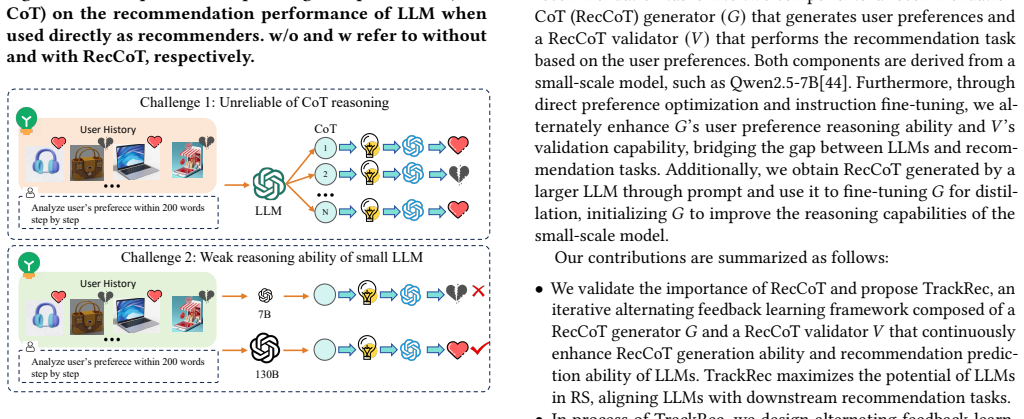
The extensive world knowledge and powerful reasoning capabilities of large language models (LLMs) have attracted significant attention in recommendation systems (RS). Specifically, The chain of thought (CoT) has been shown to improve the performance of LLMs on complex reasoning tasks for RS. However, due to the fact that LLMs often suffer from hallucination issues, there is no guarantee that their reasoning CoT is effective. A key challenge is to further enhance the recommendation capabilities of LLMs through effective CoT reasonings. Therefore, we propose \textbf{TrackRec}, a framework designed to enhance reasoning capabilities of LLMs for RS. TrackRec specifically focuses on accurately inferring recommendation CoT \textbf{(RecCoT)} for user preference using the knowledge from LLMs. This RecCoT can serve both as an explanation for the LLM's completion of recommendation tasks and as auxiliary features to assist recommendation models in accomplishing recommendation tasks. TrackRec consists of a RecCoT generator $(G)$ and a RecCoT validator $(V)$. Furthermore, we design alternating feedback learning mechanism that $G$ undergoes direct preference optimization via feedback from $V$ to produce increasingly accurate RecCoT aligned with $V$'s standards. Meanwhile, $V$ is fine-tuned using the inference feedback from $G$ to enhance its validation capabilities in alignment with recommendation tasks. Through iterative alternating feedback learning between $G$ and $V$, TrackRec continuously improves the user preference analysis capability of $G$ and the validation capacity of $V$. Extensive experiments demonstrate the effectiveness of our approach, showing that it surpasses state-of-the-art methods. Moreover, TrackRec has been deployed on a lagre advertising platform with hundreds of millions of users, achieving substantial gains.
Figures


Figures from the paper (2 more)


Reference graph
Works this paper leans on
-
[1]
Josh Achiam, Steven Adler, Sandhini Agarwal, Lama Ahmad, Ilge Akkaya, Floren- cia Leoni Aleman, Diogo Almeida, Janko Altenschmidt, Sam Altman, Shyamal Anadkat, et al. 2023. Gpt-4 technical report.arXiv preprint arXiv:2303.08774 (2023)
arXiv 2023
-
[2]
Sanjeev Arora. 2024. From Word-prediction to Complex Skills: Compositional Thinking and Metacognition in LLMs. InProceedings of the 30th ACM SIGKDD Conference on Knowledge Discovery and Data Mining. 1–1
work page 2024
-
[3]
Amos Azaria, Avinatan Hassidim, Sarit Kraus, Adi Eshkol, Ofer Weintraub, and Irit Netanely. 2013. Movie recommender system for profit maximization. In Proceedings of the 7th ACM conference on Recommender systems. 121–128
work page 2013
-
[4]
Zhuoxi Bai, Ning Wu, Fengyu Cai, Xinyi Zhu, and Yun Xiong. 2024. Finetuning Large Language Model for Personalized Ranking.arXiv preprint arXiv:2405.16127 (2024)
arXiv 2024
-
[5]
Keqin Bao, Jizhi Zhang, Yang Zhang, Wenjie Wang, Fuli Feng, and Xiangnan He. 2023. Tallrec: An effective and efficient tuning framework to align large language model with recommendation. InProceedings of the 17th ACM Conference on Recommender Systems. 1007–1014
2023
-
[6]
Jin Chen, Zheng Liu, Xu Huang, Chenwang Wu, Qi Liu, Gangwei Jiang, Yuanhao Pu, Yuxuan Lei, Xiaolong Chen, Xingmei Wang, et al. 2023. When large language models meet personalization: Perspectives of challenges and opportunities.arXiv preprint arXiv:2307.16376(2023)
arXiv 2023
-
[7]
Zeyu Cui, Jianxin Ma, Chang Zhou, Jingren Zhou, and Hongxia Yang. 2022. M6-rec: Generative pretrained language models are open-ended recommender systems.arXiv preprint arXiv:2205.08084(2022)
arXiv 2022
-
[8]
Jacob Devlin, Ming-Wei Chang, Kenton Lee, and Kristina Toutanova. 2018. Bert: Pre-training of deep bidirectional transformers for language understanding.arXiv preprint arXiv:1810.04805(2018)
arXiv 2018
Show all 60 references
-
[9]
Wenqi Fan, Zihuai Zhao, Jiatong Li, Yunqing Liu, Xiaowei Mei, Yiqi Wang, Jiliang Tang, and Qing Li. 2023. Recommender systems in the era of large language models (llms).arXiv preprint arXiv:2307.02046(2023)
2023 arXiv
-
[10]
Tianyu Gao, Adam Fisch, and Danqi Chen. 2020. Making pre-trained language models better few-shot learners.arXiv preprint arXiv:2012.15723(2020)
2020 arXiv
-
[11]
Yunfan Gao, Tao Sheng, Youlin Xiang, Yun Xiong, Haofen Wang, and Jiawei Zhang. 2023. Chat-rec: Towards interactive and explainable llms-augmented recommender system.arXiv preprint arXiv:2303.14524(2023)
2023 arXiv
-
[12]
Hao Gu, Rui Zhong, Yu Xia, Wei Yang, Chi Lu, Peng Jiang, and Kun Gai. 2025. R4ec: A Reasoning, Reflection, and Refinement Framework for Recommendation Systems.arXiv preprint arXiv:2507.17249(2025)
2025 arXiv
-
[13]
Huifeng Guo, Ruiming Tang, Yunming Ye, Zhenguo Li, and Xiuqiang He. 2017. DeepFM: A Factorization-Machine based Neural Network for CTR Prediction. CoRRabs/1703.04247 (2017). arXiv:1703.04247 http://arxiv.org/abs/1703.04247
2017 arXiv
-
[14]
Joseph F Hair Jr, Barry J Babin, and Nina Krey. 2017. Covariance-based structural equation modeling in the Journal of Advertising: Review and recommendations. Journal of Advertising46, 1 (2017), 163–177
2017
-
[15]
Ruining He and Julian McAuley. 2016. VBPR: visual bayesian personalized ranking from implicit feedback. InProceedings of the AAAI conference on artificial intelligence, Vol. 30
2016
-
[16]
Yupeng Hou, Junjie Zhang, Zihan Lin, Hongyu Lu, Ruobing Xie, Julian McAuley, and Wayne Xin Zhao. 2024. Large language models are zero-shot rankers for recommender systems. InEuropean Conference on Information Retrieval. Springer, 364–381
2024
-
[17]
Tongwen Huang, Zhiqi Zhang, and Junlin Zhang. 2019. FiBiNET: combining fea- ture importance and bilinear feature interaction for click-through rate prediction. InProceedings of the 13th ACM conference on recommender systems. 169–177
2019
-
[18]
Xuanwen Huang, Kaiqiao Han, Yang Yang, Dezheng Bao, Quanjin Tao, Ziwei Chai, and Qi Zhu. 2024. Can GNN be Good Adapter for LLMs?. InProceedings of the ACM on Web Conference 2024. 893–904
2024
-
[19]
Xu Huang, Jianxun Lian, Yuxuan Lei, Jing Yao, Defu Lian, and Xing Xie. 2023. Recommender ai agent: Integrating large language models for interactive recom- mendations.arXiv preprint arXiv:2308.16505(2023)
2023 arXiv
-
[20]
Takeshi Kojima, Shixiang Shane Gu, Machel Reid, Yutaka Matsuo, and Yusuke Iwasawa. 2022. Large language models are zero-shot reasoners.Advances in neural information processing systems35 (2022), 22199–22213
2022
-
[21]
Anis Koubaa. 2023. GPT-4 vs. GPT-3.5: A concise showdown. (2023)
2023
-
[22]
Chunyuan Li, Haotian Liu, Liunian Li, Pengchuan Zhang, Jyoti Aneja, Jianwei Yang, Ping Jin, Houdong Hu, Zicheng Liu, Yong Jae Lee, et al . 2022. Elevater: A benchmark and toolkit for evaluating language-augmented visual models. Advances in Neural Information Processing Systems...
2022
-
[23]
Zekun Li, Zeyu Cui, Shu Wu, Xiaoyu Zhang, and Liang Wang. 2019. Fi-gnn: Modeling feature interactions via graph neural networks for ctr prediction. In Proceedings of the 28th ACM international conference on information and knowledge management. 539–548
2019
-
[24]
Wensheng Lu, Jianxun Lian, Wei Zhang, Guanghua Li, Mingyang Zhou, Hao Liao, and Xing Xie. 2024. Aligning Large Language Models for Controllable Recommendations.arXiv preprint arXiv:2403.05063(2024)
2024 arXiv
-
[25]
Hanjia Lyu, Song Jiang, Hanqing Zeng, Yinglong Xia, and Jiebo Luo. 2023. Llm- rec: Personalized recommendation via prompting large language models.arXiv preprint arXiv:2307.15780(2023)
2023 arXiv
-
[26]
Long Ouyang, Jeffrey Wu, Xu Jiang, Diogo Almeida, Carroll Wainwright, Pamela Mishkin, Chong Zhang, Sandhini Agarwal, Katarina Slama, Alex Ray, et al. 2022. Training language models to follow instructions with human feedback.Advances in neural information processing systems35 (...
2022
-
[27]
Weiping Song, Chence Shi, Zhiping Xiao, Zhijian Duan, Yewen Xu, Ming Zhang, and Jian Tang. 2019. Autoint: Automatic feature interaction learning via self- attentive neural networks. InProceedings of the 28th ACM international conference on information and knowledge management....
2019
-
[28]
Zayne Sprague, Fangcong Yin, Juan Diego Rodriguez, Dongwei Jiang, Manya Wadhwa, Prasann Singhal, Xinyu Zhao, Xi Ye, Kyle Mahowald, and Greg Durrett
-
[29]
Qi Sun, Kun Huang, Xiaocui Yang, Rong Tong, Kun Zhang, and Soujanya Poria
-
[30]
Weiwei Sun, Lingyong Yan, Xinyu Ma, Pengjie Ren, Dawei Yin, and Zhaochun Ren. 2023. Is chatgpt good at search? investigating large language models as re-ranking agent.arXiv preprint arXiv:2304.09542(2023)
2023 arXiv
-
[31]
InProceedings of the ACM on Web Conference 2024
Consistency guided knowledge retrieval and denoising in llms for zero- shot document-level relation triplet extraction. InProceedings of the ACM on Web Conference 2024. 4407–4416
2024
-
[32]
Lei Wang, Wanyu Xu, Yihuai Lan, Zhiqiang Hu, Yunshi Lan, Roy Ka-Wei Lee, and Ee-Peng Lim. 2023. Plan-and-solve prompting: Improving zero-shot chain- of-thought reasoning by large language models.arXiv preprint arXiv:2305.04091 (2023)
2023 arXiv
-
[33]
Aaron Van den Oord, Sander Dieleman, and Benjamin Schrauwen. 2013. Deep content-based music recommendation.Advances in neural information processing systems26 (2013). TrackRec: Iterative Alternating Feedback with Chain-of-Thought via Preference Alignment for Recommendation Con...
2013
-
[34]
Yancheng Wang, Ziyan Jiang, Zheng Chen, Fan Yang, Yingxue Zhou, Eunah Cho, Xing Fan, Xiaojiang Huang, Yanbin Lu, and Yingzhen Yang. 2023. Rec- mind: Large language model powered agent for recommendation.arXiv preprint arXiv:2308.14296(2023)
2023 arXiv
-
[35]
Ruoxi Wang, Bin Fu, Gang Fu, and Mingliang Wang. 2017. Deep & cross network for ad click predictions. InProceedings of the ADKDD’17. 1–7
2017
-
[36]
Jason Wei, Yi Tay, Rishi Bommasani, Colin Raffel, Barret Zoph, Sebastian Borgeaud, Dani Yogatama, Maarten Bosma, Denny Zhou, Donald Metzler, et al
-
[37]
Jason Wei, Maarten Bosma, Vincent Y Zhao, Kelvin Guu, Adams Wei Yu, Brian Lester, Nan Du, Andrew M Dai, and Quoc V Le. 2021. Finetuned language models are zero-shot learners.arXiv preprint arXiv:2109.01652(2021)
2021 arXiv
-
[38]
Jiaxing Wu, Lin Ning, Luyang Liu, Harrison Lee, Neo Wu, Chao Wang, Sushant Prakash, Shawn O’Banion, Bradley Green, and Jun Xie. 2024. RLPF: Reinforcement Learning from Prediction Feedback for User Summarization with LLMs.arXiv preprint arXiv:2409.04421(2024)
2024 arXiv
-
[39]
Likang Wu, Zhi Zheng, Zhaopeng Qiu, Hao Wang, Hongchao Gu, Tingjia Shen, Chuan Qin, Chen Zhu, Hengshu Zhu, Qi Liu, et al . 2023. A survey on large language models for recommendation.arXiv preprint arXiv:2305.19860(2023)
2023 arXiv
-
[40]
Jason Wei, Xuezhi Wang, Dale Schuurmans, Maarten Bosma, Fei Xia, Ed Chi, Quoc V Le, Denny Zhou, et al. 2022. Chain-of-thought prompting elicits reasoning in large language models.Advances in neural information processing systems35 (2022), 24824–24837
2022
-
[41]
Yunjia Xi, Weiwen Liu, Jianghao Lin, Xiaoling Cai, Hong Zhu, Jieming Zhu, Bo Chen, Ruiming Tang, Weinan Zhang, and Yong Yu. 2024. Towards open-world recommendation with knowledge augmentation from large language models. In Proceedings of the 18th ACM Conference on Recommender ...
2024
-
[42]
Yunjia Xi, Weiwen Liu, Jianghao Lin, Jieming Zhu, Bo Chen, Ruiming Tang, Weinan Zhang, Rui Zhang, and Yong Yu. 2023. Towards open-world recommen- dation with knowledge augmentation from large language models.arXiv preprint arXiv:2306.10933(2023)
2023 arXiv
-
[43]
Songhao Wu, Quan Tu, Hong Liu, Jia Xu, Zhongyi Liu, Guannan Zhang, Ran Wang, Xiuying Chen, and Rui Yan. 2024. Unify Graph Learning with Text: Unleashing LLM Potentials for Session Search. InProceedings of the ACM on Web Conference 2024. 1509–1518
2024
-
[44]
An Yang, Baosong Yang, Binyuan Hui, Bo Zheng, Bowen Yu, Chang Zhou, Cheng- peng Li, Chengyuan Li, Dayiheng Liu, Fei Huang, Guanting Dong, Haoran Wei, Huan Lin, Jialong Tang, Jialin Wang, Jian Yang, Jianhong Tu, Jianwei Zhang, Jianxin Ma, Jin Xu, Jingren Zhou, Jinze Bai, Jinzhe...
2024 arXiv
-
[45]
Fan Yang, Zheng Chen, Ziyan Jiang, Eunah Cho, Xiaojiang Huang, and Yanbin Lu. 2023. Palr: Personalization aware llms for recommendation.arXiv preprint arXiv:2305.07622(2023)
2023 arXiv
-
[46]
Yu Xia, Rui Zhong, Hao Gu, Wei Yang, Chi Lu, Peng Jiang, and Kun Gai. 2025. Hierarchical Tree Search-based User Lifelong Behavior Modeling on Large Lan- guage Model. InProceedings of the 48th International ACM SIGIR Conference on Research and Development in Information Retriev...
2025
-
[47]
Junjie Zhang, Ruobing Xie, Yupeng Hou, Wayne Xin Zhao, Leyu Lin, and Ji-Rong Wen. 2023. Recommendation as instruction following: A large language model empowered recommendation approach.arXiv preprint arXiv:2305.07001(2023)
2023 arXiv
-
[48]
Yang Zhang, Keqin Bao, Ming Yan, Wenjie Wang, Fuli Feng, and Xiangnan He
-
[49]
Jizhi Zhang, Keqin Bao, Yang Zhang, Wenjie Wang, Fuli Feng, and Xiangnan He. 2023. Is chatgpt fair for recommendation? evaluating fairness in large lan- guage model recommendation. InProceedings of the 17th ACM Conference on Recommender Systems. 993–999
2023
-
[50]
Yang Zhang, Fuli Feng, Jizhi Zhang, Keqin Bao, Qifan Wang, and Xiangnan He
-
[51]
Rui Zhao, Rui Zhong, Haoran Zheng, Wei Yang, Chi Lu, Beihong Jin, Peng Jiang, and Kun Gai. 2025. Hierarchical Sequence ID Representation of Large Language Models for Large-scale Recommendation Systems. InCompanion Proceedings of the ACM on Web Conference 2025. 641–650
2025
-
[52]
arXiv:2406.03210 [cs.IR] https://arxiv.org/abs/2406.03210
Text-like Encoding of Collaborative Information in Large Language Models for Recommendation. arXiv:2406.03210 [cs.IR] https://arxiv.org/abs/2406.03210
-
[53]
Yuhui Zhang, Hao Ding, Zeren Shui, Yifei Ma, James Zou, Anoop Deoras, and Hao Wang. 2021. Language models as recommender systems: Evaluations and limitations. InI (Still) Can’t Believe It’s Not Better! NeurIPS 2021 Workshop
2021
-
[54]
Guorui Zhou, Na Mou, Ying Fan, Qi Pi, Weijie Bian, Chang Zhou, Xiaoqiang Zhu, and Kun Gai. 2019. Deep Interest Evolution Network for Click-Through Rate Prediction.Proceedings of the AAAI Conference on Artificial Intelligence33, 01 (Jul. 2019), 5941–5948. doi:10.1609/aaai.v33i0...
2019 doi
-
[55]
Guorui Zhou, Xiaoqiang Zhu, Chenru Song, Ying Fan, Han Zhu, Xiao Ma, Yanghui Yan, Junqi Jin, Han Li, and Kun Gai. 2018. Deep Interest Network for Click- Through Rate Prediction. InProceedings of the 24th ACM SIGKDD International Conference on Knowledge Discovery & Data Mining(...
2018
-
[57]
Wayne Xin Zhao, Kun Zhou, Junyi Li, Tianyi Tang, Xiaolei Wang, Yupeng Hou, Yingqian Min, Beichen Zhang, Junjie Zhang, Zican Dong, et al. 2023. A survey of large language models.arXiv preprint arXiv:2303.18223(2023)
2023 arXiv
-
[58]
Denny Zhou, Nathanael Schärli, Le Hou, Jason Wei, Nathan Scales, Xuezhi Wang, Dale Schuurmans, Claire Cui, Olivier Bousquet, Quoc Le, et al. 2022. Least-to- most prompting enables complex reasoning in large language models.arXiv preprint arXiv:2205.10625(2022)
2022 arXiv
-
[2022]
Emergent abilities of large language models.arXiv preprint arXiv:2206.07682 (2022)
2022 arXiv
-
[2023]
Collm: Integrating collaborative embeddings into large language models for recommendation.arXiv preprint arXiv:2310.19488(2023)
2023 arXiv
-
[2024]
To CoT or not to CoT? Chain-of-thought helps mainly on math and symbolic reasoning.arXiv preprint arXiv:2409.12183(2024)
2024 arXiv
Reviewed August 5, 2026 · model on record in the stance chip above.
Discussion (0). Sign in to comment.