REVIEW 2 major objections 5 minor 82 references
FUMES IV: Optical and Far-ultraviolet Spectra of a Flare on the M Dwarf GJ 4334
T0 review · 2 major / 5 minor · reviewed 2026-08-05 · deepseek-v4-flash
Pith's one-line read A flare on the M dwarf GJ 4334, caught simultaneously in far-ultraviolet and optical light, shows transition-region lines rising, peaking, and fading during the rise of the optical lines, with the Balmer lines ordered from Hδ starting first
desk verdict Rare simultaneous optical+FUV flare spectrum with a real empirical core; the FFD 'excess of large flares' claim in the abstract does not survive contact with the paper's own analysis. read the letter →
The pith
A machine-rendered reading of the paper's core claim, the machinery that carries it, and where it could break.
The reading
What carries the argument
The central object is a two-component analytic lightcurve model, F_line(t) = q_line + F_primary(t) + F_secondary(t), where each component is a Gaussian rise with timescale r_i and an exponential decay with timescale d_i peaking at t_i (Eqs. 1–2). It lets the authors compare onset times (t_i − 3r_i), decay timescales, secondary-bump lags, and the line-dependent equivalent duration δ_line = ∫(F_line/q_line − 1) dt (Eq. 3), which converts to flare energy when multiplied by the quiescent flux and 4πd². The Balmer decrement relative to Hβ diagnoses how the flare populates upper hydrogen levels, and the Neupert-effect comparison frames the FUV/optical timing. The TESS analysis uses maximum-likelih
What would settle it
Re-fit the same 21 line lightcurves with the quiescent baseline q_line allowed to float (or anchored to the lowest observed pre-flare flux) and check whether the Hδ-to-Hα onset ordering and the Hα-slowest decay hierarchy survive; if they disappear, the timing claim depends on the baseline choice. A cleaner test is a second simultaneous FUV+optical flare on GJ 4334 observed with higher cadence and a long, stable pre-flare sequence.
Extended reading notes
Core claim
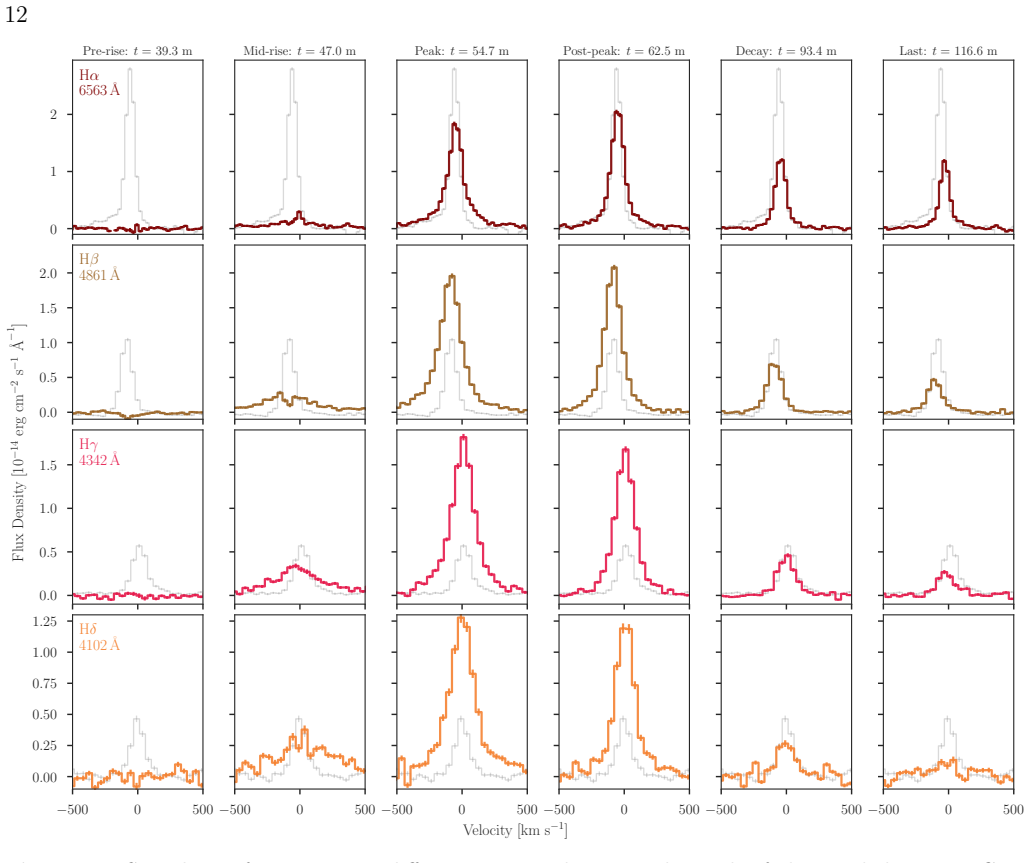
Fitting every line lightcurve with a Gaussian-rise/exponential-decay two-component model, the paper measures per-line peak, onset, decay, and equivalent duration. It finds all FUV transition-region lines peak within ~48.6–49.1 min and decay in minutes, while optical Balmer lines peak at ~56–57 min and decay over 12.3 min (Hδ) to 27.2 min (Hα); onsets run from Hδ (36.4 min) to Hα (43.4 min), Ca II K later still. Peak-to-start ratios span 1.3 (Hα) to 171 (Si III). At peak the flare-excess Balmer decrement is near unity, showing strong population of high-n hydrogen states; higher-order decrements relax exponentially while Hα relaxes linearly. Both bands end above their pre-flare levels, a pseud
Load-bearing premise
The flare energies, equivalent durations, and timescale comparisons all assume that the median pre-flare flux of each line is the star's true quiescent baseline; the paper itself notes the pre-flare Hα points are sloped, so the 'quiescence' may be the decay of an earlier flare, which would make every measured flare energy and some timing comparisons underestimates.
Editorial extensions
If this is right
- FUV transition-region lines can serve as the impulsive-phase tracer on M dwarfs: their rise and peak precede the optical chromospheric peak, so optical-only flare timing is delayed relative to the heating event.
- The systematic Balmer ordering (Hδ first, Hα last) and the near-unity flare-excess Balmer decrement at peak mean high-n hydrogen states are overpopulated by the flare, with recombination and thermalization working down the series.
- The elevated post-flare pseudo-quiescence implies that single-epoch FUV spectra of active M dwarfs may be contaminated by earlier flares, biasing measured line ratios and quiescent levels.
- TESS-like broadband optical surveys systematically miss FUV-only flares and underpredict high-energy flare radiation; the observed 10^3–10^4 s equivalent durations would have only a ~0.5% chance of detection in the 2-hour optical window.
- GJ 4334's excess of large flares over its small-flare power law, if typical of intermediate rotators, connects to enhanced coronal mass ejections and angular momentum loss at the saturation-decay transition.
Reading between the lines
- If the pre-flare 'quiescence' is itself the tail of an earlier flare, then the true baseline is lower and all equivalent durations and line energies in this paper are lower limits; the same argument applies to any active M dwarf observed for only a short window.
- The Balmer onset ordering may be a probe of where flare energy is deposited: higher-order lines presumably form higher in the chromosphere and respond to the beam before the lower, denser layers that dominate Hα; this is testable with RADYN-style flare models tuned to reproduce the Hα–Hδ timing.
- The line-to-line variation in the secondary FUV bump, with slow decays for C IV and N V versus fast decays for Si III, is consistent with the FIP-effect / Alfvén-wave ponderomotive explanation the authors raise, but distinguishing it from multiplet optical-depth effects would need simultaneous high-cadence UV spectra plus abundance measurements.
- A prediction follows for the intermediate-rotation population: stars with 10–100 day periods should show a similar large-flare excess in TESS data, which can be checked with the full TESS sample rather than a single target.
Editorial analysis
A structured set of objections, weighed in public.
Referee Report
Summary. The paper presents simultaneous HST/STIS far-ultraviolet and APO/DIS optical spectroscopy of a flare on the M5V dwarf GJ 4334, together with a TESS-based flare frequency distribution (FFD) analysis. The core observational claims are: (1) Balmer lines show a systematic ordering in which higher-order lines (Hδ, Hγ) begin rising earlier and decay faster than Hα, while Hα peaks slightly earlier and decays much more slowly (d1 = 27.2 min versus 12.3 min for Hδ, Table 4); (2) FUV transition-region lines rise, peak, and decay within the rise phase of the optical lines, with peak-to-start flux ratios up to 171 for Si III versus 1.3 for Hα; (3) a post-flare elevated pseudo-quiescent level is observed in both regimes; and (4) the FFD fit yields α = 1.86 ± 0.11 for GJ 4334, slightly shallower than EV Lac's α = 2.05 ± 0.08, which the authors interpret as an excess of large flares relative to a power law established by smaller flares. The paper also discusses line asymmetries, Balmer decrements, and potential implications for angular momentum loss among intermediate rotators.
Significance. If the FFD interpretation is supportable, this dataset constitutes a rare simultaneous FUV/optical spectroscopic benchmark of flare energy flow across atmospheric layers for an intermediate rotator near the activity saturation-to-decay transition, with direct relevance to exoplanet atmosphere modeling and stellar angular momentum evolution. The empirical spectroscopic core is valuable: the authors provide open-source reduction tools, full figuresets, a transparent two-component flare model, and honest caveats about the pseudo-quiescence baseline and the qualitative nature of the line-asymmetry interpretation. These strengths make the paper worth publishing even if the FFD claim requires revision. However, the FFD 'excess of large flares' conclusion, which appears in the abstract and in the angular-momentum-loss discussion, is currently not supported by a formal statistical test.
major comments (2)
- [Section 5.2 / Fig. 18 / Section 7] Section 3.2.2 / Eq. (3) / Tables 6–7: The equivalent durations and line energies are computed using q_line fixed to the median pre-flare flux. The authors themselves note in Section 7 (and the sloping pre-flare Hα in Fig. 3 suggests) that the 'quiescence' may be pseudo-quiescence from an earlier flare, in which case q_line is overestimated and all equivalent durations and energies are underestimated. The abstract presents the ranges 800–3×10^4 s and 1×10^28–3×10^29 erg without this caveat. Please state explicitly that these are lower limits under the pseudo-quiescence assumption and briefly quantify the sensitivity to a plausible alternative baseline.
- [Section 5.1] The detection and characterization of large flares involves manual merging of complex events that stella/altaiPony split into multiple smaller flares, and δ_m is selected via the Anderson-Darling test on the same data. These choices can preferentially affect the high-δ tail from which the 'excess of large flares' is inferred. A robustness check (e.g., altaiPony-only detections, varying the merging criterion, or a fixed δ_m) is needed to show that the conclusion is not an artifact of these analysis choices.
minor comments (5)
- [Section 5.2 / Table 3] The normalization k in Eq. (5) is defined as the number of flares with δ ≥ δ_m (dimensionless), but Table 3 lists k* in units of d^-1. Clarify whether k in Eq. (5) is a count or a rate, and if a count, state the observing time used to convert to a rate.
- [Section 2.2] State the total number of HST pseudo-exposures and the time span of the second orbit explicitly in the text (not only in figures) to make the pseudo-quiescence discussion easier to follow.
- [Figure 10] The caption says 'for Hα (left), Hβ (middle), and Hγ (right)', but the figure has four panels (Hα, Hβ, Hγ, Hδ). Please correct the caption.
- [Section 5.1] Give the total observing time (or sectors and exposure time) for both GJ 4334 and EV Lac, since the quoted flare rates (1.02 and 3.90 d^-1) otherwise lack context.
- [Section 3.2.2] It would be helpful to state which FUV pseudo-exposure binning (1-min, 3-min, or count-sliced) was used for the lightcurves in Figures 12 and 15.
Circularity Check
FFD 'excess of large flares' claim is circular: the reference power law is fitted to the same large events it is said to exceed.
-
fitted input called prediction
[Section 5.2 (Eqs. 4–5, Fig. 18 discussion)]
"We used the Anderson-Darling goodness-of-fit test comparing the data against the expected maximum-likelihood fit with a power-law distribution ... We chose δm as the value of minimum equivalent duration where the Anderson-Darling test statistic first bottoms out to consistent values with increasing δm. ... Our subsequent fits thus utilized only those data for each star above the noted threshold. ... GJ 4334 does appear to have a slightly shallower FFD slope, a consequence of more frequent very strong flares ( δ > 102), although it is consistent with EV Lac to within 1 σ. The small difference i"
The FFD reference is not independent of the large flares it is used to judge. Equation (4) is fit to all TESS events above a completeness threshold δm chosen by Anderson-Darling on the same data; the resulting α=1.86±0.11 is therefore determined jointly by the small and large events. The text then interprets the shallow slope as 'an excess of large flares that depart from the power-law established by the majority of the smaller flares.' But no power law fitted to smaller flares only is ever presented, so the claimed reference 'established by the majority of smaller flares' is a construct of the same fit that includes the large events. The excess is thus not a prediction tested against an independent small-flare law; it is read off from the very points that define the fit. The 'excess' clai
full rationale
The spectroscopic core of the paper is self-contained and not circular. The flare lightcurves, Balmer-series rise/decay ordering, FUV/optical timing, equivalent durations, and line-energy estimates are derived directly from the APO/HST observations with stated fitting procedures (Eqs. 1–3). The paper even flags its own baseline limitation: the pre-flare 'quiescence' may itself be a decay phase, which would make equivalent durations underestimates—this is a caveat, not circularity. The TESS FFD analysis, however, contains a real circular step: the power-law index α is fit to all events above a threshold chosen on the same data, and then the same fit is used to claim that large flares depart from a power law 'established by the majority of the smaller flares.' No small-flare-only fit, extrapolation test, or broken-power-law comparison is provided. The claimed excess is therefore not independently established; it is an interpretation of the same fitted curve. This matters because the 'excess of large flares' is load-bearing for the abstract's conclusion and the angular-momentum-loss speculation in Section 7. I score 6: partial circularity in a central claim, while the main flare characterization remains independent.
Assumptions & free parameters
free parameters (7)
- FFD power-law index alpha for GJ 4334 =
1.86 ± 0.11
- FFD power-law index alpha for EV Lac =
2.05 ± 0.08
- FFD normalization k for GJ 4334 and EV Lac =
0.80 (+0.11/-0.09) d^-1; 1.48 ± 0.11 d^-1
- FFD minimum threshold delta_m =
5 s (GJ 4334); 3 s (EV Lac)
- Two-component flare model parameters per line (t_i, r_i, d_i, A_i) =
Tables 4 to 6
- Manual integration wavelength boundaries =
Table 2
- Quiescent flux level qline per line =
Table 7
assumptions (6)
- domain assumption The flare excess is defined relative to a stable quiescent baseline qline (Eqs. 2 to 3).
- ad hoc to paper The flare lightcurve functional form: a Gaussian rise plus exponential decay, summed over two components (Eqs. 1 to 2).
- domain assumption The differential FFD is a single Pareto power law above delta_m (Eqs. 4 to 5).
- domain assumption Continuum regions around H beta and H alpha are flare-invariant and used for flux normalization.
- domain assumption Distance to GJ 4334 is taken from prior literature and enters E_line = q_line * delta_line * 4 pi d^2.
- domain assumption Manual redefinition of complex TESS flares as single events with hand-integrated equivalent durations.
Cite this review
Pith. "Pith review of FUMES IV: Optical and Far-ultraviolet Spectra of a Flare on the M Dwarf GJ 4334." pith.science (2026). https://pith.science/paper/XR7QWIVQ
@misc{pith2026250818459,
  author       = {Pith},
  title        = {Pith review of: FUMES IV: Optical and Far-ultraviolet Spectra of a Flare on the M Dwarf GJ 4334},
  year         = {2026},
  howpublished = {\url{https://pith.science/paper/XR7QWIVQ}},
  note         = {Machine review of arXiv:2508.18459}
}
read the original abstract
On 2017-09-20 we observed GJ 4334, an M5V dwarf rotating with a period of 23.5 days, simultaneously with both the Space Telescope Imaging Spectrograph aboard Hubble (1160 -- 1710 Angstroms) and the Dual Imaging Spectrograph mounted on the 3.5m telescope at Apache Point Observatory (3750 -- 5050; 5800 -- 6950 Angstroms) as part of a larger survey of intermediately active M dwarfs. GJ 4334 flared during the observation, starting with a rise in the flux of optical chromospheric emission lines, followed by the rapid rise and decay of multiple far-ultraviolet emission lines formed in the transition region, followed by the slow decay of the optical lines. We find significant broadening and asymmetries in the optical emission lines that are potentially from bulk plasma motion, a post-flare elevated flux in both the optical and far-ultraviolet, and trends in the rise and decay timescales of the Balmer series such that higher-order lines rise earlier and decay faster than lower-order lines. The equivalent durations of the flare in individual lines range from 800 -- 3e4 seconds, mapping to flare energies of 1e28 -- 3e29 erg for each line. To contextualize GJ 4334's flare behavior we measure and compare its optical flare frequency distribution with TESS to EV Lacertae, a similar mass but faster rotating M dwarf, and find that GJ 4334 has an excess of large flares relative to the power-law established by the majority of its smaller flares. This dataset is a rare opportunity to characterize flares near a critical transition in stellar magnetic activity.
Figures


Figures from the paper (15 more)



Reference graph
Works this paper leans on
-
[1]
Aarnio, A. N., Matt, S. P., & Stassun, K. G. 2012, ApJ, 760, 9, doi: 10.1088/0004-637X/760/1/9
-
[2]
McGregor, S. L. 2011, SoPh, 268, 195, doi: 10.1007/s11207-010-9672-7
-
[3]
Abril-Pla, O., Andreani, V., Carroll, C., et al. 2023, PeerJ Computer Science, doi: https://doi.org/10.7717/peerj-cs.1516 34 T able 4.Primary Peak Time and Timescale Flare Profile Parameters Line Name Primary Peak t1 Primary Rise r1 Primary Decay d1 Primary Onset t1 − 3r1 [–] [min] [min] [min] [min] Si I – Si III + O I 49.09+0.28 −0.27 0.32+0.13 −0.13 0.3...
-
[4]
Allred, J. C., Kowalski, A. F., & Carlsson, M. 2015, ApJ, 809, 104, doi: 10.1088/0004-637X/809/1/104 Alvarado-G´ omez, J. D., Drake, J. J., Cohen, O.,
-
[5]
Moschou, S. P., & Garraffo, C. 2018, ApJ, 862, 93, doi: 10.3847/1538-4357/aacb7f Alvarado-G´ omez, J. D., Drake, J. J., Moschou, S. P., et al. 2019, ApJL, 884, L13, doi: 10.3847/2041-8213/ab44d0 Astropy Collaboration, Robitaille, T. P., Tollerud, E. J., et al. 2013, A&A, 558, A33, doi: 10.1051/0004-6361/201322068 Astropy Collaboration, Price-Whelan, A. M....
-
[6]
2025, AJ, 169, 281, doi: 10.3847/1538-3881/adc570
Ayres, T. 2025, AJ, 169, 281, doi: 10.3847/1538-3881/adc570
-
[7]
R., France, K., Brown, A., et al
Behr, P. R., France, K., Brown, A., et al. 2023, AJ, 166, 35, doi: 10.3847/1538-3881/acdb70
-
[8]
Benz, A. O., & G¨ udel, M. 2010, ARA&A, 48, 241, doi: 10.1146/annurev-astro-082708-101757
Show all 82 references
-
[9]
Cubillos, P. E. 2020, bibmanager: A BibTeX manager for LaTeX projects, Zenodo, doi: 10.5281/zenodo.2547042
2020 doi
-
[10]
Davenport, J., De Val-Borro, M., & Wilkinson, T. D. 2016, pydis: Possibly Useful, v1.1 Zenodo, doi: 10.5281/zenodo.58753
2016 doi
-
[11]
Davenport, J. R. A., Covey, K. R., Clarke, R. W., et al. 2019, ApJ, 871, 241, doi: 10.3847/1538-4357/aafb76 Del Zanna, G., Dere, K. P., Young, P. R., &
2019 doi
-
[12]
2021, ApJ, 909, 38, doi: 10.3847/1538-4357/abd8ce
Landi, E. 2021, ApJ, 909, 38, doi: 10.3847/1538-4357/abd8ce
2021 doi
-
[13]
C., & Young, P
Fossi, B. C., & Young, P. R. 1997, A&AS, 125, 149, doi: 10.1051/aas:1997368 35 T able 5.Secondary Bump Time and Timescale Flare Profile Parameters Line Name Secondary Bump t2 Secondary Rise r2 Secondary Decay d2 Secondary Onset t2 − 3r2 Primary – Secondary Lag t2 − t1 [–] [min...
1997 doi
-
[14]
W., Youngblood, A., et al
Diamond-Lowe, H., King, G. W., Youngblood, A., et al. 2024, A&A, 689, A48, doi: 10.1051/0004-6361/202450107
2024 doi
-
[15]
2017, ApJL, 847, L4, doi: 10.3847/2041-8213/aa8a60
Dong, C., Huang, Z., Lingam, M., et al. 2017, ApJL, 847, L4, doi: 10.3847/2041-8213/aa8a60
2017 doi
-
[16]
G., & Butler, C
Doyle, J. G., & Butler, C. J. 1985, Nature, 313, 378, doi: 10.1038/313378a0
1985 doi
-
[17]
M., Pineda, J
Duvvuri, G. M., Pineda, J. S., Berta-Thompson, Z. K., France, K., & Youngblood, A. 2022, FUMES III: Ultraviolet and Optical Variability of M Dwarf Chromospheres, Zenodo, doi: 10.5281/zenodo.6909473
2022 doi
-
[18]
M., Pineda, J
Duvvuri, G. M., Pineda, J. S., Berta-Thompson, Z. K., France, K., & Youngblood, A. 2023, AJ, 165, 12, doi: 10.3847/1538-3881/ac9b49 European Organization For Nuclear Research, & OpenAIRE. 2013, Zenodo, CERN, doi: 10.25495/7GXK-RD71
2023 doi
- [19]
-
[20]
2020, The Journal of Open Source Software, 5, 2347, doi: 10.21105/joss.02347
Feinstein, A., Montet, B., & Ansdell, M. 2020, The Journal of Open Source Software, 5, 2347, doi: 10.21105/joss.02347
2020 doi
-
[21]
D., France, K., Youngblood, A., et al
Feinstein, A. D., France, K., Youngblood, A., et al. 2022, AJ, 164, 110, doi: 10.3847/1538-3881/ac8107
2022 doi
-
[22]
Fisher, G. H. 1989, ApJ, 346, 1019, doi: 10.1086/168084
1989 doi
-
[23]
2013, PASP, 125, 306, doi: 10.1086/670067
Goodman, J. 2013, PASP, 125, 306, doi: 10.1086/670067
2013 doi
-
[24]
France, K., Loyd, R. O. P., Youngblood, A., et al. 2016, ApJ, 820, 89, doi: 10.3847/0004-637X/820/2/89
2016 doi
-
[25]
2020, AJ, 160, 237, doi: 10.3847/1538-3881/abb465
France, K., Duvvuri, G., Egan, H., et al. 2020, AJ, 160, 237, doi: 10.3847/1538-3881/abb465
2020 doi
-
[26]
S., Kowalski, A., France, K., et al
Froning, C. S., Kowalski, A., France, K., et al. 2019, ApJL, 871, L26, doi: 10.3847/2041-8213/aaffcd
2019 doi
-
[27]
2011, A&A, 534, A133, doi: 10.1051/0004-6361/201117447
Fuhrmeister, B., Lalitha, S., Poppenhaeger, K., et al. 2011, A&A, 534, A133, doi: 10.1051/0004-6361/201117447
2011 doi
-
[28]
Fuhrmeister, B., Czesla, S., Schmitt, J. H. M. M., et al. 2018, A&A, 615, A14, doi: 10.1051/0004-6361/201732204 Garc ´ ıa Soto, A., Duvvuri, G. M., Newton, E. R., et al. 2025, ApJ, 982, 98, doi: 10.3847/1538-4357/adb615
2018 doi
- [29]
-
[30]
V., Feigelson, E
Getman, K. V., Feigelson, E. D., & Garmire, G. P. 2021, ApJ, 920, 154, doi: 10.3847/1538-4357/ac1746
2021 doi
- [31]
-
[32]
C., & Kasting, J
Schottelkotte, J. C., & Kasting, J. F. 2015, ApJ, 812, 137, doi: 10.1088/0004-637X/812/2/137
2015 doi
-
[33]
R., Millman, K
Harris, C. R., Millman, K. J., van der Walt, S. J., et al. 2020, Nature, 585, 357, doi: 10.1038/s41586-020-2649-2
2020 doi
-
[34]
L., & Pettersen, B
Hawley, S. L., & Pettersen, B. R. 1991, ApJ, 378, 725, doi: 10.1086/170474
1991 doi
-
[35]
L., Allred, J
Hawley, S. L., Allred, J. C., Johns-Krull, C. M., et al. 2003, ApJ, 597, 535, doi: 10.1086/378351
2003 doi
-
[36]
Hilton, E. J. 2011, PhD thesis, University of
2011
-
[37]
1967, Information Bulletin on Variable Stars, 203, 1 H¨ orst, S
Hoffmeister, C. 1967, Information Bulletin on Variable Stars, 203, 1 H¨ orst, S. M. 2017, Journal of Geophysical Research (Planets), 122, 432, doi: 10.1002/2016JE005240
1967 doi
-
[38]
S., MacGregor, M
Howard, W. S., MacGregor, M. A., Osten, R., et al. 2022, ApJ, 938, 103, doi: 10.3847/1538-4357/ac9134
2022 doi
-
[39]
2012, ApJ, 761, 166, doi: 10.1088/0004-637X/761/2/166
Hu, R., Seager, S., & Bains, W. 2012, ApJ, 761, 166, doi: 10.1088/0004-637X/761/2/166
2012 doi
-
[40]
Hunter, J. D. 2007, Computing in Science and Engineering, 9, 90, doi: 10.1109/MCSE.2007.55
2007 doi
-
[41]
2021, The Journal of Open Source Software, 6, 2845, doi: 10.21105/joss.02845
Ilin, E. 2021, The Journal of Open Source Software, 6, 2845, doi: 10.21105/joss.02845
2021 doi
-
[42]
Jackman, J. A. G., Shkolnik, E. L., Loyd, R. O. P., & Richey-Yowell, T. 2024, MNRAS, 533, 1894, doi: 10.1093/mnras/stae1570
2024 doi
-
[43]
Jackman, J. A. G., Shkolnik, E. L., Million, C., et al. 2023, MNRAS, 519, 3564, doi: 10.1093/mnras/stac3135
2023 doi
-
[44]
Jackman, J. A. G., Wheatley, P. J., Acton, J. S., et al. 2021, MNRAS, 504, 3246, doi: 10.1093/mnras/stab979
2021 doi
-
[45]
P., Bartel, M., & G¨ udel, M
Johnstone, C. P., Bartel, M., & G¨ udel, M. 2021, A&A, 649, A96, doi: 10.1051/0004-6361/202038407 39
2021 doi
-
[46]
M., et al
Klein, B., Donati, J.-F., H´ ebrard,´E. M., et al. 2021, MNRAS, 500, 1844, doi: 10.1093/mnras/staa3396
2021 doi
-
[47]
T., Lavvas, P., Huang, C., et al
Koskinen, T. T., Lavvas, P., Huang, C., et al. 2022, ApJ, 929, 52, doi: 10.3847/1538-4357/ac4f45
2022 doi
-
[48]
F., Allred, J
Kowalski, A. F., Allred, J. C., & Carlsson, M. 2024, ApJ, 969, 121, doi: 10.3847/1538-4357/ad4148
2024 doi
-
[49]
F., Hawley, S
Kowalski, A. F., Hawley, S. L., Wisniewski, J. P., et al. 2013, ApJS, 207, 15, doi: 10.1088/0067-0049/207/1/15
2013 doi
-
[50]
F., Allred, J
Kowalski, A. F., Allred, J. C., Uitenbroek, H., et al. 2017, ApJ, 837, 125, doi: 10.3847/1538-4357/aa603e
2017 doi
-
[51]
F., Wisniewski, J
Kowalski, A. F., Wisniewski, J. P., Hawley, S. L., et al. 2019, ApJ, 871, 167, doi: 10.3847/1538-4357/aaf058
2019 doi
-
[52]
H., Moffett, T
Lacy, C. H., Moffett, T. J., & Evans, D. S. 1976, ApJS, 30, 85, doi: 10.1086/190358
1976 doi
-
[53]
Laming, J. M. 2021, ApJ, 909, 17, doi: 10.3847/1538-4357/abd9c3
2021 doi
-
[54]
Loyd, R. O. P., & France, K. 2014, ApJS, 211, 9, doi: 10.1088/0067-0049/211/1/9
2014 doi
-
[55]
Loyd, R. O. P., Shkolnik, E. L., Schneider, A. C., et al. 2018a, ApJ, 867, 70, doi: 10.3847/1538-4357/aae2ae
-
[56]
Loyd, R. O. P., France, K., Youngblood, A., et al. 2018b, ApJ, 867, 71, doi: 10.3847/1538-4357/aae2bd
-
[57]
A., Weinberger, A
MacGregor, M. A., Weinberger, A. J., Loyd, R. O. P., et al. 2021, ApJL, 911, L25, doi: 10.3847/2041-8213/abf14c
2021 doi
-
[58]
2021, PASJ, 73, 44, doi: 10.1093/pasj/psaa098
Maehara, H., Notsu, Y., Namekata, K., et al. 2021, PASJ, 73, 44, doi: 10.1093/pasj/psaa098
2021 doi
-
[59]
2022, ApJ, 935, 104, doi: 10.3847/1538-4357/ac77f9
Charbonneau, D. 2022, ApJ, 935, 104, doi: 10.3847/1538-4357/ac77f9
2022 doi
-
[60]
2019, ApJ, 870, 10, doi: 10.3847/1538-4357/aaee64
Irwin, J. 2019, ApJ, 870, 10, doi: 10.3847/1538-4357/aaee64
2019 doi
-
[61]
H., Gosling, J
Munro, R. H., Gosling, J. T., Hildner, E., et al. 1979, SoPh, 61, 201, doi: 10.1007/BF00155456
1979 doi
-
[62]
2022, ApJ, 933, 209, doi: 10.3847/1538-4357/ac75cd
Shibata, K. 2022, ApJ, 933, 209, doi: 10.3847/1538-4357/ac75cd
2022 doi
-
[63]
Neupert, W. M. 1968, ApJL, 153, L59, doi: 10.1086/180220
1968 doi
-
[64]
R., Irwin, J., Charbonneau, D., et al
Newton, E. R., Irwin, J., Charbonneau, D., et al. 2016, ApJ, 821, 93, doi: 10.3847/0004-637X/821/2/93
2016 doi
-
[65]
M., & Roark, C
Johns-Krull, C. M., & Roark, C. 2005, ApJ, 621, 398, doi: 10.1086/427275 pandas development team, T. 2020, pandas-dev/pandas: Pandas, latest Zenodo, doi: 10.5281/zenodo.3509134
2005 doi
-
[66]
K., Charbonneau, D., Latham, D
Pass, E. K., Charbonneau, D., Latham, D. W., et al. 2024, ApJ, 966, 231, doi: 10.3847/1538-4357/ad3631
2024 doi
-
[67]
R., Barclay, T., Schlieder, J
Paudel, R. R., Barclay, T., Schlieder, J. E., et al. 2021, ApJ, 922, 31, doi: 10.3847/1538-4357/ac1946
2021 doi
-
[68]
Phillips, K. J. H., Bromage, G. E., & Doyle, J. G. 1992, ApJ, 385, 731, doi: 10.1086/170979
1992 doi
-
[69]
S., Youngblood, A., & France, K
Pineda, J. S., Youngblood, A., & France, K. 2021a, ApJ, 911, 111, doi: 10.3847/1538-4357/abe8d7
-
[70]
S., Youngblood, A., & France, K
Pineda, J. S., Youngblood, A., & France, K. 2021b, ApJ, 918, 40, doi: 10.3847/1538-4357/ac0aea
-
[71]
E., Newton, E
Rockcliffe, K. E., Newton, E. R., Youngblood, A., et al. 2023, AJ, 166, 77, doi: 10.3847/1538-3881/ace536
2023 doi
-
[72]
E., Newton, E
Rockcliffe, K. E., Newton, E. R., Youngblood, A., et al. 2025, AJ, 169, 321, doi: 10.3847/1538-3881/adccc7
2025 doi
-
[73]
2016, ApJ, 829, 63, doi: 10.3847/0004-637X/829/2/63
Berta-Thompson, Z., & Sasselov, D. 2016, ApJ, 829, 63, doi: 10.3847/0004-637X/829/2/63
2016 doi
-
[74]
2013, ApJS, 209, 5, doi: 10.1088/0067-0049/209/1/5
Shibayama, T., Maehara, H., Notsu, S., et al. 2013, ApJS, 209, 5, doi: 10.1088/0067-0049/209/1/5
2013 doi
-
[75]
L., & Barman, T
Shkolnik, E. L., & Barman, T. S. 2014, AJ, 148, 64, doi: 10.1088/0004-6256/148/4/64
2014 doi
-
[76]
1972, ApJ, 171, 565, doi: 10.1086/151310
Skumanich, A. 1972, ApJ, 171, 565, doi: 10.1086/151310
1972 doi
-
[77]
1986, ApJ, 309, 858, doi: 10.1086/164654
Skumanich, A. 1986, ApJ, 309, 858, doi: 10.1086/164654
1986 doi
-
[78]
Sun, X., T¨ or¨ ok, T., & DeRosa, M. L. 2022, MNRAS, 509, 5075, doi: 10.1093/mnras/stab3249
2022 doi
-
[79]
L., Mauas, P
Tian, F., France, K., Linsky, J. L., Mauas, P. J. D., & Vieytes, M. C. 2014, Earth and Planetary Science Letters, 385, 22, doi: 10.1016/j.epsl.2013.10.024 40
2014 doi
-
[80]
I., Notsu, Y., Kowalski, A
Tristan, I. I., Notsu, Y., Kowalski, A. F., et al. 2023, ApJ, 951, 33, doi: 10.3847/1538-4357/acc94f
2023 doi
-
[81]
Waskom, M. L. 2021, Journal of Open Source Software, 6, 3021, doi: 10.21105/joss.03021 Wes McKinney. 2010, in Proceedings of the 9th Python in Science Conference, ed. St´ efan van der Walt & Jarrod Millman, 56 – 61, doi: 10.25080/Majora-92bf1922-00a
2021 doi
-
[82]
S., & France, K
Youngblood, A., Pineda, J. S., & France, K. 2021, ApJ, 911, 112, doi: 10.3847/1538-4357/abe8d8
2021 doi
Reviewed August 5, 2026 · model on record in the stance chip above.
Discussion (0). Continue with ORCID to comment.