REVIEW 3 major objections 4 minor 47 references
Changing Newton's law so a fast particle's gravity scales with its total energy gives the sun a capture orbit outside its surface—and a solar origin for cosmic rays up to 10^6 GeV/nucleon.
Reviewed by Pith at T0; open to challenge. T0 means a machine referee read the full paper against a public rubric. the ladder, T0–T4 →
A speculative revision of Newton's gravity, replacing masses by energies, is proposed to make the sun a cosmic-ray accelerator to 10^6 GeV, alongside storage-ring proposals for nuclear astrophysics.
T0 review reviewed 2026-08-05 challenge →
load-bearing objection The solar-cosmic-ray headline collapses on a unit error; the E&M storage-ring proposal is a separate, credible piece that deserves its own focused review. the 3 major comments →
Solar cosmic ray generation, Newtonian gravity, missing mass, dark energy, laboratory-based nuclear astrophysics, and all that
The pith
A machine-rendered reading of the paper's core claim, the machinery that carries it, and where it could break.
The reading
Core claim
The paper replaces the force on a light relativistic particle, F = G M m/r², with F ≈ G M_sun γ m / r²—gravitational 'charge' is energy, not rest mass. The key result, Eq. (18), is the limiting radius r_A-lim = G M_sun / 2 = 6.6 × 10^9 m, where energy scales exactly with γ, so gravitational bending auto-ramps with the energy gained from the Parker electric field. This radius lies outside the 0.70 × 10^9 m solar radius, so protons and heavier nuclei can circle the sun and be accelerated over many turns. The two-stage 'double slingshot' (Jupiter pre-acceleration, then solar capture) lets a substantial fraction of cosmic rays up to 10^6 GeV/nucleon begin life in the solar system. The same chang
What carries the argument
The central object is the revised gravitational force law, Eq. (14): F ≈ G M_sun γ m / r², in which the Lorentz factor γ of a fast light particle enters the gravitational coupling between a heavy body and that particle. Its companion anchor is the limiting capture radius r_A-lim = G M_sun / 2 = 6.6 × 10^9 m (Eq. 18), where the particle's energy scales exactly with γ, so the gravitational bend strength automatically matches the particle's growing stiffness—an 'auto-ramping' property the paper likens to an ideal accelerator bend field. The Parker solar-wind model supplies the longitudinal electric field that adds energy each turn, and the dipole magnetic fields of the sun and Jupiter superpose
Load-bearing premise
The load-bearing premise is the revised gravitational law itself: a fast light particle is pulled toward a heavy body with force proportional to its total energy, γ times its rest mass—whereas under the standard law the capture radius for a relativistic proton is about 1.5 km, far inside the sun, so the proposed solar accelerator cannot work; the author explicitly doubts that the revision can be accommodated by general relativity.
What would settle it
Two concrete checks would settle it. (1) Search heliospheric particle data for the bound, helically orbiting proton population the mechanism requires—long-lived capture orbits between one and ten solar radii with energies ramping over many turns; spacecraft observations instead show a radially outflowing solar wind with no gravitationally bound relativistic component. (2) Measure the gravitational deflection of relativistic particles as a function of Lorentz factor: general relativity predicts deflection nearly independent of γ at leading order, while the revised law predicts deflection propor
If this is right
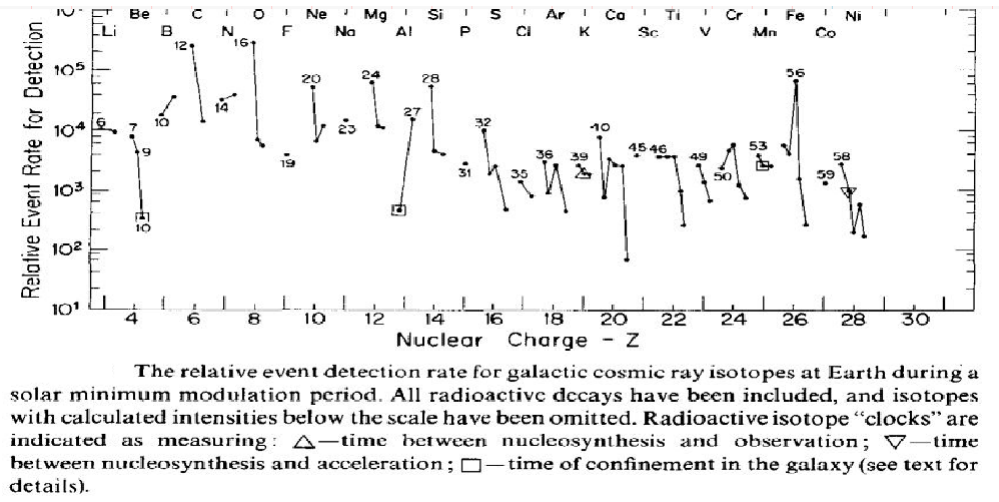
- If the revised law is right, a substantial fraction of cosmic rays up to at least 10^6 GeV/nucleon can be produced inside the solar system, and the measured flux would be an incoherent mixture of a solar-system class and a non-solar class that current detectors cannot separate by source.
- The revision would leave ordinary astronomy and low-energy physics untouched—slow or heavy bodies have E ≈ m—so all well-understood gravitational processes survive; the effect appears only for relativistic light particles near a massive body.
- Energy-coupling gravity would alter the interpretation of missing mass and dark energy, because the gravitational contribution of relativistic matter would be systematically underestimated in the standard cosmological accounting.
- The proposed E&M storage ring would let two different isotopes co-circulate at different velocities with a fixed, phase-locked crossing pattern, enabling rear-end nuclear collisions in a moving frame—for instance 6Li + 7Li → 13C + γ—with spin control and weak-interaction channels not accessible in fixed-target experiments.
Where Pith is reading between the lines
- My inference: the cleanest discriminator is a γ-dependence test. General relativity predicts gravitational deflection of a relativistic particle that is essentially independent of its Lorentz factor at leading order, while the revised law predicts deflection growing ∝ γ; the author notes that no experiment has ever been motivated to look for such an effect, so a deflection measurement at two parti
- My inference: the paper's ceiling of 10^6 GeV/nucleon (about 1 PeV) sits essentially at the observed 'knee' of the cosmic-ray spectrum. If the solar mechanism is correct, the knee would reflect solar-system acceleration limits—set by the Parker field strength and the roughly 10-year run imposed by the 22-year magnetic cycle—rather than Galactic propagation, a distinction testable through compositi
- My inference: the argument generalizes to every magnetized, windy star, so the double-slingshot efficiency implied by solar-system production could be extrapolated over the galaxy's stellar population to predict a diffuse galactic cosmic-ray budget; comparing that budget with observed fluxes would give an independent check of the claimed efficiency.
Editorial analysis
A structured set of objections, weighed in public.
Referee Report
Summary. The paper argues that replacing masses by total energies in Newton's law, Eq. (14), allows the Sun to capture and accelerate protons to energies of at least 10^6 GeV/nucleon within the solar system. The key quantitative anchor is Eq. (18), r_A-lim = G M_sun/2 = 6.6e9 m, which the paper compares with the solar radius 0.6957e9 m. A "double slingshot" mechanism is then proposed, involving pre-acceleration at Jupiter and capture around the Sun. A large fraction of the manuscript is devoted to accelerator physics: co-circulating E&M storage rings, rear-end nuclear collisions, kinematic tables, and a proposed lattice design for experiments such as 6Li + 7Li -> 13C + gamma.
Significance. If the modified gravitational law were correct, the paper would have broad implications for cosmic-ray origin, missing mass, and dark energy. The storage-ring material contains detailed kinematic tables and design considerations for co-moving beams, which may be of technical interest. However, the central astrophysical claim rests on an unsupported, ad hoc modification of Newtonian gravity and on a capture-radius calculation that is dimensionally inconsistent. The numerical agreement claimed between r_A-lim and r_sun is an artifact of unit mishandling, so the proposed solar cosmic-ray mechanism is not established.
major comments (3)
- [Section 8, Eqs. (17)-(18), and Recapitulation Eqs. (41)-(42)] The quantitative anchor is dimensionally inconsistent. With SI units restored, G M_sun/2 = 6.6e19 m^3/s^2; converting to a length requires division by c^2, giving about 7.4e2 m (0.74 km), not 6.6e9 m. Equivalently, using KE_A = (gamma_A - 1) m_A c^2 in Eq. (17) gives r_A-lim = (G M_sun / 2c^2) gamma_A/(gamma_A - 1), which approaches 0.74 km for gamma_A >> 1. This is five orders of magnitude smaller than the solar radius, not ten times larger. The claimed capture orbits outside the Sun and the 'double slingshot' mechanism therefore do not follow from Eq. (18).
- [Section 8, Eq. (14)] The modified gravitational force law F = G E1 E2 / r^2 is introduced as a postulate, with no derivation. The text itself states 'I doubt that this is possible' concerning consistency with general relativity. Every subsequent capture and acceleration result is a direct consequence of the gamma factor in this assumed law. Under standard rest-mass coupling, the capture radius for a relativistic proton is G M_sun / c^2 ~ 1.5 km, far inside the Sun, so the proposed mechanism fails unless Eq. (14) is independently established. The paper supplies no equivalence-principle test, no ultrarelativistic gravitational-deflection prediction, and no other falsifiable consequence of the modified law.
- [Section 8, 'Double slingshot' and 'Improving the performance'] The paper gives no quantitative flux, spectrum, or arrival-direction prediction. The mechanism is described as 'semi-quantitative', and the expected energy distribution is left as 'As a guess, one hopes/expects...'. This prevents any observational discrimination between solar and galactic cosmic-ray origin. In addition, the static longitudinal electric-field line-integral objection is dismissed with 'Perhaps, or even probably' (bullet 2) that the 22-year solar cycle overcomes it; no model or calculation demonstrates that net acceleration survives the cycle.
minor comments (4)
- [Section 8, Eq. (14)] The symbol r is introduced as 'the radius of the sun' in the sentence after Eq. (14), but is then used as a general radial coordinate. This obscures the derivation and should be fixed.
- [Appendix A] Typos: 'Coles-Notes' should be 'CliffsNotes'; 'read read' appears in the text. A careful proofreading pass is needed throughout.
- [References] Reference [8] is listed twice for the same book; reference [16] is used for two different sources; reference [42] has no author. Several bibliographic entries are incomplete.
- [Section 8, Eq. (16)] Equation (16) identifies KE_A with gamma_A m_A v_A^2/2, which is not the relativistic kinetic energy (gamma_A - 1)m_A c^2 used elsewhere in the paper. This inconsistency should be resolved or the derivation revised.
Circularity Check
The headline solar-capture result is computed from the modified gravitational law that was itself adopted to make solar cosmic rays possible; the 'prediction' restates the input.
specific steps
-
fitted input called prediction
[Section 8, Eq. (14)]
"Fp = G E1E2/r2 ≈ G m1γpmp/r2 , (14) ... I am forced to revise Newton ’s gravitational law in this new way in order to explain how most of the cosmic rays observed in nature, at least up to 106 GeV/nucleus for example, can have been produced within the solar system."
The modified force law is introduced specifically so that relativistic protons feel a γ-enhanced gravitational force and can be captured by the Sun. The subsequent cosmic-ray energies are then presented as consequences of that law, but they are the motivation for the law, not independent predictions. No external data, equivalence-principle test, or parameter-free constraint is used to fix Eq. (14); the solar-capture conclusion is built into the chosen input.
-
self definitional
[Section 8, Eqs. (16)-(18); Section 12, Eqs. (41)-(42)]
"rA−lim = G Msun 2 = 6.6 × 10⁹ m. (18) ... The most persuasive theoretical indication that this replacement of mass by energy may be physically correct comes in the comparison of Eq. (18) and Eq. (19)."
Eq. (18) is just the limiting radius obtained by inserting E≈γm into the assumed force law and setting the kinetic-energy factor to 1. Comparing that computed radius with the observed solar radius is offered as evidence for the force law, but the comparison is a consistency check with no independent predictive content: the force law was chosen so that capture at solar-system scales would be possible. The 'prediction' is the definition of the model, not a test of it.
-
other
[Section 8, Eqs. (17)-(18)]
"Following Eq.(58) in Appendix B, the final factor in Eq. (17) has been set equal to 1."
Eq. (17) contains the factor γ_A m_A / KE_A. Setting this factor to 1 is not a consequence of Eq. (58), which is the non-relativistic approximation E≈E0+mv^2/2; for a relativistic proton the factor is not 1 in the same units. This algebraic choice removes the energy dependence that would otherwise determine the numerical radius, so the claimed 6.6×10^9 m result is effectively inserted by hand rather than derived.
full rationale
The paper contains two distinct projects. The storage-ring sections (Sections 9-11) are concrete accelerator-physics designs and are not circular: they use standard Lorentz-force optics and are checked against internal kinematic consistency. The headline claim, however, is the solar cosmic-ray mechanism, and that claim is circular in the central sense. Eq. (14) is an ad hoc replacement of rest mass by total energy in Newton's law, explicitly adopted 'in order to explain' solar production of cosmic rays up to 10^6 GeV/nucleon. The key quantitative anchor, r_A-lim = G M_sun/2, is then derived from that same equation and exhibited as 'the most persuasive theoretical indication' that the mass-to-energy replacement is correct. That is comparing the model's own assumption with an observed radius, not testing the assumption. The step from Eq. (17) to Eq. (18) further sets the kinetic-energy factor to 1 without justification, making the numerical result an even more direct construction. Thus the central derivation reduces by construction to its input: the gamma factor in the input law produces the gamma factor in the capture condition, and the capture radius is presented as validation. The paper's own admission that it is 'forced' to revise the law and its doubt about compatibility with general relativity reinforce that the premise is not independently established. Score 8: the headline result is forced by definition, while the non-cosmic-ray accelerator material remains independent.
Axiom & Free-Parameter Ledger
free parameters (6)
- Energy coupling factor gamma2 in modified Newton law
- Injection energy E_inj =
10 MeV
- Capture radius r_A-lim =
6.6 x 10^9 m
- Planetary magnetic moment fit beta* =
spans roughly three orders of magnitude
- PTR electric field exponent mnom =
0.32349
- Electric bending fudge factor =
1.1
axioms (7)
- ad hoc to paper Gravitational force between a heavy body and a light relativistic particle is F = G E1 E2 / r^2 approx G M_sun gamma m / r^2 (Eq 14).
- domain assumption The Parker solar wind provides a longitudinal electric field that accelerates captured ions.
- domain assumption The solar system is treated as a closed and isolated system for cosmic ray accounting.
- standard math KE_A approx gamma_A m_A in the ultrarelativistic limit, used to derive r_A-lim.
- standard math Cary-Brizard guiding-center adiabatic theory applies to ions in the solar wind.
- domain assumption Solar isotope abundance ratios can be read as evidence for solar-system cosmic ray production.
- ad hoc to paper The 22-year solar magnetic cycle overcomes the impossibility of a static longitudinal electric field line integral.
invented entities (1)
-
Energy-weighted gravitational coupling for light particles
no independent evidence
Cite this review
Pith. "Pith review of Solar cosmic ray generation, Newtonian gravity, missing mass, dark energy, laboratory-based nuclear astrophysics, and all that." pith.science (2026). https://pith.science/paper/R6YB3HUL
@misc{pith2026250819296,
  author       = {Pith},
  title        = {Pith review of: Solar cosmic ray generation, Newtonian gravity, missing mass, dark energy, laboratory-based nuclear astrophysics, and all that},
  year         = {2026},
  howpublished = {\url{https://pith.science/paper/R6YB3HUL}},
  note         = {Machine review of arXiv:2508.19296}
}
abstract
Begun as part of a promotion of accelerator-based nuclear astrophysics, research toward this goal has shifted to cosmic ray production within the solar system. This has been motivated by the high quality of data collected recently by programs such as the International Space Station (ISS), by the fundamental importance of the topic, and by the unsatisfactory state of our understanding of the actual source of cosmic rays. A ``minor'' change in the Newtonian gravitational formulation converts solar production of high energy cosmic rays from ``impossible'' to ``likely'', without much disrupting the vast existent domain of well understood astronomical gravitational processes. This change enables the sun to ``capture'' protons of energy so high that they would, otherwise, escape the solar system. This change in Newton's gravitational formula would disrupt current cosmological understanding of missing mass and dark energy. With this changed understanding of gravity, it has been quite easy to produce a semi-quantitative understanding of the solar origin of cosmic rays up to energies at least as great as $10^6$\,GeV/nucleon that have by now been detected and measured so persuasively. A ``Double Slingshot'' mechanism is proposed according to which at least a substantial fraction of all cosmic rays could have begun their life within the solar system. Accelerator-based nuclear astrophysics is promoted, beginning with the functioning of an ``{\rm E}\&{\rm M}'' storage ring for laboratory-based study of processes such as ${\rm 6LI} + {\rm 7Li} \rightarrow {\rm 13C} + \gamma$. Especially to be emphasized are experiments made possible by ''rear-end collisions'' between nuclear isotopes of two different types traveling simultaneously at different velocities in the same direction in the same storage ring. This amounts to ``studying nuclear physics in a moving frame of reference''.
Figures






Reference graph
Works this paper leans on
-
[1]
A. Coc, Variation of fundamental constants and the role of A=5 and A=8 nuclei on primordial nucleosynthesis. Phys. Rev. D 86, 043529, 2012
work page 2012
-
[2]
A.C. Merchant and N. Rowley, Alpha-deuteron cluster model of 6Li including tensor forces , Phys. Letters, 3 January, 1985
work page 1985
-
[3]
T. Uesaka and N. Itagaki, Nuclear clustering—manifestations of non-uniformity in nuclei, doi.org/10.1098/rsta.2023.0123, 2024
-
[4]
S.V. Badman and S.W.H. Cowley, Significance of Dungey-cycle flows in Jupiter’s and Saturn ’s magneto-spheres, Ann. Geophys., 25, 941–951, 2007,www.ann- geophys.net/25/941/2007/ © European Geo-sciences Union 2007
work page 2007
-
[5]
M.J. Owens and R.J. Forsyth, The Heliospheric magnetic field, doi:10.12942/lrsp- 2013-5
-
[6]
L. Landau and E. Lifshitz, Mechanics, Third Edition, Elsevier, Butterworth, Heine- Mann, Section 39, 2010
work page 2010
-
[8]
Richard Talman, Geometric Mechanics, 2nd edition, Wiley VCH, Chapter 14, 2007
work page 2007
- [9]
-
[10]
Simpson, Elemental and Isotopic Composition of the Galactic Cos- mic Rays, Ann
J.A. Simpson, Elemental and Isotopic Composition of the Galactic Cos- mic Rays, Ann. Rev. Nucl. Part. Sci., 33 p. 323, 1983 DOI: 10.1146/an- nurev.ns.33.120183.001543
arXiv 1983
-
[11]
A.G.W. Cameron and W.A. Fowler, Lithium and the s-process in red-giant stars, The Astrophysical Journal, 171 1971
work page 1971
- [12]
-
[13]
S.A. Koldobsky, Time Lag Between Cosmic-Ray and Solar Variability: Sunspot Numbers and Open Solar Magnetic Flux, https://doi.org/10.1007/s11207-022-01970- 1, 2021
-
[14]
Wiens et al.Earth and Planetary Science Letters 226 (2004) 549–565
R.C. Wiens et al.Earth and Planetary Science Letters 226 (2004) 549–565
work page 2004
-
[15]
Fowler, The Astrophysical Journal, 164:111-114, 1971
Cameron and W. Fowler, The Astrophysical Journal, 164:111-114, 1971
work page 1971
-
[16]
C. A. Barnes, D.D. Clayton. and D.N Schram, Editors, Essays in Nuclear Astro- physics, W.A. Fowler 70th Birthday, Cambridge University Press, 1982
work page 1982
-
[17]
C.E. Rolfs and W.S. Rodney, Cauldrons in the Cosmos:Nuclear Astrophysics, Uni- versity of Chicago Press, 1988
work page 1988
-
[18]
T. Travis and S. Cambioni, The Role of Giant Impacts in Planet Formation, Annu. Rev. Earth Planet. Sci. 51:671–95, 2023
work page 2023
-
[19]
Jacob Biemond, The Schuster-Wilson-Blackett hypothesis, arXiv:physics/0411129v1 [physics.gen-ph] 63
work page internal anchor Pith review Pith/arXiv arXiv
-
[20]
Christensen-Dalsgaard, Solar structure and evolution, arXiv:2007.06488v2 [astro- ph.SR] 14 May, 2021
J. Christensen-Dalsgaard, Solar structure and evolution, arXiv:2007.06488v2 [astro- ph.SR] 14 May, 2021
Pith/arXiv arXiv 2007
-
[21]
Z. Yang, et al. Global maps of the magnetic field in the solar corona, Science 369, 694–697, 2020
work page 2020
-
[22]
External Inversion, Internal Inversion, and Reflection Invariance
M. Pavsic, “External Inversion, Internal Inversion, and Reflection Invariance”, Int. J. Theor. Phys. , vol. 9, pp. 229–244, 1974
work page 1974
-
[23]
Talman, Novel Relativistic Effect Important in Accelerators, PRL 56, 14, p.1429, 1986
R. Talman, Novel Relativistic Effect Important in Accelerators, PRL 56, 14, p.1429, 1986
work page 1986
-
[24]
D. Agle, Jet Propulsion Laboratory, https://www.pas.rochester.edu/blackman/ast104/jmagnetic.html, May 20, 2019
work page 2019
-
[25]
I. A. Koop, Asymmetric energy colliding ion beams in the EDM storage ring, TUPWO040, Proceedings of IPAC2013, Shanghai, China
-
[26]
R. Talman and J. Talman, Electric dipole moment planning with a resurrected BNL Alternating Gradient Synchrotron electron analog ring , PRST-AB, 18, 074004, 2015
work page 2015
-
[27]
Superimposed Electric/Magnetic "Dipole Moment Comparator" Lattice Design
R. Talman, Superimposed Electric/Magnetic Dipole Moment Comparator Lattice De- sign, arXiv:2108.12353
work page internal anchor Pith review Pith/arXiv arXiv
-
[28]
R. Talman, Difference of measured proton and He3 EDMs: a reduced systematics test of T-reversal invariance, Journal of Instrumentation, JINST 060P 0522, 2022
work page 2022
-
[29]
Predominantly electric storage ring with nuclear spin control capability
R. Talman, Predominantly electric storage ring with nuclear spin capability, https://arxiv.org/2402.04109
work page internal anchor Pith review Pith/arXiv arXiv
-
[30]
R. Talman, Proposed experimental study of wave-particle duality in p,p scattering, https://arxiv.org/abs/2302.03557, and Journal of Instrumentation, https://pos.sissa.it/433/039/pdf, 2023
work page internal anchor Pith review Pith/arXiv arXiv 2023
-
[31]
R. Talman, Difference of measured proton and He3 EDMs: reduced systematics test of T-reversal Invariance, Snowmass-Seattle Meeting, https://indico.fnal.gov/event/22303/contributions/247083,, 2022
work page 2022
-
[32]
CPEDM Group, Storage ring to search for electric dipole moments of charged parti- cles Feasibility study, CERN Yellow Reports: Monographs, CERN-2021-003, 2021
work page 2021
-
[33]
Lattice Design and Performance
Proposed experimental study of wave-particle duality in p,p scattering, Journal of Instrumentation, https://pos.sissa.it/433/039/pdf, Chapter 5, “Lattice Design and Performance”
-
[34]
D. Eversmann et al., New method for a continuous determination of the spin tune in storage rings and implications for precision experiments, Phys. Rev. Lett. 115 094801, 2015
work page 2015
-
[35]
Hempelmann et al., Phase-locking the spin precession in a storage ring, P.R.L
N. Hempelmann et al., Phase-locking the spin precession in a storage ring, P.R.L. 119, 119401, 2017
work page 2017
-
[36]
F. Rathmann, N. Nikolaev, and J. Slim, Spin dynamics investigations for the electric dipole moment experiment, Phys. Rev. Accel. Beams 23, 024601, 2020
work page 2020
-
[37]
J. Slim et al., First detection of collective oscillations of a stored deuteron beam with an amplitude close to the quantum limit, Phys. Rev. Accel. Beams, 24, 124601, 2021 64
work page 2021
-
[38]
R.Talman, Improving the hadron EDM upper limit using doubly-magic proton and helion beams, arXiv:2205.10526v1 [physics.acc-ph] 21 May, 2022
work page internal anchor Pith review Pith/arXiv arXiv 2022
-
[39]
R. Talman and N. N. Nikolaev, Colliding beam elastic p, pand p, dscattering to test T - and P -violation, Snowmass 2021, Community Town Hall/86, 5 October, 2020
work page 2021
-
[40]
P. Lenisa et al., Low-energy spin-physics experiments with polarized beams and targets at the COSY storage ring, EPJ Techniques and Instrumentation, https://doi.org/10.1140/epjti/s40485-019-0051-y, 2019
-
[41]
Burbidge, Burbidge, Fowler, and Hoyle, Rev. Mod. Phys., 29, 547, 1957
work page 1957
-
[42]
, Cosmology and elementary particles , Rev. Mod. Phys. , Vol. 53, No. 1, January 1981
work page 1981
-
[43]
W. Sweeney, Jr. and J. Marion. Gamma-Ray Transitions Involving Mixed states in Be8, Phys. Rev. 182, 4, 1969
work page 1969
-
[44]
Private communication from Deepak Raparia, BNL, 2024
work page 2024
-
[45]
https://doi.org/10.1016/j.nimb.2024.165460
Measurement of lithium cross-sections ..,. https://doi.org/10.1016/j.nimb.2024.165460
-
[46]
Kai Zuber, Neutrino Physics, Second Edition, CRC Press, Taylor and Fransis Group, 2012
work page 2012
-
[47]
Private communication from Anatoli Zelenski, BNL, 2024
work page 2024
-
[48]
S.L. Shapiro and S.A. Teukolsky, Black Holes, White Dwarfs and Neutron Stars: The Physics of Compact Objects, John Wiley and Sons, 1993 A Cary-Brizard guiding-center adiabatic theory John Cary and Alain Brizard[9] (C-B) have produced a clear and comprehensive modern Lagrangian and Hamiltonian classical mechanics phase space treatment of the guided field m...
work page 1993
This paper was first reviewed by deepseek-v4-flash on August 5, 2026.
discussion (0)
Sign in with ORCID, Apple, or X to comment. Anyone can read and Pith papers without signing in.