REVIEW 3 major objections 6 minor 1 cited by
A Comprehensive Survey of 5G URLLC and Challenges in the 6G Era
T0 review · 3 major / 6 minor · reviewed 2026-08-05 · deepseek-v4-flash
Pith's one-line read This survey aims to be the first complete map of URLLC, from short-packet physics to 6G research agendas.
desk verdict Useful, current survey with a real comprehensiveness claim that its own Table I undercuts; worth refereeing despite fixable errors. read the letter →
The pith
A machine-rendered reading of the paper's core claim, the machinery that carries it, and where it could break.
The reading
What carries the argument
The load-bearing mechanism is the URLLC KPI pair—≤1 ms end-to-end latency and reliability from (1−10⁻⁵) to (1−10⁻⁹)—together with the short-packet constraint it forces. Because packets shrink to a few tens of bytes, the traditional levers for reliability (coding gain, HARQ retransmission rounds, pilot/control overhead, cryptographic key length) all change behavior, so the survey organizes techniques by which layer absorbs the tension. Its second device is a layered taxonomy—PHY, MAC, cross-layer, machine learning, security—used to classify the literature, with a comparison table of prior surveys serving as the evidence that the gap exists.
What would settle it
Apply the paper's own six-column grid (PHY, MAC, cross-layer, machine learning, security, 6G overview) to every prior URLLC survey, including those not cited in the comparison table. If any one of them scores six of six—or if the table mischaracterizes [21], the closest prior candidate—the central 'no comprehensive survey exists' claim fails. A simpler observation would settle it: find one important URLLC subtopic (e.g., energy-efficiency co-design or positioning) that the survey itself does not cover; that shows 'comprehensive' is scope-dependent.
Extended reading notes
Core claim
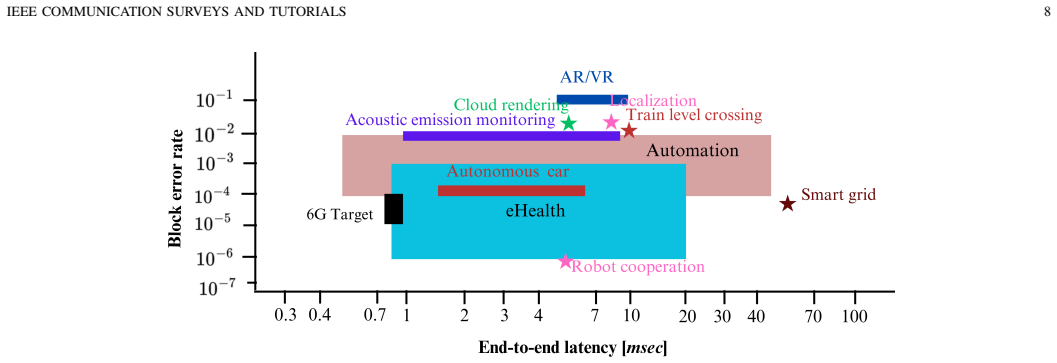
The paper sets out to be the first survey that covers URLLC end to end: it traces the history and standards (3GPP Releases 15–18), collects latency and reliability targets across verticals (factory automation, intelligent transport, smart grid, smart city, tactile internet), then reviews the physical layer (frame structure, packet structure, waveforms, channel coding, MIMO, mmWave, diversity), MAC layer (scheduling, multi-connectivity), cross-layer design (ARQ/HARQ, retransmission, resource allocation), security, and machine-learning solutions. It closes by framing 6G challenges—0.1 ms user-plane latency, 99.99999% reliability, communication-control co-design, mobility, scalability, energy,
Load-bearing premise
The claim of comprehensiveness rests on an unstated assumption: that the prior surveys compared in the table were selected and characterized accurately enough to prove that none already covers all the same dimensions, and the paper gives no search or inclusion protocol to back that selection.
Editorial extensions
If this is right
- A newcomer gets a structured map of the URLLC design space: frame structures, short-blocklength codes, scheduling, retransmission, multi-connectivity, ML, and security, all keyed to the same latency-reliability targets.
- The paper's layered review implies that no single-layer fix suffices; meeting 1 ms and 99.999% requires joint PHY-MAC-cross-layer design, with machine learning increasingly used to predict and pre-empt delay.
- 3GPP Releases 15–18 form the current baseline, and the survey shows each release adding URLLC features—redundant transmission, sub-slot HARQ feedback, and traffic prioritization.
- The 6G agenda is specified: sub-0.1 ms user-plane latency, 99.99999% reliability, communication-control co-design, and candidate technologies such as OTFS/DDAM, ISAC, RSMA, cell-free massive MIMO, and split learning.
- If the taxonomy is complete, future work can position itself against a known checklist instead of rediscovering prior art.
Reading between the lines
- The comprehensiveness claim is testable and time-sensitive: the paper states no systematic search or inclusion protocol, so the 'gap' is an assertion about the literature as of its writing; a newer or non-indexed survey could already span all six dimensions.
- The short-packet constraint likely binds harder than the survey frames it: ML-based prediction and split learning add their own signaling and model-exchange overhead, and the paper does not budget those against the 1 ms deadline.
- The six-dimension taxonomy could serve as an evaluation checklist for future URLLC proposals, making the survey's structure a reusable artifact independent of its reference list.
- An implicit consequence is that if 0.1 ms and 99.99999% are hard physical targets, incremental 5G tuning may plateau; the paper's 6G catalogue points toward a new air-interface paradigm rather than refinement of the current one.
Editorial analysis
A structured set of objections, weighed in public.
Referee Report
Summary. This survey aims to provide a comprehensive treatment of URLLC in 5G and its evolution toward 6G. It is organized around a layered taxonomy: history, vertical use cases, challenges, physical layer techniques, MAC layer techniques, cross-layer designs, machine-learning approaches, and 6G research directions. The paper positions itself against ten prior surveys in Table I and claims that no existing survey covers all aspects of URLLC, with the stated contribution being to fill that gap. The survey draws on a large reference base and provides numerous summary tables and a taxonomy of techniques.
Significance. If the coverage claim is accurate, this would be a useful reference map for researchers entering the URLLC area, spanning PHY, MAC, cross-layer, security, machine learning, and 6G. The paper's strengths include its broad scope, the classification of prior surveys into a comparative table, the layered organization, and the compilation of recent results on topics such as cell-free massive MIMO, ISAC, OTFS, and federated reinforcement learning. These features make it potentially valuable as an entry point to the literature. However, the survey's primary contribution is its claim to comprehensiveness, and that claim currently rests on an internally inconsistent prior-survey comparison and an unreported selection methodology. The paper does not provide machine-checked artifacts, but it does offer a large curated bibliography and structured tables, which are useful if the accuracy issues are resolved.
major comments (3)
- [Section II, Table I] The paper's central claim (Section I: "there is no survey that comprehensively covers all the aspects of URLLC") is supported only by Table I, but Table I is internally inconsistent with the text. For [21], the text credits only PHY/MAC protocols, a brief cross-layer overview, applications, and future directions, and explicitly says it overlooks recent 5G progress; the table nevertheless marks five dimensions (PHY, MAC, URLLC, Cross layer, Machine learning). Similarly, [30] is described as focused on FRL and MAC channel access, while the table marks PHY, MAC, URLLC, Cross layer and ML with only the ML dimension footnoted as "FRL only." No search protocol, database, or inclusion/exclusion criteria are given, so the completeness claim cannot be reproduced. This is load-bearing for the stated contribution. Please correct Table I to match the text or provide a verifiable protocol/audit, and
- [Section VI-E and reference list] References [138] and [145] are the same paper (Tärneberg et al., SECON Workshops 2017), as are [143] and [146] (Vu et al., IEEE Communications Letters 2017). This is not merely editorial: the sentences citing [145] ("evaluated the performance bounds of massive MIMO") and [146] ("utility-delay control approach using Lyapunov technique") attribute findings that are not in the cited works. Table V likewise uses [138] and [143] as if distinct. Deduplicate and re-verify all affected attributions.
- [Section IV-A] The vertical requirements contain a numeric error: motion control is stated to have "E2E delay of 1 µs", whereas the same subsection and Table II (and 3GPP TS 22.261) specify 1 ms. The following sentence "jitter of 10 1µs" is garbled. Since the paper's survey of vertical requirements is part of its content, this needs correction; please re-check all latency/reliability figures against the cited 3GPP documents.
minor comments (6)
- [Section III] "ultra low latency and ultra low reliability" should read "ultra low latency and ultra high reliability" (or equivalent), given the surrounding discussion.
- [Section V-C] Typos: "probelms" should be "problems", "alloction" should be "allocation". Similar typos appear in Section VII-C ("reduced-sised") and Section VII-B ("career aggregation" should be "carrier aggregation").
- [Table I] The footnotes "1 Partial description of URLLC" and "2 FRL only" appear in cells but are not explained in the caption; it is unclear which rows/columns they apply to. Also, the table's checkmarks should be reconciled with the narrative descriptions of each survey.
- [Section VI-C] "OFTS" in the sentence "OFTS provides the lowest latency" should be "OTFS". Also, "peak-to-average (PAPR)" should be expanded as "peak-to-average power ratio" on first use.
- [Section II] The introduction contains "URRLLC" (should be "URLLC"). Please run a consistency check on terminology.
- [Section IV-A] "user plain" appears repeatedly and should be "user-plane". Also, the phrase "1 µs" in the motion-control description is a candidate for the same correction already noted in the major comments.
Circularity Check
No significant circularity: the survey's synthesis rests on external literature; self-citations are contextual and not load-bearing.
full rationale
The paper's central claim (Section I) is that 'there is no survey that comprehensively covers all the aspects of URLLC' and that this survey fills that gap. This is an assertion about the surveyed literature, supported by the comparative Table I, not a result derived from the paper's own equations, fitted parameters, or normalizations. The paper is an attributive survey: each technical statement is traced to cited external works, and no derivation chain reduces to the paper's own inputs. Self-citations appear ([1] Tariq et al., [28] with M. A. Imran, [52] Imran et al.) but only as background/context for 6G visions, interference management, and verticals; they do not justify the comprehensiveness claim and are not invoked as uniqueness theorems or forced choices. The skeptic's concerns — an apparent inconsistency in Table I's characterization of prior survey [21] (machine-learning check vs. text that does not mention ML) and the absence of a stated search protocol — are correctness/reproducibility limitations, not circularity. They do not exhibit any step where a claimed output is equivalent by construction to an input. Therefore the paper falls in the normal non-circular range; score 1 reflects the presence of minor self-citations that are not load-bearing.
Assumptions & free parameters
assumptions (3)
- domain assumption URLLC is defined by the ITU/3GPP KPI envelope: user-plane latency up to about 1 ms and reliability from 99.999% to 99.9999999% (Sections I and III).
- domain assumption The characterization of the prior survey literature in Table I is accurate, in particular that [21] does not provide the same comprehensive coverage as this paper.
- domain assumption Summaries of 3GPP Release 15-18 features and of the cited technical papers faithfully reflect the underlying standards and results.
Cite this review
Pith. "Pith review of A Comprehensive Survey of 5G URLLC and Challenges in the 6G Era." pith.science (2026). https://pith.science/paper/IGXAIYJQ
@misc{pith2026250820205,
  author       = {Pith},
  title        = {Pith review of: A Comprehensive Survey of 5G URLLC and Challenges in the 6G Era},
  year         = {2026},
  howpublished = {\url{https://pith.science/paper/IGXAIYJQ}},
  note         = {Machine review of arXiv:2508.20205}
}
read the original abstract
As the wireless communication paradigm is being transformed from human centered communication services towards machine centered communication services, the requirements of rate, latency and reliability for these services have also been transformed drastically. Thus the concept of Ultra Reliable and Low Latency Communication (URLLC) has emerged as a dominant theme for 5G and 6G systems. Though the latency and reliability requirement varies from one use case to another, URLLC services generally aim to achieve very high reliability in the range of 99.999\% while ensuring the latency of up to 1 ms. These two targets are however inherently opposed to one another. Significant amounts of work have been carried out to meet these ambitious but conflicting targets. In this article a comprehensive survey of the URLLC approaches in 5G systems are analysed in detail. Effort has been made to trace the history and evolution of latency and reliability issues in wireless communication. A layered approach is taken where physical layer, Medium Access Control (MAC) layer as well as cross layer techniques are discussed in detail. It also covers the design consideration for various 5G and beyond verticals. Finally the article concludes by providing a detailed discussion on challenges and future outlook with particular focus on the emerging 6G paradigm.
Figures


Figures from the paper (7 more)



Forward citations
Cited by 1 Pith paper
-
Measurement-Driven Early Warning of Reliability Breakdown in 5G NSA Railway Networks
On real 10 Hz 5G NSA metro-train traces, TimesNet and CNN predict radio link failures up to three seconds ahead, with best F1 ≈ 0.85 (TimesNet) and 0.82 (CNN).
Reference graph
Works this paper leans on
-
[21]
Enabling technologies for ultra-reliable and low la- tency communications: From phy and mac layer perspectives,
G. J. Sutton, J. Zeng, R. P. Liu, W. Ni, D. N. Nguyen, B. A. Jayawickrama, X. Huang, M. Abolhasan, Z. Zhang, E. Dutkiewicz, and T. Lv, “Enabling technologies for ultra-reliable and low la- tency communications: From phy and mac layer perspectives,” IEEE Communications Surveys Tutorials , vol. 21, no. 3, pp. 2488–2524, thirdquarter 2019
2019
-
[145]
Utilizing massive mimo for the tactile internet: Advantages and trade- offs,
W. Tarneberg, M. Karaca, A. Robertsson, F. Tufvesson, and M. Kihl, “Utilizing massive mimo for the tactile internet: Advantages and trade- offs,” in 2017 IEEE International Conference on Sensing, Communi- cation and Networking (SECON Workshops) . IEEE, 2017, pp. 1–6
2017
-
[143]
Ultra-reliable and low latency communication in mmwave- enabled massive mimo networks,
T. K. Vu, C.-F. Liu, M. Bennis, M. Debbah, M. Latva-Aho, and C. S. Hong, “Ultra-reliable and low latency communication in mmwave- enabled massive mimo networks,” IEEE Communications Letters , vol. 21, no. 9, pp. 2041–2044, 2017
-
[146]
Ultra-reliable and low latency communication in mmwave- enabled massive mimo networks,
T. K. Vu, C. Liu, M. Bennis, M. Debbah, M. Latva-aho, and C. S. Hong, “Ultra-reliable and low latency communication in mmwave- enabled massive mimo networks,” IEEE Communications Letters , vol. 21, no. 9, pp. 2041–2044, Sep. 2017
-
[30]
Urllc for 5g and beyond: Requirements, enabling incumbent technologies and network intelligence,
R. Ali, Y . B. Zikria, A. K. Bashir, S. Garg, and H. S. Kim, “Urllc for 5g and beyond: Requirements, enabling incumbent technologies and network intelligence,” IEEE Access, vol. 9, pp. 67 064–67 095, 2021
2021
-
[1]
A speculative study on 6G,
F. Tariq, M. R. A. Khandaker, K. Wong, M. A. Imran, M. Bennis, and M. Debbah, “A speculative study on 6G,” IEEE Wireless Communica- tion, vol. 99, 2020
2020
-
[2]
What will 5G be?
J. G. Andrews, S. Buzzi, W. Choi, S. V . Hanly, A. Lozano, A. C. Soong, and J. C. Zhang, “What will 5G be?” IEEE Journal on selected areas in communications , vol. 32, no. 6, pp. 1065–1082, 2014
2014
-
[3]
M. M. Islam, M. L. Baptista, and F. Tariq, Artificial Intelligence for Smart Manufacturing and Industry X. 0 . Springer, 2025
2025
Show all 299 references
-
[4]
A survey of 5G network: Architecture and emerging technologies,
A. Gupta and R. K. Jha, “A survey of 5G network: Architecture and emerging technologies,” IEEE Access, vol. 3, pp. 1206–1232, 2015
2015
-
[5]
Survey on network slicing for internet of things realization in 5g networks,
S. Wijethilaka and M. Liyanage, “Survey on network slicing for internet of things realization in 5g networks,” IEEE Communications Surveys & Tutorials, vol. 23, no. 2, pp. 957–994, 2021
2021
-
[6]
Radio resource management techniques for embb and mmtc services in 5G dense small cell scenarios,
N. H. Mahmood, M. Lauridsen, G. Berardinelli, D. Catania, and P. Mogensen, “Radio resource management techniques for embb and mmtc services in 5G dense small cell scenarios,” in 2016 IEEE 84th Vehicular Technology Conference (VTC-Fall), Sep. 2016, pp. 1–5
2016
-
[7]
Dynamic sdn- based radio access network slicing with deep reinforcement learning for urllc and embb services,
A. Filali, Z. Mlika, S. Cherkaoui, and A. Kobbane, “Dynamic sdn- based radio access network slicing with deep reinforcement learning for urllc and embb services,” IEEE Transactions on Network Science and Engineering, 2022
2022
-
[8]
Towards massive connectivity support for scalable mmtc communications in 5G networks,
C. Bockelmann, N. K. Pratas, G. Wunder, S. Saur, M. Navarro, D. Gregoratti, G. Vivier, E. De Carvalho, Y . Ji, C. Stefanovic, P. Popovski, Q. Wang, M. Schellmann, E. Kosmatos, P. Demestichas, M. Raceala-Motoc, P. Jung, S. Stanczak, and A. Dekorsy, “Towards massive connectivity...
2018
-
[9]
5g: A tutorial overview of standards, trials, challenges, deployment, and practice,
M. Shafi, A. F. Molisch, P. J. Smith, T. Haustein, P. Zhu, P. De Silva, F. Tufvesson, A. Benjebbour, and G. Wunder, “5g: A tutorial overview of standards, trials, challenges, deployment, and practice,” IEEE Journal on Selected Areas in Communications , vol. 35, no. 6, pp. 1201...
2017
-
[10]
Deliverable d6. 3 intermediate system evaluation results,
P. Popovski, G. Mange, A. Roos, T. Rosowski, G. Zimmermann, J. S ¨oder et al. , “Deliverable d6. 3 intermediate system evaluation results,” ICT-317669-METIS/D6. 3, 2014
2014
-
[11]
5g- enabled tactile internet,
M. Simsek, A. Aijaz, M. Dohler, J. Sachs, and G. Fettweis, “5g- enabled tactile internet,” IEEE Journal on Selected Areas in Com- munications, vol. 34, no. 3, pp. 460–473, March 2016
2016
-
[12]
Verticals urllc use cases and requirements,
N. Alliance, “Verticals urllc use cases and requirements,” NGMN Alliance, 2019
2019
-
[13]
‘5G and e-health,
G. Association et al. , “‘5G and e-health,” 5GPPP , White Paper, Oct, 2015
2015
-
[14]
Trans-oceanic teler- obotic surgery,
B. Challacombe, L. Kavoussi, and P. Dasgupta, “Trans-oceanic teler- obotic surgery,” BJU international, vol. 92, no. 7, pp. 678–680, 2003
2003
-
[15]
Cross-layer optimization for ultra- reliable and low-latency radio access networks,
C. She, C. Yang, and T. Q. Quek, “Cross-layer optimization for ultra- reliable and low-latency radio access networks,” IEEE Transactions on Wireless Communications, vol. 17, no. 1, pp. 127–141, 2018. IEEE COMMUNICATION SURVEYS AND TUTORIALS 33
2018
-
[16]
Fundamental tradeoffs among reliability, latency and throughput in cellular networks,
B. Soret, P. Mogensen, K. I. Pedersen, and M. C. Aguayo-Torres, “Fundamental tradeoffs among reliability, latency and throughput in cellular networks,” in Globecom Workshops (GC Wkshps), 2014 . IEEE, 2014, pp. 1391–1396
2014
-
[17]
Pre-scheduled resources for retransmissions in ultra-reliable and low latency communications,
R. Abreu, P. Mogensen, and K. I. Pedersen, “Pre-scheduled resources for retransmissions in ultra-reliable and low latency communications,” in 2017 IEEE Wireless Communications and Networking Conference (WCNC), March 2017, pp. 1–5
2017
-
[18]
Ultra-reliable and low-latency communications in 5G downlink: Physical layer aspects,
H. Ji, S. Park, J. Yeo, Y . Kim, J. Lee, and B. Shim, “Ultra-reliable and low-latency communications in 5G downlink: Physical layer aspects,” IEEE Wireless Communications, vol. 25, no. 3, pp. 124–130, 2018
2018
-
[19]
Radio access for ultra-reliable and low-latency 5G communications,
N. A. Johansson, Y .-P. E. Wang, E. Eriksson, and M. Hessler, “Radio access for ultra-reliable and low-latency 5G communications,” in Com- munication Workshop (ICCW), 2015 IEEE International Conference on. IEEE, 2015, pp. 1184–1189
2015
-
[20]
Toward massive, ultrareliable, and low-latency wireless communication with short packets,
G. Durisi, T. Koch, and P. Popovski, “Toward massive, ultrareliable, and low-latency wireless communication with short packets,” Proceed- ings of the IEEE , vol. 104, no. 9, pp. 1711–1726, 2016
2016
-
[22]
5g ultra-reliable low-latency communication implementation challenges and operational issues with iot devices,
M. A. Siddiqi, H. Yu, and J. Joung, “5g ultra-reliable low-latency communication implementation challenges and operational issues with iot devices,” Electronics, vol. 8, no. 9, p. 981, 2019
2019
-
[23]
Ai/ml-aided capacity maximization strategies for urllc in 5g/6g wireless systems: A survey,
R. B. Shaik, P. Nagaradjane, I. Ioannou, V . Sittakul, V . Vasiliou, and A. Pitsillides, “Ai/ml-aided capacity maximization strategies for urllc in 5g/6g wireless systems: A survey,” Computer Networks, p. 110506, 2024
2024
-
[24]
A survey on security of ultra/hyper reliable low latency communication: Recent advancements, challenges, and future directions,
A. Pradhan, S. Das, M. J. Piran, and Z. Han, “A survey on security of ultra/hyper reliable low latency communication: Recent advancements, challenges, and future directions,” arXiv preprint arXiv:2404.08160 , 2024
2024 arXiv
-
[25]
Energy efficiency and latency optimization for iot urllc and mmtc use cases,
O. Elgarhy, L. Reggiani, M. M. Alam, A. Zoha, R. Ahmad, and A. Kuusik, “Energy efficiency and latency optimization for iot urllc and mmtc use cases,” IEEE Access, 2024
2024
-
[26]
Urllc and embb in 5g industrial iot: A survey,
B. S. Khan, S. Jangsher, A. Ahmed, and A. Al-Dweik, “Urllc and embb in 5g industrial iot: A survey,” IEEE Open Journal of the Communications Society, vol. 3, pp. 1134–1163, 2022
2022
-
[27]
Next-generation wireless solutions for the smart factory, smart vehicles, the smart grid and smart cities,
T. M. Ho, T. D. Tran, T. T. Nguyen, S. Kazmi, L. B. Le, C. S. Hong, and L. Hanzo, “Next-generation wireless solutions for the smart factory, smart vehicles, the smart grid and smart cities,” arXiv preprint arXiv:1907.10102, 2019
1907 arXiv
-
[28]
Urllc in beyond 5g and 6g networks: An interference management perspective,
M. U. A. Siddiqui, H. Abumarshoud, L. Bariah, S. Muhaidat, M. A. Imran, and L. Mohjazi, “Urllc in beyond 5g and 6g networks: An interference management perspective,” IEEE Access, 2023
2023
-
[29]
Uav-enabled ultra-reliable low-latency communications for 6g: A comprehensive survey,
A. Masaracchia, Y . Li, K. K. Nguyen, C. Yin, S. R. Khosravirad, D. B. Da Costa, and T. Q. Duong, “Uav-enabled ultra-reliable low-latency communications for 6g: A comprehensive survey,”IEEE Access, 2021
2021
-
[31]
3GPP, further advancements for e-utra physical layer aspects, tech- nical report 36.814, release 9,
“3GPP, further advancements for e-utra physical layer aspects, tech- nical report 36.814, release 9,” Mar., 2010
2010
-
[32]
Service requirements for the 5G system; stage 1, release 15,
3GPP TS 22.261, “Service requirements for the 5G system; stage 1, release 15,” 3GPP Technical Specification Group, Tech. Rep., 2017
2017
-
[33]
The impact of 5g on the evolution of intelligent automa- tion and industry digitization,
M. Attaran, “The impact of 5g on the evolution of intelligent automa- tion and industry digitization,” Journal of Ambient Intelligence and Humanized Computing, pp. 1–17, 2021
2021
-
[34]
3GPP: Study on scenarios and requirements for next generation access technologies. technical report 38.913, release 14,
“3GPP: Study on scenarios and requirements for next generation access technologies. technical report 38.913, release 14,” Oct, 2016
2016
-
[35]
Downlink packet scheduling in lte cellular networks: Key design issues and a survey,
F. Capozzi, G. Piro, L. A. Grieco, G. Boggia, and P. Camarda, “Downlink packet scheduling in lte cellular networks: Key design issues and a survey,” IEEE Communications Surveys & Tutorials , vol. 15, no. 2, pp. 678–700, 2013
2013
-
[36]
Hippi-6400 technology dissemination,
J. Hoffman, “Hippi-6400 technology dissemination,” in Broadband Access Systems, vol. 2917. SPIE, 1996, pp. 422–430
1996
-
[37]
Ultra-reliable communication over unreliable optical networks via lightpath diversity: system characterization and optimization,
Y . Wen and V . W. Chan, “Ultra-reliable communication over unreliable optical networks via lightpath diversity: system characterization and optimization,” in GLOBECOM’03. IEEE Global Telecommunications Conference (IEEE Cat. No. 03CH37489) , vol. 5. IEEE, 2003, pp. 2529–2535
2003
-
[38]
Ultra-reliable communication over vulnerable all-optical net- works via lightpath diversity,
——, “Ultra-reliable communication over vulnerable all-optical net- works via lightpath diversity,” IEEE Journal on Selected Areas in Communications, vol. 23, no. 8, pp. 1572–1587, 2005
2005
-
[39]
Reducing outage probability over wireless channels under hard real-time constraints,
C. Dombrowski and J. Gross, “Reducing outage probability over wireless channels under hard real-time constraints,” in1st Workshop on Real-Time Wireless for Industrial Applications 2011 (RealWin 2011) , 2011
2011
-
[40]
The foundation of the mobile and wireless communications system for 2020 and beyond: Challenges, enablers and technology solutions,
A. Osseiran, V . Braun, T. Hidekazu, P. Marsch, H. Schotten, H. Tull- berg, M. A. Uusitalo, and M. Schellman, “The foundation of the mobile and wireless communications system for 2020 and beyond: Challenges, enablers and technology solutions,” in 2013 IEEE 77th Vehicular Techn...
2020
-
[41]
An enriched multimedia experience for wireless networks in horizon 2020 and beyond,
D. Soldani, D. Virette, G. Cordara, and Q. Zhang, “An enriched multimedia experience for wireless networks in horizon 2020 and beyond,” IEEE COMSOC MMTC E-Letter , vol. 7, no. 8, 2012
2020
-
[42]
Ultra-reliable and real-time communication in local wireless applications,
J. Silvo, L. M. Eriksson, M. Bj ¨orkbom, and S. Nethi, “Ultra-reliable and real-time communication in local wireless applications,” in IECON 2013 - 39th Annual Conference of the IEEE Industrial Electronics Society, Nov 2013, pp. 5611–5616
2013
-
[43]
Future wireless communica- tions,
R. Baldemair, E. Dahlman, S. Parkvall, Y . Selen, K. Balachandran, T. Irnich, G. Fodor, and H. Tullberg, “Future wireless communica- tions,” in 2013 IEEE 77th Vehicular Technology Conference (VTC Spring), June 2013, pp. 1–5
2013
-
[44]
Avail- ability indication as key enabler for ultra-reliable communication in 5g,
H. D. Schotten, R. Sattiraju, D. G. Serrano, Z. Ren, and P. Fertl, “Avail- ability indication as key enabler for ultra-reliable communication in 5g,” in 2014 European Conference on Networks and Communications (EuCNC). IEEE, 2014, pp. 1–5
2014
-
[45]
Ultra-reliable communication in 5G wireless systems,
P. Popovski, “Ultra-reliable communication in 5G wireless systems,” in 5G for Ubiquitous Connectivity (5GU), 2014 1st International Conference on. IEEE, 2014, pp. 146–151
2014
-
[46]
A novel adaptive error correction control scheme for the ultra low-latency mobile network based on ofdm,
X. W ANG, “A novel adaptive error correction control scheme for the ultra low-latency mobile network based on ofdm,” Proc. IEICE Technical Report, 2005
2005
-
[47]
Information transmission between financial markets in chicago and new york,
G. Laughlin, A. Aguirre, and J. Grundfest, “Information transmission between financial markets in chicago and new york,”Financial Review, vol. 49, no. 2, pp. 283–312, 2014
2014
-
[48]
Towards the benchmarking of ultra- low latency communication protocols for wireless sensor and actuator networks,
M. Brachmann and S. Santini, “Towards the benchmarking of ultra- low latency communication protocols for wireless sensor and actuator networks,” in Proceedings of the 11th ACM Conference on Embedded Networked Sensor Systems . ACM, 2013, p. 55
2013
-
[49]
A cyber-physical approach to a wide-area actionable system for the power grid,
J. D. Allen, X. Liu, I. Lozano, and X. Yuan, “A cyber-physical approach to a wide-area actionable system for the power grid,” in MILCOM 2012-2012 IEEE Military Communications Conference . IEEE, 2012, pp. 1–6
2012
-
[50]
A comprehensive survey of the tactile internet: State-of-the-art and research directions,
N. Promwongsa, A. Ebrahimzadeh, D. Naboulsi, S. Kianpisheh, F. Belqasmi, R. Glitho, N. Crespi, and O. Alfandi, “A comprehensive survey of the tactile internet: State-of-the-art and research directions,” IEEE Communications Surveys & Tutorials , vol. 23, no. 1, pp. 472– 523, 2020
2020
-
[51]
Wireless access for ultra-reliable low-latency com- munication: Principles and building blocks,
P. Popovski, J. J. Nielsen, C. Stefanovic, E. d. Carvalho, E. Strom, K. F. Trillingsgaard, A. Bana, D. M. Kim, R. Kotaba, J. Park, and R. B. Sorensen, “Wireless access for ultra-reliable low-latency com- munication: Principles and building blocks,” IEEE Network , vol. 32, no. ...
2018
-
[52]
M. A. Imran., Y . A. Sambo, and Q. H. Abbasi, Enabling 5G Communi- IEEE COMMUNICATION SURVEYS AND TUTORIALS 34 cation Systems to Support Vertical Industries . Wiley Online Library, 2019
2019
-
[53]
Over- the-air time synchronization for urllc: Requirements, challenges and possible enablers,
A. Mahmood, M. I. Ashraf, M. Gidlund, and J. Torsner, “Over- the-air time synchronization for urllc: Requirements, challenges and possible enablers,” in 2018 15th International Symposium on Wireless Communication Systems (ISWCS) , Aug 2018, pp. 1–6
2018
-
[54]
A reinforcement learning approach for d2d spectrum sharing in wireless industrial urllc networks,
I. O. Sanusi and K. M. Nasr, “A reinforcement learning approach for d2d spectrum sharing in wireless industrial urllc networks,” IEEE Transactions on Network and Service Management , pp. 1–1, 2024
2024
-
[55]
Deployment and evaluation of an industry 4.0 use case over 5g,
W. Nakimuli, J. Garcia-Reinoso, J. E. Sierra-Garcia, P. Serrano, and I. Q. Fern ´andez, “Deployment and evaluation of an industry 4.0 use case over 5g,” IEEE Communications Magazine , vol. 59, no. 7, pp. 14–20, 2021
2021
-
[56]
Energy efficiency deep reinforcement learning for urllc in 5g mission-critical swarm robotics,
T. M. Ho, K.-K. Nguyen, and M. Cheriet, “Energy efficiency deep reinforcement learning for urllc in 5g mission-critical swarm robotics,” IEEE Transactions on Network and Service Management , 2024
2024
-
[57]
Design and assessment of low-latency random access procedures in 5G networks,
M. Raftopoulou, L. Jorguseski, and R. Litjens, “Design and assessment of low-latency random access procedures in 5G networks,” in 2019 European Conference on Networks and Communications (EuCNC) , June 2019, pp. 406–411
2019
-
[58]
Scheduling and dynamic pilot allocation for massive mimo with varying traffic,
M. Karaca, “Scheduling and dynamic pilot allocation for massive mimo with varying traffic,” IEEE Wireless Communications Letters , vol. 9, no. 12, pp. 2102–2106, 2020
2020
-
[59]
5G industrial networks with comp for urllc and time sensitive network architecture,
M. Khoshnevisan, V . Joseph, P. Gupta, F. Meshkati, R. Prakash, and P. Tinnakornsrisuphap, “5G industrial networks with comp for urllc and time sensitive network architecture,” IEEE Journal on Selected Areas in Communications , vol. 37, no. 4, pp. 947–959, April 2019
2019
-
[60]
‘5G automotive vision,
G. Association et al., “‘5G automotive vision,” 5GPPP , White Paper, Oct, 2015
2015
-
[61]
Age of information, latency, and reliability in intelligent vehicular networks,
C. Guo, X. Wang, L. Liang, and G. Y . Li, “Age of information, latency, and reliability in intelligent vehicular networks,” IEEE Network, 2022
2022
-
[62]
5g-v2x: Standard- ization, architecture, use cases, network-slicing, and edge-computing,
S. A. Abdel Hakeem, A. A. Hady, and H. Kim, “5g-v2x: Standard- ization, architecture, use cases, network-slicing, and edge-computing,” Wireless Networks, vol. 26, no. 8, pp. 6015–6041, 2020
2020
-
[63]
3gpp tr 23.786 study on architecture enhancements for eps and 5G system to support advanced v2x services,
“3gpp tr 23.786 study on architecture enhancements for eps and 5G system to support advanced v2x services,” June 2018
2018
-
[64]
The road to 5G V2X: Ultra-high reliable communications,
S. Husain, A. Kunz, A. Prasad, E. Pateromichelakis, K. Samdanis, and J. Song, “The road to 5G V2X: Ultra-high reliable communications,” in 2018 IEEE Conference on Standards for Communications and Networking (CSCN), Oct 2018, pp. 1–6
2018
-
[65]
Ultra-high reliable 5G V2X communications,
S. S. Husain, A. Kunz, A. Prasad, E. Pateromichelakis, and K. Sam- danis, “Ultra-high reliable 5G V2X communications,” IEEE Commu- nications Standards Magazine , vol. 3, no. 2, pp. 46–52, June 2019
2019
-
[66]
Performance analysis of one-way highway vehicular networks with dynamic multiplexing of embb and urllc traffics,
X. Song and M. Yuan, “Performance analysis of one-way highway vehicular networks with dynamic multiplexing of embb and urllc traffics,” IEEE Access, vol. 7, pp. 118 020–118 029, 2019
2019
-
[67]
A V2X design for 5G network based on requirements of autonomous driving,
H. S. Ma, E. Zhang, S. Li, Z. Lv, and J. Hu, “A V2X design for 5G network based on requirements of autonomous driving,” SAE Technical Paper, Tech. Rep., 2016
2016
-
[68]
Ultra-reliable low-latency communications in autonomous vehicular networks,
X. Ge, “Ultra-reliable low-latency communications in autonomous vehicular networks,” IEEE Transactions on Vehicular Technology , vol. 68, no. 5, pp. 5005–5016, May 2019
2019
-
[69]
A network slicing framework for uav-aided vehicular networks,
E. Skondras, E. T. Michailidis, A. Michalas, D. J. Vergados, N. I. Miridakis, and D. D. Vergados, “A network slicing framework for uav-aided vehicular networks,” Drones, vol. 5, no. 3, p. 70, 2021
2021
-
[70]
Age of information modeling and optimization for fast information dissemination in vehicular social networks,
Z. Li, L. Xiang, and X. Ge, “Age of information modeling and optimization for fast information dissemination in vehicular social networks,” IEEE Transactions on Vehicular Technology, vol. 71, no. 5, pp. 5445–5459, 2022
2022
-
[71]
Ultra- reliable and low-latency vehicular communication: An active learning approach,
M. K. Abdel-Aziz, S. Samarakoon, M. Bennis, and W. Saad, “Ultra- reliable and low-latency vehicular communication: An active learning approach,” IEEE Communications Letters , pp. 1–1, 2019
2019
-
[72]
The path of the smart grid,
H. Farhangi, “The path of the smart grid,” IEEE Power and Energy Magazine, vol. 8, no. 1, pp. 18–28, January 2010
2010
-
[73]
5G network- based internet of things for demand response in smart grid: A survey on application potential,
H. Hui, Y . Ding, Q. Shi, F. Li, Y . Song, and J. Yan, “5G network- based internet of things for demand response in smart grid: A survey on application potential,” Applied Energy, vol. 257, p. 113972, 2020
2020
-
[74]
Latency critical iot applications in 5g: Perspective on the design of radio interface and network architecture,
P. Schulz, M. Matthe, H. Klessig, M. Simsek, G. Fettweis, J. Ansari, S. A. Ashraf, B. Almeroth, J. V oigt, I. Riedel, A. Puschmann, A. Mitschele-Thiel, M. Muller, T. Elste, and M. Windisch, “Latency critical iot applications in 5g: Perspective on the design of radio interface ...
2017
-
[75]
Impact of 5G technologies on smart city implementation,
S. K. Rao and R. Prasad, “Impact of 5G technologies on smart city implementation,” Wireless Personal Communications, vol. 100, no. 1, pp. 161–176, 2018
2018
-
[76]
Smart city as a 5G ready application,
B. Rusti, H. Stefanescu, J. Ghenta, and C. Patachia, “Smart city as a 5G ready application,” in 2018 International Conference on Communications (COMM). IEEE, 2018, pp. 207–212
2018
-
[77]
Sensing, communication and security planes: A new challenge for a smart city system design,
H. Habibzadeh, T. Soyata, B. Kantarci, A. Boukerche, and C. Kaptan, “Sensing, communication and security planes: A new challenge for a smart city system design,” Computer Networks , vol. 144, pp. 163 – 200, 2018
2018
-
[78]
Modeling and key technologies of a data-driven smart city system,
Y . Fang, Z. Shan, and W. Wang, “Modeling and key technologies of a data-driven smart city system,” IEEE Access , vol. 9, pp. 91 244– 91 258, 2021
2021
-
[79]
Structural health monitoring and earthquake early warning on 5G URLLC network,
L. D’Errico, F. Franchi, F. Graziosi, A. Marotta, C. Rinaldi, M. Boschi, and A. Colarieti, “Structural health monitoring and earthquake early warning on 5G URLLC network,” in 2019 IEEE 5th World Forum on Internet of Things (WF-IoT) , 2019, pp. 783–786
2019
-
[80]
A versatile experimental platform for tactile internet: Design guidelines and practical imple- mentation,
X. Shi, M. Feng, G. He, S. Li, and T. Jiang, “A versatile experimental platform for tactile internet: Design guidelines and practical imple- mentation,” IEEE Network, 2022
2022
-
[81]
Short block- length codes for ultra-reliable low latency communications,
M. Shirvanimoghaddam, M. S. Mohammadi, R. Abbas, A. Minja, C. Yue, B. Matuz, G. Han, Z. Lin, W. Liu, Y . Li et al., “Short block- length codes for ultra-reliable low latency communications,” IEEE Communications Magazine, vol. 57, no. 2, pp. 130–137, 2018
2018
-
[82]
Ultrareliable and low-latency communication techniques for tactile internet services,
K. S. Kim, D. K. Kim, C. Chae, S. Choi, Y . Ko, J. Kim, Y . Lim, M. Yang, S. Kim, B. Lim, K. Lee, and K. L. Ryu, “Ultrareliable and low-latency communication techniques for tactile internet services,” Proceedings of the IEEE , vol. 107, no. 2, pp. 376–393, Feb 2019
2019
-
[83]
5g-based systems design for tactile internet,
C. Li, C. Li, K. Hosseini, S. B. Lee, J. Jiang, W. Chen, G. Horn, T. Ji, J. E. Smee, and J. Li, “5g-based systems design for tactile internet,” Proceedings of the IEEE , vol. 107, no. 2, pp. 307–324, Feb 2019
2019
-
[84]
3GPP, “3gpp tr 38.913 v15.0.0: Study on scenarios and requirements for next generation access technologies; (release 15),
“3GPP, “3gpp tr 38.913 v15.0.0: Study on scenarios and requirements for next generation access technologies; (release 15),” Jan., 2018
2018
-
[85]
Manufacturing reengineered: Robots, 5G and the industrial IoT,
A. Osseiran, J. Sachs, M. Puleri et al., “Manufacturing reengineered: Robots, 5G and the industrial IoT,” Ericsson Business Review , no. 4, 2015
2015
-
[86]
Ultra-reliable low latency cellular networks: Use cases, challenges and approaches,
H. Chen, R. Abbas, P. Cheng, M. Shirvanimoghaddam, W. Hard- jawana, W. Bao, Y . Li, and B. Vucetic, “Ultra-reliable low latency cellular networks: Use cases, challenges and approaches,” IEEE Com- munications Magazine, vol. 56, no. 12, pp. 119–125, 2018
2018
-
[87]
Wireless communication for factory automa- tion: An opportunity for lte and 5G systems,
B. Holfeld, D. Wieruch, T. Wirth, L. Thiele, S. A. Ashraf, J. Huschke, I. Aktas, and J. Ansari, “Wireless communication for factory automa- tion: An opportunity for lte and 5G systems,” IEEE Communications Magazine, vol. 54, no. 6, pp. 36–43, 2016
2016
-
[88]
Semi- persistent scheduling scheme for low-latency and high-reliability transmissions in private 5g networks,
H. Song, K. J. Kim, J. Guo, P. V . Orlik, and K. Parsons, “Semi- persistent scheduling scheme for low-latency and high-reliability transmissions in private 5g networks,” in 2022 IEEE International Conference on Communications Workshops (ICC Workshops). IEEE, 2022, pp. 651–656
2022
-
[89]
Uplink grant-free access solutions for urllc services in 5g new radio,
N. H. Mahmood, R. Abreu, R. B ¨ohnke, M. Schubert, G. Berardinelli, and T. H. Jacobsen, “Uplink grant-free access solutions for urllc services in 5g new radio,” in 2019 16th International Symposium on Wireless Communication Systems (ISWCS). IEEE, 2019, pp. 607–612
2019
-
[90]
Noma with index modulation for uplink urllc through grant-free access,
S. Do ˘gan, A. Tusha, and H. Arslan, “Noma with index modulation for uplink urllc through grant-free access,” IEEE Journal of Selected Topics in Signal Processing , vol. 13, no. 6, pp. 1249–1257, 2019. IEEE COMMUNICATION SURVEYS AND TUTORIALS 35
2019
-
[91]
Rsma-enabled aerial ris-aided mu-mimo system for improved spectral-efficient urllc,
M. V . Katwe, R. Deshpande, K. Singh, M.-L. Ku, and B. Cler- ckx, “Rsma-enabled aerial ris-aided mu-mimo system for improved spectral-efficient urllc,” IEEE Transactions on Vehicular Technology , 2024
2024
-
[92]
Joint scheduling of urllc and embb traffic in 5G wireless networks,
A. Anand, G. De Veciana, and S. Shakkottai, “Joint scheduling of urllc and embb traffic in 5G wireless networks,” in IEEE INFOCOM 2018-IEEE Conference on Computer Communications . IEEE, 2018, pp. 1970–1978
2018
-
[93]
Risk-resistant re- source allocation for embb and urllc coexistence under m/g/1 queueing model,
B. Shi, F.-C. Zheng, C. She, J. Luo, and A. G. Burr, “Risk-resistant re- source allocation for embb and urllc coexistence under m/g/1 queueing model,” IEEE Transactions on Vehicular Technology , vol. 71, no. 6, pp. 6279–6290, 2022
2022
-
[94]
Chairman’s notes 3GPP: 3GPP TSG RAN WG1 meeting 88bis Available at http : //www.3gpp.org/f tp/tsgran/wg1rl1/tsgr188b/report,
“Chairman’s notes 3GPP: 3GPP TSG RAN WG1 meeting 88bis Available at http : //www.3gpp.org/f tp/tsgran/wg1rl1/tsgr188b/report,” November, 2016
2016
-
[95]
5g nr system design: a concise survey of key features and capabilities,
F. Rinaldi, A. Raschella, and S. Pizzi, “5g nr system design: a concise survey of key features and capabilities,” Wireless Networks, vol. 27, no. 8, pp. 5173–5188, 2021
2021
-
[96]
Resource optimization with flexible numerology and frame structure for heterogeneous services,
L. You, Q. Liao, N. Pappas, and D. Yuan, “Resource optimization with flexible numerology and frame structure for heterogeneous services,” IEEE Communications Letters , vol. 22, no. 12, pp. 2579–2582, 2018
2018
-
[97]
5g ultra-reliable and low-latency systems design,
C.-P. Li, J. Jiang, W. Chen, T. Ji, and J. Smee, “5g ultra-reliable and low-latency systems design,” in 2017 European Conference on Networks and Communications (EuCNC) . IEEE, 2017, pp. 1–5
2017
-
[98]
5g wireless network slicing for embb, urllc, and mmtc: A communication- theoretic view,
P. Popovski, K. F. Trillingsgaard, O. Simeone, and G. Durisi, “5g wireless network slicing for embb, urllc, and mmtc: A communication- theoretic view,” Ieee Access, vol. 6, pp. 55 765–55 779, 2018
2018
-
[99]
An intelligent coexistence strategy for embb/urllc traffic in multi-uav relay networks via deep reinforcement learning,
M. Tian, C. Li, Y . Hui, B. Chen, W. Yue, Y . Fu, and Z. Han, “An intelligent coexistence strategy for embb/urllc traffic in multi-uav relay networks via deep reinforcement learning,” IEEE Transactions on Wireless Communications, 2024
2024
-
[100]
Puncturing-based resource allocation for urllc and embb services via matching theory and unsupervised deep learning,
B. Shi, C. She, F.-C. Zheng, L. Gao, and G. Li, “Puncturing-based resource allocation for urllc and embb services via matching theory and unsupervised deep learning,” IEEE Transactions on Vehicular Technology, 2024
2024
-
[101]
Down- link mimo-noma for ultra-reliable low-latency communications,
C. Xiao, J. Zeng, W. Ni, X. Su, R. P. Liu, T. Lv, and J. Wang, “Down- link mimo-noma for ultra-reliable low-latency communications,” IEEE Journal on Selected Areas in Communications, vol. 37, no. 4, pp. 780– 794, April 2019
2019
-
[102]
5G new radio: Waveform, frame structure, multiple access, and initial access,
S.-Y . Lien, S.-L. Shieh, Y . Huang, B. Su, Y .-L. Hsu, and H.-Y . Wei, “5G new radio: Waveform, frame structure, multiple access, and initial access,” IEEE communications magazine , vol. 55, no. 6, pp. 64–71, 2017
2017
-
[103]
5G field experimental trials on urllc using new frame structure,
M. Iwabuchi, A. Benjebbour, Y . Kishiyama, G. Ren, C. Tang, T. Tian, L. Gu, T. Takada, and T. Kashima, “5G field experimental trials on urllc using new frame structure,” in 2017 IEEE Globecom Workshops (GC Wkshps). IEEE, 2017, pp. 1–6
2017
-
[104]
A novel radio frame structure for 5G dense outdoor radio access networks,
P. Kela, M. Costa, J. Salmi, K. Leppanen, J. Turkka, T. Hiltunen, and M. Hronec, “A novel radio frame structure for 5G dense outdoor radio access networks,” in 2015 IEEE 81st Vehicular Technology Conference (VTC Spring). IEEE, 2015, pp. 1–6
2015
-
[105]
A flexible frame structure for 5G wide area,
K. Pedersen, F. Frederiksen, G. Berardinelli, and P. Mogensen, “A flexible frame structure for 5G wide area,” in 2015 IEEE 82nd Vehicular Technology Conference (VTC2015-Fall). IEEE, 2015, pp. 1–5
2015
-
[106]
Numerology and frame structure for 5G radio access,
J. Vihri ¨al¨a, A. A. Zaidi, V . Venkatasubramanian, N. He, E. Tiirola, J. Medbo, E. L ¨ahetkangas, K. Werner, K. Pajukoski, A. Cedergren et al., “Numerology and frame structure for 5G radio access,” in 2016 IEEE 27th Annual International Symposium on Personal, Indoor, and Mob...
2016
-
[107]
A flexible 5G frame structure design for frequency- division duplex cases,
K. I. Pedersen, G. Berardinelli, F. Frederiksen, P. Mogensen, and A. Szufarska, “A flexible 5G frame structure design for frequency- division duplex cases,” IEEE Communications Magazine , vol. 54, no. 3, pp. 53–59, 2016
2016
-
[108]
Resource allocation for secure urllc in mission-critical iot scenarios,
H. Ren, C. Pan, Y . Deng, M. Elkashlan, and A. Nallanathan, “Resource allocation for secure urllc in mission-critical iot scenarios,” IEEE Transactions on Communications, vol. 68, no. 9, pp. 5793–5807, 2020
2020
-
[109]
Radio resource allocation and retransmission schemes for urllc over 5G networks,
S. E. Elayoubi, P. Brown, M. Deghel, and A. Galindo-Serrano, “Radio resource allocation and retransmission schemes for urllc over 5G networks,” IEEE Journal on Selected Areas in Communications , vol. 37, no. 4, pp. 896–904, 2019
2019
-
[110]
Partial retransmission scheme for harq enhancement in 5G wireless communications,
J. Yeo, S. Park, J. Oh, Y . Kim, and J. Lee, “Partial retransmission scheme for harq enhancement in 5G wireless communications,” in 2017 IEEE Globecom Workshops (GC Wkshps) , Dec 2017, pp. 1–5
2017
-
[111]
Retransmission policy with frequency hopping for ultra-reliable and low-latency communications,
C. Sun, C. She, and C. Yang, “Retransmission policy with frequency hopping for ultra-reliable and low-latency communications,” in 2018 IEEE International Conference on Communications (ICC) , May 2018, pp. 1–6
2018
-
[112]
Comparison of slot and mini-slot based approaches for URLLC, 3GPP R1-1609664, 3GPP Technical Specification Group,
“Comparison of slot and mini-slot based approaches for URLLC, 3GPP R1-1609664, 3GPP Technical Specification Group,” Oct, 2016
2016
-
[113]
3GPP R1-1609663, on the mini-slot structure, 3GPP Technical Spec- ification Group,
“3GPP R1-1609663, on the mini-slot structure, 3GPP Technical Spec- ification Group,” Oct, 2016
2016
-
[114]
On the URLLC transmission formats for NR TDD, 3GPP proposal R1-167269,
“On the URLLC transmission formats for NR TDD, 3GPP proposal R1-167269,” Aug, 2016
2016
-
[115]
Packet structure and receiver design for low latency wireless communications with ultra- short packets,
B. Lee, S. Park, D. J. Love, H. Ji, and B. Shim, “Packet structure and receiver design for low latency wireless communications with ultra- short packets,” IEEE Transactions on Communications, vol. 66, no. 2, pp. 796–807, 2017
2017
-
[116]
Optimizing pilot overhead for ultra- reliable short-packet transmission,
M. Mousaei and B. Smida, “Optimizing pilot overhead for ultra- reliable short-packet transmission,” in 2017 IEEE International Con- ference on Communications (ICC) . IEEE, 2017, pp. 1–5
2017
-
[117]
Sparse vector coding for ultra reliable and low latency communications,
H. Ji, S. Park, and B. Shim, “Sparse vector coding for ultra reliable and low latency communications,” IEEE Transactions on Wireless Communications, vol. 17, no. 10, pp. 6693–6706, 2018
2018
-
[118]
A unified treatment of optimum pilot overhead in multipath fading channels,
N. Jindal and A. Lozano, “A unified treatment of optimum pilot overhead in multipath fading channels,” IEEE Transactions on Com- munications, vol. 58, no. 10, pp. 2939–2948, 2010
2010
-
[119]
Pilot overhead vs. pilot power: Short packet structure optimization for urllc over continuous fading,
X. Lin, X. Zhu, Y . Jiang, and J. Cao, “Pilot overhead vs. pilot power: Short packet structure optimization for urllc over continuous fading,” in 2021 IEEE Global Communications Conference (GLOBECOM) . IEEE, 2021, pp. 01–06
2021
-
[120]
Pilot-less sparse vector coding for short packet transmission,
H. Ji, W. Kim, and B. Shim, “Pilot-less sparse vector coding for short packet transmission,” IEEE Wireless Communications Letters , 2019
2019
-
[121]
The road towards 6g: A comprehensive survey,
W. Jiang, B. Han, M. A. Habibi, and H. D. Schotten, “The road towards 6g: A comprehensive survey,” IEEE Open Journal of the Communications Society, vol. 2, pp. 334–366, 2021
2021
-
[122]
A comparative performance evaluation of ofdm, gfdm, and otfs in impulsive noise channels,
M. Sheikh-Hosseini, F. Rahdari, H. Ghasemnezhad, S. Ahmadi, and M. Uysal, “A comparative performance evaluation of ofdm, gfdm, and otfs in impulsive noise channels,” IEEE Open Journal of the Communications Society, 2024
2024
-
[123]
Single-versus multicarrier terahertz-band communications: A com- parative study,
S. Tarboush, H. Sarieddeen, M.-S. Alouini, and T. Y . Al-Naffouri, “Single-versus multicarrier terahertz-band communications: A com- parative study,” IEEE Open Journal of the Communications Society , vol. 3, pp. 1466–1486, 2022
2022
-
[124]
Rethinking waveform for 6g: Harnessing delay-doppler alignment modulation,
Z. Xiao, X. Liu, Y . Zeng, J. A. Zhang, S. Jin, and R. Zhang, “Rethinking waveform for 6g: Harnessing delay-doppler alignment modulation,” IEEE Communications Magazine , 2024
2024
-
[125]
Impact of waveforms on coexistence of mixed numerologies in 5g urllc networks,
S. Eldessoki, D. Wieruch, and B. Holfeld, “Impact of waveforms on coexistence of mixed numerologies in 5g urllc networks,” in WSA 2017; 21th International ITG Workshop on Smart Antennas , 2017, pp. 1–6
2017
-
[126]
Filtered-ofdm-enabler for flexible waveform in the 5th generation cellular networks,
X. Zhang, M. Jia, L. Chen, J. Ma, and J. Qiu, “Filtered-ofdm-enabler for flexible waveform in the 5th generation cellular networks,” in 2015 IEEE Global Communications Conference (GLOBECOM) . IEEE, 2015, pp. 1–6
2015
-
[127]
Mixed numerologies interference analysis and inter-numerology interference cancellation for windowed ofdm systems,
X. Zhang, L. Zhang, P. Xiao, D. Ma, J. Wei, and Y . Xin, “Mixed numerologies interference analysis and inter-numerology interference cancellation for windowed ofdm systems,” IEEE Transactions on Vehicular Technology, vol. 67, no. 8, pp. 7047–7061, 2018. IEEE COMMUNICATION SURV...
2018
-
[128]
Channel coding for ultra-reliable low-latency communication in 5G systems,
M. Sybis, K. Wesolowski, K. Jayasinghe, V . Venkatasubramanian, and V . Vukadinovic, “Channel coding for ultra-reliable low-latency communication in 5G systems,” in Vehicular Technology Conference (VTC-Fall), 2016 IEEE 84th . IEEE, 2016, pp. 1–5
2016
-
[129]
Near shannon limit error-correcting coding and decoding: Turbo-codes. 1,
C. Berrou, A. Glavieux, and P. Thitimajshima, “Near shannon limit error-correcting coding and decoding: Turbo-codes. 1,” in Proceedings of ICC’93-IEEE International Conference on Communications , vol. 2. IEEE, 1993, pp. 1064–1070
1993
-
[130]
Channel polarization: A method for constructing capacity- achieving codes for symmetric binary-input memoryless channels,
E. Arikan, “Channel polarization: A method for constructing capacity- achieving codes for symmetric binary-input memoryless channels,” IEEE Transactions on information Theory , vol. 55, no. 7, pp. 3051– 3073, 2009
2009
-
[131]
List decoding of polar codes,
I. Tal and A. Vardy, “List decoding of polar codes,” IEEE Transactions on Information Theory , vol. 61, no. 5, pp. 2213–2226, 2015
2015
-
[132]
Low latency coding: Convolutional codes vs. ldpc codes,
S. V . Maiya, D. J. Costello, and T. E. Fuja, “Low latency coding: Convolutional codes vs. ldpc codes,” IEEE Transactions on Commu- nications, vol. 60, no. 5, pp. 1215–1225, 2012
2012
-
[133]
Low-density parity-check codes,
R. Gallager, “Low-density parity-check codes,” IRE Transactions on information theory, vol. 8, no. 1, pp. 21–28, 1962
1962
-
[134]
Low-rate pbrl-ldpc codes for urllc in 5g,
X. Wu, M. Jiang, C. Zhao, L. Ma, and Y . Wei, “Low-rate pbrl-ldpc codes for urllc in 5g,” IEEE Wireless Communications Letters, vol. 7, no. 5, pp. 800–803, 2018
2018
-
[135]
Low-rate ldpc codes with simple protograph structure,
D. Divsalar, S. Dolinar, and C. Jones, “Low-rate ldpc codes with simple protograph structure,” in Proceedings. International Symposium on Information Theory, 2005. ISIT 2005. IEEE, 2005, pp. 1622–1626
2005
-
[136]
Crc-aided decoding of polar codes,
K. Niu and K. Chen, “Crc-aided decoding of polar codes,” IEEE communications letters, vol. 16, no. 10, pp. 1668–1671, 2012
2012
-
[137]
Improving la- tency and reliability in 5G internet-of-things networks,
H. Tang, W. Zhang, W. Hardjawana, and B. Vucetic, “Improving la- tency and reliability in 5G internet-of-things networks,” in 2016 IEEE International Conference on Smart Grid Communications (SmartGrid- Comm). IEEE, 2016, pp. 509–513
2016
-
[139]
Enabling ultra reliable wireless communications for factory automation with distributed mimo,
G. Casciano, P. Baracca, and S. Buzzi, “Enabling ultra reliable wireless communications for factory automation with distributed mimo,” arXiv preprint arXiv:1907.03530, 2019
1907 arXiv
-
[140]
Large scale massive MIMO field trial for 5G mobile communications system,
T. Kashima, J. Qiu, H. Shen, C. Tang, T. Tian, X. Wang, X. Hou, H. Jiang, A. Benjebbour, Y . Saito et al., “Large scale massive MIMO field trial for 5G mobile communications system,” in 2016 Interna- tional Symposium on Antennas and Propagation (ISAP). IEEE, 2016, pp. 602–603
2016
-
[141]
3D MIMO radio channel modeling of a weighted linear array system of antennas for 5G cellular systems,
C. Xu, J. Cosmas, Y . Zhang, P. Lazaridis, G. Araniti, and Z. D. Zaharis, “3D MIMO radio channel modeling of a weighted linear array system of antennas for 5G cellular systems,” in 2016 International Conference on Telecommunications and Multimedia (TEMU) . IEEE, 2016, pp. 1–6
2016
-
[142]
Terahertz massive MIMO for beyond-5G wireless communication,
S. A. Busari, K. M. S. Huq, S. Mumtaz, and J. Rodriguez, “Terahertz massive MIMO for beyond-5G wireless communication,” in ICC 2019-2019 IEEE International Conference on Communications (ICC) . IEEE, 2019, pp. 1–6
2019
-
[144]
An overview of massive mimo: Benefits and challenges,
L. Lu, G. Y . Li, A. L. Swindlehurst, A. Ashikhmin, and R. Zhang, “An overview of massive mimo: Benefits and challenges,” IEEE journal of selected topics in signal processing , vol. 8, no. 5, pp. 742–758, 2014
2014
-
[147]
Resource allocation for uplink cell-free massive mimo enabled urllc in a smart factory,
Q. Peng, H. Ren, C. Pan, N. Liu, and M. Elkashlan, “Resource allocation for uplink cell-free massive mimo enabled urllc in a smart factory,” IEEE Transactions on Communications , vol. 71, no. 1, pp. 553–568, 2022
2022
-
[148]
Resource allocation for cell-free massive mimo-enabled urllc downlink systems,
——, “Resource allocation for cell-free massive mimo-enabled urllc downlink systems,” IEEE Transactions on Vehicular Technology, 2023
2023
-
[149]
Performance analysis of cell-free massive mimo-urllc systems over correlated rician fading channels with phase shifts,
Y . Zhang, W. Xia, H. Zhao, Y . Zhu, W. Xu, and W. Lu, “Performance analysis of cell-free massive mimo-urllc systems over correlated rician fading channels with phase shifts,” IEEE Transactions on Wireless Communications, 2024
2024
-
[150]
Performance of spectral and energy efficiency in cell-free massive mimo-aided urllc system with short blocklength communications,
Y . Huang, Y . Jiang, F.-C. Zheng, P. Zhu, D. Wang, and X. You, “Performance of spectral and energy efficiency in cell-free massive mimo-aided urllc system with short blocklength communications,” IEEE Transactions on Vehicular Technology, 2024
2024
-
[151]
Joint precoding for mimo radar and urllc in isac systems,
C. Ding, C. Zeng, C. Chang, J.-B. Wang, and M. Lin, “Joint precoding for mimo radar and urllc in isac systems,” in Proceedings of the 1st ACM MobiCom Workshop on Integrated Sensing and Communications Systems, 2022, pp. 12–18
2022
-
[152]
Joint Processing and Transmission Energy Optimization for ISAC in Cell-Free Massive MIMO with URLLC,
Z. Behdad, ¨O. T. Demir, K. W. Sung, and C. Cavdar, “Joint Processing and Transmission Energy Optimization for ISAC in Cell-Free Massive MIMO with URLLC,” arXiv preprint arXiv:2401.10315 , 2024
2024 arXiv
-
[153]
A mimo isac system for ultra-reliable and low-latency communications,
H. Nikbakht, Y . C. Eldar, and H. V . Poor, “A mimo isac system for ultra-reliable and low-latency communications,” arXiv preprint arXiv:2501.13025, 2025
2025 arXiv
-
[154]
Orthogonal time frequency space and predictive beamforming-enabled urllc in vehicular networks,
W. Yuan, J. Zou, Y . Cui, X. Li, J. Mu, and K. Han, “Orthogonal time frequency space and predictive beamforming-enabled urllc in vehicular networks,” IEEE Wireless Communications, vol. 30, no. 2, pp. 56–62, 2023
2023
-
[155]
Variations and extension of the convex–concave procedure,
T. Lipp and S. Boyd, “Variations and extension of the convex–concave procedure,” Optimization and Engineering, vol. 17, no. 2, pp. 263–287, 2016
2016
-
[156]
Ultra-reliable communication in 5G mmWave networks: A risk- sensitive approach,
T. K. Vu, M. Bennis, M. Debbah, M. Latva-Aho, and C. S. Hong, “Ultra-reliable communication in 5G mmWave networks: A risk- sensitive approach,” IEEE Communications Letters, vol. 22, no. 4, pp. 708–711, 2018
2018
-
[157]
Achieving ultra-low latency in 5G millimeter wave cellular networks,
R. Ford, M. Zhang, M. Mezzavilla, S. Dutta, S. Rangan, and M. Zorzi, “Achieving ultra-low latency in 5G millimeter wave cellular networks,” IEEE Communications Magazine , vol. 55, no. 3, pp. 196–203, 2017
2017
-
[158]
A deep learning- based low overhead beam selection in mmwave communications,
H. Echigo, Y . Cao, M. Bouazizi, and T. Ohtsuki, “A deep learning- based low overhead beam selection in mmwave communications,” IEEE Transactions on Vehicular Technology, vol. 70, no. 1, pp. 682– 691, 2021
2021
-
[159]
Context-aware beam tracking for 5g mmwave v2i communications,
H. Ding and K. G. Shin, “Context-aware beam tracking for 5g mmwave v2i communications,” IEEE Transactions on Mobile Com- puting, 2021
2021
-
[160]
Radio interface design for ultra-low latency millimeter-wave communications in 5G era,
T. Levanen, J. Pirskanen, and M. Valkama, “Radio interface design for ultra-low latency millimeter-wave communications in 5G era,” in 2014 IEEE Globecom Workshops (GC Wkshps) . IEEE, 2014, pp. 1420–1426
2014
-
[161]
Frame structure design and analysis for millimeter wave cellular systems,
S. Dutta, M. Mezzavilla, R. Ford, M. Zhang, S. Rangan, and M. Zorzi, “Frame structure design and analysis for millimeter wave cellular systems,” IEEE Transactions on Wireless Communications , vol. 16, no. 3, pp. 1508–1522, 2017
2017
-
[162]
Field experimental evaluation of beam- tracking and latency performance for 5G mmWave radio access in outdoor mobile environment,
S. Yoshioka, Y . Inoue, S. Suyama, Y . Kishiyama, Y . Okumura, J. Kepler, and M. Cudak, “Field experimental evaluation of beam- tracking and latency performance for 5G mmWave radio access in outdoor mobile environment,” in 2016 IEEE 27th Annual International Symposium on Perso...
2016
-
[163]
mmwave-based mobile backhaul transceiver for high speed train communication systems,
G. Noh, J. Kim, H. S. Chung, B. Hui, Y .-M. Choi, and I. Kim, “mmwave-based mobile backhaul transceiver for high speed train communication systems,” in 2017 IEEE Globecom Workshops (GC Wkshps). IEEE, 2017, pp. 1–5. IEEE COMMUNICATION SURVEYS AND TUTORIALS 37
2017
-
[164]
Optimal nonuniform steady mmwave beamforming for high-speed railway,
Y . Cui, X. Fang, Y . Fang, and M. Xiao, “Optimal nonuniform steady mmwave beamforming for high-speed railway,” IEEE Transactions on Vehicular Technology, vol. 67, no. 5, pp. 4350–4358, 2018
2018
-
[165]
Design and performance evaluation of joint sensing and communication integrated system for 5g mmwave enabled cavs,
Q. Zhang, X. Wang, Z. Li, and Z. Wei, “Design and performance evaluation of joint sensing and communication integrated system for 5g mmwave enabled cavs,” IEEE Journal of Selected Topics in Signal Processing, vol. 15, no. 6, pp. 1500–1514, 2021
2021
-
[166]
Signal space diversity aided dynamic multiplexing for embb and urllc traffics,
Z. Wu, F. Zhao, and X. Liu, “Signal space diversity aided dynamic multiplexing for embb and urllc traffics,” in 2017 3rd IEEE Interna- tional Conference on Computer and Communications (ICCC) . IEEE, 2017, pp. 1396–1400
2017
-
[167]
Spatial diversity to support urllc through unlicensed spectrum in industrial wireless network systems,
G. Gashema, S. Bhardwaj, A. Abdukhakimov, D.-S. Kim, and J.-M. Lee, “Spatial diversity to support urllc through unlicensed spectrum in industrial wireless network systems,” in 2018 IEEE 3rd International Conference on Communication and Information Systems (ICCIS) . IEEE, 2018,...
2018
-
[168]
Improving the transmission reliability in smart factory through spatial diversity with arq,
Y . Gao, T. Yang, and B. Hu, “Improving the transmission reliability in smart factory through spatial diversity with arq,” in 2016 IEEE/CIC In- ternational Conference on Communications in China (ICCC) . IEEE, 2016, pp. 1–5
2016
-
[169]
Performance analysis of maximal ratio combining with transmit antenna selection and signal space diversity under exponential antenna correlation,
S. ¨Ozyurt and O. Kucur, “Performance analysis of maximal ratio combining with transmit antenna selection and signal space diversity under exponential antenna correlation,” IET Communications, vol. 12, no. 5, pp. 612–619, 2018
2018
-
[170]
Feasibility of large antenna arrays towards low latency ultra reliable communication,
S. R. Panigrahi, N. Bjorsell, and M. Bengtsson, “Feasibility of large antenna arrays towards low latency ultra reliable communication,” in 2017 IEEE International Conference on Industrial Technology (ICIT) . IEEE, 2017, pp. 1289–1294
2017
-
[171]
A probabilistic shaping scheme for mimo systems with signal space diversity,
W. Kang, “A probabilistic shaping scheme for mimo systems with signal space diversity,” in 2022 IEEE Wireless Communications and Networking Conference (WCNC) . IEEE, 2022, pp. 251–255
2022
-
[172]
Applying time diversity for improved reliability in a real-time heterogeneous mac protocol,
P. G. Pe ´on, E. Uhlemann, W. Steiner, and M. Bjorkman, “Applying time diversity for improved reliability in a real-time heterogeneous mac protocol,” in 2017 IEEE 85th Vehicular Technology Conference (VTC Spring). IEEE, 2017, pp. 1–7
2017
-
[173]
An improved time diversity combining for helicopter satellite communications,
T. Kojima and Y . Takanashi, “An improved time diversity combining for helicopter satellite communications,” in 2015 International Con- ference on Advanced Technologies for Communications (ATC). IEEE, 2015, pp. 6–9
2015
-
[174]
An accurate time diversity combining with a novel channel estimation for helicopter satellite communications,
D. Sato and T. Kojima, “An accurate time diversity combining with a novel channel estimation for helicopter satellite communications,” in 2018 International Conference on Advanced Technologies for Com- munications (ATC). IEEE, 2018, pp. 89–93
2018
-
[175]
Packet duplication for urllc in 5g: Architectural enhancements and performance analysis,
J. Rao and S. Vrzic, “Packet duplication for urllc in 5g: Architectural enhancements and performance analysis,” IEEE Network , vol. 32, no. 2, pp. 32–40, 2018
2018
-
[176]
System-level study of data duplication enhancements for 5G downlink URLLC,
M. Centenaro, D. Laselva, J. Steiner, K. Pedersen, and P. Mogensen, “System-level study of data duplication enhancements for 5G downlink URLLC,” IEEE Access, 2019
2019
-
[177]
Data duplication for high reliabil- ity: A protocol-level simulation assessment,
D. S. Michalopoulos and V . Pauli, “Data duplication for high reliabil- ity: A protocol-level simulation assessment,” in ICC 2019-2019 IEEE International Conference on Communications (ICC) . IEEE, 2019, pp. 1–7
2019
-
[178]
Non-orthogonal contention-based access for urllc devices with frequency diversity,
C. Boyd, R. Kotaba, O. Tirkkonen, and P. Popovski, “Non-orthogonal contention-based access for urllc devices with frequency diversity,” in 2019 IEEE 20th International Workshop on Signal Processing Advances in Wireless Communications (SPAWC) . IEEE, 2019, pp. 1–5
2019
-
[179]
An improved frequency diversity scheme for ofdm systems with frequency offset,
B. Senthil, “An improved frequency diversity scheme for ofdm systems with frequency offset,” in Innovations in Electronics and Communica- tion Engineering. Springer, 2019, pp. 287–297
2019
-
[180]
Uplink transmission design with massive machine type devices in tactile internet,
C. She, C. Yang, and T. Q. S. Quek, “Uplink transmission design with massive machine type devices in tactile internet,” CoRR, vol. abs/1610.02816, 2016. [Online]. Available: http://arxiv.org/abs/1610. 02816
2016 arXiv
-
[181]
Joint time-frequency diversity based uplink grant-free transmission scheme for urllc,
S. Zhao, Y . Wang, Y . Xie, and D. Xu, “Joint time-frequency diversity based uplink grant-free transmission scheme for urllc,” in 2019 11th International Conference on Wireless Communications and Signal Processing (WCSP). IEEE, 2019, pp. 1–6
2019
-
[182]
Urllc in large-scale wireless networks with time and frequency diversities,
M. Wu, Y . Zhong, G. Wang, C. She, X. Ge, and H.-C. Chao, “Urllc in large-scale wireless networks with time and frequency diversities,” in 2019 IEEE Global Communications Conference (GLOBECOM) . IEEE, 2019, pp. 1–6
2019
-
[183]
Ultra-reliable low latency communication using interface diversity,
J. J. Nielsen, R. Liu, and P. Popovski, “Ultra-reliable low latency communication using interface diversity,” IEEE Transactions on Com- munications, vol. 66, no. 3, pp. 1322–1334, March 2018
2018
-
[184]
Wideband antennas with polarization diversity for wireless applications,
A. Desai, “Wideband antennas with polarization diversity for wireless applications,” Ph.D. dissertation, Colorado School of Mines, 2020
2020
-
[185]
Urllc based cooperative industrial iot networks with non-linear energy harvesting,
S. Kurma, P. K. Sharma, K. Singh, S. Mumtaz, and C.-P. Li, “Urllc based cooperative industrial iot networks with non-linear energy harvesting,” IEEE Transactions on Industrial Informatics , 2022
2022
-
[186]
Scheduling urllc users with reliable latency guarantees,
A. Destounis, G. S. Paschos, J. Arnau, and M. Kountouris, “Scheduling urllc users with reliable latency guarantees,” in2018 16th International Symposium on Modeling and Optimization in Mobile, Ad Hoc, and Wireless Networks (WiOpt). IEEE, 2018, pp. 1–8
2018
-
[187]
Joint scheduling of urllc and embb traffic in 5g wireless networks,
A. Anand, G. De Veciana, and S. Shakkottai, “Joint scheduling of urllc and embb traffic in 5g wireless networks,”IEEE/ACM Transactions On Networking, vol. 28, no. 2, pp. 477–490, 2020
2020
-
[188]
Joint link adaptation and scheduling for 5G ultra-reliable low-latency communications,
G. Pocovi, K. I. Pedersen, and P. Mogensen, “Joint link adaptation and scheduling for 5G ultra-reliable low-latency communications,” Ieee Access, vol. 6, pp. 28 912–28 922, 2018
2018
-
[189]
Opportunistic spatial preemptive scheduling for urllc and embb coexistence in multi-user 5G networks,
A. A. Esswie and K. I. Pedersen, “Opportunistic spatial preemptive scheduling for urllc and embb coexistence in multi-user 5G networks,” Ieee Access, vol. 6, pp. 38 451–38 463, 2018
2018
-
[190]
Radio resource management for ultra-reliable and low-latency communications,
C. She, C. Yang, and T. Q. Quek, “Radio resource management for ultra-reliable and low-latency communications,” IEEE Communica- tions Magazine, vol. 55, no. 6, pp. 72–78, 2017
2017
-
[191]
Optimized transmission and resource allocation strategies for ultra- reliable communications,
H. Shariatmadari, S. Iraji, Z. Li, M. A. Uusitalo, and R. J ¨antti, “Optimized transmission and resource allocation strategies for ultra- reliable communications,” in 2016 IEEE 27th Annual International Symposium on Personal, Indoor, and Mobile Radio Communications (PIMRC). IE...
2016
-
[192]
Energy-efficient resource allocation for ultra-reliable and low-latency communications,
C. Sun, C. She, and C. Yang, “Energy-efficient resource allocation for ultra-reliable and low-latency communications,” in GLOBECOM 2017-2017 IEEE Global Communications Conference . IEEE, 2017, pp. 1–6
2017
-
[193]
Coordinated multi-cell resource allocation for 5G ultra-reliable low latency communications,
V . Hyt ¨onen, Z. Li, B. Soret, and V . Nurmela, “Coordinated multi-cell resource allocation for 5G ultra-reliable low latency communications,” in 2017 European Conference on Networks and Communications (EuCNC). IEEE, 2017, pp. 1–5
2017
-
[194]
Resource allocation and harq opti- mization for urllc traffic in 5G wireless networks,
A. Anand and G. de Veciana, “Resource allocation and harq opti- mization for urllc traffic in 5G wireless networks,” IEEE Journal on Selected Areas in Communications , vol. 36, no. 11, pp. 2411–2421, 2018
2018
-
[195]
Risk-aware resource allocation for urllc: Challenges and strategies with machine learning,
A. Azari, M. Ozger, and C. Cavdar, “Risk-aware resource allocation for urllc: Challenges and strategies with machine learning,” IEEE Communications Magazine, vol. 57, no. 3, pp. 42–48, 2019
2019
-
[196]
Robust urllc packet scheduling of ofdm systems,
J. Cheng, C. Shen, and S. Xia, “Robust urllc packet scheduling of ofdm systems,” in 2020 IEEE Wireless Communications and Networking Conference (WCNC). IEEE, 2020, pp. 1–6
2020
-
[197]
Priority-based urllc uplink resource scheduling for smart grid neighborhood area network,
L. Zhu, L. Feng, Z. Yang, W. Li, and Q. Ou, “Priority-based urllc uplink resource scheduling for smart grid neighborhood area network,” in 2019 IEEE International Conference on Energy Internet (ICEI) . IEEE, 2019, pp. 510–515
2019
-
[198]
Uplink resource allocation based on short block- length regime in heterogeneous cellular networks for smart grid,
S. Wu, Z. Wang, Z. Li, Z. WeiJun, W. Shao, B. Ma, S. Yao, and Y . Wang, “Uplink resource allocation based on short block- length regime in heterogeneous cellular networks for smart grid,” in International Conference on Innovative Mobile and Internet Services in Ubiquitous Comp...
2020
-
[199]
Joint scheduling and power IEEE COMMUNICATION SURVEYS AND TUTORIALS 38 allocation for 6g terahertz mesh networks,
M. Yu, A. Tang, X. Wang, and C. Han, “Joint scheduling and power IEEE COMMUNICATION SURVEYS AND TUTORIALS 38 allocation for 6g terahertz mesh networks,” in 2020 International Conference on Computing, Networking and Communications (ICNC) . IEEE, 2020, pp. 631–635
2020
-
[200]
How reliable and capable is multi-connectivity?
A. Wolf, P. Schulz, M. D ¨orpinghaus, J. C. S. Santos Filho, and G. Fettweis, “How reliable and capable is multi-connectivity?” IEEE Transactions on Communications, vol. 67, no. 2, pp. 1506–1520, Feb 2019
2019
-
[201]
On the resource utilization of multi-connectivity trans- mission for URLLC services in 5G new radio,
N. H. Mahmood, A. Karimi, G. Berardinelli, K. I. Pedersen, and D. Laselva, “On the resource utilization of multi-connectivity trans- mission for URLLC services in 5G new radio,” arXiv preprint arXiv:1904.07963, 2019
1904 arXiv
-
[202]
Mission reliability for urllc in wireless networks,
T. H ¨oßler, M. Simsek, and G. P. Fettweis, “Mission reliability for urllc in wireless networks,” IEEE Communications Letters , vol. 22, no. 11, pp. 2350–2353, Nov 2018
2018
-
[203]
Reliability oriented dual connectivity for urllc services in 5G new radio,
N. H. Mahmood, M. Lopez, D. Laselva, K. Pedersen, and G. Be- rardinelli, “Reliability oriented dual connectivity for urllc services in 5G new radio,” in 2018 15th International Symposium on Wireless Communication Systems (ISWCS) , Aug 2018, pp. 1–6
2018
-
[204]
Improving network availability of ultra-reliable and low-latency com- munications with multi-connectivity,
C. She, Z. Chen, C. Yang, T. Q. S. Quek, Y . Li, and B. Vucetic, “Improving network availability of ultra-reliable and low-latency com- munications with multi-connectivity,” IEEE Transactions on Commu- nications, vol. 66, no. 11, pp. 5482–5496, Nov 2018
2018
-
[205]
Joint analysis of channel availability and time-based reliability metrics for wireless urllc,
T. H ¨oßler, M. Simsek, and G. P. Fettweis, “Joint analysis of channel availability and time-based reliability metrics for wireless urllc,” in 2018 IEEE Global Communications Conference (GLOBECOM) , Dec 2018
2018
-
[206]
Co- operative deep reinforcement learning enabled power allocation for packet duplication urllc in multi-connectivity vehicular networks,
J. Xue, K. Yu, T. Zhang, H. Zhou, L. Zhao, and X. Shen, “Co- operative deep reinforcement learning enabled power allocation for packet duplication urllc in multi-connectivity vehicular networks,” IEEE Transactions on Mobile Computing , 2024
2024
-
[207]
Providing quality of service over a shared wireless link,
M. Andrews, K. Kumaran, K. Ramanan, A. Stolyar, P. Whiting, and R. Vijayakumar, “Providing quality of service over a shared wireless link,” IEEE Communications magazine , vol. 39, no. 2, pp. 150–154, 2001
2001
-
[208]
Performance analysis of exp/pf and m-lwdf in downlink 3gpp lte system,
R. Basukala, H. M. Ramli, and K. Sandrasegaran, “Performance analysis of exp/pf and m-lwdf in downlink 3gpp lte system,” in 2009 First Asian Himalayas International Conference on Internet . IEEE, 2009, pp. 1–5
2009
-
[209]
Two- level downlink scheduling for real-time multimedia services in lte networks,
G. Piro, L. A. Grieco, G. Boggia, R. Fortuna, and P. Camarda, “Two- level downlink scheduling for real-time multimedia services in lte networks,” IEEE Transactions on Multimedia, vol. 13, no. 5, pp. 1052– 1065, 2011
2011
-
[210]
An efficient packet schedul- ing algorithm for urllc systems,
M. I. Husain, M. E. Haque, and F. Tariq, “An efficient packet schedul- ing algorithm for urllc systems,” in 2020 International Conference on UK-China Emerging Technologies (UCET) , 2020, pp. 1–4
2020
-
[211]
Latency reduction in narrowband 4g lte networks,
Z. Amjad, A. Sikora, J.-P. Lauffenburger, and B. Hilt, “Latency reduction in narrowband 4g lte networks,” in 2018 15th International Symposium on Wireless Communication Systems (ISWCS) . IEEE, 2018, pp. 1–5
2018
-
[212]
Latency reduction for narrowband lte with semi-persistent scheduling,
Z. Arnjad, A. Sikora, B. Hilt, and J.-P. Lauffenburger, “Latency reduction for narrowband lte with semi-persistent scheduling,” in 2018 IEEE 4th International Symposium on Wireless Systems within the International Conferences on Intelligent Data Acquisition and Advanced Comput...
2018
-
[213]
Ultra-reliable and low-latency communication for wireless factory au- tomation: From lte to 5g,
S. A. Ashraf, I. Aktas, E. Eriksson, K. W. Helmersson, and J. Ansari, “Ultra-reliable and low-latency communication for wireless factory au- tomation: From lte to 5g,” in 2016 IEEE 21st International Conference on Emerging Technologies and Factory Automation (ETFA) . IEEE, 201...
2016
-
[214]
A survey of scheduling in 5g urllc and outlook for emerging 6g systems,
M. E. Haque, F. Tariq, M. R. Khandaker, K.-K. Wong, and Y . Zhang, “A survey of scheduling in 5g urllc and outlook for emerging 6g systems,” IEEE Access, 2023
2023
-
[215]
Joint beamforming and scheduling for integrated sensing and communication systems in urllc: A pomdp approach,
X. Zhao and Y .-J. A. Zhang, “Joint beamforming and scheduling for integrated sensing and communication systems in urllc: A pomdp approach,” IEEE Transactions on Communications , 2024
2024
-
[216]
Channel coding versus cooperative arq: Reducing outage probability in ultra-low latency wireless communications,
M. Serror, C. Dombrowski, K. Wehrle, and J. Gross, “Channel coding versus cooperative arq: Reducing outage probability in ultra-low latency wireless communications,” in2015 IEEE Globecom Workshops (GC Wkshps). IEEE, 2015, pp. 1–6
2015
-
[217]
Analysis of transmission methods for ultra-reliable communications,
H. Shariatmadari, S. Iraji, and R. J ¨antti, “Analysis of transmission methods for ultra-reliable communications,” in2015 IEEE 26th Annual International Symposium on Personal, Indoor, and Mobile Radio Communications (PIMRC). IEEE, 2015, pp. 2303–2308
2015
-
[218]
Adaptive modulation and coding and cooperative arq in a cognitive radio system,
J. Hwang, H. Saki, and M. Shikh-Bahaei, “Adaptive modulation and coding and cooperative arq in a cognitive radio system,” in 2017 International Conference on Advances in Computing, Communications and Informatics (ICACCI) . IEEE, 2017, pp. 310–315
2017
-
[219]
Cross-layer performance analysis of cooperative arq with opportunistic multi-point relaying in mobile networks,
H.-L. Chiu and S.-H. Wu, “Cross-layer performance analysis of cooperative arq with opportunistic multi-point relaying in mobile networks,” IEEE Transactions on Wireless Communications , vol. 17, no. 6, pp. 4191–4205, 2018
2018
-
[220]
Per- formance analysis of cooperative arq systems for wireless industrial networks,
M. Serror, Y . Hu, C. Dombrowski, K. Wehrle, and J. Gross, “Per- formance analysis of cooperative arq systems for wireless industrial networks,” in 2016 IEEE 17th International Symposium on A World of Wireless, Mobile and Multimedia Networks (WoWMoM) . IEEE, 2016, pp. 1–4
2016
-
[221]
A node-cooperative arq scheme for wireless ad hoc networks,
M. Dianati, X. Ling, K. Naik, and X. Shen, “A node-cooperative arq scheme for wireless ad hoc networks,” IEEE Transactions on Vehicular Technology, vol. 55, no. 3, pp. 1032–1044, 2006
2006
-
[222]
Cooperative arq in wireless networks: Protocols description and performance analysis,
G. Yu, Z. Zhang, and P. Qiu, “Cooperative arq in wireless networks: Protocols description and performance analysis,” in 2006 IEEE Inter- national Conference on Communications , vol. 8. IEEE, 2006, pp. 3608–3614
2006
-
[223]
Efficient cross-layer design for mimo-harq wireless systems,
A. Selmi, M. Siala, and H. Boujemaa, “Efficient cross-layer design for mimo-harq wireless systems,” in 2016 International Symposium on Signal, Image, Video and Communications (ISIVC) . IEEE, 2016, pp. 337–342
2016
-
[224]
Cross layer 1, 2 and 5 resource allocation in uplink turbo-coded harq based ofdma video transmission systems,
Y .-F. Chen, S.-M. Tseng, C.-H. Shen, and M.-S. He, “Cross layer 1, 2 and 5 resource allocation in uplink turbo-coded harq based ofdma video transmission systems,” Wireless Personal Communica- tions, vol. 98, no. 2, pp. 1997–2008, 2018
1997
-
[225]
Throughput maximization and ir-harq optimization for urllc traffic in 5G systems,
A. Avranas, M. Kountouris, and P. Ciblat, “Throughput maximization and ir-harq optimization for urllc traffic in 5G systems,” in ICC 2019-2019 IEEE International Conference on Communications (ICC) . IEEE, 2019, pp. 1–6
2019
-
[226]
Joint optimization of link adaptation and harq retransmissions for urllc ser- vices,
M. Deghel, S. E. Elayoubi, A. Galindo-Serrano, and R. Visoz, “Joint optimization of link adaptation and harq retransmissions for urllc ser- vices,” in 2018 25th International Conference on Telecommunications (ICT). IEEE, 2018, pp. 21–26
2018
-
[227]
Low latency hybrid arq method using channel state information before channel decoding,
Y . Imamura, D. Muramatsu, Y . Kishiyama, and K. Higuchi, “Low latency hybrid arq method using channel state information before channel decoding,” in 2017 23rd Asia-Pacific Conference on Com- munications (APCC). IEEE, 2017, pp. 1–6
2017
-
[228]
Cross-layer transmission design for tactile internet,
C. She, C. Yang, and T. Q. Quek, “Cross-layer transmission design for tactile internet,” in 2016 IEEE Global Communications Conference (GLOBECOM). IEEE, 2016, pp. 1–6
2016
-
[229]
Reliable transmission of short packets through queues and noisy channels under latency and peak-age violation guarantees,
R. Devassy, G. Durisi, G. C. Ferrante, O. Simeone, and E. Uysal, “Reliable transmission of short packets through queues and noisy channels under latency and peak-age violation guarantees,” IEEE Journal on Selected Areas in Communications , vol. 37, no. 4, pp. 721–734, 2019
2019
-
[230]
Energy-latency tradeoff in ultra-reliable low-latency communication with retransmissions,
A. Avranas, M. Kountouris, and P. Ciblat, “Energy-latency tradeoff in ultra-reliable low-latency communication with retransmissions,” IEEE Journal on Selected Areas in Communications , vol. 36, no. 11, pp. 2475–2485, 2018
2018
-
[231]
Effective 5G wireless downlink scheduling and resource allocation in cyber-physical systems,
A. V ora and K.-D. Kang, “Effective 5G wireless downlink scheduling and resource allocation in cyber-physical systems,” Technologies, vol. 6, no. 4, p. 105, 2018
2018
-
[232]
Statistical qos-driven energy- efficiency optimization for urllc over 5G mobile wireless networks in IEEE COMMUNICATION SURVEYS AND TUTORIALS 39 the finite blocklength regime,
X. Zhang, J. Wang, and H. V . Poor, “Statistical qos-driven energy- efficiency optimization for urllc over 5G mobile wireless networks in IEEE COMMUNICATION SURVEYS AND TUTORIALS 39 the finite blocklength regime,” in 2019 53rd Annual Conference on Information Sciences and Syst...
2019
-
[233]
Downlink scheduling and resource allocation for 5g mimo-multicarrier: Ofdm vs fbmc/oqam,
G. Femenias, F. Riera-Palou, X. Mestre, and J. J. Olmos, “Downlink scheduling and resource allocation for 5g mimo-multicarrier: Ofdm vs fbmc/oqam,” IEEE access, vol. 5, pp. 13 770–13 786, 2017
2017
-
[234]
Cp-less ofdm with alignment signals for enhancing spectral efficiency, reducing latency, and improving PHY security of 5G services,
J. M. Hamamreh, Z. E. Ankarali, and H. Arslan, “Cp-less ofdm with alignment signals for enhancing spectral efficiency, reducing latency, and improving PHY security of 5G services,” IEEE Access, vol. 6, pp. 63 649–63 663, 2018
2018
-
[235]
Blocklength optimization and power allocation for energy-efficient and secure urllc in industrial iot,
A. Pradhan, S. Das, and M. J. Piran, “Blocklength optimization and power allocation for energy-efficient and secure urllc in industrial iot,” IEEE Internet of Things Journal , 2023
2023
-
[236]
Secure transmission design in harq assisted cognitive noma networks,
Z. Xiang, W. Yang, Y . Cai, Z. Ding, and Y . Song, “Secure transmission design in harq assisted cognitive noma networks,” IEEE Transactions on Information Forensics and Security, vol. 15, pp. 2528–2541, 2020
2020
-
[237]
Rate-splitting multiple access for commu- nications and jamming in multi-antenna multi-carrier cognitive radio systems,
O. Dizdar and B. Clerckx, “Rate-splitting multiple access for commu- nications and jamming in multi-antenna multi-carrier cognitive radio systems,” IEEE Transactions on Information Forensics and Security , vol. 17, pp. 628–643, 2022
2022
-
[238]
Quantum learning based nonrandom superimposed coding for secure wireless access in 5g urllc,
D. Xu and P. Ren, “Quantum learning based nonrandom superimposed coding for secure wireless access in 5g urllc,” IEEE Transactions on Information Forensics and Security , vol. 16, pp. 2429–2444, 2021
2021
-
[239]
Rate-splitting multiple access for urllc uplink in physical layer network slicing with embb,
E. J. Dos Santos, R. D. Souza, and J. L. Rebelatto, “Rate-splitting multiple access for urllc uplink in physical layer network slicing with embb,” IEEE Access, vol. 9, pp. 163 178–163 187, 2021
2021
-
[240]
Network slicing for embb, urllc, and mmtc: An uplink rate-splitting multiple access approach,
Y . Liu, B. Clerckx, and P. Popovski, “Network slicing for embb, urllc, and mmtc: An uplink rate-splitting multiple access approach,” IEEE Transactions on Wireless Communications , 2023
2023
-
[241]
Network slicing for urllc,
P. Yang, X. Xi, T. Q. Quek, J. Chen, C. Xianbin, and W. Dapeng, “Network slicing for urllc,” Ultra-Reliable and Low-Latency Commu- nications (URLLC) Theory and Practice: Advances in 5G and Beyond , pp. 215–239, 2023
2023
-
[242]
Massive connectivity with massive mimo—part i: Device activity detection and channel estimation,
L. Liu and W. Yu, “Massive connectivity with massive mimo—part i: Device activity detection and channel estimation,” IEEE Transactions on Signal Processing , vol. 66, no. 11, pp. 2933–2946, 2018
2018
-
[243]
Secure d2d communication for 5g iot network based on lightweight cryptography,
B. Seok, J. C. S. Sicato, T. Erzhena, C. Xuan, Y . Pan, and J. H. Park, “Secure d2d communication for 5g iot network based on lightweight cryptography,” Applied Sciences, vol. 10, no. 1, p. 217, 2019
2019
-
[244]
Lightweight cryptographic urllc for 5g- v2x,
I. Mustafa and C. Y . Huang, “Lightweight cryptographic urllc for 5g- v2x,” in 2020 International Symposium on Networks, Computers and Communications (ISNCC). IEEE, 2020, pp. 1–6
2020
-
[245]
Adversarial attacks on deep reinforcement learning-based traffic signal control systems with colluding vehicles,
A. Qu, Y . Tang, and W. Ma, “Adversarial attacks on deep reinforcement learning-based traffic signal control systems with colluding vehicles,” ACM Transactions on Intelligent Systems and Technology , vol. 14, no. 6, pp. 1–22, 2023
2023
-
[246]
Environment poisoning in reinforcement learning: attacks and resilience,
H. Xu, “Environment poisoning in reinforcement learning: attacks and resilience,” Ph.D. dissertation, Nanyang Technological University, 2023
2023
-
[247]
Un- derstanding adversarial attacks on observations in deep reinforcement learning,
Y . Qiaoben, C. Ying, X. Zhou, H. Su, J. Zhu, and B. Zhang, “Un- derstanding adversarial attacks on observations in deep reinforcement learning,” Science China Information Sciences , vol. 67, no. 5, pp. 1– 15, 2024
2024
-
[248]
Federated learning for generalization, robustness, fairness: A survey and benchmark,
W. Huang, M. Ye, Z. Shi, G. Wan, H. Li, B. Du, and Q. Yang, “Federated learning for generalization, robustness, fairness: A survey and benchmark,” IEEE Transactions on Pattern Analysis and Machine Intelligence, 2024
2024
-
[249]
The impact of adversarial attacks on federated learning: A survey,
K. N. Kumar, C. K. Mohan, and L. R. Cenkeramaddi, “The impact of adversarial attacks on federated learning: A survey,” IEEE Trans- actions on Pattern Analysis and Machine Intelligence , 2023
2023
-
[250]
En- hanced machine learning techniques for early harq feedback prediction in 5g,
N. Strodthoff, B. G ¨oktepe, T. Schierl, C. Hellge, and W. Samek, “En- hanced machine learning techniques for early harq feedback prediction in 5g,” IEEE Journal on Selected Areas in Communications , vol. 37, no. 11, pp. 2573–2587, 2019
2019
-
[251]
Machine learning based flexible transmission time interval scheduling for embb and urllc coexistence scenario,
J. Zhang, X. Xu, K. Zhang, B. Zhang, X. Tao, and P. Zhang, “Machine learning based flexible transmission time interval scheduling for embb and urllc coexistence scenario,” IEEE Access , vol. 7, pp. 65 811– 65 820, 2019
2019
-
[252]
Online radio pattern optimization based on dual reinforcement-learning approach for 5g urllc networks,
A. A. Esswie, K. I. Pedersen, and P. E. Mogensen, “Online radio pattern optimization based on dual reinforcement-learning approach for 5g urllc networks,” IEEE Access , vol. 8, pp. 132 922–132 936, 2020
2020
-
[253]
Supervised learning for physical layer based message authentication in urllc scenarios,
A. Weinand, R. Sattiraju, M. Karrenbauer, and H. D. Schotten, “Supervised learning for physical layer based message authentication in urllc scenarios,” in 2019 IEEE 90th vehicular technology conference (VTC2019-fall). IEEE, 2019, pp. 1–7
2019
-
[254]
A supervised learning based qos assurance architecture for 5g networks,
G. Zhu, J. Zan, Y . Yang, and X. Qi, “A supervised learning based qos assurance architecture for 5g networks,” IEEE Access, vol. 7, pp. 43 598–43 606, 2019
2019
-
[255]
Resource alloca- tion of urllc and embb mixed traffic in 5g networks: A deep learning approach,
M. Y . Abdelsadek, Y . Gadallah, and M. H. Ahmed, “Resource alloca- tion of urllc and embb mixed traffic in 5g networks: A deep learning approach,” in GLOBECOM 2020-2020 IEEE Global Communications Conference. IEEE, 2020, pp. 1–6
2020
-
[256]
Energy efficient power allocation for ultra-reliable and low-latency communi- cations via unsupervised learning,
H. Zhao, B. Xu, H. Huang, Q. Wang, C. Zhu, and G. Gui, “Energy efficient power allocation for ultra-reliable and low-latency communi- cations via unsupervised learning,” IET Communications, 2023
2023
-
[257]
Unsupervised deep learning for opti- mizing wireless systems with instantaneous and statistic constraints,
C. Sun, C. She, and C. Yang, “Unsupervised deep learning for opti- mizing wireless systems with instantaneous and statistic constraints,” Ultra-Reliable and Low-Latency Communications (URLLC) Theory and Practice: Advances in 5G and Beyond , pp. 85–117, 2023
2023
-
[258]
Unsupervised deep learning for ultra-reliable and low-latency communications,
C. Sun and C. Yang, “Unsupervised deep learning for ultra-reliable and low-latency communications,” in 2019 IEEE Global Communications Conference (GLOBECOM). IEEE, 2019, pp. 1–6
2019
-
[259]
Cluster-based random access scheme for 5g urllc,
P. Orim, N. Ventura, and J. Mwangama, “Cluster-based random access scheme for 5g urllc,” in 2019 IEEE International Conference on Advanced Networks and Telecommunications Systems (ANTS). IEEE, 2019, pp. 1–6
2019
-
[260]
Deep reinforcement learning-based joint schedul- ing of embb and urllc in 5g networks,
J. Li and X. Zhang, “Deep reinforcement learning-based joint schedul- ing of embb and urllc in 5g networks,” IEEE Wireless Communications Letters, vol. 9, no. 9, pp. 1543–1546, 2020
2020
-
[261]
Machine learning for 6g enhanced ultra-reliable and low-latency services,
Y . Liu, Y . Deng, A. Nallanathan, and J. Yuan, “Machine learning for 6g enhanced ultra-reliable and low-latency services,” IEEE Wireless Communications, vol. 30, no. 2, pp. 48–54, 2023
2023
-
[262]
A deep-reinforcement- learning-based approach to dynamic embb/urllc multiplexing in 5g nr,
Y . Huang, S. Li, C. Li, Y . T. Hou, and W. Lou, “A deep-reinforcement- learning-based approach to dynamic embb/urllc multiplexing in 5g nr,” IEEE Internet of Things Journal , vol. 7, no. 7, pp. 6439–6456, 2020
2020
-
[263]
A federated reinforcement learning framework for incumbent technologies in beyond 5g networks,
R. Ali, Y . B. Zikria, S. Garg, A. K. Bashir, M. S. Obaidat, and H. S. Kim, “A federated reinforcement learning framework for incumbent technologies in beyond 5g networks,” IEEE Network , vol. 35, no. 4, pp. 152–159, 2021
2021
-
[264]
Asynchronous federated deep reinforcement learning- based urllc-aware computation offloading in space-assisted vehicular networks,
C. Pan, Z. Wang, H. Liao, Z. Zhou, X. Wang, M. Tariq, and S. Al-Otaibi, “Asynchronous federated deep reinforcement learning- based urllc-aware computation offloading in space-assisted vehicular networks,” IEEE Transactions on Intelligent Transportation Systems , 2022
2022
-
[265]
Federated deep reinforce- ment learning for resource allocation in o-ran slicing,
H. Zhang, H. Zhou, and M. Erol-Kantarci, “Federated deep reinforce- ment learning for resource allocation in o-ran slicing,” in GLOBECOM 2022-2022 IEEE Global Communications Conference . IEEE, 2022, pp. 958–963
2022
-
[266]
Swift harq based on machine learning for latency minimization in urllc,
S. Almarshed, D. Triantafyllopoulou, and K. Moessner, “Swift harq based on machine learning for latency minimization in urllc,” IEEE access, vol. 11, pp. 113 422–113 436, 2023
2023
-
[267]
Dynamic proactive- reactive scheduling for urllc in 5g: Leveraging xgboost and network virtualization,
S. Hendaoui, F. Hendaoui, and N. Zangar, “Dynamic proactive- reactive scheduling for urllc in 5g: Leveraging xgboost and network virtualization,” Physical Communication, p. 102553, 2024
2024
-
[268]
Unleashing the power of tomorrow: Exploration of next frontier with 6g networks and cutting edge technologies,
I. Ishteyaq, K. Muzaffar, N. Shafi, and M. A. Alathbah, “Unleashing the power of tomorrow: Exploration of next frontier with 6g networks and cutting edge technologies,” IEEE Access, 2024
2024
-
[269]
Deep rein- forcement learning for uplink scheduling in noma-urllc networks,
B.-M. Robaglia, M. Coupechoux, and D. Tsilimantos, “Deep rein- forcement learning for uplink scheduling in noma-urllc networks,” IEEE COMMUNICATION SURVEYS AND TUTORIALS 40 IEEE Transactions on Machine Learning in Communications and Networking, 2024
2024
-
[270]
Distributed learning framework for embb-urllc multiplexing in open radio access networks,
M. Alsenwi, E. Lagunas, and S. Chatzinotas, “Distributed learning framework for embb-urllc multiplexing in open radio access networks,” IEEE Transactions on Network and Service Management , 2024
2024
-
[271]
Feder- ated learning enables 6 g communication technology: Requirements, applications, and integrated with intelligence framework,
M. K. Hasan, A. A. Habib, S. Islam, N. Safie, T. M. Ghazal, M. A. Khan, A. I. Alzahrani, N. Alalwan, S. Kadry, and A. Masood, “Feder- ated learning enables 6 g communication technology: Requirements, applications, and integrated with intelligence framework,” Alexandria Enginee...
2024
-
[272]
Intelli- gence and learning in o-ran for data-driven nextg cellular networks,
L. Bonati, S. D’Oro, M. Polese, S. Basagni, and T. Melodia, “Intelli- gence and learning in o-ran for data-driven nextg cellular networks,” IEEE Communications Magazine , vol. 59, no. 10, pp. 21–27, 2021
2021
-
[273]
Extreme urllc: Vision, challenges, and key enablers,
J. Park, S. Samarakoon, H. Shiri, M. K. Abdel-Aziz, T. Nishio, A. Elgabli, and M. Bennis, “Extreme urllc: Vision, challenges, and key enablers,” arXiv preprint arXiv:2001.09683 , 2020
2001 arXiv
-
[274]
Holographic integrated sensing and communications: Principles, technology, and implemen- tation,
H. Zhang, H. Zhang, B. Di, and L. Song, “Holographic integrated sensing and communications: Principles, technology, and implemen- tation,” IEEE Communications Magazine , vol. 61, no. 5, pp. 83–89, 2023
2023
-
[275]
Terahertz communications for 6g and beyond wireless networks: Challenges, key advancements, and opportunities,
A. Shafie, N. Yang, C. Han, J. M. Jornet, M. Juntti, and T. K ¨urner, “Terahertz communications for 6g and beyond wireless networks: Challenges, key advancements, and opportunities,” IEEE Network , vol. 37, no. 3, pp. 162–169, 2022
2022
-
[276]
6g networks and the ai revolu- tion—exploring technologies, applications, and emerging challenges,
R. Chataut, M. Nankya, and R. Akl, “6g networks and the ai revolu- tion—exploring technologies, applications, and emerging challenges,” Sensors, vol. 24, no. 6, p. 1888, 2024
2024
-
[277]
Blockchain and 6g: The future of secure and ubiquitous communication,
A. H. Khan, N. U. Hassan, C. Yuen, J. Zhao, D. Niyato, Y . Zhang, and H. V . Poor, “Blockchain and 6g: The future of secure and ubiquitous communication,” IEEE Wireless Communications , vol. 29, no. 1, pp. 194–201, 2021
2021
-
[278]
Blockchain technology meets 6 g wireless networks: A systematic survey,
K. M. B. Hasan, M. Sajid, M. A. Lapina, M. Shahid, and K. Kotecha, “Blockchain technology meets 6 g wireless networks: A systematic survey,” Alexandria Engineering Journal, vol. 92, pp. 199–220, 2024
2024
-
[279]
Joint cooper- ative clustering and power control for energy-efficient cell-free xl- mimo with multi-agent reinforcement learning,
Z. Liu, J. Zhang, Z. Liu, D. W. K. Ng, and B. Ai, “Joint cooper- ative clustering and power control for energy-efficient cell-free xl- mimo with multi-agent reinforcement learning,” IEEE Transactions on Communications, 2024
2024
-
[280]
Toward immersive communications in 6g,
X. Shen, J. Gao, M. Li, C. Zhou, S. Hu, M. He, and W. Zhuang, “Toward immersive communications in 6g,” Frontiers in Computer Science, vol. 4, p. 1068478, 2023
2023
-
[281]
Digital- twin-enabled 6g: Vision, architectural trends, and future directions,
L. U. Khan, W. Saad, D. Niyato, Z. Han, and C. S. Hong, “Digital- twin-enabled 6g: Vision, architectural trends, and future directions,” IEEE Communications Magazine , vol. 60, no. 1, pp. 74–80, 2022
2022
-
[282]
Zero touch realization of pervasive artificial intelli- gence as a service in 6g networks,
E. Baccour, M. S. Allahham, A. Erbad, A. Mohamed, A. R. Hussein, and M. Hamdi, “Zero touch realization of pervasive artificial intelli- gence as a service in 6g networks,” IEEE Communications Magazine, vol. 61, no. 2, pp. 110–116, 2023
2023
-
[283]
6g wireless communications: Vision and potential techniques,
P. Yang, Y . Xiao, M. Xiao, and S. Li, “6g wireless communications: Vision and potential techniques,” IEEE Network , vol. 33, no. 4, pp. 70–75, 2019
2019
-
[284]
6g wireless networks: Vision, requirements, architecture, and key technologies,
Z. Zhang, Y . Xiao, Z. Ma, M. Xiao, Z. Ding, X. Lei, G. K. Kara- giannidis, and P. Fan, “6g wireless networks: Vision, requirements, architecture, and key technologies,” IEEE Vehicular Technology Mag- azine, vol. 14, no. 3, pp. 28–41, 2019
2019
-
[285]
A vision of 6g wireless systems: Applications, trends, technologies, and open research problems,
W. Saad, M. Bennis, and M. Chen, “A vision of 6g wireless systems: Applications, trends, technologies, and open research problems,” IEEE Network, vol. 34, no. 3, pp. 134–142, 2020
2020
-
[286]
Toward 6g networks: Use cases and technologies,
M. Giordani, M. Polese, M. Mezzavilla, S. Rangan, and M. Zorzi, “Toward 6g networks: Use cases and technologies,” IEEE Communi- cations Magazine, vol. 58, no. 3, pp. 55–61, 2020
2020
-
[287]
6g: The next frontier: From holographic messaging to artificial intelligence using subterahertz and visible light communication,
E. Calvanese Strinati, S. Barbarossa, J. L. Gonzalez-Jimenez, D. Kte- nas, N. Cassiau, L. Maret, and C. Dehos, “6g: The next frontier: From holographic messaging to artificial intelligence using subterahertz and visible light communication,” IEEE Vehicular Technology Magazine ...
2019
-
[288]
Tariq, M
F. Tariq, M. Khandaker, and I. S. Ansari, 6G wireless: the communi- cation paradigm beyond 2030 . CRC Press, 2023
-
[289]
Faster urllc: Deep learning waveform finger- printing,
T. Xu and I. Darwazeh, “Faster urllc: Deep learning waveform finger- printing,” in 2021 IEEE International Conference on Communications Workshops (ICC Workshops). IEEE, 2021, pp. 1–6
2021
-
[290]
A tutorial on ultrareliable and low-latency communications in 6g: Integrating domain knowledge into deep learning,
C. She, C. Sun, Z. Gu, Y . Li, C. Yang, H. V . Poor, and B. Vucetic, “A tutorial on ultrareliable and low-latency communications in 6g: Integrating domain knowledge into deep learning,” Proceedings of the IEEE, vol. 109, no. 3, pp. 204–246, 2021
2021
-
[291]
A vision of 6g urllc: Physical-layer technologies and enablers,
A. Pourkabirian, M. S. Kordafshari, A. Jindal, and M. H. Anisi, “A vision of 6g urllc: Physical-layer technologies and enablers,” IEEE Communications Standards Magazine, vol. 8, no. 2, pp. 20–27, 2024
2024
-
[292]
Toward real- time control in future wireless networks: Communication-control co- design,
G. Zhao, M. A. Imran, Z. Pang, Z. Chen, and L. Li, “Toward real- time control in future wireless networks: Communication-control co- design,” IEEE Communications Magazine, vol. 57, no. 2, pp. 138–144, February 2019
2019
-
[293]
Integrated communi- cations and control co-design for wireless vehicular platoon systems,
T. Zeng, O. Semiari, W. Saad, and M. Bennis, “Integrated communi- cations and control co-design for wireless vehicular platoon systems,” in 2018 IEEE International Conference on Communications (ICC) . IEEE, 2018, pp. 1–6
2018
-
[294]
A survey on orthogonal time frequency space modulation,
M. Aldababsa, S. ¨Ozyurt, O. Kucur et al. , “A survey on orthogonal time frequency space modulation,” IEEE Open Journal of the Com- munications Society, 2024
2024
-
[295]
Novel ocdm transceiver de- sign for doubly-dispersive channels,
H. Haif, S. E. Zegrar, and H. Arslan, “Novel ocdm transceiver de- sign for doubly-dispersive channels,” IEEE Transactions on Vehicular Technology, 2024
2024
-
[296]
Orthogonal time sequency multiplexing modulation,
T. Thaj and E. Viterbo, “Orthogonal time sequency multiplexing modulation,” in 2021 IEEE Wireless Communications and Networking Conference (WCNC). IEEE, 2021, pp. 1–7
2021
-
[297]
Affine frequency division multiplexing for next generation wireless communications,
A. Bemani, N. Ksairi, and M. Kountouris, “Affine frequency division multiplexing for next generation wireless communications,” IEEE Transactions on Wireless Communications , 2023
2023
-
[298]
A comprehensive overview of security and privacy in the 6g era,
S. Zaman, F. Tariq, M. Khandaker, and R. T. Khan, “A comprehensive overview of security and privacy in the 6g era,” 6G Wireless, pp. 203– 258, 2023
2023
-
[299]
Split learning over wireless networks: Parallel design and resource management,
W. Wu, M. Li, K. Qu, C. Zhou, X. Shen, W. Zhuang, X. Li, and W. Shi, “Split learning over wireless networks: Parallel design and resource management,” IEEE Journal on Selected Areas in Communications , vol. 41, no. 4, pp. 1051–1066, 2023
2023
-
[300]
Efficient parallel split learning over resource-constrained wireless edge networks,
Z. Lin, G. Zhu, Y . Deng, X. Chen, Y . Gao, K. Huang, and Y . Fang, “Efficient parallel split learning over resource-constrained wireless edge networks,” IEEE Transactions on Mobile Computing , 2024
2024
Reviewed August 5, 2026 · model on record in the stance chip above.
Discussion (0). Continue with ORCID to comment.