REVIEW 3 major objections 5 minor 48 references
HCCM: Hierarchical Cross-Granularity Contrastive and Matching Learning for Natural Language-Guided Drones
T0 review · 3 major / 5 minor · reviewed 2026-08-15 · deepseek-v4-flash
Pith's one-line read A training framework that contrasts image regions with whole texts, and vice versa, lifts natural-language-guided drone retrieval to 28.8% image-query Recall@1 on GeoText-1652 and 39.93% mean recall zero-shot on the unseen ERA dataset.
desk verdict Solid region-global contrastive/matching extension for drone retrieval; the zero-shot generalization claim outruns the evidence. read the letter →
The pith
A machine-rendered reading of the paper's core claim, the machinery that carries it, and where it could break.
The reading
What carries the argument
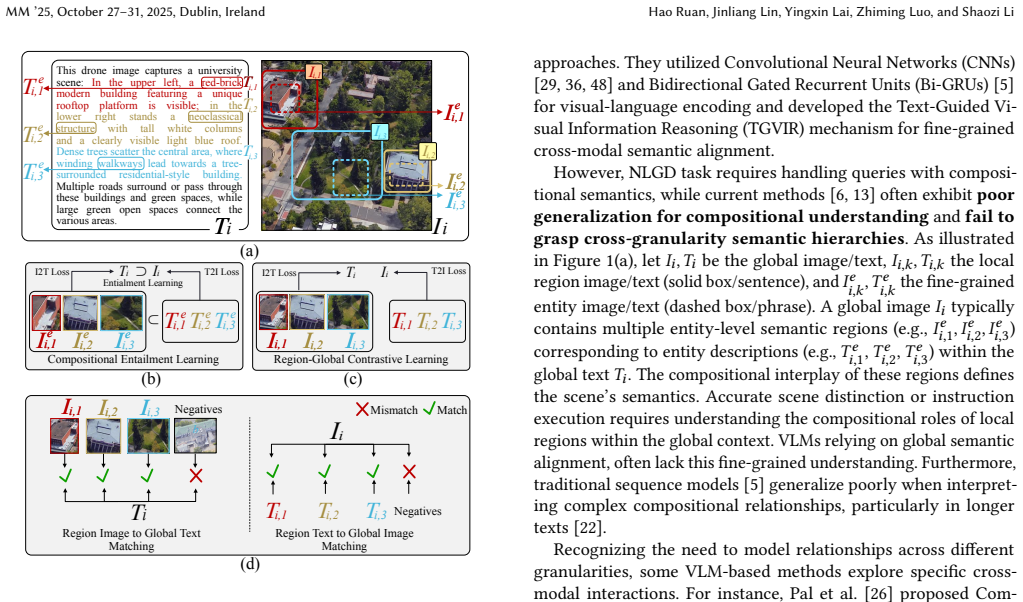
The load-bearing mechanism is the trio of training objectives that together define HCCM. RG-ITC uses a contrastive loss in which local visual regions are pulled toward the global text of the same image-text pair and pushed against other samples' global texts, with the symmetric direction for text fragments; this is the paper's replacement for strict part-whole entailment modeling. RG-ITM feeds fused region-plus-global features, built from positive pairs and hard-negative pairs sampled by embedding similarity, into a matching head that scores local-global consistency. MCD stabilizes the global alignment by maintaining momentum encoder queues of historical global features and using momentum-model predictions as soft targets, so that a single ambiguous caption fragment cannot dominate the contrastive signal. The full training loss is a weighted sum of the stabilized global contrastive loss, global matching loss, both region-global losses, and a bounding-box regression term.
What would settle it
Train HCCM on GeoText-1652 with the same text fragments but with the region bounding boxes replaced by random boxes sampled from the same image; if the image-query R@1 stays near 28.8%, the reported gain is not coming from the region-to-global alignment and the paper's central mechanism is not doing the claimed work.
Extended reading notes
Core claim
The central claim is that hierarchical cross-granularity semantics can be learned by a pair of region-to-global objectives rather than by strict entailment constraints. Region-Global Image-Text Contrastive Learning (RG-ITC) treats each visual region $I_{i,k}$ as a positive match for the global text embedding $T_i$ of the same sample and as a negative for other samples' global texts, and symmetrically for each text fragment $T_{i,k}$ against the global image embedding $I_i$, so the model absorbs local-to-global associations without needing exact entity boundaries. Region-Global Image-Text Matching (RG-ITM) then fuses each regional feature with the complementary global feature and uses a matching head with hard negatives to check whether local detail is consistent with the global cross-modal context. To keep noisy or incomplete captions from destabilizing this alignment, a Momentum Contrast and Distillation (MCD) mechanism adds momentum queues and soft targets to the global contrastive loss. On GeoText-1652 the full objective outperforms the compared methods on every reported Recall@K, and on the unseen ERA dataset the zero-shot model exceeds the best fine-tuned baseline's mean recall.
Load-bearing premise
The region-to-global losses presuppose that the bounding-box regions and text fragments in GeoText-1652 really are the locally matched semantic units they are treated as; if those annotations are noisy or only loosely tied to the captions, the objectives could reinforce spurious correlations rather than true local-global semantics.
Editorial extensions
If this is right
- On GeoText-1652, HCCM reports the best Recall@K in both retrieval directions, with image-query R@1 28.8% and text-query R@1 14.7%.
- Each directional component contributes: ablations show that removing either the text-region-to-global-image contrast or matching loss costs roughly 1.9 points of image-query R@1.
- The momentum contrast and distillation components alone raise image-query R@1 by 1.35 points over the base model, and combining them with the region-global losses produces the full 3.31-point gain.
- Zero-shot on ERA, HCCM reaches 39.93% mean recall, higher than the best fine-tuned ERA model's 38.96%, suggesting the learned alignment transfers to a dataset the model never saw during fine-tuning.
Reading between the lines
- The same region-to-global recipe could apply to other overhead-imagery retrieval tasks, such as satellite or street-view geolocalization, whose captions also mix local landmarks with global spatial relations; the paper only evaluates drone views.
- Because the method replaces entity partitioning with soft region-to-global alignment, its benefit should grow as region annotations get noisier; a testable extension is to train with automatically proposed regions instead of human bounding boxes.
- The zero-shot result on ERA leaves open whether the transfer comes from the region-global objectives or simply from the stronger GeoText-1652 fine-tuning; an ablation that zero-shot evaluates the base model with the same MCD-only objective would isolate the cause.
- The momentum queues increase memory footprint, so part of the measured gain may be reproducible by simply enlarging the batch size; the paper does not report a batch-size-matched comparison.
Signed reviews
Editorial analysis
A structured set of objections, weighed in public.
Referee Report
Summary. The paper proposes HCCM, a fine-tuning framework for natural-language-guided drone image-text retrieval built on the XVLM architecture. It contributes three main components: Region-Global Image-Text Contrastive Learning (RG-ITC, Eq. 1), Region-Global Image-Text Matching Learning (RG-ITM, Eq. 10), and a Momentum Contrast and Distillation mechanism (MCD, Eq. 12), combined with standard ITC/ITM and bounding-box losses in Eq. 14. On GeoText-1652 the authors report state-of-the-art Recall@1 of 28.8% for image query and 14.7% for text query, and on the unseen ERA dataset they report a zero-shot mean recall of 39.93%, which they claim surpasses fine-tuned ERA baselines. The paper also includes ablations (Tables 2 and 3), a zero-shot generalization table (Table 4), and GradCAM visualizations.
Significance. If the results hold, the paper makes a useful contribution by relaxing strict entity-partitioning and entailment constraints for hierarchical vision-language alignment in drone imagery, a direction that is plausible and relevant for the multimedia community. The ablation design is systematic: Tables 2 and 3 consistently show that each proposed component improves either image or text Recall@1, providing internal support for the method. The paper also provides an implementation link and includes a genuinely held-out ERA transfer check. However, the strength of the empirical claims is currently undermined by a confounded zero-shot comparison, lack of statistical reporting, and an unclear hyperparameter selection protocol.
major comments (3)
- [§4.5, Table 4] The claimed zero-shot superiority over fine-tuned ERA models is not supported as stated. The top block of Table 4 lists "Reported Fine-tuned Results on ERA Dataset" taken from prior papers, while the bottom block reports zero-shot results computed by the authors on models fine-tuned on GeoText-1652. The paper does not state that both blocks use the same ERA evaluation protocol (same query set, same image preprocessing, same R@K computation, same subset handling, and same mR definition). The text only says that the GeoText-1652 evaluation strictly follows official splits and protocols; no such statement is made for ERA. If the ERA benchmarks or evaluation pipelines differ between the two blocks, the comparison is invalid regardless of model quality. The 0.97-point mR margin over VCSR and the 1.93-point margin over the zero-shot GeoText-1652 baseline are also within the range of seed-to-seed variation typical for fine-tuned retrieval models, and no error bars or significance tests are reported anywhere. Please either re-run the fine-tuned ERA baselines under exactly the same evaluation code/pipeline as the zero-shot models, or provide concrete evidence that the quoted numbers are directly comparable, and add multi-seed statistics for the key comparisons.
- [§4.2, §4.4] The hyperparameter selection procedure is underspecified and appears to be conducted on the test benchmark. The paper states that loss weights were "determined via preliminary search" and lists specific values for momentum, queue size, distillation alpha, and temperature, but it does not describe a validation split or the search criterion. If hyperparameters were selected using the GeoText-1652 test split, all reported gains, including the ablation differences, are optimistically biased. In addition, all tables appear to report single-run numbers; the abstract and Table 1 report 28.8% image R@1 while Table 2 reports 28.82% for the full model, confirming run-to-run variability that is not quantified. Please specify the exact validation protocol used for hyperparameter selection, report mean and standard deviation over multiple seeds, and provide significance tests for the main claims, especially the ERA zero-shot comparison.
- [§3.2, §3.3] The central training signal of HCCM depends on an unvalidated data assumption: that the bounding-box-based region patches I_{i,k} and text fragments T_{i,k} in GeoText-1652 form semantically matched local-global pairs. RG-ITC (Eq. 1) and RG-ITM (Eq. 10) use these regions and fragments as positive signals against the global representation of the other modality, but the paper provides no analysis of the quality of the region-fragment alignment. If the bounding boxes are noisy, or if a text fragment is only loosely related to its corresponding region, the contrastive and matching objectives can reinforce spurious correlations rather than true local-to-global semantics. The authors should report annotation statistics (e.g., box overlap with relevant objects, fragment-region correspondence rates) or provide quantitative or qualitative evidence that the alignment assumption holds for the region pairs used in training.
minor comments (5)
- [Figure 1 and Figure 3 captions] There are typographical errors in the figure captions: "Entialment Learning" should be "Entailment Learning" in Figure 1, and "Vison Encoder" should be "Vision Encoder" in Figure 3.
- [§4.2] The sentence "Loss weights, determined via preliminary search" should be expanded to include the search space and the criterion (validation versus test) used for selection.
- [Table 3 and §3.3] The directional ablation names such as "L_RG-ITC(I_{i,k}→T_i)" and "L_RG-ITM(T_{i,k}↔I_i)" are not explicitly defined in the loss equations; please clarify how each directional term is isolated when removing it from Eq. (1) and Eq. (10).
- [§3.5, Eq. (13)] The bounding-box regression head input is underspecified: please state which fused features are used to regress \hat{b}_k and how the ground-truth boxes b_{i,k} are obtained for each text fragment.
- [§4.4 text] The sentence in §4.4 referring to "the cross-granularity-only setup (row 5)" is correct but could be clearer; consider adding explicit row labels to Table 2 so that the row references are unambiguous.
Circularity Check
No significant circularity: the reported improvements are empirical retrieval results measured on benchmark splits, and no claimed result reduces to a fitted parameter or a self-citation chain.
full rationale
HCCM is an empirical vision-language method, not a derivation whose output coincides with its input. The total objective (Eq. 14) combines standard global ITC/ITM losses with the proposed RG-ITC (Eq. 1), RG-ITM (Eq. 10), and MCD (Eq. 12); the paper's claims are then evaluated by Recall@K on the official GeoText-1652 splits and by zero-shot retrieval on the unseen ERA dataset. No equation is defined in terms of the quantity it is said to predict: retrieval accuracy is measured independently of the loss definitions. The loss weights and queue size are tuned hyperparameters, but tuning hyperparameters on the same benchmark is an overfitting/validity caveat, not a circular reduction. The ERA zero-shot evaluation is a genuine held-out test, and the fine-tuned ERA baselines are cited from prior work, so the comparison may suffer protocol mismatch, but this is an experimental-validity concern outside circularity. Self-citations ([20], [21]) are background references and are not load-bearing for any central claim; the backbone and momentum mechanisms are credited to external work. No uniqueness theorem or ansatz is imported from the authors' prior work. Therefore no circular step is present.
Assumptions & free parameters
free parameters (5)
- loss weights w_itc, w_itm, w_rg-itc, w_rg-itm, w_box =
0.25, 1, 0.25, 0.5, 0.1
- momentum beta =
0.995
- distillation alpha =
0.4
- temperature tau =
0.07
- queue size Q =
57,600
assumptions (3)
- domain assumption GeoText-1652 region boxes and text fragments form correct local-global positive pairs
- domain assumption The fusion encoder E_f learns meaningful cross-modal consistency when fed one regional and one global feature
- domain assumption Drone text descriptions are frequently incomplete or ambiguous, so momentum distillation helps
Cite this review
Pith. "Pith review of HCCM: Hierarchical Cross-Granularity Contrastive and Matching Learning for Natural Language-Guided Drones." pith.science (2026). https://pith.science/paper/XXNPCNPX
@misc{pith2026250821539,
  author       = {Pith},
  title        = {Pith review of: HCCM: Hierarchical Cross-Granularity Contrastive and Matching Learning for Natural Language-Guided Drones},
  year         = {2026},
  howpublished = {\url{https://pith.science/paper/XXNPCNPX}},
  note         = {Machine review of arXiv:2508.21539}
}
read the original abstract
Natural Language-Guided Drones (NLGD) provide a novel paradigm for tasks such as target matching and navigation. However, the wide field of view and complex compositional semantics in drone scenarios pose challenges for vision-language understanding. Mainstream Vision-Language Models (VLMs) emphasize global alignment while lacking fine-grained semantics, and existing hierarchical methods depend on precise entity partitioning and strict containment, limiting effectiveness in dynamic environments. To address this, we propose the Hierarchical Cross-Granularity Contrastive and Matching learning (HCCM) framework with two components: (1) Region-Global Image-Text Contrastive Learning (RG-ITC), which avoids precise scene partitioning and captures hierarchical local-to-global semantics by contrasting local visual regions with global text and vice versa; (2) Region-Global Image-Text Matching (RG-ITM), which dispenses with rigid constraints and instead evaluates local semantic consistency within global cross-modal representations, enhancing compositional reasoning. Moreover, drone text descriptions are often incomplete or ambiguous, destabilizing alignment. HCCM introduces a Momentum Contrast and Distillation (MCD) mechanism to improve robustness. Experiments on GeoText-1652 show HCCM achieves state-of-the-art Recall@1 of 28.8% (image retrieval) and 14.7% (text retrieval). On the unseen ERA dataset, HCCM demonstrates strong zero-shot generalization with 39.93% mean recall (mR), outperforming fine-tuned baselines.
Figures


Figures from the paper (1 more)

Reference graph
Works this paper leans on
-
[1]
Pablo Arbeláez, Michael Maire, Charless Fowlkes, and Jitendra Malik. 2011. Con- tour Detection and Hierarchical Image Segmentation. IEEE Transactions on Pattern Analysis and Machine Intelligence 33, 5 (2011), 898–916
work page 2011
-
[2]
Kanwal, Tegan Maharaj, Asja Fischer, Aaron Courville, Yoshua Bengio, and Simon Lacoste-Julien
Devansh Arpit, Stanisław Jastrzębski, Nicolas Ballas, David Krueger, Emmanuel Bengio, Maxinder S. Kanwal, Tegan Maharaj, Asja Fischer, Aaron Courville, Yoshua Bengio, and Simon Lacoste-Julien. 2017. A Closer Look at Memorization in Deep Networks. In Proceedings of the 34th International Conference on Machine Learning, Vol. 70. 233–242
work page 2017
-
[3]
Mei Chen, Xiaoyan Wang, Hong Wang, and Shufang Zhao. 2022. A UAV-Based Energy-Efficient and Real-Time Object Detection System with Multi-Source Image Fusion. Journal of Circuits, Systems and Computers 31, 09 (2022), 2250166
work page 2022
-
[4]
Yen-Chun Chen, Linjie Li, Licheng Yu, Ahmed El Kholy, Faisal Ahmed, Zhe Gan, Yu Cheng, and Jingjing Liu. 2020. Uniter: Universal image-text representation learning. In European conference on computer vision . 104–120
work page 2020
-
[5]
Kyunghyun Cho, Bart van Merriënboer, Caglar Gulcehre, Dzmitry Bahdanau, Fethi Bougares, Holger Schwenk, and Yoshua Bengio. 2014. Learning Phrase Representations using RNN Encoder–Decoder for Statistical Machine Translation. (2014), 1724–1734
work page 2014
-
[6]
Meng Chu, Zhedong Zheng, Wei Ji, Tingyu Wang, and Tat-Seng Chua. 2024. Towards natural language-guided drones: GeoText-1652 benchmark with spatial relation matching. In European Conference on Computer Vision . 213–231
work page 2024
-
[7]
Sanghyuk Chun, Seong Joon Oh, Rafael Sampaio de Rezende, Yannis Kalantidis, and Diane Larlus. 2021. Probabilistic Embeddings for Cross-Modal Retrieval. In Proceedings of the IEEE/CVF Conference on Computer Vision and Pattern Recognition. 8415–8424
work page 2021
-
[8]
Zi-Yi Dou, Yichong Xu, Zhe Gan, Jianfeng Wang, Shuohang Wang, Lijuan Wang, Chenguang Zhu, Pengchuan Zhang, Lu Yuan, Nanyun Peng, et al . 2022. An empirical study of training end-to-end vision-and-language transformers. In Proceedings of the IEEE/CVF conference on computer vision and pattern recognition . 18166–18176
work page 2022
Show all 48 references
-
[9]
Fartash Faghri, David J Fleet, Jamie Ryan Kiros, and Sanja Fidler. 2018. VSE++: Improving Visual-Semantic Embeddings with Hard Negatives. In Proceedings of the British Machine Vision Conference
2018
-
[10]
Jorge Gago, Cyril Douthe, Rafael E Coopman, Pedro Pablo Gallego, Miquel Ribas- Carbo, Jaume Flexas, Jb Escalona, and Hb Medrano. 2015. UAVs challenge to assess water stress for sustainable agriculture. Agricultural water management (2015), 9–19
2015
-
[11]
Octavian Ganea, Gary Becigneul, and Thomas Hofmann. 2018. Hyperbolic Entailment Cones for Learning Hierarchical Embeddings. In Proceedings of the 35th International Conference on Machine Learning , Vol. 80. 1646–1655
2018
-
[12]
Kaiming He, Haoqi Fan, Yuxin Wu, Saining Xie, and Ross Girshick. 2020. Momen- tum Contrast for Unsupervised Visual Representation Learning. In Proceedings of the IEEE/CVF Conference on Computer Vision and Pattern Recognition
2020
-
[13]
Jinghao Huang, Yaxiong Chen, Shengwu Xiong, and Xiaoqiang Lu. 2024. Visual Contextual Semantic Reasoning for Cross-Modal Drone Image-Text Retrieval. IEEE Transactions on Geoscience and Remote Sensing 62 (2024), 1–12
2024
-
[14]
Dong-Wook Kim, Tae-Sun Min, Yoonha Kim, Renato Rodrigues Silva, Hae-Nam Hyun, Ju-Sung Kim, Kyung-Hwan Kim, Hak-Jin Kim, and Yong Suk Chung. 2019. Sustainable agriculture by increasing nitrogen fertilizer efficiency using low- resolution camera mounted on unmanned aerial vehicl...
2019
-
[15]
Matthew Le, Stephen Roller, Laetitia Papaxanthos, Douwe Kiela, and Maximilian Nickel. 2019. Inferring Concept Hierarchies from Text Corpora via Hyperbolic Embeddings. In Proceedings of the 57th Annual Meeting of the Association for Computational Linguistics, Anna Korhonen, Dav...
2019
-
[16]
Junnan Li, Dongxu Li, Silvio Savarese, and Steven Hoi. 2023. BLIP-2: Boot- strapping Language-Image Pre-training with Frozen Image Encoders and Large Language Models. In Proceedings of the 40th International Conference on Machine Learning, Vol. 202. 19730–19742
2023
-
[17]
Junnan Li, Dongxu Li, Caiming Xiong, and Steven Hoi. 2022. BLIP: Bootstrap- ping Language-Image Pre-training for Unified Vision-Language Understanding and Generation. In Proceedings of the 39th International Conference on Machine Learning, Vol. 162. 12888–12900
2022
-
[19]
Junnan Li, Ramprasaath Selvaraju, Akhilesh Gotmare, Shafiq Joty, Caiming Xiong, and Steven Chu Hong Hoi. 2021. Align before Fuse: Vision and Language Repre- sentation Learning with Momentum Distillation. In Advances in Neural Informa- tion Processing Systems, Vol. 34. 9694–9705
2021
-
[20]
Jinliang Lin, Zhiming Luo, Dazhen Lin, Shaozi Li, and Zhun Zhong. 2024. A Self-Adaptive Feature Extraction Method for Aerial-View Geo-Localization. IEEE Transactions on Image Processing (2024)
2024
-
[21]
Jinliang Lin, Zhedong Zheng, Zhun Zhong, Zhiming Luo, Shaozi Li, Yi Yang, and Nicu Sebe. 2022. Joint representation learning and keypoint detection for cross-view geo-localization. IEEE Transactions on Image Processing 31 (2022), 3780–3792
2022
-
[22]
Qian Liu, Shengnan An, Jian-Guang Lou, Bei Chen, Zeqi Lin, Yan Gao, Bin Zhou, Nanning Zheng, and Dongmei Zhang. 2020. Compositional generalization by learning analytical expressions. Advances in Neural Information Processing Systems 33 (2020), 11416–11427
2020
-
[23]
Ilya Loshchilov and Frank Hutter. 2019. Decoupled Weight Decay Regularization. In International Conference on Learning Representations
2019
-
[24]
Kim Anh Nguyen, Maximilian Köper, Sabine Schulte im Walde, and Ngoc Thang Vu. 2017. Hierarchical Embeddings for Hypernymy Detection and Directionality. In Proceedings of the 2017 Conference on Empirical Methods in Natural Language Processing. 233–243
2017
-
[25]
Paraskevi Nousi, Ioannis Mademlis, Iason Karakostas, Anastasios Tefas, and Ioannis Pitas. 2019. Embedded UAV Real-Time Visual Object Detection and Tracking. In 2019 IEEE International Conference on Real-time Computing and Robotics. 708–713
2019
-
[26]
Avik Pal, Max van Spengler, Guido Maria D’Amely di Melendugno, Alessandro Flaborea, Fabio Galasso, and Pascal Mettes. 2025. Compositional Entailment Learning for Hyperbolic Vision-Language Models. (2025)
2025
-
[28]
Alec Radford, Jong Wook Kim, Chris Hallacy, Aditya Ramesh, Gabriel Goh, Sandhini Agarwal, Girish Sastry, Amanda Askell, Pamela Mishkin, Jack Clark, Gretchen Krueger, and Ilya Sutskever. 2021. Learning Transferable Visual Models From Natural Language Supervision. In Proceedings...
2021
-
[29]
Anamaria Radoi and Mihai Datcu. 2019. Multilabel annotation of multispectral remote sensing images using error-correcting output codes and most ambiguous examples. IEEE Journal of Selected Topics in Applied Earth Observations and Remote Sensing 12, 7 (2019), 2121–2134
2019
-
[30]
Hamid Rezatofighi, Nathan Tsoi, JunYoung Gwak, Amir Sadeghian, Ian Reid, and Silvio Savarese. 2019. Generalized Intersection Over Union: A Metric and a Loss for Bounding Box Regression. In Proceedings of the IEEE/CVF Conference on Computer Vision and Pattern Recognition
2019
-
[31]
Selvaraju, Michael Cogswell, Abhishek Das, Ramakrishna Vedan- tam, Devi Parikh, and Dhruv Batra
Ramprasaath R. Selvaraju, Michael Cogswell, Abhishek Das, Ramakrishna Vedan- tam, Devi Parikh, and Dhruv Batra. 2017. Grad-CAM: Visual Explanations From Deep Networks via Gradient-Based Localization. In Proceedings of the IEEE Inter- national Conference on Computer Vision
2017
-
[32]
Yale Song and Mohammad Soleymani. 2019. Polysemous Visual-Semantic Em- bedding for Cross-Modal Retrieval. In Proceedings of the IEEE/CVF Conference on Computer Vision and Pattern Recognition
2019
-
[33]
Paolo Tripicchio, Massimo Satler, Giacomo Dabisias, Emanuele Ruffaldi, and Carlo Alberto Avizzano. 2015. Towards smart farming and sustainable agriculture with drones. In 2015 international conference on intelligent environments . IEEE, 140–143
2015
-
[34]
Ivan Vendrov, Ryan Kiros, Sanja Fidler, and Raquel Urtasun. 2015. Order- embeddings of images and language. arXiv preprint arXiv:1511.06361 (2015)
2015 arXiv
-
[35]
Ivan Vulić and Nikola Mrkšić. 2018. Specialising Word Vectors for Lexical Entail- ment. In Proceedings of the 2018 Conference of the North American Chapter of the Association for Computational Linguistics: Human Language Technologies, Volume 1 (Long Papers). 1134–1145
2018
-
[36]
Guoli Wang, Bin Fan, Shiming Xiang, and Chunhong Pan. 2017. Aggregating rich hierarchical features for scene classification in remote sensing imagery.IEEE Journal of Selected Topics in Applied Earth Observations and Remote Sensing 10, 9 (2017), 4104–4115
2017
-
[37]
Tingyu Wang, Zhedong Zheng, Yaoqi Sun, Chenggang Yan, Yi Yang, and Tat- Seng Chua. 2024. Multiple-environment Self-adaptive Network for Aerial-view Geo-localization. Pattern Recognition 152 (2024), 110363
2024
-
[38]
E Wardihani, Magfur Ramdhani, Amin Suharjono, Thomas Agung Setyawan, Sidiq Syamsul Hidayat, Sarono Widodo Helmy, Eddy Triyono, and FIRDANIS Saifullah. 2018. Real-time forest fire monitoring system using unmanned aerial vehicle. Journal of Engineering Science and Technology 6 (...
2018
-
[39]
Henriques, and Daniel Cremers
Yan Xia, Zhendong Li, Yun-Jin Li, Letian Shi, Hu Cao, João F. Henriques, and Daniel Cremers. 2024. UniLoc: Towards Universal Place Recognition Using Any Single Modality. arXiv preprint arXiv:2412.12079 (2024). MM ’25, October 27–31, 2025, Dublin, Ireland Hao Ruan, Jinliang Lin...
2024 arXiv
-
[40]
Jiahao Xie, Xiaohang Zhan, Ziwei Liu, Yew Soon Ong, and Chen Change Loy
-
[41]
Junyan Ye, Honglin Lin, Leyan Ou, Dairong Chen, Zihao Wang, Conghui He, and Weijia Li. 2024. Where am I? Cross-View Geo-localization with Natural Language Descriptions. arXiv preprint arXiv:2412.17007 (2024)
2024 arXiv
-
[42]
Zhiqiang Yuan, Wenkai Zhang, Kun Fu, Xuan Li, Chubo Deng, Hongqi Wang, and Xian Sun. 2022. Exploring a Fine-Grained Multiscale Method for Cross-Modal Remote Sensing Image Retrieval. IEEE Transactions on Geoscience and Remote Sensing 60 (2022), 1–19
2022
-
[43]
Zhiqiang Yuan, Wenkai Zhang, Changyuan Tian, Xuee Rong, Zhengyuan Zhang, Hongqi Wang, Kun Fu, and Xian Sun. 2022. Remote Sensing Cross-Modal Text- Image Retrieval Based on Global and Local Information. IEEE Transactions on Geoscience and Remote Sensing 60 (2022), 1–16
2022
-
[44]
Yan Zeng, Xinsong Zhang, and Hang Li. 2022. Multi-Grained Vision Language Pre-Training: Aligning Texts with Visual Concepts. In Proceedings of the 39th International Conference on Machine Learning , Vol. 162. 25994–26009
2022
-
[45]
Kejia Zhang, Keda Tao, Jiasheng Tang, and Huan Wang. 2025. Poison as Cure: Visual Noise for Mitigating Object Hallucinations in LVMs. arXiv preprint arXiv:2501.19164 (2025)
2025 arXiv
-
[46]
Pengyu Zhang, Jie Zhao, Dong Wang, Huchuan Lu, and Xiang Ruan. 2022. Visible- thermal UAV tracking: A large-scale benchmark and new baseline. InProceedings of the IEEE/CVF Conference on Computer Vision and Pattern Recognition . 8886– 8895
2022
-
[47]
Xiao Zhang and Michael Maire. 2020. Self-Supervised Visual Representation Learning from Hierarchical Grouping. In Advances in Neural Information Process- ing Systems, Vol. 33. 16579–16590
2020
-
[48]
Zhengyuan Zhang, Wenkai Zhang, Wenhui Diao, Menglong Yan, Xin Gao, and Xian Sun. 2019. VAA: Visual aligning attention model for remote sensing image captioning. IEEE Access 7 (2019), 137355–137364
2019
-
[49]
Zhedong Zheng, Yunchao Wei, and Yi Yang. 2020. University-1652: A Multi-view Multi-source Benchmark for Drone-based Geo-localization. In Proceedings of the 28th ACM International Conference on Multimedia . 1395–1403
2020
-
[2021]
In Advances in Neural Information Processing Systems , Vol
Unsupervised Object-Level Representation Learning from Scene Images. In Advances in Neural Information Processing Systems , Vol. 34. 28864–28876
Reviewed August 15, 2026 · model on record in the stance chip above.
Discussion (0). Continue with ORCID to comment.