REVIEW 3 major objections 6 minor 93 references
Summarize-Exemplify-Reflect: Data-driven Insight Distillation Empowers LLMs for Few-shot Tabular Classification
T0 review · 3 major / 6 minor · reviewed 2026-08-15 · deepseek-v4-flash
Pith's one-line read The paper claims that distilling few-shot tabular rows into natural-language rules makes LLM classifiers substantially more accurate, and it demonstrates consistent gains over classical and LLM baselines across nine datasets.
desk verdict A sensible, incremental method with a real contamination confound: the gains over baselines are consistent, but the paper never proves the rules come from the data rather than the summarizer's memory of these benchmark tables. read the letter →
The pith
A machine-rendered reading of the paper's core claim, the machinery that carries it, and where it could break.
The reading
What carries the argument
The load-bearing object is the multifaceted serialization prompt $\mathrm{MSP}(x, T, D_s, R)$, which turns the test row, task description, few-shot demonstrations, and mined rules into one text prompt. It is carried by Algorithm 1: an XGBoost model's first tree partitions the training rows (group), class-probability entropy ranks rows from easy to hard (rank), an LLM summarizes and then merges group-wise rules (summarize), and incorrectly predicted hard rows produce extra rules (reflect). The first tree is the partition mechanism; entropy is the difficulty signal; rule merging is what keeps the prompt concise.
What would settle it
Compare InsightTab against a control that replaces the XGBoost first-tree grouping with random partitions of the same size while keeping ranking, summarization, and reflection identical; if the F1 gap disappears or reverses on the nine datasets, the grouping step is not doing the work the paper claims.
Extended reading notes
Core claim
InsightTab claims that the bottleneck in few-shot LLM tabular classification is not the LLM's reasoning but the absence of task-specific knowledge, and that this gap can be closed by distilling the few labeled rows into natural-language insights before asking the LLM to predict. The distillation follows three human-learning principles: divide-and-conquer (split training rows by the leaves of a single XGBoost tree and summarize each group's rules), easy-first (use the lowest-entropy rows as in-context demonstrations), and reflective learning (have the predictor try hard, high-entropy rows, keep the mistakes, and summarize additional rules from them). The final prompt combines the merged rules, the easy demonstrations, and any reflection-derived rules. On nine datasets with 16 to 128 training rows, InsightTab reports average F1 of 64.8 with mistral-7b and 62.8 with gpt-3.5-turbo, beating the same-base-LLM baselines in 19 of 20 comparisons and improving over XGBoost, TabPFN, Original, Tablet, TabLLM, and SumBoost by 21, 32, 55, 37, 10, and 44 percent on average.
Load-bearing premise
The entire gain rests on the assumption that the first tree of an XGBoost model trained on as few as 16 to 128 rows partitions the data into groups whose shared patterns can be summarized into transferable rules; with so few samples, those splits may instead reflect noise or single-class leaves, producing misleading rules.
Editorial extensions
If this is right
- If a task has only 16 to 128 labeled rows, InsightTab's rule-first prompting yields higher F1 than both classical tabular models and LLM baselines on the nine datasets tested.
- The same base LLM with InsightTab beats other LLM methods in 19 of 20 comparisons, so the gain comes from the distillation process rather than from choosing a better model.
- Rules distilled from grouped samples let the predictor use more in-context examples before performance degrades, reducing overfitting to individual examples.
- On feature-order shuffling and class-imbalance tests, InsightTab degrades less than serialization-only baselines, indicating better generalization under distribution shifts.
- With full training data, XGBoost is still generally stronger, but InsightTab is the only LLM method that matches or beats it on some datasets.
Reading between the lines
- An untested corollary of the two-model split is that the expensive summarizer runs once while the cheap predictor runs many times, so insight distillation could serve as a general cost-saving pattern for structured LLM inference.
- Because grouping only needs a partition, any interpretable weak model could replace XGBoost's first tree; testing whether random partitions perform worse would isolate where the gain comes from.
- The natural-language rules are auditable and reusable: they could be inspected by humans, transferred to datasets with similar schemas, or updated incrementally, implications the paper leaves unexplored.
- The position-bias results suggest rule prompts may reduce LLM reliance on token-order memorization, which connects to the data-contamination risk the authors acknowledge.
Signed reviews
Editorial analysis
A structured set of objections, weighed in public.
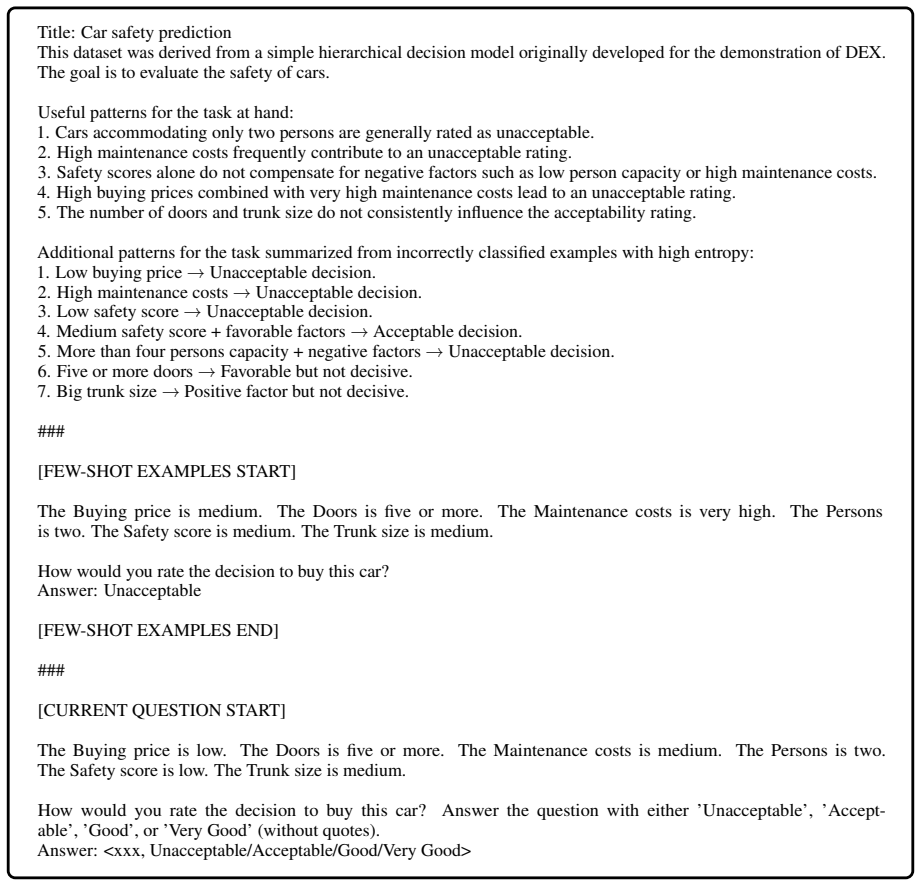
Referee Report
Summary. The paper proposes InsightTab, a framework for few-shot tabular classification with LLMs that distills the few available labeled rows into natural-language insights. The method uses three principles: divide-and-conquer (training samples are grouped via the first tree of an XGBoost model, per-group rules are summarized by an LLM, and the rules are merged), easy-first (low-entropy training samples are selected as in-context demonstrations), and reflective learning (high-entropy samples are classified with the current rules, and the mistakes are summarized into additional rules). The final prompted prediction combines the merged rules, the easy demonstrations, and the reflection rules. The paper evaluates InsightTab on nine datasets from the TabLLM benchmark suite with mistral-7b and gpt-3.5-turbo as predictors, reporting average F1 gains over XGBoost, TabPFN, Original, Tablet, TabLLM, and SumBoost, and provides ablations, position-bias and class-bias analyses, a cost comparison, and open-source code.
Significance. If the reported gains hold up, InsightTab is a practically useful and conceptually clean contribution: it combines a cheap, traditional model (XGBoost) with LLM summarization to produce human-readable rules and few-shot demonstrations, and it consistently outperforms strong LLM baselines such as TabLLM and SumBoost in the paper's experiments. The method is simple, reproducible in principle, and the authors provide code and a data link. The framework of group-rank-summarize is clearly described and the ablations are consistent with the claimed importance of each component. However, the significance is conditional on separating the distillation procedure from possible LLM memorization of these widely used public benchmark datasets, which the paper itself acknowledges as an open issue.
major comments (3)
- [Table 1 and Table 2] The central claim of 'consistent improvement' is based on point estimates averaged over 5-fold cross-validation and multiple runs, but no variance, confidence intervals, or significance tests are reported anywhere in the main text or appendix. For example, the Creditg comparison between InsightTab (81.9) and TabLLM (80.9) with n=16 in Table 1 may not be meaningful without knowing run-to-run variability. Since the main message of the paper is a robust advantage over baselines, please report standard deviations or confidence intervals for the averaged F1 numbers, and ideally paired significance tests across folds or datasets.
- [Limitations and Section 5.2] The evaluation does not isolate the data-driven distillation procedure from parametric knowledge in the LLMs. All nine datasets are standard public benchmarks (Income, Diabetes, Heart, etc.), the rule summarizer is gpt-4-turbo, and the position-bias analysis in Section 5.2 only shuffles feature order while preserving semantically meaningful column names and value labels. Five-fold cross-validation does not prevent target memorization because the same column names and label semantics appear in every fold. The paper itself acknowledges this at the end of the Limitations section: 'future work should follow this direction and explore whether our model remains effective when column names lack semantic meaning.' This is load-bearing for the claim that the method is data-driven. Please add an experiment with sanitized/randomized column names (or an evaluation on a private or novel dataset) and compare the quality of the mined rules and the resulting accuracy under that condition.
- [Algorithm 1, lines 3-6] The grouping step uses the first tree of an XGBoost model trained on as few as 16 to 128 rows. With such few samples, leaf partitions can be dominated by a single class or by noise, and the resulting per-leaf summaries may not capture transferable classification rules. The alternative-strategy experiments in Appendix C.3 compare different sampling/grouping heuristics, but they do not evaluate the stability of the first-tree grouping, the distribution of leaf sizes, or per-leaf label purity, and they do not vary the number of trees used for grouping. Please add an analysis of group quality (e.g., leaf sizes and class entropy across folds) and a sensitivity check on the number of boosting rounds or tree depth used for grouping.
minor comments (6)
- [Section 4.2] The sentence reporting 'average improvements of 21%, 32%, 55%, 37%, 10%, and 44%' should state whether these are relative or absolute F1 changes, since the base rates differ across the baselines.
- [Table 2] The variant label '- demostr.' contains a typo for '- demonstration'; please fix it in the table and in the text that refers to it.
- [Algorithm 1, line 13] The symbol ⊕ used for rule enhancement is not defined in the text; please explain how the additional rules R_h are merged with R.
- [Appendix B.3] The paper reports a hyperparameter grid for XGBoost but not the selected hyperparameter values per dataset or fold; please state the selected values or note that the defaults in the code were used throughout.
- [Section 4.1 and Appendix B.3] No decoding temperature or sampling parameters are reported for the LLM calls (mistral-7b, gpt-3.5-turbo, gpt-4-turbo); please specify these settings to enable reproducibility.
- [Table 5, n = all] The caption for the full-training-data results should explicitly state that TabPFN is omitted due to runtime errors, as this is mentioned only in the main text of Appendix C.2.
Circularity Check
No internal circularity: the pipeline is trained on labeled rows and evaluated out-of-sample, with only a peripheral non-load-bearing self-citation.
full rationale
The claimed derivation chain is: fit XGBoost on the labeled training set, group rows by the first tree's leaves, have gpt-4-turbo summarize per-leaf rules, merge those rules, rank training rows by model entropy to pick easy and hard examples, use easy examples as demonstrations and hard misclassified training rows for reflective rule enhancement, and finally classify each test row using the resulting rules and demonstrations. Every component in Algorithm 1 consumes only the labeled training set, and test rows enter only in the final prediction; therefore the distilled 'insights' are not constructed from or evaluated on the same outputs that they are claimed to predict. No fitted parameter is renamed as a prediction, and no equation defines the output in terms of the target. The only self-citation I could locate is Li et al. 2024 (Perteval) in the Limitations section, used to characterize serialization and rule summarization as perturbations to raw data; that citation is peripheral and does not carry the central claim, so it does not constitute load-bearing circularity. The acknowledged pretraining-contamination risk for the nine TabLLM benchmark datasets is an external-validity and memorization concern, not a circular-derivation concern, and the paper explicitly flags it in its Limitations section. The internal derivation is self-contained and out-of-sample.
Assumptions & free parameters
free parameters (4)
- Number of easy demonstrations ne =
16 (equal to shot count)
- Hard sample fraction nh =
50% of training data
- XGBoost hyperparameters (n_estimators, max_depth, learning_rate) =
Grid search over {10,50,100,200}, {3,4,5,6}, {0.01,0.03,0.1,0.3}
- XGBoost boosting rounds =
100
assumptions (5)
- domain assumption The first tree of a fitted XGBoost model partitions training samples into groups that are similar enough for LLM rule summarization.
- domain assumption Entropy of XGBoost class probabilities orders samples by prediction difficulty for the LLM predictor.
- domain assumption Rules generated by gpt-4-turbo from group samples are accurate, non-conflicting, and generalizable.
- domain assumption Reflection on incorrectly predicted high-entropy training samples yields corrective rules that improve test accuracy.
- domain assumption The nine datasets from Hegselmann et al. (2022) with random 80/20 splits represent the broad space of few-shot tabular classification.
Cite this review
Pith. "Pith review of Summarize-Exemplify-Reflect: Data-driven Insight Distillation Empowers LLMs for Few-shot Tabular Classification." pith.science (2026). https://pith.science/paper/2G4GNT6V
@misc{pith2026250821561,
  author       = {Pith},
  title        = {Pith review of: Summarize-Exemplify-Reflect: Data-driven Insight Distillation Empowers LLMs for Few-shot Tabular Classification},
  year         = {2026},
  howpublished = {\url{https://pith.science/paper/2G4GNT6V}},
  note         = {Machine review of arXiv:2508.21561}
}
read the original abstract
Recent studies show the promise of large language models (LLMs) for few-shot tabular classification but highlight challenges due to the variability in structured data. To address this, we propose distilling data into actionable insights to enable robust and effective classification by LLMs. Drawing inspiration from human learning processes, we introduce InsightTab, an insight distillation framework guided by principles of divide-and-conquer, easy-first, and reflective learning. Our approach integrates rule summarization, strategic exemplification, and insight reflection through deep collaboration between LLMs and data modeling techniques. The obtained insights enable LLMs to better align their general knowledge and capabilities with the particular requirements of specific tabular tasks. We extensively evaluate InsightTab on nine datasets. The results demonstrate consistent improvement over state-of-the-art methods. Ablation studies further validate the principle-guided distillation process, while analyses emphasize InsightTab's effectiveness in leveraging labeled data and managing bias.
Figures


Figures from the paper (15 more)




Reference graph
Works this paper leans on
-
[1]
Higher education levels (bachelor’s degree or higher) generally correlate with earning more than $50K per year
-
[2]
Significant capital gains in a year are a strong indicator of earning more than $50K
-
[3]
Tabllm: Few-shot classification of tabular data with large language models. ArXiv, abs/2210.10723. Noah Hollmann, Samuel G. Müller, Katharina Eggensperger, and Frank Hutter. 2022. Tabpfn: A transformer that solves small tabular classification problems in a second. In International Conference on Learning Representations. Yushi Hu, Chia-Hsuan Lee, Tianbao X...
arXiv 2022
-
[4]
**Number of Contacts in Current Campaign**: A higher number of contacts does not necessarily increase the likelihood of subscription; fewer, more effective contacts might be more beneficial
-
[5]
Perteval: Unveiling real knowledge capac- ity of LLMs with knowledge-invariant perturbations. In The Thirty-eight Conference on Neural Informa- tion Processing Systems Datasets and Benchmarks Track. Qian Liu, Bei Chen, Jiaqi Guo, Zeqi Lin, and Jian-Guang Lou. 2021. Tapex: Table pre- training via learning a neural sql executor. ArXiv, abs/2107.07653. Weizh...
arXiv 2021
-
[6]
**Yearly Balance**: Clients with higher average yearly balances tend to have a slightly higher likelihood of subscribing, though this is not a strong predictor
-
[7]
Tablellama: Towards open large generalist models for tables. ArXiv, abs/2311.09206. Xiaokang Zhang, Jing Zhang, Zeyao Ma, Yang Li, Bo- han Zhang, Guanlin Li, Zijun Yao, Kangli Xu, Jin- chang Zhou, Daniel Zhang-li, Jifan Yu, Shu Zhao, Juan-Zi Li, and Jie Tang. 2024. Tablellm: Enabling tabular data manipulation by llms in real office usage scenarios. ArXiv,...
arXiv 2024
-
[8]
The results are averaged across 9 datasets
We see our method shows advantage against the 0.450 0.475 0.500 0.425 0.550 0.575 0.600 0.625 2 4 8 16 32 Shots Number Figure 6: gpt-3.5-turbo performance with 32 training samples across different number of shots (samples at- tached in the prompts). The results are averaged across 9 datasets. most state-of-the-art LLM prompt-based method SumBoost both in ...
Show all 93 references
-
[9]
**Credit in Default**: Clients with no credit default are commonly targeted but this factor alone does not predict subscription
-
[10]
Table 3: Illustration of mined rules for Income data
Lower educational attainment and employment in sec- tors like agriculture, forestry, fisheries, or non-specialized government roles tend to correlate with incomes below $50K. Table 3: Illustration of mined rules for Income data. Table 3 illustrates three mined rules related to...
2022
-
[12]
**Previous Campaign Outcome**: Clients with a successful outcome in the previous marketing campaign are more likely to subscribe to a term deposit
-
[13]
**Contact Duration**: Longer last contact durations tend to correlate with a higher likelihood of subscription
-
[14]
**Housing and Personal Loans**: Clients without housing or personal loans are more likely to subscribe to a term deposit
-
[16]
**Communication Type**: While not a strong predictor on its own, effective communication types like cellular phones are commonly used
-
[18]
**Previous Campaign Contact**: Clients not previously contacted in earlier campaigns show varied subscription outcomes, suggesting that this alone is not a strong predictor
-
[19]
**Marital Status, Job Type, and Education Level**: These factors do not show a clear trend in influencing the decision to subscribe to a term deposit
-
[21]
### [FEW-SHOT EXAMPLES START] The age is 41
**Last Contact Timing (Month and Day)**: No clear trend on how specific months or days impact the likelihood of subscription. ### [FEW-SHOT EXAMPLES START] The age is 41. The type of job is management. The marital status is married. The education is tertiary. The has credit in...
-
[22]
Lower recency values correlate with a higher likelihood of donating blood
-
[23]
Higher frequency of donations increases the likelihood of donating again
-
[24]
The total volume of blood donated does not consistently predict donation likelihood
-
[25]
Shorter time since the first donation does not consistently predict donation likelihood
-
[26]
### [FEW-SHOT EXAMPLES START] The Recency - months since last donation is 2
A combination of low recency and high frequency often predicts a positive donation outcome. ### [FEW-SHOT EXAMPLES START] The Recency - months since last donation is 2. The Frequency - total number of donation is 13. The Mone- tary - total blood donated in c.c. is 3250. The Ti...
1990
-
[27]
Higher median income is associated with higher house block value
-
[28]
Lower median age may indicate a more desirable area, potentially increasing property value
-
[29]
A higher number of total rooms and bedrooms often correlates with more valuable properties
-
[30]
Population size and number of households can suggest demand, but are not definitive indicators of value
-
[31]
### [FEW-SHOT EXAMPLES START] The median income is 3.9097
Geographic location (latitude and longitude) may influence property value based on regional trends. ### [FEW-SHOT EXAMPLES START] The median income is 3.9097. The median age is 52. The total rooms is 2684. The total bedrooms is 574. The population is 1395. The households is 54...
-
[32]
Cars accommodating only two persons are generally rated as unacceptable
-
[33]
High maintenance costs frequently contribute to an unacceptable rating
-
[34]
Safety scores alone do not compensate for negative factors such as low person capacity or high maintenance costs
-
[35]
High buying prices combined with very high maintenance costs lead to an unacceptable rating
-
[36]
Additional patterns for the task summarized from incorrectly classified examples with high entropy:
The number of doors and trunk size do not consistently influence the acceptability rating. Additional patterns for the task summarized from incorrectly classified examples with high entropy:
-
[37]
Low buying price → Unacceptable decision
-
[38]
High maintenance costs → Unacceptable decision
-
[39]
Low safety score → Unacceptable decision
-
[40]
Medium safety score + favorable factors → Acceptable decision
-
[41]
More than four persons capacity + negative factors → Unacceptable decision
-
[42]
Five or more doors → Favorable but not decisive
-
[43]
### [FEW-SHOT EXAMPLES START] The Buying price is medium
Big trunk size → Positive factor but not decisive. ### [FEW-SHOT EXAMPLES START] The Buying price is medium. The Doors is five or more. The Maintenance costs is very high. The Persons is two. The Safety score is medium. The Trunk size is medium. How would you rate the decision...
-
[44]
- Higher balances (>= 200 DM) tend to result in denial
**Status of Existing Checking Account**: - No checking account or a positive balance often leads to approval. - Higher balances (>= 200 DM) tend to result in denial
-
[45]
**Credit History**: - A history of paying back credits duly often leads to approval
-
[46]
### [FEW-SHOT EXAMPLES START] The Status of existing checking account is < 0 DM
**Foreign Worker**: - Being a foreign worker generally does not prevent credit approval. ### [FEW-SHOT EXAMPLES START] The Status of existing checking account is < 0 DM. The Duration in month is 33. The Credit history is criti- cal account/ other credits existing (not at this ...
-
[47]
**Plasma Glucose Concentration at 2 Hours in GTT**: Values above 140 mg/dL are indicative of diabetes
-
[48]
**Body Mass Index (BMI)**: Values over 30 often correlate with diabetes diagnoses
-
[49]
**Diabetes Pedigree Function**: Higher values generally correlate with a higher risk of diabetes
-
[50]
**Age**: Middle-aged and older adults show a higher prevalence of diabetes
-
[51]
**Number of Pregnancies**: Increased number of pregnancies tends to be associated with a higher likelihood of diabetes
-
[52]
**2-Hour Serum Insulin**: Higher levels can be indicative of diabetes, especially when combined with other risk factors
-
[53]
**Triceps Skin Fold Thickness**: Higher values are often observed in patients with diabetes
-
[54]
### [FEW-SHOT EXAMPLES START] The Age is 52
**Diastolic Blood Pressure**: Readings above 80 mmHg frequently appear in patients diagnosed with diabetes. ### [FEW-SHOT EXAMPLES START] The Age is 52. The Number of times pregnant is 8. The Diastolic blood pressure is 76. The Triceps skin fold thickness is 24. The Plasma glu...
-
[55]
Presence of exercise-induced angina or asymptomatic chest pain with other risk factors suggests heart disease
-
[56]
ST depression induced by exercise relative to rest, especially values of 2.0 or higher, indicates heart disease
-
[57]
A flat or downsloping slope of the peak exercise ST segment is indicative of heart disease
-
[58]
High fasting blood sugar levels (> 120 mg/dl) are associated with heart disease
-
[59]
Lower maximum heart rate achieved during exercise, particularly when combined with other risk factors, suggests heart disease
-
[60]
Abnormalities in resting electrocardiogram results (such as ST-T wave abnormality or left ventricular hypertrophy) indicate heart disease, even if chest pain is absent
-
[61]
Additional patterns for the task summarized from incorrectly classified examples with high entropy:
Elevated resting blood pressure and high serum cholesterol levels are risk factors that, when combined with other indicators, suggest heart disease. Additional patterns for the task summarized from incorrectly classified examples with high entropy:
-
[62]
Older age increases the likelihood of heart disease
-
[63]
Asymptomatic cases are more likely to indicate heart disease compared to non-anginal pain
-
[64]
Elevated serum cholesterol levels are indicative of heart disease
-
[65]
Elevated fasting blood sugar (> 120 mg/dl) may suggest heart disease
-
[66]
Abnormal resting electrocardiogram results indicate a higher risk of heart disease
-
[67]
Presence of exercise-induced angina is a strong indicator of heart disease
-
[68]
Higher ST depression induced by exercise is associated with heart disease
-
[69]
### [FEW-SHOT EXAMPLES START] The Age of the patient is 46
Flat slopes of the peak exercise ST segment may indicate heart disease. ### [FEW-SHOT EXAMPLES START] The Age of the patient is 46. The Sex of the patient is male. The Chest pain type is asymptomatic. The Resting blood pressure is 120. The Serum cholesterol is 231. The Fasting...
-
[70]
Higher education levels, particularly master’s and doctoral degrees, are associated with higher earnings
-
[71]
Occupations in management, execution, professional specialties, and protective services (especially in local government) are linked to higher earnings
-
[72]
Employment in government sectors (state and local) and ownership of incorporated businesses tend to correlate with higher earnings
-
[73]
Working 40 hours per week or more is generally associated with higher earnings, particularly in professional, managerial, or government roles
-
[74]
Marital status as married and relation as husband often correlates with higher earnings
-
[75]
Capital gains can indicate higher earnings, but capital losses do not necessarily indicate lower earnings
-
[76]
citizens do not show a clear trend affecting earnings compared to other countries based on the provided data
Native-born U.S. citizens do not show a clear trend affecting earnings compared to other countries based on the provided data
-
[77]
Additional patterns for the task summarized from incorrectly classified examples with high entropy:
Younger individuals, especially those under 25, are less likely to earn more than $50,000, regardless of other factors. Additional patterns for the task summarized from incorrectly classified examples with high entropy:
-
[78]
Higher education levels (master’s degree or higher) are associated with earning more than $50,000 per year
-
[79]
Occupations in professional specialties are likely to earn more than $50,000, while occupations in agriculture or with lower education levels typically do not
-
[80]
Working higher hours (60 or more) in certain sectors can lead to earnings above $50,000
-
[81]
Local government positions’ incomes vary based on occupation and education level, potentially leading to earnings above $50,000
-
[82]
### [FEW-SHOT EXAMPLES START] The Age is 23
Capital gains and losses do not directly affect annual earnings above or below $50,000. ### [FEW-SHOT EXAMPLES START] The Age is 23. The Race is White. The Sex is Male. The Marital status is married. The Relation to head of the household is Husband. The Native country is Unite...
-
[83]
White wins if the white piece has higher strength than the black piece, unless the positional difference is too great
-
[84]
White does not win when both pieces have equal strength
-
[85]
Proximity of the white piece to the opponent’s den (lower ranks) increases the likelihood of a win for white
-
[86]
The file position (horizontal alignment) of the pieces does not significantly influence the outcome
-
[87]
White does not win when the white piece has the lowest strength (0), regardless of the black piece’s position or strength
-
[88]
Additional patterns for the task summarized from incorrectly classified examples with high entropy:
Strategic positioning, such as cornering the opponent’s piece, can increase the likelihood of winning for the stronger piece. Additional patterns for the task summarized from incorrectly classified examples with high entropy:
-
[89]
Higher piece strength generally favors the player with the stronger piece
-
[90]
Positioning on the board (file and rank) can influence the outcome, particularly in endgames
-
[91]
The ability to control key squares or escape routes is crucial for determining the winner
-
[92]
When piece strengths are equal, positioning becomes more significant in deciding the outcome
-
[93]
### [FEW-SHOT EXAMPLES START] The white piece strength is 4
A piece with greater strength positioned to attack is likely to lead to a win. ### [FEW-SHOT EXAMPLES START] The white piece strength is 4. The white piece file is 1. The white piece rank is 7. The black piece strength is 0. The black piece file is 4. The black piece rank is 8...
-
[2017]
In Neural Information Processing Systems
Lightgbm: A highly efficient gradient boost- ing decision tree. In Neural Information Processing Systems. Jiatong Li, Renjun Hu, Kunzhe Huang, Yan Zhuang, Qi Liu, Mengxiao Zhu, Xing Shi, and Wei Lin
-
[2022]
Sungwon Han, Jinsung Yoon, Sercan Ö
Why do tree-based models still outperform deep learning on typical tabular data? In Neural Information Processing Systems. Sungwon Han, Jinsung Yoon, Sercan Ö. Arik, and Tomas Pfister. 2024. Large language models can automatically engineer features for few-shot tabular learnin...
2024 arXiv
-
[2023]
ArXiv, abs/2306.14101
Language models are weak learners. ArXiv, abs/2306.14101. Jaehyun Nam, Jihoon Tack, Kyungmin Lee, Hankook Lee, and Jinwoo Shin. 2023. Stunt: Few-shot tabular learning with self-generated tasks from unlabeled tables. ArXiv, abs/2303.00918. Linyong Nan, Yilun Zhao, Weijin Zou, N...
2023 arXiv
-
[2024]
Preprint, arXiv:2301.00234
A survey on in-context learning. Preprint, arXiv:2301.00234. Lun Du, Fei Gao, Xu Chen, Ran Jia, Junshan Wang, Shi Han, and Dongmei Zhang. 2021. Tabularnet: A neu- ral network architecture for understanding semantic structures of tabular data. Proceedings of the 27th ACM SIGKDD...
2021 arXiv
Reviewed August 15, 2026 · model on record in the stance chip above.
Discussion (0). Continue with ORCID to comment.