REVIEW 2 major objections 5 minor 19 cited by
The Perfect Host: JWST Cepheid Observations in a Background-Free SN Ia Host Confirm No Bias in Hubble-Constant Measurements
T0 review · 2 major / 5 minor · reviewed 2026-08-05 · deepseek-v4-flash
Pith's one-line read JWST Cepheids in a background-free galaxy show no crowding bias, leaving the Hubble tension intact.
desk verdict The strongest observational case yet that crowding cannot resolve the Hubble tension: a clean background-free Cepheid test in NGC 3447A, with the caveat that the differential test leans on an unverified common-distance assumption. read the letter →
The pith
A machine-rendered reading of the paper's core claim, the machinery that carries it, and where it could break.
The reading
What carries the argument
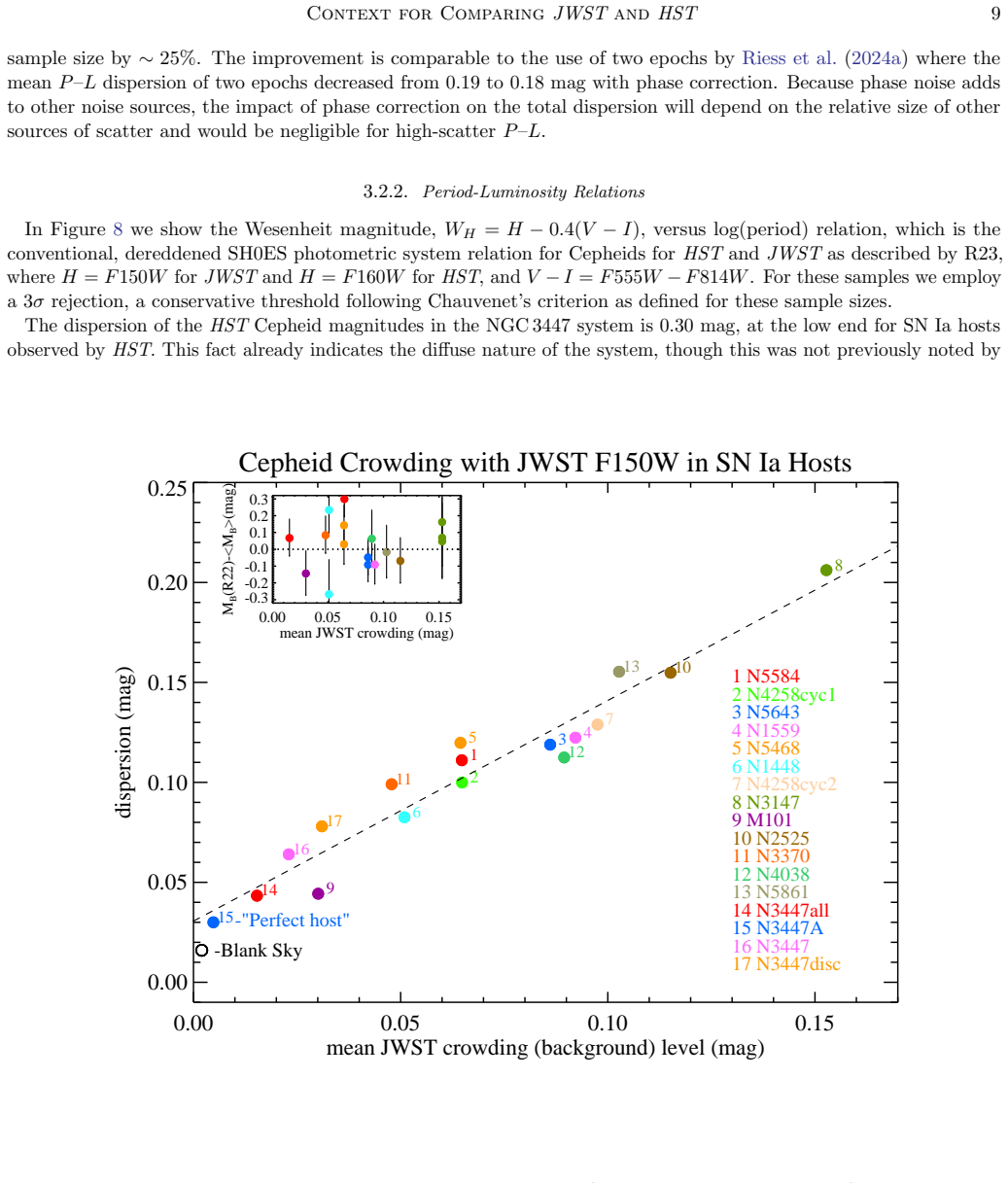
The load-bearing object is NGC 3447A itself, a tidal dwarf galaxy in which Cepheids form against an essentially empty background: no old red giants, a crowding bias of about 0.005 mag, and an artificial-star dispersion near 0.03 mag, close to blank sky. The test works because the dwarf and the spiral component are plausibly at the same distance and have the same metallicity ([O/H] ≈ -0.25 dex), so any offset between their period-luminosity relations must be attributed to crowding or environment. Supporting the measurement are PSF-fitting photometry with DOLPHOT, artificial-star crowding corrections, a single-epoch phase-recovery scheme that uses the known F814W light curve to assign the F090
What would settle it
Measure an independent distance to NGC 3447A that does not rely on Cepheid crowding assumptions, for example using resolved stellar populations in the young dwarf or a future geometric parallax of a compact object in it. If that distance differs from NGC 3447's distance modulus by more than about 0.03 mag, the same-distance premise breaks and the zero period-luminosity offset could be masking a crowding bias of equal size.
Extended reading notes
Core claim
The central claim is that a crowding-induced bias in HST Cepheid photometry cannot account for the Hubble tension. The key evidence is a three-way comparison inside one galaxy system: HST Cepheids in the crowded spiral, JWST Cepheids in the same spiral, and JWST Cepheids in the tidal companion NGC 3447A, which lacks the old red-giant background that causes crowding. The two JWST components differ by 0.002 ± 0.028 mag in distance modulus, a differential measurement that does not depend on the geometric anchor or absolute calibration. The background-free sample has a period-luminosity scatter of 0.121 mag, the lowest of any supernova host, and artificial-star tests place the crowding bias ther
Load-bearing premise
The test assumes NGC 3447 and NGC 3447A lie at the same distance, so a zero offset between their period-luminosity relations is read as no crowding bias rather than as a distance difference; if the dwarf were about 0.03 mag nearer or farther along the line of sight, a crowding bias of that size would be hidden.
Editorial extensions
If this is right
- If correct, the roughly 0.17 mag step needed to bring H0 from 73 to 67 km/s/Mpc via crowding is ruled out at more than 8 sigma, so crowding cannot resolve the Hubble tension.
- Combining JWST Cepheid measurements in 19 hosts with HST and TRGB calibrations gives H0 = 73.18 ± 0.88 km/s/Mpc, about 6 sigma above the Lambda-CDM plus CMB expectation.
- A period-luminosity scatter of 0.12 mag in background-free conditions provides a noise floor for extragalactic Cepheid distances, indicating that most of the usual scatter is crowding and phase error.
- Background-free tidal dwarfs could allow Cepheid distance measurements out to roughly 100 Mpc, potentially removing the supernova rung from the distance ladder and offering a more direct Hubble-flow calibration.
Reading between the lines
- The null result doubles as a line-of-sight check: it implies NGC 3447A and NGC 3447 share distance modulus within about 0.03 mag. An independent distance to the dwarf would verify this geometric premise, because a hidden distance offset would alias into the crowding test.
- Because the comparison uses a single reddening-free Wesenheit combination and one adopted slope, a small slope or color-term mismatch between telescopes could partly mimic a crowding signal; repeating the comparison in additional filter combinations would expose such a degeneracy.
- A second background-free tidal-dwarf host at a different distance would test whether this particular system's zero offset is generic; crowding from a parent galaxy's old halo could in principle be small in NGC 3447A but larger elsewhere.
Editorial analysis
A structured set of objections, weighed in public.
Referee Report
Summary. The paper presents JWST Cycle 2 NIRCam observations of Cepheids in the interacting system NGC 3447, which contains a spiral component (NGC 3447) and a young tidal companion (NGC 3447A) that is nearly free of old stellar populations and hence of crowding. The authors measure ~60 Cepheids in each component, construct Wesenheit P-L relations, and find a component-to-component offset of 0.002 ± 0.028 mag, with the background-free component showing a P-L scatter of 0.121 mag, the lowest for any SN Ia host outside the Local Group. They also combine all JWST Cycle 1-2 Cepheid observations of 19 SN Ia hosts and find a mean JWST-HST distance difference of -0.022 ± 0.029 mag, concluding that the evidence against a 0.17 mag crowding-induced bias exceeds 8σ. Recomputing the distance ladder with JWST data yields H0 = 73.49 ± 0.93 km/s/Mpc, and including TRGB calibrations gives 73.18 ± 0.88 km/s/Mpc, ~6σ above the ΛCDM+CMB prediction.
Significance. If the results hold, this is an important contribution to the Hubble-tension debate. The paper leverages a uniquely clean, background-free SN Ia host to test the crowding hypothesis that has been proposed as a systematic explanation for the HST Cepheid distances. The differential comparison between two components of the same galaxy is anchor-free and therefore robust to many global systematics. The expansion of the JWST comparison to 19 hosts, including the most crowded and distant ones, is a substantial increase in statistical power. The strengths include the use of artificial-star tests to quantify crowding, the measured metallicities in both components, and the public availability of photometric tables in the appendix. The central finding—that JWST and HST distances agree to ~0.02 mag despite large differences in crowding—is a falsifiable prediction that directly constrains the crowding-based resolution of the Hubble tension.
major comments (2)
- [§1.1, §3.2.2 (Table 1)] The zero-offset test between NGC 3447 and NGC 3447A is interpreted as a null crowding bias, but this interpretation requires both components to lie at the same physical distance. The paper states (§1.1) that the tidal-dwarf origin story is 'not of relevance' to the utility of the system, yet the common-distance assumption is exactly what makes the differential test meaningful. No independent distance check (e.g., redshift difference, TRGB, SBF, or a geometric link) is provided. A line-of-sight separation of 0.03 mag (~350 kpc at 25 Mpc) would be sufficient to mask a crowding bias of the same size. Please provide an independent constraint on the relative distance or explicitly incorporate this systematic uncertainty into the 'perfect host' claim and the derived significance.
- [§3.2.3] The statement that 'the evidence against a crowding solution exceeds 8σ' is not derived in the text. The mean JWST-HST difference for 19 hosts is −0.022 ± 0.029 mag; comparing this to the 0.17 mag crowding solution gives about 5σ, not 8σ. If the 8σ is obtained by combining this with the NGC 3447A component offset (0.002 ± 0.028 mag), the combination formula and treatment of covariance should be explicitly stated. As written, the headline significance is unsupported and should be recalculated or clarified.
minor comments (5)
- [Title] Typo: 'Background-F ree' should be 'Background-Free'.
- [Acknowledgments] C.D.H. is acknowledged for financial support but is not a listed author; this appears to be an error.
- [Figure 11 caption] The caption includes a duplicated phrase: 'Wesenheit relations for F 115W Wesenheit relations for F 115W'.
- [Table 1 and Table 2] The columns labeled 'σ' are not defined; they appear to be total distance errors, but it would be helpful to state whether they include anchor, photometric, and systematic terms. Also, the symbol for distance modulus is inconsistent (µ vs μ) across the text.
- [§3.2.2] The statement that SN 2012ht is '3.6σ brighter/closer' than the Hubble-tension hypothesis is not derived; please show the explicit comparison and the error budget used to compute the significance.
Circularity Check
No significant circularity: the JWST/HST comparison is an independent differential measurement; no prediction reduces to a fitted input or to a self-citation chain.
full rationale
The paper's central claims rest on new JWST photometry compared with existing HST photometry, not on fitting a parameter that later reappears as a prediction. The component-to-component offset in NGC 3447A is computed from separately fitted distance moduli (Table 1: JWST spiral 31.909 ± 0.030, JWST NGC 3447A 31.911 ± 0.025), so the near-zero difference (0.002 ± 0.028 mag) is not forced by construction. The 19-host JWST–HST mean difference is likewise an unconstrained comparison, anchored to the same geometric distance (NGC 4258) for both instruments. The paper does reuse the authors' earlier HST measurements (Riess et al. 2022) and the SH0ES calibration pipeline, but these are the data being tested rather than a fitted input defining the result. The only substantial assumption—that NGC 3447 and NGC 3447A are at the same physical distance—is a geometric precondition for interpreting the null offset as a null crowding bias, not a circular derivation; the paper explicitly declines to verify the system's origin story, but an unverified auxiliary assumption is a correctness risk, not circularity. No equation or claimed prediction reduces to its own input, and no load-bearing conclusion is supported solely by an unverified self-citation.
Assumptions & free parameters
free parameters (3)
- P-L slope =
-3.25
- Color transformation coefficients =
1.18, -0.18
- Sigma-clipping threshold =
3 sigma
assumptions (4)
- domain assumption NGC 3447 and NGC 3447A are at the same physical distance
- domain assumption Cepheid period-luminosity relation is universal with a single slope across both components
- domain assumption The synthetic color transformation accurately maps HST and JWST photometry for phase recovery
- domain assumption Artificial-star simulations faithfully represent the true crowding background
Cite this review
Pith. "Pith review of The Perfect Host: JWST Cepheid Observations in a Background-Free SN Ia Host Confirm No Bias in Hubble-Constant Measurements." pith.science (2026). https://pith.science/paper/PEYLYI4T
@misc{pith2026250901667,
  author       = {Pith},
  title        = {Pith review of: The Perfect Host: JWST Cepheid Observations in a Background-Free SN Ia Host Confirm No Bias in Hubble-Constant Measurements},
  year         = {2026},
  howpublished = {\url{https://pith.science/paper/PEYLYI4T}},
  note         = {Machine review of arXiv:2509.01667}
}
read the original abstract
Cycle 1 JWST observations of Cepheids in SN Ia hosts resolved their red-giant-dominated NIR backgrounds, sharply reducing crowding and showing that photometric bias in lower-resolution HST data does not account for the Hubble tension. We present Cycle 2 JWST observations of >100 Cepheids in NGC 3447, a unique system that pushes this test to the limit by transitioning from low to no background contamination. NGC 3447, an SN Ia host at D~25 Mpc, is an interacting pair comprising (i) a spiral with mixed stellar populations, typical of H0 calibrators, and (ii) a young, star-forming companion (NGC 3447A) devoid of old stars and hence stellar crowdinga rare "perfect host" for testing photometric bias. We detect ~60 long-period Cepheids in each, enabling a "three-way comparison" across HST, JWST, and background-free conditions. We find no component-to-component offset (sigma<0.03 mag; a calibration independent test), and a 50% reduction in scatter to ~0.12 mag in the background-free case, the tightest seen for any SN Ia host. Across Cycles 1-2 we also measure Cepheids in all SH0ES hosts observed by JWST (19 hosts of 24 SNe Ia; >50% of the sample) and find no evidence of bias relative to HST photometry, including for the most crowded, distant hosts. These observations constitute the most rigorous test yet of Cepheid distances and provide strong evidence for their reliability. Combining JWST Cepheid measurements in 19 hosts (24 SNe Ia) with HST data (37 hosts, 42 SNe Ia) yields H0 = 73.49 +/- 0.93 km/s/Mpc. Including 35 TRGB-based calibrations (from HST and JWST) totals 55 SNe Ia and gives H0 = 73.18 +/- 0.88 km/s/Mpc, ~6 sigma above the LambdaCDM+CMB expectation.
Figures


Figures from the paper (8 more)




Forward citations
Cited by 19 Pith papers
-
Dispersion Measure Distribution of Unlocalized Fast Radio Bursts as a Probe of the Hubble Constant
The DM distribution of unlocalized FRBs yields H0 = 73.8 +14.0/-12.3 km/s/Mpc with 18% uncertainty.
-
A Quantitative Framework for Testing the Hubble Tension in a Bianchi Type I Cosmological Background
An analytic weak-shear Bianchi I calculation bounds the low-redshift luminosity-distance quadrupole to |Aμ(0.15)|≲2.4×10^-11 mag under BBN shear limits, ruling out shear-only resolution of the Hubble tension.
-
DESI DR2 Results IV: Alcock-Paczy\'nski Measurements from the Lyman Alpha Forest and Cosmological Constraints
DESI DR2 Lyman-alpha forest full-shape correlations yield a 1% Alcock-Paczyński measurement at z=2.33 and 0.8% distance ratio constraints.
-
DESI DR2 Results IV: Alcock-Paczy\'nski Measurements from the Lyman Alpha Forest and Cosmological Constraints
The full shape of DESI DR2 Lyman-alpha forest correlations constrains the distance ratio DM/DH at z=2.33 to 1.0%, twice as precise as BAO alone.
-
Hubble tension: the shape wall
Late-time modifications to the expansion history can raise H0 by at most about 2% (conservative) to 3.7% (permissive) if the CMB acoustic scale is fixed.
-
Double the axions, half the tension: multi-field early dark energy eases the Hubble tension
Two-field axion-like early dark energy reduces Hubble tension to 1.5 sigma residual and improves high-ell CMB fits over single-field models.
-
Nonlinear Matter Power Spectrum from relativistic $N$-body Simulations: $\Lambda_{\rm s}$CDM versus $\Lambda$CDM
Relativistic N-body simulations of Lambda_s CDM produce a redshift-dependent crest in the matter power spectrum ratio, peaking at 20-25% near the transition and leaving a 15-20% uplift at z=0 on group scales.
-
Selection effects in correlated observations with application to distance-ladder observations
Residual correlated-selection effects are weakly detected (1.2–1.9σ) in Cepheid photometry and can shift the distance-ladder Hubble constant down by 0.7–1.1 km/s/Mpc.
-
The type Ia supernova 2023vjh: a peculiar 1991bg-like SN with unusually faint light curves
SN 2023vjh is an unusually faint 91bg-like SN Ia whose light curves and colors suggest possible CSM extinction despite minimal host interstellar dust signatures.
-
Hubble tension in k-essence: Evidence for robust tension alleviation
Dilaton and tachyon k-essence models robustly reduce Planck–late-Universe H0 tension to 0.14σ and 0.69σ without dataset-dependent fine-tuning of model parameters.
-
Model-independent H0 from GWTC-4 standard sirens and TDCOSMO 2025 strong lensing time delays
Combining GWTC-4 standard sirens with TDCOSMO2025 lensing data under the distance sum rule yields H0 = 83.78 +12.53/-10.23 km/s/Mpc (13.6% precision) in one configuration, consistent with both Planck and SH0ES.
-
Disentangling cosmic distance tensions with early and late dark energy
Early dark energy resolves CMB-BAO tension and, combined with thawing quintessence, reduces overall cosmological tensions without phantom crossing.
-
Statistical consistency of sign-switching vacuum energy with cosmological observations
Using exact non-Gaussian shift and posterior predictive tests, ΛsCDM improves CMB–BAO consistency and softens but does not resolve the Hubble tension, which persists at p≈4×10⁻⁴.
-
Late Time Dynamical Dark Energy and the CMB-Distance Ladder Tension
The SNIa absolute-magnitude tension between the distance ladder (−19.204) and CMB+ΛCDM (−19.430) is independent of late-time expansion history, and DESI's w0–wa dark-energy hints shift H0 by only ~0.3–0.4 km/s/Mpc.
-
Intertwined Constraints in Extended Cosmologies: Dark Energy, Curvature, Neutrinos, and Inflation
Dynamical dark energy remains preferred across extended models while curvature, neutrino mass and inflation parameters show strong model dependence, with no resolution of the H0 tension.
-
The Hubble tension: A decade review
Pure early or late fixes to the Hubble tension are tightly constrained; remaining options are combined early-late interacting dark energy or new physics at the local-to-homogeneous transition.
-
Distance-Ladder Measurements of the Hubble Constant: Recent Progress, Systematics, and Prospects
Review of distance-ladder H0 measurements finds a seven-route combined value of 73.30 ± 0.92 km s^{-1} Mpc^{-1}, 5.6σ above Planck base-ΛCDM.
-
The Hubble tension: A decade review
A review summarizing the Hubble tension as a persistent crisis and discussing resolutions via interacting dark energy models that combine early-time and late-time modifications.
-
Fundamental Physics in 2025: Status, Decisive Targets, and Path Forward
The review summarizes the baseline SM+GR+Lambda-CDM framework, lists major anomalies and missing pieces, surveys theoretical and experimental approaches, and outlines a staged roadmap organized by decision points.
Reference graph
Works this paper leans on
-
[1]
, " * write output.state after.block = add.period write newline
ENTRY address archivePrefix author booktitle chapter doi edition editor eprint howpublished institution journal key month number organization pages publisher school series title misctitle type volume year version url label extra.label sort.label short.list INTEGERS output.state before.all mid.sentence after.sentence after.block FUNCTION init.state.consts ...
-
[2]
write newline
" write newline "" before.all 'output.state := FUNCTION format.url url empty "" new.block "" url * "" * if FUNCTION format.eprint eprint empty "" archivePrefix empty "" archivePrefix "arXiv" = new.block " " eprint * " " * new.block " " eprint * " " * if if if FUNCTION format.doi doi empty "" " " doi * " " * if FUNCTION format.pid doi empty eprint empty ur...
-
[3]
e Ų] A b ;l õW ϙ2_E,(ۈ #Z sێ<5)
thebibliography [1] 20pt to REFERENCES 6pt =0pt -12pt 10pt plus 3pt =0pt =0pt =1pt plus 1pt =0pt =0pt -12pt =13pt plus 1pt =20pt =13pt plus 1pt \@M =10000 =-1.0em =0pt =0pt 0pt =0pt =1.0em @enumiv\@empty 10000 10000 `\.\@m \@noitemerr \@latex@warning Empty `thebibliography' environment \@ifnextchar \@reference \@latexerr Missing key on reference command E...
2021
-
[4]
Envisioning the Distance Ladder in the Era of the Habitable Worlds Observatory
Anand , G., Durbin , M., Beaton , R., Jensen , J., & Riess , A. 2025, arXiv e-prints, arXiv:2507.02056, 10.48550/arXiv.2507.02056
work page Pith review arXiv doi:10.48550/arxiv.2507.02056 2025
-
[5]
Anand , G. S., Riess , A. G., Yuan , W., et al. 2024, , 966, 89, 10.3847/1538-4357/ad2e0a
-
[6]
Breuval , L., Riess , A. G., Casertano , S., et al. 2024, arXiv e-prints, arXiv:2404.08038, 10.48550/arXiv.2404.08038
-
[7]
Breuval , L., Anand , G. S., Anderson , R. I., et al. 2025, arXiv e-prints, arXiv:2507.15936, 10.48550/arXiv.2507.15936
-
[8]
2021, Classical and Quantum Gravity, 38, 153001, 10.1088/1361-6382/ac086d
Di Valentino , E., Mena , O., Pan , S., et al. 2021, Classical and Quantum Gravity, 38, 153001, 10.1088/1361-6382/ac086d
Show all 37 references
-
[9]
2016, DOLPHOT: Stellar photometry , Astrophysics Source Code Library, record ascl:1608.013
Dolphin , A. 2016, DOLPHOT: Stellar photometry , Astrophysics Source Code Library, record ascl:1608.013
2016
-
[10]
2016, , 222, 8, 10.3847/0067-0049/222/1/8
Dotter , A. 2016, , 222, 8, 10.3847/0067-0049/222/1/8
2016 doi
-
[11]
A., Mould , J
Ferrarese , L., Silbermann , N. A., Mould , J. R., et al. 2000, , 112, 177, 10.1086/316520
2000 doi
- [12]
- [13]
-
[14]
L., Macri , L
Hoffmann , S. L., Macri , L. M., Riess , A. G., et al. 2016, , 830, 10, 10.3847/0004-637X/830/1/10
2016 doi
-
[15]
B., Blakeslee , J
Jensen , J. B., Blakeslee , J. P., Cantiello , M., et al. 2025, , 987, 87, 10.3847/1538-4357/addfd6
2025 doi
-
[16]
Kamionkowski , M., & Riess , A. G. 2023, Annual Review of Nuclear and Particle Science, 73, 153, 10.1146/annurev-nucl-111422-024107
2023 doi
-
[17]
2015, , 584, A113, 10.1051/0004-6361/201526613
Lelli , F., Duc , P.-A., Brinks , E., et al. 2015, , 584, A113, 10.1051/0004-6361/201526613
2015 doi
- [18]
-
[19]
2018, , 610, A8, 10.1051/0004-6361/201731182
Mazzei , P., Marino , A., Rampazzo , R., et al. 2018, , 610, A8, 10.1051/0004-6361/201731182
2018 doi
-
[20]
S., Riess , A
Murakami , Y. S., Riess , A. G., Stahl , B. E., et al. 2023, , 2023, 046, 10.1088/1475-7516/2023/11/046
2023 doi
-
[21]
B., Cohen , J
Oke , J. B., Cohen , J. G., Carr , M., et al. 1995, , 107, 375, 10.1086/133562
1995 doi
-
[22]
I., Breuval , L., et al
Riess , A., Anderson , R. I., Breuval , L., et al. 2023 a , Scrutinizing the Dirtiest Cepheids, a Test of the Hubble Tension , JWST Proposal. Cycle 2, ID. \#2875
2023
-
[23]
G., Casertano , S., Yuan , W., Macri , L
Riess , A. G., Casertano , S., Yuan , W., Macri , L. M., & Scolnic , D. 2019, , 876, 85, 10.3847/1538-4357/ab1422
2019 doi
-
[24]
G., Fliri , J., & Valls-Gabaud , D
Riess , A. G., Fliri , J., & Valls-Gabaud , D. 2012, , 745, 156, 10.1088/0004-637X/745/2/156
2012 doi
-
[25]
G., Yuan , W., Casertano , S., Macri , L
Riess , A. G., Yuan , W., Casertano , S., Macri , L. M., & Scolnic , D. 2020, , 896, L43, 10.3847/2041-8213/ab9900
2020 doi
-
[26]
G., Macri , L
Riess , A. G., Macri , L. M., Hoffmann , S. L., et al. 2016, , 826, 56, 10.3847/0004-637X/826/1/56
2016 doi
-
[27]
G., Yuan , W., Macri , L
Riess , A. G., Yuan , W., Macri , L. M., et al. 2022, , 934, L7, 10.3847/2041-8213/ac5c5b
2022 doi
-
[28]
G., Anand , G
Riess , A. G., Anand , G. S., Yuan , W., et al. 2023 b , , 956, L18, 10.3847/2041-8213/acf769
2023 doi
-
[29]
2024 a , , 962, L17, 10.3847/2041-8213/ad1ddd
---. 2024 a , , 962, L17, 10.3847/2041-8213/ad1ddd
2024 doi
-
[30]
G., Scolnic , D., Anand , G
Riess , A. G., Scolnic , D., Anand , G. S., et al. 2024 b , , 977, 120, 10.3847/1538-4357/ad8c21
2024 doi
-
[31]
F., & Finkbeiner , D
Schlafly , E. F., & Finkbeiner , D. P. 2011, , 737, 103, 10.1088/0004-637X/737/2/103
2011 doi
-
[32]
G., Murakami , Y
Scolnic , D., Riess , A. G., Murakami , Y. S., et al. 2025, , 979, L9, 10.3847/2041-8213/ada0bd
2025 doi
-
[33]
2024, , 528, 6861, 10.1093/mnras/stae451
Sharon , A., Kushnir , D., Yuan , W., Macri , L., & Riess , A. 2024, , 528, 6861, 10.1093/mnras/stae451
2024 doi
- [34]
-
[35]
B., Kourkchi , E., Courtois , H
Tully , R. B., Kourkchi , E., Courtois , H. M., et al. 2023, , 944, 94, 10.3847/1538-4357/ac94d8
2023 doi
- [36]
-
[37]
R., Dolphin , A
Weisz , D. R., Dolphin , A. E., Savino , A., et al. 2024, , 271, 47, 10.3847/1538-4365/ad2600
2024 doi
Reviewed August 5, 2026 · model on record in the stance chip above.
Discussion (0). Sign in to comment.