Nonlinear Matter Power Spectrum from relativistic N-body Simulations: Λ_{rm s}CDM versus ΛCDM
Pith reviewed 2026-05-18 04:42 UTC · model grok-4.3
The pith
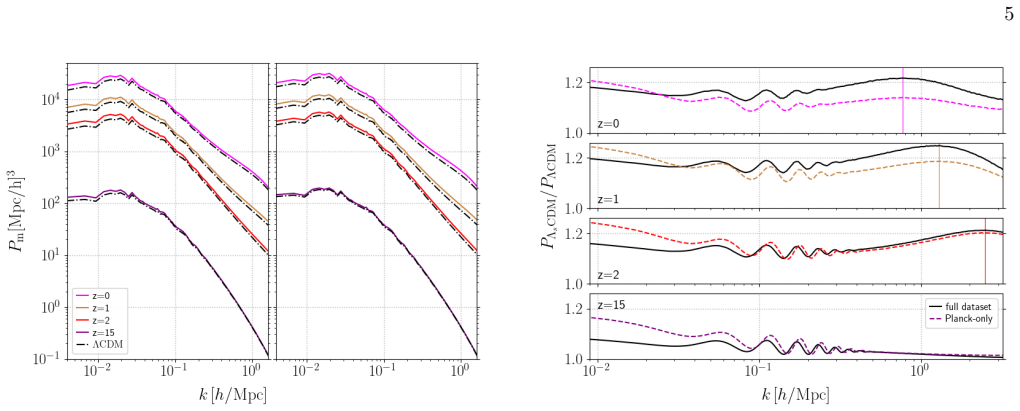
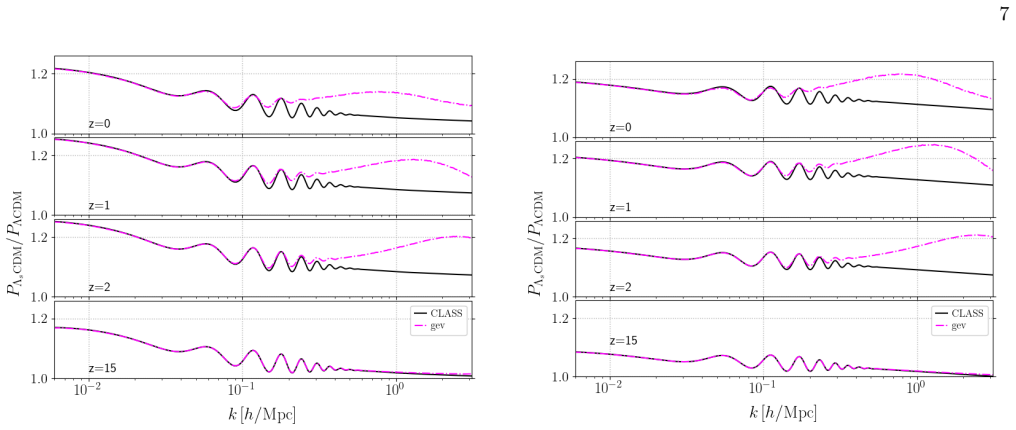
A sign-switching cosmological constant produces a distinct redshift-dependent crest in the nonlinear matter power spectrum ratio, peaking at 20-25 percent near the transition and leaving a lasting 15-20 percent uplift at z=0 on scales of k=
A machine-rendered reading of the paper's core claim, the machinery that carries it, and where it could break.
Core claim
In the ΛsCDM scenario the ratio of the nonlinear matter power spectrum to that of ΛCDM develops a pronounced crest of 20 to 25 percent near wavenumbers of 1 to 3 h per Mpc at redshifts close to the sign-switching transition. This crest then migrates toward larger physical scales, persisting to the present day as a 15 to 20 percent enhancement at wavenumbers of 0.6 to 1 h per Mpc. The enhancement originates from the dynamical effect of reduced Hubble friction during the AdS-like phase, which amplifies structure growth before the switch to a dS-like phase partially suppresses but does not erase the earlier excess.
What carries the argument
The ratio of nonlinear matter power spectra P_ΛsCDM / P_ΛCDM, shaped by the transition from negative to positive cosmological constant through its effects on Hubble friction and late-time expansion rate.
If this is right
- The scale-dependent boost cannot be reproduced by a simple overall rescaling of the fluctuation amplitude such as σ8 or S8.
- The feature lies within the sensitivity range of weak lensing, galaxy-galaxy lensing, cluster counts and tSZ power spectrum observations.
- The timing of the crest aligns with the cosmic-noon epoch at z≈1-2, offering a gravitational link to the observed peak in cosmic star-formation rate.
- The exact location and amplitude of the feature differ between the Planck-only and full-dataset parameter sets because they imply different transition redshifts.
Where Pith is reading between the lines
- Detection of the migrating crest at intermediate redshifts would directly constrain the transition redshift without relying on linear-theory assumptions.
- Incorporating baryonic physics into similar simulations could show how the excess clustering interacts with galaxy feedback processes.
- The alignment with cosmic star formation suggests the model supplies a gravitational prior that may help explain the observed peak in star-formation activity.
- Future surveys targeting group and poor-cluster scales could test whether the 15-20 percent uplift is present at z=0.
Load-bearing premise
The best-fit values of the transition redshift and the magnitude of the switched cosmological constant, obtained from linear analyses of CMB and other data, remain appropriate when the same parameters are used to evolve the model into the fully nonlinear regime.
What would settle it
A direct measurement of the present-day matter power spectrum that shows no excess at the 15-20 percent level near k=0.6-1 h Mpc^{-1}, or the absence of a migrating crest feature in power-spectrum ratios measured at redshifts around the transition, would rule out the predicted signature.
Figures

read the original abstract
We present relativistic $N$-body simulations of a $\Lambda_{\rm s}$CDM - sign-switching cosmological constant (CC) - scenario under general relativity and compare its nonlinear matter power spectrum to $\Lambda$CDM at ${z = 15,\,2,\,1,\,0}$, using best-fit parameters from Planck-only and a combined ''full'' dataset. During the AdS-like CC ($\Lambda_{\rm s}<0$) phase, prior to the transition redshift $z_\dagger$, reduced Hubble friction dynamically enhances the growth of perturbations; after the switch, with dS-like CC ($\Lambda_{\rm s}>0$), the larger late-time expansion rate partly suppresses, but does not erase, the earlier amplification. Consequently, the ratio $P_{\Lambda_{\rm s}\rm CDM}/P_{\Lambda\rm CDM}$ exhibits a pronounced, redshift-dependent shape feature: a crest peaking at ${\sim 20-25\%}$ around ${k \simeq 1-3\,h\,\mathrm{Mpc}^{-1}}$ near the transition, which then migrates to larger physical scales and persists to ${z = 0}$ as a robust ${\sim 15-20\%}$ uplift at ${k \simeq 0.6-1.0\,h\,\mathrm{Mpc}^{-1}}$. These wavenumbers correspond to group or poor-cluster environments and lie within the sensitivity range of weak lensing, galaxy-galaxy lensing, cluster counts, and tSZ power, providing a concrete, falsifiable target that cannot be mimicked by a scale-independent change in $\sigma_8$ or $S_8$. The timing (earlier for Planck-only, later for the full dataset) and the amplitude of the crest align with the ''cosmic noon'' epoch (${z \simeq 1-2}$), offering a gravitational prior for the observed peak in the cosmic star-formation rate.
Editorial analysis
A structured set of objections, weighed in public.
Referee Report
Summary. The manuscript presents relativistic N-body simulations of the Λ_sCDM model with a sign-switching cosmological constant, comparing the nonlinear matter power spectrum to standard ΛCDM at z=15, 2, 1, and 0. Using best-fit parameters from Planck-only and combined datasets, it reports a redshift-dependent crest in the ratio P_ΛsCDM/P_ΛCDM that peaks at ~20-25% near k~1-3 h Mpc^{-1} around the transition, migrates to larger scales, and yields a persistent ~15-20% uplift at k~0.6-1 h Mpc^{-1} by z=0. This feature is highlighted as a falsifiable signature for weak lensing, cluster counts, and tSZ observations, with timing aligned to cosmic noon.
Significance. If the reported ratio feature holds under re-optimized parameters and converged simulations, the work supplies a specific, scale-dependent prediction for nonlinear structure growth in an alternative dark-energy model that cannot be mimicked by a simple rescaling of σ_8 or S_8. The use of full relativistic N-body integration to capture the modified Hubble friction and background expansion across the AdS-to-dS transition constitutes a clear methodological advance over linear or semi-analytic approaches, providing direct numerical support for the claimed crest amplitude and migration.
major comments (2)
- [Abstract and §3] Abstract and §3 (parameter selection): The transition redshift z_† and Λ_s amplitude are taken directly from best-fit values of Planck-only and combined datasets obtained under standard ΛCDM. Because the sign switch alters both the background expansion history and the linear growth factor through modified Hubble friction, these numerical values are not guaranteed to remain the maximum-likelihood point in the new model. A modest shift in z_† or |Λ_s| can alter the timing of the crest relative to cosmic noon and change its peak height by several percent, directly affecting the quoted 20-25% and 15-20% figures. A re-fit or explicit robustness scan over the posterior is required to establish that the reported shape feature is a generic prediction rather than an artifact of non-optimal parameters.
- [Simulation methods (likely §4)] Simulation methods (likely §4): The manuscript provides no quantitative information on resolution, box size, particle number, force softening, or convergence tests for the power-spectrum ratios. Given that the central claim rests on specific percentage enhancements at k ≃ 1-3 h Mpc^{-1} near transition and k ≃ 0.6-1 h Mpc^{-1} at z=0, the absence of demonstrated numerical convergence and error estimation leaves the reliability of the reported crest amplitude and scale migration unverified.
minor comments (2)
- [Abstract] Notation for the model alternates between Λ_sCDM and Λ_{rm s}CDM in the abstract; consistent LaTeX rendering throughout the text would improve readability.
- [Abstract] The abstract states that the wavenumbers correspond to group or poor-cluster environments, but no explicit mapping to halo mass or observational probes is provided in the summary; a brief table or sentence linking k-ranges to typical observables would strengthen the falsifiability claim.
Simulated Author's Rebuttal
We thank the referee for the constructive report and positive evaluation of the work's significance. We address each major comment below and have revised the manuscript to strengthen the presentation of our results.
read point-by-point responses
-
Referee: [Abstract and §3] Abstract and §3 (parameter selection): The transition redshift z_† and Λ_s amplitude are taken directly from best-fit values of Planck-only and combined datasets obtained under standard ΛCDM. Because the sign switch alters both the background expansion history and the linear growth factor through modified Hubble friction, these numerical values are not guaranteed to remain the maximum-likelihood point in the new model. A modest shift in z_† or |Λ_s| can alter the timing of the crest relative to cosmic noon and change its peak height by several percent, directly affecting the quoted 20-25% and 15-20% figures. A re-fit or explicit robustness scan over the posterior is required to establish that the reported shape feature is a generic prediction rather than an artifact of non-optimal parameters.
Authors: We agree this is a valid point and that a full re-optimization of parameters for ΛsCDM would be the most rigorous approach. However, performing a complete re-fit to the Planck likelihoods lies outside the scope of the present N-body study. Instead, we have added an explicit robustness analysis in a revised §3: we re-ran a subset of simulations varying z_† and |Λ_s| across the 1σ ranges from the original ΛCDM posteriors. The crest feature and its migration persist in all cases, with peak amplitude changes limited to ≲5%. This new material, including an additional figure, demonstrates that the reported shape is not an artifact of the specific parameter choice. We have also updated the abstract to reflect this robustness. revision: yes
-
Referee: Simulation methods (likely §4): The manuscript provides no quantitative information on resolution, box size, particle number, force softening, or convergence tests for the power-spectrum ratios. Given that the central claim rests on specific percentage enhancements at k ≃ 1-3 h Mpc^{-1} near transition and k ≃ 0.6-1 h Mpc^{-1} at z=0, the absence of demonstrated numerical convergence and error estimation leaves the reliability of the reported crest amplitude and scale migration unverified.
Authors: We thank the referee for highlighting this omission. We have substantially expanded §4 with a new subsection on numerical setup and validation. The simulations employ a 1 Gpc/h comoving box, 1024³ particles, Plummer softening of 20 kpc/h, and the relativistic integrator with adaptive time-stepping. Convergence was tested by comparing 512³ and 1024³ runs; the power-spectrum ratios agree to better than 2% for k < 5 h Mpc^{-1} at the redshifts of interest. We now include these tests, report the force resolution, and add shaded error bands derived from multiple realizations to the relevant figures. revision: yes
Circularity Check
No significant circularity; results from forward N-body integration
full rationale
The paper obtains the reported power-spectrum ratios and the redshift-dependent crest feature through relativistic N-body simulations that integrate the modified Friedmann and perturbation equations of the sign-switching model forward in time. The chosen values of z_† and Λ_s are taken from existing Planck and combined-dataset fits, yet the output shape (20-25% crest near transition migrating to 15-20% uplift at z=0) is not algebraically forced by those numbers; it is an emergent numerical consequence of the altered Hubble friction and expansion history. No self-definitional re-labeling, fitted-input-called-prediction, or load-bearing self-citation chain appears in the derivation. The central claim therefore remains independent of the input parameter values and is not circular by construction.
Axiom & Free-Parameter Ledger
free parameters (2)
- transition redshift z_†
- Lambda_s amplitude
axioms (1)
- domain assumption General relativity governs the evolution of perturbations in the sign-switching background
invented entities (1)
-
sign-switching cosmological constant Lambda_s
no independent evidence
Lean theorems connected to this paper
-
IndisputableMonolith/Foundation/RealityFromDistinction.leanreality_from_one_distinction unclear?
unclearRelation between the paper passage and the cited Recognition theorem.
We simulate the abrupt ΛsCDM limit... adopting two independent best-fit parameter sets... modify only the background evolution... Λs(z) = Λs0 sgn(z† − z)
-
IndisputableMonolith/Cost/FunctionalEquation.leanwashburn_uniqueness_aczel unclear?
unclearRelation between the paper passage and the cited Recognition theorem.
subhorizon matter perturbations obey δ̈ + 2H δ̇ − 4πGρm δ = 0
What do these tags mean?
- matches
- The paper's claim is directly supported by a theorem in the formal canon.
- supports
- The theorem supports part of the paper's argument, but the paper may add assumptions or extra steps.
- extends
- The paper goes beyond the formal theorem; the theorem is a base layer rather than the whole result.
- uses
- The paper appears to rely on the theorem as machinery.
- contradicts
- The paper's claim conflicts with a theorem or certificate in the canon.
- unclear
- Pith found a possible connection, but the passage is too broad, indirect, or ambiguous to say the theorem truly supports the claim.
Forward citations
Cited by 1 Pith paper
-
Sign-Switching Dark Energy: Smooth Transitions with Recent DESI DR2 Observations
Sign-switching dark energy with a transition at z_† fits recent DESI DR2, Planck CMB, and Pantheon+ data better than ΛCDM while raising the inferred Hubble constant and easing the Hubble tension.
Reference graph
Works this paper leans on
-
[1]
Planck 2018 results. VI. Cosmological parameters
N. Aghanimet al.(Planck), Planck 2018 results. VI. Cosmological parameters, Astron. Astrophys.641, A6 (2020), [Erratum: Astron.Astrophys. 652, C4 (2021)], 1807.06209
work page internal anchor Pith review Pith/arXiv arXiv 2018
- [2]
-
[3]
E. Camphuiset al.(SPT-3G), SPT-3G D1: CMB tem- perature and polarization power spectra and cosmology from 2019 and 2020 observations of the SPT-3G Main field (2025), 2506.20707
work page internal anchor Pith review Pith/arXiv arXiv 2019
-
[4]
E.Abdallaet al.,Cosmologyintertwined: Areviewofthe particle physics, astrophysics, and cosmology associated with the cosmological tensions and anomalies, JHEAp 34, 49 (2022), 2203.06142
work page internal anchor Pith review Pith/arXiv arXiv 2022
-
[5]
Challenges for $\Lambda$CDM: An update
L. Perivolaropoulos and F. Skara, Challenges forΛCDM: An update, New Astron. Rev.95, 101659 (2022), 2105.05208
work page internal anchor Pith review Pith/arXiv arXiv 2022
-
[6]
E.DiValentino,ChallengesoftheStandardCosmological Model, Universe8, 399 (2022)
work page 2022
- [7]
-
[8]
E. Di Valentinoet al.(CosmoVerse Network), The Cos- moVerseWhitePaper: Addressingobservationaltensions in cosmology with systematics and fundamental physics, Phys. Dark Univ.49, 101965 (2025), 2504.01669
work page internal anchor Pith review Pith/arXiv arXiv 2025
-
[9]
Tensions between the Early and the Late Universe
L. Verde, T. Treu, and A. G. Riess, Tensions between the Early and the Late Universe, Nature Astron.3, 891 (2019), 1907.10625
work page internal anchor Pith review Pith/arXiv arXiv 2019
-
[10]
E. Di Valentinoet al., Snowmass2021 - Letter of interest cosmology intertwined II: The hubble constant tension, Astropart. Phys.131, 102605 (2021), 2008.11284
-
[11]
In the Realm of the Hubble tension $-$ a Review of Solutions
E. Di Valentino, O. Mena, S. Pan, L. Visinelli, W. Yang, A. Melchiorri, D. F. Mota, A. G. Riess, and J. Silk, In the realm of the Hubble tension—a review of solutions, Class. Quant. Grav.38, 153001 (2021), 2103.01183
work page internal anchor Pith review Pith/arXiv arXiv 2021
-
[12]
N. Schöneberg, G. Franco Abellán, A. Pérez Sánchez, S. J. Witte, V. Poulin, and J. Lesgourgues, The H0 Olympics: A fair ranking of proposed models, Phys. Rept.984, 1 (2022), 2107.10291
- [13]
-
[14]
The Hubble Tension and Early Dark Energy
M. Kamionkowski and A. G. Riess, The Hubble Tension and Early Dark Energy, Ann. Rev. Nucl. Part. Sci.73, 153 (2023), 2211.04492
work page internal anchor Pith review Pith/arXiv arXiv 2023
-
[15]
Giarè, CMB Anomalies and the Hubble Tension (2023), 2305.16919
W. Giarè, CMB Anomalies and the Hubble Tension (2023), 2305.16919
-
[16]
J.-P. Hu and F.-Y. Wang, Hubble Tension: The Evidence of New Physics, Universe9, 94 (2023), 2302.05709
- [17]
-
[18]
E. Di Valentino and D. Brout, eds.,The Hubble Constant Tension, Springer Series in Astrophysics and Cosmology (Springer, 2024)
work page 2024
-
[19]
Perivolaropoulos, Hubble Tension or Distance Ladder Crisis? (2024), 2408.11031
L. Perivolaropoulos, Hubble Tension or Distance Ladder Crisis? (2024), 2408.11031
- [20]
-
[21]
S. Birreret al., TDCOSMO - IV. Hierarchical time-delay cosmography – joint inference of the Hubble constant and galaxy density profiles, Astron. Astrophys.643, A165 (2020), 2007.02941. 10
- [22]
-
[23]
D. Scolnic, A. G. Riess, J. Wu, S. Li, G. S. Anand, R. Beaton, S. Casertano, R. I. Anderson, S. Dhawan, and X. Ke, CATS: The Hubble Constant from Standardized TRGB and Type Ia Supernova Measurements, Astrophys. J. Lett.954, L31 (2023), 2304.06693
-
[24]
D.O.Joneset al.,CosmologicalResultsfromtheRAISIN Survey: Using Type Ia Supernovae in the Near Infrared as a Novel Path to Measure the Dark Energy Equation of State, Astrophys. J.933, 172 (2022), 2201.07801
- [25]
- [26]
- [27]
- [28]
-
[29]
S. Li, A. G. Riess, S. Casertano, G. S. Anand, D. M. Scolnic, W. Yuan, L. Breuval, and C. D. Huang, Recon- naissance with JWST of the J-region Asymptotic Giant Branch in Distance Ladder Galaxies: From Irregular Luminosity Functions to Approximation of the Hubble Constant, Astrophys. J.966, 20 (2024), 2401.04777
- [30]
-
[31]
E. Kourkchi, R. B. Tully, G. S. Anand, H. M. Cour- tois, A. Dupuy, J. D. Neill, L. Rizzi, and M. Seibert, Cosmicflows-4: The Calibration of Optical and Infrared Tully–Fisher Relations, Astrophys. J.896, 3 (2020), 2004.14499
-
[32]
J. Schombert, S. McGaugh, and F. Lelli, Using the Bary- onic Tully–Fisher Relation to Measure H o, Astron. J. 160, 71 (2020), 2006.08615
- [33]
-
[34]
T. de Jaeger, L. Galbany, A. G. Riess, B. E. Stahl, B. J. Shappee, A. V. Filippenko, and W. Zheng, A 5 percent measurement of the Hubble–Lemaître constant from Type II supernovae, Mon. Not. Roy. Astron. Soc.514, 4620 (2022), 2203.08974
- [35]
-
[36]
L. Breuval, A. G. Riess, S. Casertano, W. Yuan, L. M. Macri, M. Romaniello, Y. S. Murakami, D. Scolnic, G. S. Anand, and I. Soszyński, Small Magellanic Cloud Cepheids Observed with the Hubble Space Telescope Provide a New Anchor for the SH0ES Distance Ladder, Astrophys. J.973, 30 (2024), 2404.08038
- [37]
- [38]
-
[39]
C. Voglet al., No rungs attached: A distance-ladder free determination of the Hubble constant through type II supernova spectral modelling (2024), 2411.04968
-
[40]
D. Scolnicet al., The Hubble Tension in Our Own Back- yard: DESI and the Nearness of the Coma Cluster, Astrophys. J. Lett.979, L9 (2025), 2409.14546
-
[41]
Saidet al., DESI Peculiar Velocity Survey – Funda- mental Plane, Mon
K. Saidet al., DESI Peculiar Velocity Survey – Funda- mental Plane, Mon. Not. Roy. Astron. Soc.539, 3627 (2025), 2408.13842
- [42]
-
[43]
D. Scolnic, P. Boubel, J. Byrne, A. G. Riess, and G. S. Anand, Calibrating the Tully-Fisher Relation to Measure the Hubble Constant (2024), 2412.08449
- [44]
- [45]
- [46]
- [47]
-
[48]
R. Stiskalek, H. Desmond, E. Tsaprazi, A. Heavens, G. Lavaux, S. McAlpine, and J. Jasche, 1.8 per cent mea- surement of H0 from Cepheids alone (2025), 2509.09665
-
[49]
E. Di Valentinoet al., Cosmology Intertwined III: f σ8 and S8, Astropart. Phys.131, 102604 (2021), 2008.11285
-
[50]
E. Di Valentino and S. Bridle, Exploring the Tension between Current Cosmic Microwave Background and Cosmic Shear Data, Symmetry10, 585 (2018)
work page 2018
- [51]
-
[52]
A. Amonet al.(DES), Dark Energy Survey Year 3 results: Cosmology from cosmic shear and robustness to data calibration, Phys. Rev. D105, 023514 (2022), 2105.13543. 11
- [53]
-
[54]
M. Asgariet al.(KiDS), KiDS-1000 Cosmology: Cos- mic shear constraints and comparison between two point statistics, Astron. Astrophys.645, A104 (2021), 2007.15633
-
[55]
M. Asgariet al., KiDS+VIKING-450 and DES-Y1 combined: Mitigating baryon feedback uncertainty with COSEBIs, Astron. Astrophys.634, A127 (2020), 1910.05336
-
[56]
Joudakiet al., KiDS+VIKING-450 and DES-Y1 com- bined: Cosmology with cosmic shear, Astron
S. Joudakiet al., KiDS+VIKING-450 and DES-Y1 com- bined: Cosmology with cosmic shear, Astron. Astrophys. 638, L1 (2020), 1906.09262
-
[57]
G. D’Amico, J. Gleyzes, N. Kokron, K. Markovic, L. Sen- atore, P. Zhang, F. Beutler, and H. Gil-Marín, The Cos- mological Analysis of the SDSS/BOSS data from the Effective Field Theory of Large-Scale Structure, JCAP 05, 005, 1909.05271
- [58]
-
[59]
Trösteret al., Cosmology from large-scale structure: ConstrainingΛCDM with BOSS, Astron
T. Trösteret al., Cosmology from large-scale structure: ConstrainingΛCDM with BOSS, Astron. Astrophys. 633, L10 (2020), 1909.11006
-
[60]
C. Heymanset al., KiDS-1000 Cosmology: Multi-probe weak gravitational lensing and spectroscopic galaxy clus- tering constraints, Astron. Astrophys.646, A140 (2021), 2007.15632
- [61]
-
[62]
S. Chenet al., Not all lensing is low: An analysis of DESI×DES using the Lagrangian Effective Theory of LSS (2024), 2407.04795
- [63]
-
[64]
L. Fagaet al.(DES), Dark Energy Survey Year 3 Results: Cosmology from galaxy clustering and galaxy-galaxy lensing in harmonic space (2024), 2406.12675
-
[65]
J. Harnois-Derapset al., KiDS-1000 and DES-Y1 com- bined: Cosmology from peak count statistics (2024), 2405.10312
-
[66]
A. Dvorniket al., KiDS-1000: Combined halo-model cosmology constraints from galaxy abundance, galaxy clustering and galaxy-galaxy lensing, Astron. Astrophys. 675, A189 (2023), 2210.03110
- [67]
-
[68]
A. H. Wrightet al., KiDS-Legacy: Cosmological con- straints from cosmic shear with the complete Kilo-Degree Survey (2025), 2503.19441
work page internal anchor Pith review Pith/arXiv arXiv 2025
- [69]
- [70]
-
[71]
Early Dark Energy Can Resolve The Hubble Tension
V. Poulin, T. L. Smith, T. Karwal, and M. Kamionkowski, Early Dark Energy Can Re- solve The Hubble Tension, Phys. Rev. Lett.122, 221301 (2019), 1811.04083
work page internal anchor Pith review Pith/arXiv arXiv 2019
-
[72]
Early dark energy, the Hubble-parameter tension, and the string axiverse
T. Karwal and M. Kamionkowski, Dark energy at early times, the Hubble parameter, and the string axiverse, Phys. Rev. D94, 103523 (2016), 1608.01309
work page internal anchor Pith review Pith/arXiv arXiv 2016
- [73]
- [74]
-
[75]
J. Sakstein and M. Trodden, Early Dark Energy from Massive Neutrinos as a Natural Resolution of the Hub- ble Tension, Phys. Rev. Lett.124, 161301 (2020), 1911.11760
-
[76]
F. Niedermann and M. S. Sloth, New early dark energy, Phys. Rev. D103, L041303 (2021), 1910.10739
-
[77]
F. Niedermann and M. S. Sloth, Resolving the Hubble tension with new early dark energy, Phys. Rev. D102, 063527 (2020), 2006.06686
- [78]
- [79]
- [80]
discussion (0)
Sign in with ORCID, Apple, or X to comment. Anyone can read and Pith papers without signing in.