Towards a Unified Framework for Pseudo-Nambu-Goldstone Dark Matter and Electroweak Baryogenesis
Pith reviewed 2026-05-18 19:12 UTC · model grok-4.3
The pith
The cS2HDM unifies a pseudo-Nambu-Goldstone dark matter candidate with electroweak baryogenesis by permitting CP violation under flavour alignment.
A machine-rendered reading of the paper's core claim, the machinery that carries it, and where it could break.
Core claim
The cS2HDM predicts a pseudo-Nambu-Goldstone DM candidate whose interactions with nuclei are naturally suppressed, while allowing for all sources of CP-violation under the assumption of flavour alignment in the Yukawa sector, which enables CP-violating interactions of the Higgs bosons even in the alignment limit. This feature makes the model attractive for studies of electroweak baryogenesis while accommodating a Higgs-portal DM candidate with standard thermal freeze-out.
What carries the argument
The complex singlet-extended 2-Higgs-Doublet Model (cS2HDM), which adds a complex singlet to two Higgs doublets to generate both the pseudo-Nambu-Goldstone DM and additional CP-violating phases that survive the alignment limit.
If this is right
- The model yields testable LHC signals from additional Higgs bosons and dark matter production channels.
- One-loop DM-nucleon scattering amplitudes are computed explicitly, including CP-violating effects.
- Current Higgs signal strengths, electroweak precision data, and relic density are satisfied within viable parameter regions.
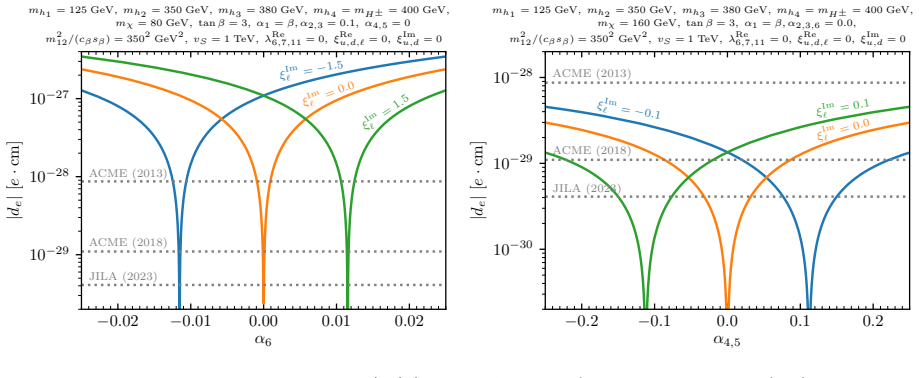
- The electron EDM provides a direct constraint on the new CP-violating sources.
Where Pith is reading between the lines
- Similar singlet extensions of the 2HDM could incorporate neutrino mass generation without spoiling the DM or baryogenesis features.
- The public software package allows external groups to map the full viable space as new collider or EDM bounds appear.
- If the alignment limit is only approximate, small deviations could produce measurable rates in flavour-violating Higgs decays.
Load-bearing premise
The assumption of flavour alignment in the Yukawa sector is required to permit CP-violating Higgs interactions even in the alignment limit.
What would settle it
A direct detection experiment reporting a DM-nucleon scattering rate significantly above the one-loop suppressed prediction, or an electron EDM measurement exceeding the model's CP-violating contributions, would rule out the central claim.
Figures






read the original abstract
We propose the complex singlet-extended 2-Higgs-Doublet Model (cS2HDM), a spin-0 Dark Matter (DM) model with a Higgs sector consisting of two Higgs doublets and a complex singlet, as a benchmark for LHC DM searches. The model predicts a pseudo-Nambu-Goldstone DM candidate whose interactions with nuclei are naturally suppressed, while allowing for all sources of CP-violation under the assumption of flavour alignment in the Yukawa sector, which enables CP-violating interactions of the Higgs bosons even in the alignment limit. This feature makes the model attractive for studies of electroweak baryogenesis while accommodating a Higgs-portal DM candidate with standard thermal freeze-out. We confront the model with a comprehensive set of theoretical and experimental constraints, including Higgs-boson signal strength measurements, searches for additional Higgs bosons, DM relic abundance and direct detection, as well as electroweak precision observables and the electron EDM, with emphasis on the impact of the new CP-violating sources. For DM direct detection, we perform a one-loop computation of DM-nucleon scattering including CP-violating effects. We provide a public software package to facilitate future phenomenological studies of the cS2HDM.
Editorial analysis
A structured set of objections, weighed in public.
Referee Report
Summary. The manuscript proposes the complex singlet-extended 2-Higgs-Doublet Model (cS2HDM) as a benchmark for LHC DM searches. It features a pseudo-Nambu-Goldstone DM candidate with naturally suppressed nuclear interactions and incorporates all sources of CP violation for electroweak baryogenesis under the assumption of flavour alignment in the Yukawa sector, which permits CP-violating Higgs couplings even in the alignment limit. The work confronts the model with theoretical and experimental constraints including Higgs signal strengths, additional Higgs searches, DM relic abundance, direct detection (via one-loop DM-nucleon scattering including CP effects), electroweak precision observables, and the electron EDM, while providing a public software package.
Significance. If the flavour alignment remains consistent with the new CP-violating phases introduced by the complex singlet, the model offers a unified framework linking pseudo-Nambu-Goldstone DM with electroweak baryogenesis in a Higgs-portal setup. The one-loop direct detection calculation and public code are positive features that support reproducibility and further phenomenological studies.
major comments (2)
- [Abstract and Yukawa sector definition] Abstract and model definition section: The central claim that flavour alignment in the Yukawa sector enables CP-violating Higgs interactions even in the alignment limit while suppressing FCNCs is load-bearing for both the baryogenesis mechanism and the overall viability. The complex singlet vev and CP-odd phases in the scalar potential can induce effective off-diagonal operators at one loop or via mixing; the manuscript does not explicitly verify that the alignment conditions are preserved under RG evolution or protected by an additional symmetry.
- [DM direct detection calculation] DM direct detection and constraint scan section: The one-loop computation of DM-nucleon scattering is presented as including CP-violating effects and yielding naturally suppressed rates, but the manuscript provides no detailed breakdown of the loop contributions, renormalization scheme, or quantitative comparison to tree-level results that would substantiate the suppression claim across the scanned parameter space.
minor comments (1)
- [Model setup] The notation for the scalar potential parameters and mixing angles could be introduced with a dedicated table or explicit definitions at the start of the model section to improve clarity for readers unfamiliar with extended 2HDMs.
Simulated Author's Rebuttal
We thank the referee for their detailed and constructive report. We address each major comment below and indicate the revisions we will make to strengthen the manuscript.
read point-by-point responses
-
Referee: [Abstract and Yukawa sector definition] Abstract and model definition section: The central claim that flavour alignment in the Yukawa sector enables CP-violating Higgs interactions even in the alignment limit while suppressing FCNCs is load-bearing for both the baryogenesis mechanism and the overall viability. The complex singlet vev and CP-odd phases in the scalar potential can induce effective off-diagonal operators at one loop or via mixing; the manuscript does not explicitly verify that the alignment conditions are preserved under RG evolution or protected by an additional symmetry.
Authors: We appreciate the referee drawing attention to this foundational aspect. The flavour alignment is imposed directly on the Yukawa matrices at the electroweak scale, ensuring that the CP-violating phases introduced by the complex singlet (which enter only through the scalar potential) do not generate tree-level FCNCs. The effective Higgs-fermion couplings remain flavour-diagonal by construction in the alignment limit. While the manuscript does not perform an explicit RG analysis, the alignment conditions are protected at the relevant low-energy scale in the same manner as in other aligned 2HDM realisations; any higher-scale mixing effects are suppressed by the small portal couplings. We will add a clarifying paragraph in Section 2 discussing this protection and the scale at which the alignment is applied. revision: partial
-
Referee: [DM direct detection calculation] DM direct detection and constraint scan section: The one-loop computation of DM-nucleon scattering is presented as including CP-violating effects and yielding naturally suppressed rates, but the manuscript provides no detailed breakdown of the loop contributions, renormalization scheme, or quantitative comparison to tree-level results that would substantiate the suppression claim across the scanned parameter space.
Authors: We agree that additional technical details would improve clarity. The one-loop amplitude receives contributions from CP-odd and CP-even Higgs exchanges, with the dominant suppression arising from the derivative couplings characteristic of the pseudo-Nambu-Goldstone DM candidate. The calculation is performed in the on-shell scheme. In the revised manuscript we will expand the relevant subsection to list the individual diagram classes, state the renormalization scheme explicitly, and include a supplementary figure showing the ratio of one-loop to tree-level cross sections for benchmark points across the scanned parameter space. revision: yes
Circularity Check
No significant circularity in derivation chain
full rationale
The cS2HDM is introduced as an explicit model extension with new fields, a scalar potential, and the flavour-alignment assumption stated outright in the abstract and model definition. All subsequent claims (suppressed DM-nucleon scattering at one loop, CP-violating sources compatible with alignment limit, relic density via thermal freeze-out) are derived from these inputs via standard calculations rather than by re-expressing fitted quantities or prior self-citations as new predictions. No load-bearing step reduces by the paper's own equations to a tautological redefinition of its inputs.
Axiom & Free-Parameter Ledger
free parameters (1)
- Higgs-sector parameters (masses, mixing angles, couplings, vevs)
axioms (1)
- domain assumption Flavour alignment in the Yukawa sector
invented entities (1)
-
Complex singlet scalar field
no independent evidence
Lean theorems connected to this paper
-
IndisputableMonolith/Cost/FunctionalEquation.leanwashburn_uniqueness_aczel unclear?
unclearRelation between the paper passage and the cited Recognition theorem.
The scalar potential is defined such that the singlet field ΦS respects a global U(1) symmetry which is only softly broken via a dimension-two term... the imaginary component of ΦS acts as a pseudo-Nambu-Goldstone boson
-
IndisputableMonolith/Foundation/ArithmeticFromLogic.leanabsolute_floor_iff_bare_distinguishability unclear?
unclearRelation between the paper passage and the cited Recognition theorem.
We apply the so-called flavour-alignment scenario... (Y(1)f)ij = ξf (Y(2)f)ij
-
IndisputableMonolith/Foundation/AlexanderDuality.leanalexander_duality_circle_linking unclear?
unclearRelation between the paper passage and the cited Recognition theorem.
the model still allows for the presence of CP-violation by setting λIm5 ≠ 0... purely bosonic CP-violating interaction
What do these tags mean?
- matches
- The paper's claim is directly supported by a theorem in the formal canon.
- supports
- The theorem supports part of the paper's argument, but the paper may add assumptions or extra steps.
- extends
- The paper goes beyond the formal theorem; the theorem is a base layer rather than the whole result.
- uses
- The paper appears to rely on the theorem as machinery.
- contradicts
- The paper's claim conflicts with a theorem or certificate in the canon.
- unclear
- Pith found a possible connection, but the passage is too broad, indirect, or ambiguous to say the theorem truly supports the claim.
Reference graph
Works this paper leans on
-
[1]
ATLAS collaboration, Observation of a new particle in the search for the Standard Model Higgs boson with the ATLAS detector at the LHC , Phys. Lett. B 716 (2012) 1 [ 1207.7214]
work page internal anchor Pith review Pith/arXiv arXiv 2012
-
[2]
CMS collaboration, Observation of a New Boson at a Mass of 125 GeV with the CMS Experiment at the LHC, Phys. Lett. B 716 (2012) 30 [ 1207.7235]
work page internal anchor Pith review Pith/arXiv arXiv 2012
- [3]
-
[4]
, Nature 607 (2022) 60 [ 2207.00043]
CMS collaboration, A portrait of the Higgs boson by the CMS experiment ten years after the discovery. , Nature 607 (2022) 60 [ 2207.00043]
- [5]
- [6]
-
[7]
Higgs-field Portal into Hidden Sectors
B. Patt and F. Wilczek, Higgs-field portal into hidden sectors , hep-ph/0605188
work page internal anchor Pith review Pith/arXiv arXiv
-
[8]
A second Higgs from the Higgs portal
A. Falkowski, C. Gross and O. Lebedev, A second Higgs from the Higgs portal , JHEP 05 (2015) 057 [1502.01361]
work page internal anchor Pith review Pith/arXiv arXiv 2015
-
[9]
LHC Phenomenology of an Extended Standard Model with a Real Scalar Singlet
V. Barger, P. Langacker, M. McCaskey, M.J. Ramsey-Musolf and G. Shaughnessy, LHC Phenomenology of an Extended Standard Model with a Real Scalar Singlet , Phys. Rev. D 77 (2008) 035005 [ 0706.4311]
work page internal anchor Pith review Pith/arXiv arXiv 2008
-
[10]
T. Biek¨ otter and M. Pierre,Higgs-boson visible and invisible constraints on hidden sectors , Eur. Phys. J. C 82 (2022) 1026 [ 2208.05505]
- [11]
-
[12]
Complex Singlet Extension of the Standard Model
V. Barger, P. Langacker, M. McCaskey, M. Ramsey-Musolf and G. Shaughnessy, Complex Singlet Extension of the Standard Model , Phys. Rev. D 79 (2009) 015018 [ 0811.0393]
work page internal anchor Pith review Pith/arXiv arXiv 2009
-
[13]
A cancellation mechanism for dark matter-nucleon interaction
C. Gross, O. Lebedev and T. Toma, Cancellation Mechanism for Dark-Matter–Nucleon Interaction , Phys. Rev. Lett. 119 (2017) 191801 [ 1708.02253]. 43
work page internal anchor Pith review Pith/arXiv arXiv 2017
-
[14]
Probing pseudo-Goldstone dark matter at the LHC
K. Huitu, N. Koivunen, O. Lebedev, S. Mondal and T. Toma, Probing pseudo-Goldstone dark matter at the LHC, Phys. Rev. D 100 (2019) 015009 [ 1812.05952]
work page internal anchor Pith review Pith/arXiv arXiv 2019
-
[15]
K. Kannike and M. Raidal, Phase Transitions and Gravitational Wave Tests of Pseudo-Goldstone Dark Matter in the Softly Broken U(1) Scalar Singlet Model , Phys. Rev. D 99 (2019) 115010 [ 1901.03333]
-
[16]
Sakharov, Violation of CP Invariance, C asymmetry, and baryon asymmetry of the universe , Pisma Zh
A.D. Sakharov, Violation of CP Invariance, C asymmetry, and baryon asymmetry of the universe , Pisma Zh. Eksp. Teor. Fiz. 5 (1967) 32
work page 1967
-
[17]
V.A. Kuzmin, V.A. Rubakov and M.E. Shaposhnikov, On the Anomalous Electroweak Baryon Number Nonconservation in the Early Universe , Phys. Lett. B 155 (1985) 36
work page 1985
- [18]
- [19]
-
[20]
T. Biek¨ otter and M.O. Olea-Romacho,Reconciling Higgs physics and pseudo-Nambu-Goldstone dark matter in the S2HDM using a genetic algorithm , JHEP 10 (2021) 215 [ 2108.10864]
-
[21]
M. M¨ uhlleitner, J. M¨ uller, S.L. Williamson and J. Wittbrodt,The CN2HDM, 2110.06680
-
[22]
T. Biek¨ otter, P. Gabriel, M.O. Olea-Romacho and R. Santos, Direct detection of pseudo-Nambu-Goldstone dark matter in a two Higgs doublet plus singlet extension of the SM , JHEP 10 (2022) 126 [ 2207.04973]
-
[23]
N. Darvishi and B. Grzadkowski, Pseudo-Goldstone dark matter model with CP violation , JHEP 06 (2022) 092 [2204.04737]
-
[24]
T. Biek¨ otter, S. Heinemeyer and G. Weiglein,The CMS di-photon excess at 95 GeV in view of the LHC Run 2 results, Phys. Lett. B 846 (2023) 138217 [ 2303.12018]
-
[25]
Electroweak Phase Transition in Two Higgs Doublet Models
J.M. Cline and P.-A. Lemieux, Electroweak phase transition in two Higgs doublet models , Phys. Rev. D 55 (1997) 3873 [ hep-ph/9609240]
work page internal anchor Pith review Pith/arXiv arXiv 1997
-
[26]
Weinberg, Unitarity Constraints on CP Nonconservation in Higgs Exchange , Phys
S. Weinberg, Unitarity Constraints on CP Nonconservation in Higgs Exchange , Phys. Rev. D 42 (1990) 860
work page 1990
-
[27]
S. Baum and N.R. Shah, Two Higgs Doublets and a Complex Singlet: Disentangling the Decay Topologies and Associated Phenomenology, JHEP 12 (2018) 044 [ 1808.02667]
work page internal anchor Pith review Pith/arXiv arXiv 2018
-
[28]
S. Heinemeyer, C. Li, F. Lika, G. Moortgat-Pick and S. Paasch, Phenomenology of a 96 GeV Higgs boson in the 2HDM with an additional singlet , Phys. Rev. D 106 (2022) 075003 [ 2112.11958]
- [29]
-
[30]
Search for Dark Matter in 2HDMS at LHC and future Lepton Colliders
J. Dutta, J. Lahiri, C. Li, G. Moortgat-Pick, S.F. Tabira and J.A. Ziegler, Search for Dark Matter in 2HDMS at LHC and future Lepton Colliders , 2504.14529
work page internal anchor Pith review Pith/arXiv arXiv
-
[31]
S. Ipek, D. McKeen and A.E. Nelson, A Renormalizable Model for the Galactic Center Gamma Ray Excess from Dark Matter Annihilation , Phys. Rev. D 90 (2014) 055021 [ 1404.3716]
work page internal anchor Pith review Pith/arXiv arXiv 2014
-
[32]
J.M. No, Looking through the pseudoscalar portal into dark matter: Novel mono-Higgs and mono-Z signatures at the LHC , Phys. Rev. D 93 (2016) 031701 [ 1509.01110]
work page internal anchor Pith review Pith/arXiv arXiv 2016
-
[33]
LHC Dark Matter Working Group: Next-generation spin-0 dark matter models
LHC Dark Matter Working Group collaboration, LHC Dark Matter Working Group: Next-generation spin-0 dark matter models , Phys. Dark Univ. 27 (2020) 100351 [ 1810.09420]
work page internal anchor Pith review Pith/arXiv arXiv 2020
-
[34]
Extended gamma-ray emission from Coy Dark Matter
C. Boehm, M.J. Dolan, C. McCabe, M. Spannowsky and C.J. Wallace, Extended gamma-ray emission from Coy Dark Matter , JCAP 05 (2014) 009 [ 1401.6458]
work page internal anchor Pith review Pith/arXiv arXiv 2014
-
[35]
A. Alves, S. Profumo, F.S. Queiroz and W. Shepherd, Effective field theory approach to the Galactic Center gamma-ray excess, Phys. Rev. D 90 (2014) 115003 [ 1403.5027]
work page internal anchor Pith review Pith/arXiv arXiv 2014
-
[36]
HDECAY: a Program for Higgs Boson Decays in the Standard Model and its Supersymmetric Extension
A. Djouadi, J. Kalinowski and M. Spira, HDECAY: A Program for Higgs boson decays in the standard model and its supersymmetric extension , Comput. Phys. Commun. 108 (1998) 56 [ hep-ph/9704448]
work page internal anchor Pith review Pith/arXiv arXiv 1998
-
[37]
HDECAY collaboration, HDECAY: Twenty++ years after, Comput. Phys. Commun. 238 (2019) 214 [1801.09506]
work page internal anchor Pith review Pith/arXiv arXiv 2019
- [38]
-
[39]
micrOMEGAs2.0: a program to calculate the relic density of dark matter in a generic model
G. Belanger, F. Boudjema, A. Pukhov and A. Semenov, MicrOMEGAs 2.0: A Program to calculate the relic density of dark matter in a generic model , Comput. Phys. Commun. 176 (2007) 367 [ hep-ph/0607059]
work page internal anchor Pith review Pith/arXiv arXiv 2007
-
[40]
G. B´ elanger, F. Boudjema, A. Goudelis, A. Pukhov and B. Zaldivar, micrOMEGAs5.0 : Freeze-in , Comput. Phys. Commun. 231 (2018) 173 [ 1801.03509]
work page internal anchor Pith review Pith/arXiv arXiv 2018
-
[41]
Basis-independent methods for the two-Higgs-doublet model II. The significance of tan(beta)
H.E. Haber and D. O’Neil, Basis-independent methods for the two-Higgs-doublet model. II. The Significance of tanβ, Phys. Rev. D 74 (2006) 015018 [ hep-ph/0602242]
work page internal anchor Pith review Pith/arXiv arXiv 2006
-
[42]
Yukawa Alignment in the Two-Higgs-Doublet Model
A. Pich and P. Tuzon, Yukawa Alignment in the Two-Higgs-Doublet Model , Phys. Rev. D 80 (2009) 091702 [0908.1554]
work page internal anchor Pith review Pith/arXiv arXiv 2009
-
[43]
Renormalization-group constraints on Yukawa alignment in multi-Higgs-doublet models
P.M. Ferreira, L. Lavoura and J.P. Silva, Renormalization-group constraints on Yukawa alignment in multi-Higgs-doublet models, Phys. Lett. B 688 (2010) 341 [ 1001.2561]
work page internal anchor Pith review Pith/arXiv arXiv 2010
-
[44]
Flavour alignment in multi-Higgs-doublet models
A. Pe˜ nuelas and A. Pich,Flavour alignment in multi-Higgs-doublet models , JHEP 12 (2017) 084 [1710.02040]
work page internal anchor Pith review Pith/arXiv arXiv 2017
-
[45]
S.L. Glashow and S. Weinberg, Natural Conservation Laws for Neutral Currents , Phys. Rev. D 15 (1977) 1958
work page 1977
-
[46]
T. Biek¨ otter, D. Fontes, M. M¨ uhlleitner, J.C. Rom˜ ao, R. Santos and J.a.P. Silva,Impact of new experimental data on the C2HDM: the strong interdependence between LHC Higgs data and the electron EDM , JHEP 05 (2024) 127 [ 2403.02425]
-
[47]
One-loop contribution to dark matter-nucleon scattering in the pseudoscalar dark matter model
D. Azevedo, M. Duch, B. Grzadkowski, D. Huang, M. Iglicki and R. Santos, One-loop contribution to dark-matter-nucleon scattering in the pseudo-scalar dark matter model , JHEP 01 (2019) 138 [ 1810.06105]
work page internal anchor Pith review Pith/arXiv arXiv 2019
- [48]
-
[49]
S. Kanemura, M. Kubota and K. Yagyu, Aligned CP-violating Higgs sector canceling the electric dipole moment, JHEP 08 (2020) 026 [ 2004.03943]
- [50]
- [51]
-
[52]
Abe, Early kinetic decoupling and a pseudo-Nambu-Goldstone dark matter model , Phys
T. Abe, Early kinetic decoupling and a pseudo-Nambu-Goldstone dark matter model , Phys. Rev. D 104 (2021) 035025 [2106.01956]
-
[53]
L.J. Hall, K. Jedamzik, J. March-Russell and S.M. West, Freeze-In Production of FIMP Dark Matter , JHEP 03 (2010) 080 [ 0911.1120]
work page internal anchor Pith review Pith/arXiv arXiv 2010
-
[54]
M.J.D. Powell, An efficient method for finding the minimum of a function of several variables without calculating derivatives, The Computer Journal 7 (1964) 155
work page 1964
-
[55]
https://github.com/jacobwilliams/PowellOpt, accessed: 2024-04-01
work page 2024
- [56]
-
[57]
C.-Y. Chen, M. Freid and M. Sher, Next-to-minimal two Higgs doublet model , Phys. Rev. D 89 (2014) 075009 [1312.3949]
work page internal anchor Pith review Pith/arXiv arXiv 2014
-
[58]
G.C. Dorsch, S.J. Huber, K. Mimasu and J.M. No, Echoes of the Electroweak Phase Transition: Discovering a second Higgs doublet through A0 → ZH 0, Phys. Rev. Lett. 113 (2014) 211802 [ 1405.5537]
work page internal anchor Pith review Pith/arXiv arXiv 2014
-
[59]
Strong First Order Electroweak Phase Transition in the CP-Conserving 2HDM Revisited
P. Basler, M. Krause, M. Muhlleitner, J. Wittbrodt and A. Wlotzka, Strong First Order Electroweak Phase Transition in the CP-Conserving 2HDM Revisited , JHEP 02 (2017) 121 [ 1612.04086]
work page internal anchor Pith review Pith/arXiv arXiv 2017
-
[60]
T. Biek¨ otter, S. Heinemeyer, J.M. No, M.O. Olea-Romacho and G. Weiglein, The trap in the early Universe: impact on the interplay between gravitational waves and LHC physics in the 2HDM , JCAP 03 (2023) 031 [2208.14466]
-
[61]
T. Biek¨ otter, S. Heinemeyer, J.M. No, K. Radchenko, M.O.O. Romacho and G. Weiglein, First shot of the smoking gun: probing the electroweak phase transition in the 2HDM with novel searches for A → ZH in ℓ+ℓ−tt and ννb b final states, JHEP 01 (2024) 107 [ 2309.17431]
-
[62]
The Higgs Vacuum Uplifted: Revisiting the Electroweak Phase Transition with a Second Higgs Doublet
G.C. Dorsch, S.J. Huber, K. Mimasu and J.M. No, The Higgs Vacuum Uplifted: Revisiting the Electroweak Phase Transition with a Second Higgs Doublet , JHEP 12 (2017) 086 [ 1705.09186]. 45
work page internal anchor Pith review Pith/arXiv arXiv 2017
-
[63]
P. Basler, M. M¨ uhlleitner and J. Wittbrodt, The CP-Violating 2HDM in Light of a Strong First Order Electroweak Phase Transition and Implications for Higgs Pair Production , JHEP 03 (2018) 061 [ 1711.04097]
work page internal anchor Pith review Pith/arXiv arXiv 2018
-
[64]
T. Biek¨ otter and M.O. Olea-Romacho,Benchmarking a fading window: electroweak baryogenesis in the C2HDM, LHC constraints after Run 2 and prospects for LISA , 2505.09670
- [65]
-
[66]
HiggsSignals: Confronting arbitrary Higgs sectors with measurements at the Tevatron and the LHC
P. Bechtle, S. Heinemeyer, O. St˚ al, T. Stefaniak and G. Weiglein,HiggsSignals : Confronting arbitrary Higgs sectors with measurements at the Tevatron and the LHC , Eur. Phys. J. C 74 (2014) 2711 [ 1305.1933]
work page internal anchor Pith review Pith/arXiv arXiv 2014
-
[67]
Probing the Standard Model with Higgs signal rates from the Tevatron, the LHC and a future ILC
P. Bechtle, S. Heinemeyer, O. St˚ al, T. Stefaniak and G. Weiglein,Probing the Standard Model with Higgs signal rates from the Tevatron, the LHC and a future ILC , JHEP 11 (2014) 039 [ 1403.1582]
work page internal anchor Pith review Pith/arXiv arXiv 2014
-
[68]
P. Bechtle, S. Heinemeyer, T. Klingl, T. Stefaniak, G. Weiglein and J. Wittbrodt, HiggsSignals-2: Probing new physics with precision Higgs measurements in the LHC 13 TeV era , Eur. Phys. J. C 81 (2021) 145 [2012.09197]
-
[69]
H. Georgi and D.V. Nanopoulos, Suppression of Flavor Changing Effects From Neutral Spinless Meson Exchange in Gauge Theories , Phys. Lett. B 82 (1979) 95
work page 1979
-
[70]
HiggsBounds: Confronting Arbitrary Higgs Sectors with Exclusion Bounds from LEP and the Tevatron
P. Bechtle, O. Brein, S. Heinemeyer, G. Weiglein and K.E. Williams, HiggsBounds: Confronting Arbitrary Higgs Sectors with Exclusion Bounds from LEP and the Tevatron , Comput. Phys. Commun. 181 (2010) 138 [0811.4169]
work page internal anchor Pith review Pith/arXiv arXiv 2010
-
[71]
P. Bechtle, O. Brein, S. Heinemeyer, G. Weiglein and K.E. Williams, HiggsBounds 2.0.0: Confronting Neutral and Charged Higgs Sector Predictions with Exclusion Bounds from LEP and the Tevatron , Comput. Phys. Commun. 182 (2011) 2605 [ 1102.1898]
work page internal anchor Pith review Pith/arXiv arXiv 2011
-
[72]
P. Bechtle, O. Brein, S. Heinemeyer, O. St˚ al, T. Stefaniak, G. Weiglein et al., HiggsBounds − 4: Improved Tests of Extended Higgs Sectors against Exclusion Bounds from LEP, the Tevatron and the LHC , Eur. Phys. J. C 74 (2014) 2693 [ 1311.0055]
work page internal anchor Pith review Pith/arXiv arXiv 2014
-
[73]
P. Bechtle, D. Dercks, S. Heinemeyer, T. Klingl, T. Stefaniak, G. Weiglein et al., HiggsBounds-5: Testing Higgs Sectors in the LHC 13 TeV Era , Eur. Phys. J. C 80 (2020) 1211 [ 2006.06007]
-
[74]
High scale flavor alignment in two-Higgs doublet models and its phenomenology
S. Gori, H.E. Haber and E. Santos, High scale flavor alignment in two-Higgs doublet models and its phenomenology, JHEP 06 (2017) 110 [ 1703.05873]
work page internal anchor Pith review Pith/arXiv arXiv 2017
-
[75]
Weak Radiative Decays of the B Meson and Bounds on $M_{H^\pm}$ in the Two-Higgs-Doublet Model
M. Misiak and M. Steinhauser, Weak radiative decays of the B meson and bounds on MH± in the Two-Higgs-Doublet Model, Eur. Phys. J. C 77 (2017) 201 [ 1702.04571]
work page internal anchor Pith review Pith/arXiv arXiv 2017
- [76]
-
[77]
D.A. Ross and M.J.G. Veltman, Neutral Currents in Neutrino Experiments , Nucl. Phys. B 95 (1975) 135
work page 1975
-
[78]
Particle Data Group collaboration, Review of Particle Physics , PTEP 2022 (2022) 083C01
work page 2022
-
[79]
M.B. Einhorn, D.R.T. Jones and M.J.G. Veltman, Heavy Particles and the rho Parameter in the Standard Model, Nucl. Phys. B 191 (1981) 146
work page 1981
-
[80]
M.E. Peskin and T. Takeuchi, A New constraint on a strongly interacting Higgs sector , Phys. Rev. Lett. 65 (1990) 964
work page 1990
discussion (0)
Sign in with ORCID, Apple, or X to comment. Anyone can read and Pith papers without signing in.